Karnataka 2nd PUC Biology Microbes in Human Welfare MCQ with Answers
Finished viewing? Save it for later —
Download Karnataka 2nd PUC Biology Microbes in Human Welfare MCQ with Answers (PDF · 16 pages)About Karnataka 2nd PUC Biology Microbes in Human Welfare MCQ with Answers
Karnataka 2nd PUC Biology Microbes in Human Welfare MCQ with Answers is available here for free download. Published by Karnataka Board for Class 12, this question bank can be viewed online or downloaded as a PDF (16 pages). Candidates preparing for Class 12 can use Karnataka 2nd PUC Biology Microbes in Human Welfare MCQ with Answers to understand the exam pattern, the type of questions asked, and the overall difficulty level.
Frequently Asked Questions
How can I download Karnataka 2nd PUC Biology Microbes in Human Welfare MCQ with Answers?
Open this page and click the Download button to save Karnataka 2nd PUC Biology Microbes in Human Welfare MCQ with Answers as a PDF. It is completely free on AglaSem Docs.
Is Karnataka 2nd PUC Biology Microbes in Human Welfare MCQ with Answers free to download?
Yes. Karnataka 2nd PUC Biology Microbes in Human Welfare MCQ with Answers can be viewed online and downloaded as a PDF free of cost on AglaSem Docs.
How many pages does Karnataka 2nd PUC Biology Microbes in Human Welfare MCQ with Answers have?
Karnataka 2nd PUC Biology Microbes in Human Welfare MCQ with Answers contains 16 pages, which you can read online or download together as a single PDF.
Where can I find more Class 12 study material?
You can find more Class 12 question papers, sample papers, syllabus, and answer keys on AglaSem Docs.
Karnataka 2nd PUC Biology Microbes in Human Welfare MCQ with Answers – Text
Read the full text of this question bank below — useful to quickly search, copy and reference the content online without downloading the PDF.
📄 View text version (16 pages)
Page 1
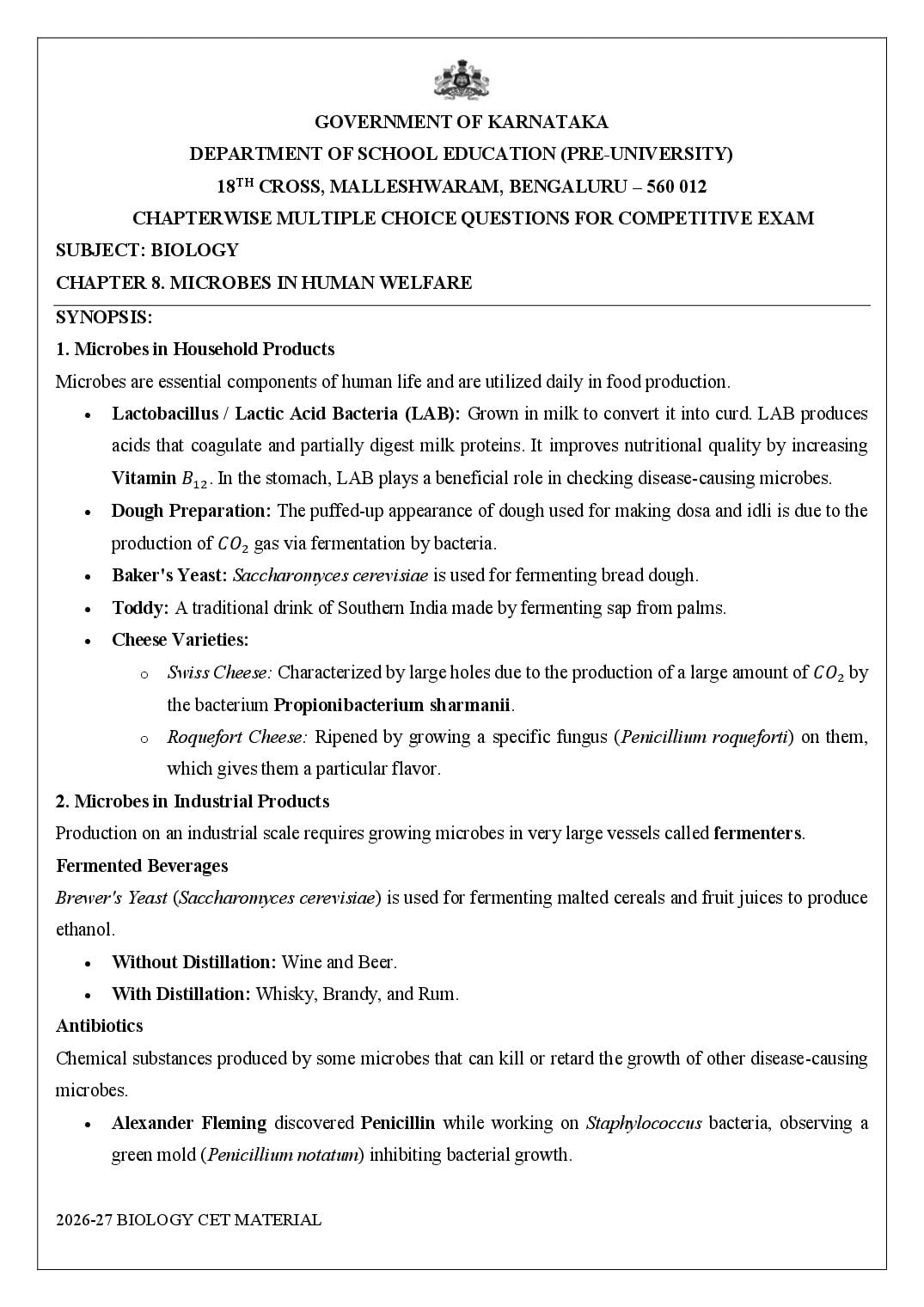
DEPARTMENT OF SCHOOL EDUCATION (PRE-UNIVERSITY)
18TH CROSS, MALLESHWARAM, BENGALURU – 560 012
CHAPTERWISE MULTIPLE CHOICE QUESTIONS FOR COMPETITIVE EXAM
SUBJECT: BIOLOGY
CHAPTER 8. MICROBES IN HUMAN WELFARE
SYNOPSIS:
1. Microbes in Household Products
Microbes are essential components of human life and are utilized daily in food production.
• Lactobacillus / Lactic Acid Bacteria (LAB): Grown in milk to convert it into curd. LAB produces
acids that coagulate and partially digest milk proteins. It improves nutritional quality by increasing
Vitamin 𝐵12. In the stomach, LAB plays a beneficial role in checking disease-causing microbes.
• Dough Preparation: The puffed-up appearance of dough used for making dosa and idli is due to the
production of 𝐶𝑂2 gas via fermentation by bacteria.
• Baker's Yeast: Saccharomyces cerevisiae is used for fermenting bread dough.
• Toddy: A traditional drink of Southern India made by fermenting sap from palms.
• Cheese Varieties:
o Swiss Cheese: Characterized by large holes due to the production of a large amount of 𝐶𝑂2 by
the bacterium Propionibacterium sharmanii.
o Roquefort Cheese: Ripened by growing a specific fungus (Penicillium roqueforti) on them,
which gives them a particular flavor.
2. Microbes in Industrial Products
Production on an industrial scale requires growing microbes in very large vessels called fermenters.
Fermented Beverages
Brewer's Yeast (Saccharomyces cerevisiae) is used for fermenting malted cereals and fruit juices to produce
ethanol.
• Without Distillation: Wine and Beer.
• With Distillation: Whisky, Brandy, and Rum.
Antibiotics
Chemical substances produced by some microbes that can kill or retard the growth of other disease-causing
microbes.
• Alexander Fleming discovered Penicillin while working on Staphylococcus bacteria, observing a
green mold (Penicillium notatum) inhibiting bacterial growth.
Page 2
(all three received the Nobel Prize in 1945).
Chemicals, Enzymes, and Other Bioactive Molecules
Type of Name of Microbial Source
Primary Function / Use
Molecule Molecule (Type)
Organic Aspergillus niger
Citric Acid Industrial acidifier / preservative.
Acid (Fungus)
Organic Acetobacter aceti
Acetic Acid Vinegar production.
Acid (Bacterium)
Clostridium
Organic
Butyric Acid butyricum Industrial chemical synthesis.
Acid
(Bacterium)
Organic Lactobacillus
Lactic Acid Food preservation and processing.
Acid (Bacterium)
Used in detergent formulations; helps
Enzyme Lipases Microbial cultures
remove oily stains from laundry.
Pectinases & Used to clear bottled fruit juices, making
Enzymes Microbial cultures
Proteases them clearer than homemade ones.
Modified by genetic engineering; used as a
Streptococcus "clot buster" to remove clots from blood
Enzyme Streptokinase
(Bacterium) vessels of patients with myocardial
infarction.
Trichoderma
Bioactive Used as an immunosuppressive agent in
Cyclosporin A polysporum
Agent organ-transplant patients.
(Fungus)
Used as a blood-cholesterol lowering
Bioactive Monascus
Statins agent. It competitively inhibits the enzyme
Agent purpureus (Yeast)
responsible for cholesterol synthesis.
Page 3
Municipal waste-water (sewage) contains large amounts of organic matter and pathogenic microbes. It is
treated in Sewage Treatment Plants (STPs) before disposal.
1.Primary Treatment (Physical Process):
Removes large and small particles through sequential filtration (removes floating debris) and sedimentation
(grit, soil, and small pebbles settle out). The settled solids form the primary sludge, and the supernatant forms
the primary effluent.
2.Secondary Treatment: Aeration Phase (Biological Process):
Primary effluent is passed into large aeration tanks and constantly agitated. This allows vigorous growth of
useful aerobic microbes into flocs (masses of bacteria associated with fungal filaments to form mesh-like
structures). These microbes consume the major part of the organic matter in the effluent, significantly reducing
the BOD (Biochemical Oxygen Demand).
3.Secondary Treatment: Settling Phase:
Once BOD is reduced, the effluent is passed into a settling tank where the bacterial flocs are allowed to
sediment. This sediment is called activated sludge. A small part of it is pumped back into the aeration tank
to serve as the inoculum.
4.Anaerobic Sludge Digestion:
The remaining major part of the activated sludge is pumped into large tanks called anaerobic sludge digesters.
Here, anaerobic bacteria digest the bacteria and fungi in the sludge. During this digestion, a mixture of gases
is produced: Methane (𝐶𝐻4 ), Hydrogen Sulfide (𝐻2 𝑆), and Carbon Dioxide (𝐶𝑂2), which form Biogas
(used as an energy source).
BOD (Biochemical Oxygen Demand): The amount of oxygen consumed if all the organic matter in one liter
of water were oxidized by bacteria. High BOD indicates high polluting potential.
4. Microbes in Biogas Production
Biogas is a mixture of gases (predominantly methane) produced by microbial activity.
• Methanogens: Anaerobic bacteria that grow on cellulosic material and produce large amounts of
methane along with 𝐶𝑂2 and 𝐻2 . The most common bacterium is Methanobacterium.
• Occurrence: Found in the anaerobic sludge during sewage treatment and inside the rumen of cattle
(helps break down cellulose in cattle feed, making excreta/dung rich in these bacteria).
• Biogas Plant Structure: Consists of a concrete tank (10--15 feet deep) where slurry of dung and
water is fed. A floating cover is placed over the slurry, which rises as gas is produced due to microbial
activity. An outlet is connected to pipes to supply biogas to nearby houses. The spent slurry is removed
through another outlet and used as fertilizer.
• Development in India: Championed largely due to the efforts of the Indian Agricultural Research
Institute (IARI) and the Khadi and Village Industries Commission (KVIC).
5. Microbes as Biocontrol Agents & Biofertilizers
Page 4
The use of biological methods for controlling plant diseases and pests, reducing reliance on toxic chemical
pesticides.
• Ladybird and Dragonflies: Used to get rid of aphids and mosquitoes, respectively.
• Bacillus thuringiensis (Bt): Used to control butterfly caterpillars. Available in sachets as dry spores,
which are mixed with water and sprayed onto vulnerable plants. The toxin is activated in the alkaline
pH of the insect gut after ingestion, killing the pathogen.
• Trichoderma: Free-living fungi common in root ecosystems; acts as a potent biocontrol agent against
several plant pathogens.
• Baculoviruses (Genus: Nucleopolyhedrovirus): Pathogens that attack insects and other arthropods.
They are excellent for species-specific, narrow-spectrum insecticidal applications and have no
negative impacts on plants, mammals, birds, or non-target insects (vital for Integrated Pest
Management - IPM programs).
Biofertilizers
Organisms that enrich the nutrient quality of the soil. The main sources are bacteria, fungi, and cyanobacteria.
• Bacteria:
o Rhizobium: Forms symbiotic nodules on the roots of leguminous plants, fixing atmospheric
nitrogen.
o Azospirillum & Azotobacter: Free-living bacteria in the soil that enrich its nitrogen content.
• Fungi (Mycorrhiza): Symbiotic association between fungi (mostly from the genus Glomus) and plant
roots. The fungal symbiont absorbs phosphorus from the soil and passes it to the plant. It also provides
resistance to root-borne pathogens and tolerance to salinity and drought.
• Cyanobacteria: Autotrophic microbes widely distributed in aquatic and terrestrial environments;
many can fix atmospheric nitrogen (e.g., Anabaena, Nostoc, Oscillatoria). In paddy fields,
Cyanobacteria serve as an important biofertilizer and add organic matter to the soil.
MULTIPLE CHOICE QUESTIONS
1. Choose the correct option regarding statement A and B.
A: Lactic Acid Bacteria (LAB) are responsible for converting milk into curd.
B: LAB creates acidic medium necessary to coagulate and fully digest the milk proteins.
(a) Statements A and B are correct (b) Statements A and B are incorrect.
(c) Statement A is correct but B is incorrect (d) Statement B is correct and A is incorrect
2. The bacteria shown in figure (a) and (b) are at which level of magnification?
Page 5
3. Roquefort cheese is ripened by growing a specific fungus on it which gives it a particular
_________.
(a) Texture (b) Large holes (c) Flavour (d) Colour
4. ‘Gal ghotu’ is a common name for which disease?
(a) Whooping cough (b) Diphtheria (c) Plague (d) Leprosy
5. Which microbe produces butyric acid?
(a) Saccharomyces cerevisiae (b) Clostridium butylicum
(c) Aspergillus niger (d) Propionibacterium sharmanii
6. What is depicted in figure ‘b’?
(a) Fungal colony (b) Algal colony (c) Bacterial colony (d) Viral colony
7. The fruit juices available commercially are clearer than ones which are homemade. Which
ingredient is added in commercially available fruit juices?
(a) Lipase and protease (b) Pectinase and hydrolase
(c) Pectinase and protease (d) Hydrolase and protease
8. Blood cholesterol lowering agents are known as _________.
(a) Steroids (b) Statins (c) Lipolytics (d) Diuretics
9. STP stands for
(a) Sequential Topographical Projection (b) Standard Test Procedure
(c) Sewage Treatment Plant (d) None of these
10. Sewage water treatment is done in how many stages?
(a) 1 (b) 3 (c) 2 (d) 4
11. The supernatant left after sedimentation of sewage water during primary treatment is known
as
(a) Affluent (b) Flocs (c) Sludge (d) Effluent
12. Which of the following is transferred from primary setting
tank to another tank for secondary treatment?
(a) Grit (b) Sludge (c) Effluent (d) Floc
13. What does ‘p’ indicate in the figure (a)?
Page 6
14. Which of the following is used in secondary treatment of sewage water?
(a) Fermentation tanks (b) Digester tanks (c) Detoxification tanks (d) Aeration tanks
15. What is BOD?
(a) Bacterial Oxygen Demand (b) Biological Organic Debris
(c) Biochemical Organic Demand (d) Biochemical Oxygen Demand
16. The remaining major part of activated sludge is pumped into large tanks called _________.
(a) Aerobic fermenters (b) Anaerobic fermenters
(c) Aerobic Sludge digesters (d) Anaerobic sludge digesters
17. In an anaerobic sludge digester, during the digestion process, mixture of gases like _________ are
produced.
(a) CH4, H2O, O2 (b) C2H6, H2S, CO2 (c) CH4, H2O2, CO2 (d) CH4, H2S, CO2
18. Methanogens are _________ microbes.
(a) Anaerobic (b) Aerobic (c) Microaerophiles (d) Aerotobiont
19. The rumen of cattle harbour the bacteria
(a) Methanogens (b) Cyanobacteria (c) Cellulogens (d) Ethanogens
20. The depth of concrete tank, a part of biogas plant, ranges from _________ to _________.
(a) 10–15 feet (b) 10–15 metre (c) 15–20 feet (d) 15–20 metre
21. Apart from cooking, biogas is generally used in rural areas for _________.
(a) Mechanical work (b) Lighting (c) Chemical transformation (d) None of these
22. Biocontrol refers to
(a) Indiscriminate use of microbes for human welfare (b) Use of microbes to control plant diseases
(c) Use of microbes to control cattle diseases (d) Both (b) and (c)
23. Baculovirus belongs to the genus
(a) Retrohedro Virus (b) Nucleohedero-Virus
(c) Nucleopolyhedro Virus (d) Polyhedral Virus
24. This image is an aerial view of a _________ .
(a) Nuclear reactor (b) Sewage plant (c) Biogas plant (d) Fermentation plant
25. Mycorrhiza absorbs _________ from soil and passes it to the plant.
(a) K (b) P (c) Fe (d) Mg
Page 7
(a) Dung and vegetable waste (b) Water and dung
(c) Vegetable and human excreta (d) All of these
27. What does ‘T’ indicate in the figure?
(a) By-product collector (b) Sludge (c) Digester (d) Gas holder
28. A common biocontrol agent for the control of plant diseases is
(a) Baculovirus (b) Bacillus thuringiensis (c) Glomus (d) Trichoderma
29. Which of the following is mainly produced by the activity of anaerobic bacteria on sewage?
(a) Propane (b) Mustard gas (c) Marsh gas (d) Laughing gas
30. Which one of the following helps in absorption of phosphorus from soil by plants?
(a) Rhizobium (b) Frankia (c) Anabaena (d) Glomus
31. The continuous addition of sugars in ‘fed batch’ fermentation is done to
(a) Obtain antibiotics (b) Purify enzymes
(c) Degrade sewage (d) Produce methane
32. The most common substrate used in distilleries for the production of ethanol is
(a) Soya meal (b) Ground gram (c) Molasses (d) Corn meal
33. In gobar gas, the maximum amount is that of
(a) Methane (b) Propane (c) Carbon dioxide (d) Butane
34. Read the following four statements (A to D):
(A) Colostrum is recommended for the new born because it is rich in antigen.
(B) Chikungunya is caused by a Gram-negative bacterium.
(C) Tissue culture has proved useful in obtaining virus-free plants.
(D) Beer is manufactured by distillation of fermented grape juice.
How many of the above statements are wrong?
Page 8
35. Match the following list of microbes and their importance:
(a) Saccharomyces cerevisiae Production of immunosuppressive agents
(b) Monascus purpureus Ripening of Swiss cheese
(c) Trichoderma polysporum Commercial production of ethanol
(d) Propionibacterium shermanii Production of blood-cholesterol lowering agents
(a) (b) (c) (d)
(a) (iv) (iii) (ii) (i)
(b) (iv) (ii) (i) (iii)
(c) (iii) (i) (iv) (ii)
(d) (iii) (iv) (i) (ii)
36. Methanogenic bacteria are not found in
(a) Rumen of cattle (b) Gobar gas plant
(c) Bottom of water-logged paddy fields (d) Activated sludge
37. Match the following list of bioactive substances and their roles:
Bioactive substance Role
(i) Statin (A) Removal of oil stains
(ii) Cyclosporin A (B) Removal of clots from blood vessels
(iii) Streptokinase (C) Lowering blood cholesterol
(iv) Lipase (D) Immunosuppressive agent
Choose the correct match:
(a) i-B, ii-C, iii-A, iv-D (b) i-D, ii-B, iii-A, iv-C
(c) i-D, ii-A, iii-B, iv-C (d) i-C, ii-D, iii-B, iv-A
38. Which one of the following alcoholic drinks is produced without distillation?
(a) Wine (b) Whisky (c) Rum (d) Brandy
39. The free-living fungus Trichoderma can be used for
(a) Killing insects (b) Biological control of plant diseases
(c) Controlling butterfly caterpillars (d) Producing antibiotics
40. Mycorrhiza does not help the host plant in
(a) Enhancing its phosphorus uptake capacity (b) Increasing its tolerance to drought
(c) Enhancing its resistance to root pathogens (d) Increasing its resistance to insects
41. Which one of the following is not a nitrogen fixing organism?
(a) Anabaena (b) Nostoc (c) Azotobacter (d) Pseudomonas
42. The nutritive medium for growing bacteria and many fungi in the laboratory is called
(a) culture media (b) fermentation media (c) baking media (d) None of the above
Page 9
production of antibiotics are the ones categorised as
(a) cyanobacteria (b) archaebacteria (c) chemosynthetic autotrophs (d) heterotrophic bacteria
44. Consider the following statements. Which of the statement given below is incorrect?
(a) Microbes are also used to ferment fish, soybean and bamboo shoots to make foods
(b) Different varieties of cheese are known by their characteristic texture, flavour and taste, the specificity
coming from the microbe used
(c) Trichoderma sp., free-living fungi, are present in root ecosystems where they act against several plant
pathogens
(d) Rhizobium is a symbiotic bacterium that lives in the stem of legumes
45. Read the following statements about disadvantages of chemical agents.
I. Chemicals are toxic and harmful to human beings and animals.
II. Chemicals pollute the environment and plants.
III. Weedicides used to remove weeds also pollute the soil.
Choose the correct option.
(a) I, II and III (b) I and II (c) I and III (d) II and III
46. In the primary treatment of sewage, the soil and small pebbles are removed by
(a) filtration (b) sedimentation (c) condensation (d) evaporation
47. Which of the following plans have been initiated by the Ministry of Environment and Forests to
protect rivers from water pollution?
(a) Ganga action plan (b) Yamuna action plan
(c) Both (a) and (b) (d) None of the above
48. The primitive prokaryotes responsible for the production of biogas from the dung of ruminant
animals, include the
(a) thermoacidophiles (b) methanogens (c) eubacteria (d) halophiles
49. The free-living fungus Trichoderma can be used for
(a) killing insects (b) biological control of plant diseases
(c) controlling butterfly caterpillars (d) producing antibiotics
50. Mycorrhiza does not help the host plant in
(a) enhancing its phosphorus uptake capacity (b) increasing its tolerance to drought
(c) enhancing its resistance to root pathogens (d) increasing its resistance to insects
51. Which antibiotic from the list below was frequently used to heal American soldiers who had been
hurt in World War II?
(a) Streptokinase (b) Penicillin (c) Statins (d) Neomycin
52. Identify the blank spaces A, B, C and D given in the following table and select the correct answer.
Page 10
(b) A–Staphylococcus, B–Clostridium, C–Yeast, D–Penicillin
(c) A–Lactobacillus, B–Microsporum, C–Yeast, D–Penicillin
(d) A–Staphylococcus, B–Microsporum, C–Agaricus, D–Penicillin
53. The technology of biogas production in India has been developed by the efforts of
A. Khadi and Village Industries Commision (KVIC)
B. Indian Council of Agricultural Research (IARI)
C. Indian Agricultural Research Institute (IARI)
D. Indian Council of Medical Research (ICMR)
(a) A,C,D (b) C, D (c) A,C (d) A,B
54. Which of the following food items is produced by fermentation by the microbes?
A. Idli B. Dosa C. Toddy D. Cheese
(a) A, B, C, D (b) C, D (c) A, C (d) A, B, C
55. The distillation of the fermented broth is required in the formation of
A. rum I B. beer C. brandy D. whisky
(a) A, B, C (b) A, C, D (c) B, C, D (d) A, B, D
56. Microbes are used in
A. primary treatment of sewage
B. secondary treatment of sewage
C. anaerobic sludge digester
D. production of bioactive molecules
(a) A, C, D (b) A, B, C, D (c) B, C, D . (d) C, D
57. Which industrial products are synthesized from microbes?
A. Antibiotics B. Fermented beverages C. Enzymes and chemicals D. Bioactive molecules
(a) A, C, D (b) A, B, C, D (c) A, C (d) A, B, C
58. Which of the following bacteria help in nitrogen fixation from atmosphere?
A. Azotobacter B. Rhizobium C. Azospirillum D. Lactobacillus
(a) A, C, D (b) A, B, C, D (c) B, C, D (d) A, B, C
59. First hormone produced artificially by culturing bacteria is-
(a) Insulin (b) Thyroxine (c) Testosterone (d) Adrenaline
Page 11
A. ethanol B. organic acids C. anaerobic sludge D. rumen of cattle
(a) A, C, D (b) C, D (c) B, C, D (d)A, B
61. Streptomyces ramosus is the source of the antibiotic -
(a) erythromycin (b) chloromycetin (c) aureomycin ' (d) terramycin
62. Which of the following serve as biofertilizer in paddy fields?
(a) Bacteria (b) Yeast (c) Cyanobacteria. (blue-green algae) (d) Fungi
63. Which of the following bacteria has a role in removing clots from our blood vessels?
(a) Bacillus thuringiensis (b) Clostridium butylicum
(c) Streptococcus (d) Lactobacillus
64. The below diagram shows a typical biogas plant. Which of the following four option, products
labelled as A, B and C are correctly identified-
(a) A - Sludge; B - Methane, Oxygen; C - Dung/water
(b) A- Sludge; B - Methane, Carbon dioxide; C - Dung, water
(c) A- Sludge; B- Ethylin, Carbon dioxide; C - Dung, water
(d) A- Sludge; B - Methane, Carbon dioxide; C – Sewage
65.
I. All cyanobacteria are N2-fixers
II. The main sources of biofertilizers are bacteria, fungi and cyanobacteria'
III. Azospirilium and Azotobacter are symbiotic N2-fixers.
IV. Microbes like bacteria and many fungi can be grown on nutritive media to form colonies but they
cannot be
seen with the naked eyes.
(a) All are correct (b) All are wrong
(c) Only I, III and IV are wrong (d)Only II is wrong
66. Which of the following statements about mycorrhizae is false?
I. In ectomycorrhizae, association between the fungus and plant is less intimate than in
endomycorrhizae
Page 12
land plant
III. The mycorrhizal association is a mutualistic symbiosis
IV. Fungal partner is associated with the only roots of the higher plants (like angiosperms)
V. Only advanced modern plants such as angiosperms possess mycorrhizae
(a) Only V (b) Only IV (c) Only I and III (d) Only II and V
67. In cheese manufacture, the micro-organisms are used for-
(a) the souring of milk only (b) the ripening only
(c) development of resistance to spoilage (d) Both a and b
68. Following is the sewage treatment. In which of the following options, correct word for all the four
numbers (1,2,3 and 4) are indicated –
(a) 1 - Large aeration tanks; 2 - Chemically agitation; 3 - High; 4 -Anaerobic
(b) 1 - Large aeration tanks; 2 - Mechanically agitation; 3 - Low; 4 -Anaerobic
(c) 1 - Large aeration tanks; 2 - Mechanically agitation; 3 - Low; 4 -Aerobic
(d) 1 - Large aeration tanks; 2 - Mechanically agitation; 3 - High; 4 -Anaerobic
69. Given below are three statements (A-B) each with one or more blanks. Select the option which
correctly fills the blanks in the statements –
Statements:
A. The dough which is used to prepare idli and dosa is fermented by _______ and _______. The puffy
appearance of dough is due to the release of ________ by these microorganisms.
B. Microbes are also used in commercial production of certain organic acids. Butyric acid is produced
by ____ and lactic acid is produced by ________.
Options:
(a) A - Streptococcus faecalis, Pedicoccus cerevisiae, CO2; B - Clostridium butylicum, Lactobacillus
(b) A - Agaricus faecalis, Pedicoccus cerevisiae, O2; B - Clostridium butylicum, Lactobacillus
(c) A - Streptococcus faecalis, Pedicoccus cerevisiae, CO2; B - Bacillus, Lactobacillus
(d) A - Streptococcus faecalis, Spirulina, CO2; B - Clostridium butylicum, Lactobacillus
70. The gas responsible for puffing-up appearance of dough comes from
(a) aerobic respiration (b) fermentation (c) photosynthesis (d) photorespiration
71. The bacterium that commonly lives in animal and human intestines is
(a) Bacillus anthracis (b) Vibrio cholerae (c) Escherichia coli (d) Corynebacterium
Page 13
(a) lichen (b) mycorrhiza (c) biofertilizer (d) BOD
73. During which stage of sewage treatment microbes are used?
(a) Primary treatment (b) Secondary treatment
(c) Tertiary treatment (d) All of these
74. Match the terms in Column I with the correct description in Column II.
Column-I Column-II
(A) Prions (1) Acellular infectious agents with protein coat and genome.
(B) Protists (2) Infectious agents consisting of only ss-RNA genome.
(C) Viruses (3) Unicellular eukaryotes.
(D) Viroid (4) The causative agent of spongiform encephalopathies.
A B C D
(a) 2 4 1 3
(b) 4 3 1 2
(c) 2 1 4 3
(d) 2 3 1 4
75. Match the groups of organisms in Column-I with their suitable description in Column-II.
Column-I Column-II
(A) Archaea (1) Heterotrophic molds and mushrooms.
(B) Bacteria (2) The domain of life with membrane-bound organelles in their cells.
(C) Eucarya (3) Prokaryotic cells that lack peptidoglycan in their cell walls.
(D) Fungi (4) Prokaryotic organisms with a cell wall made of peptidoglycan.
A B C D
(a) 3 4 2 1
(b) 2 4 1 3
(c) 2 1 4 3
(d) 2 3 1 4
76. Several species of lactate fermenters, collectively known as lactic acid bacteria are useful for
humans. Select the function that is not performed by lactic acid bacteria.
(a) Conversion of milk into curd (b) Prevent growth of pathogens in the stomach
(c) Formation of yogurt (d) Ripening of Roquefort cheese
77. Baking industries rely on the process of
(a) dairy fermentation (b) photophosphorylation
(c) both (a) and (b) (d) non-dairy fermentation
78. Which of the following used in Swiss cheese?
(a) Saccharomyces cerevisiae (b) Propionibacterium sharmanii
Page 14
79. Which one of the following is used in industrial preparation of ethanol?
(a) Lactobacillus (b) Acetobacter (c) Penicillium (d) Saccharomyces
80. Which of the following are fermented using microbes?
(a) Fish (b) Bamboo (c) Soyabean (d) All of these
81. Toddy is obtained from which part of the palm tree?
(a) Blossoms (b) Sap (c) Roots (d) Leaves
82. Yeast is used in the production of-
(a) Citric acid and lactic acid (b) Lipase and pectinase
(c) Bread and beer (d) Cheese and butter
83. First antibiotic which was discovered is
(a) Streptomycin (b) Penicillin (c) Chloramphenicol (d) Kanamycin
84. Mark the odd one out with respect to fungal products.
(a) Statins (b) Cyclosporin A (c) Ethanol (d) Streptokinase
85. The chemical substance produces by some microbes which can kill or retard the growth of other
microbes are called-
(a) Toddy (b) Lactic acid (c) Antibiotics (d) Ethanol
86. In which of the following step large and small particles are removed from sewage through
sequential filtration and sedimentation?
(a) Primary treatment (b) Secondary treatment
(c) Biological treatment (d) Tertiary treatment
87. In a sewage treatment plant all of the following processes belong to secondary treatment except-
(a) Sedimentaion
(b) Addition of a part of activated sludge as inoculum
(c) Anaerobic sludge digesters
(d) Production of biogas
88. STPs (Sewage Treatment Plants) make the sewage-
(a) Less polluting (b) More polluting (c) Non polluting (d) Potable
89. In a STP (Sewage Treatment Plant), arrange the following in sequence of involvement-
(A) Anaerobic sludge digester
(B) Large aeration tank
(C) Primary settling tank
(D) Large settling tank
(a) (C) → (B) → (D) → (A) (b) (B) → (A) → (D) → (C)
(c) (B) → (D) → (A) → (C) (d) (C) → (B) → (A) → (D)
90. What gases are produced in anaerobic sludge digesters?
Page 15
(c) Methane and CO2 only (d) Methane, hydrogen sulphide and CO2
91. Which is correct sequence for purification process of STPs?
(a) Primary Sludge → Effluent → Flocs → Activated Sludge → Biogas
(b) Flocs → Primary Sludge → Effluent → Activated Sludge → Biogas
(c) Primary Sludge → Effluent → Activated Sludge → Flocs → Biogas
(d) Effluent → Flocs → Primary Sludge → Activated sludge → Biogas
92. Who was taken initiation for the production of technology of biogas production?
(a) Indian Agricultural Research Institute (IARI)
(b) Khadi and Village Industries Commission (KVIC)
(c) Ministry of environment and forest
(d) Both (a) & (b)
93. Select the incorrect statement:
(a) Use of biopesticides in field increases the use of toxic chemicals.
(b) In a biogas plant, biogas is collected in gas holder.
(c) More the biodiversity in an ecosystem, more stable it is
(d) Spent slurry in a biogas plant can be used as fertilizer.
94. Select the odd one out w.r.t. biofertilisers
(a) Bacteria (b) Fungi (c) Cyanobacteria (d) Viruses
95. Which of the following can be controlled by using biopesticides?
(a) Insects (b) Diseases (c) Weeds (d) All of these
96. Glomus is a
(a) Cyanobacterium (b) Symbiotic nitrogen fixing bacterium
(c) Mycorrhizal fungus (d) Non symbiotic nitrogen fixing bacterium
97. In paddy fields, which of the following act as an important biofertilizer?
(a) Bacteria (b) Cyanobacteria (c) Fungi (d) Protozoa
98. In paddy fields, ..............1............ serve as an important biofertilizer ……1……also add some
…….2…….matter to increase the fertility of soil.
1 2 3
(a) Bacteria Glomus Organic
(b) Bacteria Nostoc Inorganic
(c) Cyanobacteria Blue green algae Organic
(d) Cyanobacteria Rhizobium Inorganic
Page 16
following is not correctly listed?
(a) Tolerance to salinity (b) Tolerance to drought
(c) Increased growth (d) Resistance to shoot borne pathogens.
100. Which of the following is a non-symbiotic source of biofertilizers?
(a) VAM (b) Azotobacter (c) Anabaena (d) Rhizobium
KEY ANSWERS:
1. (c) 2. (b) 3. (c) 4. (b) 5. (b) 6. (a) 7. (c)
8. (b) 9. (c) 10. (c) 11. (d) 12. (c) 13. (b) 14. (d)
15. (d) 16. (d) 17. (d) 18. (a) 19. (a) 20. (a) 21. (b)
22. (b) 23. (c) 24. (b) 25. (b) 26. (b) 27. (b) 28. (d)
29. (c) 30. (d) 31. (b) 32. (c) 33. (a) 34. (a) 35. (d)
36. (d) 37. (d) 38. (a) 39. (b) 40. (d) 41. (d) 42. (a)
43. (d) 44. (d) 45. (a) 46. (b) 47. (c) 48. (b) 49. (b)
50. (d) 51. (b) 52. (a) 53. (c) 54. (a) 55. (b) 56. (c)
57. (b) 58. (d) 59. (a) 60. (b) 61. (d) 62. (c) 63. (c)
64. (b) 65. (c) 66. (a) 67. (d) 68. (b) 69. (a) 70. (b)
71. (c) 72. (b) 73. (b) 74. (b) 75. (a) 76. (d) 77. (d)
78. (b) 79. (d) 80. (d) 81. (b) 82. (c) 83. (b) 84. (d)
85. (c) 86. (a) 87. (a) 88. (a) 89. (a) 90. (d) 91. (a)
92. (d) 93. (a) 94. (d) 95. (d) 96. (c) 97. (b) 98. (c)
99. (d) 100. (b)
Document Details
| Board / Org | Karnataka Board |
| Exam | Class 12 |
| Type | Question Bank |
| Pages | 16 |
| Updated | 24 Sep 2026 |