Karnataka 2nd PUC Biology Organisms and Population MCQ with Answers
Finished viewing? Save it for later —
Download Karnataka 2nd PUC Biology Organisms and Population MCQ with Answers (PDF · 16 pages)About Karnataka 2nd PUC Biology Organisms and Population MCQ with Answers
Karnataka 2nd PUC Biology Organisms and Population MCQ with Answers is available here for free download. Published by Karnataka Board for Class 12, this question bank can be viewed online or downloaded as a PDF (16 pages). Candidates preparing for Class 12 can use Karnataka 2nd PUC Biology Organisms and Population MCQ with Answers to understand the exam pattern, the type of questions asked, and the overall difficulty level.
Frequently Asked Questions
How can I download Karnataka 2nd PUC Biology Organisms and Population MCQ with Answers?
Open this page and click the Download button to save Karnataka 2nd PUC Biology Organisms and Population MCQ with Answers as a PDF. It is completely free on AglaSem Docs.
Is Karnataka 2nd PUC Biology Organisms and Population MCQ with Answers free to download?
Yes. Karnataka 2nd PUC Biology Organisms and Population MCQ with Answers can be viewed online and downloaded as a PDF free of cost on AglaSem Docs.
How many pages does Karnataka 2nd PUC Biology Organisms and Population MCQ with Answers have?
Karnataka 2nd PUC Biology Organisms and Population MCQ with Answers contains 16 pages, which you can read online or download together as a single PDF.
Where can I find more Class 12 study material?
You can find more Class 12 question papers, sample papers, syllabus, and answer keys on AglaSem Docs.
Karnataka 2nd PUC Biology Organisms and Population MCQ with Answers – Text
Read the full text of this question bank below — useful to quickly search, copy and reference the content online without downloading the PDF.
📄 View text version (16 pages)
Page 1
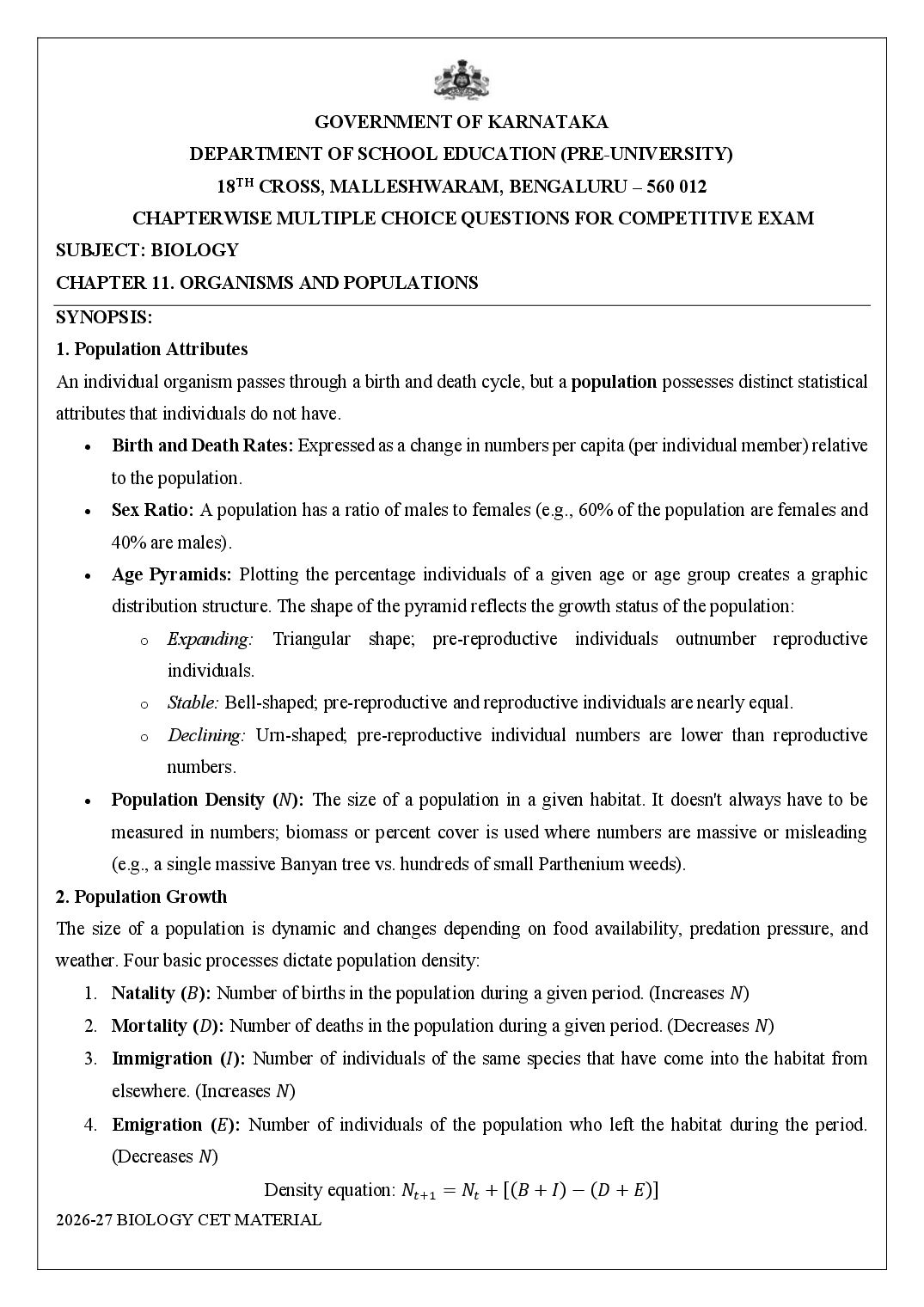
DEPARTMENT OF SCHOOL EDUCATION (PRE-UNIVERSITY)
18TH CROSS, MALLESHWARAM, BENGALURU – 560 012
CHAPTERWISE MULTIPLE CHOICE QUESTIONS FOR COMPETITIVE EXAM
SUBJECT: BIOLOGY
CHAPTER 11. ORGANISMS AND POPULATIONS
SYNOPSIS:
1. Population Attributes
An individual organism passes through a birth and death cycle, but a population possesses distinct statistical
attributes that individuals do not have.
• Birth and Death Rates: Expressed as a change in numbers per capita (per individual member) relative
to the population.
• Sex Ratio: A population has a ratio of males to females (e.g., 60% of the population are females and
40% are males).
• Age Pyramids: Plotting the percentage individuals of a given age or age group creates a graphic
distribution structure. The shape of the pyramid reflects the growth status of the population:
o Expanding: Triangular shape; pre-reproductive individuals outnumber reproductive
individuals.
o Stable: Bell-shaped; pre-reproductive and reproductive individuals are nearly equal.
o Declining: Urn-shaped; pre-reproductive individual numbers are lower than reproductive
numbers.
• Population Density (𝑁): The size of a population in a given habitat. It doesn't always have to be
measured in numbers; biomass or percent cover is used where numbers are massive or misleading
(e.g., a single massive Banyan tree vs. hundreds of small Parthenium weeds).
2. Population Growth
The size of a population is dynamic and changes depending on food availability, predation pressure, and
weather. Four basic processes dictate population density:
1. Natality (𝐵): Number of births in the population during a given period. (Increases 𝑁)
2. Mortality (𝐷): Number of deaths in the population during a given period. (Decreases 𝑁)
3. Immigration (𝐼): Number of individuals of the same species that have come into the habitat from
elsewhere. (Increases 𝑁)
4. Emigration (𝐸): Number of individuals of the population who left the habitat during the period.
(Decreases 𝑁)
Density equation: 𝑁𝑡+1 = 𝑁𝑡 + [(𝐵 + 𝐼) − (𝐷 + 𝐸)]
Page 2
Exponential / Geometric Growth
Occurs when resources (food and space) in the habitat are unlimited. The population grows in a geometric
fashion, creating a J-shaped curve.
𝑑𝑁
Differential Equation: = 𝑟𝑁
𝑑𝑡
Integral Form: 𝑁𝑡 = 𝑁0 𝑒 𝑟𝑡
• 𝑟 is the intrinsic rate of natural increase (a key parameter assessing impacts of biotic and abiotic
factors).
• 𝑒 is the base of natural logarithms.
Logistic Growth
Occurs because resources are limited and finite. Survival of the fittest leads to competition. A habitat can
support only a maximum possible number, beyond which no further growth is possible—this limit is called
the Carrying Capacity (𝐾). It creates a Sigmoid (S-shaped) curve, also called Verhulst-Pearl Logistic
Growth.
𝑑𝑁 𝐾−𝑁
= 𝑟𝑁 ( )
𝑑𝑡 𝐾
3. Life History Variation
Populations evolve to maximize their reproductive fitness (called Darwinian fitness, measured by high 𝑟
value) in the habitat they live in.
• Some organisms breed only once in their lifetime (e.g., Pacific salmon fish, Bamboo).
• Others breed many times during their lifetime (e.g., most birds and mammals).
• Some produce a large number of small-sized offspring (e.g., Oysters, pelagic fishes).
• Others produce a small number of large-sized offspring (e.g., birds, mammals).
4. Population Interactions
In nature, an isolated species cannot survive; species must interact to form biological communities.
Name of
Species A Species B Key Nature / Mechanism
Interaction
Mutualism + + Both species benefit obligationally.
Competition − − Both species lose or are adversely affected.
One species (predator) kills and eats the other
Predation + −
(prey).
Page 3
Species A Species B Key Nature / Mechanism
Interaction
Parasitism + − One species (parasite) lives on/in host, harming it.
Commensalism + 0 One benefits, the other is completely unaffected.
Amensalism − 0 One is harmed, the other is completely unaffected.
Detailed Interaction Dynamics
Predation
Acts as conduits for energy transfer across trophic levels and keeps prey populations under control.
• Prickly pear cactus introduced into Australia (1920s) caused havoc by spreading rapidly. It was
brought under control only when a cactus-feeding predator (Cactoblastis moth) was introduced.
• Prey defenses: Camouflage (cryptic coloration in insects/frogs), chemical defense (Monarch butterfly
accumulates toxic cardiac glycosides from a weed during its caterpillar stage), or morphological
defenses (thorns in Acacia, Cactus). Calotropis produces poisonous cardiac glycosides to deter
herbivores.
Competition
Occurs when closely related species compete for the same limited resources. However, unrelated species can
also compete (e.g., visiting Flamingos and resident fishes in South American lakes compete for zooplankton).
• Gause’s ‘Competitive Exclusion Principle’: States that two closely related species competing for the
same limiting resources cannot co-exist indefinitely; the competitively inferior one will eventually be
eliminated. (e.g., Abingdon tortoise in Galapagos became extinct within a decade after goats were
introduced due to greater browsing efficiency).
• Resource Partitioning: Mechanism to avoid exclusion. If two species compete for the same resource,
they can choose different feeding times or foraging patterns to co-exist (MacArthur showed 5 warbler
species co-existing on the same tree via foraging alterations).
Parasitism
• Ectoparasites: Feed on the external surface of the host (e.g., lice on humans, ticks on dogs, marine
copepods on fish, and Cuscuta parasitic plant on hedge plants).
• Endoparasites: Live inside the host body at different sites like liver, lungs, or RBCs (e.g., liver fluke,
plasmodium). Their life cycles are complex.
• Brood Parasitism: Seen in birds. The parasitic bird lays eggs in the nest of its host and lets the host
incubate them. The eggs have evolved to resemble the host’s eggs in size and color (e.g., Cuckoo/Koel
laying eggs in a Crow's nest).
Commensalism
Page 4
• Barnacles growing on the back of a whale.
• Cattle egrets foraging close to grazing cattle (cattle flush out insects from vegetation as they move,
making it easy for egrets to catch them).
• Sea anemone (stinging tentacles) and Clown fish (gets protection from predators).
Mutualism
• Lichens: Symbiotic configuration between a fungus (provides absorption/protection) and
photosynthesizing algae or cyanobacteria.
• Mycorrhizae: Mutualistic association between fungi (genus Glomus) and roots of higher plants.
• Plant-Animal Mutualism: Plants need animal pollinators for pollen dispersal and seed vectors;
animals get rewards in the form of nectar, pollen, or juicy fruits.
Fig tree and Fig Wasp: The fig species can be pollinated only by its partner wasp species. The female wasp
uses the fruit as an egg-laying (oviposition) site and uses the developing seeds to nourish its larvae.
Sexual Deceit (Ophrys): The Mediterranean orchid Ophrys employs sexual deceit. One petal of its flower
bears an uncanny resemblance to the female bee in color, size, and markings. The male bee is attracted,
"pseudo-copulates" with the flower, and transfers pollen grains to successive flowers.
MULTIPLE CHOICE QUESTIONS
1. (A): Regional and local variations occur with each habitat. (RATIONALISED)
(B): It causes formation of a wide variety of biomes.
(a) (A) is true and (B) is also true (b) (A) is false but (B) is true
(c) (A) is true but (B) is false (d) (A) is false and (B) is also false
2. Individuals resulting from asexual reproduction are also considered __________ while performing
ecological studies.
(a) Biome (b) Ecosystem (c) Population (d) Species
3. After poaching 3 lions in certain forests of Gujarat, only 15 are left in a year. Determine the death
rate per capita.
(a) 5.000 (b) 0.200 (c) 0.166 (d) 0.800
4. Population size in any given habitat is also known as __________
(a) Population cluster (b) Population explosion
(c) Population abundance (d) Population density
5. Tiger census in our national parks and tiger reserves is done by counting
(a) Tiger cubs (b) Tiger pug marks
(c) Tiger faecal pellets (d) Both (b) and (c)
6. If a new habitat is just being colonized then which of the following options do you think would
have a greater contribution towards population density?
(a) Mortality (b) Natality (c) Immigration (d) Emigration
Page 5
(a) 0.15 (b) 0.0015 (c) 0.015 (d) 1.5
8. The ‘r’ value for flour beetle is __________
(a) 0.15 (b) 0.12 (c) 0.21 (d) 0.012
9. The fish that breeds once in its lifetime is __________
(a) Atlantic tuna fish (b) Indian pomfret fish
(c) Pacific salmon fish (d) Arctic whale
10. Who proposed the competitive exclusion principle?
(a) Gause (b) Robert May (c) Darwin (d) Von Humboldt
11. A species whose distribution is restricted to a small geographical area because of the presence of a
competitive superior species is found to expand its distributional range dramatically when the
competing species is experimentally removed. This phenomenon is known as
(a) Competitive exclusion (b) Competitive release
(c) Interference competition (d) Resource partitioning
12. In some shallow South American lakes, which of the following compete for the same food that is
zooplanktons of lake?
(a) Visiting flamingos (b) Resident fishes (c) Both (a) and (b) (d) None of these
13. Liver fluke belongs to the class
(a) Cestoda (b) Trematoda (c) Hirudinaria (d) Turbellaria
14. Malarial parasites require which vector to spread to other hosts
(a) Snail (b) Fish (c) Housefly (d) Mosquito
15. Which of the following shows commensalism?
(a) Sea anemone and clown fish (b) Lichens
(c) Lice and human (d) Mycorrhizae
16. Mycorrhizae are association between
(a) Fungus and photosynthetic algae (b) Fungus and roots of higher plants
(c) Fungus and cyanobacteria (d) Fig plant and wasp
17. Pseudocopulation helps in pollination in
(a) Fig plant (b) Orchid (c) Cuscuta (d) Sunflower
18. Select the incorrect statement.
(a) The mediterranean orchid Ophrys employs sexual deceit to get pollinated.
(b) In mycorrhizal association, fungi helps the plant in the absorption of essential nutrients from the soil.
(c) Pinus seeds cannot germinate and establish without the presence of mycorrhizae.
(d) When resources are unlimited, the growth is usually logistic, but when resources become
progressively limiting, the growth pattern turns exponential.
Page 6
which of the following aspect?
(a) Size (b) Colour (c) Markings (d) All of these
20. In which of the following interaction only one of the species is benefited?
(a) Mutualism (b) Competition (c) Parasitism and predation (d) Ammensalism
21. Populations evolve to maximize their
(a) Health fitness (b) Body fitness (c) Mental fitness (d) Reproductive fitness
22. Graph ‘b’ is represented by the formula:
dN dN
(a) dt = rN (b) dt = N
dN K−N dN K−N
(c) dt = rN ( K ) (d) dt = N ( K )
23. What is the meaning of K?
(a) Intrinsic rate of natural reproduction
(b) Population density at time zero
(c) Carrying capacity
(d) Population density after time
24. Which of the growth curve is considered a more realistic one?
Page 7
25. Lichens are the associations of
(a) Bacteria and fungus (b) Algae and bacterium
(c) Fungus and algae (d) Fungus and virus
26. Which plant is pollinated by the insect below?
(a) Orchid flower (b) Fig flower (c) Sunflower (d) Lotus flower
27. Which two of the following changes (A to D) usually tend to occur in the plain dwellers when they
move to high altitudes (3500 m or more)? (RATIONALISED)
(A) Increase in red blood cell size (B) Increase in red blood cell production
(C) Increased breathing rate (D) Increase in thrombocyte count The changes
occurring are
(a) (B) and (C) (b) (C) and (D) (c) (A) and (D) (d) (A) and (B)
28. Consider the following statements (A to D) each with one or two blanks. (RATIONALISED)
(A) Bears go into __(i)__ during winter to __(ii)__ cold weather.
(B) A conical age pyramid with a broad base represents __(iii)__ human population.
(C) A wasp pollinating a fig flower is an example of __(iv)__.
(D) An area with high levels of species richness is known as __(v)__.
Which one of the following options, gives the correct fill ups for the respective blank numbers
from (i) to (v) in the statements?
(a) (iii) stable (iv) commensalism, (v) marsh
(b) (i) aestivation, (ii) escape, (iii) stable, (iv) mutualism
(c) (iii) expanding, (iv) commensalism, (v) biodiversity park
(d) (i) hibernation, (ii) escape, (iii) expanding (v) hot spot
Page 8
K−N K−N
(a) dt/dN = Nr ( K ) (b) dN/dt = rN ( K )
N−K
(c) dN/dt = rN (d) dN/dt = rN ( N )
30. What type of human population is represented by the following age pyramid?
(a) Stable population (b) Declining population
(c) Expanding population (d) Vanishing population
31. Which one of the following is categorized as a parasite in true sense?
(a) Human foetus developing inside the uterus draws nourishment from the mother.
(b) Head louse living on the human scalp as well as laying eggs on human hair.
(c) The cuckoo (koel) lays its eggs in crew’s nest.
(d) The female Anopheles bites and sucks blood from humans.
32. People who have migrated from the planes to an area adjoining Rohtang Pass about six months
back(RATIONALISED)
(a) Have more RBCs and their haemoglobin has a lower binding affinity to O2.
(b) Are not physically fit to play games like football.
(c) Suffer from altitude sickness with symptoms like nausea, fatigue, etc.
(d) Have the usual RBC count but then haemoglobin has very high binding affinity to O2.
33. A biologist studied the population of eats in a barn. He found that the average natality was 250,
average mortality is 240, immigration is 20 and emigration to be 30. The net increase in population
is
(a) 10 (b) 15 (c) 05 (d) Zero
34. Leaves become modified into spines in
(a) Opuntia (b) Pea (c) Onion (d) Skin cotton
35. It is much easier for a small animal to run uphill than for animal, because: (RATIONALISED)
(a) It is easier to carry a small body weight
(b) Smaller animals have a higher metabolic rate
(c) Small animals have a lower O2 requirement
(d) The efficiency of muscles in large animals is less than in small animals
36. The primary producers of the deep-sea hydrothermal vent ecosystem are
Page 9
37. Which of the following is correct for ‘r’ selected species?
(a) Large number of progenies with large size (b) Small number of progenies with small size
(c) Small number of progenies with large size (d) Large number of progenies with small size
38. The principle of competitive exclusion was stated by
(a) G. F. Gause (b) MacArthur (c) Verhulst and Pearl (d) C. Darwin
39. Biosphere is
(a) A component in the ecosystem
(b) Composed of the plants present in the soil
(c) Life in outer space
(d) Composed of all living organisms present on earth which interact with the physical environment.
40. According to Allen’s Rule, the mammals from colder climates have(RATIONALISED)
(a) Shorter ears and longer limbs (b) Longer ears and shorter limbs
(c) Longer ears and longer limbs (d) Shorter ears and shorter limbs
41. If a population of 50 paramoecium present in a pool increases to 150 after an hour, then what
would be the growth rate of that population?
(a) 50 per hour (b) 200 per hour (c) 5 per hour (d) 100 per hour
42. What would be the per cent growth or birth rate per individual per hour for the same population
mentioned in the previous question?
(a) 100 (b) 200 (c) 50 (d) 150
43. A population has more young individuals compared to the older individuals. What would be the
status of the population after some years?
(a) It will decline (b) It will stabilize (c) It will increase (d) It will first decline and then stabilize
44. What parameters are used for the tiger census in our country’s national parks and sanctuaries?
(a) Pug marks only (b) Pug marks and faecal pellets
(c) Faecal pellets only (d) Actual head counts
45. Which of the following would necessarily decrease the density of a population in a given habitat?
(a) Natality > mortality (b) Immigration > emigration
(c) Mortality and emigration (d) Natality and immigration
46. A protozoan reproduces by binary fission. What will be the number of protozoans in its population
after six generations?
(a) 128 (b) 24 (c) 64 (d) 32
47. Which of the following is a partial root parasite?
(a) Sandal wood (b) Mistletoe (c) Orobanche (d) Ganoderma
48. Consider the name of the fish given below. (RATIONALISED)
(I) Salmon
Page 10
(III) Sting ray
Which of them is/are stenohaline and euryhaline?
(a) (I),(III)- Stenohaline, (II) – Euryhaline (b) (I), (II) - Stenohaline, (III) – Euryhaline
(c) (II), (III) - Stenohaline, (I) – Euryhaline (d) (I) – Stenohaline, (II), (III) - Euryhaline
49. Population is the total number of
(a) interbreeding individuals of a species found in a geographical area
(b) interbreeding individuals of a species found in different geographical area
(c) Both (a) and (b)
(d) None of the above
50. Age structure of a population influences population growth because
(a) different age groups have different reproductive capabilities
(b) different age groups have same reproductive capabilities
(c) more young individuals indicate decreasing population
(d) All of the above
51. In a growing population of a country,
(a) reproductive and pre-reproductive individuals are equal in number
(b) reproductive individuals are less than the post-reproductive individuals
(c) pre-reproductive individuals are more than the reproductive individuals
(d) pre-reproductive individuals are less than the reproductive individuals
52. When there is a large number of post-reproductive or older individuals and lesser number of pre-
reproductive individuals then that population is
(a) growing (b) declining (c) stable (d) None of these
53. Population size is more technically called
(a) population density (b) demography (c) population growth (d) population dynamics
54. If b = 65 and d is = 45, N =100 then find out dN /dt
(a) 2000 (b) 5000 (c) 400 (d) 300
55. Asymptote in a logistic growth curve is obtained, when
(a) The value of ‘r’ approaches zero (b) K = N (c) K > N (d) K < N
56. Life history traits of organisms have evolved in relation to the constraints imposed by which
components of habitat?
(a) Organic components (b) Abiotic components
(c) Biotic components (d) Both (b) and (c)
57. The attributes of population but not of the individual are
(a) birth rate (b) death rate
(c) sex ratio (d) All of these
Page 11
(a) 18 - 25°C and 150 - 400 cm(RATIONALISED)
(b) 5 - 15°C and 50 - 100 cm
(c) 30 - 50°C and 100 - 150 cm
(d) 5 - 15°C and 100 - 200 cm
59. You never see any cattle or goat browsing on Calotropis due to
(a) its appearance
(b) production of foul odour
(c) production of cardiac glycosides
(d) distastefulness of its leaves
60. The first living organisms originated (RATIONALISED)
(a) on earth in water (b) Is sustainable with water only
(c) Is possible without water (d) Both a and c are correct
61. Snow leopards are not found in Kerala forests. Which factor is responsible for it?
(a) Temperature (b) Soil (c) Water (d) Light
62. What are the key elements that lead to so much variation in the physical and chemical conditions
of different habitats? (RATIONALISED)
(a) Temperature and Sight (b) Soil and water
(c) Only soil (d) Temperature, light, soil and water
63. A regional ecological unit having a specific climate is -
(a) Biome (b) Landscape (c) Ecosystem (d) Biotic community
64. Select the false statement –(RATIONALISED)
(a) Average temperature on land varies seasonally
(b) Temperature progressively decreases from pole to equator
(c) Temperature progressively decreases from plains to mountain tops
(d) Our intestine is a unique habitat for hundreds of species of microbes
65. Different systems have evolved inside organisms to maintain homeostasis in order to carry out
their physiological and biochemical processes This can be acquired by –(RATIONALISED)
(a) Regulation (b) Conformation (c) Migration or suspension (d) AII
66. Kangaroo rats -(RATIONALISED)
(a) Have a genre zed diet (b) Avoid eating fats
(c) Do not need to drink water (d) Are insensitive to heat
67. Choose the odd one out w.r.t adaptations in the organisms –(RATIONALISED)
(a) biochemical adaptations are seen in organisms living in great depth of the ocean to face crushing
pressure
(b) Allen's rule is seen in mammals living in colder climates
Page 12
pressure at high altitude
(d) Desert lizards lack the physiological and behavioural means to manage to their body temperature
68. Elephants use their ears to dump heat to the environment. What mechanisms might they employ
to increase heat loss from ears?
(a) Increased convection due to flapping of the ears
(b) Moving into the sun
(c) Increased blood flow to the ears
(d) (a) and (c)
69. (I) Conformers are the organisms that cannot maintain a constant internal environment.
(RATIONALISED)
(II) 99% animals and nearly all plants cannot maintain their constant internal environments
(III) During the course of evolution, the cost and benefits of maintaining a constant internal environment
are discarded.
(IV) Conformity is a condition in which an external challenge induces parallel internal changes.
(V) Regulation is a condition in which external challenge elicits compensatory action to maintain the
internal milien.
(a) All are correct (b) All are wrong
(c) Only (III) is wrong (d) Only (IV) and (V) are wrong
70. Which one is correct? (RATIONALISED)
(I) In a hot climate.reptiles can maintain a constant body temperature in the day by behavioural
regulation.
(II) The body temperature of thermoconformers changes with ambient temperature.
(III) In aquatic osmoconformers, the osmolarity of. body fluids changes with that of ambient water.
(IV) Small animals have a larger surface area relative their volume, they tend to lose body heat very fast
when it is cold outside, then they have to expend much energy to generate body heat through
metabolism.
(a) All (b) None (c) Only (IV) (d) (I), (II), (III)
71. Acclimatization (compensatory mechanisms) to altitude sickness includes all except (RATIONALISED)
(a) Polycythaemia (b) Hyperveritilation
(c) Asphyxia (d) Decreasing binding capacity of Mb
72. Population density of aquatic animals in some waterbody is measured in term of per -
(a) m2 (b) m4 (c) m (d) m3
73. What four factors define population growth?
(a) Births; deaths, immigration, emigration
(b) Survivorship, age-specific mort ty, fecundity, death rate
Page 13
(d) Age-specific birth rate, metapopulation structure, quadrate, ecotone
74. Thousands of migratory birds travel from Siberia and other bitterly cold northern regions to
Keolado National Park in Bharatpur. This park can be found in (RATIONALISED)
(a) Gujrat (b) West Bengal (c) Rajasthan (d) Madhya Pradesh
75. Which of the following is an important adaptation of animals to cold climate (RATIONALISED)
(a) Thin layer of body fat (b) Aestivation
(c) Increased tendency to shiver (d) Reduced surface area to volume ratio
76. Biotic potential refers to –
(a) Increase of population under optimum condition
(b) Increase of population under given condition
(c) Increase of population under natural condition
(d) Increase of population under stress condition
77. Which of the following is correct?
(a) Natality under actual conditions is called ecological natty
(b) Ability of an environment to support a population is called earring capacity '
(c) Plants are killed by frost in winter because of desiccation and mechanical damage
(d) AII
78. As the number of individuals approaches the carrying capacity of a population, which of the
following is predicted by the sigmoidal growth curve?
(a) Population biomass will remain the same
(b) Population density will increase exponentially
(c) Population growth rate will decrease
(d) Population growth rate will increase
79. Assuming that an animal generates heat at a rate proportional to its volume and can radiate heat
at a rate proportional to its body surface area. Which of the following would be best at
maintaining its body temperature in a cold climate-?
(a) Mouse (b) Rabbit (c) bear (d) Fox
80. Logistic growth occurs when there is –
(a) Asexual reproduction only (b) Sexual reproduction only
(c) No inhibition from crowding (d) A fixed carrying capacity
81. Exponential growth occurs when there is –
(a) Asexual reproduction only (b) Sexual reproduction only
(c) No inhibition from crowding (d) A fixed carrying capacity
82. A behavioural strategy of adaptation is called echolocation is found in –
(a) bats (b) Butterfly (c) Praying mantis (d) Arctic tern
Page 14
individuals?
(a) Growing (b) Declining (c) Becomes highly dynamic (d) Unpredictable
84. Which of the following is true for the carrying capacity (K)?
(a) When N = K, the birth rate in a population is zero
(b) The rate of population growth in an unlimited environment is proportional to K
(c) K is always; determined by the amount of food in an environment
(d) In population at its K the birth rate equals the death rate
85. In a life table, the number of individuals alive at The beginning of the 1-year to 2-year age interval
is 800. During this interval 200 individuals die. The death rate for this interval is –
(a) 0.25 (b) 200 (c) 800 (d) 0.2
86. Which of these is an explanation of why a population can fluctuate once it has reached earring
capacity?
(a) The number of organisms decreases but never increases it reaches earring capacity
(b) All populations experience exponential growth once they reach earring capacity
(c) A population of organisms always grow rapidly once it reaches earring capacity
(d) Limiting factors can influence the number of organisms in a population once it reaches earring
capacity
87. Choose the correct option-
(a) Geometric growth produces J-shaped population growth curve
(b) Logistic growth occurs when resources are limiting
(c) For exponential growth equation is Nt = N0ert
(d) All
88. Which one of the following is incorrect?
(a) Biological control methods adopted in agricultural pest control are based on the ability of the
predator to regulate prey population
(b) Predators also help in maintaining species diversity in a community by increasing the intensity of
competition among competing prey species
(c) In the rocky intertidal communities of the American Pacific Coast the starfish piaster is an important
predator.
(d) In a field experiment, when all the starfish were removed from an enclosed intertidal area, more than
10
89. A division of ecology that deals with anthropogenic environmental problems are called
(a) Autecology (b) Ethology (c) Synecology (d) Anthropology
90. Which of the following component is not an abiotic factor of the ecosystem?
(a) Water (b) Nutrients (c) Organisms (d) Energy
Page 15
unfavorable climatic conditions of Thar Desert makes ____ the level of ecology.
(a) population (b) organism (c) community (d) biome
92. Which of the following statement is correct about biomes?
(a) Biomes correspond to climatic zones based on nutrient availability.
(b) Annual variations in temperature and precipitation account for the formation of major biomes.
(c) A biome may exhibit varied climatic conditions in different locations of the earth.
(d) Several ecosystems together make a biome.
93. Which of the given statement is incorrect about permafrost?
(a) It is a layer of permanently frozen ground.
(b) The depth and thickness of permafrost vary.
(c) It is found in temperature rain forests.
(d) It does not allow thick vegetation cover to develop.
94. The seasonal variations in temperature on the earth are due to
(a) a tilt of the earth on its axis
(b) relative humidity
(c) amount of solar radiation intercepted by the earth
(d) both (a) and (c)
95. Which of the following produce large number of small size offspring?
(a) Oysters (b) Pelagic fishes (c) Snail (d) Both (a) & (b)
96. Exponential growth is:
(a) Geometric growth (b) Have unlimited resources
(c) J - shaped curve is obtained (d) All the above
97. 𝐍𝐭 = 𝐍𝐨 𝐞𝐫𝐭 is an equation of-
(a) Logistic growth (b) Verhulst-Pearl Logistic Growth
(c) Exponential growth (d) Both (a) & (b)
𝐝𝐍 𝐊−𝐍
98. 𝐝𝐭 = 𝐫𝐍 ( 𝐊 ) in logistic growth " 𝐊 " represents-
(a) Carrying capacity (b) Exponential factor
(c) Intrinsic rate of natural increase (d) Intrinsic rate of natural decrease.
99. If one species get benefit and the other species do not have any effect, then this type of interaction
is called:
(a) Ammensalism (b) Commensalism (c) Predation (d) Competition
100. Barnacles growing on the back of the whale getting benefit is an example of-
(a) Mutualism (b) Parasitism (c) Commensalism (d) Ammensalism
KEY ANSWERS:
Page 16
8. (b) 9. (c) 10. (a) 11. (b) 12. (c) 13. (b) 14. (d)
15. (a) 16. (b) 17. (b) 18. (d) 19. (d) 20. (c) 21. (d)
22. (c) 23. (c) 24. (b) 25. (c) 26. (a) 27. (a) 28. (d)
29. (b) 30. (b) 31. (b) 32. (a) 33. (d) 34. (a) 35. (b)
36. (a) 37. (d) 38. (a) 39. (d) 40. (d) 41. (d) 42. (b)
43. (c) 44. (b) 45. (c) 46. (c) 47. (a) 48. (c) 49. (a)
50. (a) 51. (c) 52. (b) 53. (a) 54. (a) 55. (b) 56. (d)
57. (d) 58. (a) 59. (c) 60. (a) 61. (a) 62. (d) 63. (a)
64. (b) 65. (d) 66. (c) 67. (d) 68. (d) 69. (c) 70. (a)
71. (c) 72. (d) 73. (a) 74. (c) 75. (d) 76. (a) 77. (d)
78. (c) 79. (c) 80. (d) 81. (c) 82. (a) 83. (a) 84. (d)
85. (a) 86. (d) 87. (d) 88. (b) 89. (d) 90. (c) 91. (b)
92. (b) 93. (c) 94. (d) 95. (d) 96. (d) 97. (c) 98. (a)
99. (b) 100. (c)
Document Details
| Board / Org | Karnataka Board |
| Exam | Class 12 |
| Type | Question Bank |
| Pages | 16 |
| Updated | 24 Sep 2026 |