Karnataka 2nd PUC Biology Principles of Inheritance and Variation MCQ with Answers
Finished viewing? Save it for later —
Download Karnataka 2nd PUC Biology Principles of Inheritance and Variation MCQ with Answers (PDF · 17 pages)About Karnataka 2nd PUC Biology Principles of Inheritance and Variation MCQ with Answers
Karnataka 2nd PUC Biology Principles of Inheritance and Variation MCQ with Answers is available here for free download. Published by Karnataka Board for Class 12, this question bank can be viewed online or downloaded as a PDF (17 pages). Candidates preparing for Class 12 can use Karnataka 2nd PUC Biology Principles of Inheritance and Variation MCQ with Answers to understand the exam pattern, the type of questions asked, and the overall difficulty level.
Frequently Asked Questions
How can I download Karnataka 2nd PUC Biology Principles of Inheritance and Variation MCQ with Answers?
Open this page and click the Download button to save Karnataka 2nd PUC Biology Principles of Inheritance and Variation MCQ with Answers as a PDF. It is completely free on AglaSem Docs.
Is Karnataka 2nd PUC Biology Principles of Inheritance and Variation MCQ with Answers free to download?
Yes. Karnataka 2nd PUC Biology Principles of Inheritance and Variation MCQ with Answers can be viewed online and downloaded as a PDF free of cost on AglaSem Docs.
How many pages does Karnataka 2nd PUC Biology Principles of Inheritance and Variation MCQ with Answers have?
Karnataka 2nd PUC Biology Principles of Inheritance and Variation MCQ with Answers contains 17 pages, which you can read online or download together as a single PDF.
Where can I find more Class 12 study material?
You can find more Class 12 question papers, sample papers, syllabus, and answer keys on AglaSem Docs.
Karnataka 2nd PUC Biology Principles of Inheritance and Variation MCQ with Answers – Text
Read the full text of this question bank below — useful to quickly search, copy and reference the content online without downloading the PDF.
📄 View text version (17 pages)
Page 1
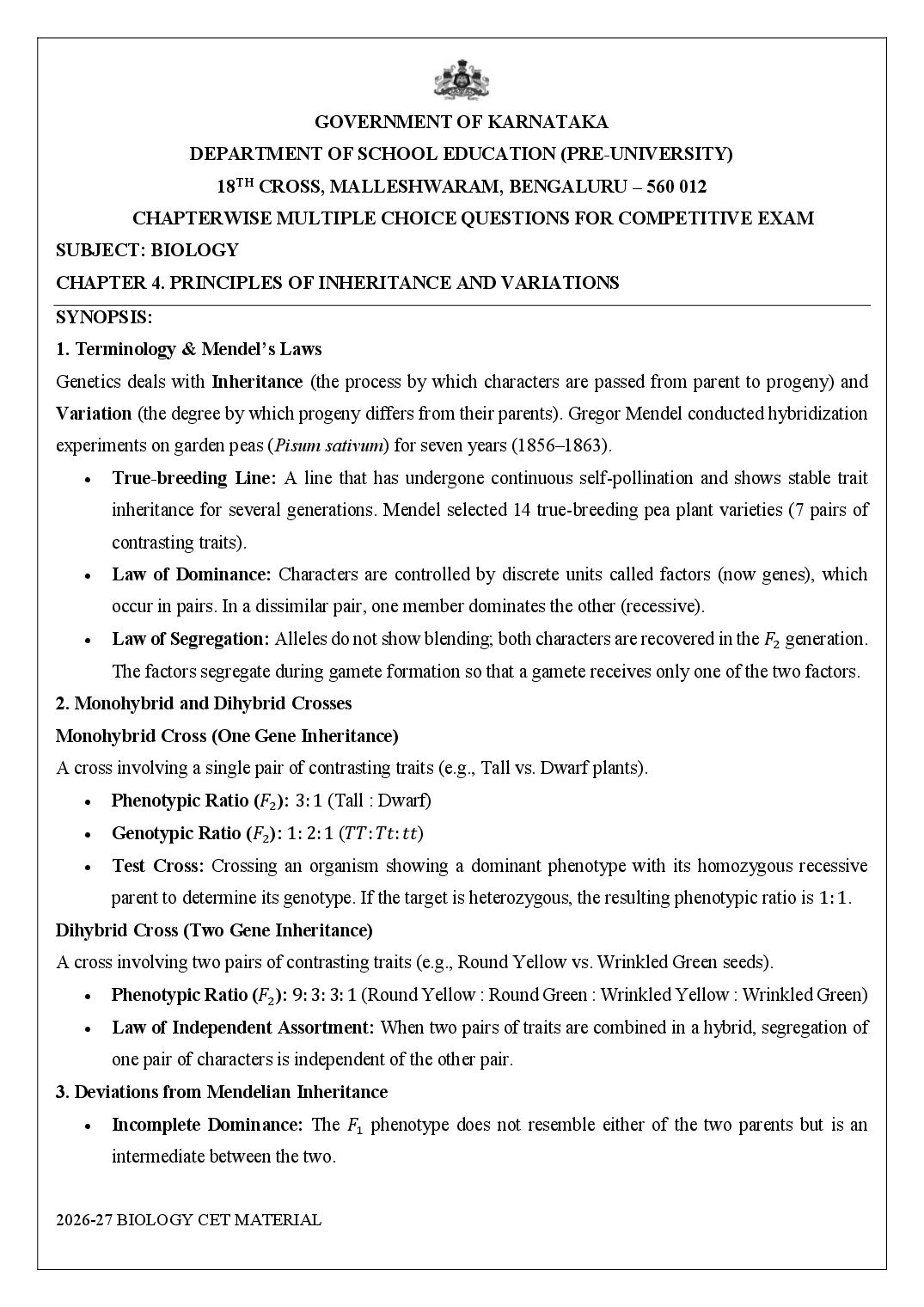
DEPARTMENT OF SCHOOL EDUCATION (PRE-UNIVERSITY)
18TH CROSS, MALLESHWARAM, BENGALURU – 560 012
CHAPTERWISE MULTIPLE CHOICE QUESTIONS FOR COMPETITIVE EXAM
SUBJECT: BIOLOGY
CHAPTER 4. PRINCIPLES OF INHERITANCE AND VARIATIONS
SYNOPSIS:
1. Terminology & Mendel’s Laws
Genetics deals with Inheritance (the process by which characters are passed from parent to progeny) and
Variation (the degree by which progeny differs from their parents). Gregor Mendel conducted hybridization
experiments on garden peas (Pisum sativum) for seven years (1856–1863).
• True-breeding Line: A line that has undergone continuous self-pollination and shows stable trait
inheritance for several generations. Mendel selected 14 true-breeding pea plant varieties (7 pairs of
contrasting traits).
• Law of Dominance: Characters are controlled by discrete units called factors (now genes), which
occur in pairs. In a dissimilar pair, one member dominates the other (recessive).
• Law of Segregation: Alleles do not show blending; both characters are recovered in the 𝐹2 generation.
The factors segregate during gamete formation so that a gamete receives only one of the two factors.
2. Monohybrid and Dihybrid Crosses
Monohybrid Cross (One Gene Inheritance)
A cross involving a single pair of contrasting traits (e.g., Tall vs. Dwarf plants).
• Phenotypic Ratio (𝐹2 ): 3: 1 (Tall : Dwarf)
• Genotypic Ratio (𝐹2 ): 1: 2: 1 (𝑇𝑇: 𝑇𝑡: 𝑡𝑡)
• Test Cross: Crossing an organism showing a dominant phenotype with its homozygous recessive
parent to determine its genotype. If the target is heterozygous, the resulting phenotypic ratio is 1: 1.
Dihybrid Cross (Two Gene Inheritance)
A cross involving two pairs of contrasting traits (e.g., Round Yellow vs. Wrinkled Green seeds).
• Phenotypic Ratio (𝐹2 ): 9: 3: 3: 1 (Round Yellow : Round Green : Wrinkled Yellow : Wrinkled Green)
• Law of Independent Assortment: When two pairs of traits are combined in a hybrid, segregation of
one pair of characters is independent of the other pair.
3. Deviations from Mendelian Inheritance
• Incomplete Dominance: The 𝐹1 phenotype does not resemble either of the two parents but is an
intermediate between the two.
Page 2
crossed with White (𝑟𝑟) produces Pink (𝑅𝑟).
o Ratios (𝐹2 ): Both Phenotypic and Genotypic ratios are identical: 1: 2: 1.
• Codominance: The 𝐹1 generation resembles both parents; both alleles express themselves completely.
o Example: ABO blood grouping in humans, controlled by the 𝐼 gene which has three alleles:
𝐼 𝐴 , 𝐼 𝐵 , and 𝑖. 𝐼 𝐴 and 𝐼 𝐵 are completely dominant over 𝑖, but codominant with each other (𝐼 𝐴 𝐼 𝐵
results in blood group AB).
• Pleiotropy: A single gene exhibits multiple phenotypic expressions.
o Example: Phenylketonuria (mutation in the gene encoding phenylalanine hydroxylase leads to
mental retardation, reduction in hair, and skin pigmentation) or starch grain size/shape in pea
seeds.
• Polygenic Inheritance: Traits controlled by three or more genes where the environment also plays a
major role, creating a gradient/continuous variation.
o Example: Human skin color and human height.
4. Chromosomal Theory and Linkage
• Chromosomal Theory of Inheritance: Formulated by Walter Sutton and Theodore Boveri (1902).
They noted that the behavior of chromosomes mirrors the behavior of Mendelian factors (genes) during
meiosis.
• Experimental Verification: Done by Thomas Hunt Morgan using the fruit fly, Drosophila
melanogaster.
• Linkage and Recombination: Morgan discovered that when two genes in a dihybrid cross are situated
on the same chromosome, the proportion of parental gene combinations is much higher than the non-
parental (recombinant) type.
o Linkage: Physical association of genes on a chromosome.
o Recombination: Generation of non-parental gene combinations.
• Genetic Mapping: Alfred Sturtevant used the frequency of recombination between gene pairs on the
same chromosome as a measure of the distance between genes, mapping their positions.
5. Sex Determination
• Male Heterogamety: Males produce two distinct types of gametes.
o XX-XY type: Human beings and Drosophila. (Females XX, Males XY).
o XX-XO type: Grasshopper. (Females XX, Males XO—lacking a Y chromosome).
• Female Heterogamety: Females produce two distinct types of gametes.
o ZW-ZZ type: Birds. (Females ZW, Males ZZ).
Page 3
from fertilized eggs and are diploid (2𝑛 = 32). Males (Drones) develop parthenogenetically from
unfertilized eggs and are haploid (𝑛 = 16).
6. Genetic Disorders
Alterations or mutations affecting genes or chromosomes can be tracked using Pedigree Analysis—the study
of an inherited trait across multiple generations of a family tree.
Mendelian Disorders
Mainly determined by alteration or mutation in a single gene.
1. Haemophilia: Sex-linked (X-linked) recessive disorder. A single protein involved in blood clotting is
affected, leading to non-stop bleeding from simple cuts.
2. Sickle-Cell Anaemia: Autosomal recessive disorder. Caused by a point mutation substituting
Glutamic acid (𝐺𝑙𝑢) with Valine (𝑉𝑎𝑙) at the sixth position of the beta-globin chain of hemoglobin.
Under low oxygen tension, RBCs change from biconcave discs to elongated, sickle shapes.
3. Phenylketonuria (PKU): Autosomal recessive inborn error of metabolism. The affected individual
lacks the enzyme phenylalanine hydroxylase that converts the amino acid phenylalanine into tyrosine.
Phenylalanine accumulates and converts into phenylpyruvic acid, causing mental retardation.
4. Thalassemia: Autosomal recessive, quantitative blood disorder. Reduced synthesis rate of one of the
globin chains (𝛼 or 𝛽). 𝛼-Thalassemia is controlled by closely linked genes HBA1 and HBA2 on
chromosome 16; 𝛽-Thalassemia is controlled by a single gene HBB on chromosome 11.
5. Cystic Fibrosis: Autosomal recessive disorder affecting mucus secretion glands.
Chromosomal Disorders
Caused by the absence, excess, or abnormal arrangement of one or more chromosomes due to non-disjunction
(failure of chromatids to segregate during cell division).
• Aneuploidy: Gain or loss of a chromosome (e.g., 2𝑛 + 1 or 2𝑛 − 1).
• Polyploidy: Increase in a whole set of chromosomes (3𝑛, 4𝑛 etc.), common in plants when cytokinesis
fails after telophase.
Chromosomal
Disorder Major Symptoms
Aberration
Short stature, small round head, furrowed tongue,
Trisomy of
Down’s partially open mouth, broad palm with characteristic
Chromosome 21
Syndrome palm crease, physical and mental development is
(2𝑛 + 1)
retarded.
Page 4
Disorder Major Symptoms
Aberration
Individual has overall masculine development but
Trisomy of Sex
Klinefelter’s feminine development (like Gynecomastia—
Chromosome (47,
Syndrome development of breasts) is also expressed. Such
XXY)
individuals are sterile.
Monosomy of Sex
Turner’s Affected females are sterile as ovaries are rudimentary.
Chromosome (45,
Syndrome They lack secondary sexual characteristics.
X0)
MULTIPLE CHOICE QUESTIONS
1. Self-pollination between Tt and Tt plants results into the genotype ratio of
(a) 3 : 1 (b) 1 : 2 : 1 (c) 1 : 3 (d) 4 : 0
2. A farmer crossed a walnut combed chicken with a single combed one and obtained all walnut
combed chickens in F1. The genotype of the parents was
(a) Rr Pp × rr pp (b) RR PP × rr pp (c) RR pp × rr pp (d) RR Pp × rr pp
3. In sweet peas, genes C and P are necessary for colour in flowers. The flowers are white in the
absence of either or both the genes. What will be the percentage of coloured flowers in the
offspring of the cross Cc pp × cc Pp?
(a) 100% (b) 75% (c) 25% (d) 50%
4. Mendel’s law of independent assortment is applicable for
(a) All genes in all organisms (b) All genes of pea plant only
(c) All linked genes only (d) All non-linked genes only
5. In Mendelian dihybrid cross, how many individuals are homozygous recessive for one of the
character only in F2 generation?
1 2 3 6
(a) 16 (b) 16 (c) 16 (d) 16
6. In the number of insects and mammals the type of sex determination is
(a) XO type (b) XY type (c) ZW type (d) Any of these
7. Which of the below column A and B represents genes and chromosomes?
Page 5
(c) A: Gene, B: Chromosome (d) A: Chromosome. B; Gene
8. The method for analyzing inheritance patterns of traits in human being is
(a) DNA finger printing (b) Control cross
(c) Pedigree analysis (d) All of these
9. The following pedigree shows
(a) Autosomal dominant trait (b) Autosomal recessive trait
(c) X-linked recessive trait (d) X-linked dominant trait
10. The following features belong to which syndrome?
(A) Furrowed tongue
(B) Palm is broad with characteristic palm crease
(C) Physical, psychomotor and mental retardation
(D) Short statured with small round head
(a) Down’s syndrome (b) AIDS
(c) Turner’s syndrome (d) Klinefelter’s syndrome
11. Which of the following is genetically dominant in man?
(a) Colour blindness (b) Rh positive (c) Haemophilia (d) Albinism
12. If a certain patient with blood group B requires immediate blood transfusion, the following type
can be given to him
(a) O and B (b) O and AB (c) A and AB (d) B and AB
13. Queen Victoria was a carrier of which disease?
(a) Myotonic dystrophy (b) Sickle-cell anaemia (c) Haemophilia (d) Phenylketonuria
14. Which of the following is true about Phenylketonuria?
(a) Mental retardation
(b) Accumulation of phenylalanine and phenylpyruvic acid and other derivatives
(c) Autosomal recessive trait
(d) All the above
15. Variation in DNA is due to
(a) Mutation (b) Recombination (c) Both (a) and (b) (d) None of these
16. Find out the correct statement.
(a) UV radiation can cause mutation in organism.
(b) Chromosomal aberrations are commonly observed in cancer cells.
Page 6
in changes in the genotype and the phenotype of an organism.
(d) All the above
17. The inheritance pattern of a gene over generations among humans is studied by the pedigree
analysis. Character studied in the pedigree analysis is equivalent to
(a) Quantitative trait (b) Mendelian trait (c) Polygenic trait (d) Maternal trait
18. The genotype of a plant showing the dominant phenotype can be determined by
(a) Test cross (b) Dihybrid cross (c) Pedigree analysis (d) Back cross
19. Which one of the following conditions correctly describes the manner of determining the sex in the
given example?
(a) XO type of sex chromosomes determines male sex in grasshopper.
(b) XO condition in humans as found in Turner syndrome, determines female sex.
(c) Homozygous sex chromosomes (XX) produce male in Drosophila.
(d) Homozygous sex chromosomes (ZZ) determine female sex in birds.
20. Test cross in plants or in Drosophila involves crossing Principles of Inheritance and Variation 5.33
(a) Between two genotypes with recessive trait
(b) Between two F1 hybrids
(c) The F1 hybrid with a double recessive genotype
(d) Between two genotypes with dominant trait
21. Which one of the following conditions of the zygotic cell would lead to the birth of a normal human
female child?
(a) Two X chromosomes (b) Only one Y chromosome
(c) Only one X chromosome (d) One X and one Y chromosome
22. Which Mendelian idea is depicted by a cross in which the F1 generation resembles both the
parents?
(a) Incomplete dominance (b) Law of dominance
(c) Inheritance of one gene (d) Codominance
23. How many pairs by contrasting characters in pea plants were studied by Mendel in his
experiments?
(a) 5 (b) 6 (c) 8 (d) 7
24. A gene showing codominance has:
(a) Alleles tightly linked on the same chromosome
(b) Alleles that are recessive to each other
(c) Both alleles independently expressed in the heterozygote
(d) One allele dominant on the other
25. A tall true breeding garden pea plant is crossed with a dwarf true breeding garden pea plant.
Page 7
(a) 1:2:1: Tall homozygous: Tall heterozygous : Dwarf
(b) 1:2:1: Tall heterozygous: Tall homozygous: Dwarf
(c) 3 : 1 : : Tall Dwarf
(d) 3 : 1 : : Dwarf : Tall
26. A cell at telophase stage is observed by a student in a plant brought from the field. He tells his
teacher that his cell is not like other cells at telophase stage. There is no formation of cell plate and
thus the cell is ontaining more number of chromosomes as compared to other, dividing cells. This
would result in:
(a) Aneuploidy (b) Polyploidy (c) Somaclonal variation (d) Polyteny
27. Taylor conducted the experiments to prove semi conservative mode of chromosome replication on
(a) Vicia faba (b) Drosophila melanogaster (c) E. coli (d) Vinca rosea
28. If a genetic disease is transferred from a phenotypically normal but carrier female to only
some of the male progeny, then the disease is
(a) Autosomal dominant (b) Autosomal recessive
(c) Sex-linked dominant (d) Sex-linked recessive
29. A person having genotype IA IB would show the blood group as AB. This is because of
(a) Pleiotropy (b) Co-dominance
(c) Segregation (d) Incomplete dominance
30. Occasionally, a single gene may express more than one effect. This phenomenon is called
(a) Multiple allelism (b) Mosaicism (c) Pleiotropy (d) Polygeny
31. Genetics is the branch of biology which deals with
(a) variation (b) inheritance (c) Both (a) and (b) (d) study of characters
32. In Antirrhinum (Snapdragon), a red flower was crossed with a white flower and in F1-generation,
pink flowers were obtained. When pink flowers were selfed, the F2-generation showed white, red
and pink flowers. Choose the incorrect statement from the following.
(a) Pink colour in 𝐹1 is due to incomplete dominance
1 2 1
(b) Ratio of F2 is (Red) : (Pink) : (White)
4 4 4
(c) Law of segregation does not apply in this experiment
(d) This experiment does not follow the principle of dominance
33. Thalassemia and sickle-cell anaemia are caused due to problems in globin molecule synthesis.
Select the correct statement.
(a) Both are due to a qualitative defect in global chain synthesis
(b) Both are due to a quantitative defect in globin chain synthesis
(c) Thalassemia is due to the synthesis of abnormal haemoglobin molecules
Page 8
34. Select the incorrect statement.
(a) RBCs become sickle-shaped under low oxygen tension in sickle-cell anaemia
(b) Phenylpyruvic acid gets accumulated in brain and excreted in urine due to poor absorption by kidney
(c) In thalassemia, alpha and beta-globin chains are altogether absent in body
(d) Thalassemia is an autosome linked recessive disease
35. Consider the following statements.
I. 100% parental combinations are found in F2-generation.
II. F2 phenotypic ratio is 3 : 1 in dihybrid cross.
III. Dihybridtestcross ratiois1 : 1inF2 -generation.
IV. Linked genes tends to separate frequently.
Which of the statement given above are correct?
(a) I, II and IV (b) I, III and IV (c) II, III and IV (d) I and II
36. Consider the following statement and select the statements which are correct with respect to the
reasons as to why Mendel’s work remains unrecognized for a long time.
I. Communication was not easy.
II. Concept of factors which did not blend was not accepted.
III. Use of mathematics to explain biological problem was unacceptable.
IV He could not provide any physical proof for the existence of factors.
(a) I and II (b) II and III (c) III and IV (d) All of these
37. Pick out the correct statements.
I. Haemophilia is a sex-linked recessive disease.
II. Down's syndrome is due to aneuploidy.
III. Phenylketonuria is an autosomal recessive gene disorder.
IV. Sickle-cell anaemia is anX- linked recessive gene disorder.
(a) II and IV (b) I, III and IV (c) I, II and III (d) I and IV
38. In the following human pedigree, the filled symbols represent the affected individuals. Identify the
type of given pedigree.
(a) X-linked dominant (b) Autosomal recessive
(c) Autosomal dominant (d) X-linked recessive
Page 9
(a) pleiotropy (b) polyalleles (c) multiple alleles (d) All of these
40. The frequency of recombination between gene pairs on the same chromosome as a measure of the
distance between genes was explained by
(a) Gregor J Mendel (b) Alfred Sturtevant (c) Sutton-Boveri (d) TH Morgan
41. Linkage groups are always present on the
(a) homologous chromosomes (b) analogous chromosomes
(c) sex chromosomes (d) heterologous chromosomes
42. Genes A, B and C are linked. Genes A and B are closer than A and C.
I. Amight be beforeBand C.
II. Bmight be betweenAand C.
III. Cmight be betweenAand B.
IV. More crosses cannot occur between A and C than A and B. Find out the correct option for the
given information.
(a) I and II (b) II and III (c) III and IV (d) I, II and IV
43. Frame-shift mutation arises due to
(a) deletion of base pair of DNA (b) insertion of base pair of DNA
(c) Both (a) and (b) (d) change in single base pair of DNA
44. Atall red-flowered pea plant after crossing with a dwarf white-flowered plant yields only tall, red-
flowered plants. A test cross shall give a ratio of
(a) 1 : 1 (b) 3 : 1 (c) 1 : 2 : 4 : 6 : 4 : 2 : 1 (d) 1 : 1 : 1 : 1
45. A cross between parents with AaBB and aaBB genotype will form -
(a) all AaBB (b) 1 AaBB : 3 aaBB (c) 1 AaBB : 1 aaBB (d) 3 AaBB : 1 aaBB
46. How many types of gametes will be produced by individuals of AABbcc genotype ?
(a) Two (b)Four (c) Six (d)Nine
47. In a red and white-flowered cross of Mirabilisjalapa, F2 generation has red, pink and white-
flowered plants in the ratio of
(a) 2 : 1 : 1 (b) 1 : 1 : 2 (c) 1 : 2 : 1 (d) 1:0:1
48. A woman with one gene for haemophilia and a gene for colour blindness on one of X chromosomes
marries a normal man. How will the progeny be?
(a) All sons and daughters haemophilic and colour blind
(b) 50% haemophilic colourblind sons and 50% normal sons
(c) 50% haemophilic daughters and 50% colour blind daughters
(d) Haemophilic and colourblind daughters
49. Two dominant independently assorting genes react with each other. They are
(a) supplementary (b) complementary (c) duplicate (d) collaborative
Page 10
(a) homologous chromosome (b) crossing over
(c) pachytene (d) diakinesis
51. The test cross of an F1 individual with genotype (++/ab) produced the following offsprings -
++/ab 10
ab/ab 10
+a/ab 40
+b/ab 40
Based on this data predict the configuration of F1 heterozygous -
(a) Cis-configuration (b) Trans-configuration (c) Both the above (d) None of the above
52. Which one of the following is the genotypic ratio in monohybrid cross?
(a)9:3:3:1 (b) 1:2:1 (c)9:7 (d) 3 : 1
53. The meaning of syndrome is related to
(a) dwarf organ ism (b) diseased condition (c) a group of symptoms (d) viral disease
54. Individuals homozygous for cd genes were crossed with wild type (++). The Ft dihybrid thus
produced was test crossed. It produced progeny in the following ratio -
++ 900
cd 880
+d 115
+c 105
What is distance between c
(a) 5.75 unit (b) 11 units (c) 27 units (d) 88 units
55. In which stage crossing over takes place?
(a) Leptotene (b) Cytokinesis (c) Pachytene (d) Diakinesis
56. Which of the following statements is true about Mendel?
(a) His discoveries concerning genetic inheritance were generally accepted by the scientific community
when he published them during the mid 19th century.
(b) He believed that genetic traits of parents will usually blend in their children.
(c) His principles about genetics apply usually to plants and animals.
(d) He discovered linkage
57. Refer to the following family
Page 11
(a) 1 in 2. (b) 1 in 3. (c) 1 in 4. (d) 1 in 5.
58. Observe the sex determination in the following
𝐈. 𝐅𝐦𝐞𝐥𝐚𝐞 𝐡𝐞𝐧 = 𝐙𝐖
𝐈𝐈. 𝐅𝐞𝐦𝐚𝐥𝐞 𝐡𝐞𝐧 = 𝐙𝐖
𝐈𝐈𝐈. 𝐌𝐚𝐥𝐞 𝐃𝐫𝐨𝐬𝐨𝐩𝐡𝐢𝐥𝐚 = 𝐗𝐘
𝐈𝐕. 𝐌𝐚𝐥𝐞 𝐠𝐫𝐚𝐬𝐬𝐡𝐨𝐩𝐩𝐞𝐫 = 𝐗𝐎
𝐕. 𝐌𝐚𝐥𝐞 𝐛𝐢𝐫𝐝𝐬 = 𝐙𝐙,
𝐦𝐚𝐥𝐞 𝐡𝐞𝐭𝐞𝐫𝐨𝐠𝐚𝐦𝐞𝐭𝐲 = 𝐀
𝐌𝐚𝐥𝐞 𝐡𝐨𝐦𝐨𝐠𝐚𝐦𝐞𝐥𝐲 = 𝐂
Which of the following combination is correct -
A B C
(a) I, III, IV II V
(b) II, IV I III
(c) III,1V II I
(d) II, IV I II
59. Given below is a pedigree chart showing the inheritance of a certain sex-linked trait in humans.
Key :
The trait traced in the above pedigree chart is
(a) dominant X-linked (b) recessive X-linked
(c) dominant Y-linked (d) recessive Y-linked 14
60. Given below is a pedigree chart of a family with five children. It shows the inheritance of attached,
ear-lobes as opposed to the free ones. The squares represent the male and circles the female
individuals. Which one of the following conclusions drawn is correct?
(a) the trait is Y-linked
(b) the parents are heterozygous
(c) the parents are homozygous recessive
Page 12
61. The daughter was married to a normal person and their daughter had the trait.
It can be explained as
(a)
(b)
(c)
(d)
62.
Column A Column B
I. Nondisjunction A. Pea
II. Mendel B. Drosophila
III. Morgan C. Genome
IV. Set of chromosomes D. Aneuploidy
The correct match is
(a)l-B, II- A, III-D, IV-C (b)l-D, II-A, III-B, IV-C
(c)l-D, II-B, III-A.IV-C (d)l-B,ll-C,lll-D,IV-A
63. The fruit fly's eyes are the subject of this query. The gene for red eyes is dominant over the allele
for white eyes in this sex-related characteristic. How many of the female progeny will have white
eyes if a heterozygous red-eyed female crosses with a white-eyed male?
(a)7% (b)95% (c)50% (d)56%
Page 13
animal chromosome complement
(a) fruit fly 2n = 6 + XY
(b) fowl 2n = 14 + XX
(c) grasshopper 2n = 16 + XO
(d) human 2n = 44 + XY
65. Study the pedigree chart of a certain family given below. It is related to myotonic dystrophy.
The trait traced in the above pedigree chart is
(a) dominant X-linked (b) recessive X-linked
(c) Autosomal dominant (d) recessive Y-linked
66. Polyploid wheat does NOT normally show an increase in
(a) size (b) vigour (c) resistance to disease (d) length of life cycle
67. A mutation is a
(a) sudden temporary change in an organism's genetic material.
(b) change in phenotype followed by a change in genotype.
(c) change in hereditary material directed by a changing environment.
(d) change in genotype which may result in a new expression of a characteristic.
68. Sickle cell anemia Las not been eliminated from the African population because-
(a) It is controlled by recessive gene (b) It is not a foetal disease
(c) It provides immunity against malaria (d) It is controlled by dominant gene
69. Linkage reduces the frequency of-
(a) hybrids (b) all parental types
(c) homozygous recessive parents (d) heterozygous recessive parents
70. Linkage was discovered by -
(a) Mendel in Pisum sativum (b) Beadle in Neurospora crassa
(c) Bateson in Lathyrus odoratus (d) Morgan in pea
71. In a particular plant, two genes control leaf shape and color. Round leaves (R) are dominant to
jagged leaves (r). Yellow fruits (Y) are dominant to white fruits (y). A true-breeding round-leaved,
yellow-fruited plant is mated with a jagged-leaved, white-fruited plant. What are the genotypes of
the plants involved in this cross?
(a) RRYY x RRYY (b) RRYY x rryy (c) RrYy x RrYy (d) RrYy x rryy
Page 14
biologists because-
(a) It induces mutation (b) It induces multiple births
(c) It induces recensive alleles to come together (d) It induces abnormalities is child birth
73. Match Column-I with Column-II and choose the correct answer from the codes given below.
Column-I Column-II
(A) Genetics (1) Process of passing characters from parent to offspring
(B) Inheritance (2) Laws of inheritance
(C) Variation (3) A branch of Biology
(D) Mendel (4) Degree of difference of progeny from their parents
Codes A B C D
(a) 1 4 2 3
(b) 4 2 3 1
(c) 3 1 4 2
(d) 2 3 1 4
74. Which contrasting trait was not studied by Mendel during his experiments?
(a) Seed colour (b) Leaf colour (c) Flower colour (d) Stem height
75. Among the following, which one is not a dominating trait?
(a) Axial position of flower (b) Green colour of pod
(c) Violet colour of flower (d) Green colour of seed
76. A true-breeding line is one that
(a) has undergone continuous self-pollination (b) shows stable trait inheritance
(c) shows expressions of trait for several generations (d) all of these
77. Which technique was used by Mendel during his experiments on pea plant?
(a) Artificial pollination (b) Cross pollination
(c) Self-pollination (d) All of these
78. Assertion: Mendel used contrasting traits for his studies.
Reason: He used Ocimum plant for his experiments.
(a) Both assertion and reason are true, and reason is the correct explanation of assertion.
(b) Both assertion and reason are true, but reason is not correct explanation of assertion.
(c) Assertion is true, but reason is false.
(d) Both assertion and reason are false.
79. Correct reason for Mendel's success was
(a) He repeated each experiment several times
(b) Traits chosen by him had genes far apart so that linkage was absent
(c) He kept record of all experiments
Page 15
80. Genetics deals with
(a) Heredity and variations (b) Mutations (c) Variations (d) Mendel's laws
81. Hybrid of pure red flowered and white flowered pea is crossed to pure red flowered plant. The
progeny shall be:
(a) Red flowered (b) White flowered
(c) Both red and white flowered plants (d) Mostly red flowered plants
82. When both alleles express their effect on being present together, the phenomenon is called:
(a) Dominance (b) Incomplete dominance
(c) Pseudodominance (d) Co-dominance
83. What is ratio of homozygous plants for both dominant characters in 𝐅𝟐 of a dihybrid cross?
(a) 1/16 (b) 3/16 (c) 4/16 (d) 9/16
84. When the Mendel work got rediscovered?
(a) 1998 (b) 1988 (c) 1900 (d) 1991
85. Percentage of heterozygous individuals obtained from selfing of Rr individuals is:
(a) 50 (b) 75 (c) 100 (d) 25
86. Number of gamete types formed by AaBbCc individual/ heterozygous for three gene loci is:
(a) 8 (b) 4 (c) 2 (d) 16
87. Pleiotropic gene has:
(a) Multiple genotype (b) Single phenotype
(c) Multiple phenotype (d) Single genotype
88. Occasionally, a single gene may express more than one effect. This is
(a) Polygenic inheritance (b) Pleiotropy (c) Multiple allelism (d) Co-dominance
89. Skin colour in humans is regulated by
(a) 3 dominant and 3 recessive genes (b) 4 dominant and 2 recessive genes
(c) 2 dominant and 4 recessive genes (d) 2 dominant and 2 recessive genes
90. An unfertilised egg in honeybees develops as a drone by means of
(a) Parthenogenesis (b) Meiosis (c) Mitosis (d) Apogamy
91. In organisms with male heterogamety, males produce two types of gametes that differ in the
presence of which chromosome?
(a) X-chromosome (b) Y-chromosome (c) Z-chromosome (d) W-chromosome
92. In honey bees, females are (i) having (ii) chromosomes and males are (iii) having (iv)
chromosomes.
(i) (ii) (iii) (iv)
Page 16
(b) Haploid 23 Diploid 46
(c) Diploid 32 Haploid 16
(d) Haploid 16 Diploid 32
93. In Drosophila, the sex is determined by
(a) The ratio of number of XX-chromosomes to the sets of autosomes
(b) X and Y chromosomes
(c) The ratio of X-chromosomes to the pairs of autosomes
(d) Whether the egg is fertilized or develops parthenogenetically
94. Which of the following is a classic example of point mutation?
(a) Down's syndrome (b) Haemophilia (c) Sickle-cell anemia (d) Phenylketonuria
95. Mutations result in
(a) Death (b) Change in genetic constitution
(c) Better varieties (d) All above
96. Point mutation involves
(a) Deletion (b) Insertion (c) Duplication (d) Change in single base pair
97. Chromosomal aberrations are commonly observed in which type of cells?
(a) Somatic cells (b) Cancer cells (c) Epithelial cells (d) Cork cells
98. An analysis of traits in several generations of a family.
(a) Amniocentesis (b) Pedigree analysis (c) Polyploidy (d) Serological technique
99. Down syndrome is
(a) Failure of segregation of chromosome
(b) Failure of Telophase
(c) Presence of addition copy of chromosome number 21
(d) Presence of addition copy of chromosome number 17
100. Which type of genetic disorder can be determined as dominant or recessive through pedigree
analysis?
(a) Chromosomal disorders (b) Polygenic disorders
(c) Mendelian disorders (d) Complex disorders
Page 17
1. (b) 2. (b) 3. (c) 4. (d) 5. (d)
6. (b) 7. (c) 8. (c) 9. (a) 10. (a)
11. (b) 12. (a) 13. (c) 14. (d) 15. (c)
16. (d) 17. (b) 18. (a) 19. (a) 20. (c)
21. (a) 22. (d) 23. (d) 24. (c) 25. (a)
26. (b) 27. (a) 28. (d) 29. (b) 30. (c)
31. (c) 32. (c) 33. (c) 34. (c) 35. (d)
36. (d) 37. (c) 38. (b) 39. (c) 40. (b)
41. (a) 42. (a) 43. (c) 44. (d) 45. (c)
46. (a) 47. (c) 48. (b) 49. (b) 50. (b)
51. (b) 52. (b) 53. (c) 54. (b) 55. (c)
56. (c) 57. (c) 58. (a) 59. (a) 60. (b)
61. (a) 62. (b) 63. (c) 64. (b) 65. (c)
66. (d) 67. (d) 68. (b) 69. (a) 70. (c)
71. (b) 72. (c) 73. (c) 74. (b) 75. (d)
76. (d) 77. (d) 78. (c) 79. (b) 80. (a)
81. (a) 82. (d) 83. (a) 84. (c) 85. (a)
86. (a) 87. (b) 88. (b) 89. (a) 90. (a)
91. (b) 92. (c) 93. (a) 94. (c) 95. (d)
96. (d) 97. (c) 98. (b) 99. (c) 100. (c)
Document Details
| Board / Org | Karnataka Board |
| Exam | Class 12 |
| Type | Question Bank |
| Pages | 17 |
| Updated | 24 Sep 2026 |