HBSE Class 12 Question Paper 2025 History
Finished viewing? Save it for later —
Download HBSE Class 12 Question Paper 2025 History (PDF · 24 pages)About HBSE Class 12 Question Paper 2025 History
HBSE Class 12 Question Paper 2025 History is available here for free download. Published by Haryana Board for Class 12, this question paper can be viewed online or downloaded as a PDF (24 pages). Candidates preparing for Class 12 can use HBSE Class 12 Question Paper 2025 History to understand the exam pattern, the type of questions asked, and the overall difficulty level.
Frequently Asked Questions
How can I download HBSE Class 12 Question Paper 2025 History?
Open this page and click the Download button to save HBSE Class 12 Question Paper 2025 History as a PDF. It is completely free on AglaSem Docs.
Is HBSE Class 12 Question Paper 2025 History free to download?
Yes. HBSE Class 12 Question Paper 2025 History can be viewed online and downloaded as a PDF free of cost on AglaSem Docs.
How many pages does HBSE Class 12 Question Paper 2025 History have?
HBSE Class 12 Question Paper 2025 History contains 24 pages, which you can read online or download together as a single PDF.
Where can I find more Class 12 study material?
You can find more Class 12 question papers, sample papers, syllabus, and answer keys on AglaSem Docs.
HBSE Class 12 Question Paper 2025 History – Text
Read the full text of this question paper below — useful to quickly search, copy and reference the content online without downloading the PDF.
📄 View text version (24 pages)
Page 1
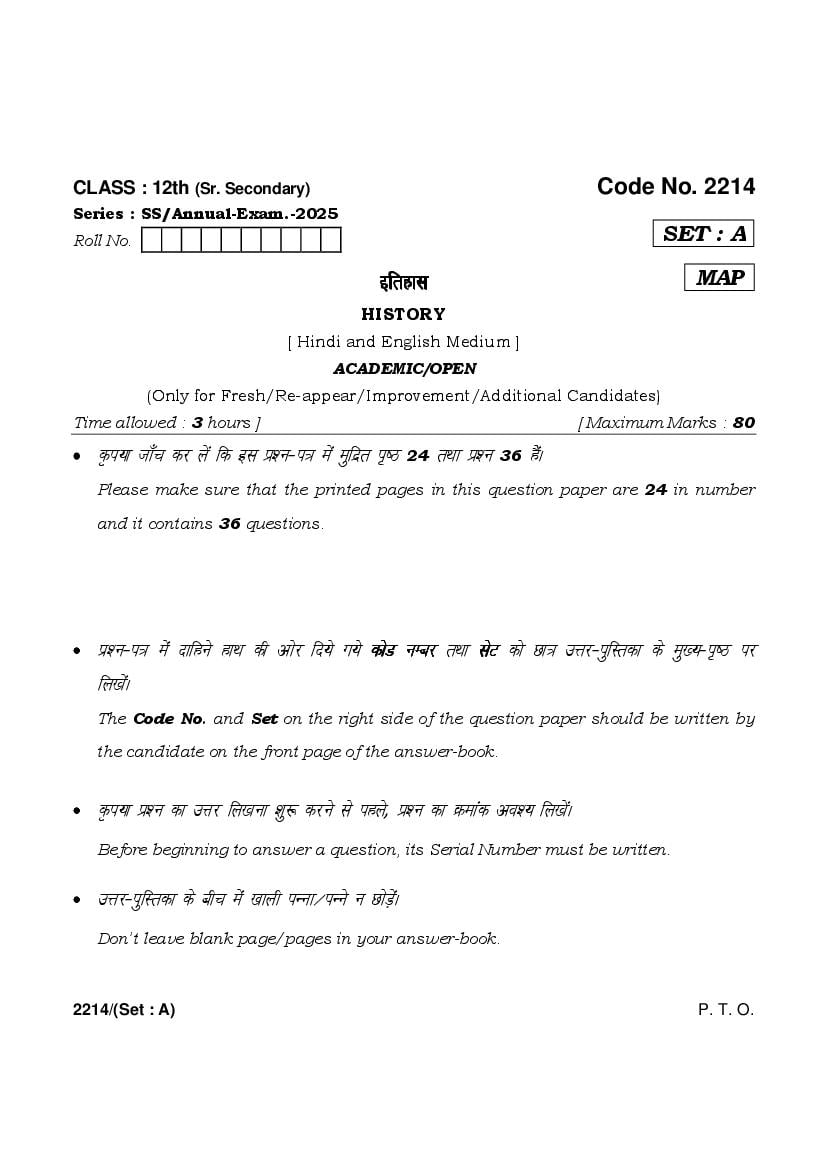
Series : SS/Annual-Exam.-2025
Roll No. SET : A
bfrgkl MAP
HISTORY
[ Hindi and English Medium ]
ACADEMIC/OPEN
(Only for Fresh/Re-appear/Improvement/Additional Candidates)
Time allowed : 3 hours ] [ Maximum Marks : 80
• Ñi;k tk¡p dj ysa fd bl iz'u&i= esa eqfnzr i`"B 24 rFkk iz'u 36 gSaA
Please make sure that the printed pages in this question paper are 24 in number
and it contains 36 questions.
• iz'u&i= esa nkfgus gkFk dh vksj fn;s x;s dksM uEcj rFkk lsV dks Nk= mÙkj&iqfLrdk ds eq[;&i`"B ij
fy[ksaA
The Code No. and Set on the right side of the question paper should be written by
the candidate on the front page of the answer-book.
• Ñi;k iz'u dk mÙkj fy[kuk 'kq: djus ls igys] iz'u dk Øekad vo'; fy[ksaA
Before beginning to answer a question, its Serial Number must be written.
• mÙkj&iqfLrdk ds chp esa [kkyh iUuk@iUus u NksMsa+A
Don’t leave blank page/pages in your answer-book.
2214/(Set : A) P. T. O.
Page 2
• mÙkj&iqfLrdk ds vfrfjDr dksbZ vU; 'khV ugha feysxhA vr% vko';drkuqlkj gh fy[ksa vkSj fy[kk mÙkj u
dkVsaA
Except answer-book, no extra sheet will be given. Write to the point and do not
strike the written answer.
• ijh{kkFkhZ viuk jksy ua0 iz'u&i= ij vo'; fy[ksaA jksy ua0 ds vfrfjDr iz'u&i= ij vU; dqN Hkh u
fy[ksa vkSj oSdfYid iz'uksa ds mÙkjksa ij fdlh izdkj dk fu'kku u yxk,¡A
Candidates must write their Roll No. on the question paper. Except Roll No. do not
write anything on question paper and don't make any mark on answers of objective
type questions.
• d`i;k iz'uksa ds mÙkj nsus lss iwoZ ;g lqfuf'pr dj ysa fd iz'u&i= iw.kZ o lgh gS] ijh{kk ds mijkUr bl
Lohdkj
lEcU/k esa dksbZ Hkh nkok Lohd kj ugha fd;k tk;sxkA
Before answering the questions, ensure that you have been supplied the correct and
complete question paper, no claim in this regard, will be entertained after
examination.
lkekU; funsZ'k %
(i) bl iz'u-i= esa dqy 36 iz'u gSa] tksfd ik¡p [k.Mksa ^d*] ^[k
[k**] ^x*] ^?k* rFkk ^³* esa foHkDr gSaA
lHkh iz'u vfuok;Z gSaA
2214/(Set : A)
Page 3
(ii) [k.M & ^^dd* esa iz'u la[;k 1 ls 21 rd oLrqfu"B iz'u gSaA izR;sd iz'u 1 vad dk gSA
funsZ'kkuqlkj bu iz'uksa ds mÙkj nhft,A
(iii) [k.M & ^^[k
[k** esa iz'u la[;k 22 ls 29 rd y?kq mÙkjh; iz'u gSaA izR;sd iz'u 3 vad dk gSA
[k
izR;sd iz'u dk mÙkj 80 'kCnksa ls vf/kd ugha gksuk pkfg,A
(iv) [k.M & ^^xx* esa iz'u la[;k 30 ls 32 rd pkj mi-iz'uksa (i-iv) ds lkFk lzksr vk/kkfjr iz'u gSaA
izR;sd iz'u 4 vad dk gSA
(v) [k.M & ^^?k?k?k** esa iz'u la[;k 33 ls 35 rd nh?kZ mÙkjh; iz'u gSaA izR;sd iz'u 6 vad dk gSA izR;sd
iz'u dk mÙkj 250 'kCnksa ls vf/kd ugha gksuk pkfg,A
(vi) [k.M & ^³* eas iz'u la[;k 36 ekufp= vk/kkfjr gS] ftlds 5 vad gSaA ekufp= dks Hkjdj
mÙkj-iqfLrdk ds lkFk layXu djsaA
(vii) dqN iz'uksa eas vkUrfjd fodYi miyC/k gSaA ,sls iz'uksa esa ls vkidks dsoy ,d gh iz'u djuk gSA
General Instructions :
(i) This question-paper contains a total of 36 questions, which are divided into
five Sections : 'A', 'B', 'C', 'D' and 'E'. All questions are compulsory.
2214/(Set : A) P. T. O.
Page 4
(ii) Section – 'A' consists of Objective Type Questions from Question Nos. 1 to
21, carrying 1 mark each. Answer these questions as per directions.
(iii) Section – 'B' consists of Short Answer Type Questions from Question Nos.
22 to 29, carrying 3 marks each. Answer to each question should not exceed
80 words.
(iv) Section – 'C' consists of Source Based Questions from Question Nos. 30 to
32 with four sub-questions (i - iv). Each question carries 4 marks.
(v) Section – 'D' consists of Long Answer Type Questions from Question Nos. 33
to 35, carrying 6 marks each. Answer to each question should not exceed
250 words.
(vi) Section – 'E' consist of Question No. 36 which is Map - based, carrying 5
marks. After filling the map attach it with your answer-book.
(vii) Internal choice is available in some questions. You have to attempt only one
of the given choices in such questions.
2214/(Set : A)
Page 5
[k.M – d
SECTION – A
¼oLrqfu"B iz'u½
(Objective Type Questions)
funsZ'k % fuEufyf[kr cgqfodYih; iz'uksa ds lgh fodYi pqfu, %
Direction : Choose the correct alternatives of the following multiple choice type
questions :
1. gM+Iik lH;rk dh lcls egÙoiw.kZ fo'ks"krk Fkh % 1
(A) uxj ;kstuk (B) O;kikj
(C) dyk (D) i'kqikyu
The most salient feature of Harappan Civilisation was :
(A) Urban Planning (B) Trade
(C) Art (D) Animal Husbandry
2. ekS;Z oa'k dk laLFkkid dkSu Fkk \ 1
(A) v'kksd (B) fcUnqlkj
(C) pUnzxqIr (D) dq.kky
Who was the founder of the Mauryan Dynasty ?
(A) Ashoka (B) Bindusara
(C) Chandragupta (D) Kunala
2214/(Set : A) P. T. O.
Page 6
3. ^egkHkkjr* dh jpuk ewy :i ls fdl Hkk"kk esa fy[kh xbZ Fkh \ 1
(A) fgUnh esa (B) laLÑr esa
(C) ikfy esa (D) izkÑr esa
In which language was 'Mahabharata' originally written ?
(A) Hindi (B) Sanskrit
(C) Pali (D) Prakrit
4. ^f=fiVd* dk lEcU/k fdl /keZ ls gS \ 1
(A) tSu (B) ckS)
(C) eqfLye (D) buesa ls dksbZ ugha
To which religion is 'Tripitaka' related ?
(A) Jainism (B) Buddhism
(C) Muslim (D) None of these
5. ^lrh izFkk* dk vk¡[kksa ns[kk gky fdlus izLrqr fd;k gS \ 1
(A) bCucrwrk (B) ekdksZ iksyks
(C) vycs:uh (D) cfuZ;j
2214/(Set : A)
Page 7
Who has described the practice of 'Sati' as per his eyewitnesses ?
(A) Ibn-Battuta (B) Marco Polo
(C) Al-Beruni (D) Bernier
6. fut+keqíhu vkSfy;k dk lEcU/k fdl lwQðh flyflys ls Fkk \ 1
(A) fp'rh (B) lqgjkonhZ
(C) dknjh (D) buesa ls dksbZ ugha
To which Sufi order was Nizamuddin Auliya associated ?
(A) Chishti (B) Suhrawardi
(C) Qadri (D) None of these
7. loZizFke fot;uxj dh ;k=k ij vkus okyk fons'kh ;k=h dkSu Fkk \ 1
(A) vCnqjZT+t+kd (B) fudksyks n dksUVh
(C) Mksfeaxks isl (D) QukZvks uwfut+
Who was the first foreign traveler to visit Vijayanagara ?
(A) Abdur-Razzaq (B) Nicolo de Conti
(C) Domingo Paes (D) Fernao Nuniz
8. lksygoha-l=goha 'krkCnh esa Hkkjr dh yxHkx fdrus izfr'kr vkcknh 'kgjksa esa jgrh Fkh \ 1
(A) 8% (B) 10%
(C) 15% (D) 18%
2214/(Set : A) P. T. O.
Page 8
Approximately what percentage of India's population lived in the cities during
sixteenth and seventeenth centuries ?
(A) 8% (B) 10%
(C) 15% (D) 18%
9. lgk;d laf/k iz.kkyh fdlus rS;kj dh \ 1
(A) ykWMZ oSystyh (B) ykWMZ MygkSth
(C) ykWMZ dSfuax (D) ykWMZ fe.Vks
Who had devised the Subsidiary Alliance System ?
(A) Lord Wellesley (B) Lord Dalhousie
(C) Lord Canning (D) Lord Minto
10. egkRek xk¡/kh us igyk fdlku vkUnksyu dgk¡ 'kq: fd;k Fkk \ 1
(A) ckjnksyh (B) o/kkZ
(C) [ksM+k (D) paikj.k
Where was the first Peasant Movement launched by Mahatma Gandhi ?
(A) Bardoli (B) Wardha
(C) Kheda (D) Champaran
11. Hkkjrh; lafo/kku dh izLrkouk esa dkSu-lk 'kCn fufgr ugha gS \ 1
(A) lektokn (B) jktra=
(C) /keZfujis{k (D) iztkrkaf=d
2214/(Set : A)
Page 9
Which word is not contained in the Preamble of the Indian Constitution ?
(A) Socialist (B) Monarchy
(C) Secular (D) Democratic
12. f}rh; fo'o ;q) fdl o"kZ 'kq: gqvk \ 1
(A) 1935 (B) 1937
(C) 1939 (D) 1945
In which year was World War II started ?
(A) 1935 (B) 1937
(C) 1939 (D) 1945
funsZ'k % fuEufyf[kr iz'uksa ds mÙkj ,d 'kCn/okD; esa nhft, %
Direction : Answer the following questions in one word/sentence :
13. fdl gM+IikbZ uxj dh [kkst lcls igys gqbZ Fkh \ 1
Which Harappan City was discovered first ?
14. iqjk.kksa dh la[;k fdruh gS \ 1
What is the number of Puranas ?
15. nkaMh ;k=k dc 'kq: dh xbZ \ 1
When was the Dandi March started ?
2214/(Set : A) P. T. O.
Page 10
funsZ'k % fjDr LFkkuksa dh iwfrZ mfpr 'kCnksa }kjk dhft, %
Direction : Fill in the blanks by appropriate words :
16. gM+Iik lH;rk dh fyfi esa fpUgksa dh la[;k ………….. ls ………….. ds chp gSA 1
The number of symbols in the script of Harappan Civilization is between
………….. to ………….. .
17. ^g"kZpfjr* dUukSt ds 'kkld ………….. dh thouh gSA 1
The 'Harshacharita' is a biography of ………….. the emperor of Kannauj.
18. v'kksd ds vfHkys[k ………….. fyfi;ksa esa fy[ks x, FksA 1
Ashoka's inscriptions were written in ………….. scripts.
funsZ'k % fuEufyf[kr iz'uksa (iz0 la0 19 ls 21) eas nks-nks dFku fn, x, gSa] ftuesa ,d dks vfHkdFku (A) vkSj
nwljs dks dkj.k (R) }kjk vafdr fd;k x;k gSA bu nksuksa dFkuksa dks /;ku ls if<+, vkSj uhps fn, x, fodYiksa
(A), (B), (C) o (D) esa ls mÙkj ds :i esa lgh fodYi pqfu, %
Direction : The following questions (Q. Nos. 19 to 21) there are two statements in
each, one labelled as Assertion (A) and the other labelled as Reason (R). Read both
these statements carefully and choose the correct option as your answer from the
options (A), (B), (C) and (D) given below :
2214/(Set : A)
Page 11
19. vfHkdFku (A) : gM+IikbZ eqgj lEHkor% gM+Iik lH;rk dh lcls fof'k"V iqjkoLrq gSA
dkj.k (R) : ;s eksgjsa lksus ,oa pk¡nh dh cuh gksrh FkhaA
fodYi % 1
(A) vfHkdFku (A) vkSj dkj.k (R) nksuksa lgh gSa vkSj dkj.k (R), vfHkdFku (A) dh lgh O;k[;k gSA
(B) vfHkdFku (A) vkSj dkj.k (R) nksuksa lgh gSa] ijUrq dkj.k (R), vfHkdFku (A) dh lgh O;k[;k ugha
gSA
(C) vfHkdFku (A) lgh gS] ijUrq dkj.k (R) lgh ugha gSA
(D) dkj.k (R) lgh gS] ijUrq vfHkdFku (A) lgh ugha gSA
Assertion (A) : The Harappan seal is probably the most distinctive artifact of
Harappan Civilisation.
Reason (R) : These seals were made up of Gold and Silver.
Options :
(A) Both Assertion (A) and Reason (R) are correct and Reason (R) is the correct
explanation of Assertion (A).
(B) Both Assertion (A) and Reason (R) are correct, but Reason (R) is not the
correct explanation of Assertion (A).
(C) Assertion (A) is correct, but Reason (R) is not correct.
(D) Reason (R) is correct, but Assertion (A) is not correct.
2214/(Set : A) P. T. O.
Page 12
20. vfHkdFku
vfHkdFku (A) : vejuk;d iz.kkyh fot;uxj lkezkT; dh ,d izeq[k jktuhfrd [kkst FkhA
dkj.k (R) : bl iz.kkyh ds dbZ rÙo fnYyh lYrur dh bDrk iz.kkyh ls fy, x, FksA
fodYi % 1
(A) vfHkdFku (A) vkSj dkj.k (R) nksuksa lgh gSa vkSj dkj.k (R), vfHkdFku (A) dh lgh O;k[;k gSA
(B) vfHkdFku (A) vkSj dkj.k (R) nksuksa lgh gSa] ijUrq dkj.k (R), vfHkdFku (A) dh lgh O;k[;k ugha
gSA
(C) vfHkdFku (A) lgh gS] ijUrq dkj.k (R) lgh ugha gSA
(D) dkj.k (R) lgh gS] ijUrq vfHkdFku (A) lgh ugha gSA
Assertion (A) : The Amaranayaka System was a major political innovation of
Vijayanagara empire.
Reason (R) : Many features of this system were derived from the Iqta System
of Delhi Sultanate.
Options :
(A) Both Assertion (A) and Reason (R) are correct and Reason (R) is the correct
explanation of Assertion (A).
(B) Both Assertion (A) and Reason (R) are correct, but Reason (R) is not correct
explanation of Assertion (A).
(C) Assertion (A) is correct, but Reason (R) is not correct.
(D) Reason (R) is correct, but Assertion (A) is not correct.
2214/(Set : A)
Page 13
21. vfHkdFku
vfHkdFku (A) : 1929 esa fnlEcj ds vUr esa dkaxszl us viuk okf"kZd vf/kos'ku ykgkSj 'kgj esa fd;kA
dkj.k (R) : Hkkjr NksM+ks vkUnksyu 1942 esa 'kq: gqvkA
fodYi % 1
(A) vfHkdFku (A) vkSj dkj.k (R) nksuksa lgh gSa vkSj dkj.k (R), vfHkdFku (A) dh lgh O;k[;k gSA
(B) vfHkdFku (A) vkSj dkj.k (R) nksuksa lgh gSa] ijUrq dkj.k (R), vfHkdFku (A) dh lgh O;k[;k ugha
gSA
(C) vfHkdFku (A) lgh gS] ijUrq dkj.k (R) lgh ugha gSA
(D) dkj.k (R) lgh gS] ijUrq vfHkdFku (A) lgh ugha gSA
Assertion (A) : In the end of December 1929, the Congress held its Annual
Session in the Lahore city.
Reason (R) : The Quit India Movement began in 1942.
Options :
(A) Both Assertion (A) and Reason (R) are correct and Reason (R) is the correct
explanation of Assertion (A).
(B) Both Assertion (A) and Reason (R) are correct, but Reason (R) is not correct
explanation of Assertion (A).
(C) Assertion (A) is correct, but Reason (R) is not correct.
(D) Reason (R) is correct, but Assertion (A) is not correct.
2214/(Set : A) P. T. O.
Page 14
[k.M – [k
SECTION – B
¼y?kq mÙkjh; iz'u½
u½
(Short Answer Type Questions)
22. NBh 'krkCnh bZ0 iw0 dks vkjfEHkd Hkkjrh; bfrgkl esa ,d egÙoiw.kZ ifjorZudkjh dky D;ksa ekuk tkrk
gS \ 3
Why is the sixth century BCE regarded as a major turning point in early Indian
history ?
vFkok
OR
,sfrgkfld tkudkjh ds lzksr ds :i esa v'kksd ds LrEHkksa dk D;k egÙo gS \
What is the significance of Ashoka's Pillars as a source of historical information ?
vFkok
OR
;ksX;rk vk/kkfjr iz'u %
Competency Based Question :
^^bfrgkldkj vfHkys[kksa dks vius vki esa ,d laiw.kZ lzksr ugha ekurs gSa vkSj bu lk{;ksa ds iwjd ds fy,
vU; lzksrksa dk mi;ksx djrs gSaA** bfrgkldkj ,slk D;ksa vkSj fdlfy, djrs gSa \
"Historian do not consider inscriptions as a complete source in itself and often
use other sources to complement the evidence." Why do historians do so ?
2214/(Set : A)
Page 15
23. D;k vkjfEHkd jkT;ksa esa 'kkld dsoy {kf=; gh gksrs Fks \ ppkZ dhft,A 3
Were the rulers in the early states only Kshtraiyas ? Discuss.
vFkok
OR
vkjfEHkd lekt esa L=h-iq#"k ds chp fo"kerk,¡ fdruh egÙoiw.kZ jgh gksaxh \
How important were gender differences in early societies ?
24. cs-'kfj;k vkSj ck-'kfj;k lwQh ijEijkvksa ds chp lekurk vkSj vUrj dks Li"V dhft,A 3
What were the similarities and differences between the Be-sharia and Ba-sharia
Sufi traditions ?
25. fot;uxj lkezkT; dh vejuk;d O;oLFkk ij ,d uksV fyf[k,A 3
Write a note on the Amaranayak System of Vijayanagar empire.
26. mu lcwrksa dh iM+rky dhft, ftuls irk pyrk gS fd eqxy jktdks"k ds fy, Hkw-jktLo vfr egÙoiw.kZ
FkkA 3
Examine the evidences that suggest that land-revenue was very important for
the Mughal's fiscal system.
27. fonzksgh flikfg;ksa us vusd LFkkuksa ij usr`Ro l¡Hkkyus ds fy, iqjkus 'kkldksa ls vkxzg D;ksa fd;k \ 3
Why did the mutinous sepoys in many places turn to the erstwhile rulers to
provide leadership to the revolt ?
2214/(Set : A) P. T. O.
Page 16
28. 1929 dk dkaxszl dk okf"kZd vf/kos'ku fdl izdkj ls egÙoiw.kZ Fkk \ 3
How was the Congress's Annual Session of 1929 significant ?
29. mís'; izLrko esa fdu vkn'kks± dks vfHkO;Dr fd;k x;k Fkk \ 3
What were the ideals expressed in the Objective Resolution ?
vFkok
OR
os dkSu-lh ,sfrgkfld rkdrsa Fkha] ftUgksaus lafo/kku dk Lo:i r; fd;k \
What historical forces shaped the vision of the Constitution ?
[k.M – x
SECTION – C
¼òksr vk/kkfjr iz'u½
(Source Based Questions)
funsZ'k % iz'u la[;k 30 ls 32 rd ds òksrksa dks /;ku ls if<+, vkSj mlds uhps fn;s x;s iz'uksa ds mÙkj
nhft, %
Direction : Read the Sources of Question Nos. 30 to 32 carefully and answer the
questions that below :
30. egkjktk gqfo"d ¼,d dq"kk.k 'kkld½ ds rSarhlosa lky esa xeZ ekSle ds igys eghus ds vkBosa fnu f=fiVd
tkuus okys fHkD[kq cy dh f'k";k f=fiVd tkuus okyh cq)ferk dh cgu dh csVh fHkD[kquh /kuorh us
vius ekrk-firk ds lkFk e/kqoud esa cksf/klRo dh ewfrZ LFkkfir dhA
iz'u %
(i) egkjktk gqfo"d dk lEcU/k fdl oa'k ls Fkk \ 1
(ii) /kuorh fdl /keZ esa J)k j[krh Fkh \ 1
(iii) /kuorh dks dkSu-ls ckS)xzaFkksa dk Kku Fkk \ 1
(iv) mlus ;s xzUFk fdlls lh[ks Fks \ 1
2214/(Set : A)
Page 17
In the year 33 of the Maharaja Huvishka (a Kushana ruler), in the first month of
the hot season, on the eighth day, a Bodhisattva was set up at Madhuvanaka by
the Bhikkhuni Dhanavati, the sister's daughter of the Bhikkhuni Buddhamita,
who knows the Tripitaka, the female pupil of the Bhikkhu Bala, who knows the
Tripitaka, together with her father and mother.
Questions :
(i) Which dynasty did Maharaja Huvishka belong to ?
(ii) Which religion did Dhanavati believe in ?
(iii) Which Buddhist texts did Dhanavati know ?
(iv) From whom did she learn these texts ?
31. O;kid xjhch
isylVZ uked ,d Mp ;k=h us l=goha 'krkCnh ds vkjfEHkd n'kdksa esa Hkkjrh; miegk}hi dh ;k=k dh
FkhA cfuZ;j dh rjg og Hkh yksxksa esa O;kid xjhch dks ns[kdj vpafHkr FkkA jkT; dks mÙkjnk;h Bgjkrs gq,
og dgrk gS fd Ñ"kdksa dks bruk vf/kd fupksM+k tkrk gS fd isV Hkjus ds fy, muds ikl lw[kh jksVh Hkh
eqf'dy ls cprh gSA
iz'u %
(i) l=goha 'krkCnh ds vkjfEHkd o"kks± esa isylVZ us fdl miegk}hi dh ;k=k dh Fkh \ 1
(ii) cfuZ;j dkSu Fkk \ 1
(iii) isylVZ dks fdl pht us vpafHkr fd;k \ 1
(iv) isylVZ us fdlkuksa dh xjhch ds fy, fdldks ftEesokj ekuk \ 1
2214/(Set : A) P. T. O.
Page 18
Widespread Poverty
Pelsaert, a Dutch traveller visited the Indian Subcontinent during the early
decades of seventeenth century. Like Bernier, he was shocked to see the
widespread poverty. Holding the State responsible, he says, "So much is wrung
from the peasants that even dry bread is scarcely left to fill their stomachs."
Questions :
(i) Which Subcontinent did Pelsaert visit during the early decades of
seventeenth century ?
(ii) Who was Bernier ?
(iii) What did make Pelsaert shocked ?
(iv) Whom did Pelsaert hold responsible for peasants poverty ?
32. tksrnnkkjksa dk mn;
vBkjgoha 'krkCnh ds vUr esa tgk¡ ,d vksj vusd tehankj ladV dh fLFkfr ls xqtj jgs Fks] ogha nwljh
vksj /kuh fdlkuksa ds dqN lewg xk¡oksa esa viuh fLFkfr etcwr djrs tk jgs FksA Ýkafll cqdkuu us mÙkjh
caxky ds fnuktiqj ftys ds losZ{k.k esa gesa /kuh fdlkuksa ds bl oxZ dk] ftUgsa tksrnkj dgk tkrk Fkk]
fo'kn~ fooj.k ns[kus dks feyrk gSA mUuhloha 'krkCnh ds izkjfEHkd o"kks± rd vkrs-vkrs tksrnkjksa us tehu ds
cM+s-cM+s jdcs vftZr dj fy, FksA LFkkuh; O;kikj vkSj lkgwdkj ds dkjksckj ij Hkh mudk fu;a=.k FkkA
2214/(Set : A)
Page 19
iz'u %
(i) tksrnkj dkSu Fks \ 1
(ii) fnuktiqj esa Hkwfe losZ{k.k dk dk;Z fdlus fd;k \ 1
(iii) xzkeh.k caxky esa LFkkuh; O;kikj vkSj lkgwdkjh ds dkjksckj ij fdldk fu;U=.k Fkk \ 1
(iv) vBkjgoha 'krkCnh ds vUr esa dkSu ladV dh fLFkfr ls xqtj jgs Fks \ 1
The rise of Jotedars
While many Zamindars were facing a crisis at the end of the eighteenth century,
a group of rich peasants were consolidating their position in the villages. In
Francis Buchanan's survey of the Dinajpur district in North Bengal we have a
vivid description of this class of rich peasants known as Jotedars. By the early
nineteenth century. Jotedars had acquired vast areas of land. They controlled
local trade and as well as moneylending.
Questions :
(i) Who were Jotedars ?
(ii) Who did undertake the survey of land in Dinajpur ?
(iii) Who did control over the local trade and moneylending in rural Bengal.
(iv) Who were facing crisis at the end of the eighteenth century ?
2214/(Set : A) P. T. O.
Page 20
[k.M – ?k
SECTION – D
¼nh?kZ mÙkjh; iz'u½
(Long Answer Type Questions)
33. vk/kqfud 'kgjksa dh dkSu-lh fo'ks"krk,¡ gM+Iikdkyhu uxjksa esas ikbZ xbZ gSa \ 6
What features of modern-day cities are found in the Harappan cities ?
vFkok
OR
gM+Iikokfl;ksa ds lqnwj {ks=ksa ls lEidZ FksA mnkgj.k nhft,A
The Harappans had contact with the remote areas. Give examples.
vFkok
OR
;ksX;rk vk/kkfjr iz'u %
Competency Based Question :
^iqjkrkfRod lk{; n'kkZrs gSa fd gM+Iik lH;rk dk f'kYi mRiknu thoar o le`)'kkyh FkkA* mu nks rjhdksa
dh ppkZ djsa ftuds ek/;e ls gM+Iik lH;rk ds yksx f'kYi mRiknu o m|eksa ds fy, dPpk eky izkIr
djrs FksA ;g fn[kkus ds fy, iqjkrkfRod ,oa ikB~; lk{;ksa ds mnkgj.k nhft, fd f'kYi mRiknu o m|eksa
ds fy, fons'kh O;kikj Hkh fd;k tkrk FkkA
2214/(Set : A)
Page 21
'The archaeological evidence shows that the Harappan Civilization had a
flourishing vibrant craft production.' Discuss the two ways in which the people
of the Harappan Civilization procured raw materials for these enterprises. Give
examples of archaeological and textual evidences to show that overseas trade
was also practiced in aid of these enterprises.
34. vyokj] u;ukj vkSj ohj'kSo dkSu Fks \ ppkZ dhft, fd mUgksaus fdl izdkj tkfr izFkk dh vkykspuk
dh \ 6
Who were Alwars, Nayanars and Virashaivas ? Discuss the ways in which they
criticised the caste system.
vFkok
OR
mnkgj.k lfgr fo'ys"k.k dhft, fd D;ksa HkfDr vkSj lwQh fpardksa us vius fopkjksa dks vfHkO;Dr djus ds
fy, fofHkUu Hkk"kkvksa dk iz;ksx fd;k \
Analyse with illustrations, why Bhakti and Sufi thinkers adopted a variety of
languages to express their opinions ?
2214/(Set : A) P. T. O.
Page 22
35. fonzksgh D;k pkgrs Fks \ fofHkUu lkekftd lewgksa ds n`f"Vdks.k esa fdruk QdZ Fkk \ 6
What did the rebels want ? To what extent did the vision of different social
groups differ ?
vFkok
OR
1857 ds fonzksg ds dkj.kksa dh ppkZ dhft,A
Discuss the causes of the Revolt of 1857.
[k.M – ³
SECTION – E
¼ekufp= dk;Z½
(Map Work)
36. fn, x, Hkkjr ds jktuSfrd js[kk-ekufp= ij fuEufyf[kr LFkkuksa dks n'kkZb, %
Locate the following places on the given political map of India :
(i) yksFky 1
Lothal
(ii) ikVfyiq= 1
Pataliputra
2214/(Set : A)
Page 23
(iii) lkjukFk 1
Sarnath
(iv) vtesj 1
Ajmer
(v) >k¡lh 1
Jhansi
[ dsoy n`f"Vghu ijh{kkfFkZ;ksa ds fy, ]
[ For Blind Candidates Only ]
uksV % fuEufyf[kr iz'u dsoy n`f"Vghu ijh{kkfFkZ;ksa ds fy, iz'u la[;k 36 ds LFkku ij gSa %
The following questions are only for Blind Candidates in lieu of Question
No. 36 :
(i) xqtjkr esa fLFkr gM+Iik lH;rk dk cUnjxkg uxjA 1
Port city of Harappan Civilisation in Gujarat.
(ii) ekS;ks± dh jkt/kkuhA 1
Capital city of Mauryans.
(iii) og LFkku tgk¡ ij xkSre cq) us viuk izFke mins'k fn;kA 1
The place where Gautam Buddha taught his first sermon.
2214/(Set : A) P. T. O.
Page 24
(iv) og LFkku tgk¡ [oktk eksbZuqíhu fp'rh dh njxkg fLFkr gSA 1
The place where the Dargah of Khwaja Moinuddin Chishti is situated.
(v) cqansy[k.M esa fonzksg dk izeq[k dsUnzA 1
Major center of rebellion in Bundelkhand.
S
2214/(Set : A)
Document Details
| Board / Org | Haryana Board |
| Exam | Class 12 |
| Type | Question Paper |
| Pages | 24 |
| Updated | 24 Sep 2026 |