Goa Board Class 10 Question Paper 2022 Agriculture
Finished viewing? Save it for later —
Download Goa Board Class 10 Question Paper 2022 Agriculture (PDF · 8 pages)About Goa Board Class 10 Question Paper 2022 Agriculture
Goa Board Class 10 Question Paper 2022 Agriculture is available here for free download. Published by Goa Board for Class 10, this question paper can be viewed online or downloaded as a PDF (8 pages). Candidates preparing for Class 10 can use Goa Board Class 10 Question Paper 2022 Agriculture to understand the exam pattern, the type of questions asked, and the overall difficulty level.
Frequently Asked Questions
How can I download Goa Board Class 10 Question Paper 2022 Agriculture?
Open this page and click the Download button to save Goa Board Class 10 Question Paper 2022 Agriculture as a PDF. It is completely free on AglaSem Docs.
Is Goa Board Class 10 Question Paper 2022 Agriculture free to download?
Yes. Goa Board Class 10 Question Paper 2022 Agriculture can be viewed online and downloaded as a PDF free of cost on AglaSem Docs.
How many pages does Goa Board Class 10 Question Paper 2022 Agriculture have?
Goa Board Class 10 Question Paper 2022 Agriculture contains 8 pages, which you can read online or download together as a single PDF.
Where can I find more Class 10 study material?
You can find more Class 10 question papers, sample papers, syllabus, and answer keys on AglaSem Docs.
Goa Board Class 10 Question Paper 2022 Agriculture – Text
Read the full text of this question paper below — useful to quickly search, copy and reference the content online without downloading the PDF.
📄 View text version (8 pages)
Page 1
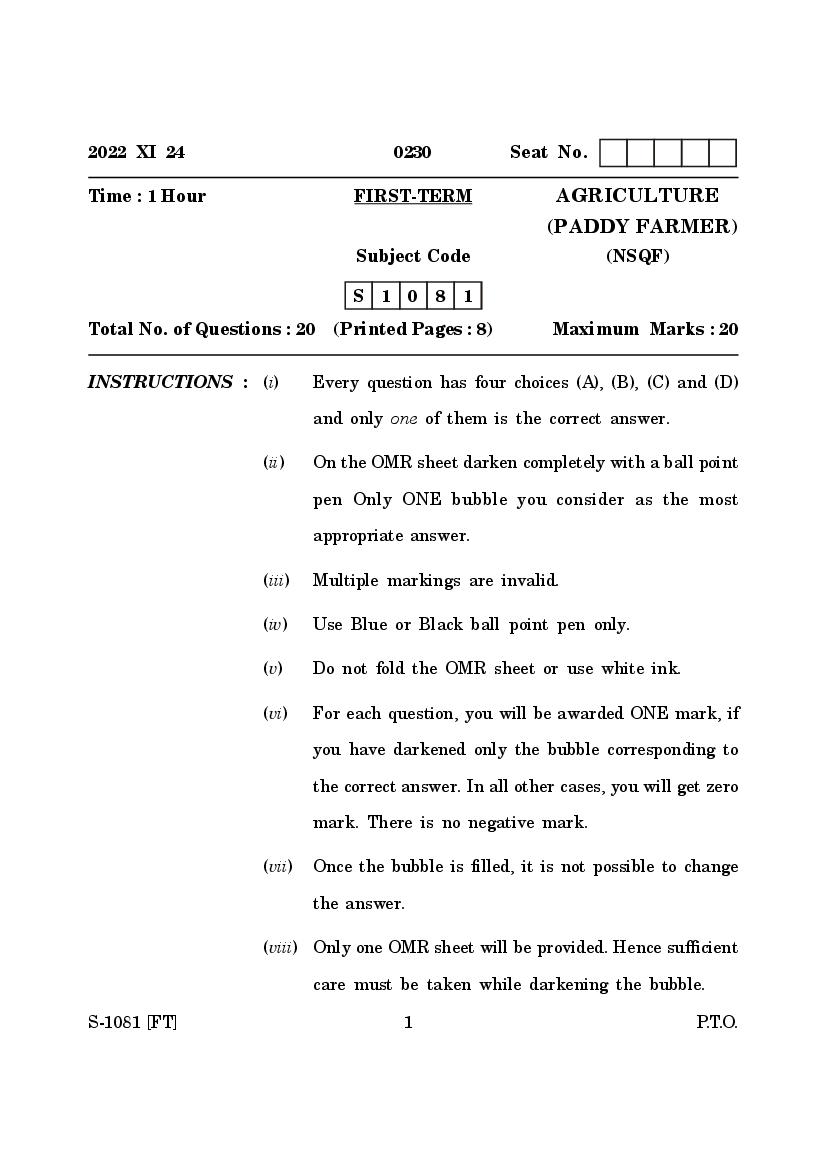
Time : 1 Hour FIRST-TERM AGRICULTURE
(PADDY FARMER)
Subject Code (NSQF)
S 1 0 8 1
Total No. of Questions : 20 (Printed Pages : 8) Maximum Marks : 20
INSTRUCTIONS : (i) Every question has four choices (A), (B), (C) and (D)
and only one of them is the correct answer.
(ii) On the OMR sheet darken completely with a ball point
pen Only ONE bubble you consider as the most
appropriate answer.
(iii) Multiple markings are invalid.
(iv) Use Blue or Black ball point pen only.
(v) Do not fold the OMR sheet or use white ink.
(vi) For each question, you will be awarded ONE mark, if
you have darkened only the bubble corresponding to
the correct answer. In all other cases, you will get zero
mark. There is no negative mark.
(vii) Once the bubble is filled, it is not possible to change
the answer.
(viii) Only one OMR sheet will be provided. Hence sufficient
care must be taken while darkening the bubble.
S-1081 [FT] 1 P.T.O.
Page 2
1. Which of the following is an example of oral communication ? 1
(A) Newspapers
(B) Letters
(C) Phone call
(D) E-mail
2. What does the below sign indicate ? 1
(A) Visual communication
(B) Verbal communication
(C) Oral communication
(D) Non-verbal communication
3. Which of these is a positive (good) facial expression ? 1
(A) Frowning while concentrating
(B) Maintaining eye contact
(C) Smiling continuously
(D) Rolling up your eyes
S-1081 [FT] 2
Page 3
(A) Self-control
(B) Communication
(C) Self-motivation
(D) Self-esteem
5. Knowing yourself as an individual is ...................................... 1
(A) Self-motivation
(B) Self-control
(C) Self-awareness
(D) None of the above
6. Delayed onset of monsson is referred to as ........................ 1
(A) Early drought
(B) Terminal or late season drought
(C) Mid-season drought
(D) Chronic drought
7. Chronic type of drought is found in ....................... areas. 1
(A) Semi-arid
(B) Arid
(C) Dry
(D) None of the above
S-1081 [FT] 3 P.T.O.
Page 4
(A) 55-60 days
(B) 75-80 days
(C) 25-30 days
(D) 95-100 days
9. Weed competition causes reduction in the crop yield by ................. in upland
direct seeded rice. 1
(A) 10-15%
(B) 20-25%
(C) 35-45%
(D) All of the above
10. Identify the given weed plant species : 1
(A) Bhui aonla
(B) Jungli mehandi
(C) Jungle rice
(D) Marvel grass
S-1081 [FT] 4
Page 5
(A) Dicot weeds
(B) Monocot weeds
(C) Annual weeds
(D) Biennial weeds
12. Weeds which complete their lifecycle in two seasons or years are known
as ............................... 1
(A) Biennials
(B) Perennials
(C) Annuals
(D) None of the above
13. Application of herbicide after sowing but prior to emergence of weeds : 1
(A) Paraquat
(B) Butachlor
(C) Metasulfuron methyl
(D) All of the above
14. Hand weeding Physical method Natural enemy 1
(A) Biological method
(B) Cultural method
(C) Physical method
(D) Mechanical method
S-1081 [FT] 5 P.T.O.
Page 6
What happens when there is very dense paddy crop in a field ? 1
(A) Attack of Brown leaf-hopper is high
(B) Attack of Gall midge is high
(C) Attack of cutworm is high
(D) Attack of armyworm is high
16. IPM is adopted when pest population is .................................... 1
(A) High
(B) Very high
(C) Medium
(D) Low to high
17. Hand picking and killing of insects is a ................................... 1
(A) Mechanical method
(B) Physical method
(C) Both (A) and (B)
(D) None of the above
S-1081 [FT] 6
Page 7
disease : 1
(A) Gundhi bug
(B) Brown leaf-hopper
(C) Leaf folder
(D) Green leaf-hopper
19. What is the effect of High Nitrogen in pest management ? 1
(A) It reduces pest incidence
(B) No effect
(C) It increases pest incidence
(D) All of the above
20. Name the disease that infects all aerial parts of a plant including leaf, neck
and node. 1
(A) Bacterial leaf blight
(B) Sheath blight
(C) Rice tungro disease
(D) Blast
S-1081 [FT] 7 P.T.O.
Page 8
Document Details
| Board / Org | Goa Board |
| Exam | Class 10 |
| Type | Question Paper |
| Pages | 8 |
| Updated | 24 Sep 2026 |