HBSE Class 12 Question Paper 2018 Chemistry
Finished viewing? Save it for later —
Download HBSE Class 12 Question Paper 2018 Chemistry (PDF · 13 pages)About HBSE Class 12 Question Paper 2018 Chemistry
HBSE Class 12 Question Paper 2018 Chemistry is available here for free download. Published by Haryana Board for Class 12, this question paper can be viewed online or downloaded as a PDF (13 pages). Candidates preparing for Class 12 can use HBSE Class 12 Question Paper 2018 Chemistry to understand the exam pattern, the type of questions asked, and the overall difficulty level.
Frequently Asked Questions
How can I download HBSE Class 12 Question Paper 2018 Chemistry?
Open this page and click the Download button to save HBSE Class 12 Question Paper 2018 Chemistry as a PDF. It is completely free on AglaSem Docs.
Is HBSE Class 12 Question Paper 2018 Chemistry free to download?
Yes. HBSE Class 12 Question Paper 2018 Chemistry can be viewed online and downloaded as a PDF free of cost on AglaSem Docs.
How many pages does HBSE Class 12 Question Paper 2018 Chemistry have?
HBSE Class 12 Question Paper 2018 Chemistry contains 13 pages, which you can read online or download together as a single PDF.
Where can I find more Class 12 study material?
You can find more Class 12 question papers, sample papers, syllabus, and answer keys on AglaSem Docs.
HBSE Class 12 Question Paper 2018 Chemistry – Text
Read the full text of this question paper below — useful to quickly search, copy and reference the content online without downloading the PDF.
📄 View text version (13 pages)
Page 1
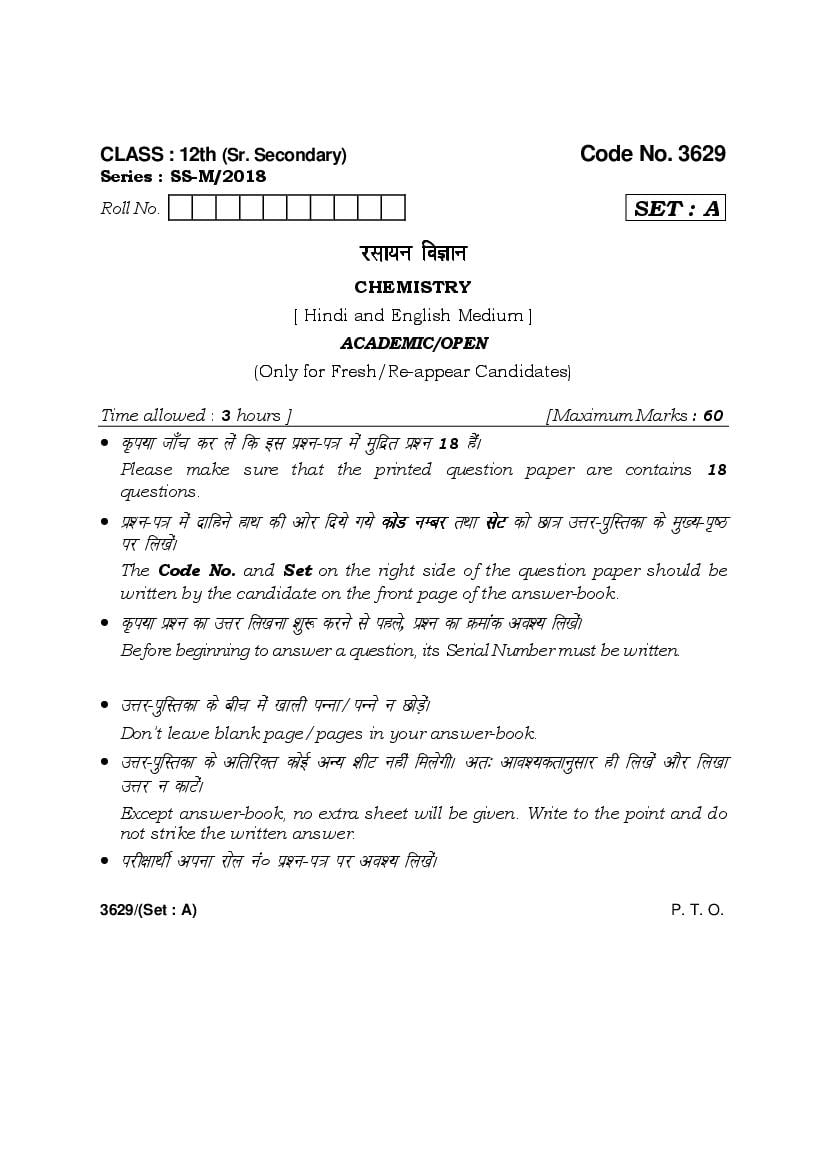
Series : SS-M/2018
Roll No. SET : A
jlk;u foKku
CHEMISTRY
[ Hindi and English Medium ]
ACADEMIC/OPEN
(Only for Fresh/Re-appear Candidates)
Time allowed : 3 hours ] [ Maximum Marks : 60
• d`i;k tk¡p dj ysa fd bl iz'u-i= esa eqfnzr iz'u 18 gSaA
Please make sure that the printed question paper are contains 18
questions.
• iz'u-i= esa nkfgus gkFk dh vksj fn;s x;s dksM uEcj rFkk lsV dks Nk= mÙkj-iqfLrdk ds eq[;-i`"B
ij fy[ksaA
The Code No. and Set on the right side of the question paper should be
written by the candidate on the front page of the answer-book.
• d`i;k iz'u dk mÙkj fy[kuk 'kq: djus ls igys] iz'u dk Øekad vo'; fy[ksaA
Before beginning to answer a question, its Serial Number must be written.
• mÙkj-iqfLrdk ds chp esa [kkyh iUuk / iUus u NksMsa+A
Don’t leave blank page / pages in your answer-book.
• mÙkj-iqfLrdk ds vfrfjDr dksbZ vU; 'khV ugha feysxhA vr% vko';drkuqlkj gh fy[ksa vkSj fy[kk
mÙkj u dkVsaA
Except answer-book, no extra sheet will be given. Write to the point and do
not strike the written answer.
• ijh{kkFkhZ viuk jksy ua0 iz'u-i= ij vo'; fy[ksaA
3629/(Set : A) P. T. O.
Page 2
Candidates must write their Roll Number on the question paper.
• d`i;k iz'uksa dk mÙkj nsus lss iwoZ ;g lqfuf'pr dj ysa fd iz'u-i= iw.kZ o lgh gS] ijh{kk ds
mijkUr bl lEcU/k esa dksbZ Hkh nkok Lohdkj ugha fd;k tk;sxkA
Before answering the question, ensure that you have been supplied the
correct and complete question paper, no claim in this regard, will be
entertained after examination.
lkekU; funs
funsZ'k %
(i) LkHkh iz'u vfuok;Z gSaA
(ii) izR;sd iz'u ds vad mlds lkeus n'kkZ, x, gSaA
(iii) ç'u la[;k 1 esa ckjg (i - xii) cgqfodYih; iz'u gSAa izR;sd 1 vad dk gSA ftuds lgh
mÙkj viuh mÙkj&iqfLrdk esa fy[kus gSaA
(iv) ç'u la[;k 2 ls 10 rd vfry?kq mÙkjh; ç'u gSaA çR;sd 2 vadksa dk gSA izR;sd iz'u
dk mÙkj yxHkx 30 'kCnksa esa nhft,A
(v) ç'u la[;k 11 ls 15 rd y?kq mÙkjh; ç'u gSaA çR;sd ç'u 3 vadksa dk gSA izR;sd iz'u
dk mÙkj yxHkx 40 'kCnksa esa nhft,A
(vi) ç'u la[;k 16 ls 18 rd nh?kZ mÙkjh; ç'u gSaA çR;sd ç'u 5 vadksa dk gSA izR;sd
iz'u dk mÙkj yxHkx 70 'kCnksa esa nhft,A
(vii) iz'u-i= esa lexz :i ls dksbZ fodYi ugha gSA rFkkfi 5 vadksa okys lHkh nh?kZ mÙkjh;
iz'uksa esa vkarfjd p;u iznku fd;k x;k gSA ,sls iz'uksa esa ls vkidks dsoy ,d gh iz'u
djuk gSA
General Instructions :
(i) All questions are compulsory.
(ii) Marks for each question are indicated against it.
(iii) Question Number 1 consists of twelve (i-xii) multiple choice questions
carrying 1 mark each. Candidates have to write the correct answer
in their answer-book.
3629/(Set : A)
Page 3
(iv) Question Numbers 2 to 10 are very short answer type questions of 2
marks each. Answer these in about 30 words each.
(v) Question Numbers 11 to 15 are short answer type questions of 3
marks each. Answer these in about 40 words each.
(vi) Question Numbers 16 to 18 are long answer type questions of 5
marks each. Answer these in about 70 words each.
(vii) There is no over all choice. However, internal choice is given in all
long answer type questions of 5 marks each. You have to attempt
only one of the given choice in such questions.
1. (i) fofy;Elu la'ys"k.k fuEu esa fdldks cukus dh fof/k gS \ 1
(A) ,sYdksgkWy (B) ,sehu
(C) dhVksu (D) bZFkj
Williamson Synthesis is used to prepare :
(A) Alcohol (B) Amine
(C) Ketone (D) Ether
O
(ii) ;kSfxd dk IUPAC uke fyf[k,A 1
CH3
O
Write the IUPAC name of this compound.
CH3
(iii) [Cr (NH 3 )3 Br Cl I ] milgla;kstd ;kSfxd dk IUPAC uke fyf[k,A
1
3629/(Set : A) P. T. O.
Page 4
Write IUPAC name of coordinate compound [Cr (NH 3 )3 Br Cl I ]
(iv) mRizsjd vfHkfØ;k ds osx dks c<+krk gS] rks osx fLFkjkad ds eku ij D;k izHkko gksxk \
1
(A) c<s+xk (B) ?kVsxk
(C) fLFkj jgsxk (D) buesa ls dksbZ ugha
A catalyst increases the rate of reaction, then what will be the
effect on rate constant ?
(A) Increases (B) Decreases
(C) Not Changed (D) None of these
(v) fuEu esa ls dhysV (Chelate) fyxUM gS % 1
(A) OH − (B) H 2NCH 2CH 2NH 2
(C) Cl − (D) CN −
In the following chelating ligand is
(A) OH − (B) H 2NCH 2CH 2NH 2
(C) Cl − (D) CN −
OCH3
+ HI → A + B vfHkfØ;k esa A o B gS % 1
373 K
(vi)
(A) C 6H 5 I , CH 3OH
(B) C6H 5OH , CH 3I
(C) C6H 5CΗ 2OH , CH 3I
3629/(Set : A)
Page 5
(D) CH 3CH 2I , C6H 5OH
OCH3
373 K
In the Reaction + HI → A + B A and B are :
(A) C 6H 5 I , CH 3OH
(B) C6H 5OH , CH 3I
(C) C6H 5CΗ 2OH , CH 3I
(D) CH 3CH 2I , C6H 5OH
(vii) osx fLFkjkad eksy yhVj–1 lsd.M–1 fuEu dksfV dh vfHkfØ;k ds fy, gksxk % 1
(A) 'kwU; (B) izFke
(C) f}rh; (D) dksbZ Hkh ugha
If rate constant for a Reaction is mole litre–1 second–1 then order of
reaction is :
(A) Zero order (B) First order
(C) Second order (D) None of these
(viii) fuEufyf[kr ;kSfxdksa esa lcls de DoFkukad fdldk gS \ 1
(A) H 2Se (B) H 2Te
(C) H 2O (D) H 2S
In the following compounds which has minimum boiling point ?
(A) H 2Se (B) H 2Te
(C) H 2O (D) H 2S
3629/(Set : A) P. T. O.
Page 6
(ix) fuEu esa ls lcls de vEyh; gksxk % 1
(A) CH 3OH (B) (CH 3 )2CHOH
(C) CH 3CH 2OH (D) (CH 3 )3COH
Which is weakest acid in the following ?
(A) CH 3OH (B) (CH 3 )2CHOH
(C) CH 3CH 2OH (D) (CH 3 )3COH
(x) ;kSfxd K 3 [Cr (C2O4 )3 ] esa milgla;kstu la[;k D;k gksxh \ 1
(A) 3 (B) 6
(C) 4 (D) 2
What is the coordination number in the K 3 [Cr (C2O 4 )3 ] coordinate
compound :
(A) 3 (B) 6
(C) 4 (D) 2
conc . H 2SO 4
(xi) CH 3CH 2OH → A′, A′ gksxk % 1
413 K
(A) CH 2 = CH 2 (B) C 2H 5OCH 3
(C) (C 2H 5 )2O (D) CH 3CH 2CH 2CH 3
conc . H 2SO 4
CH 3CH 2OH → A′, A′ will be :
413 K
(A) CH 2 = CH 2 (B) C 2H 5OCH 3
(C) (C 2H 5 )2O (D) CH 3CH 2CH 2CH 3
3629/(Set : A)
Page 7
(xii) fuEufyf[kr ;kSfxdksa esa dkSu SN 2
fØ;kfof/k vf/kdre rhozrk ls djsxk \
1
(A) CH 3Br (B) CH 3Cl
(C) CH 3CH 2Cl (D) (CH 3 )2CHCl
SN 2 reaction will be fastest in :
(A) CH 3Br (B) CH 3Cl
(C) CH 3CH 2Cl (D) (CH 3 )2CHCl
2. rkilq?kV~; o rkin`<+ cgqydksa esa foHksn dhft,A 2
Write difference between Thermoplastic and Thermosetting polymers.
3. gsujh fu;e ds nks mi;ksx fyf[k,A 2
Give two applications of Henry's Law.
4. 'kkVdh nks"k dks mnkgj.k lfgr le>kb;sA 2
Explain Schottky defect with an example.
5. ;fn 4.0 xzke NaOH, 500 feyh foy;u esa ?kqyk gks] rks foy;u dh eksyjrk Kkr dhft,A
2
4.0 gm of NaOH, dissolved in 500 ml of solution, calculate molarity of
the solution.
3629/(Set : A) P. T. O.
Page 8
6. 0.05 M NaOH foy;u dk izfrjks/k 31.6 Ω gSA bldk lsy fLFkjkad 0.357 cm–1 gSA
bldh pkydrk o eksyj pkydrk Kkr djsaA 2
The resistances of 0.05 M NaOH solution is 31.6 Ω and its cell
constant is 0.357 cm–1. Calculate its conductivity and molar
conductivity.
7. iz'kkard vkS"k/k fdls dgrs gSa \ mi;ksx fyf[k,A 2
What is Tranquilizer ? Give use.
8. QSjkMs ds oS|qr vi?kVu ds f}rh; fu;e dks le>kb,A 2
Discuss Second Law of Faradey Law of electrolysis.
9. Nn~e ,dk.kqd vfHkfØ;k dks mnkgj.k lfgr ifjHkk"kk djsaA 2
Define Pseudounimolecular reaction with an example.
10. fuEu inksa dks ifjHkkf"kr dhft, % 2
(i) F-dsUnz
(ii) ,dd dksf"Bdk
Define the following terms :
(i) F-centre
(ii) Unit Cell
11. /kkrqvksa ds 'kks/ku ds fy, eaMy ifj"dj.k fof/k dh O;k[;k dhft,A3
Explain Zone refining method for refining of metals.
3629/(Set : A)
Page 9
12. fuEufyf[kr vfHkfØ;k,¡ fyf[k, % 3
(a) LokVZ~t vfHkfØ;k
(b) lSSUMes;j vfHkfØ;k
(c) oqVZt~ -fQfVax vfHkfØ;k
Write the following reactions :
(a) Swarts reaction
(b) Sandmeyer reaction
(c) Wurtz-fitting reaction
13. lekaxh mRizsj.k o fo"kekaxh mRizsj.k ls vki D;k le>rs gSa \ 3
What do you understand by homogeneous catalysis and heterogeneous
catalysis.
14. fuEufyf[kr inksa dks ifjHkkf"kr dhft, % 3
(a) ,suksej
(b) isIVkbM cU/k
(c) foÑrhdj.k
Define the following terms :
(a) Anomer
(b) Peptide Bond
(c) Reducing sugar
15. fuEu dks iwjk dhft, % 3
CH3
3629/(Set : A) P. T. O.
NH2
Page 10
NaNO2 / HCl H 2O KMnO4
→ ? ? → ?
273 − 278 K H 3PO2 OH −
Complete the following :
CH3
NaNO2 / HCl H 2O KMnO4
→ ? ? → ?
273 − 278 K H 3PO2 OH −
NH2
16. dkUVsDV fof/k }kjk H 2SO4 cukus dh fof/k dk o.kZu dhft,A bldh lajpuk Hkh fyf[k,A 5
Explain contact process for manufacturing sulphuric acid. Draw its
structures.
vFkok
OR
(a) H 3PO3 o H 3PO 4 v.kqvksa dh lajpuk,¡] {kkjdrk fyf[k,A 3
(b) ukbVªkstu ds vlkekU; xq.kksa dh O;k[;k dhft,A 2
(a) Draw structures of H 3PO3 and H 3PO 4 Molecules. Also give their
basicity.
(b) Discuss Abnormals behaviour of Nitrogen.
3629/(Set : A)
Page 11
17. laØe.k /kkrq,¡ ds lanHkZ esa fuEufyf[kr dks Li"V dhft,A 5
(i) vkWDlhdj.k voLFkk,¡
(ii) mRizsjdh; xq.k
Explain the following with reference to Transition metals :
(i) Oxidation states
(ii) Catalytic properties
vFkok
OR
(a) vEyh; KMnO4 fuEu ls vfHkfØ;k djus ij D;k gksxk \ 3
(i) H 2S
(ii) KI
(iii) FeSO 4
(b) Zn, Cd o Hg dks laØe.k /kkrq,¡ ugha ekuk tkrk gSA dkj.k fyf[k,A
2
(a) What happens when acidified KMnO4 react with :
(i) H 2S
(ii) KI
3629/(Set : A) P. T. O.
Page 12
(iii) FeSO 4
(b) Zn, Cd and Hg metals are not considered as transition metals.
Give reason.
18. (a) QhukWy o csUtksbd vEy esa foHksn djus ds fy, jklk;fud ijh{k.k nhft,A 2
(b) csUthu dks fuEufyf[kr esa ifjofrZr dhft, % 3
(i) ,slhVksQhuksu
(ii) cSUtsfYMgkbM
(iii) csUtksQhuku
(a) Give a chemical test to distinguish between Phenol and Benzoic
acid.
(b) Convert Benzene into :
(i) Acetophenone
(ii) Benzaldehyde
(iii) Benzophenone
3629/(Set : A)
Page 13
vFkok
OR
fuEufyf[kr ij laf{kIr uksV fyf[k, % 5
(i) gsyQksykMZ tsfyaLdh vfHkfØ;k
(ii) ,sYMksy la?kuu
Write short notes on the following :
(i) Hell-Volhard-Zelinsky Reaction
(ii) Aldol Condensation
S
3629/(Set : A) P. T. O.
Document Details
| Board / Org | Haryana Board |
| Exam | Class 12 |
| Type | Question Paper |
| Pages | 13 |
| Updated | 30 Apr 2026 |