UGC NET 2021 Question Paper Indian Culture
Finished viewing? Save it for later —
Download UGC NET 2021 Question Paper Indian Culture (PDF · 87 pages)About UGC NET 2021 Question Paper Indian Culture
UGC NET 2021 Question Paper Indian Culture is available here for free download. Published by NTA for UGC NET, this question paper can be viewed online or downloaded as a PDF (87 pages). Candidates preparing for UGC NET can use UGC NET 2021 Question Paper Indian Culture to understand the exam pattern, the type of questions asked, and the overall difficulty level.
Frequently Asked Questions
How can I download UGC NET 2021 Question Paper Indian Culture?
Open this page and click the Download button to save UGC NET 2021 Question Paper Indian Culture as a PDF. It is completely free on AglaSem Docs.
Is UGC NET 2021 Question Paper Indian Culture free to download?
Yes. UGC NET 2021 Question Paper Indian Culture can be viewed online and downloaded as a PDF free of cost on AglaSem Docs.
How many pages does UGC NET 2021 Question Paper Indian Culture have?
UGC NET 2021 Question Paper Indian Culture contains 87 pages, which you can read online or download together as a single PDF.
Where can I find more UGC NET study material?
You can find more UGC NET question papers, sample papers, syllabus, and answer keys on AglaSem Docs.
UGC NET 2021 Question Paper Indian Culture – Text
Read the full text of this question paper below — useful to quickly search, copy and reference the content online without downloading the PDF.
📄 View text version (87 pages)
Page 1
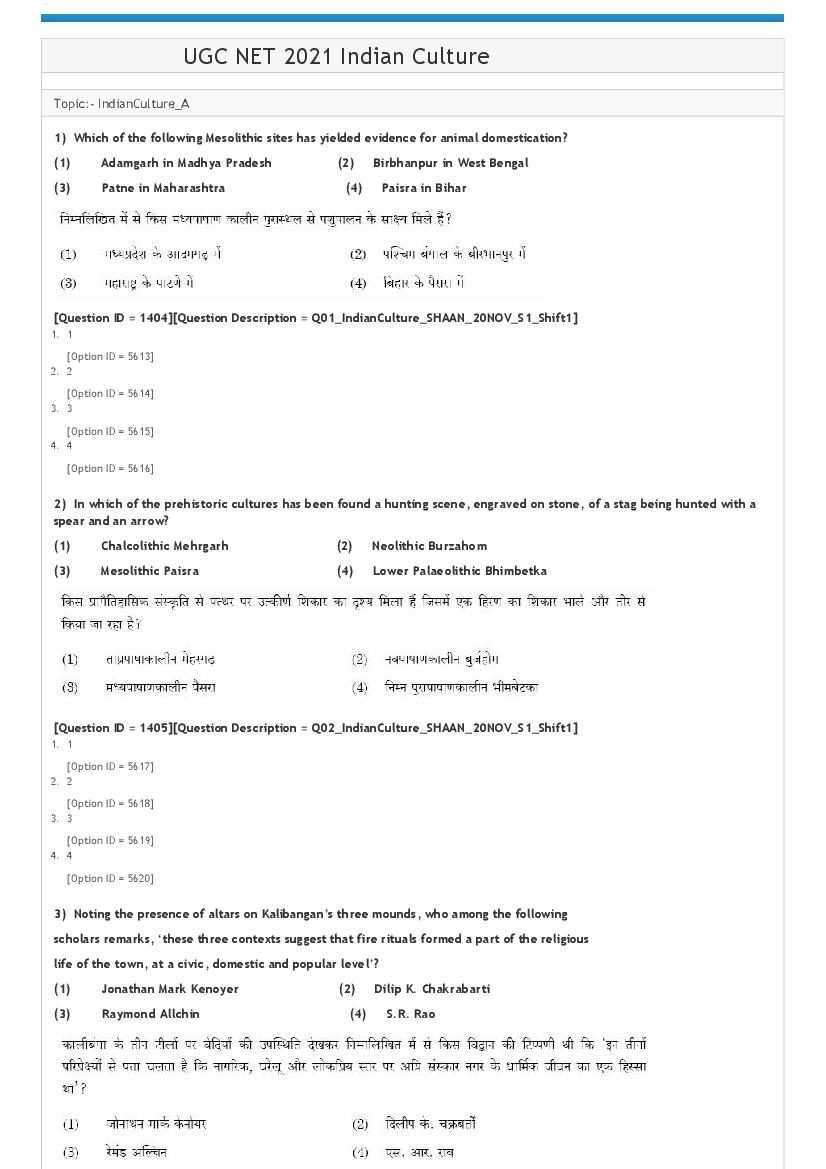
Topic:‐ IndianCulture_A
1) Which of the following Mesolithic sites has yielded evidence for animal domestication?
(1) Adamgarh in Madhya Pradesh (2) Birbhanpur in West Bengal
(3) Patne in Maharashtra (4) Paisra in Bihar
[Question ID = 1404][Question Description = Q01_IndianCulture_SHAAN_20NOV_S1_Shift1]
[Option ID = 5613]
[Option ID = 5614]
[Option ID = 5615]
[Option ID = 5616]
2) In which of the prehistoric cultures has been found a hunting scene, engraved on stone, of a stag being hunted with a
spear and an arrow?
(1) Chalcolithic Mehrgarh (2) Neolithic Burzahom
(3) Mesolithic Paisra (4) Lower Palaeolithic Bhimbetka
[Question ID = 1405][Question Description = Q02_IndianCulture_SHAAN_20NOV_S1_Shift1]
[Option ID = 5617]
[Option ID = 5618]
[Option ID = 5619]
[Option ID = 5620]
3) Noting the presence of altars on Kalibangan’s three mounds, who among the following
scholars remarks, ‘these three contexts suggest that fire rituals formed a part of the religious
life of the town, at a civic, domestic and popular level’?
(1) Jonathan Mark Kenoyer (2) Dilip K. Chakrabarti
(3) Raymond Allchin (4) S.R. Rao
Page 2
[Option ID = 5621]
[Option ID = 5622]
[Option ID = 5623]
[Option ID = 5624]
4) The Gopatha Brahmana relates an interesting story of a distinguished scholar of Kuru‐
Panchala. He was moving through the country carrying a banner to which a Nishka was
attached. He had offered the same (Nishka) to one who could defeat him in debate. Identify
this scholar:
(1) Raikva (2) Svetaketu
(3) Uddalaka Aruni (4) Yajnavalkya
[Question ID = 1407][Question Description = Q04_IndianCulture_SHAAN_20NOV_S1_Shift1]
[Option ID = 5625]
[Option ID = 5626]
[Option ID = 5627]
[Option ID = 5628]
5) In which of the following Upanishads Itihasa purana is called ‘Pancham Veda’?
(1) Brihadaranyaka Upanishad (2) Mundaka Upanishad
(3) Chhandogya Upanishad (4) Kena Upanishad
[Question ID = 1408][Question Description = Q05_IndianCulture_SHAAN_20NOV_S1_Shift1]
[Option ID = 5629]
[Option ID = 5630]
[Option ID = 5631]
[Option ID = 5632]
6) Who among the following women during the period of Gautama Buddha converted her father‐in‐law to Buddhism?
(1) Amrapali (2) Bhadrakundalakesi
(3) Prakriti (4) Visakha
Page 3
[Option ID = 5633]
[Option ID = 5634]
[Option ID = 5635]
[Option ID = 5636]
7) According to Baudhayana the standard annual rate of interest was
(1) 6% (2) 8%
(3) 10% (4) 12%
[Question ID = 1410][Question Description = Q07_IndianCulture_SHAAN_20NOV_S1_Shift1]
[Option ID = 5637]
[Option ID = 5638]
[Option ID = 5639]
[Option ID = 5640]
8) In Mahabharata at the time of the marriages of Gandhari and Madri a heavy bride‐price had
to be paid to their guardians. This form of marriage is called
(1) Asura (2) Gandharva
(3) Paishacha (4) Rakshasa
[Question ID = 1411][Question Description = Q08_IndianCulture_SHAAN_20NOV_S1_Shift1]
[Option ID = 5641]
[Option ID = 5642]
[Option ID = 5643]
[Option ID = 5644]
9) Which of the following was the basic principle of ancient Indian medicine?
(1) The doctrine of guna (2) The doctrine of dosha
(3) The doctrine of prana (4) The doctrine of ayu
Page 4
[Option ID = 5645]
[Option ID = 5646]
[Option ID = 5647]
[Option ID = 5648]
10) In which period are iron tongs, pliers and scissors known to have been first used in India?
(1) Later Vedic (2) Post‐Vedic
(3) Mauryan (4) Post‐Mauryan
[Question ID = 1413][Question Description = Q10_IndianCulture_SHAAN_20NOV_S1_Shift1]
[Option ID = 5649]
[Option ID = 5650]
[Option ID = 5651]
[Option ID = 5652]
11) The Naturalis Historia was written by
(1) Plutarch (2) Pliny
(3) Ptolemy (4) Kosmas Indicopleustes
[Question ID = 1414][Question Description = Q11_IndianCulture_SHAAN_20NOV_S1_Shift1]
[Option ID = 5653]
[Option ID = 5654]
[Option ID = 5655]
[Option ID = 5656]
12) Which of the following inscriptions mentions the two types of Sachivas – Mantra Sachiva
(Minister) and Karma Sachiva (Executive Officer)?
(1) Hathigumpha Inscription of Kharavela
(2) Nasik cave Inscription of Vasishthiputra Pulumavi
(3) Junagarh Inscription of Rudradaman I
(4) Junagarh Inscription of Skandagupta
Page 5
[Option ID = 5657]
[Option ID = 5658]
[Option ID = 5659]
[Option ID = 5660]
13) Who among the following rulers issued coins with the figures of Skanda under various
names such as Kumara, Visakha and Mahasena?
(1) Agathokles (2) Kanishka I
(3) Huvishka (4) Vasudeva
[Question ID = 1416][Question Description = Q13_IndianCulture_SHAAN_20NOV_S1_Shift1]
[Option ID = 5661]
[Option ID = 5662]
[Option ID = 5663]
[Option ID = 5664]
14) According to the Kamasutra, a ganika was NOT expected to:
(1) Play musical instruments (2) Perform conjuring tricks
(3) Have knowledge of literature (4) Choose the object of her love
[Question ID = 1417][Question Description = Q14_IndianCulture_SHAAN_20NOV_S1_Shift1]
[Option ID = 5665]
[Option ID = 5666]
[Option ID = 5667]
[Option ID = 5668]
15) In which of the following temples 108 karanas of Bharatanatyam described in the
Natyasastra of Bharatamuni are represented?
(1) Great Kailasa Temple, Ellora (2) Kailasanatha Temple, Kanchi
(3) Lingaraja Temple, Bhubaneswar (4) Nataraja Temple, Chidambaram
Page 6
[Option ID = 5669]
[Option ID = 5670]
[Option ID = 5671]
[Option ID = 5672]
16) Goloki matha mentioned in early medieval inscriptions belongs to the school of
(1) Pasupata (2) Saiva Siddhanta
(3) Pancharatra (4) Vaikhanasa
[Question ID = 1419][Question Description = Q16_IndianCulture_SHAAN_20NOV_S1_Shift1]
[Option ID = 5673]
[Option ID = 5674]
[Option ID = 5675]
[Option ID = 5676]
17) Which of the following is NOT a part of R.S. Sharma’s view of urbanism in early India?
(1) The first stage of decline of urban centres began in the 3rd or 4th century A.D.
(2) Deurbanisation started in the post‐Gupta period
(3) There was a mild revival of urbanism in the 11th Century A.D.
(4) A major evidence of urban decline is the account of Xuanzang
[Question ID = 1420][Question Description = Q17_IndianCulture_SHAAN_20NOV_S1_Shift1]
[Option ID = 5677]
[Option ID = 5678]
[Option ID = 5679]
[Option ID = 5680]
18) Dipankara Srijnana had studied under Chandrakirti in:
Page 7
(3) Kashmir (4) Suvarnadvipa
[Question ID = 1421][Question Description = Q18_IndianCulture_SHAAN_20NOV_S1_Shift1]
[Option ID = 5681]
[Option ID = 5682]
[Option ID = 5683]
[Option ID = 5684]
19) Saiyyid Salar Masud Ghazi who is venerated as a sufi saint and whose tomb is at Bahraich
was the soldier in the army of which of the following Sultans?
(1) Mahmud of Ghazni (2) Subuktigin
(3) Alaptigin (4) Qutbuddin Aibak
[Question ID = 1422][Question Description = Q19_IndianCulture_SHAAN_20NOV_S1_Shift1]
[Option ID = 5685]
[Option ID = 5686]
[Option ID = 5687]
[Option ID = 5688]
20) So far as the Muslim ulama were concerned which of the following sultans allowed this ‘army
of prayer’ to be controlled, managed and provided for by his sadr‐us sudur
(1) Iltutmish (2) Alauddin Khalji
(3) Firuz Tughlaq (4) Sikandar Lodi
[Question ID = 1423][Question Description = Q20_IndianCulture_SHAAN_20NOV_S1_Shift1]
[Option ID = 5689]
[Option ID = 5690]
[Option ID = 5691]
[Option ID = 5692]
Page 8
upasraya (rest house for monks and a go‐math (gaushala; resting place for cows)?
(1) Balban (2) Alauddin Khalji
(3) Muhammad bin Tughlaq (4) Firuz Shah Tughlaq
[Question ID = 1424][Question Description = Q21_IndianCulture_SHAAN_20NOV_S1_Shift1]
[Option ID = 5693]
[Option ID = 5694]
[Option ID = 5695]
[Option ID = 5696]
22) About which of the following Sultans Ibn Battuta writes that, ‘One of the habits of the
Sultan of India is to love foreigners and to honour them by specially appointing them as
governors and high officers’?
(1) Alauddin Khalji (2) Qutbuddin Muhammad Shah Khalji
(3) Muhammad Tughlaq (4) Firuz Tughlaq
[Question ID = 1425][Question Description = Q22_IndianCulture_SHAAN_20NOV_S1_Shift1]
[Option ID = 5697]
[Option ID = 5698]
[Option ID = 5699]
[Option ID = 5700]
23) About which of the following Sultans, Afif writes that, ‘He (the Sultan) with the help of
astronomers invented the tas‐ghariyal – a metal cup perforated at the bottom which, when
put in a tub of water would be filled up and sink after a ghari or twenty four minutes’?
(1) Alauddin Khalji (2) Firuz Tughlaq
(3) Mubarak Shah (4) Sikandar Lodi
Page 9
[Option ID = 5701]
[Option ID = 5702]
[Option ID = 5703]
[Option ID = 5704]
24) Shaikh Bahauddin Zakariya belonged to which of the following sufi silsilahs?
(1) Chishti Silsilah (2) Naqshbandi Silsilah
(3) Firdausia Silsilah (4) Suhrawardi Silsilah
[Question ID = 1427][Question Description = Q24_IndianCulture_SHAAN_20NOV_S1_Shift1]
[Option ID = 5705]
[Option ID = 5706]
[Option ID = 5707]
[Option ID = 5708]
25) Who among the following translated Varahmihr’s Brihat Samhita into Persian, named
Tarjamah‐i Barahi?
(1) Izz al‐Din Khalid Khani (2) Abd al‐Aziz bin Shams
(3) Abdul Qadir Badauni (4) Faizi
[Question ID = 1428][Question Description = Q25_IndianCulture_SHAAN_20NOV_S1_Shift1]
[Option ID = 5709]
[Option ID = 5710]
[Option ID = 5711]
[Option ID = 5712]
26) The beneficiaries of which of the following grants were not, directly, individuals but
institutions?
(1) Auqaf (2) Inam‐i al‐tamgha
(3) Amlak (4) Idrar
Page 10
[Option ID = 5713]
[Option ID = 5714]
[Option ID = 5715]
[Option ID = 5716]
27) Who among the following travellers pays glowing tribute to the prosperity of Bijapur
nd praises the diamonds from Golkonda?
(1) Ralph Fitch (2) William Leeds
(3) Jean de Thevenot (4) William Finch
[Question ID = 1430][Question Description = Q27_IndianCulture_SHAAN_20NOV_S1_Shift1]
[Option ID = 5717]
[Option ID = 5718]
[Option ID = 5719]
[Option ID = 5720]
28) Who among the following is known to have introduced eminent Jain scholars Man Singh and
Jai Chand Suri to emperor Akbar?
(1) Raja Rai Singh of Bikaner (2) Todar Mal
(3) Karam Chand (4) Birbal
[Question ID = 1431][Question Description = Q28_IndianCulture_SHAAN_20NOV_S1_Shift1]
[Option ID = 5721]
[Option ID = 5722]
[Option ID = 5723]
[Option ID = 5724]
29) At which of the following places Jahangir, as prince Salim, established his own independent
painting workshop?
(1) Allahabad (2) Oudh
(3) Gwalior (4) Mandu
Page 11
[Option ID = 5725]
[Option ID = 5726]
[Option ID = 5727]
[Option ID = 5728]
30) Which of the following group of thinkers believed that education should be imparted through spread of true
faith and eradication of ignorance and superstition?
(1) Utilitarians (2) Orientalists
(3) Evangelicals (4) Anglicists
[Question ID = 1433][Question Description = Q30_IndianCulture_SHAAN_20NOV_S1_Shift1]
[Option ID = 5729]
[Option ID = 5730]
[Option ID = 5731]
[Option ID = 5732]
31) Who was appointed the Professor of Sanskrit at Fort William College of Calcutta in 1800?
(1) William Jones (2) Henry T. Colebrook
(3) Jagannath Tarka Panchanan (4) Radhakanta Deb
[Question ID = 1434][Question Description = Q31_IndianCulture_SHAAN_20NOV_S1_Shift1]
[Option ID = 5733]
[Option ID = 5734]
[Option ID = 5735]
[Option ID = 5736]
32) Modern Indian Scholarship on Indian art was born and bred under the aegis of Orientalism.
Which of the following pioneering works was produced under British initiative and directions
for a Western readership?
(1) The Antiquities of Orissa – Dr. Rajendralala Mitra
(2) Essay on the Architecture of Hindus – Ram Raz
(3) Hinduism and Buddhism – Anand K Coomaraswamy
(4) Fine Arts of Ancient India, with a Short Sketch of the Origin of Art – Shyama Charan
Page 12
[Question ID = 1435][Question Description = Q32_IndianCulture_SHAAN_20NOV_S1_Shift1]
[Option ID = 5737]
[Option ID = 5738]
[Option ID = 5739]
[Option ID = 5740]
33) While interpreting India’s art, which Orientalist scholar remarked that the remains of
architecture and sculpture were mere ‘monuments of antiquity and not specimen of art,
which seemed to share their origins with the arts of Africa’.
(1) Colin Mackenzie (2) James Fergusson
(3) Alexander Cunningham (4) William Jones
[Question ID = 1436][Question Description = Q33_IndianCulture_SHAAN_20NOV_S1_Shift1]
[Option ID = 5741]
[Option ID = 5742]
[Option ID = 5743]
[Option ID = 5744]
34) Who were the two painters of Delhi commissioned by the Fraser brothers in about 1815 to
paint water colours of the inhabitants of Delhi?
(1) Ghulam Ali Khan and Lallji (2) Bhawani Das and Ram Das
(3) Thomas and William Daniell (4) Shiekh Mohammad Amir and Lallji
[Question ID = 1437][Question Description = Q34_IndianCulture_SHAAN_20NOV_S1_Shift1]
[Option ID = 5745]
Page 13
[Option ID = 5747]
[Option ID = 5748]
35) In which year the Indian (Imperial) Museum was established at Kolkata, a cradle of the
Asiatic Society of Bengal?
(1) 1814 (2) 1815
(3) 1818 (4) 1820
[Question ID = 1438][Question Description = Q35_IndianCulture_SHAAN_20NOV_S1_Shift1]
[Option ID = 5749]
[Option ID = 5750]
[Option ID = 5751]
[Option ID = 5752]
36) Sayyid Ahmad Barelwi was the founder of which socio‐religious reform movement?
(1) Faraizi (2) Ahmadiyya
(3) Tariqah‐i Muhammadiyah (4) Dar‐ul Ulum Deoband
[Question ID = 1439][Question Description = Q36_IndianCulture_SHAAN_20NOV_S1_Shift1]
[Option ID = 5753]
[Option ID = 5754]
[Option ID = 5755]
[Option ID = 5756]
37) Who condemned the reform movements of 19th century as elitist and invoked the ideal of
social service? According to him the best way to serve God was to serve the poor people.
(1) Raja Ram Mohan Roy (2) Ramkrishna Paramhamsa
(3) Dayanand Saraswati (4) Vivekanand
[Question ID = 1440][Question Description = Q37_IndianCulture_SHAAN_20NOV_S1_Shift1]
[Option ID = 5757]
Page 14
[Option ID = 5759]
[Option ID = 5760]
38) Sir Charles Wood’s despatch of 1854 emphasized on :
(1) English education for the elite population
(2) The expansion of Sanskrit and Oriental scholarship
(3) Mass education in the vernacular
(4) Religious education
[Question ID = 1441][Question Description = Q38_IndianCulture_SHAAN_20NOV_S1_Shift1]
[Option ID = 5761]
[Option ID = 5762]
[Option ID = 5763]
[Option ID = 5764]
39) A major victory was won by the Akalis in the ‘Keys Affair’ in October, 1921 in which the
British government surrendered the keys of the Toshakhana of the Golden Temple to Baba
Kharak Singh, head of the SGPC and released all those arrested in the ‘Keys Affair’. Who
among the following immediately sent a telegram to the Baba : ‘First battle for India’s
freedom won. Congratulations’ ?
(1) Lala Lajpat Rai (2) Mahatma Gandhi
(3) Pt. Jawaharlal Nehru (4) Motilal Nehru
[Question ID = 1442][Question Description = Q39_IndianCulture_SHAAN_20NOV_S1_Shift1]
[Option ID = 5765]
[Option ID = 5766]
[Option ID = 5767]
[Option ID = 5768]
40) Who among the following was an influential figure in the creation of nationalist art in India?
(1) Abanindranath Tagore (2) Ernest Binfield Havell
(3) Annada Bagchi (4) William Morris
Page 15
[Option ID = 5769]
[Option ID = 5770]
[Option ID = 5771]
[Option ID = 5772]
41) Who of the following is/are the god(s) or goddess(es) of roads, herdsmen and straying cattle
in the Rigveda?
(A) Pushan
(B) Ashvins
(C) Maruts
(D) Aranyani
Choose the correct answer from the options given below :
(1) (A), (B) and (D) only
(2) (A) only
(3) (D) only
(4) (B) and (C) only
[Question ID = 1444][Question Description = Q41_IndianCulture_SHAAN_20NOV_S1_Shift1]
[Option ID = 5773]
[Option ID = 5774]
[Option ID = 5775]
[Option ID = 5776]
42) Which of the following are the ornaments mentioned in Rigveda?
Page 16
(B) Khadi
(C) Kurira
(D) Rukma
Choose the correct answer from the options given below :
(1) (A) and (B) only
(2) (A) and (C) only
(3) (A), (B) and (C) only
(4) (A),(B),(C), (D)
[Question ID = 1445][Question Description = Q42_IndianCulture_SHAAN_20NOV_S1_Shift1]
[Option ID = 5777]
[Option ID = 5778]
[Option ID = 5779]
[Option ID = 5780]
43) Which of the following texts discusses the origin of state?
(A) Aitareya Brahmana
(B) Digha Nikaya
(C) Raipaseniya Sutta
(D) Mahabharata
Choose the correct answer from the options given below :
(1) (A), (B) and (D) only
(2) (A) and (B) only
(3) (C) and (D) only
(4) (A), (B) and (C) only
Page 17
[Option ID = 5781]
[Option ID = 5782]
[Option ID = 5783]
[Option ID = 5784]
44) Which of the following belief systems subscribe (s) to the view that nature is atomic?
(A) Vedanta
(B) Vaisheshika
(C) Jainism
(D) Some schools of Buddhism
Choose the correct answer from the options given below :
(1) (B) only
(2) (A), (B) and (C) only
(3) (B) and (C) only
(4) (B), (C) and (D) only
Page 18
[Option ID = 5785]
[Option ID = 5786]
[Option ID = 5787]
[Option ID = 5788]
45) Which of the following have been brought under Yama, one of the 8 limbs of yoga in the
Yogasutra?
(A) Ahimsa (non‐voilence)
(B) Brahmacharya (celibacy)
(C) Satya (Truth)
(D) Tapa (Penance)
Choose the correct answer from the options given below :
(1) (A), (B) and (D) only
(2) (A) and (B) only
(3) (C) and (D) only
(4) (A), (B) and (C) only
[Question ID = 1448][Question Description = Q45_IndianCulture_SHAAN_20NOV_S1_Shift1]
[Option ID = 5789]
[Option ID = 5790]
[Option ID = 5791]
[Option ID = 5792]
46) Which of the following sources indicates the early worship of both Vasudeva and
Samkarshana?
(A) Buddhist text Niddesa
Page 19
(C) Nanaghat cave inscription of Naganika
(D) Coins of Agathocles
Choose the correct answer from the options given below :
(1) (A) and (B) only
(2) (B) and (C) only
(3) (B), (C) and (D) only
(4) (A),(B),(C),(D)
[Question ID = 1449][Question Description = Q46_IndianCulture_SHAAN_20NOV_S1_Shift1]
[Option ID = 5793]
[Option ID = 5794]
[Option ID = 5795]
[Option ID = 5796]
47) Who among the following are mentioned as sculptors in inscriptions?
(A) Dinna
(B) Gomitra
(C) Kunika
(D) Naka
Choose the correct answer from the options given below :
(1) (A) and (B) only
(2) (C) and (D) only
(3) (B),(C),(D) only
(4) (A),(B),(C),(D)
Page 20
[Option ID = 5797]
[Option ID = 5798]
[Option ID = 5799]
[Option ID = 5800]
48) Who from the following divine dancers (Apsara) are depicted in Bharhut sculpture?
(A) Alambusa
(B) Mishrakesi
(C) Sudarsana
(D) Subhadra
Choose the correct answer from the options given below :
(1) (A) and (B) only
(2) (B) and (C) only
(3) (C) and (D) only
(4) (A),(B),(C),(D)
Page 21
[Option ID = 5801]
[Option ID = 5802]
[Option ID = 5803]
[Option ID = 5804]
49) In the segmentary state model, the intermediate zone of Chola polity comprised
(A) Tondaimandalam
(B) Pandimandalam
(C) Kongumandalam
(D) Gangavadi
Choose the most appropriate answer from the options given below :
(1) (A) and (B) only
(2) (A),(B) and (C) only
(3) (B), (C) and (D) only
(4) (C) and (D) only
[Question ID = 1452][Question Description = Q49_IndianCulture_SHAAN_20NOV_S1_Shift1]
[Option ID = 5805]
[Option ID = 5806]
[Option ID = 5807]
[Option ID = 5808]
50) Gupta coins exhibit variety not only of types but of metals as well. Who among the following
rulers issued coins of gold, silver, copper and lead?
(A) Samudragupta
(B) Chandragupta–II
(C) Kumaragupta‐I
Page 22
Choose the correct answer from the options given below :
(1) (A) and (B) only
(2) (B) and (C) only
(3) (C) and (D) only
(4) (A), (B) and (C) only
[Question ID = 1453][Question Description = Q50_IndianCulture_SHAAN_20NOV_S1_Shift1]
[Option ID = 5809]
[Option ID = 5810]
[Option ID = 5811]
[Option ID = 5812]
51) Which of the following books were written by Ramanujacharya?
(A) Vedantasara
(B) Vedarthasamgraha
(C) Vedantadipa
(D) Commentary on Brahmasutra
Choose the correct answer from the options given below :
(1) (A) and (B) only
(2) (A) and (D) only
(3) (A),(B),(C), (D)
(4) (C) and (D) only
Page 23
[Option ID = 5813]
[Option ID = 5814]
[Option ID = 5815]
[Option ID = 5816]
52) The Mushika Vamsha
(A) was written by Atula
(B) belongs to the eleventh century AD
(C) is an account of a ruling dynasty of Kerala
(D) is a story from the Jatakas
Choose the correct answer from the options given below :
(1) (A), (B) and (C) only
(2) (A), (C) and (D) only
(3) (B) and (C) only
(4) (A), (B), (C) and (D)
Page 24
[Option ID = 5817]
[Option ID = 5818]
[Option ID = 5819]
[Option ID = 5820]
53) The types of iqtas referred to by Mawardi were:
(A) Iqta‐i italaq
(B) Iqta‐i tamlik
(C) Iqta‐i istighlal
(D) Iqta‐i Ataraf
Choose the correct answer from the options given below :
(1) (A) and (B) only
(2) (B) and (C) only
(3) (C) and (D) only
(4) (A) and (D) only
[Question ID = 1456][Question Description = Q53_IndianCulture_SHAAN_20NOV_S1_Shift1]
[Option ID = 5821]
[Option ID = 5822]
[Option ID = 5823]
[Option ID = 5824]
54) Which of the following statements are correct about the octagonal style tombs of Sultanate and Mughal periods?
(A) The so‐called ‘Saiyyid’ tombs and ‘Lodi’ tombs are octagonal in style
(B) Isa Khan Niyazi’s Mausoleum at Delhi shows the persistence of the octagonal variety of tomb well into the Suri period
(C) Its supreme development can be seen in Suri monuments at Sasaram in Bihar
(D) This octagonal style is also visible in Adham Khan’s tomb at Delhi
Page 25
(1) (A) and (B) only
(2) (B) and (C) only
(3) (C) and (D) only
(4) (A),(B),(C),(D)
[Question ID = 1457][Question Description = Q54_IndianCulture_SHAAN_20NOV_S1_Shift1]
[Option ID = 5825]
[Option ID = 5826]
[Option ID = 5827]
[Option ID = 5828]
55) With regard to Kabir, which of the following statements are correct?
(A) Kabir propounded an absolute monotheism that countenanced no image worship and no ritual
(B) The evidence of their compositions show that Sant Ravidas and Sain, both belonging to the sixteenth century,
regarded Kabir as their precursor
(C) A similar position with regard to Kabir was adopted by Dadu, who had a considerable following in
Rajasthan
(D) In the sixteenth century, the Satnami sect which appeared in Uttar Pradesh also owed explicit allegiance to
Kabir
Choose the most appropriate answer from the options given below :
(1) (A),(C) and (D) only
(2) (A),(B) and (D) only
(3) (A),(B) and (C) only
(4) (A) and (D) only
Page 26
[Option ID = 5829]
[Option ID = 5830]
[Option ID = 5831]
[Option ID = 5832]
56) Which of the following statements are correct about the architectural styles of Bengal?
(A) Eklakhi mausoleum at Pandua is notable for a curve on each cornice of the square tomb‐
Chamber
(B) It derived its feature from a local method of constructing huts with bamboo rafters
(C) Some similar buildings were erected at Gaur after the 15th century under the later Ilyas Shahi and Husain Shahi
rulers
(D) In Ilyas Shahi and Husain Shahi buildings decorations became specially lavish
Choose the most appropriate answer from the options given below :
(1) (A) and (B) only
(2) (A), (B) and (C) only
(3) (B),(C) and (D) only
(4) (A),(B),(C),(D)
Page 27
[Option ID = 5833]
[Option ID = 5834]
[Option ID = 5835]
[Option ID = 5836]
57) With regard to Bukka I, the ruler of Vijayanagar empire, which of the following statements are correct?
(A) Under his patronage, a number of scholars produced literary works on religion, philosophy and
law
(B) He restored harmony between the Vaishnavas and the Jains, and his pronouncement on this occasion almost
echoes Ashoka’s edict of toleration
(C) He was against of reviving agraharas
(D) Firishta writes that his country was well peopled, and the subjects were submissive to his authority
Choose the most appropriate answer from the options given below :
(1) (A),(B) and (D) only
(2) (B),(C) and (D) only
(3) (A), (C) and (D) only
(4) (C) and (D) only
[Question ID = 1460][Question Description = Q57_IndianCulture_SHAAN_20NOV_S1_Shift1]
[Option ID = 5837]
[Option ID = 5838]
[Option ID = 5839]
[Option ID = 5840]
58) With regard to European painting’s influence on Indian painting, which of the following statements are correct?
(A) The court painters had become aware of European miniature painting by the last years of Akbar’s reign
(B) Jahangir’s artistic interests inspired his artists to draw upon European paintings for inspiration
(C) The sixteenth century Italian style of painting particularly influenced Miskin
Page 28
Choose the most appropriate answer from the options given below :
(1) (B),(C) and (D) only
(2) (A),(B) and (C) only
(3) (A),(C) and (D) only
(4) (C) and (D) only
[Question ID = 1461][Question Description = Q58_IndianCulture_SHAAN_20NOV_S1_Shift1]
[Option ID = 5841]
[Option ID = 5842]
[Option ID = 5843]
[Option ID = 5844]
59) Which among the following statements are true about Alfonso de Albuquerque
(A) It was Alfonso de Albuquerque who laid the real foundation of Portuguese power in India
(B) He captured the rich port of Goa from the Bijapur Sultanat
(C) With a view to securing permanent Portuguese population he encouraged his fellow countrymen to marry Indian wives
(D) He established a friendly relationship with the Muslims
Choose the most appropriate answer from the options given below :
(1) (A) and (B) only
(2) (B) and (C) only
(3) (C) and (D) only
(4) (A),(B) and (C) only
Page 29
[Option ID = 5845]
[Option ID = 5846]
[Option ID = 5847]
[Option ID = 5848]
60) Which among the following colleges were established in India by the British?
(A) Fort William College
(B) Sanskrit College
(C) Wellingdon College
(D) East India College
Choose the correct answer from the options given below :
(1) (A) and (B) only
(2) (A),(B) and (C) only
(3) (A) and (D) only
(4) (A),(B),(C),(D)
[Question ID = 1463][Question Description = Q60_IndianCulture_SHAAN_20NOV_S1_Shift1]
Page 30
[Option ID = 5850]
[Option ID = 5851]
[Option ID = 5852]
61) Which of the following statements are true about the spread of Western education in India?
(A) James Thomason established the Civil Engineering College at Roorkee in 1847
(B) Iswar Chandra Vidyasagar was the Head Pandit at the Fort William College, Calcutta
(C) The Young Bengals of Hindoo College were inspired by Raja Rammohan Roy
(D) Thomas Belington Macaulay showed interest in the translation of Sanskrit and Arabic literature
(E) Ecole de Medicine de Pondicherry was one of the first institutes of tropical medicine in Asia
Choose the correct answer from the options given below :
(1) (A),(C) and (E) only
(2) (A),(B) and (E) only
(3) (A), (C) and (D) only
(4) (C),(D) and (E) only
[Question ID = 1464][Question Description = Q61_IndianCulture_SHAAN_20NOV_S1_Shift1]
[Option ID = 5853]
[Option ID = 5854]
[Option ID = 5855]
[Option ID = 5856]
62) Which of the following statements are true about the Brahmo Samaj movement?
(A) Rammohan Roy criticized the idea of monotheism in his Persian tract Tuhfat
al‐Muwabhiddin
(B) Roy based his vision of interpretation of Hinduism on the Vedas, Upanishads and the Vedanta Sutra
(C) Members of the Hindu Dharma Sabha, that opposed Roy’s visions, were closely associated with the English
Government
(D) The intercaste marriage (which was also a widow remarriage) sponsored by Keshab Chandra sen in 1864
shocked the orthodox sect of the Brahmos
Page 31
and initiated social reforms
Choose the most appropriate answer from the options given below :
(1) (B),(D) and (E) only
(2) (B) and (D) only
(3) (B) and (E) only
(4) (B),(C) and (D) only
[Question ID = 1465][Question Description = Q62_IndianCulture_SHAAN_20NOV_S1_Shift1]
[Option ID = 5857]
[Option ID = 5858]
[Option ID = 5859]
[Option ID = 5860]
63) Which of the following Urdu poets of Delhi left for Lucknow in search of a new patron especially after the sack of Delhi
by Nadir Shah?
(A) Mir Dard
(B) Mir Sauda
(C) Mir Taqi Mir
(D) Mirza Ghalib
Choose the correct answer from the options given below :
(1) (A) and (B) only
(2) (A),(B) and (C) only
(3) (B),(C) and (D) only
(4) (A),(B),(C) and (D) only
Page 32
[Option ID = 5861]
[Option ID = 5862]
[Option ID = 5863]
[Option ID = 5864]
64) Which of the following statements are true about Ramakrishna Paramahamsa?
(A) His preachings inspired the peasants to rebel against the zamindars
(B) He instructed his disciples to keep away from non‐vegetarian food
(C) He stated that Kali, Christ and Allah, all are same
(D) He believed in formless god
(E) Tota Puri, a devotee of Shankaracharya, initiated him into sannyas.
Choose the most appropriate answer from the options given below :
(1) (C) and (E) only
(2) (A),(B) and (D) only
(3) (B), (C) and (E) only
(4) (A), (B) and (C) only
Page 33
[Option ID = 5865]
[Option ID = 5866]
[Option ID = 5867]
[Option ID = 5868]
65) Which of the following statement are NOT true about Sayyid Ahmad Khan?
(A) In his political tract Asbab‐i‐Baghvati‐i‐Hind (Causes of the Indian Revolt), he laid
the blame for the uprising of 1857 on missionary activities
(B) His Loyal Muhammadans of India is a tract that contained accounts of Muslims who
remained allied with the Raj
(C) History of the Revolt in Bijnor was written on the basis of his conversation with
Maulvi Liaquat Ali Khan
(D) In his Islamic Modernism he argued that if a naturalistic and rational explanation of
Islam could be found that did not directly clash with the Quran, it was to be used
(E) He suggested that Muslims should learn European literature and philosophy, but
should keep away from Western science and technology
Choose the most appropriate answer from the options given below :
(1) (A),(C) and (E) only
(2) (A) and (D) only
(3) (C), (D) and (E) only
(4) (C) and (E) only
[Question ID = 1468][Question Description = Q65_IndianCulture_SHAAN_20NOV_S1_Shift1]
[Option ID = 5869]
[Option ID = 5870]
[Option ID = 5871]
[Option ID = 5872]
Page 34
List I List II
Inscriptions Scripts
(A) Taxila Fragmentary Inscription of
(I) Greek
Asoka
(B) Besnagar Garuda Pillar
(II) Kharosthi
inscription of Heliodorus
(C) Sinkot Steatite Casket inscription
(III) Brahmi
of the time of Menander
(D) Rabatak inscription of Kanishka I (IV) Aramaic
Choose the correct answer from the options given below :
(1) (A)‐(IV), (B)‐(III), (C)‐(II), (D)‐(I)
(2) (A)‐(I), (B)‐(III), (C)‐(II), (D)‐(IV)
(3) (A)‐(I), (B)‐(II), (C)‐(III), (D)‐(IV)
(4) (A)‐(III), (B)‐(II), (C)‐(IV), (D)‐(I)
[Question ID = 1469][Question Description = Q66_IndianCulture_SHAAN_20NOV_S1_Shift1]
[Option ID = 5873]
[Option ID = 5874]
[Option ID = 5875]
[Option ID = 5876]
67) Match List I with List II
List I List II
Indian lunar months Corresponding range of Modern solar months
(A) Bhadrapada or Praushthapada (I) November‐December
(B) Ashvin or Ashvayuja (II) December‐January
(C) Margashirsha or Agrahayana (III) September‐October
(D) Pausha or Taisha (IV) August‐September
Choose the correct answer from the options given below :
Page 35
(2) (A)‐(IV), (B)‐(III), (C)‐(I), (D)‐(II)
(3) (A)‐(II), (B)‐(III), (C)‐(IV), (D)‐(I)
(4) (A)‐(III), (B)‐(IV), (C)‐(I), (D)‐(II)
[Question ID = 1470][Question Description = Q67_IndianCulture_SHAAN_20NOV_S1_Shift1]
[Option ID = 5877]
[Option ID = 5878]
[Option ID = 5879]
[Option ID = 5880]
68) Match List I with List II
List I List II
Jain councils Their presidents
(A) Pataliputra Council (I) Arya Skandila
(B) Mathura Council (II) Devardhigani Kshamashraman
(C) Valabhi, Ist Council (III) Nagarjunasuri
(D) Valabhi, IIn d Council (IV) Sthulabhadra
Choose the correct answer from the options given below :
(1) (A)‐(I), (B)‐(II), (C)‐(III), (D)‐(IV)
(2) (A)‐(III), (B)‐(IV), (C)‐(I), (D)‐(II)
(3) (A)‐(IV), (B)‐(I), (C)‐(III), (D)‐(II)
(4) (A)‐(IV), (B)‐(III), (C)‐(I), (D)‐(II)
Page 36
[Option ID = 5881]
[Option ID = 5882]
[Option ID = 5883]
[Option ID = 5884]
69) Match List I with List II
List I List II
(Types of Drama) (Examples)
(A) Bhana (I) Abhijnana‐Sakuntalam
(B) Nataka (II) Latakamelaka
(C) Prahasana (III) Mrichchhakatika
(D) Prakarana (IV) Padataditaka
Choose the correct answer from the options given below :
(1) (A)‐(I), (B)‐(II), (C)‐(III), (D)‐(IV)
(2) (A)‐(II), (B)‐(I), (C)‐(IV), (D)‐(III)
(3) (A)‐(III), (B)‐(II), (C)‐(I), (D)‐(IV)
(4) (A)‐(IV), (B)‐(I), (C)‐(II), (D)‐(III)
Page 37
[Option ID = 5885]
[Option ID = 5886]
[Option ID = 5887]
[Option ID = 5888]
70) Match List I with List II
List I List II
Muhammad Tughlaq’s Hindu Nobles Post Held
(A) Ratan (I) Diwan‐i Wizarat
(B) Bhiran (II) Governor of Siwistan
(C) Kihan Bazari (III) Governor of Gulbarga
(D) Pira Mali (IV) Iqtadar of Awadh
Codes:
(1) (A)‐(II), (B)‐(III), (C)‐(IV), (D)‐(I)
(2) (A)‐(IV), (B)‐(III), (C)‐(II), (D)‐(I)
(3) (A)‐(III), (B)‐(IV), (C)‐(I), (D)‐(II)
(4) (A)‐(II), (B)‐(I), (C)‐(IV), (D)‐(III)
[Question ID = 1473][Question Description = Q70_IndianCulture_SHAAN_20NOV_S1_Shift1]
[Option ID = 5889]
[Option ID = 5890]
[Option ID = 5891]
[Option ID = 5892]
71)
Page 38
[Option ID = 5893]
[Option ID = 5894]
[Option ID = 5895]
[Option ID = 5896]
72) Match List I with List II
List I List II
Monuments Situated at
(A) Sher Mandal (I) Vrindaban
(B) Govind‐dev temple (II) Lahore
(C) Jahangiri Mandir (III) Delhi
(D) Shalimar Bagh (IV) Orchha
Choose the correct answer from the options given below :
(1) (A)‐(III), (B)‐(I), (C)‐(IV), (D)‐(II)
Page 39
(3) (A)‐(III), (B)‐(IV), (C)‐(II), (D)‐(I)
(4) (A)‐(IV), (B)‐(II), (C)‐(I), (D)‐(III)
[Question ID = 1475][Question Description = Q72_IndianCulture_SHAAN_20NOV_S1_Shift1]
[Option ID = 5897]
[Option ID = 5898]
[Option ID = 5899]
[Option ID = 5900]
73) Match List I with List II
List I List II
Writer Book
(A) Ishwar Chandra Vidyasagar (I) Barnaparichay
(B) Bankim Chandra Chatterjee (II) Anand Math
(C) Michael Madhusudan Dutta (III) Megnadbadh Kavya
(D) Veeresalingam (IV) Prahasanas
Choose the correct answer from the options given below :
(1) (A)‐(I), (B)‐(II), (C)‐(III), (D)‐(IV)
(2) (A)‐(III), (B)‐(II), (C)‐(I), (D)‐(IV)
(3) (A)‐(II), (B)‐(I), (C)‐(III), (D)‐(IV)
(4) (A)‐(III), (B)‐(II), (C)‐(IV), (D)‐(I)
Page 40
[Option ID = 5901]
[Option ID = 5902]
[Option ID = 5903]
[Option ID = 5904]
74) Match List I with List II
List I List II
Internationally recognized personalities Field of Excellence
(A) KS Krishnan (I) Physics
(B) SS Bhatnagar (II) Chemistry
(C) TS Venkataraman (III) Agricultural Science
(D) Birbal Sahni (IV) Palaeobotany
Choose the correct answer from the options given below :
(1) (A)‐(I), (B)‐(II), (C)‐(IV), (D)‐(III)
(2) (A)‐(IV), (B)‐(III), (C)‐(II), (D)‐(I)
(3) (A)‐(I), (B)‐(II), (C)‐(III), (D)‐(IV)
(4) (A)‐(III), (B)‐(IV), (C)‐(I), (D)‐(II)
Page 41
[Option ID = 5905]
[Option ID = 5906]
[Option ID = 5907]
[Option ID = 5908]
75) Match List I with List II
List I List II
(A) Urdu Akhbar (I) 1818, Serampore
(B) Sambad Prabhakar (II) 1822, Calcutta
(C) Mirat Ul‐Akhbar (III) 1840, Calcutta
(D) Samachar Darpan (IV) 1836, Delhi
Choose the correct answer from the options given below :
(1) (A)‐(IV), (B)‐(III), (C)‐(II), (D)‐(I)
(2) (A)‐(I), (B)‐(IV), (C)‐(II), (D)‐(III)
(3) (A)‐(III), (B)‐(II), (C)‐(I), (D)‐(IV)
(4) (A)‐(I), (B)‐(III), (C)‐(IV), (D)‐(II)
[Question ID = 1478][Question Description = Q75_IndianCulture_SHAAN_20NOV_S1_Shift1]
[Option ID = 5909]
[Option ID = 5910]
[Option ID = 5911]
[Option ID = 5912]
76) Arrange the following acts of Asoka in chronological order
(A) Gift of two caves to Ajivikas
(B) Pilgrimage to Lumbini
(C) Pilgrimage to Bodhgaya
(D) Enlargement of the stupa of Konagamana Buddha
Page 42
(1) (C), (A), (D), (B)
(2) (B), (C), (A), (D)
(3) (A), (B), (C), (D)
(4) (D), (A), (B), (C)
[Question ID = 1479][Question Description = Q76_IndianCulture_SHAAN_20NOV_S1_Shift1]
[Option ID = 5913]
[Option ID = 5914]
[Option ID = 5915]
[Option ID = 5916]
77) Arrange in correct chronological order the following scholars who went to Tibet for propagation of Buddhism:
(A) Kamalasila
(B) Padmasambhava
(C) Santarakshita
(D) Atisa Dipankara
Choose the correct answer from the options given below :
(1) (C), (B), (A), (D)
(2) (A), (B), (C), (D)
(3) (C), (B), (D), (A)
(4) (B), (A), (C), (D)
Page 43
[Option ID = 5917]
[Option ID = 5918]
[Option ID = 5919]
[Option ID = 5920]
78) Arrange the following foreign observers of India in chronological order
(A) Ibn Hauqal
(B) Ibn Battuta
(C) Al‐Idrisi
(D) Alberuni
Choose the correct answer from the option given below :
(1) (D), (A), (C), (B)
(2) (A), (B), (D), (C)
(3) (A), (D), (C), (B)
(4) (C), (D), (A), (B)
[Question ID = 1481][Question Description = Q78_IndianCulture_SHAAN_20NOV_S1_Shift1]
Page 44
[Option ID = 5922]
[Option ID = 5923]
[Option ID = 5924]
79) Arrange the following writers known for their ‘ornate prose’ in chronological order’:
(A) Banabhatta
(B) Dhanapala
(C) Soddhala
(D) Subandhu
Choose the correct answer from the options given below :
(1) (A), (B), (C), (D)
(2) (A), (D), (B), (C)
(3) (D), (A), (C), (B)
(4) (D), (A), (B), (C)
[Question ID = 1482][Question Description = Q79_IndianCulture_SHAAN_20NOV_S1_Shift1]
[Option ID = 5925]
[Option ID = 5926]
[Option ID = 5927]
[Option ID = 5928]
80) Chronologically arrange the women sufi saints of the medieval period :
(A) Rabia
(B) Bibi Fatima Sam
(C) Bibi Jamal Khatun
(D) Bibi Sara
Page 45
(1) (D), (C), (B), (A)
(2) (B), (A), (D), (C)
(3) (A), (D), (B), (C)
(4) (C), (D), (A), (B)
[Question ID = 1483][Question Description = Q80_IndianCulture_SHAAN_20NOV_S1_Shift1]
[Option ID = 5929]
[Option ID = 5930]
[Option ID = 5931]
[Option ID = 5932]
81) Chronologically arrange the following market control regulations of Alauddin Khalji as per Regulations order:
(A) Appointment of grain market
(B) Fixation of prices of all variety of grain
(C) All grain transport merchants of the empire were made subject of the controller of the grain market
(D) Collection of grain in the royal (Sultani) stores
Choose the correct answer from the options given below :
(1) (C), (D), (B), (A)
(2) (B), (A), (C), (D)
(3) (B), (A), (D), (C)
(4) (D), (C), (A), (B)
Page 46
[Option ID = 5933]
[Option ID = 5934]
[Option ID = 5935]
[Option ID = 5936]
82) Arrange the following steps undertaken by emperor Akbar in chronological order:
(A) Founding of Ain‐i Iradat‐i Ghazinan or Din‐i Ilahi
(B) Abolition of Jiziya
(C) Abolition of pilgrimage tax
(D) Proclamation of Mahzar
Choose the correct answer from the options given below :
(1) (C), (D), (B), (A)
(2) (B), (A), (C), (D)
(3) (D), (C), (B), (A)
(4) (C), (B), (A), (D)
[Question ID = 1485][Question Description = Q82_IndianCulture_SHAAN_20NOV_S1_Shift1]
[Option ID = 5937]
Page 47
[Option ID = 5939]
[Option ID = 5940]
83) Arrange these temple entry Satyagrahas in a chronological sequence
(A) Kalaram Temple Satyagraha
(B) Munshiganj Kali Temple Satyagraha
(C) Vaikom Satyagraha
(D) Guruvayyur Temple Satyagraha
Choose the correct answer from the options given below :
(1) (A), (B), (C) and (D)
(2) (A), (C), (B) and (D)
(3) (C), (D), (B) and (A)
(4) (C), (B), (A) and (D)
[Question ID = 1486][Question Description = Q83_IndianCulture_SHAAN_20NOV_S1_Shift1]
[Option ID = 5941]
[Option ID = 5942]
[Option ID = 5943]
[Option ID = 5944]
84) Arrange the following events in the life of Rabindranath Tagore chronologically
(A) His publication of novel Gora
(B) On his appeal, rakhi bandhan was observed the day partition of Bengal came into effect
(C) His publication of Ghare Baire
(D) He established Swadeshi Bhandar to promote the production and sale of Indian handicrafts
Choose the correct answer from the options given below :
(1) (C), (B), (A) and (D)
(2) (D), (B), (A) and (C)
(3) (A), (B), (D) and (C)
Page 48
[Question ID = 1487][Question Description = Q84_IndianCulture_SHAAN_20NOV_S1_Shift1]
[Option ID = 5945]
[Option ID = 5946]
[Option ID = 5947]
[Option ID = 5948]
85) Professor DK Karve took up the cause of widow re‐marriage in western India. Chronologically arrange the events in his
life
(A) He refused to marry a teenager on becoming a widower and married a Brahmin widow
(B) He became a professor at Fergussan College
(C) He opened a Widow Home in Poona
(D) He set up an Indian Women’s University at Bombay
Choose the correct answer from the options given below :
(1) (A), (B), (C), (D)
(2) (B), (A), (D), (C)
(3) (B), (A), (C), (D)
(4) (A), (C), (D), (B)
Page 49
[Option ID = 5949]
[Option ID = 5950]
[Option ID = 5951]
[Option ID = 5952]
86) Given below are two statements:
Statement I : Fa – Hien came to India in the reign of Chandragupta II
Statement II : He gave detailed description of his meeting with Chandragupta II
In the light of the above statements, choose the correct answer from the options given below:
(1) Both Statement I and Statement II are true
(2) Both Statement I and Statement II are false
(3) Statement I is true but Statement II is false
(4) Statement I is false but Statement II is true
[Question ID = 1489][Question Description = Q86_IndianCulture_SHAAN_20NOV_S1_Shift1]
[Option ID = 5953]
[Option ID = 5954]
[Option ID = 5955]
[Option ID = 5956]
87) Given below are two statements:
Page 50
enlightened Buddha with Upaka, the Ajivika accompanied by two fellow Ajivikas
Statement II : At the time of the building of the Borobudur stupa the Javanese were in contact with
Cholamandalam and Ajivikas were to be found in that region.
In the light of the above statements, choose the most appropriate answer from the options given below:
(1) Both Statement I and Statement II are correct
(2) Both Statement I and Statement II are incorrect
(3) Statement I is correct but Statement II is incorrect
(4) Statement I is incorrect but Statement II is correct
[Question ID = 1490][Question Description = Q87_IndianCulture_SHAAN_20NOV_S1_Shift1]
[Option ID = 5957]
[Option ID = 5958]
[Option ID = 5959]
[Option ID = 5960]
88) Given below are two statements
Statement I : Barkhurdar, son of Abdur Rahman, as he had come to court without a summons, I
(Jahangir) ordered back to his jagir.
Statement II : ‘It is not according to good manners to go to the king’s banquet without a summons,
otherwise there would be no forbidding of the doors and walls to the foot of desire’.
In the light of the above statements, choose the most appropriate answer from the options given below:
(1) Both Statement I and Statement II are correct
(2) Both Statement I and Statement II are incorrect
(3) Statement I is correct but Statement II is incorrect
(4) Statement I is incorrect but Statement II is correct
Page 51
[Option ID = 5961]
[Option ID = 5962]
[Option ID = 5963]
[Option ID = 5964]
89) Given below are two statements: One is labelled as Assertion A and the other is labelled as Reason R.
Assertion (A) : In 1781, Warren Hastings founded Calcutta Madarassa where Muslims could be trained in
principles and practices of Islamic law. Ten years later, Jonathan Duncun, as orientalist scholar‐
administrator, founded Sanskrit College at Benaras.
Reason (R) : Both these institutions supported by the government were concerned with classical
learning for Indians.
In the light of the above statements, choose the most appropriate answer from the options given below:
(1) Both (A) and (R) are correct and (R) is the correct explanation of (A)
(2) Both (A) and (R) are correct but (R) is NOT the correct explanation of (A)
(3) (A) is correct but (R) is not correct
(4) (A) is not correct but (R) is correct
Page 52
[Option ID = 5965]
[Option ID = 5966]
[Option ID = 5967]
[Option ID = 5968]
90) Given below are two statements: One is labelled as Assertion A and the other is labelled as Reasons R.
Assertion (A) : The nationalist historians in late colonial times consisted of an English–educated ‘middle
class’ engaging in various activities, eventually turning against the British, and thus giving birth to modern
nationalism.
Reason (R) : British Utilitarian John Stuart mill classified all societies hierarchically, at the bottom of
which were people who enjoyed ‘savage independence’ (oriental societies)
In the light of the above statements, choose the most appropriate answer from the options given below:
(1) Both (A) and (R) are correct and (R) is the correct explanation of (A)
(2) Both (A) and (R) are correct but (R) is NOT the correct explanation of (A)
(3) (A) is correct but (R) is not correct
(4) (A) is not correct but (R) is correct
[Question ID = 1493][Question Description = Q90_IndianCulture_SHAAN_20NOV_S1_Shift1]
[Option ID = 5969]
[Option ID = 5970]
[Option ID = 5971]
[Option ID = 5972]
Topic:‐ 50IndianCulture_B
1) Read the following passage from the Sangam texts, and answer the questions given below:
Where merchants live the fish is safe.
In the sea and the cattle in the land..….
Here are brought
Page 53
And bales of pepper black by carts
Himalayas sends gems and gold
While Kudda hills, sweet sandal‐wood
And akhil; pearls
From the South sea come
Red coral from the eastern sea
The Ganges and the Kaviri bring
Their yield: Ceylon provides its food.
Who from the following appears in the Sangam literature as the merchant in gold:
(1) vaidehaka (2) uppu‐Vanikam
(3) pon‐Vanikam (4) muventar
[Question ID = 1494][Question Description = Q91_IndianCulture_SHAAN_20NOV_S1_Shift1]
[Option ID = 5973]
[Option ID = 5974]
[Option ID = 5975]
[Option ID = 5976]
2) Read the following passage from the Sangam texts, and answer the questions given below:
Where merchants live the fish is safe.
In the sea and the cattle in the land..….
Here are brought
Swift, prancing steeds by sea in ships
Page 54
Himalayas sends gems and gold
While Kudda hills, sweet sandal‐wood
And akhil; pearls
From the South sea come
Red coral from the eastern sea
The Ganges and the Kaviri bring
Their yield: Ceylon provides its food.
Which of the following places is prominently mentioned in the classical sources for the availability of excellent pearls?
(1) Muziris (2) Arikamedu
(3) Poduke (4) Colchi
[Question ID = 1495][Question Description = Q92_IndianCulture_SHAAN_20NOV_S1_Shift1]
[Option ID = 5977]
[Option ID = 5978]
[Option ID = 5979]
[Option ID = 5980]
3) Read the following passage from the Sangam texts, and answer the questions given below:
Where merchants live the fish is safe.
In the sea and the cattle in the land..….
Here are brought
Swift, prancing steeds by sea in ships
And bales of pepper black by carts
Page 55
While Kudda hills, sweet sandal‐wood
And akhil; pearls
From the South sea come
Red coral from the eastern sea
The Ganges and the Kaviri bring
Their yield: Ceylon provides its food.
Which of the following Tinais referred to the coastal region?
(1) Neidal (2) Marudam
(3) Mullai (4) Palai
[Question ID = 1496][Question Description = Q93_IndianCulture_SHAAN_20NOV_S1_Shift1]
[Option ID = 5981]
[Option ID = 5982]
[Option ID = 5983]
[Option ID = 5984]
4) Read the following passage from the Sangam texts, and answer the questions given below:
Where merchants live the fish is safe.
In the sea and the cattle in the land..….
Here are brought
Swift, prancing steeds by sea in ships
And bales of pepper black by carts
Himalayas sends gems and gold
While Kudda hills, sweet sandal‐wood
Page 56
From the South sea come
Red coral from the eastern sea
The Ganges and the Kaviri bring
Their yield: Ceylon provides its food.
In which century were the earliest Indian settlements in Java established?
(1) Second century BC (2) First century AD
(3) Second century AD (4) Third century AD
[Question ID = 1497][Question Description = Q94_IndianCulture_SHAAN_20NOV_S1_Shift1]
[Option ID = 5985]
[Option ID = 5986]
[Option ID = 5987]
[Option ID = 5988]
5) Read the following passage from the Sangam texts, and answer the questions given below:
Where merchants live the fish is safe.
In the sea and the cattle in the land..….
Here are brought
Swift, prancing steeds by sea in ships
And bales of pepper black by carts
Himalayas sends gems and gold
While Kudda hills, sweet sandal‐wood
And akhil; pearls
Page 57
Red coral from the eastern sea
The Ganges and the Kaviri bring
Their yield: Ceylon provides its food.
Ancient Socotra is known?
(1) as the birth‐place of Sphujidhvaja
(2) for its silk and sword manufactures
(3) for the presence of a considerable Indian colony
(4) as the landfall for ships crossing Red Sea
[Question ID = 1498][Question Description = Q95_IndianCulture_SHAAN_20NOV_S1_Shift1]
[Option ID = 5989]
[Option ID = 5990]
[Option ID = 5991]
[Option ID = 5992]
Topic:‐ 50IndianCulture_C
1) Read the given nagari‐inscription on Qutb minar and answer the questions that follow:
During the victorious reign of the illustrious Sultan Firuz Shah on Friday, the 5th of the bright‐half of Phalguna in Samvat
Page 58
Devapala.... The craftsman were.....
The nagari inscription on the Qutb minar dated 1326 CE refers to which of the following Sultans?
(1) Sultan Muhammad (2) Qutbuddin Aibak
(3) Sultan Mahmud of Ghazni (4) Subuktigin
[Question ID = 1499][Question Description = Q96_IndianCulture_SHAAN_20NOV_S1_Shift1]
[Option ID = 5993]
[Option ID = 5994]
[Option ID = 5995]
[Option ID = 5996]
2) Read the given nagari‐inscription on Qutb minar and answer the questions that follow:
During the victorious reign of the illustrious Sultan Firuz Shah on Friday, the 5t h of the bright‐half of Phalguna in Samvat
1426, the minar was restored. The work was completed by the grace of Sri Visvakarman. The architect was .... son of
Devapala.... The craftsman were.....
During which of the following Saiyyid/Lodi Sultans’ reigns repair work of Qutb minar was carried out?
(1) Khizr Khan (2) Bahlol Lodi
(3) Sikandar Lodi (4) Ibrahim Lodi
[Question ID = 1500][Question Description = Q97_IndianCulture_SHAAN_20NOV_S1_Shift1]
[Option ID = 5997]
[Option ID = 5998]
[Option ID = 5999]
Page 59
3) Read the given nagari‐inscription on Qutb minar and answer the questions that follow:
During the victorious reign of the illustrious Sultan Firuz Shah on Friday, the 5t h of the bright‐half of Phalguna in Samvat
1426, the minar was restored. The work was completed by the grace of Sri Visvakarman. The architect was .... son of
Devapala.... The craftsman were.....
In which of the following years the lightning struck and damaged the top story of the minaret during Firuz Shah Tughlaq’s
reign?
(1) 1363 (2) 1365
(3) 1367 (4) 1369
[Question ID = 1501][Question Description = Q98_IndianCulture_SHAAN_20NOV_S1_Shift1]
[Option ID = 6001]
[Option ID = 6002]
[Option ID = 6003]
[Option ID = 6004]
4) Read the given nagari‐inscription on Qutb minar and answer the questions that follow:
During the victorious reign of the illustrious Sultan Firuz Shah on Friday, the 5th of the bright‐half of Phalguna in Samvat
1426, the minar was restored. The work was completed by the grace of Sri Visvakarman. The architect was .... son of
Devapala.... The craftsman were.....
According to the above nagari inscription who among the following was the architect of the repair work of Qutb Minar?
(1) Suritrana (2) Viswakarma
(3) Chahada (4) Darukarmma
[Question ID = 1502][Question Description = Q99_IndianCulture_SHAAN_20NOV_S1_Shift1]
Page 60
[Option ID = 6006]
[Option ID = 6007]
[Option ID = 6008]
5) Read the given nagari‐inscription on Qutb minar and answer the questions that follow:
During the victorious reign of the illustrious Sultan Firuz Shah on Friday, the 5t h of the bright‐half of Phalguna in Samvat
1426, the minar was restored. The work was completed by the grace of Sri Visvakarman. The architect was .... son of
Devapala.... The craftsman were.....
Name the craftsmen involved in the repair work of the minaret as described in the above Nagari inscirption?
(A) Nana
(B) Salha
(C) Dharmu Vanani
(D) Vijayaraj
Choose the correct answer from the option given below :
(1) (A) and (B) only
(2) (A),(B) and (C) only
(3) (B) and (D) only
(4) (B),(C) and (D) only
[Question ID = 1503][Question Description = Q100_IndianCulture_SHAAN_20NOV_S1_Shift1]
[Option ID = 6009]
[Option ID = 6010]
[Option ID = 6011]
Page 61
Topic:‐ General Paper_Set1_A
1)
What is the average number of male workforce in all the sectors put together? (rounded‐off to two decimal places)
(1) 6.39 lakhs (2) 4.69 lakhs
(3) 5.96 lakhs (4) 7.48 lakhs
[Question ID = 2007][Question Description = Q01_GP_20NOV_S1_SHAAN]
1. 1 [Option ID = 8025]
2. 2 [Option ID = 8026]
3. 3 [Option ID = 8027]
4. 4 [Option ID = 8028]
2)
Page 62
sector?
(1) 330% (2) 318%
(3) 320% (4) 80%
[Question ID = 2008][Question Description = Q02_GP_20NOV_S1_SHAAN]
1. 1 [Option ID = 8029]
2. 2 [Option ID = 8030]
3. 3 [Option ID = 8031]
4. 4 [Option ID = 8032]
3)
Page 63
workforce in PT sector?
(1) 82% (2) 87%
(3) 89% (4) 85%
[Question ID = 2009][Question Description = Q03_GP_20NOV_S1_SHAAN]
1. 1 [Option ID = 8033]
2. 2 [Option ID = 8034]
3. 3 [Option ID = 8035]
4. 4 [Option ID = 8036]
4)
Page 64
in PT sector is :
(1) 5.1 lakhs (2) 7.5 lakhs
(3) 5.7 lakhs (4) 13.2 lakhs
[Question ID = 2010][Question Description = Q04_GP_20NOV_S1_SHAAN]
1. 1 [Option ID = 8037]
2. 2 [Option ID = 8038]
3. 3 [Option ID = 8039]
4. 4 [Option ID = 8040]
5)
Page 65
sectors put together?
(1) 17 : 39 (2) 16 : 37
(3) 16 : 35 (4) 16 : 39
[Question ID = 2011][Question Description = Q05_GP_20NOV_S1_SHAAN]
1. 1 [Option ID = 8041]
2. 2 [Option ID = 8042]
3. 3 [Option ID = 8043]
4. 4 [Option ID = 8044]
Topic:‐ General Paper_Set1_B
1) In which level of teaching, the main focus is laid on capturing and systematic presentation of ideas and information?
(1) Memory level (2) Understanding level
(3) Reflective level (4) Autonomous development level
[Question ID = 2012][Question Description = Q06_GP_20NOV_S1_SHAAN]
[Option ID = 8045]
[Option ID = 8046]
[Option ID = 8047]
[Option ID = 8048]
2) The following is a list of some basic teaching competencies identified through various researches on teaching. Which
among of them fall in the domain of behavioural competencies?
(A) Self efficacy
(B) Planning
(C) Locus of control
(D) Communicating
(E) Flexibility
Choose the correct answer from the options given below :
(1) (A) and (B)
(2) (B) and (C)
(3) (D) and (E)
(4) (B) and (D)
Page 66
[Option ID = 8049]
[Option ID = 8050]
[Option ID = 8051]
[Option ID = 8052]
3) Match List I with List II
. List I gives the methods of teaching in Institutions of higher learning while List II provides the techniques of increasing
effectiveness of the method.
List I List II
Methods of teaching Techniques for increasing effectiveness
(A) Face to face interactive method (I) Using Swayam and Moocs
(B) Open and distance learning method (II) Programmed instructional packages
(C) Individualized method of teaching (III) Modular instructional material
(D) Online methods of teaching (IV) Reflective questions coupled with discussion
Choose the correct answer from the option given below :
(1) (A)‐(I), (B)‐(II), (C)‐(III), (D)‐(IV)
(2) (A)‐(III), (B)‐(IV), (C)‐(I), (D)‐(II)
(3) (A)‐(IV), (B)‐(III), (C)‐(II), (D)‐(I)
(4) (A)‐(II), (B)‐(I), (C)‐(IV), (D)‐(III)
Page 67
1. 1 [Option ID = 8053]
2. 2 [Option ID = 8054]
3. 3 [Option ID = 8055]
4. 4 [Option ID = 8056]
4) Given below are two statements
Statement (I) : Achievement and aptitude tests are designed to assess the upper limits of the examinees’ knowledge and
abilities.
Statement (II) : Objective personality tests and projective personality tests are designed to measure the typical behaviour
and characteristics of examinees.
In the light of the above statements, choose the most appropriate answer from the options given below:
(1) Both Statement (I) and Statement (II) are correct
(2) Both Statement (I) and Statement (II) are incorrect
(3) Statement (I) is correct but Statement (II) is incorrect
(4) Statement (I) is incorrect but Statement (II) is correct
[Question ID = 2015][Question Description = Q09_GP_20NOV_S1_SHAAN]
1. 1 [Option ID = 8057]
2. 2 [Option ID = 8058]
3. 3 [Option ID = 8059]
4. 4 [Option ID = 8060]
5) Given below are two statements : One is labelled as Assertion (A) and the other is labelled as Reason (R).
Assertion (A) : The purpose underlying modern and ICT based support system in teaching is to optimise learning outcomes.
Reasons (R) : An effective instructional support system has to be linked with enhancement of learning conditions.
In the light of the above statements, choose the correct answer from the options given below
(1) Both (A) and (R) are true and (R) is the correct explanation of (A)
(2) Both (A) and (R) are true but (R) is NOT the correct explanation of (A)
(3) (A) is true but (R) is false
(4) (A) is false but (R) is true
Page 68
1. 1 [Option ID = 8061]
2. 2 [Option ID = 8062]
3. 3 [Option ID = 8063]
4. 4 [Option ID = 8064]
6) Which type of research encourages participant's perspective?
(1) Ethnographic method (2) Historical research
(3) Exegetic research (4) Experimental research
[Question ID = 2017][Question Description = Q11_GP_20NOV_S1_SHAAN]
1. 1 [Option ID = 8065]
2. 2 [Option ID = 8066]
3. 3 [Option ID = 8067]
4. 4 [Option ID = 8068]
7) Hypothesis testing which results into either affirmation or disaffirmation is the explicit concern in which methods of
research?
(A) Descriptive method
(B) Experimental method
(C) Ex Post Facto method
(D) Historical method
(E) Exegetical method
Choose the correct answer from the options given below :
(1) (A) and (B)
(2) (B) and (C)
(3) (C) and (D)
(4) (D) and (E)
[Question ID = 2018][Question Description = Q12_GP_20NOV_S1_SHAAN]
1. 1 [Option ID = 8069]
2. 2 [Option ID = 8070]
3. 3 [Option ID = 8071]
4. 4 [Option ID = 8072]
8) Match List I with List II. List I gives steps of research while List II provides techniques used.
List I List II Steps of research Techniques used
Page 69
(B) Hypothesis making (II) Drawing a subset from a larger set
(C) Selecting a sampling procedure (III) Raising pivotal question in a field of enquiry
(D) Data Analysis (IV) Setting up relationship among variables of research
Choose the correct answer from the option given below :
(1) (A)‐(III), (B)‐(IV), (C)‐(II), (D)‐(I)
(2) (A)‐(I), (B)‐(II), (C)‐(III), (D)‐(IV)
(3) (A)‐(II), (B)‐(III), (C)‐(I), (D)‐(IV)
(4) (A)‐(III), (B)‐(I), (C)‐(II), (D)‐(IV)
[Question ID = 2019][Question Description = Q13_GP_20NOV_S1_SHAAN]
1. 1 [Option ID = 8073]
2. 2 [Option ID = 8074]
3. 3 [Option ID = 8075]
4. 4 [Option ID = 8076]
9) Given below are two statements
Statement (I) : There is no difference between format and styles of writing and referencing in a thesis and a research
article.
Statement (II) : Research ethics and its observance is mandatory for all researches.
In the light of the above statements, choose the correct answer from the options given below:
(1) Both Statement (I) and Statement (II) are true
(2) Both Statement (I) and Statement (II) are false
(3) Statement (I) is true but Statement (II) is false
(4) Statement (I) is false but Statement (II) is true
Page 70
1. 1 [Option ID = 8077]
2. 2 [Option ID = 8078]
3. 3 [Option ID = 8079]
4. 4 [Option ID = 8080]
10) Given below are two statements : One is labelled as Assertion (A) and the other is labelled as Reason (R).
Assertion (A) : A research hypothesis (H1), has to be tested with the help of a Null hypothesis called (H0).
Reasons (R) : Tenability of research hypothesis (H1) cannot be directly affirmed.
In the light of the above statements, choose the most appropriate answer from the options given below
(1) Both (A) and (R) are correct and (R) is the correct explanation of (A)
(2) Both (A) and (R) are correct but (R) is NOT the correct explanation of (A)
(3) (A) is correct but (R) is not correct
(4) (A) is not correct but (R) is correct
[Question ID = 2021][Question Description = Q15_GP_20NOV_S1_SHAAN]
1. 1 [Option ID = 8081]
2. 2 [Option ID = 8082]
3. 3 [Option ID = 8083]
4. 4 [Option ID = 8084]
11) Every year Press Council of India celebrates the National Press‐Day on :
(1) January 30 (2) May 30
(3) October 15 (4) November 15
[Question ID = 2022][Question Description = Q16_GP_20NOV_S1_SHAAN]
1. 1 [Option ID = 8085]
2. 2 [Option ID = 8086]
3. 3 [Option ID = 8087]
4. 4 [Option ID = 8088]
12) Which Newspaper logo bears ‘‘Let Truth prevail’’?
(1) The Statesman (2) Times of India
(3) The Tribune (4) The Hindu
[Question ID = 2023][Question Description = Q17_GP_20NOV_S1_SHAAN]
1. 1 [Option ID = 8089]
2. 2 [Option ID = 8090]
3. 3 [Option ID = 8091]
4. 4 [Option ID = 8092]
Page 71
Assertion (A) : The more performative broadcast is also more cohesive and popular, but owing to new media its effect is
decreasing.
Reasons (R) : Internet is tending to eclipse broadcast media.
In the light of the above statements, choose the most appropriate answer from the options given below
(1) Both (A) and (R) are correct and (R) is the correct explanation of (A)
(2) Both (A) and (R) are correct but (R) is NOT the correct explanation of (A)
(3) (A) is correct but (R) is not correct
(4) (A) is not correct but (R) is correct
[Question ID = 2024][Question Description = Q18_GP_20NOV_S1_SHAAN]
1. 1 [Option ID = 8093]
2. 2 [Option ID = 8094]
3. 3 [Option ID = 8095]
4. 4 [Option ID = 8096]
14) For emerging field of mass communication researcher Paul Lazarsfeld proved to be seminal thinker and researcher in
what way?
(A) For exploring the potential of Social Science methods.
(B) For providing training with a high level of entrepreneurial skill.
(C) For raising the standard of American Education System.
(D) For making assumptions that media have limited direct effect.
Choose the most appropriate answer from the options given below :
(1) (A) and (B) only
(2) (B) and (C) only
(3) (C) and (D) only
(4) (A) and (D) only
Page 72
1. 1 [Option ID = 8097]
2. 2 [Option ID = 8098]
3. 3 [Option ID = 8099]
4. 4 [Option ID = 8100]
15) From the list given below, identify the Psychological barriers to communication
(A) Noise
(B) Invisibility
(C) Prejudice
(D) Disinterest
(E) Inattention
Choose the most appropriate answer from the options given below :
(1) (A), (B) and (C) only
(2) (B), (C) and (D) only
(3) (C), (D) and (E) only
(4) (A), (C) and (D) only
[Question ID = 2026][Question Description = Q20_GP_20NOV_S1_SHAAN]
1. 1 [Option ID = 8101]
2. 2 [Option ID = 8102]
3. 3 [Option ID = 8103]
4. 4 [Option ID = 8104]
16) The average monthly expenditure of a family was Rs. 4,000/‐ for the first 3 months; Rs. 4,500/‐ for the next 4 months
and Rs. 5,000/‐ for the last 5 months of a year. If the total saving during the year was Rs. 5,000, find the average monthly
income of the family
(1) Rs. 3,000/‐ (2) Rs. 4,000/‐
(3) Rs. 5,000/‐ (4) Rs. 6,000/‐
[Question ID = 2027][Question Description = Q21_GP_20NOV_S1_SHAAN]
1. 1 [Option ID = 8105]
2. 2 [Option ID = 8106]
3. 3 [Option ID = 8107]
4. 4 [Option ID = 8108]
17) Find the average of all prime numbers between 70 to 90
Page 73
(3) 55.75 (4) 56.75
[Question ID = 2028][Question Description = Q22_GP_20NOV_S1_SHAAN]
1. 1 [Option ID = 8109]
2. 2 [Option ID = 8110]
3. 3 [Option ID = 8111]
4. 4 [Option ID = 8112]
18) By selling 33 litres of milk, one gains the selling price of 11 litres. Find the gain in percentage :
(1) 25% (2) 50%
(3) 70% (4) 80%
[Question ID = 2029][Question Description = Q23_GP_20NOV_S1_SHAAN]
1. 1 [Option ID = 8113]
2. 2 [Option ID = 8114]
3. 3 [Option ID = 8115]
4. 4 [Option ID = 8116]
19) If the cost price is 95% of the selling price, then what is the profit in percentage?
(1) 4.26% (2) 5.26%
(3) 5% (4) 7.2%
[Question ID = 2030][Question Description = Q24_GP_20NOV_S1_SHAAN]
1. 1 [Option ID = 8117]
2. 2 [Option ID = 8118]
3. 3 [Option ID = 8119]
4. 4 [Option ID = 8120]
20) If someone sells an item at a cost of Rs. 1,200/‐ with a loss of 25%, at what cost she/he should have sold it to get a
profit of 30%?
(1) Rs. 1,600/‐ (2) Rs. 2,000/‐
(3) Rs. 2,080/‐ (4) Rs. 1,560/‐
[Question ID = 2031][Question Description = Q25_GP_20NOV_S1_SHAAN]
1. 1 [Option ID = 8121]
2. 2 [Option ID = 8122]
3. 3 [Option ID = 8123]
4. 4 [Option ID = 8124]
21) Which one of the following sources of knowledge (pramāna) in classical Indian Philosophy is based on similarity of the
unobserved object with a known object?
(1) Arthāpatti (2) Anumāna
(3) Upamāna (4) Unuplabdhi
Page 74
1. 1 [Option ID = 8125]
2. 2 [Option ID = 8126]
3. 3 [Option ID = 8127]
4. 4 [Option ID = 8128]
22) What is the correct sequence of steps in case of inference according to Indian Logic?
(A) Statement of similarity/applicability of the example to case in consideration (upanaya)
(B) Statement of Reason (hetu)
(C) Affirmation of the thesis as proved (nigmana)
(D) Statement of thesis (Pratijñā)
(E) Giving an example of the underlying rule (udāharana)
Choose the correct answer from the options given below :
(1) (D), (E), (A), (C), (B)
(2) (D), (C), (B), (A), (E)
(3) (D), (B), (E), (A), (C)
(4) (D), (E), (A), (B), (C)
[Question ID = 2033][Question Description = Q27_GP_20NOV_S1_SHAAN]
1. 1 [Option ID = 8129]
2. 2 [Option ID = 8130]
3. 3 [Option ID = 8131]
4. 4 [Option ID = 8132]
23)
Page 75
1. 1 [Option ID = 8133]
2. 2 [Option ID = 8134]
3. 3 [Option ID = 8135]
4. 4 [Option ID = 8136]
24) Given below are two statements
Statement (I) : According to classical Indian Logic the psychological sequence also corresponds to the logical sequence.
Statement (II) : The logical structure represents not how we ought to infer, but how, as a matter of fact, we do infer.
In the light of the above statements, choose the correct answer from the options given below:
(1) Both Statement (I) and Statement (II) are true
(2) Both Statement (I) and Statement (II) are false
(3) Statement (I) is true but Statement (II) is false
(4) Statement (I) is false but Statement (II) is true
[Question ID = 2035][Question Description = Q29_GP_20NOV_S1_SHAAN]
[Option ID = 8137]
Page 76
[Option ID = 8139]
[Option ID = 8140]
25) Match List I with List II
List I List II
Steps of Argument Propositions
(A) Affirmation of the thesis as proven (I) Wherever there is smoke, there is fire as in the kitchen
(B) Statement of reason (II) There is fire on the hill
(C) Giving an example of underlying rule (III) Therefore there is fire on the hill
(D) Statement of thesis to be established (IV) Becuase there is smoke
[Question ID = 2036][Question Description = Q30_GP_20NOV_S1_SHAAN]
1. 1 [Option ID = 8141]
2. 2 [Option ID = 8142]
3. 3 [Option ID = 8143]
4. 4 [Option ID = 8144]
26) An IT Company has recently produced a new laptop model that uses less power, is smaller in size and weighs less than
previous laptop models.
The technology that has been used to accomplish this, is :
(1) Faster RAM (2) Blu‐Ray Drive
(3) Solid State Hard Drive (4) LCD Technology
[Question ID = 2037][Question Description = Q31_GP_20NOV_S1_SHAAN]
1. 1 [Option ID = 8145]
2. 2 [Option ID = 8146]
3. 3 [Option ID = 8147]
4. 4 [Option ID = 8148]
27) Given below are two statements : One is labelled as Assertion (A) and the other is labelled as Reason (R).
Assertion (A) : Every general‐purpose computer must have an Operating System (OS) installed on it.
Reasons (R) : Man and Computer cannot communicate directly.
In the light of the above statements, choose the correct answer from the options given below
Page 77
(2) Both (A) and (R) are true but (R) is NOT the correct explanation of (A)
(3) (A) is true but (R) is false
(4) (A) is false but (R) is true
[Question ID = 2038][Question Description = Q32_GP_20NOV_S1_SHAAN]
1. 1 [Option ID = 8149]
2. 2 [Option ID = 8150]
3. 3 [Option ID = 8151]
4. 4 [Option ID = 8152]
28) Identify the correct order of the following storage capacities ranked from largest to smallest capacity
(A) 1500 M Bytes
(B) 5 K Bytes
(C) 1 G Bytes
(D) 2 T Bytes
Choose the correct answer from the option given below :
(1) (D), (A), (C), (B)
(2) (A), (D), (C), (B)
(3) (A), (B), (C), (D)
(4) (D), (C), (A), (B)
[Question ID = 2039][Question Description = Q33_GP_20NOV_S1_SHAAN]
1. 1 [Option ID = 8153]
2. 2 [Option ID = 8154]
3. 3 [Option ID = 8155]
4. 4 [Option ID = 8156]
29) Given below are two statements regarding a smartphone that has both Bluetooth and Wi‐Fi technology :
Statement (I) : Wi‐Fi has a shorter range than Bluetooth.
Statement (II) : Wi‐Fi can transmit data at a faster rate than Bluetooth.
Page 78
(1) Both Statement (I) and Statement (II) are true
(2) Both Statement (I) and Statement (II) are false
(3) Statement (I) is true but Statement (II) is false
(4) Statement (I) is false but Statement (II) is true
[Question ID = 2040][Question Description = Q34_GP_20NOV_S1_SHAAN]
1. 1 [Option ID = 8157]
2. 2 [Option ID = 8158]
3. 3 [Option ID = 8159]
4. 4 [Option ID = 8160]
30) Match List I with List II :
Page 79
[Option ID = 8161]
[Option ID = 8162]
[Option ID = 8163]
[Option ID = 8164]
31) Which of the following is an ozone depleting substance?
(1) Sulphur dioxide (2) Methyl chloride
(3) Carbon dioxide (4) Methane
[Question ID = 2042][Question Description = Q36_GP_20NOV_S1_SHAAN]
1. 1 [Option ID = 8165]
2. 2 [Option ID = 8166]
3. 3 [Option ID = 8167]
4. 4 [Option ID = 8168]
32) Which of the following sources of energy is not a form of solar power?
(1) Tidal Power (2) Wind Power
(3) Coal (4) Hydro Power
[Question ID = 2043][Question Description = Q37_GP_20NOV_S1_SHAAN]
1. 1 [Option ID = 8169]
2. 2 [Option ID = 8170]
3. 3 [Option ID = 8171]
4. 4 [Option ID = 8172]
33) Which of the following natural hazards is characterized by progressive occurrence and multicausality?
(1) Earthquake (2) Volcanic eruption
(3) Epidemic (4) Storm
[Question ID = 2044][Question Description = Q38_GP_20NOV_S1_SHAAN]
1. 1 [Option ID = 8173]
2. 2 [Option ID = 8174]
3. 3 [Option ID = 8175]
4. 4 [Option ID = 8176]
34) The abbreviation NMSHE, in the context of Climate Action Plan of Govt. of India, stands for
(1) National Mission on Solar‐Hydro Energy
(2) National Mission on Sustaining Himalayan Ecosystem
(3) National Mission on Sustainable Hydrogen Energy
(4) National Mission on Survey of Himalayan Ecosystem
Page 80
1. 1 [Option ID = 8177]
2. 2 [Option ID = 8178]
3. 3 [Option ID = 8179]
4. 4 [Option ID = 8180]
35) Which of the following pollutants have adverse implications for human health as well as climate change?
(A) Nitrogen dioxide
(B) Particulate matter (PM2.5)
(C) Ozone
(D) Methane
(E) Nitrous oxide
Choose the correct answer from the options given below :
(1) (B), (C) and (D) only
(2) (A), (B) and (C) only
(3) (B) and (D) only
(4) (B) and (C) only
[Question ID = 2046][Question Description = Q40_GP_20NOV_S1_SHAAN]
1. 1 [Option ID = 8181]
2. 2 [Option ID = 8182]
3. 3 [Option ID = 8183]
4. 4 [Option ID = 8184]
36) In context of Higher Education, Hon’ble Supreme Court directed which of the following national body/organisation to
frame and prescribe a course in Environment Education?
(1) UGC ; ; (2) NCTE
(3) NCERT ; ; (4) AICTE
[Question ID = 2047][Question Description = Q41_GP_20NOV_S1_SHAAN]
1. 1 [Option ID = 8185]
2. 2 [Option ID = 8186]
3. 3 [Option ID = 8187]
4. 4 [Option ID = 8188]
37) Match List I with List II. List I names various organizations while List II gives their location :
List I ; ; ; ; List II
(A) NAAC ; ; (I) Delhi
Page 81
(C) NDRI ; ; (III) Lucknow
(D) CDRI ; ; (IV) Karnal
[Question ID = 2048][Question Description = Q42_GP_20NOV_S1_SHAAN]
1. 1 [Option ID = 8189]
2. 2 [Option ID = 8190]
3. 3 [Option ID = 8191]
4. 4 [Option ID = 8192]
38) NEP‐2020 proposes to establish NETF. What are the stipulated functions of this body?
(A) Articulate new directions for research and innovation in technology.
(B) Provide a platform for free exchange of ideas on use of technology to understand learning.
(C) Engage multilingual experts to help promotion of all Indian Languages.
(D) Advancing international research efforts to address global challenges in healthcare agriculture and climate change using
AI (Artificial Intelligence).
(E) Build intellectual and institutional capacities in Educational technology.
Choose the correct answer from the options given below :
(1) (A), (D), (E) only
(2) (A), (B), (E) only
(3) (B), (D), (E) only
(4) (A), (C), (D) only
Page 82
1. 1 [Option ID = 8193]
2. 2 [Option ID = 8194]
3. 3 [Option ID = 8195]
4. 4 [Option ID = 8196]
39) Which of the following are e‐learning platforms?
(A) SWAYAM
(B) PARAKH
(C) SWAYAMPRABHA
(D) DIKSHA
(E) MOOC
Choose the correct answer from the options given below :
(1) (A), (B), (E) only
(2) (A), (C), (D) only
(3) (B), (C), (D) only
(4) (C), (D), (E) only
[Question ID = 2050][Question Description = Q44_GP_20NOV_S1_SHAAN]
1. 1 [Option ID = 8197]
2. 2 [Option ID = 8198]
3. 3 [Option ID = 8199]
4. 4 [Option ID = 8200]
40) Which among the following goals adopted by the UN member States in 2015 is related to SDG‐4?
(1) Good health and well being (2) Quality education
(3) Poverty alleviation (4) Industry innovation and infrastructure
[Question ID = 2051][Question Description = Q45_GP_20NOV_S1_SHAAN]
1. 1 [Option ID = 8201]
2. 2 [Option ID = 8202]
3. 3 [Option ID = 8203]
4. 4 [Option ID = 8204]
Topic:‐ General Paper_Set1_C
1)
Page 83
(1) Industrial (2) Technological
(3) Communication (4) Health
[Question ID = 2052][Question Description = Q46_GP_20NOV_S1_SHAAN]
1. 1 [Option ID = 8205]
2. 2 [Option ID = 8206]
3. 3 [Option ID = 8207]
4. 4 [Option ID = 8208]
2)
Page 84
(1) Social (2) Economic
(3) Travel and tourism (4) Telecommunication
[Question ID = 2053][Question Description = Q47_GP_20NOV_S1_SHAAN]
1. 1 [Option ID = 8209]
2. 2 [Option ID = 8210]
3. 3 [Option ID = 8211]
4. 4 [Option ID = 8212]
3)
Page 85
(1) Asia (2) North America
(3) Australia (4) Antarctica
[Question ID = 2054][Question Description = Q48_GP_20NOV_S1_SHAAN]
1. 1 [Option ID = 8213]
2. 2 [Option ID = 8214]
3. 3 [Option ID = 8215]
4. 4 [Option ID = 8216]
4)
Page 86
(1) UNDP (2) UNICEF
(3) UN‐GHRP (4) UNSC
[Question ID = 2055][Question Description = Q49_GP_20NOV_S1_SHAAN]
1. 1 [Option ID = 8217]
2. 2 [Option ID = 8218]
3. 3 [Option ID = 8219]
4. 4 [Option ID = 8220]
5)
Page 87
(1) Tourism industry (2) Health care centres
(3) Industrial establishments (4) Educational institutions
[Question ID = 2056][Question Description = Q50_GP_20NOV_S1_SHAAN]
1. 1 [Option ID = 8221]
2. 2 [Option ID = 8222]
3. 3 [Option ID = 8223]
4. 4 [Option ID = 8224]
Document Details
| Board / Org | NTA |
| Exam | UGC NET |
| Type | Question Paper |
| Pages | 87 |
| Updated | 22 Jul 2026 |