NCERT Book Class 12 Economics (Microeconomics) Chapter 3 Production and Costs
Finished viewing? Save it for later —
Download NCERT Book Class 12 Economics (Microeconomics) Chapter 3 Production and Costs (PDF · 17 pages)About NCERT Book Class 12 Economics (Microeconomics) Chapter 3 Production and Costs
NCERT Book Class 12 Economics (Microeconomics) Chapter 3 Production and Costs is available here for free download. Published by NCERT for Class 12, this books can be viewed online or downloaded as a PDF (17 pages). Candidates preparing for Class 12 can use NCERT Book Class 12 Economics (Microeconomics) Chapter 3 Production and Costs to understand the exam pattern, the type of questions asked, and the overall difficulty level.
Frequently Asked Questions
How can I download NCERT Book Class 12 Economics (Microeconomics) Chapter 3 Production and Costs?
Open this page and click the Download button to save NCERT Book Class 12 Economics (Microeconomics) Chapter 3 Production and Costs as a PDF. It is completely free on AglaSem Docs.
Is NCERT Book Class 12 Economics (Microeconomics) Chapter 3 Production and Costs free to download?
Yes. NCERT Book Class 12 Economics (Microeconomics) Chapter 3 Production and Costs can be viewed online and downloaded as a PDF free of cost on AglaSem Docs.
How many pages does NCERT Book Class 12 Economics (Microeconomics) Chapter 3 Production and Costs have?
NCERT Book Class 12 Economics (Microeconomics) Chapter 3 Production and Costs contains 17 pages, which you can read online or download together as a single PDF.
Where can I find more Class 12 study material?
You can find more Class 12 question papers, sample papers, syllabus, and answer keys on AglaSem Docs.
NCERT Book Class 12 Economics (Microeconomics) Chapter 3 Production and Costs – Text
Read the full text of this books below — useful to quickly search, copy and reference the content online without downloading the PDF.
📄 View text version (1 page)
Page 1
Production and Costs
In the previous chapter, we have discussed the behaviour of the
consumers. In this chapter as well as in the next, we shall examine
the behaviour of a producer. Production is the process by which
inputs are transformed into ‘output’. Production is carried out by
producers or firms. A firm acquires different inputs like labour,
machines, land, raw materials etc. It uses these inputs to produce
output. This output can be consumed by consumers, or used by
other firms for further production. For example, a tailor uses a
sewing machine, cloth, thread and his own labour to ‘produce’
shirts. A farmer uses his land, labour, a tractor, seed, fertilizer,
water etc to produce wheat. A car manufacturer uses land for a
factory, machinery, labour, and various other inputs (steel,
aluminium, rubber etc) to produce cars. A rickshaw puller uses a
rickshaw and his own labour to ‘produce’ rickshaw rides. A
domestic helper uses her labour to produce ‘cleaning services’.
We make certain simplifying assumptions to start with. Production
is instantaneous: in our very simple model of production no
time elapses between the combination of the inputs and
the production of the output. We also tend to use the
terms production and supply synonymously and often
interchangeably.
In order to acquire inputs a firm has to pay for them.
This is called the cost of production. Once output
has been produced, the firm sell it in the market and
earns revenue. The difference between the revenue
and cost is called the firm’s profit. We assume that
the objective of a firm is to earn the maximum profit
that it can.
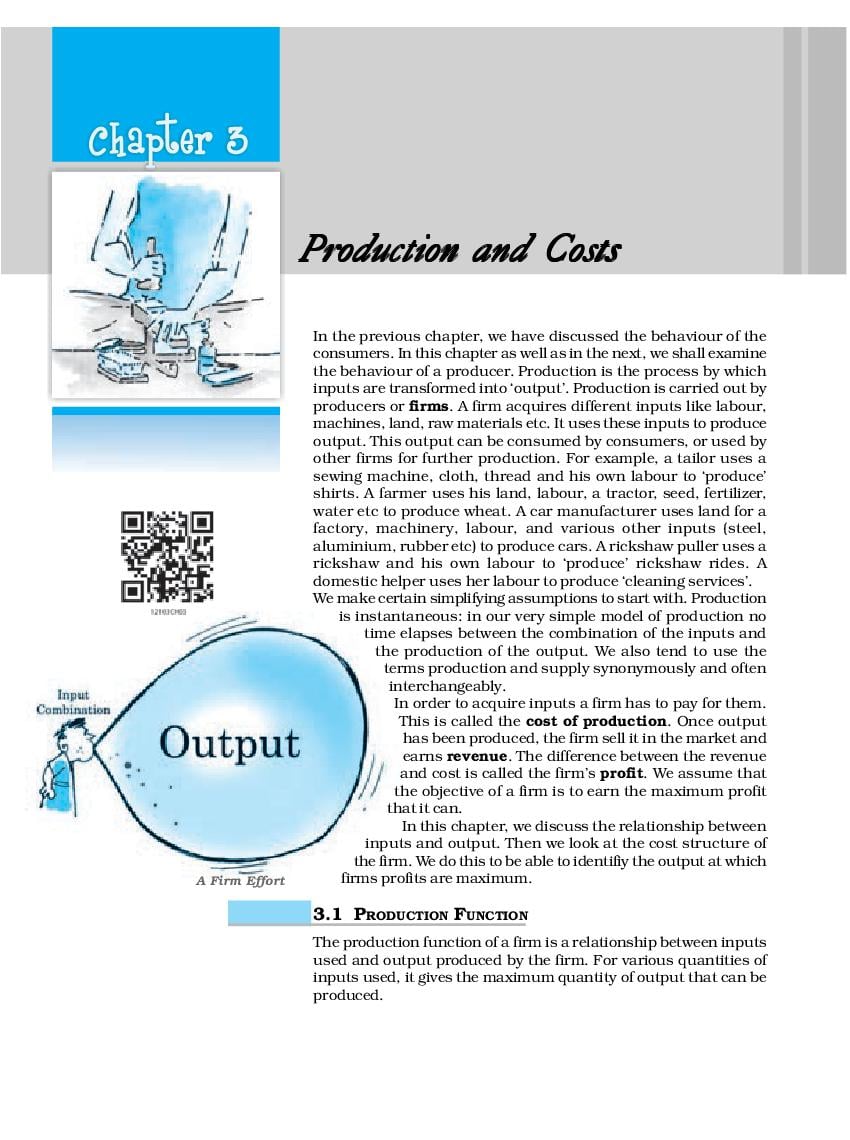
In this chapter, we discuss the relationship between
inputs and output. Then we look at the cost structure of
the firm. We do this to be able to identifiy the output at which
A Firm Effort firms profits are maximum.
3.1 PRODUCTION FUNCTION
The production function of a firm is a relationship between inputs
used and output produced by the firm. For various quantities of
inputs used, it gives the maximum quantity of output that can be
produced.
Showing the first page only. Download the PDF above for the complete document.
Document Details
| Board / Org | NCERT |
| Exam | Class 12 |
| Type | Books |
| Pages | 17 |
| Updated | 29 Aug 2026 |