TBSE Class 9 Syllabus 2021 Math
Finished viewing? Save it for later —
Download TBSE Class 9 Syllabus 2021 Math (PDF · 7 pages)About TBSE Class 9 Syllabus 2021 Math
TBSE Class 9 Syllabus 2021 Math is available here for free download. Published by Tripura Board for Class 9, this syllabus can be viewed online or downloaded as a PDF (7 pages). Candidates preparing for Class 9 can use TBSE Class 9 Syllabus 2021 Math to understand the exam pattern, the type of questions asked, and the overall difficulty level.
Frequently Asked Questions
How can I download TBSE Class 9 Syllabus 2021 Math?
Open this page and click the Download button to save TBSE Class 9 Syllabus 2021 Math as a PDF. It is completely free on AglaSem Docs.
Is TBSE Class 9 Syllabus 2021 Math free to download?
Yes. TBSE Class 9 Syllabus 2021 Math can be viewed online and downloaded as a PDF free of cost on AglaSem Docs.
How many pages does TBSE Class 9 Syllabus 2021 Math have?
TBSE Class 9 Syllabus 2021 Math contains 7 pages, which you can read online or download together as a single PDF.
Where can I find more Class 9 study material?
You can find more Class 9 question papers, sample papers, syllabus, and answer keys on AglaSem Docs.
TBSE Class 9 Syllabus 2021 Math – Text
Read the full text of this syllabus below — useful to quickly search, copy and reference the content online without downloading the PDF.
📄 View text version (7 pages)
Page 1
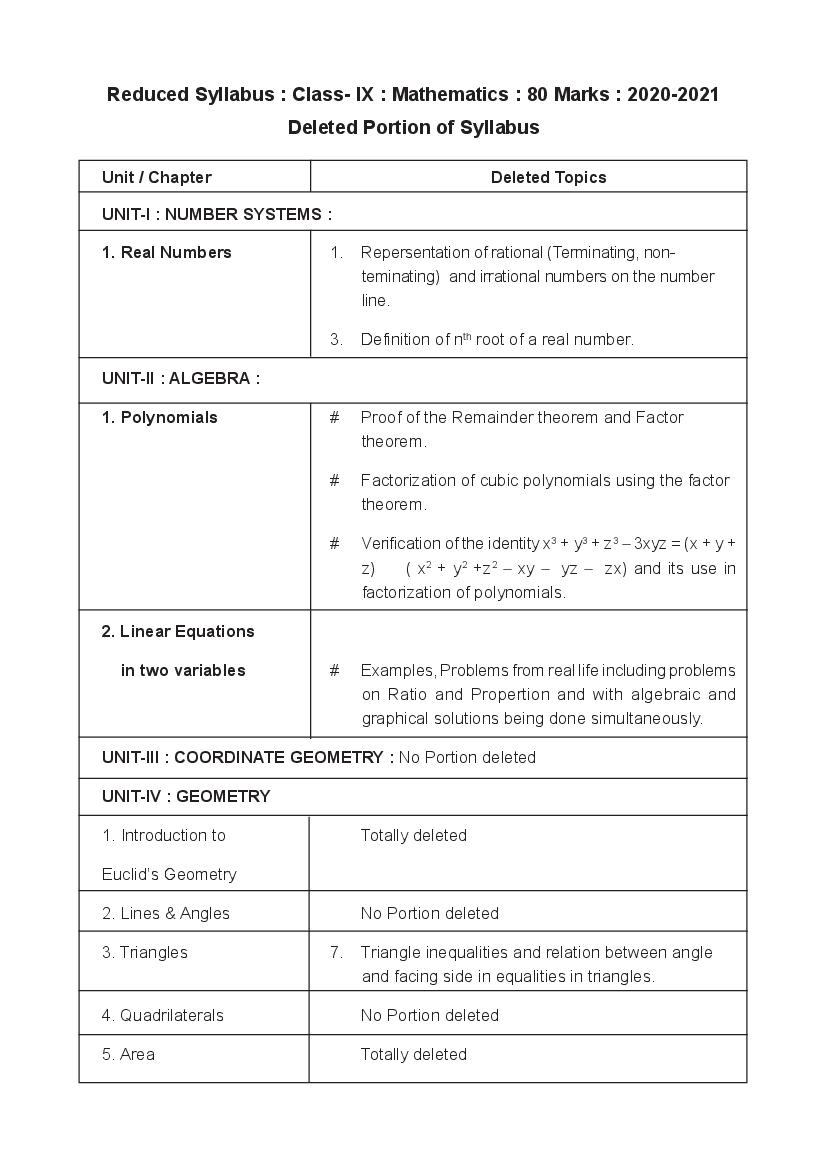
Deleted Portion of Syllabus
Unit / Chapter Deleted Topics
UNIT-I : NUMBER SYSTEMS :
1. Real Numbers 1. Repersentation of rational (Terminating, non-
teminating) and irrational numbers on the number
line.
3. Definition of nth root of a real number.
UNIT-II : ALGEBRA :
1. Polynomials # Proof of the Remainder theorem and Factor
theorem.
# Factorization of cubic polynomials using the factor
theorem.
# Verification of the identity x3 + y3 + z3 − 3xyz = (x + y +
z) ( x2 + y2 +z2 − xy − yz − zx) and its use in
factorization of polynomials.
2. Linear Equations
in two variables # Examples, Problems from real life including problems
on Ratio and Propertion and with algebraic and
graphical solutions being done simultaneously.
UNIT-III : COORDINATE GEOMETRY : No Portion deleted
UNIT-IV : GEOMETRY
1. Introduction to Totally deleted
Euclid’s Geometry
2. Lines & Angles No Portion deleted
3. Triangles 7. Triangle inequalities and relation between angle
and facing side in equalities in triangles.
4. Quadrilaterals No Portion deleted
5. Area Totally deleted
Page 2
passin through three given non-collinear points.
7. Motivate 7 : If a line segment joining two points
subsends equal angle at two other points lying on
the same side of the line containing the segment,
the four points lie on a circle.
7. Constructions 3. Construction : Contruction of a triangle of given
perimeter and base angles.
UNIT-V : MENSURATION :
1. Areas 1. Application of Heron’s formula in finding the area of
a quadrilateral.
2. Surface area and volumes # No Portion deleted
UNIT-VI :STATISTICS
1. Statistics # Histograms (with varying base lengths)
# Frequency polygons
# Mean, median and mode of ungrouped data.
2. Probability # No Portion deleted
Page 3
Unit/Chapter VSA SA-I SA-II LA-I Total
1 Mark 2 Marks 3 Marks 4 Marks Marks
1. Arithemetic 03 01 01 -- 08
(Number System)
2. Algebra (17)
(a) Polynomical 01 01 01 01 10
(b) Linear equation 02 01 01 -- 07
3. Co-ordinate/ Geometry (4) 01 -- 01 -- 04
4. Geometry (28)
(a) Lines and angles 01 01 01 -- 06
(b) Triangle 01 01 -- 01 07
(c) Quadrilateral 01 01 -- 01 07
(d) Circle -- -- -- 01 04
(e) Construction 01 -- 01 -- 04
5. Mensuration (13)
(a) Herons formula 02 -- 01 -- 05
(b) Surface area and volume 04 -- -- 01 08
6. Statistics & Probability (10)
(a) Statistics. 02 -- -- 01 06
(b) Probability 01 -- 01 -- 04
Total No. of Questions 20 06 08 06 40
Total Marks. 20 12 24 24 80
Page 4
Unit-I : NUMBER SYSTEMS
1. REAL NUMBERS
1. Review of representation of natural numbers, integers, rational numbers on
the number line. Rational numbers as recurring/terminating decimals.
Operations on real numbers.
2. Examples of non-recurring/non-terminating decimals. Explaining that every
real number is represented by a unique point on the number line and
conversely, viz. Every point on the number line represents a unique real
number.
4. Rationalization (with precise meaning) of real numbers of the type
1 1
and (and their combinations) where x and y are natural
a+b x x+ 3
number and a and b are integers.
5. Recall of laws of exponents with integral powers. Rational exponents with
positive real bases (to be done by particular cases, allowing learner to arrive
at the general laws.)
Unit-II : ALGEBRA
1. POLYNOMIALS
1. Definition of a polynomial in one varible with examples and counter examples.
Coefficients of a polynomial, terms of a polynomial and zero polynomial.
Degree of a polynomial. Constant, linear, quadratic and cubic polynomials.
Monomials, binomials, trinomials. Factors and statement. Factorization of
ax2 + bx + c, a ≠ 0 where a, b and c are real numbers. Recall of algebraic
expressions and identities. Verification of identities :
(x + y + z)2 = x2 + y2 + z2 + 2xy + 2yz + 2zx
(x ± y)3 = x3 ± y3 ± 3xy (x ± y)
x3 ± y3 = (x ± y) (x2 ∓ xy + y2)
and their use in factorization of polynomials.
2. LINEAR EQUATIONS IN TWO VARIABLES
Recall of Linear equations in one variable. Introduction to the equation in
two variables. Focus on linear equations of the type ax + by + c = 0. Explain
Page 5
their being written as ordered pairs of real numbers, plotting them and
showing that thay lie on a line. Graph of linear equations in two variables.
Unit-III : COORDINATE GEOMETRY
The Cartesian plane, coordinates of a point, names and terms associated
with the coordinate plane, notations, plotting points in the plane.
Unit-IV : GEOMETRY
2. LINES AND ANGLES
1. (Motivate) If a ray stands on a line, then the sum of the two adjecent angles
so formed is 1800 and the converse.
2. (Prove) If two lines intersect, vertically opposite angles are equal.
3. (Motivate) Results on corresponding angles, alternate angles, interior angles
when a transversal intersects two parallel lines.
4. (Motivate) Lines which are parallel to a given line are parallal.
5. (Prove) The sum of the angles of a triangle is 1800.
6. (Motivate) If a side of a triangle is produced, the exterior angle so formed is
equal to the sum of the two interior opposite angles.
3. TRIANGLES
1. (Motivate) Two triangles are congruent if any two sides and the included
angle of one triangle is equal to any sides and the included angle of the
other triangle (SAS Congruence).
2. (Prove) Two triangles are congruent if any two angles and the included side
of one triangle is equal to any two angles and the included side of the other
triangle (ASA Congruence).
3. (Motivate) Two triangles are congruent if the three sides of one triangle are
equal to three sides of the other triangle (SSS Congruence).
4. (Motivate) Two right triangles are congruent if the hypotenuse and a side of
one triangle are equal (respectively) to the hypotenuse and a side of the
other triangle. (RHS Congruence).
5. (Prove) The angles opposite to equal sides of a triangle are equal.
6. (Motivate) The sides opposite to equal angles of a triangle are equal.
Page 6
1. (Prove) The diagonal divides a parallelogram into two congruent triangles.
2. (Motivate) In a parallelogram opposite sides are equal, and conversely.
3. (Motivate) In a parallelogram opposite angles are equal and conversely.
4. (Motivate) A quadrilateral is a parallelogram if a pair of its opposite sides is
parallel and equal.
5. (Motivate) In a parallelogram, the diagonals bisect each other and conversely.
6. (Motivate) In a triangle, the line segment joining the mid points of any two
sides is parallet to the third side and in half of it and (Motivate) its converse.
6. CIRCLES
Through examples, arrive at definition of circle and related concepts-radius,
circumference, diameter, chord arc, secant, sector, segment, subtended
angle.
1. (Prove) Equal chords of a circle subtend equal angles at the center and
(motivate) its converse.
2. (Motivate) The perpendicular from the center of a circle to a chord bisects
the chord and conversely, the line drawn through the center of a circle to
bisect a chord is perpendicular to the chord.
4. (Motivate) Equal chords of a circle (or of congruent circles) are equidistant
from the center (or their respective centers) and conversely.
5. (Prove) The angle subtended by an arc at the center is double the angle
subtended by it at any point on the remaining part of the circle.
6. (Motivate) Angles in the same segment of a circle are equal.
8. (Motivate) The sum of either of the pair of the opposite angles of a cyclic
quadrilateral is 1800 and its converse.
7. CONTRUCTIONS
1. Contruction of bisectors of line segments and angles of measure 600, 900,
450 etc., equilateral triangles.
2. Construction of a triangle given its base, sum/differnce of the other two sides
and one base angle.
Page 7
2. SURFACE AREAS AND VOLUMES
Surface areas and volumes of cubes, cuboids, spheres (including
hemispheres) and right circular cylinders/cones.
Unit-VI : STATISTICS & PROBABILITY
1. STATISTICS
Introduction to statistics : Collection of data, presentation of data- tabular
form, ungrouped/grouped, bar graphs.
2. PROBABILITY
History, Repeated experiments and observed frequency approach to
probability.
Focus is on empirical probability. (A Large amount of time to be devoted to
group and to individual activities to motivate the concept; the experiments
to be drawn from real- Life situations and from examples used in the chapter
on statistics).