NCERT Book Class 6 Maths Chapter 2 Whole Numbers
Finished viewing? Save it for later —
Download NCERT Book Class 6 Maths Chapter 2 Whole Numbers (PDF · 18 pages)About NCERT Book Class 6 Maths Chapter 2 Whole Numbers
NCERT Book Class 6 Maths Chapter 2 Whole Numbers is available here for free download. Published by NCERT for Class 6, this books can be viewed online or downloaded as a PDF (18 pages). Candidates preparing for Class 6 can use NCERT Book Class 6 Maths Chapter 2 Whole Numbers to understand the exam pattern, the type of questions asked, and the overall difficulty level.
Frequently Asked Questions
How can I download NCERT Book Class 6 Maths Chapter 2 Whole Numbers?
Open this page and click the Download button to save NCERT Book Class 6 Maths Chapter 2 Whole Numbers as a PDF. It is completely free on AglaSem Docs.
Is NCERT Book Class 6 Maths Chapter 2 Whole Numbers free to download?
Yes. NCERT Book Class 6 Maths Chapter 2 Whole Numbers can be viewed online and downloaded as a PDF free of cost on AglaSem Docs.
How many pages does NCERT Book Class 6 Maths Chapter 2 Whole Numbers have?
NCERT Book Class 6 Maths Chapter 2 Whole Numbers contains 18 pages, which you can read online or download together as a single PDF.
Where can I find more Class 6 study material?
You can find more Class 6 question papers, sample papers, syllabus, and answer keys on AglaSem Docs.
NCERT Book Class 6 Maths Chapter 2 Whole Numbers – Text
Read the full text of this books below — useful to quickly search, copy and reference the content online without downloading the PDF.
📄 View text version (1 page)
Page 1
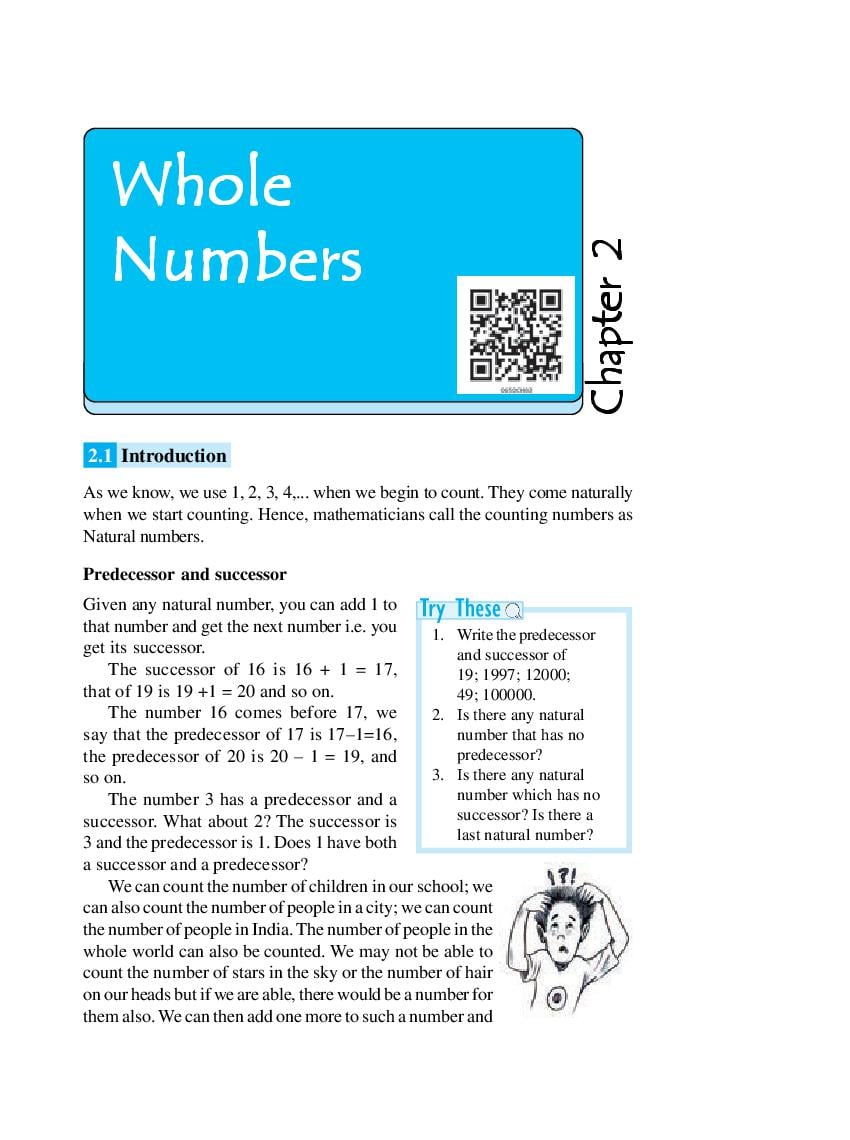
Numbers
Chapter 2
2.1 Introduction
As we know, we use 1, 2, 3, 4,... when we begin to count. They come naturally
when we start counting. Hence, mathematicians call the counting numbers as
Natural numbers.
Predecessor and successor
Given any natural number, you can add 1 to
that number and get the next number i.e. you 1. Write the predecessor
get its successor. and successor of
The successor of 16 is 16 + 1 = 17, 19; 1997; 12000;
that of 19 is 19 +1 = 20 and so on. 49; 100000.
The number 16 comes before 17, we 2. Is there any natural
say that the predecessor of 17 is 17–1=16, number that has no
the predecessor of 20 is 20 – 1 = 19, and predecessor?
so on. 3. Is there any natural
The number 3 has a predecessor and a number which has no
successor. What about 2? The successor is successor? Is there a
last natural number?
3 and the predecessor is 1. Does 1 have both
a successor and a predecessor?
We can count the number of children in our school; we
can also count the number of people in a city; we can count
the number of people in India. The number of people in the
whole world can also be counted. We may not be able to
count the number of stars in the sky or the number of hair
on our heads but if we are able, there would be a number for
them also. We can then add one more to such a number and
Showing the first page only. Download the PDF above for the complete document.
Document Details
| Board / Org | NCERT |
| Exam | Class 6 |
| Type | Books |
| Pages | 18 |
| Updated | 22 Jul 2026 |