ISC Class 12 Specimen Paper 2022 Biology Semester 2
Finished viewing? Save it for later —
Download ISC Class 12 Specimen Paper 2022 Biology Semester 2 (PDF · 4 pages)About ISC Class 12 Specimen Paper 2022 Biology Semester 2
ISC Class 12 Specimen Paper 2022 Biology Semester 2 is available here for free download. Published by CISCE for Class 12, this sample paper can be viewed online or downloaded as a PDF (4 pages). Candidates preparing for Class 12 can use ISC Class 12 Specimen Paper 2022 Biology Semester 2 to understand the exam pattern, the type of questions asked, and the overall difficulty level.
Frequently Asked Questions
How can I download ISC Class 12 Specimen Paper 2022 Biology Semester 2?
Open this page and click the Download button to save ISC Class 12 Specimen Paper 2022 Biology Semester 2 as a PDF. It is completely free on AglaSem Docs.
Is ISC Class 12 Specimen Paper 2022 Biology Semester 2 free to download?
Yes. ISC Class 12 Specimen Paper 2022 Biology Semester 2 can be viewed online and downloaded as a PDF free of cost on AglaSem Docs.
How many pages does ISC Class 12 Specimen Paper 2022 Biology Semester 2 have?
ISC Class 12 Specimen Paper 2022 Biology Semester 2 contains 4 pages, which you can read online or download together as a single PDF.
Where can I find more Class 12 study material?
You can find more Class 12 question papers, sample papers, syllabus, and answer keys on AglaSem Docs.
ISC Class 12 Specimen Paper 2022 Biology Semester 2 – Text
Read the full text of this sample paper below — useful to quickly search, copy and reference the content online without downloading the PDF.
📄 View text version (4 pages)
Page 1
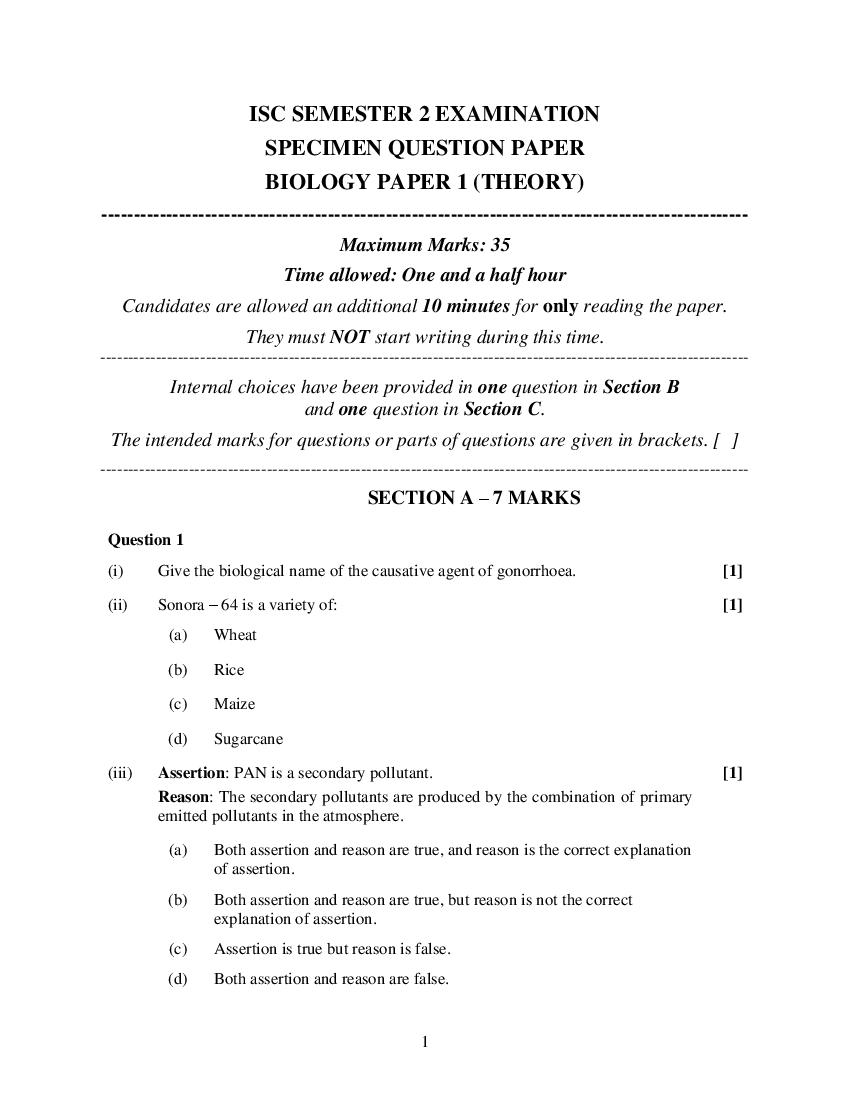
SPECIMEN QUESTION PAPER
BIOLOGY PAPER 1 (THEORY)
----------------------------------------------------------------------------------------------------
Maximum Marks: 35
Time allowed: One and a half hour
Candidates are allowed an additional 10 minutes for only reading the paper.
They must NOT start writing during this time.
---------------------------------------------------------------------------------------------------------------------
Internal choices have been provided in one question in Section B
and one question in Section C.
The intended marks for questions or parts of questions are given in brackets. [ ]
---------------------------------------------------------------------------------------------------------------------
SECTION A – 7 MARKS
Question 1
(i) Give the biological name of the causative agent of gonorrhoea. [1]
(ii) Sonora – 64 is a variety of: [1]
(a) Wheat
(b) Rice
(c) Maize
(d) Sugarcane
(iii) Assertion: PAN is a secondary pollutant. [1]
Reason: The secondary pollutants are produced by the combination of primary
emitted pollutants in the atmosphere.
(a) Both assertion and reason are true, and reason is the correct explanation
of assertion.
(b) Both assertion and reason are true, but reason is not the correct
explanation of assertion.
(c) Assertion is true but reason is false.
(d) Both assertion and reason are false.
1
Page 2
(v) Expand the term ADA. [1]
(vi) A substance that stimulates the production of antibodies is called __________. [1]
(vii) Why does a large ozone hole develop specifically over Antarctica? [1]
SECTION B (16 MARKS)
Question 2
Briefly explain the role of the following in providing defense against infections in human
body:
(i) B-cells [1]
(ii) T-cells [1]
Question 3 [2]
What is the role of a probe in recombinant DNA technology?
Question 4 [2]
The level of air pollution is very high in a city. Suggest any four measures which should
be taken by the government to control it.
Question 5 [2]
(i) If 20000 K Cal energy is available at the level of producers, what will be the
amount of energy available at the level of secondary consumers.
OR
(ii) The number of mice in a laboratory was 100 on a particular day. After one year
their number increased to 120. Calculate the growth rate in the population.
Question 6 [2]
Give any four advantages of mutation breeding.
Question 7 [2]
Name and describe the technique that helps in separation of DNA fragments.
Question 8 [2]
Which molecules are called molecular scissors? Why are they called so?
2
Page 3
Differentiate between primary succession and secondary succession with appropriate
examples.
SECTION C (12 MARKS)
Question 10 [3]
Study the graph given below and answer the following questions:
(i) Explain the ecological principle represented by the graph and write a
mathematical expression for the same.
(ii) What will happen if the slope of the line ‘b’ becomes steeper?
Question 11 [3]
Explain the steps involved in the process of plant breeding.
Question 12 [3]
The rDNA technology has provided a method to control the nematode parasite
Meloidogyne incognita. Explain the principle involved in this technique.
3
Page 4
(i) Consider the amount of organic matter at the different trophic levels in an
ecosystem given below:
Trophic Level Amount of organic
matter (in Kg)
Tertiary consumers 250
Primary consumers 150
Primary producers 100
Secondary Consumers 200
On the basis of the data provided above, construct an ecological pyramid.
Comment upon its nature giving at least one example of the type of organism
occupying each of the above mentioned trophic levels.
OR
(ii) On the basis of the demographic data of a country given below, construct an age
pyramid and explain whether the population is stable, declining or growing.
Age group No. of individuals
Pre-reproductive 20,000
Reproductive 15,000
Post-reproductive 10,000
4
Document Details
| Board / Org | CISCE |
| Exam | Class 12 |
| Type | Sample Paper |
| Pages | 4 |
| Language | english |
| Updated | 30 Apr 2026 |