Karnataka 2nd PUC Biology Sexual Reproduction in Flowering Plants MCQ with Answers
Finished viewing? Save it for later —
Download Karnataka 2nd PUC Biology Sexual Reproduction in Flowering Plants MCQ with Answers (PDF · 21 pages)About Karnataka 2nd PUC Biology Sexual Reproduction in Flowering Plants MCQ with Answers
Karnataka 2nd PUC Biology Sexual Reproduction in Flowering Plants MCQ with Answers is available here for free download. Published by Karnataka Board for Class 12, this question bank can be viewed online or downloaded as a PDF (21 pages). Candidates preparing for Class 12 can use Karnataka 2nd PUC Biology Sexual Reproduction in Flowering Plants MCQ with Answers to understand the exam pattern, the type of questions asked, and the overall difficulty level.
Frequently Asked Questions
How can I download Karnataka 2nd PUC Biology Sexual Reproduction in Flowering Plants MCQ with Answers?
Open this page and click the Download button to save Karnataka 2nd PUC Biology Sexual Reproduction in Flowering Plants MCQ with Answers as a PDF. It is completely free on AglaSem Docs.
Is Karnataka 2nd PUC Biology Sexual Reproduction in Flowering Plants MCQ with Answers free to download?
Yes. Karnataka 2nd PUC Biology Sexual Reproduction in Flowering Plants MCQ with Answers can be viewed online and downloaded as a PDF free of cost on AglaSem Docs.
How many pages does Karnataka 2nd PUC Biology Sexual Reproduction in Flowering Plants MCQ with Answers have?
Karnataka 2nd PUC Biology Sexual Reproduction in Flowering Plants MCQ with Answers contains 21 pages, which you can read online or download together as a single PDF.
Where can I find more Class 12 study material?
You can find more Class 12 question papers, sample papers, syllabus, and answer keys on AglaSem Docs.
Karnataka 2nd PUC Biology Sexual Reproduction in Flowering Plants MCQ with Answers – Text
Read the full text of this question bank below — useful to quickly search, copy and reference the content online without downloading the PDF.
📄 View text version (21 pages)
Page 1
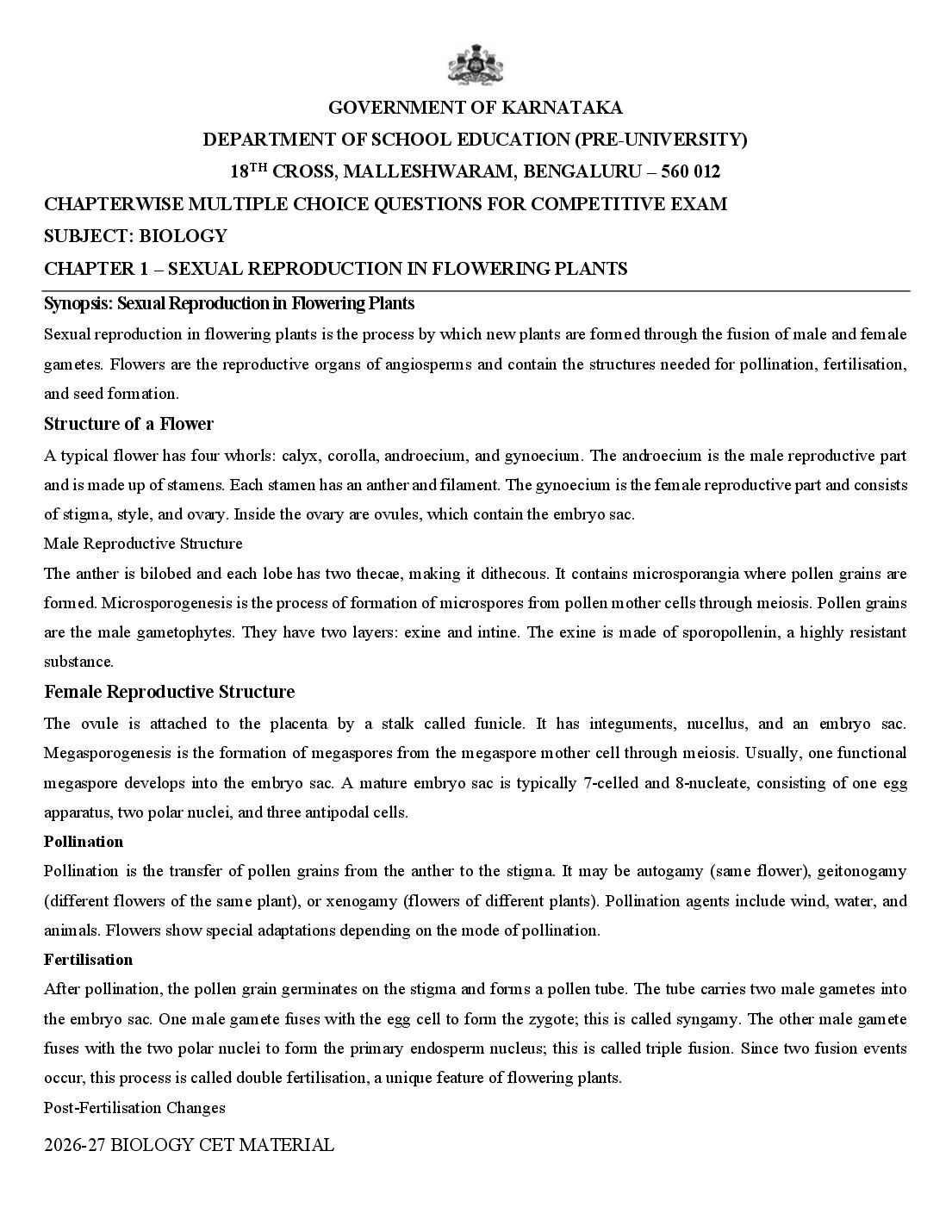
DEPARTMENT OF SCHOOL EDUCATION (PRE-UNIVERSITY)
18TH CROSS, MALLESHWARAM, BENGALURU – 560 012
CHAPTERWISE MULTIPLE CHOICE QUESTIONS FOR COMPETITIVE EXAM
SUBJECT: BIOLOGY
CHAPTER 1 – SEXUAL REPRODUCTION IN FLOWERING PLANTS
Synopsis: Sexual Reproduction in Flowering Plants
Sexual reproduction in flowering plants is the process by which new plants are formed through the fusion of male and female
gametes. Flowers are the reproductive organs of angiosperms and contain the structures needed for pollination, fertilisation,
and seed formation.
Structure of a Flower
A typical flower has four whorls: calyx, corolla, androecium, and gynoecium. The androecium is the male reproductive part
and is made up of stamens. Each stamen has an anther and filament. The gynoecium is the female reproductive part and consists
of stigma, style, and ovary. Inside the ovary are ovules, which contain the embryo sac.
Male Reproductive Structure
The anther is bilobed and each lobe has two thecae, making it dithecous. It contains microsporangia where pollen grains are
formed. Microsporogenesis is the process of formation of microspores from pollen mother cells through meiosis. Pollen grains
are the male gametophytes. They have two layers: exine and intine. The exine is made of sporopollenin, a highly resistant
substance.
Female Reproductive Structure
The ovule is attached to the placenta by a stalk called funicle. It has integuments, nucellus, and an embryo sac.
Megasporogenesis is the formation of megaspores from the megaspore mother cell through meiosis. Usually, one functional
megaspore develops into the embryo sac. A mature embryo sac is typically 7-celled and 8-nucleate, consisting of one egg
apparatus, two polar nuclei, and three antipodal cells.
Pollination
Pollination is the transfer of pollen grains from the anther to the stigma. It may be autogamy (same flower), geitonogamy
(different flowers of the same plant), or xenogamy (flowers of different plants). Pollination agents include wind, water, and
animals. Flowers show special adaptations depending on the mode of pollination.
Fertilisation
After pollination, the pollen grain germinates on the stigma and forms a pollen tube. The tube carries two male gametes into
the embryo sac. One male gamete fuses with the egg cell to form the zygote; this is called syngamy. The other male gamete
fuses with the two polar nuclei to form the primary endosperm nucleus; this is called triple fusion. Since two fusion events
occur, this process is called double fertilisation, a unique feature of flowering plants.
Post-Fertilisation Changes
Page 2
provides nutrition. The ovule becomes the seed and the ovary develops into the fruit. Seeds may be albuminous or non-
albuminous depending on whether endosperm is retained in the mature seed.]
Special Modes
Apomixis is the formation of seeds without fertilisation. It produces offspring genetically similar to the parent. Polyembryony
is the occurrence of more than one embryo in a seed. These concepts are important in plant breeding and agriculture
Recap:
• Flower is the reproductive unit in angiosperms.
• Pollen grains are male gametophytes; embryo sac is the female gametophyte.
• Pollination leads to fertilisation through pollen tube growth.
• Double fertilisation is unique to flowering plants.
• Ovule becomes seed and ovary becomes fruit after fertilisation.
• Apomixis and polyembryony are agriculturally important concepts.
MULTIPLE CHOICE QUESTIONS
1. The typical angiospermic stamen has two parts the long and slender stalk called the ...a..., and the terminal
generally bi-lobed structure called the ...b....
(A) a pedicel, b-anther (B) a petiole, b-microsporangia
(C) a peduncle, b-pollen sac (D) a-filament, b-anther
2. A typical angiosperm anther is
(A) Bilobed, monothecous and bisporangiate
(B) Bilobed, monothecous and tetrasporangiate
(C) Bilobed, dithecous and tetrasporangiate
(D) Bilobed, dithecous and bisporangiate
3. Read the following statements and find out the incorrect statement.
a. The number and length of stamens are variable in flowers of same species.
b. A typical angiosperm anther is bilobed with each lobe having two theca.
c. Often a longitudinal groove runs lengthwise separating the theca.
d. The anther consists of four microsporangia located at the corners one in each lobe.
e. The microsporangia develop further and become pollen sacs. They extend longitudinally
all through the length of an anther and are packed with pollen grains
(A) b, c and e (B) a, c and d (C) a and d only (D) a and b only
Page 3
Structure Shape
a Anther 1 Spindle
b Microsporangia 2 Spherical shaped
c Pollen grain 3 Tetragonal
d Generative cell 4 Near circular in outline
(A) a-4, b-3.c-1, d-2 (B) a-3, b-4, c-2, d-1
(C) a-1, b-2, c-3, d-4 (D) a-2, b-1, c-4, d-3
5. The bi-lobed nature of an anther is very distinct in the
(A) Transverse section (B) Longitudinal section
(C) Latitudinal section (D) Both A and B
6. Recognize the figure and find out the correct matching
(A) a-anther, b-filament, c- pollen sacs, d-pollen grains, e-line of dehiscence
(B) b-anther, a-filament, c-pollen sacs, d-pollen grains, e-line of dehiscence
(C) a-anther, b-filament, d-pollen sacs, c-pollen grains, e-line of dehiscence
(D) b-anther, a-filament, e-pollen sacs, c-pollen grains, d-line of dehiscence
7. Arrangement of four wall layers in microsporangium from inside to outside is as follows
(A) Epidermis, endothecium, tapetum and middle layers
(B) Epidermis, middle layers, endothecium and tapetum
(C) Epidermis, endothecium, middle layers and tapetum
(D) Tapetum, middle layers, endothecium and epidermis
8. In the centre of each microsporangium, there is a group of compactly arranged homogenous cells called
(A) Tapetum (B) Nucellus (C) Sporogenous tissue (D) pollen grains
Page 4
mature and dehydrate, the microspores dissociate from each other and develop into
(A) Pollen grains (B) Female gametophyte
(C) Male gametophyte (D) Both A and C
10. Diameter of the pollen grains is generally
(A) 5-10 µm (B) 10-50 µm (C) 20-50 µm (D) 25-50 µm
11. Pollen grain has a prominent two layered wall. The inner wall
(A) Is made up of cellulose and pectin (B) Is thin and continuous
(C) Is made up of Sporopollenin (D) Both A and B
12. Recognize the figure and find out the correct matching.
(A) a-epidermis, b-endothecium, c-middle layers. d-tapetum, e-sporogenous tissue, f-
connective
(B) b-epidermis, c-endotheciun, d-middle layers. e-tapetum, f-sporogenous tissue, a-connective
(C) b-epidermis, c-endothecium, f-middle layers, e-tapetum, a-sporogenous tissue, d-connective
(D) b-epidermis, c-endothecium, f-middle layers. e-tapetum, d-sporogenous tissue, a-connective
13. When the pollen grain is mature it contains two cells, the vegetative cell and generate cell. The vegetative cell
a. Is bigger b. Spindle shaped c. has abundant food reserve d. has large irregularly shaped
nucleus.
(A) a, b and c (C) a, b, c and d (B) a, cand d (D) b, c and d
14. The generative cell of a pollen grain
(A) Is small and floats in the cytoplasm of vegetative cell
Page 5
(C) Has dense cytoplasm and a nucleus.
(D) All of the above
15. In over 60 percent of angiosperms, pollen grains are shed al
(A) 2-celled stage (B) 3-celled stage
(C) 4-celled stage (D) Either A or B
16. Number of gametes produced by a male gametophyte of flowering plant is
(A) Four (C) Three (B) One (D) Two
17. Which of the following statements about sporopollenin is wrong?
(A) Exine is formed of sporopollenin
(B) Sporopollenin is not degraded by any known enzyme
(C) Sporopollenin occurs in the area of germ pores only
(D) Sporopollenin is most resistant organic material
18. Recognize the figure and find out the correct matching
(A) a-epidermis, b-endothecium, c-middle layers. d-tapetum, e-microspore mother cell
(B) b-epidermis, c-endothecium, d-middle layers, e-tapetum, a-microspore mother cell
(C) a-epidermis, b-endothecium, c-middle layers, e-tapetum, d-microspore mother cell
(D) a-epidermis, b-endothecium, e-middle layers, c-tapetum, d-microspore mother cell
19. During formation of pollen grains, a microspore mother cell undergoes
(A) One meiotic division (B) One mitotic division
(C) One meiotic and one mitotic division (D) One meiotic and two mitotic division
Page 6
(A) One meiotic division (B) Two meiotic division
(C) One meiotic and two mitotic divisionD) Three meiotic divisions
21. An anther having four microsporocytes shall produce pollen grains
(A) 24 (C) 8 (B) 12 (D) 16
22. Recognize the figure and find out the correct matching.
(A) a-nucleus, b-vacuoles, c-symmetric spindle, d-generative cell, e-vegetative cell
(B) b-nucleus, a-vacuoles, c-asymmetric spindle, e-generative cell, d-vegetative cell
(C) a-nucleus, b-vacuoles, c-symmetric spindle, e-generative cell, d-vegetative cell
(D) b-nucleus, a-vacuoles, c-asymmetric spindle, d-generative cell, e-vegetative cell
23. The process of formation of microspores from pollen mother cell (PMC) through meiosis is called
(A) Microgametogenesis (B) Microsporogenesis
(C) Megagametogenesis (D) Megasporogenesis
24. An ovule generally has a single embryo sac formed from a megaspore through
(A) Reduction division
(B) Mitotic division
(C) Mitotic division followed by meiotic division
(D) Meiotic division followed by mitotic division
25. The process of formation of megaspores from the mega-spore mother cell is called
(A) Microgametogenesis (B) Microsporogenesis
(C) Megagametogenesis (D) Megasporogenesis
26. Match the columns I and II, and choose the correct com-bination from the options given.
Page 7
a Male gametophyte 1 Ovule
b Female gametophyte 2 Locule
c Megasporangium 3 Pollen grain
d Ovarian cavity 4 Embryo sac
(A) a-3, b4, c-1, d-2 (B) a-4, b-3, c-2, d-1
(C) a-3, b-4, c-2, d-1 (D) a-4, b-3, c-1, d-2
27. Read the following statements and find out the incorrect statement.
a. The placenta is located inside the locule. Arising from the placenta are the ovules.
b. The number of ovules in an ovary may be one (papaya, watermelon and orchids) to many (wheat, paddy and
mango).
c. Each ovule has one or two protective envelops called integuments.
d. Integuments encircle the ovule except at the tip where a small opening called the chalaza is organized.
Opposite to the chalaza is the micropylar end.
e. Enclosed within the integuments is a mass of cells called the perisperm.
(A) b, d and e (B) a, c and d (C) b, c and e (D) a, b and d
28. Read the following statements and find out the incorrect statement.
a. Ovules generally differentiate a single megaspore mother cell (MMC) in the chalazal region of the nucellus.
b. The MMC undergoes reduction division and produce four megaspores.
c. In a majority of angiosperms, one of the megaspores is degenerated while the other three remains functional.
d. The nucleus of the functional megaspore divides mitotically three times and form 2-nucleate, 4-nucleate and
later 8-nucleate stages of the embryo sac.
e. These mitotic division are strictly free nuclear, that is, nuclear division are immediately followed by cell wall
formation.
(A) a, b and c (B) b, c and d (C) c, d and d (D) a, c and e
29. Recognize the figure and find out the correct matching.
Page 8
(B) a megaspore mother cell, b-chalazal end, c-megaspore dyad, d-megaspore tetrad, e-nucellus
(C) a-megaspore mother cell, b-micropylar end, c-megaspore dyad, d-megaspore tetrad, e-nucellus
(D) a-nucellus, b-micropylar end, c-megaspore dyad, d-megaspore tetrad, e-megaspore mother cell
30. Embryo sac is monosporic when it develops from
A) One of the four megaspores of a megaspore mother cell
(B) Three megaspores of megaspore tetrad
(C) Two functional megaspores
(D) The megaspore mother cell where meiosis has occurred, but cytokinesis does not take place
31. A typical embryo sac possesses
(A) Egg, synergids and secondary cell
(B) Egg, synergids, central cell and polar nuclei
(C) Egg, synergids, polar nuclei and antipodals
(D) Egg, synergids and secondary wall
32. Embryo sac develops from megaspore mother cell through
(A) I meiosis and 2 mitosis (B) 1 meiosis and 3 mitosis
(C) 2 meiosis and I mitosis (D) 2 meiosis and 2 mitosis
33. Which one produces embryo sac?
(A) Megaspore mother cell (B) Megaspore
(C) Microspore (D) Embryo cell
34. The male and female gametes in angiosperms are produced in the a... and...b..., respectively.
2. In angiosperms, both male and female gametes are c. they have to be brought together for ...d... to occur. The
e... is the mechanism to achieve this objective
Page 9
(B) a-generative cell, b-nucellus, c-non motile, d-pollination, e-fertilization
(C) a-pollen grain, b-embryo sac, c-motile, d-fertilization, e-pollination
(D) a-pollen grain, b-embryo sac, c- non motile, d-fertilization, e-pollination
35. For which of the following is rather rare flowers, complete autogamy
(A) Cleistogamous (B) Chasmogamous
(C) That do not open at all (D) Both A and C
36. Which is correct about Viola?
(A) Commonly called common pansy
(B) Bears two types of flowers chasmogamous and cleistogamous
(C) Produce assured seed-set even in the absence of pollinators
(D) All of the above
37. Read the following statements and find out the incorrect statement.
a. Plants use two abiotic (wind and water) and one biotic (animals) agents to achieve pollination.
b. Majority of plants use abiotic agents for pollination.
c. Only a small proportion of plants uses biotic agents,
d. Pollination by water is common among abiotic pol-linators.
e. Pollination by wind is quite rare in flowering plants and is restricted to about 30 genera mostly mono-
cotyledons
(A) a, b, c and d (B) b, c, d and e (C) a, c, d and e (D) band d only
38. In the corn cob the tassels which wave in the wind to trap pollen grains represents
(A) Stigma and style (B) Style and ovary
(C) Stigma (D) Style
39. Read the following statements and find out the incorrect statement.
a. Majority of flowering plants use a range of animals as pollinating agents.
b. Bees, butterflies, flies, beetles, wasps, ants, moth, birds (sunbirds and hummingbirds) and bats are the
common pollinating agents.
c. Among the animals, insects particularly bees are the dominant biotic pollinating agents.
d. Even larger animals such as some primates (lemurs), arboreal (tree dwelling) rodent, or even reptiles (gecko
lizard and garden lizard) have also been reported as pollinators in some species
Page 10
(A) a and b (B) band c (C) d and e (D) None of the above
40. Many insects may consume pollen or the nectar without bringing about pollination. Such floral visitors are
referred to as
(A) Pollen robbers (B) Nectar robbers
(C) Pseudocopulators (D) Both A and B
41. Which of the following is an out-breeding device?
a. If pollen release and stigma receptivity are not synchronized.
b. If the anther and stigma are placed at different positions so that pollen cannot come in contact with the
stigma of the same flower.
c. Self-incompatibility which prevents self-pollen (from the same plant) from fertilising the ovules by
inhibiting pollen germination or pollen tube growth in the pistil
d. Production of the unisexual flower
(A) a, b and c (B) b, c and d (C) a, c and d (D) a, b, c and d
42. Dioecious plants (papaya, date palm) etc. prevent
(A) Autogamy but not geitonogamy (B) Geitonogamy but not autogamy
(C) Both autogamy and geitonogamy (D) Neither autogamy nor geitonogamy
43. Artificial hybridisation is one of the major approaches of crop improvement programme. For the bisexual
flower u includes the following steps in correct sequence.
(A) Bagging, pollination, rebagging (B) Pollination, bagging, rebagging
(C) Emasculation, bagging, pollination, rebagging
(D) Bagging, emasculation, pollination, rebagging
44. In plants that shed pollen grain at two-celled condition, the generative cell divides and form the two male
gametes during the
(A) Entry of pollen tube in the ovule (B) Entry of pollen tube in the synergid
(C) Growth of pollen tube in the stigma (D) Growth of pollen tube in the style
45. Pollination does not guarantee the transfer of the right type of pollen (compatible pollen). If the pollen is of the
wrong type (incompatible type), then the pistil rejects the pollen by preventing
Page 11
(C) Double fertilization (D) Both A and B
46. Recognize the figure and find out the correct matching.
(A) a-egg nucleus, f-vegetative nucleus, b-synergid, e-filiform apparatus, d-male gametes, c central cell
(B) b-egg nucleus, f vegetative nucleus, c-synergid, d-filiform apparatus, e-male gametes, a-central cell
(C) b-egg nucleus, e-vegetative nucleus, c-synergid, d-filiform apparatus, f-male gametes, a-central cell
(D) b-egg nucleus, d-vegetative nucleus, a-synergid, f-filiform apparatus, emale gametes, c central cell.
47. Double fertilization is fusion of
(A) Two eggs (B) Two eggs and polar nuclei with pollen nuclei
(C) One male gamete with egg and other with synergid
(D) One male gamete with egg and other with secondary nucleus
48. A unique phenomenon observed in the embryo sac of angiosperms is
(A) Fusion of gametes (B) Double fusion
(C) Triple fusion (D) Triple fusion and double fertilization
49. Recognize the figure and find out the correct matching
(A) a-polar nuclei, begg cell, c-synergid, d-an-tipodal
(B) d-polar nuclei, a egg cell, b-synergid, c-an-tipodal
(C) b-polar nuclei, d-egg cell, c-synergid, a-an-tipodal
(D) b-polar nuclei, c-egg cell, d-synergid, a-an-tipodal
50. Fusion of one male gamete with egg and other of the same pollen tube with two polar nuclei is
(A) Triple fusion (B) Vegetative fertilization
(C) Double fertilization (D) Parthenogenesis
Page 12
a. Embryo development precedes endosperm develop ment.
b. Though the seeds differs greatly the early stages of embryo development (embrogeny) are similar inboth
monocotyledons and dicotyledons
c. A typical dicotyledonous embryo consists of an embryonal axis and two cotyledons.
d. Endosperm may either be completely consumed by the developing embryo (e.g., castor and coconut) before
seed maturation or it may persist in the ma-ture seed (e.g., wheat, rice, maize, pea, groundnut and beans).
e. The coconut water from tender coconut is cellular endosperm and the surrounding while kernel is the nuclear
endosperm.
(A) a, b and c (C) c, d and e (B) b, c and d (D) a, d and e
52. The correct sequence of embryogeny in dicot is
(A) Zygote, proembryo, globular, heart-shaped and mature embryo
(B) Zygote, globular, proembryo, heart-shaped and mature embryo
(C) Zygote, proembryo, heart-shaped, globular and mature embryo
(D) Zygote, globular, heart-shaped, proembryo and mature embry
53. Endosperm is not completely consumed by developing embryo in
(A) Gram (B) Bean (C) Castor (D) Pea
54. Embryo axis above the cotyledon is known as
(A) Hypocotyl (B) Funicle (C) Epicotyl (D) Raphe
55. Recognize the figure and find out the correct matching
(A) a radicle, b-hypocotyl, ecpicotyl, d-plumule, e-coleorhiza
(B) a plumule, b-epicotyl, c-hypocotyl, d-radicle, e-root cap
Page 13
(D) a plumule, b-cotyledons, c-hypocotyl, d-radicle, e-root cap
56. Select the correct and incorrect statements.
(a) Tapetum nourishes developing pollen grains
(b) Hilum represents junction between ovule and funicle
(c) In aquatic plants, Water Hyacinth and Water Lily, pollination is by water
(d) Primary endosperm nucleus is triploid
57. Recognize the figure and find out the correct matching
58. (A) a-zygote, b-heart shaped embryo, c-globular embryo, d-radicle, e-mature embryo
(B) a-PEN, b-globular embryo, c-heart shaped embryo, d-plumule, e-mature embryo
(C) a-PEN, b-heart shaped embryo, c-globular embryo, d-suspensor, e-cotyledon
(D) a-zygote, b-globular embryo, c-heart shaped embryo, d-suspensor, e-mature embryo
59. The fruits in which thalamus also contributes to fruit formation are called
(A) True fruits (B) False fruits
(C) Parthenocarpic fruits (D) Parthenogenic fruits
60. Albuminous seeds are found in
(A) Wheat, maize and barley (B) Castor and sunflower
(C) Orchid and podostemon (D) Both A and B
61. The transformation of ovules into seeds and ovary into
(A) Successively (one by one) (B) Simultaneously
(C) Alternatively (D) Can't say
62. Recognize the figure and find out the correct matching
Page 14
(B) b-seed, a-thalamus, d-mesocarp, c-endocarp
(C) a-seed, b-thalamus, d-mesocarp, c-endocarp
(D) b-seed, a-thalamus, c-mesocarp, d-endocarp
63. The thousands of years old viable seed of Lupinus arcticus excavated from
(A) Arctic Tundra (B) King Herod's palace near the Dead Sea
(C) Rohtang Pass near Manali (D) Tropical Pacific Island
64. Total number of meiotic divisions required for forming 100 grains of wheat is
(A) 100 (B) 75 (C) 125 (D) 50
65. A natural sequence of developmental stages in the life cycle of an angiosperm is
(A) Cleavage Fertilization Differentiation Fruit formation
(B) Pollination Fertilization Seed formation Germination
(C) Germination Double fertilization Endosperm formation Seed dispersal
(D) Maturation Mitosis Differentiation Fertilization
66. Apomictic embryos in citrus arise from
(A) Maternal sporophytic tissue in ovule (B) Antipodal cells
(C) Diploid cells (D) Synergids
67. In a type of apomixis known as adventive embryony, embryos develop directly from
(A) Nucellus or integument
(B) Zygote
(C) Synergids or antipodals of embryo sac
(D) Accessory embryo sacs in the ovule
68. Nucellar embryo is
(A) Amphimictic haploid (B) Amphimictic diploid
Page 15
ASSERTION-REASONING QUESTIONS
Read the assertion and reason carefully to mark the correct option in question
(A) If both assertion and reason are true and the reason is the correct explanation of the assertion.
(B) If both assertion and reason are true but reason is not the correct explanation of the assertion.
(C) If assertion is true but reason is false.
(D) If both assertion and reason are false.
69. Assertion: Each cell of sporogenous tissue is a potential pollen mother cell (PMC) or microspore mother cell.
Reason: Each cell of the sporogenous tissue is capable of giving rise to a microspore tetrad
70. Assertion: The period for which pollen grains remain vi-able is highly variable.
Reason: Viability of pollen grain depends some extent on the prevailing temperature and humidity.
71. Assertion: It is possible to store pollen grains of a large number of species for years in liquid nitrogen (-196°C)
Reason: Such stored pollen can be used as pollen banks, similar to seed banks, in crop breeding programmes.
72. Assertion: Pollen consumption has claimed to increase the performance of athletes and race horses.
Reason: Pollen grains are rich in the nutrients.
73. Assertion: Pollen grains of many species cause severe allergies and bronchial affections in some people leading
to acute respiratory disorders asthma, bronchitis, etc.
Reason: In some members of Rosaceae, Leguminoseac and Solanaceae, pollen grains lose viability within 30
minutes of their release.
74. Assertion: In majority of angiosperms, there is mono-sporic type of embryo sac development.
Reason: The embryo sac develops from the single functional megaspore
75. Assertion: Geitonogamy is functionally cross-pollination involving pollinating agent and genetically it is
similar to autogamy since the pollen grains come from the another plant.
Reason: Geitonogamy is the only type of pollination which during pollination brings genetically different types
of pollen grains to the stigma.
76. Assertion: To compensate the uncertainties and associated loss of pollen grains during pollination by abiotic
agents, the flowers produce enormous amount of pollen when compared to the number of ovules available for
Page 16
Reason: Pollen grains meeting the stigma is a chance factor in both wind and water pollination.
77. Assertion: Wind pollination requires that the pollen grains are light and non-sticky.
Reason: Light pollen grains can be transported easily in wind currents.
78. Assertion: The distribution of bryophytes and pteridophytes is limited.
Reason: In bryophytes and pteridophytes water is required for the transport of male gamete and fertilization.
79. Assertion: Both wind and water pollinated flowers are not very colourful and do not produce nectar.
Reason: There is no need to attract the pollinating agents
80. Assertion: Flowering plants have developed many out breeding devices to discourage self-pollination and to
encourage cross-pollination.
Reason: Continued self-pollination result in inbreeding depression.
81. Assertion: Syngamy results in the formation of endosperm
Reason: Triple fusion results in the formation of embryo.
82. Assertion: In the most common type of endosperm development, the PEN undergoes successive nuclear
division to give rise to free nuclei.
Reason: Embryo develops at the chalazal end of the embryo sac where zygote is situated.
83. Assertion: Seeds generate new genetic combinations leading to variations.
Reason: Seeds are the product of sexual reproduction.
PREVIOUS YEARS' EXAMINATION QUESTIONS
84. Raphe is
(A) Ridge formed by fused funiculus (B) Funicle attached to ovule
(C) Part of nucellus (D) Part of flower
85. Which one is surrounded by callose wall?
( A) Male gamete (B) Pollen grain
(C) Egg (D) Microspore mother cell
Page 17
(A) Geitonogamy but not xenogamy (B) Autogamy and geitonogamy
(C) Autogamy but not geitonogamy (D) Both geitonogamy and xenogamy
87. The role of filiform apparatus is
(A) Brings about opening of pollen tube
(B) Guides pollen tube from synergid to egg
(C) Helps in entry of pollen tube into synergid
(D) Prevents entry of more than one pollen tube into embryo sac
88. Which one is resistant to enzyme action?
(A) Pollen exine (B) Leaf cuticle (C) Cork (D) Wood fibre
89. Wind pollinated flowers are
(A) Small, brightly coloured, producing large number of pollen grains
(B) Small, producing large number of dry pollens
(C) Large producing abundant nectar and pollen.
(D) Small producing nectar and dry pollen.
90. The coonnut water from tender coconut represents
(a) free nuclear proembryo (b) free nuclear endosperm
(c) endocarp (d) fleshy mesocarp
91. Which one of the following statements is not true?
(a) Pollen grains of many species cause severe allergies.
(b) Stored pollen in liquid nitrogen can be used in the crop breeding programmes.
(c) Tapetum helps in the dehiscence of anther.
(d) Exine of pollen grains is made up of sporopollenin.
92. Seed formation without fertilisation in flowering plants involves the process of
(a) somatic hybridisation (b) apomixes
(c) sporulation (d) budding.
93. Which of the following statements is not correct?
(a) Pollen germination and pollen tube growth are regulated by chemical components of pollen interacting with
Page 18
(b) Some reptiles have also been reported as pollinators in some plant species.
(c) Pollen grains of many species can germinate on the stigma of a flower, but only one pollen tube of the same
species grows into the style.
(d) Insects that consume pollen or nectar without bringing about pollination are called pollen/ nectar robbers.
94. Proximal end of the filament of stamen is attached to the
(a) placenta (b) thalamus or petal
(d) connective. (c) anther
95. Which one of the following statements is not correct?
(a) Offspring produced by the asexual reproduction are called clone.
(b) Microscopic, motile, asexual reproductive structures are called zoospores.
(c) In potato, banana and ginger, the plantlets arise from, the internodes present in the modified stem.
(d) Water hyacinth, growing in the standing water, drains oxygen from water that leads to the death of fishes.
96. Which one of the following generates new genetic combinations leading to variation?
(a) Vegetative reproduction (b) Parthenogenesis
(c) Sexual reproduction (d) Nucellar polyembryony
97. Match column I with column II and select the correct option using the codes given below.
Column I Column II
A. Pistils fused together (i) Gametogenesis
B. Formation of gametes (ii) Pistillate
C. Hyphae of higher (iii) Syncarpous
Ascomycetes
D. Unisexual female flower (iv)Dikaryotic
(a) A-(iv), B-(iii), C-(i), D-(ii) (b) A-(ii), B-(i), C-(iv), D-(iii)
(c) A-(i), B-(ii), C-(iv), D-(ii) (d) A-(iii), B-(i), C-(iv), D-(ii)
98. In majority of angiosperms
(a) egg has a filiform apparatus
Page 19
(c) reduction division occurs in the megaspore mother cells
(d) a small central cell is present in that embryo sac.
99. Pollination in water hyacinth and water lily is brought about by the agency of
(a) water (b) insects or wind (c) birds (d) bats.
100. The ovule of an angiosperm is technically equivalent to
(a) megasporangium (b) megasporophyll
(c) megaspore mother cell (d) megaspore.
101. Identify the parts labelled A, B, C and D in the given figure and select the correct option.
A B C D
(a) Scutellum Epiblast Coleoptile Coleorhiza
(b) Scutellum Coleorhiza Coleoptile Epiblast
(c) Scutellum Coleoptile Coleorhiza Epiblast
(d) Epiblast Coleoptile Coleorhiza Scutellum
102. Match column I with column II and select the correct option from the given codes.
Column I Column II
A. Parthenocarpy (i) Seed formation without fertilization
B. Polyembryony (ii) More than one embryo in same seed
C. Apomixis (iii) seed less fruits without fertilization
D. Somaticembryogenesis(iv) embryo develops from a somatic cell
(a) A-(iv), B(ii), C(iii), D-(i) (b) A-(iii), B(ii), C-(i), D-(iv)
(c) A-(i), B-(iv), C-(iii), D-(ii) (d) A-(ii), B(iii), C-(i), D-(iv)
103. After double fertilization, a mature ovule has
(a) 1 diploid and 1 haploid cell (b) 1 diploid and 1 triploid cell
(c) 2 haploid and 1 triploid cell (d) 1 haploid and 1 triploid cell.
Page 20
(a) fusion of two male gametes of a pollen tube with two different eggs
(b) fusion of one male gamete with two polar nuclei
(c) fusion of two male gametes with one egg
(d) syngamy and triple fusion.
105. Albuminous seeds are found in
(a) pea, groundnut, castor (b) castor, sunflower, barley
(c) wheat, barley, castor (d) pea, groundnut, sunflower.
106. Ploidy of endothecium, microspore mother cell, tapetum and microspore is respectively,
(а) 2n, 2n, 2n, n (b) n, n, s, 2n (c) 2n, n, 2n, n (d) n, 2n, 2л, п.
107. Persistent nucellus in the seed is known as
(a) tegmen (b) chalaza (c) perisperm (d) hilum.
108. In some plants, the female gamete develops into embryo without fertilisation. This phenomenon is known
as
(a) parthenogenesis (b) autogamy
(c) parthenocarpy (d) syngamy.
109. What is the fate of the male gametes discharged in the synergid?
(a) One fuses with the egg and other fuses with central cell nuclei.
(b) One fuses with the egg, other's) degenerates in the synergid.
(c) All fuse with the egg.
(d) One fuses with the egg, other(s) fuse(s) with
110. In water hyacinth and water lily, pollination takes place by
(a) insects or wind (b) water currents only
(c) wind and water (d) insects and water.
Page 21
1 2 3 4 5 6 7 8 9 10
D C C B A C D C D D
11 12 13 14 15 16 17 18 19 20
D D B D A D C C A C
21 22 23 24 25 26 27 28 29 30
D B B B D A A D C A
31 32 33 34 35 36 37 38 39 40
C B B D B D B A D D
41 42 43 44 45 46 47 48 49 50
D C C C D B D D D C
51 52 53 54 55 56 57 58 59 60
D A C C D B D D B D
61 62 63 64 65 66 67 68 69 70
B B A C B A A D A B
71 72 73 74 75 76 77 78 79 80
B A D A D A A A A A
81 82 83 84 85 86 87 88 89 90
D C A A D C C A B B
91 92 93 94 95 96 97 98 99 100
B B C B C C D C B A
101 102 103 104 105 106 107 108 109 110
C B B D C A C A A A
Document Details
| Board / Org | Karnataka Board |
| Exam | Class 12 |
| Type | Question Bank |
| Pages | 21 |
| Updated | 24 Sep 2026 |