Karnataka 2nd PUC Biology Reproductive Health MCQ with Answers
Finished viewing? Save it for later —
Download Karnataka 2nd PUC Biology Reproductive Health MCQ with Answers (PDF · 16 pages)About Karnataka 2nd PUC Biology Reproductive Health MCQ with Answers
Karnataka 2nd PUC Biology Reproductive Health MCQ with Answers is available here for free download. Published by Karnataka Board for Class 12, this question bank can be viewed online or downloaded as a PDF (16 pages). Candidates preparing for Class 12 can use Karnataka 2nd PUC Biology Reproductive Health MCQ with Answers to understand the exam pattern, the type of questions asked, and the overall difficulty level.
Frequently Asked Questions
How can I download Karnataka 2nd PUC Biology Reproductive Health MCQ with Answers?
Open this page and click the Download button to save Karnataka 2nd PUC Biology Reproductive Health MCQ with Answers as a PDF. It is completely free on AglaSem Docs.
Is Karnataka 2nd PUC Biology Reproductive Health MCQ with Answers free to download?
Yes. Karnataka 2nd PUC Biology Reproductive Health MCQ with Answers can be viewed online and downloaded as a PDF free of cost on AglaSem Docs.
How many pages does Karnataka 2nd PUC Biology Reproductive Health MCQ with Answers have?
Karnataka 2nd PUC Biology Reproductive Health MCQ with Answers contains 16 pages, which you can read online or download together as a single PDF.
Where can I find more Class 12 study material?
You can find more Class 12 question papers, sample papers, syllabus, and answer keys on AglaSem Docs.
Karnataka 2nd PUC Biology Reproductive Health MCQ with Answers – Text
Read the full text of this question bank below — useful to quickly search, copy and reference the content online without downloading the PDF.
📄 View text version (16 pages)
Page 1
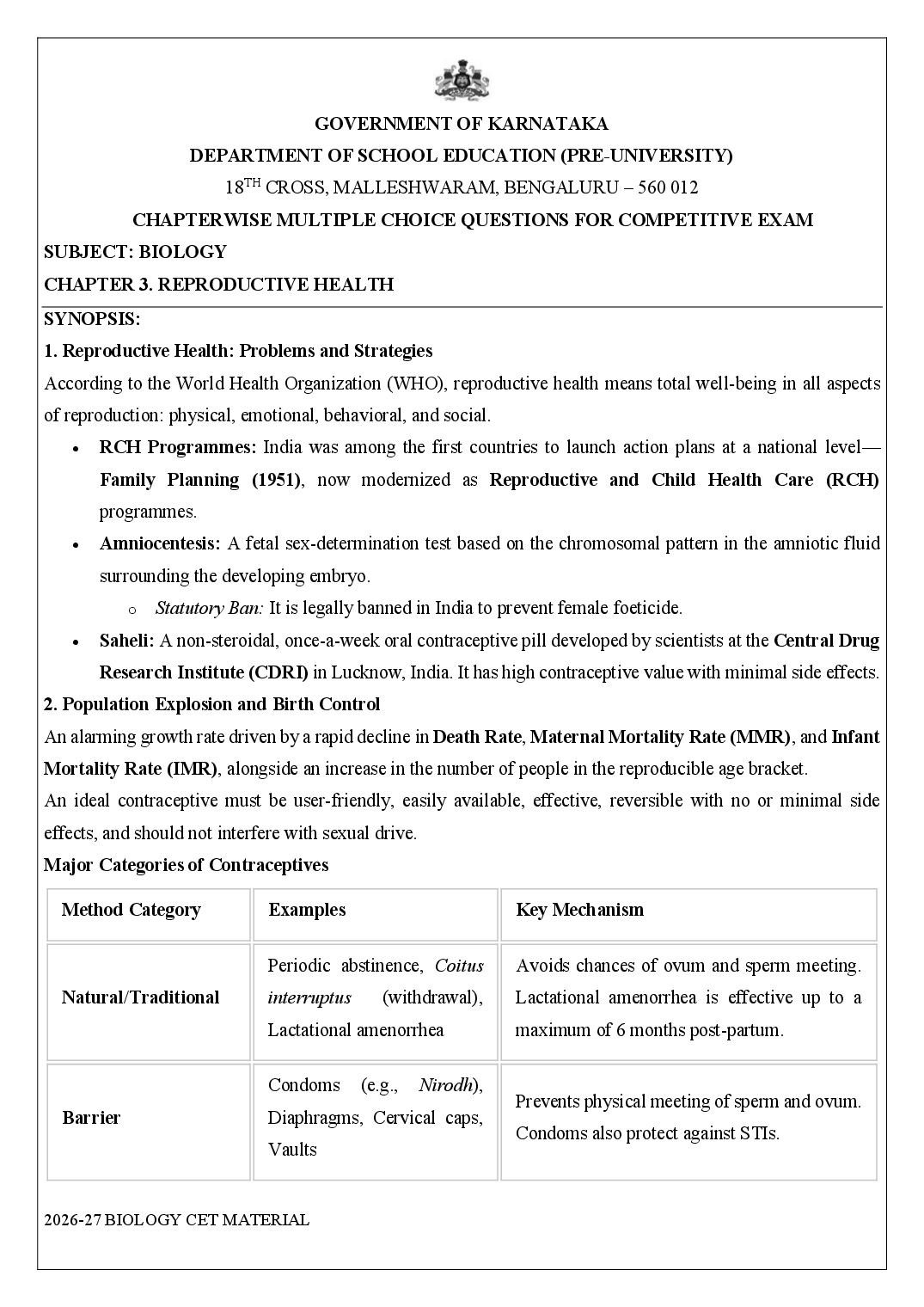
DEPARTMENT OF SCHOOL EDUCATION (PRE-UNIVERSITY)
18TH CROSS, MALLESHWARAM, BENGALURU – 560 012
CHAPTERWISE MULTIPLE CHOICE QUESTIONS FOR COMPETITIVE EXAM
SUBJECT: BIOLOGY
CHAPTER 3. REPRODUCTIVE HEALTH
SYNOPSIS:
1. Reproductive Health: Problems and Strategies
According to the World Health Organization (WHO), reproductive health means total well-being in all aspects
of reproduction: physical, emotional, behavioral, and social.
• RCH Programmes: India was among the first countries to launch action plans at a national level—
Family Planning (1951), now modernized as Reproductive and Child Health Care (RCH)
programmes.
• Amniocentesis: A fetal sex-determination test based on the chromosomal pattern in the amniotic fluid
surrounding the developing embryo.
o Statutory Ban: It is legally banned in India to prevent female foeticide.
• Saheli: A non-steroidal, once-a-week oral contraceptive pill developed by scientists at the Central Drug
Research Institute (CDRI) in Lucknow, India. It has high contraceptive value with minimal side effects.
2. Population Explosion and Birth Control
An alarming growth rate driven by a rapid decline in Death Rate, Maternal Mortality Rate (MMR), and Infant
Mortality Rate (IMR), alongside an increase in the number of people in the reproducible age bracket.
An ideal contraceptive must be user-friendly, easily available, effective, reversible with no or minimal side
effects, and should not interfere with sexual drive.
Major Categories of Contraceptives
Method Category Examples Key Mechanism
Periodic abstinence, Coitus Avoids chances of ovum and sperm meeting.
Natural/Traditional interruptus (withdrawal), Lactational amenorrhea is effective up to a
Lactational amenorrhea maximum of 6 months post-partum.
Condoms (e.g., Nirodh),
Prevents physical meeting of sperm and ovum.
Barrier Diaphragms, Cervical caps,
Condoms also protect against STIs.
Vaults
Page 2
• Non-medicated: Lippes
Loop
Phagocytosis of sperms within the uterus. 𝐶𝑢
Intrauterine Devices • Copper-releasing: CuT, ions suppress sperm motility/fertilizing
(IUDs) Cu7, Multiload 375 capacity. Hormone IUDs make the cervix
hostile.
• Hormone-releasing:
Progestasert, LNG-20
Progestogens or Inhibit ovulation and implantation; alter the
Oral Contraceptives Progestogen-estrogen quality of cervical mucus to prevent sperm
combinations (Pills) entry.
Progestogens alone or with Similar mechanism to pills, but have much
Injections / Implants
estrogen used under the skin longer effective periods.
• Vasectomy: (Males)
Cutting/tying of Vas
deferens
Blocks gamete transport to prevent conception.
Surgical /
Highly effective but terminal (terminal
Sterilization
reversibility is very poor).
• Tubectomy: (Females)
Cutting/tying of Fallopian
tubes
3. Medical Termination of Pregnancy (MTP)
Intentional or voluntary termination of pregnancy before full term is called MTP or induced abortion.
• Global Volume: Nearly 45 to 50 million MTPs are performed a year worldwide (accounting for 1/5th of
the total number of conceived pregnancies).
• Legal Status in India: Legalized in 1971 with strict conditions to avoid misuse. Amendments in
2017/2021 allow termination up to 20 weeks on specific medical grounds with the opinion of one
registered medical practitioner, and up to 24 weeks for special categories of women with two practitioners'
consent.
Page 3
pregnancy). Second-trimester abortions are significantly riskier.
4. Sexually Transmitted Infections (STIs)
Infections or diseases transmitted through sexual intercourse are called STIs, Venereal Diseases (VD), or
Reproductive Tract Infections (RTI).
• Common STIs: Gonorrhoea, Syphilis, Genital herpes, Chlamydiasis, Genital warts, Trichomoniasis,
Hepatitis-B, and HIV/AIDS.
• Curability: Except for Hepatitis-B, Genital Herpes, and HIV infection, all other STIs are completely
curable if detected early and treated properly.
• Vulnerable Age Group: Highly prevalent in the 15–24 years age group.
5. Infertility and Assisted Reproductive Technologies (ART)
Infertility is the inability to conceive or produce children even after 2 years of unprotected sexual cohabitation.
When corrective medical treatments fail, couples can be assisted via Assisted Reproductive Technologies
(ART).
1.IVF (In Vitro Fertilization): Fertilization outside the body.
Ova from the wife/donor and sperms from the husband/donor are collected and induced to form a zygote under
simulated laboratory conditions. Commonly called the Test Tube Baby programme.
2.ZIFT (Zygote Intra Fallopian Transfer): Early embryo transfer.
The zygote or early embryo (with up to 8 blastomeres) is transferred directly into the Fallopian tube.
3.IUT (Intra Uterine Transfer): Late embryo transfer.
Embryos with more than 8 blastomeres are transferred directly into the uterus to complete their development.
4.GIFT (Gamete Intra Fallopian Transfer): In vivo variation.
Transfer of an ovum collected from a donor into the Fallopian tube of another female who cannot produce one,
but can provide a suitable environment for fertilization and development.
5.ICSI (Intracytoplasmic Sperm Injection): Specialized lab procedure.
A specialized procedure in which a single sperm is directly injected into the cytoplasm of the ovum to form an
embryo.
6.AI & IUI (Artificial Insemination): For male infertility.
Semen collected from the husband or a healthy donor is artificially introduced either into the vagina or into the
uterus (IUI — Intra-Uterine Insemination) of the female. Used when the male partner has a low sperm count
or inability to inseminate.
MULTIPLE CHOICE QUESTIONS
1. In context of reproductive health, STD stands for
(a) Sexually Terminal Disease (b) Sexually Transmitted Disease
(c) Sexually Transformed Disease (d) Sexually Transducted Disease
2. Statutory ban has been laid on ________ to check female foeticide.
Page 4
(c) Uterocentesis (d) Embryocentesis
3. CDRI, Lucknow developed which new female contraceptive?
(a) ‘Sakhi’ (b) ‘Saheli’ (c) ‘Saloni’ (d) ‘Smiti’
4. Which IUD is shown in the given fi gure?
(a) Lippes loop (b) Progestasert (c) Copper T (d) Multiload-375
5. By the year 2000, the world population rocketed to
(a) 6 million (b) 6 billion (c) 6 trillion (d) 600 million
6. Many couples in the urban working areas have adopted the ________ norm.
(a) Two child (b) One child (c) No child (d) Three child
7. Lactational amenorrhea is eff ective only up to a maximum of ________ months.
(a) Two (b) Four (c) Six (d) Eight
8. In the ________ method of contraception ovum and sperms are prevented from physically meeting by
the use of a membranous sheath.
(a) Barrier (b) Sterilization (c) Natural (d) Pills
9. Which of the following is not applicable to females for contraception?
(a) Diaphragms (b) Vasectomy (c) Condoms (d) Cervical caps
10. Lippes loop is a
(a) Structure associated with nephron
(b) Structure associated with male reproductive system
(c) Structure associated with ligamentous tissue
(d) A non-medicated IUD
11. LNG-20 is a
(a) Fuel (b) Modified crop (c) Hormonal IUD (d) Cu releasing IUD
12. Which of the following is a most widely used contraceptive in India?
(a) IUD (b) Pills (c) Barrier method (d) Natural method
13. Which portion of male reproductive system has been cut and ligated in figure?
(a) Vasa efferentia (b) Urethra (c) Vas deferens (d) Rete testis
Page 5
(a) 48 (b) 72 (c) 36 (d) 86
15. Sterilization procedure in males is known as
(a) Tubectomy (b) Vasectomy (c) Hysterectomy (d) Castration
16. Misuse of amniocentesis has led to the misuse of ________.
(a) MTP (b) STD (c) RTI (d) HIV
17. The surgical procedure indicated in the figure is
(a) Tubectomy (b) Hysterectomy (c) Vasectomy (d) Orchidectomy
18. Which infections can be transmitted by sharing injection needles, surgical instruments, etc., with
infected persons; through transfusion of blood, or from an infected mother to the foetus?
(a) AIDS (b) Hepatitis B (c) Genital herpes (d) Both (a) and (b)
19. Which of these options is correct with regards to statements X and Y?
Statement X: Some STDs do not show symptoms in females.
Statement Y: Some STDs in females may remain undetected for long time.
(a) Statement ‘X’ and ‘Y’ are correct, and ‘X’ is the correct explanation for ‘Y’.
(b) Only statement ‘X’ is correct.
(c) Only statement ‘Y’ is correct.
(d) Statement ‘X’ and ‘Y’ are correct.
20. In India, most of the infertility cases are because of the
(a) Male (b) Female (c) Either (a) and (b) (d) Hereditary disorders
21. WHO refers reproductive health as
(a) Physically healthy reproductive organ
(b) Functionally healthy reproductive organ
(c) Normal emotional and behavioral interaction among people in all sex related aspects.
(d) All the above
22. Programme called family planning was initiated in ________.
(a) 1941 (b) 1951 (c) 1961 (d) 1971
23. Every ________ person in the world is an Indian.
(a) 4th (b) 6th (c) 8th (d) 10th
24. Motivation for smaller families in India can be provided by
(a) Slogans like ‘Hum Do Hamare Do’.
(b) Raising marriageable age (female –18 years and male –21 years).
Page 6
(d) All the above
25. Cu ions released from copper-releasing Intrauterine Devices (IUDs):
(a) Makes uterus unsuitable for implantation (b) Increases phagocytosis of sperms
(c) Suppress sperm motility (d) Prevent ovulation
26. Medical Termination of Pregnancy (MTP) is considered safe up to how many weeks pregnancy?
(a) 12 weeks (b) 18 weeks (c) 6 weeks (d) 8 weeks
27. If for some reason, the vasa efferentia in the human reproductive system get blocked, the gametes
will not be transported from
(a) Epididymis to vas deferens (b) Ovary to uterus
(c) Vagina to uterus (d) Testes to epididymis
28. The technique called Gamete Intra Fallopian Transfer (GIFT) is recommended for those females
(a) Who cannot produce an ovum.
(b) Who cannot retain the foetus inside uterus.
(c) Whose cervical canal is too narrow to allow the passage for the sperms.
(d) Who cannot provide suitable environment for fertilization.
29. Which of the following is a hormone releasing Intrauterine Device (IUD)?
(a) Multiload 375 (b) LNG-20 (c) Cervical cap (d) Vault
30. Assisted reproductive technology, IVF involves the transfer of
(a) Ovum into the fallopian tube (b) Zygote into the fallopian tube
(c) Zygote into the uterus (d) Embryo with 16 blastomeres into the fallopian tube
31. Which of the following approaches does not give the defined action of contraceptive?
32. Which of the following is hormone releasing IUD?
(a) Multiload 375 (b) Lippes loop (c) Cu7 (d) LNG-20
33. The method of directly injecting sperm into ovum is assisted by a reproductive technology called
(a) GIFT (b) ZIFT (c) ICSI (d) ET
34. Intensely lactating mothers do not generally conceive due to the
(a) Suppression of gonadotropins (b) Hypersecretion of gonadotropins
(c) Suppression of gametic transport (d) suppression of fertilization
35. Emergency contraceptives are effective if used within
(a) 72 hours of coitus (b) 72 hours of ovulation
Page 7
36. The following statements are given regarding MTP. Choose the correct options given below:
i. MTPs are generally advised during the first trimester.
ii. MTPs are used as a contraceptive method.
iii. MTPs are always surgical.
iv. MTPs require the assistance of qualified medical personnel.
(a) i and iii (b) ii and iii (c) i and iv (d) i and ii
37. Condoms are one of the most popular contraceptives because of the following reasons:
(a) These are-effective barriers for insemination (b) They do not interfere with coital act
(c) These help in reducing the risk of STDs (d) All of the above
38. What is the full form of RCH?
(a) Reproductive and Child Healthcare (b) Reproduction, Contraception and Health
(c) Reproduction and Child Health (d) None of the above
39. Intensely lactating mothers do not generally conceive due to the
(a) suppression of gonadotropins (b) hypersecretion of gonadotropins
(c) suppression of gametic transport (d) suppression of fertilization
40. Example of the non-medicated IUD is
(a) Cu-T (b) Cu-7 (c) Multiload-375 (d) Lippes loop
41. An injectable form of the hormone based contraceptive is
(a) Norplant (b) Depo-provera (c) Mala-D (d) Saheli
42. Copper releasing IUDs are used for suppressing the
(a) activity of ova (b) activity of the uterus (c) motility of the sperms (d) motility of ova
43. Implants (the progesterone or progesterone-estrogen combination) are used by the females usually
under the
(a) skin of the inner arm above elbow (b) vagina
(c) upper skin of stomach (d) cervix
44. During which phase of the pregnancy MTP is safe?
(a) 1st trimester (b) 2nd trimester (c) 3rd trimester (d) 4th trimester
45. IVF in which the early zygote with up to 8 blastomeres is transferred to the Fallopian tube is called
(a) ZIFT (b) GIFT (c) ICSI (d) IUI
46. IVF in which embryo with more than 8 blastomeres is transferred into female body is called
(a) IUT (b) GIFT (c) ZIFT (d) ICSI
47. A childless couple can be assisted to have a child through a technique called GIFT. The full form
of this technique is
(a) Gamete Inseminated Fallopian Transfer (b) Gamete Intra Fallopian Transfer
(c) Gamete Internal Fertilisation and Transfer (d) Germ Cell Internal Fallopian Transfer
Page 8
artificially introduced either into the vagina or into the uterus is
(a) Intra uterine devices (b) Intra uterine insemination
(c) Inter uterine insemination (d) Intra cytoplasmic sperm injection
49. Which of the following sexually transmitted diseases do not specifically affect reproductive
organs?
(a) Genital warts and Hepatitis-B (b) Syphilis and Genital herpes
(c) AIDS and Hepatitis-B (d) Chlamydiasis and AIDS
50. Which of the following is a correct statement?
(a) IUDs once inserted need not be replaced
(b) Jellies and cream enable sperms to reach towards ovum fast
(c) IUDs increase phagocytosis of sperms in the uterus
(d) Pills suppress gametogenesis in males
51. Identify the false statement from the below statements.
(a) Genital herpes and hepatitis-B are sexually transmitted diseases caused by viruses
(b) Syphilis is an STD caused by bacterium Treponema pallidum
(c) In India, there is rapid decline in infant mortality rate and MMR
(d) Genital warts is a sexually transmitted disease caused by herpes virus
52. Identify the correct statements.
(a) Infertility is the inability to produce viable offspring due to the defects in the female or male partner
(b) Lactation have no role in preventing conception
(c) Abstaining from coitus from day 10-17 of menstrual cycle when ovulation is expected constitutes natural
method of contraception
(d) Both (a) and (c)
53. Which of the following statements are correctly associated with Saheli?
I. It is a ‘once a week’ pill with very few side effects.
II. This contraceptive was developed at CDRI Lucknow.
III. Saheli is an oral pill containing steroidal preparation.
IV. This oral contraceptive is known to cause multiple side effects in women and has low
contraceptive value.
(a) III and IV (b) I and II (c) I, II and III (d) All of these
54. Which of the following given statements are not correct?
I. A statutory ban has been implemented on amniocentesis because of its regular misuse.
II. Surgical methods are also called sterilization as they block the release of gametes into secretions.
III. All sexually transmitted diseases are completely curable.
IV. MTPs are relatively safe for up to 20 weeks of pregnancy.
Page 9
55.
I. Tubectomy
II.Vasectomy
III. Implants
IV. Condoms
V. Copper!
VI. Cervical caps
(a)A-VI, B-V, C-lll, D-II, E-I (b) A-III, B-V, C-IV, D-l, E-ll
(c)A-IV, B-V, C-lll, D-ll, E-l (d)A-VI, B-V, C-IV, D-l, E-ll
56. Match the ARTs with their description -
I. Collected gametes are made to form the zygote in the laboratory.
II. Zygote or early embryo with up to 8 blastomeres is transferred into the oviduct.
III. Zygote with more than 8 blastomeres is transferred into the uterus.
IV Fusion of gametes within the female.
V Transfer of ovum from a donor to the oviduct of the recipient.
VI. Sperm is injected into the ovum in-vitro.
A. GIFT B. ZIFT C.AI G.IUI D. ICSI
E. IUT F. IVF H. In-vivo fertilisation
(a) I - G, II - B, III - F, IV - H, V -A, VI – D (b) I - F, II - B, III -A, IV - H, V - A, VI - G
(c) I-F, II -B, III-E, IV-H, V-A, VI-D (d) I-G, II-B, III-F, IV-H, V-C, VI-E
57.
Column I Column II
A. ZIFT I. Zygote Inter-Fallopian Transfer
B. ICSI II. Gamete Intra Fallopian Transfer
C. GIFT III. Zygote Intra Fallopian Transfer
IV Inter Cytoplasmic Sperm Injection
V. Intra Cytoplasmic Sperm Injection
(a) I -A, II - C, V - B (b) II - C, III -A, V – B (c)I-A,.II-C, IV-B (d) II-C, III-A, IV-B
58. People especially vulnerable to STDs are in the age group -
(a) 15-24 (b) 35-40 (c) 9-10 (d) 56-70
Page 10
(a) abstinence (b) coitus interruptus (c) lactational amenorrhoea (d) All of these
60. Birth control pills check ovulation in female by inhibiting the secretion of -
(a) follicle stimulating hormone (b) luteinizing hormone (c) Both (d) None
61. Which of the following is/are related to STDs?
(a) infertility (b) still birth (c) pelvic inflammatory disease (d) All of the above
62. Gamete Intra-fallopian transfer is -
(a) injecting embryo into oviduct
(b) an ART
(c) injecting egg and sperm into oviduct in case of infertility
(d) Both band c
63. What is false for GIFT?
(a) It is Gamete Intra-Fallopian Transfer
(b) Ovum from a donor is transferred into the oviduct of the recipient
(c) Zygote from a donor is transferred into the oviduct of the recipient
(d) The recipient cannot produce ovum
64. Cu released by CuTs plays a role in -
(a) Increasing phagocytosis of sperms (b) Suppressing sperm motility
(c) Suppressing fertilising capacity of sperms (d) Both b and c
65. Test tube" baby refers to -
(a) A baby born in test tube
(b) An ovum made to fertilise in-vitro and then implanted in the uterus
(c) A method of tissue culture
(d) None
66. Which is true?
I. Generally MTP is safe during the first trimester
II. Chances of contraception are nil until the mother breast-feeds the infant upto 2 years
III. IUDs are very effective contraceptives
IV. Pills may be taken up to one week after coitus to prevent conception
(a) I, II (b) II, III (c) III, IV (d) I,III
67.
Column I Column II
I. Pill A. Prevents implantation
II. Condom B. Prevents ovulation
III. Vasectomy C. Prevents sperms from reaching cervix
IV. CuT D. Semen contains no sperms
Page 11
(c)l-D, II-C, III-B, IV-A (d)l-C, II-D, III-A, IV-B
68. Which one of the following is the most widely accepted method of contraception in India, as at
present?
(a) IUDs' (Intra uterine devices) (b) Cervical caps
(c) Tubectomy (d) Diaphragms
69. The accompanying diagram shows the uterine tubes of four women (P, Q, R and S).
In which two women is fertilization impossible at present?
(a) P and Q (b) Q and R (c) R and S (d) S and P
70. Select the option which correctly fills up the blanks in the following statements.
Statements:
A. Destruction of embryo or foetus in the uterus is called ________.
B. Government of India leg sed MTP in the year________.
C. Natural family planning method is also called _________.
D. _______ is a method in which the male partner withdraws his penis from vagina just before
ejaculation.
E. _______ is the copper releasing and __________ is a hormone releasing intra uterine devices.
Options:
(a) A - Foeticide, B -1961, C - Rhythm method, D - Coitus interrupts, E - Multiload 375, LNG-20 -
(b) A - Foeticide, B -1971, C - Rhythm method, D - Coitus interrupts, E - Multiload 375, LNG-20
(c) A- Foeticide, B -1965, C - Rhythm method, D - Coitus interruptus, E - Multiload 375, LNG-20
(d) A- Foeticide, B -1982, C - Rhythm method, D - Coitus interruptus, E - Multiload 375, LNG-20
71. One of the legal methods of birth control is-
(a) By abstaining from coitus from day 10 to 17 of the menstrual cycle
(b) By having coitus at the time of daybreak
(c) By a premature ejaculation during coitus
Page 12
72. The test-tube Baby Programme employs which one of the following techniques
(a) Intra cytoplasmic sperm injection (ICSI) (b) Intra uterine insemination (IUI)
(c) Gamete intra fallopian transfer (GIET) (d) Zygote intra fallopian transfer (ZIFT)
73. The diaphragm, cervical cap and vaults are
(a) Disposable contraceptive devices (b) Reusable contraceptives
(c) lUDs (d) implants
74. Mark the incorrect statement
(a) According to 2001 census our population growth rate was 1.7%
(b) Marriageable age for male and female is respectively 18 and 21 years
(c) An ideal contraceptive should be reversible
(d) The problem of infertility in India lies most often in female partner
75. Tying up or removing a small part of fallopian duct is called
(a)Vasectomy (b) Ductus arteriosus (c) Archidectomy (d) Tubectomy
76. Present increase in India's population has not been due to decline in
(a) Infant mort ty rate (b) Number of people reaching reproductive age
(c) Death rate (d) Maternal mortality rate
77. RCH stands for
(a) Routine check-up of health (b) Reproduction cum hygiene
(c) Reversible contraceptive hazards (d) Reproduction and child health care
78. While providing sex education to adolescents at school, which attribute would be least
significant?
(a) Safe and hygienic sexual practices.
(b) Information about postnatal care of mother and child.
(c) Information about STDs and AIDS.
(d) Discouraging children from believing in myths related to sexual practices.
79. Statutory ban on amniocentesis helps to check or prevent
(a) female foeticides and massive child immunization (b) sexually transmitted diseases
(c) genetic disorders in foetus (d) all of these
80. Match the following columns.
Column-I (Year) Column-II (World population)
(A) 2011 (1) 2000 million
(B) 1900 (2) 7.2 billion
(C) 2000 (3) 6 billion
Select the correct option.
A B C
Page 13
(b) 1 3 2
(c) 2 1 3
(d) 3 1 2
81. Consider the following statements.
(A) The world population increased significantly in between the years 1900–2000 as compared to the
years 2000–2011.
(B) Increased health services had an explosive impact on world’s population growth. Select the correct
option.
(a) A is false, B is true (b) Both A and B are true
(c) A is true, B is false (d) Both A and B are false
82. Which among the following graph represents accurate population growth pattern of India?
(a)
(b)
(c)
(d)
Page 14
(a) more than five percent (b) less than one percent
(c) less than two percent (d) more than six percent
84. Under what circumstances, the growth of population declines?
(A) Increased number of people in reproducible age.
(B) Decreased infant mortality rate.
(C) Increased maternal mortality rate. Select the most appropriate option.
(a) (A), (B), (C) are correct (b) (A) and (B) are correct
(c) Only (C) is correct (d) Only (B) is correct
85. Which among the following measure can be opted to check the population growth rate?
(a) Contraceptives (b) MTP (c) Amniocentesis (d) ART
86. Amniocentesis is a technique used to
(a) Determine errors in amino acid metabolism in embryo
(b) Pin point specific ailments in embryo
(c) Determine any hereditary genetic abnormality in embryo
(d) All the above
87. Which is the most widely accepted method in India?
(a) Condom (b) LNG − 20 (c) Progesterone (d) IUD's
88. Saheli, a new oral contraceptive, for the females developed by Indian scientists is a:
(a) Steroidal preparation (b) Hormonal preparation
(c) Non-steroidal preparation (d) Toxic preparation to kill sperms
89. Copper releasing IUD's are
(a) Cu 7 (b) Multiload 375 (c) LNG 20 (d) Both (a) & (b)
90. Hormone releasing IUD's are
(a) Progestasert (b) Lippes loop (c) Multiload 375 (d) None of above
91. What is the function of IUD's?
(a) Inhibit Ovulation (b) Increase phagocytosis of sperm
(c) Inhibit fertilization (d) Both (b) and (c)
92. Government of India legalized MTP in the year
(a) 1951 (b) 1971 (c) 1981 (d) 1992
93. Among the given diseases which of the following are related to STDs
(A) Pelvic inflammatory disease
(B) Still Birth
(C) Infertility
(a) Only (A) (b) Only (B) (c) Only (A) and (C) (d) All (A), (B) and (C)
94. Diseases that is/are not completely curable
Page 15
(c) HIV infection and Genital Herpes (d) Syphilis and HIV infection
95. Which of the following will not be useful as a prevention in acquiring STDs?
(a) Avoid sex with unknown partner (b) Use of condoms during coitus
(c) Use of oral pills (d) Avoid sex with multiple partners
96. In ZIFT method, there is
(a) Transfer of embryo into uterus
(b) Transfer of morula into fallopian tube.
(c) Transfer of zygote or early embryo upto 8 blastomeres.
(d) Any of these
97. Which of these can be used to cure infertility in couples where male partner has low sperm count?
(a) IUD (b) GIFT (c) IUI (d) None of these
98. If male is impotent and female is normal then which of the following technique can be used?
(a) ICSI (b) ZIFT (c) GIFT (d) AI
99. Fertile couples should be made aware of all following except:
(a) Birth control measures
(b) Sex determination by tests like amniocentesis
(c) Prevention of STDs
(d) Importance of breast feeding and care of pregnant mother
100. What is the correct sequence of events used in IVF?
(A) Implantation
(B) Collection of oocytes and sperms
(C) Stimulation of ovarian follicles
(D) Incubation of oocytes and sperms
(E) Embryo transfer
(a) (D) − (B) − (C) − (A) − (E) (b) (C) − (B) − (D) − (E) − (A)
(c) (E) − (D) − (A) − (C) − (B) (d) (C) − (E) − (A) − (B) − (D)
KEY ANSWERS:
1. (b) 2. (b) 3. (b) 4. (c) 5. (b)
6. (b) 7. (c) 8. (a) 9. (b) 10. (d)
11. (c) 12. (a) 13. (c) 14. (b) 15. (b)
16. (a) 17. (a) 18. (d) 19. (a) 20. (a)
21. (d) 22. (b) 23. (b) 24. (d) 25. (c)
26. (a) 27. (d) 28. (a) 29. (b) 30. (b)
31. (d) 32. (d) 33. (c) 34. (a) 35. (a)
Page 16
41. (b) 42. (c) 43. (a) 44. (a) 45. (a)
46. (a) 47. (b) 48. (b) 49. (c) 50. (c)
51. (d) 52. (d) 53. (b) 54. (b) 55. (c)
56. (c) 57. (b) 58. (a) 59. (d) 60. (c)
61. (d) 62. (d) 63. (c) 64. (d) 65. (b)
66. (d) 67. (a) 68. (a) 69. (c) 70. (b)
71. (a) 72. (d) 73. (b) 74. (d) 75. (d)
76. (b) 77. (d) 78. (b) 79. (a) 80. (c)
81. (b) 82. (a) 83. (c) 84. (c) 85. (a)
86. (c) 87. (d) 88. (c) 89. (d) 90. (a)
91. (d) 92. (b) 93. (d) 94. (c) 95. (c)
96. (c) 97. (c) 98. (d) 99. (b) 100. (b)
Document Details
| Board / Org | Karnataka Board |
| Exam | Class 12 |
| Type | Question Bank |
| Pages | 16 |
| Updated | 24 Sep 2026 |