Karnataka 2nd PUC Chemistry Alcohols Phenols and Ethers MCQ with Answers
Finished viewing? Save it for later —
Download Karnataka 2nd PUC Chemistry Alcohols Phenols and Ethers MCQ with Answers (PDF · 12 pages)About Karnataka 2nd PUC Chemistry Alcohols Phenols and Ethers MCQ with Answers
Karnataka 2nd PUC Chemistry Alcohols Phenols and Ethers MCQ with Answers is available here for free download. Published by Karnataka Board for Class 12, this question bank can be viewed online or downloaded as a PDF (12 pages). Candidates preparing for Class 12 can use Karnataka 2nd PUC Chemistry Alcohols Phenols and Ethers MCQ with Answers to understand the exam pattern, the type of questions asked, and the overall difficulty level.
Frequently Asked Questions
How can I download Karnataka 2nd PUC Chemistry Alcohols Phenols and Ethers MCQ with Answers?
Open this page and click the Download button to save Karnataka 2nd PUC Chemistry Alcohols Phenols and Ethers MCQ with Answers as a PDF. It is completely free on AglaSem Docs.
Is Karnataka 2nd PUC Chemistry Alcohols Phenols and Ethers MCQ with Answers free to download?
Yes. Karnataka 2nd PUC Chemistry Alcohols Phenols and Ethers MCQ with Answers can be viewed online and downloaded as a PDF free of cost on AglaSem Docs.
How many pages does Karnataka 2nd PUC Chemistry Alcohols Phenols and Ethers MCQ with Answers have?
Karnataka 2nd PUC Chemistry Alcohols Phenols and Ethers MCQ with Answers contains 12 pages, which you can read online or download together as a single PDF.
Where can I find more Class 12 study material?
You can find more Class 12 question papers, sample papers, syllabus, and answer keys on AglaSem Docs.
Karnataka 2nd PUC Chemistry Alcohols Phenols and Ethers MCQ with Answers – Text
Read the full text of this question bank below — useful to quickly search, copy and reference the content online without downloading the PDF.
📄 View text version (12 pages)
Page 1
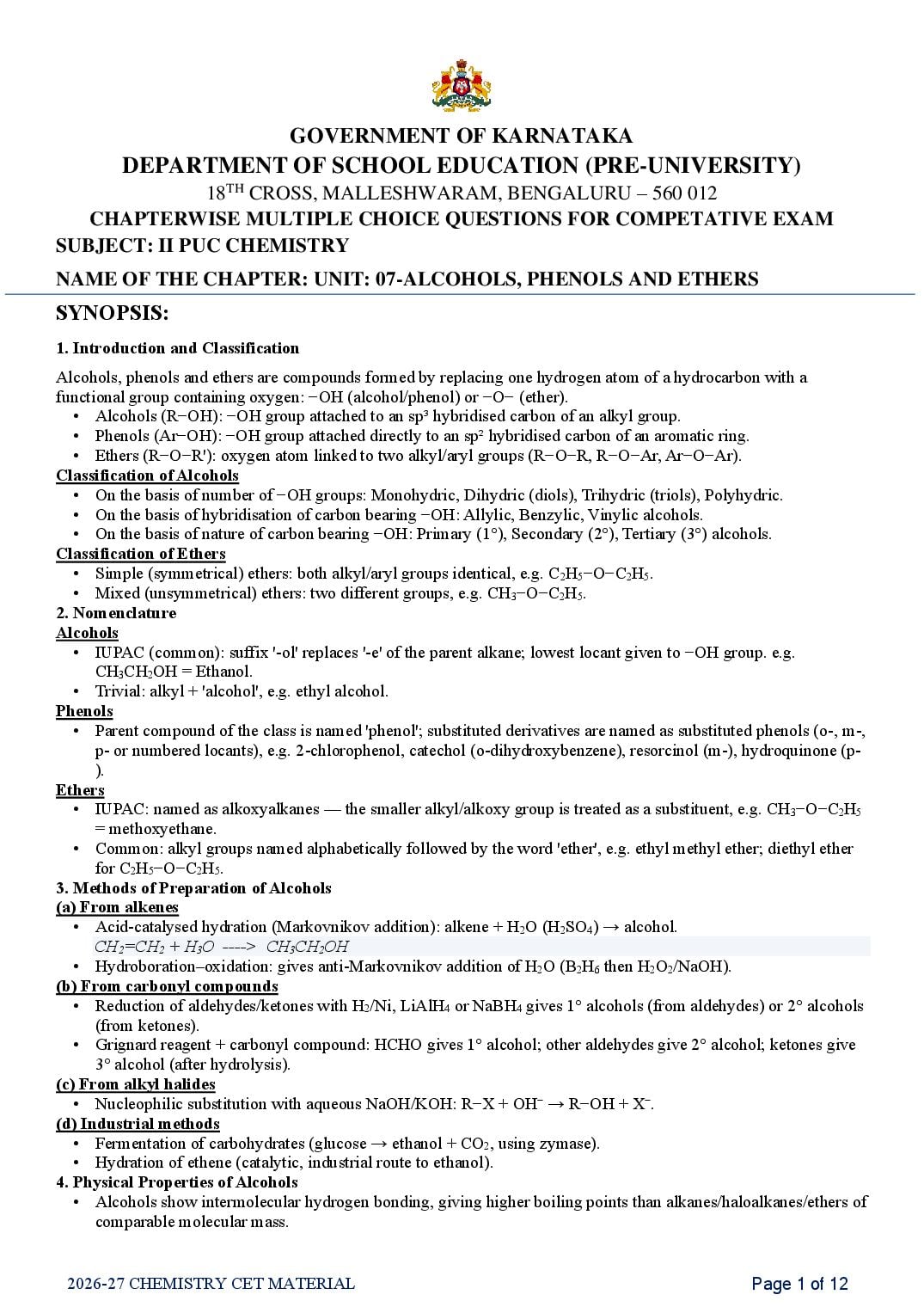
DEPARTMENT OF SCHOOL EDUCATION (PRE-UNIVERSITY)
18TH CROSS, MALLESHWARAM, BENGALURU – 560 012
CHAPTERWISE MULTIPLE CHOICE QUESTIONS FOR COMPETATIVE EXAM
SUBJECT: II PUC CHEMISTRY
NAME OF THE CHAPTER: UNIT: 07-ALCOHOLS, PHENOLS AND ETHERS
SYNOPSIS:
1. Introduction and Classification
Alcohols, phenols and ethers are compounds formed by replacing one hydrogen atom of a hydrocarbon with a
functional group containing oxygen: −OH (alcohol/phenol) or −O− (ether).
• Alcohols (R−OH): −OH group attached to an sp³ hybridised carbon of an alkyl group.
• Phenols (Ar−OH): −OH group attached directly to an sp² hybridised carbon of an aromatic ring.
• Ethers (R−O−R'): oxygen atom linked to two alkyl/aryl groups (R−O−R, R−O−Ar, Ar−O−Ar).
Classification of Alcohols
• On the basis of number of −OH groups: Monohydric, Dihydric (diols), Trihydric (triols), Polyhydric.
• On the basis of hybridisation of carbon bearing −OH: Allylic, Benzylic, Vinylic alcohols.
• On the basis of nature of carbon bearing −OH: Primary (1°), Secondary (2°), Tertiary (3°) alcohols.
Classification of Ethers
• Simple (symmetrical) ethers: both alkyl/aryl groups identical, e.g. C2H5−O−C2H5.
• Mixed (unsymmetrical) ethers: two different groups, e.g. CH3−O−C2H5.
2. Nomenclature
Alcohols
• IUPAC (common): suffix '-ol' replaces '-e' of the parent alkane; lowest locant given to −OH group. e.g.
CH3CH2OH = Ethanol.
• Trivial: alkyl + 'alcohol', e.g. ethyl alcohol.
Phenols
• Parent compound of the class is named 'phenol'; substituted derivatives are named as substituted phenols (o-, m-,
p- or numbered locants), e.g. 2-chlorophenol, catechol (o-dihydroxybenzene), resorcinol (m-), hydroquinone (p-
).
Ethers
• IUPAC: named as alkoxyalkanes — the smaller alkyl/alkoxy group is treated as a substituent, e.g. CH3−O−C2H5
= methoxyethane.
• Common: alkyl groups named alphabetically followed by the word 'ether', e.g. ethyl methyl ether; diethyl ether
for C2H5−O−C2H5.
3. Methods of Preparation of Alcohols
(a) From alkenes
• Acid-catalysed hydration (Markovnikov addition): alkene + H2O (H2SO4) → alcohol.
CH2=CH2 + H3O ----> CH3CH2OH
• Hydroboration–oxidation: gives anti-Markovnikov addition of H2O (B2H6 then H2O2/NaOH).
(b) From carbonyl compounds
• Reduction of aldehydes/ketones with H2/Ni, LiAlH4 or NaBH4 gives 1° alcohols (from aldehydes) or 2° alcohols
(from ketones).
• Grignard reagent + carbonyl compound: HCHO gives 1° alcohol; other aldehydes give 2° alcohol; ketones give
3° alcohol (after hydrolysis).
(c) From alkyl halides
• Nucleophilic substitution with aqueous NaOH/KOH: R−X + OH⁻ → R−OH + X⁻.
(d) Industrial methods
• Fermentation of carbohydrates (glucose → ethanol + CO2, using zymase).
• Hydration of ethene (catalytic, industrial route to ethanol).
4. Physical Properties of Alcohols
• Alcohols show intermolecular hydrogen bonding, giving higher boiling points than alkanes/haloalkanes/ethers of
comparable molecular mass.
2026-27 CHEMISTRY CET MATERIAL Page 1 of 12
Page 2
area).
• Lower alcohols (up to C3) are miscible with water in all proportions due to H-bonding with water; solubility
decreases as the hydrocarbon (hydrophobic) part increases.
• Boiling point order for isomeric alcohols: 1° > 2° > 3° (more branching → weaker H-bonding & lower bp).
5. Chemical Reactions of Alcohols
(a) Reaction with active metals (acidic nature)
• 2R−OH + 2Na → 2R−ONa + H2↑ (sodium alkoxide). Acidic strength: alcohols are weaker acids than water and
phenols; order — 1° > 2° > 3° (due to +I effect of alkyl groups reducing O−H polarity, opposed by decreasing
stability of alkoxide with branching).
(b) Esterification
• R−OH + R'COOH ⇌(H2SO4) R'COOR + H2O — reaction is reversible (Fischer esterification).
(c) Reaction with hydrogen halides
• R−OH + HX → R−X + H2O. Reactivity of HX: HI > HBr > HCl. Reactivity of alcohols: 3° > 2° > 1° (Lucas test
uses conc. HCl + anhydrous ZnCl2 — 3° alcohols give turbidity immediately, 2° within 5 minutes, 1° do not
react at room temperature).
(d) Dehydration
• R−OH --(conc. H2SO4 / Al2O3, heat)--> alkene + H2O, following Zaitsev's rule (more substituted alkene is the
major product). Ease of dehydration: 3° > 2° > 1° (via carbocation stability).
(e) Oxidation
• 1° alcohol --(PCC / mild oxidant)--> aldehyde; aldehyde --(strong oxidant, KMnO4/K2Cr2O7)--> carboxylic acid.
• 2° alcohol --(oxidation)--> ketone (no further oxidation under normal conditions without breaking C−C bond).
• 3° alcohols resist oxidation under normal conditions (no α-H available); under vigorous conditions, C−C bond
cleavage occurs.
• Dehydrogenation: alcohol vapours passed over hot Cu (573 K) — 1° alcohol → aldehyde, 2° alcohol → ketone,
3° alcohol → alkene.
(f) Victor Meyer's test
• Distinguishes 1°, 2°, 3° alcohols using their alkyl iodides converted to nitroalkanes then treated with HNO2 and
NaOH: 1° gives red color, 2° gives blue color, 3° gives no color.
6. Phenols
Methods of Preparation
• From haloarenes: chlorobenzene fused with NaOH at 623 K & 300 atm (Dow's process), followed by
acidification.
• From benzene sulphonic acid: fusion with NaOH, followed by acidification.
• From diazonium salts: benzene diazonium chloride hydrolysed with warm water/dilute acid.
• From cumene (industrial method): cumene (isopropylbenzene) oxidised by air to cumene hydroperoxide, then
treated with dilute acid to give phenol and acetone as by-product.
Acidic Nature of Phenol
Phenol is markedly more acidic than alcohols (pKa ≈ 10 vs ≈ 16 for ethanol) because:
• The phenoxide ion formed after loss of H⁺ is stabilised by resonance (delocalisation of negative charge into the
aromatic ring), whereas alkoxide ions have no such stabilisation.
• The C−O bond in phenol has partial double bond character due to conjugation of the lone pair on oxygen with
the ring, making O−H more polar and easier to ionise.
• Electron-withdrawing groups (−NO2, −X, −CHO) at ortho/para positions increase acidity (further stabilise
phenoxide ion by resonance/ −I effect); electron-donating groups (−OCH3, −CH3, −NH2) decrease acidity.
• Phenol reacts with NaOH to form sodium phenoxide (shows acidic character) but does NOT react with NaHCO3
(weaker acid than carbonic acid) — this distinguishes phenols from carboxylic acids.
Chemical Reactions of Phenol
(a) Reactions involving the −OH group
• Formation of sodium phenoxide with NaOH; esterification with acid chlorides/anhydrides (in presence of base);
formation of ethers via Williamson synthesis.
(b) Electrophilic aromatic substitution (−OH is a strong activating, o/p-directing group)
• Halogenation: phenol + Br2 water → 2,4,6-tribromophenol (white precipitate) — used as a test for phenol.
• Nitration: phenol + dilute HNO3 (room temperature) → mixture of o- and p-nitrophenol (separated by steam
distillation; o-nitrophenol is steam volatile due to intramolecular H-bonding, p-nitrophenol has intermolecular
H-bonding and higher bp).
• Sulphonation: with conc. H2SO4 gives o-phenolsulphonic acid at low temperature and p-phenolsulphonic acid at
higher temperature (thermodynamic vs kinetic control).
(c) Kolbe's Reaction
2026-27 CHEMISTRY CET MATERIAL Page 2 of 12
Page 3
acid) — electrophilic substitution of the phenoxide ring by CO2.
(d) Reimer–Tiemann Reaction
• Phenol + CHCl3 + NaOH (aq), followed by hydrolysis, gives salicylaldehyde (o-hydroxybenzaldehyde) via
dichlorocarbene intermediate.
(e) Friedel–Crafts Reaction
• Phenol reacts with alkyl halides (AlCl3) or acyl halides to give C-alkylated/acylated products (ortho and para);
with acyl halides in presence of anhydrous AlCl3 the acyl group may migrate to ring (Fries rearrangement).
(f) Coupling reaction
• Phenol couples with benzene diazonium chloride in weakly alkaline medium to give p-hydroxyazobenzene (an
azo dye).
7. Ethers
Methods of Preparation
• Williamson's synthesis (most important method): alkyl halide + sodium alkoxide/phenoxide → ether + NaX.
R−X + R'−ONa → R−O−R' + NaX. Works best with 1° alkyl halides (SN2); 3° alkyl halides give elimination
instead of substitution.
• Dehydration of alcohols: 2R−OH --(conc. H2SO4, 413K)--> R−O−R + H2O (intermolecular dehydration; works
well for symmetrical ethers from 1° alcohols).
Physical Properties
• Ethers are polar molecules but cannot form intermolecular H-bonds among themselves (no O−H), so their
boiling points are close to alkanes of similar mass and much lower than isomeric alcohols.
• Ethers can act as H-bond acceptors with water, giving them modest solubility in water comparable to alcohols of
similar chain length.
Chemical Reactions
(a) Cleavage of C−O bond by HX (characteristic reaction of ethers)
• R−O−R' + HX (excess, heat) → R−X + R'−OH → (further with excess HX) → R−X + R'−X. Reactivity of HX:
HI > HBr > HCl.
• With mixed alkyl-aryl ethers, cleavage always gives phenol + alkyl halide (aryl−O bond does not break because
of resonance stabilisation / partial double bond character of Ar−O bond).
(b) Electrophilic substitution (aromatic ethers, e.g. anisole)
• The −OR group is o/p-directing and ring activating (like −OH), so anisole undergoes halogenation, nitration,
sulphonation, and Friedel-Crafts reactions predominantly at ortho and para positions.
Quick Comparison Tables
Acidity Order
Carboxylic acid > Carbonic acid > Phenol > Water > Alcohol (1° > 2° > 3°)
Boiling Point Order (similar molar mass)
Alcohol > Ether ≈ Haloalkane > Alkane
Key Distinguishing Tests
Test Reagent Positive Result
Lucas test Conc. HCl + anhydrous ZnCl2 3° alcohol: turbidity at once; 2°: within 5 min; 1°: no
turbidity at room temp.
Ceric ammonium nitrate Ce(NH4)2(NO3)6 Alcohols give red color (forms complex);
test distinguishes –OH bearing compounds.
Iodoform test I2/NaOH Positive for CH3CH(OH)− group (ethanol, 2°
alcohols with methyl carbinol group) — yellow
precipitate of CHI3.
Bromine water test Br2 water Phenol gives white precipitate of 2,4,6-
tribromophenol instantly.
FeCl3 test Neutral FeCl3 solution Phenols give violet/purple coloration
(enolic/phenolic –OH); alcohols do not.
Important Uses
Alcohols
• Ethanol: solvent, in beverages, antiseptic, manufacture of other organic compounds, fuel (blended with petrol).
• Methanol: solvent, fuel, manufacture of formaldehyde.
Phenols
• Antiseptic and disinfectant (dilute solution); manufacture of Bakelite, dyes, drugs (aspirin from salicylic acid)
and picric acid.
Ethers
• Diethyl ether: was widely used as an anaesthetic and as a laboratory/industrial solvent.
2026-27 CHEMISTRY CET MATERIAL Page 3 of 12
Page 4
• Phenol is more acidic than alcohol due to resonance stabilisation of phenoxide ion; alcohols are more acidic than
terminal alkynes but less acidic than water.
• Ortho-nitrophenol is steam volatile (intramolecular H-bonding / chelation); para-nitrophenol is not
(intermolecular H-bonding, higher bp, more soluble in water).
• Anisole (aromatic ether) undergoes electrophilic substitution at ortho/para due to +R effect of −OR group,
similar to phenol.
• Williamson synthesis fails to give good yield of ether when a 3° alkyl halide is used with an alkoxide, since
elimination (E2) competes with and often dominates over substitution.
• Ethers cleave with HI to give alkyl iodide + alcohol/phenol; with aryl alkyl ethers, only the alkyl−O bond
breaks, never the aryl−O bond.
• Tertiary alcohols cannot be oxidised to carboxylic acids/ketones under mild conditions because they lack an α-
hydrogen atom on the carbon bearing −OH.
• Order of reactivity of alcohols towards HX: 3° > 2° > 1° (via carbocation mechanism, SN1); order of reactivity
of HX: HI > HBr > HCl.
• Kolbe's reaction and Reimer–Tiemann reaction both proceed through the highly nucleophilic phenoxide ion,
introducing −COOH (as salicylic acid) or −CHO (as salicylaldehyde) at the ortho position respectively.
7.1 Classification:
1. Which of the following is a primary (1°) alcohol?
(a) Propan-2-ol (b) 2-Methylpropan-2-ol
(c) Ethanol (d) Cyclohexanol
2. Which compound is correctly classified?
(a) Benzyl alcohol – Phenol (b) Phenol – Alcohol
(c) Anisole – Aromatic ether (d) Ethanol – Ether
3. The general formula of an aliphatic alcohol is
(a) R-H (b) R-OH
(c) R-CHO (d) R-COOH
7.2 Nomenclature:
4. Match the column I with column II and mark the appropriate choice
Column I Column II
A) Tertiary alcohol i) Butan – 2 – ol
B) Allylic alcohol ii) 2 – Methylpropano – 2 – ol
C) Secondary alcohol iii) Propan – 1 – ol
D) Primary alcohol iv) Prop – 2 – en – 1 – ol
(a) A-ii, B-iv, C-i, D-iii b) A-ii, B-i, C-iv, D-iii
(c) A-i, B-ii, C-iii, D-iv d) A-i, B-iv, C-iii, D-ii
5. In allylic and benzylic alcohols, – OH group is attached to
(a) sp2and sp2 – hybridized carbon atom respectively
(b) sp 3and sp3 – hybridized carbon atom respectively
c) sp 2and sp 3 – hybridized carbon atom respectively
d) sp 3and sp 2 – hybridized carbon atom respectively
6. In vinylic alcohols, – OH group is bonded to
2026-27 CHEMISTRY CET MATERIAL Page 4 of 12
Page 5
b) sp 3 – hybridized carbon atom of alkane
c) sp 2 – hybridized carbon atom of alkene
d) Both a and c
7. Catechol is an example of
a) Dihydric alcohol b) Monohydric alcohol
c) Trihydric alcohol d) Benzylic alcohol
8. Quinol is
OH OH OH OH
OH
a) b) c) d)
OH HO OH
OH
9. The correct IUPAC name of Isobutyl alcohol is
a) Butan – 2 – ol b) Butan – 1 – ol
c) 2 – Methylpropan – 1 – ol d) 2 – Methylpropan – 1 – ol
CH3
CH3 O CH CH3
10. The common and IUPAC name of the fallowing compound are
a) methylpropyl ether and 2 – methoxypropane
b) diethyl ether and 1 – methoxylpropane
c) ethylmethy ether and 1 – methoxypropane
d) methylisopropyl ether and 2 – methoxypropane.
11. Which of the following shows structure of allylic alcohol?
(i) CH2 =CH -CH2OH (ii) CH2 =CH –OH (iii) CH2=CH-CH(CH3)OH (iv) CH2 = CH - C (CH3)2 OH
a) (i), (iii) and (iv) b) (i), (ii) and (iv)
c) (ii), (iii) and (iv) d) (i), (ii), (iii) and (iv)
12. What is the IUPAC name of the organic compound formed in the following chemical reaction?
( i ) C2 H 5MgBr , dry Ether
Acetone ⎯⎯⎯⎯⎯⎯⎯ (ii )H O ,H +
→ Product [NEET-2021]
2
(a) Pentan-2ol (b) Pentan-3-ol
(c) 2-methyl butan-2-ol (d) 2-methyl propan-2-ol
7.3 Structures of Functional Groups:
13. The hybridisation of oxygen in phenol and the nature of C-O bond compared to alcohols is:
(a) sp3 oxygen; C-O bond length same as alcohols
(b) The oxygen has partial sp2 character due to conjugation with the ring, making the C-O bond shorter
than in alcohols
(c) sp oxygen; C-O bond longer than in alcohols
(d) No difference between phenol and alcohol C-O bonds.
14. The C-O-C bond angle in dimethyl ether is approximately:
(a) 109.5 degrees, exactly tetrahedral.
(b) 111.7 degrees (slightly more than tetrahedral due to bulkier alkyl groups)
2026-27 CHEMISTRY CET MATERIAL Page 5 of 12
Page 6
(d) 90 degrees
15. Which compound contains an sp²-hybridized carbon attached to –OH?
(a) Ethanol (b) Methanol
(c) Phenol (d) Propan-1-ol
16. Which statement correctly explains why the C–O bond in phenol is shorter than the C–O bond in
cyclohexanol?
(a) Carbon in phenol is sp³ hybridized. (b) The oxygen atom in phenol is sp² hybridized.
(c) Resonance between the oxygen lone pair and the benzene ring gives the C–O bond partial double
bond character.
d) Hydrogen bonding shortens the C–O bond.
17. The order of C–O bond strength is:
(a) Alcohol > Ether > Phenol b) Phenol > Ether > Alcohol
(c) Ether > Phenol > Alcohol d) Alcohol > Phenol > Ether
18. Assertion (A): The C–O bond in phenol is shorter than the C–O bond in ethanol.
Reason (R): The lone pair of electrons on oxygen in phenol participates in resonance with the benzene
ring.
a) Both A and R are true, and R is the correct explanation of A.
b) Both A and R are true, but R is not the correct explanation of A.
c) A is true, but R is false.
d) A is false, but R is true.
7.4.1 Preparation of Alcohols:
19. When vapours of a secondary alcohol is passed over heated copper at 573 K, the product formed is :-
(a) a carboxylic acid (b) an aldehyde
(c) a ketone (d) an alkene
20. CH3CH2CH = CH2 ⎯⎯⎯⎯⎯→
B2 H6
H O,H O ,OH−
Z What is Z?
2 2 2
(a) CH3CH2CH2CH2OH (b) CH3CH2CH(OH)CH3
(c) CH3CH2CH2CHO (d) CH3CH2CH2CH3
21. Reaction between acetone and methylmagnesium chloride followed by hydrolysis will give: [2020]
(a). Isobuty alcohol (b). Isopropyl alcohol
(c). Sec butyl alcohol (d). Tert butyl alcohol
22. Compound C3H6 on hydrolysis with dil. acid give a product ‘X’ and the same compound on
hydroboration oxidation give a product ‘Y’. Find X and Y
a) X= 1 – propanol and Y= 1 – propanol b) X= 2 – propanol and Y= 2 – propanol
c) X= 1 – propanol and Y= 2 – propanol d) X= 2 – propanol and Y= 1 – propanol
Pd or Pt
23. Identify the product A of the following reaction, R − CHO + H2 → A
a) RCOR b) R – H
c) R – CH2 – OH d) None of these
24. The agent used to convert ketone to secondary alcohols is
a) K2Cr2O7/H+ b) NaBH4
c) KMnO4/H+ d) All the above
25. The agent used to reduce carboxylic to primary alcohols in excellent yield is
2026-27 CHEMISTRY CET MATERIAL Page 6 of 12
Page 7
c) NaBH4 d) Nickel
26. Primary alcohols can be prepared by the reaction of
a) Formaldehyde and methyl magnesium iodide
b) Acetaldehyde and methyl magnesium iodide
c) Acetaldehyde and ethyl magnesium iodide
d) Acetone and ethyl magnesium iodide
27. The IUPAC name of the product ‘B’ in the fallowing reaction is
O
H
a) 2 – Methylbutan – 3 – ol b) 2 – Methylbutan – 2 – ol
c) Butan – 2 – ol d) 3 – Methylbutan – 2 – ol
28. Which is formed when benzalamine react with nitrous acid [KCET (Med.) 2001]
(a) C6 H 5 OH (b) C6 H 5 ON
(c) C2 H 5 N 2 OH (d) C6 H 5 CH 2 OH
7.4.2 Preparation of Phenols:
29. The structure of intermediate A in the following reaction is:-
(a) (b)
(c) (d)
30. Chlorination of toluene in the presence of light and heat followed by treatment with aqueous NaOH gives
(a) o-cresol (b) p-cresol
(c)2, 4-dihydroxy toluene (d) Benzyl alcohol
31. On heating aqueous solution of benzene diazonium chloride, which is formed
(a) Benzene (b) Chlorobenzene
(c) Phenol (d) Aniline
32. Benzene diazonium chloride on boiling with dilute sulphuric acid gives
(a) Toluene (b) Benzoic acid
2026-27 CHEMISTRY CET MATERIAL Page 7 of 12
Page 8
33. Phenol cannot be prepared directly from chlorobenzene under ordinary conditions because:
(a). C–Cl bond is highly polar
(b) C–Cl bond has partial double bond character due to resonance
(c). Chlorobenzene is unstable
(d). Phenol is acidic
34. Which process is mainly used in industry for the manufacture of phenol?
(a). Dow's process (b) Cumene process
(c). Diazotization process (d). Reimer–Tiemann reaction
35. The correct sequence in the preparation of phenol from aniline is:
(a). Diazotization → Hydrolysis (b). Hydrolysis → Diazotization
(c). Nitration → Diazotization (d). Sulphonation → Hydrolysis
36. The oxidation product of cumene before acid cleavage is:
(a) Cumyl chloride (b) Cumene hydroperoxide
(c) Cumyl alcohol (d) Benzyl alcohol
7.4.3 Physical Properties:
37. Solubility of alcohols in water is due to
(a) their ability to form hydrogen bonds with H2O molecules
(b) they are lighter than water
(c) they do not form hydrogen bonds with H2O molecules
(d) None of the above
38. Glycerol is more viscous than ethanol due to
(a) high molecular weight (b) high boiling point
(c) many hydrogen bonds per molecule (d) Fajan’s rule
39. Statement I: The boiling point of alcohols and phenols are higher than ethers and hydrocarbons.
Statement II: Due to intramolecular hydrogen bonding in ethers and hydrocarbons, boiling point
decreases.
(a) Both statement I and II are correct (b) Statement I is correct and II is incorrect
(c) Statement I is incorrect and II is correct (d) Both statement I and II are incorrect
40. Arrange the following sets of compounds in the order of their increasing boiling points
i) Propan–1–ol ii) Butan–1–ol
iii) Butan–2–ol iv) Pentan–1–ol
(a) (iv) > (ii) > (iii) > (i) (b) (iv) > (iii) > (ii) > (i)
(c) (i) > (ii) > (iii) > (iv) (d) (i) > (iii) > (ii) > (iv)
7.4.4 Chemical Reactions:
41. Which of the following reagents would distinguish cis-cyclopenta-1,2-diol from the trans-isomer?
(a) Acetone (b) Ozone
(c) MnO2 (d) Aluminium isopropxide
2026-27 CHEMISTRY CET MATERIAL Page 8 of 12
Page 9
of the following functional group?
(a) –CH2Cl (b) –COOH
(c) –CHCl2 (d) –CHO
43. Which of the following is not the product of dehydration of
44. Among the following sets of reactants which one produces anisole?
(a) CH3CHO; RMgX (b) C6H5OH; NaOH ; CH3I
(c) C6H5OH; neutral FeCl3 (d) C6H5–CH3; CH3COCl; AlCl3
45. Which of the following will not be soluble in sodium hydrogen carbonate?
(a) 2, 4, 6-trinitrophenol (b) Benzoic acid
(c) o-Nitrophenol (d) Benzenesulphonic acid
46. Identify Z in the sequence of reactions:
47. The major products C and D formed in the following reactions respectively are :- [2019]
(a) H3C–CH2–CH2–I and I–C(CH3)3 (b) H3C–CH2–CH2–OH and I–C(CH3)3
(c) H3C–CH2–CH2–I and HO–C(CH3)3 (d) H3C–CH2–CH2–OH and HO–C(CH3)3
48. Which of the following substituted phenols is the strongest acid? [2020]
(a) (b)
(c) (d)
49. Compound A, C8H10O, is found to react with NaOI (produced by reacting Y with NaOH) and yields a
yellow precipitate with characteristic smell. A and Y are respectively [2018]
2026-27 CHEMISTRY CET MATERIAL Page 9 of 12
Page 10
diethyl ether. A, B and C are in the order. [2018]
a) C2H5OH, C2H6, C2H5Cl b) C2H5OH, C2H5Cl, C2H5ONa
c) C2H5 OH, C2H5ONa, C2H5Cl d) C2H5Cl, C2H6, C2H5OH
51. Choose the incorrect statement
a) Tertiary alcohols do not produce turbidity at room temperature
b) Tertiary alcohols produce turbidity at room temperature
c) Primary alcohols produce turbidity on heating
d) Secondary alcohols produce turbidity after few minutes
52. CH3CH(OH)CH3 on reaction with Lucas reagent gives
a) immediate turbidity b) turbidity on heating
c) turbidity after few minutes d) no turbidity
53. Ethanol undergoes dehydration by
(a) conc.H2SO4 (b) conc. H3PO4
(c) Al2O3 (d) All the above
7.5 Some Commercially Important Alcohols:
54. Which commercially important alcohol is commonly known as wood alcohol?
(a) Ethanol (b) Methanol
(c) Propanol (d) Glycerol
55. Methanol is industrially prepared by the catalytic hydrogenation of:
(a)Formaldehyde (b) Carbon monoxide
(c) Carbon monoxide and hydrogen (d) Carbon dioxide
56. Ethanol is manufactured commercially by fermentation of:
(a) Starch (b) Molasses
(c) Cellulose (d) Glucose only
57. Absolute alcohol is obtained by removing water from:
(a) 50% ethanol (b) 70% ethanol
(c) 95% ethanol (d) 80% ethanol
58. Denatured alcohol is:
(a) Pure ethanol
2026-27 CHEMISTRY CET MATERIAL Page 10 of 12
Page 11
(c) Methanol
(d) Ethylene glycol
7.6.1 Preparation of Ethers:
59. The reaction is called
(a) Williamson continuous etherification process (b) Etard reaction
(c) Gatterman - Koch reaction (d) Williamson Synthesis
60. Ethanol is converted in to ethoxyethane (CET-2025)
(a) by heating excess of ethanol with conc.H2SO4 at 1400C
(b) by heating excess of ethanol with conc.H2SO4 at 443K
(c) by treating with conc. H2SO4 at room temperature
(d) by treating with conc. H2SO4 at 273K
61. CH3ONa + CH3Br CH3OCH3 + NaBr ; the reaction fallows
(a) radical mechanism b) SN2 mechanism
(c) SN1 mechanism d) E1 mechanism
62. (CH3)3CONa + CH3Br (CH3)3CO CH3 + NaBr ; the reaction fallows
a) SN1 mechanism b) SN2 mechanism
c) E1 mechanism d) E2 mechanism
63. The method used to prepare (CH3)3OC2H5, with a good yield
a) mixing (CH3)3CBr with C2H5ONa b) mixing C2H5Br with (CH3)3CONa
c) mixing C2H5OH with (CH3)3COH d) mixing C2H5COOH with (CH3)3COH
64. The major product obtained in the reaction of (CH3)3CBr with CH3ONa and this reaction follows
a) ether and nucleophilic substitution reaction
b) ether and elimination reaction
c) alkene and nucleophilic substitution reaction
d) alkene and elimination reaction
7.6.3 Chemical Reactions:
65. The heating of phenyl-methyl ethers with HI produces [2017]
(a) iodobenzene b) phenol
(c) benzene d) ethyl chlorides
66. The reaction
can be classified as :-
2026-27 CHEMISTRY CET MATERIAL Page 11 of 12
Page 12
c) Dehydration reaction d) Williamson alcohol synthesis reaction
67. Anisole is obtained by the action of
a) phenol with methyl magnesium iodide b) phenol with methanol
c) iodobenzene with sodium methoxide d) sodium phenate with methyl iodide
68. CH3 – O – C2H5 + HI→ X + Y ; X and Y are
a) CH3OH + C2H5I b) CH3I + C2H5OH
c) CH3OH + C2H5OH d) CH3I+ C2H5I
69. The heating of ethyl phenyl ether with HI produces
a) phenol and ethyl iodide b) iodo benzene and ethyl alcohol
c) iodo benzene with ethyl iodide d) phenol and ethyl alcohol
70. Phenetole +HI → X + Y; X and Y are
a) C6H5I + CH3OH b) C6H5I + CH3CH2OH
c) C6H5OH + CH3CH2I d) C6H5OH + CH3I
71. The one which produce methyl alcohol on treatment with hot concentrated HI is
a) (CH3)3CO CH3 b) CH3 – CH(CH3) – O – CH3
c) CH3 – CH2 – CH2 – CH2 – O – CH3 d) CH3 – CH2 – CH(CH3) – O – CH3
72. The order of reactivity of HX to break the C – O – C bond in ether is
a) HCl>HBr> HI b) HBr>HCl> HI
c) HI >HBr>HCl d) HI >HCl>HBr
73. CH2 = CH – O –CH2 – CH3 reacts with one mole of HI, the product formed is
a) ethane b) ethanol
c) ethanal d) iodoethane
74. An ether (A), C5H12O, when heated with excess of hot concentrated HI produced two alkyl halides
which when treated with NaOH yielded compounds (B) and (C) Oxidation of (B) and (C) gave a
propanone and an ethanoic acid respectively. The IUPAC name of the ether(A) is:
a) Ethoxypropane b) 2 – Methoxybutane
c) 2 – Ethoxypropane d) Methoxybutane
Key Answer:
1 c 2 c 3 b 4 a 5 d 6 c 7 a 8 a 9 c 10 d
11 a 12 c 13 b 14 b 15 c 16 c 17 d 18 a 19 c 20 a
21 d 22 d 23 c 24 b 25 b 26 a 27 c 28 d 29 b 30 d
31 c 32 d 33 b 34 b 35 a 36 b 37 a 38 c 39 b 40 d
41 a 42 d 43 b 44 b 45 c 46 a 47 a 48 a 49 d 50 c
51 a 52 c 53 d 54 b 55 c 56 b 57 c 58 b 59 d 60 a
61 b 62 b 63 b 64 d 65 b 66 a 67 d 68 b 69 a 70 c
71 a 72 c 73 d 74 c
2026-27 CHEMISTRY CET MATERIAL Page 12 of 12
Document Details
| Board / Org | Karnataka Board |
| Exam | Class 12 |
| Type | Question Bank |
| Pages | 12 |
| Updated | 24 Sep 2026 |