Karnataka 2nd PUC Chemistry Aldehydes Ketones and Carboxylic Acids MCQ with Answers
Finished viewing? Save it for later —
Download Karnataka 2nd PUC Chemistry Aldehydes Ketones and Carboxylic Acids MCQ with Answers (PDF · 9 pages)About Karnataka 2nd PUC Chemistry Aldehydes Ketones and Carboxylic Acids MCQ with Answers
Karnataka 2nd PUC Chemistry Aldehydes Ketones and Carboxylic Acids MCQ with Answers is available here for free download. Published by Karnataka Board for Class 12, this question bank can be viewed online or downloaded as a PDF (9 pages). Candidates preparing for Class 12 can use Karnataka 2nd PUC Chemistry Aldehydes Ketones and Carboxylic Acids MCQ with Answers to understand the exam pattern, the type of questions asked, and the overall difficulty level.
Frequently Asked Questions
How can I download Karnataka 2nd PUC Chemistry Aldehydes Ketones and Carboxylic Acids MCQ with Answers?
Open this page and click the Download button to save Karnataka 2nd PUC Chemistry Aldehydes Ketones and Carboxylic Acids MCQ with Answers as a PDF. It is completely free on AglaSem Docs.
Is Karnataka 2nd PUC Chemistry Aldehydes Ketones and Carboxylic Acids MCQ with Answers free to download?
Yes. Karnataka 2nd PUC Chemistry Aldehydes Ketones and Carboxylic Acids MCQ with Answers can be viewed online and downloaded as a PDF free of cost on AglaSem Docs.
How many pages does Karnataka 2nd PUC Chemistry Aldehydes Ketones and Carboxylic Acids MCQ with Answers have?
Karnataka 2nd PUC Chemistry Aldehydes Ketones and Carboxylic Acids MCQ with Answers contains 9 pages, which you can read online or download together as a single PDF.
Where can I find more Class 12 study material?
You can find more Class 12 question papers, sample papers, syllabus, and answer keys on AglaSem Docs.
Karnataka 2nd PUC Chemistry Aldehydes Ketones and Carboxylic Acids MCQ with Answers – Text
Read the full text of this question bank below — useful to quickly search, copy and reference the content online without downloading the PDF.
📄 View text version (9 pages)
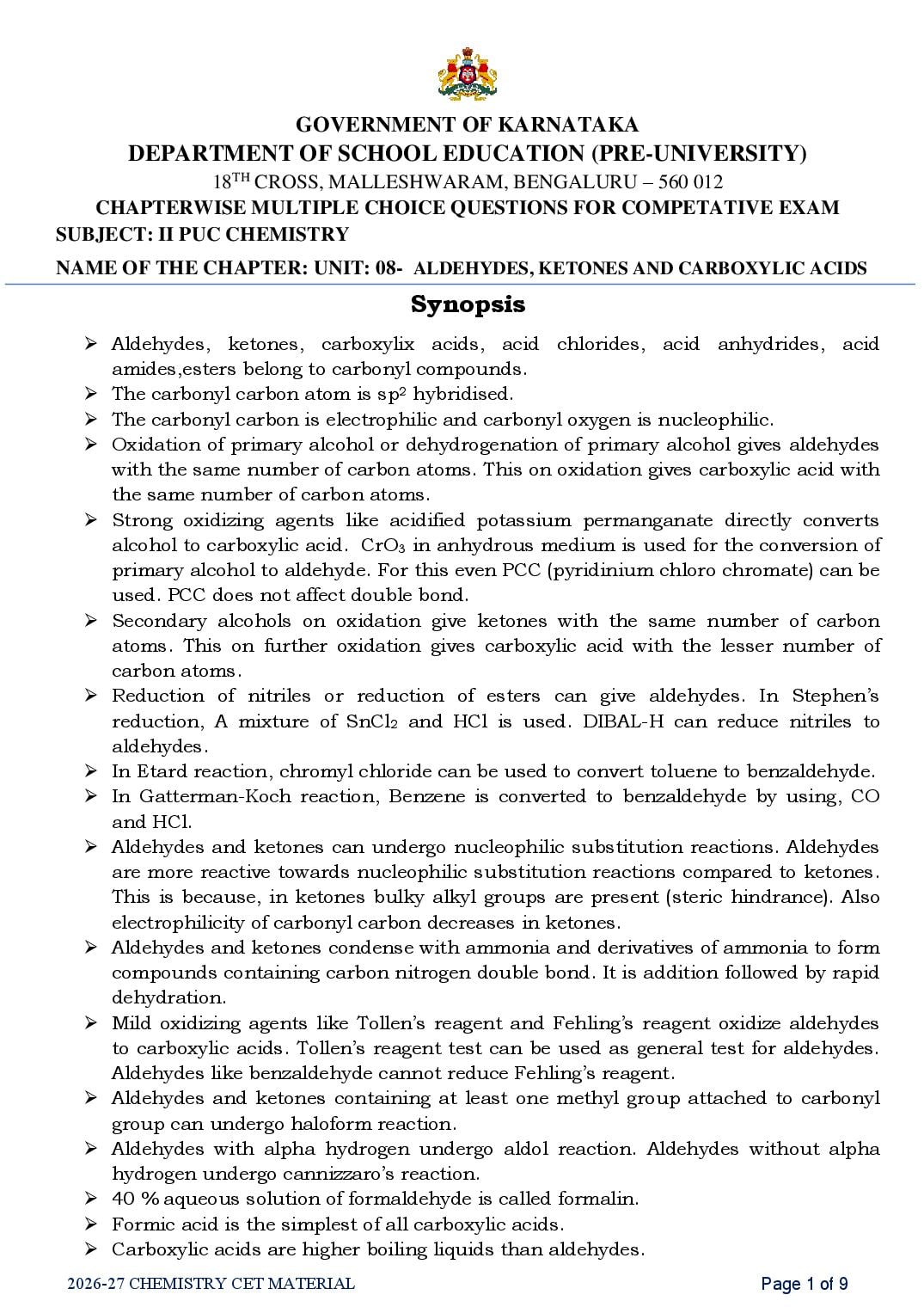
Page 1
DEPARTMENT OF SCHOOL EDUCATION (PRE-UNIVERSITY)
18TH CROSS, MALLESHWARAM, BENGALURU – 560 012
CHAPTERWISE MULTIPLE CHOICE QUESTIONS FOR COMPETATIVE EXAM
SUBJECT: II PUC CHEMISTRY
NAME OF THE CHAPTER: UNIT: 08- ALDEHYDES, KETONES AND CARBOXYLIC ACIDS
Synopsis
➢ Aldehydes, ketones, carboxylix acids, acid chlorides, acid anhydrides, acid
amides,esters belong to carbonyl compounds.
➢ The carbonyl carbon atom is sp2 hybridised.
➢ The carbonyl carbon is electrophilic and carbonyl oxygen is nucleophilic.
➢ Oxidation of primary alcohol or dehydrogenation of primary alcohol gives aldehydes
with the same number of carbon atoms. This on oxidation gives carboxylic acid with
the same number of carbon atoms.
➢ Strong oxidizing agents like acidified potassium permanganate directly converts
alcohol to carboxylic acid. CrO3 in anhydrous medium is used for the conversion of
primary alcohol to aldehyde. For this even PCC (pyridinium chloro chromate) can be
used. PCC does not affect double bond.
➢ Secondary alcohols on oxidation give ketones with the same number of carbon
atoms. This on further oxidation gives carboxylic acid with the lesser number of
carbon atoms.
➢ Reduction of nitriles or reduction of esters can give aldehydes. In Stephen’s
reduction, A mixture of SnCl2 and HCl is used. DIBAL-H can reduce nitriles to
aldehydes.
➢ In Etard reaction, chromyl chloride can be used to convert toluene to benzaldehyde.
➢ In Gatterman-Koch reaction, Benzene is converted to benzaldehyde by using, CO
and HCl.
➢ Aldehydes and ketones can undergo nucleophilic substitution reactions. Aldehydes
are more reactive towards nucleophilic substitution reactions compared to ketones.
This is because, in ketones bulky alkyl groups are present (steric hindrance). Also
electrophilicity of carbonyl carbon decreases in ketones.
➢ Aldehydes and ketones condense with ammonia and derivatives of ammonia to form
compounds containing carbon nitrogen double bond. It is addition followed by rapid
dehydration.
➢ Mild oxidizing agents like Tollen’s reagent and Fehling’s reagent oxidize aldehydes
to carboxylic acids. Tollen’s reagent test can be used as general test for aldehydes.
Aldehydes like benzaldehyde cannot reduce Fehling’s reagent.
➢ Aldehydes and ketones containing at least one methyl group attached to carbonyl
group can undergo haloform reaction.
➢ Aldehydes with alpha hydrogen undergo aldol reaction. Aldehydes without alpha
hydrogen undergo cannizzaro’s reaction.
➢ 40 % aqueous solution of formaldehyde is called formalin.
➢ Formic acid is the simplest of all carboxylic acids.
➢ Carboxylic acids are higher boiling liquids than aldehydes.
2026-27 CHEMISTRY CET MATERIAL Page 1 of 9
Page 2
or diborane. Sodium borohydride does not reduce the carboxyl group.
➢ Decarboxylation of carboxylic acids gives corresponding hydrocarbon.
➢ Electrophilic substitution of aromatic carboxylic acids give meta substituted
products.
8.1 Nomenclature and structure of carbonyl group:
1. Which of the following is not true about structure of carbonyl group?
(a) carbon uses sp2 hybrid orbitals while oxygen uses its unhybrid atomic orbitals.
(b) all the three sigma bonds lie in the same plane and are inclined to one another at an angle of 1200.
(c) the electron cloud of the pi bond lies both above and below the C-O sigma bond.
(d) carbon uses sp3 hybrid orbitals while oxygen uses its unhybrid atomic orbitals
2. Read the following statements and answer and select the correct option from the given choices:
Statement-I : The carbonyl carbon is electrophilic and carbonyl oxygen is nucleophilic.
Statement-II : Carbonyl compounds are more polar than ethers.
(a) Statements I and II are correct
(b) Statement-I is correct and statement-II is incorrect
(c) Statement-I is incorrect and statement-II is correct
(d) Statements I and II are incorrect.
3. IUPAC name of
(a) 1-Phenylethanal (b) 2-Phenylethanal
(c) ethane carbaldehyde (d) enzene carbaldehyde.
4. IUPAC name of
(a) 1-Methyl cyclohexanone (b) 2-Methylcyclohexanone.
(c) Methoxy cyclohexanone (d) 3-Methyl cyclohexanone.
5. The number of sigma and pi bonds present in one carbonyl group respectively are,
(a) 3 and 1 (b) 3 and 2
(c) 4 and 1 (d) 4 and 2.
8.2 Preparation of aldehydes and ketones:
6. A reagent used to prevent the further oxidation of aldehydes to carboxylic acids or for the controlled
oxidation of primary alcohols to aldehydes is
(a) K2Cr2O7/H2SO4. (b) KMnO4/ H2SO4
2026-27 CHEMISTRY CET MATERIAL Page 2 of 9
Page 3
7. An alkene X on ozonalysis gives acetone and formaldehyde. Alkene X is
(a) 1-Methylprop-1-ene (b) 2-Methylprop-1-ene
(c) But-1-ene (d) But-2-ene.
8. Nitriles can be reduced to imines which on hydrolysis gives aldehydes.
A : SnCl2 + HCl B : DIBAL-H . Reducing agent/s used is/are,
(a) A or B can be used (b) A can be used, but not B
(c) B can be used, but not A (d) neither A nor B can be used.
9. Toluene on oxidation using chromyl chloride followed by hydrolysis gives the compound
benzaldehyde. This reaction is called
(a) Stephen reaction (b) Etard reaction
(c) Gatterman-Koch reaction (d) Rosenmund reduction.
10. Benzal chloride on hydrolysis at 373K gives
(a) acetaldehyde (b) methyl benzene
(c) benzene (d) benzaldehyde.
11. Propiophenone can be prepared by treating benzene with X in the presence of anhydrous aluminium
chloride. The compound X is
(a) CH3COCl (b) CH3CH3
(c) C2H5COCl (d) CH3Cl.
12. The reduction of benzoyl chloride with Pd and BaSO4/CaCO3 produces
(a)Benzyl chloride (b)Benzoic acid
(c)Benzaldehyde (d) acetone.
13. Statement- I : Reduction of ester by DIBAL-H followed by hydrolysis gives aldehyde.
Statement –II : Oxidation of benzyl alcohol with aqueous KMnO4 leads to the formation of
benzaldehyde.
Among the above statements, identify the correct statement.
(a) Both statements I and II are false
(b) Statement –I is true but statement- II is false
(c) Statement-I is false but statement-II is true
(d) Both statements –I and II are true. (KCET 2025)
8.3 Physical properties:
14. Which of the following is a gas at room temperature?
(a) acetone (b) acetaldehyde
(c) formaldehyde (d) benzaldehyde.
15. The correct order of boiling points of the given compounds is
(a) propan-1-ol > propanal > n-butane (b) propanal > n-butane > propan-1-ol
(c) propan-1-ol > n-butane > propanal (d) n-butane > propanal > propan-1-ol.
16. Among methanal, ethanal , propanone and butanone, the compound with highest solubility in water is
(a) ethanal (b) methanal
2026-27 CHEMISTRY CET MATERIAL Page 3 of 9
Page 4
17. The lower members of aliphatic carboxylic acids are soluble in water. This is due to
(a) formation of hydrogen bond with water (b) London forces
(c) water is non-electrolyte (d) van der Waal’s interaction with water
(KCET 2017)
8.4 Chemical reactions:
18. Which of the following is a correct order for the reactivity towards nucleophilic addition reactions?
(a) acetone > acetaldehyde > formaldehyde
(b) formaldehyde > acetone > acetaldehyde
(c) acetone > formaldehyde > acetaldehyde
(d) formaldehyde > acetaldehyde > acetone.
19. In the addition of sodium bisulphite to aldehydes and ketones,
(a) sterically hindered aldehydes and ketones form addition compounds
(b) adducts decompose with acids or alkalies to regenerate original aldehydes or ketones.
(c) the position of equilibrium lies largely to the left for aldehydes and to the right for ketones.
(d) bisulphite addition products are usually highly soluble in water.
20. The suitable reducing agent for the conversion of But-2-enal-1-al to But-2-en-1-ol is
(a) NaBH4 (b) H2/Ni
(c) Sn + HCl (d) LiAlH4.
21. CH3-CHO CH3 - CH = N- NH2 CH3 - CH3 + Y → M
Z
(a) X = hydroxyl amine, Y = chlorine in presence of diffused sunlight, Z = ethane.
(b) X =hydrazine, Y = chlorine in presence of diffused sunlight, Z = ethene.
(c) X = Zn-Hg + con.HCl, Y = chlorine in presence of diffused sunlight, Z = ethene.
(d) X = hydrazine, Y = ferric chloride, Z = ethane.
22. Which of the following compounds cannot be converted into benzoic acid by treating with alkaline
potassium permanganate followed by acidification?
(a) Ethyl benzene (b) Acetophenone
(c) Methyl benzene (d) benzene
23. In the reaction,
A + H2 B (CH3)2CH-CH=N-NH2
The compound A is
(a) (CH3)2CH-CH2-Cl (b) (CH3)2CH-COCl
(c) (CH3)2CH-CHO (d) (CH3)2CH-CH3.
24. In the reaction,
+ CH3 MgBr B C.
2026-27 CHEMISTRY CET MATERIAL Page 4 of 9
Page 5
(a) 3-Methyl pent-2-ol. (b) 2-Methyl pent-2-ol
(c) 3- Methyl but-2-ol (d) 2-Methyl pent-1-ol
25. Tollen’s reagent contains
(a) [Ag(NH3)2]2+ (b) [Ag(NH3)3]+
(c) [Ag(NH3)]+ (d) [Ag(NH3)2]+
26. In Fehling’s test, aldehydes change the oxidation state of copper from,
(a) +1 to +2 (b) +1 to zero
(c) +2 to +1 (d) +2 to zero.
27. Which of the following compounds cannot undergo Iodoform reaction?
(a) acetone (b) Propan-2-ol
(c) acetophenone (d) methanal
28. An organic compound A with the molecular formula C8H8O forms an orange red precipitate with 2,4-
DNP reagent and gives yellow precipitate on heating with iodine and sodium hydroxide. The
compound A does not reduce Tollen’s reagent. Also it cannot decolourise Baeyer’s reagent. The
compound A is,
(a) acetone (b) benzaldehyde
(c) benzophenone (d) acetophenone.
29. An organic compound Y with the molecular formula C3H6O was treated with dilute sodium hydroxide.
It gave 4-Methylpent-3-en-2-one. The compound Y failed to give red precipitate with Fehling’s
solution. The compound Y is,
(a) acetophenone (b) propanal
(c) acetaldehyde (d) acetone.
30. The oxidized product formed when formaldehyde is treated with concentrated sodium hydroxide
solution is,
(a) Methanol (b) Methanal
(c) sodium formate (d) formalin
31. Benzalacetophenone was the major product formed when two different carbonyl compounds were
treated with sodium hydroxide solution at 293K. These two aldehydes or ketones are,
(a) acetaldehyde and benzaldehyde (b) benzaldehyde and acetophenone
(c) benzaldehyde and acetone (d) formaldehyde and acetone.
32. An organic compound X is oxidized by using acidified K2Cr2O7. The product obtained reacts with
phenyl hydrazine but does not answer silver mirror test. The possible structure of X is
(a) CH3COCH3 (b) (CH3)2CHOH
(c) CH3CHO (d) CH3CH2OH (KCET 2016)
33. The reagent used to distinguish between acetaldehyde and benzaldehyde is
(a) Tollen’s reagent (b) Fehling’s solution
(c) 2,4-dinitrophenylhydrazine (d) semicarbazide. (KCET 2013)
34. Iodoform reaction is answered by all,except
(a) CH3-CH(OH)- CH2-COOH (b) CH3-CHO
(c) CH3- CH2-OH (d) CH3- CH2- CH2-OH (KCET 2014)
2026-27 CHEMISTRY CET MATERIAL Page 5 of 9
Page 6
(i) Acetic acid (A) Stephen’s reaction
(ii) Sodium phenate (B) Friedel-Crafts reaction
(iii) Methyl cyanide (C) HVZ reaction
(iv) Toluene (D) Kolbe’s reaction
(a) i-C , ii-A , iii-D , iv-B (b) i-D , ii-B , iii-C , iv-A
(c) i-B , ii-C , iii-A , iv-D (d) i-C , ii-D , iii-A , iv-B (KCET 2014)
36. The formation of cyanohydrin from a ketone is an example of
(a) nucleophilic addition (b) electrophilic substitution
(c) nucleophilic substitution (d) electrophilic addition. (KCET 2015)
37. Benzene carbaldehyde is reacted with concentrated NaOH solution to give the products A and B. The
product A can be used as food preservative and the product B is an aromatic hydroxyl compound
where –OH group is linked to sp3 hybridised carbon atom next to benzene ring. The products A and B
respectively are ,
(a) sodium benzoate and phenol (b) sodium benzoate and phenyl methanol
(c) sodium benzoate and cresol (d) sodium benzoate and picric acid.
(KCET 2016)
38. Reduction of ketones cannot be carried out with which of the following reagents?
(a) Hydrogen in presence of palladium in barium sulphate
(b) Sodium borohydride or lithium aluminium hydride
(c) Zinc amalgam and concentrated HCl
(d) Hydrazine and KOH in ethylene glycol. (KCET 2017)
39. Which of the following compounds undergo haloform reaction?
(a) CH3-CO-CH3 (b) HCHO
(c) CH3- CH2-Br (d) CH3-O- CH3 (KCET 2018)
40. The carbonyl compound that does not undergo aldol condensation is
(a) dichloroacetaldehyde (b) trichloroacetaldehyde
(c) acetaldehyde (d) acetone. (KCET 2020)
41. Match the reagents in List-I with products obtained from their carbonyl compounds in List-II
List-I List-II
(A) NH2OH (i) cyanohydrin
(B) R-NH2 (ii) oxime
(C) R-OH (iii) Schiff’s base
(D) H-C≡N (iv) acetal
(a) A –ii , B-iii , C-iv , D-i (b) A –i , B-ii , C-iii , D-iv
(c) A –iii , B-ii , C-i , D-iv (d) A –i , B-iii , C-ii , D-iv (KCET 2026)
8.5 Uses of aldehydes and ketones:
42. Formalin used to preserve biological specimen is an aqueous solution of
(a) 20% Formaldehyde (b) 30% Formaldehyde
2026-27 CHEMISTRY CET MATERIAL Page 6 of 9
Page 7
8.6 Nomenclature and structure of carboxyl group:
43. IUPAC name of phthalic acid is
(a) Ethanedioic acid (b) Benzene-1,2-dicarboxylic acid
(c) 2-Phenylethanoic acid (d) Benzenecarboxylic acid.
44. The compound HOOC-(CH2)-COOH is called
(a) Adipic acid (b) Glutaric acid
(c) Succinic acid (d) Malonic acid
45. Which one of the following is true about the carboxyl group?
(a) carboxylic carbon is sp3 hybridised
(b) carboxylic carbon is sp hybridised
(c) carboxylic carbon is less electrophilic than carbonyl carbon
(d) carboxylic carbon is more electrophilic than carbonyl carbon.
8.7 Methods of preparation of carboxylic acids:
46. In the preparation of carboxylic acids from alkyl halides using Grignard reagents,
(a) carboxylic acid contains one carbon atom more than the alkyl halide.
(b) carboxylic acid contains one carbon atom less than the alkyl halide.
(c) carboxylic acid contains carbons equal to that in alkyl halide.
(d) cannot be predicted the number of carbon atoms.
47. Acetic acid cannot be prepared by,
(a) hydrolysis of acetic anhydride (b) oxidation of ethanol
(c) oxidation of acetone (d) dehydrogenation of ethanol.
8.8 Physical properties:
48. Which one of the following is incorrect about carboxylic acids?
(a) propanoic acid is a wax like solid at room temperature
(b) Most of the carboxylic acids exist as a dimer in the aprotic solvents
(c) propanoic acid is soluble in water
(d) carboxylic acids are soluble in benzene.
49. Acetic acid in the vapour phase
(a) exist in the isolated form (b) exist as a dimer
(c) exist as a trimer (d) cannot exist.
50. An organic compound with molecular formula C7H7NO on acid hydrolysis gives a compound B. The
pure compound B liberates carbon dioxide with sodium hydrogen carbonate. The compound B on
heating with soda lime gives a compound with the formula C6H6. The given organic compound is
(a) hexanamide (b) formamide
(c) ethanamide (d) benzamide
51. Which one of the following is an example for a reaction involving the cleavage of O-H bond of
carboxylic acids?
2026-27 CHEMISTRY CET MATERIAL Page 7 of 9
Page 8
(b) reaction of carboxylic acid with sodium hydrogen carbonate.
(c) reaction of carboxylic acids with phosphorus halides.
(d) formation of anhydride.
52. Which one of the following has highest pKa value in the given set of compounds?
4-Methoxy benzoic acid, Benzoic acid , 4-Ethoxy benzoic acid and 4-Nitrobenzoic acid.
(a) 4-Methoxy benzoic acid, (b) Benzoic acid ,
(c) 4-Ethoxy benzoic acid (d) 4-Nitrobenzoic acid.
53. The reducing agent which cannot reduce carboxylic acids is,
(a) LiAlH4 (b) B2H6
(c) NaBH4 (d) KMnO4.
54. Benzoic acid cannot undergo Friedel-Crafts reaction. This is because,
(a) carboxyl group in it is ring activating group.
(b) catalyst aluminium chloride being Lewis acid gets bonded to carboxyl group
(c) aromatic compounds cannot undergo this reaction.
(d) carboxyl group is an o and p directing group.
55. Propanoic acid is treated with bromine in presence of small amount of red phosphorus. The product
formed is,
(a) 2-Bromo propanoic acid (b) 3-Bromo propanoic acid.
(c) propyl chloride (d) propanal.
56. Concentrated sulphuric acid in the esterification of carboxylic acid acts as
(a) inhibitor (b) solvent
(c) dehydrating agent (d) oxidising agent.
57. 3-Nitrobromobenzene was converted to its Grignard reagent. Later this was treated with dry ice. The
product was acidified with dil. HCl. The final major product may be,
(a) Nitrobenzene (b) 3-Nitrobenzoic acid
(c) Benzoic acid (d) Bromobenzoic acid.
58. Propanoic acid undergoes HVZ reaction to give chloropropanoic acid. The product obtained is
(a) stronger acid than propanoic acid
(b) as strong as propanoic acid
(c) weaker acid than propanoic acid
(d) stronger than dichloro propanoic acid. (KCET 2019)
59. The reagent which can do the conversion,
CH3-COOH → CH3 - CH2OH is
(a) LiAlH4 / ether (b) H2 , Pt
(c) NaBH4 (d) Na and C2H5OH (KCET 2021)
60. Carboxylic acids are more acidic than phenols because
(a) formation of dimers
(b) inter molecular hydrogen bonding
(c) more covalent nature
(d) more resonance stabilisation of their conjugate base. (KCET 2026)
2026-27 CHEMISTRY CET MATERIAL Page 8 of 9
Page 9
1 2 3 4 5 6 7 8 9 10
d a b b a c b a b d
11 12 13 14 15 16 17 18 19 20
c c b c a b a d b a
21 22 23 24 25 26 27 28 29 30
b d b a d c d d d c
31 32 33 34 35 36 37 38 39 40
b b b d d a b a a b
41 42 43 44 45 46 47 48 49 50
a c b a c a d a b d
51 52 53 54 55 56 57 58 59 60
b c c b a c b a a d
**********
2026-27 CHEMISTRY CET MATERIAL Page 9 of 9
Document Details
| Board / Org | Karnataka Board |
| Exam | Class 12 |
| Type | Question Bank |
| Pages | 9 |
| Updated | 24 Sep 2026 |