Karnataka 2nd PUC Chemistry Amines MCQ with Answers
Finished viewing? Save it for later —
Download Karnataka 2nd PUC Chemistry Amines MCQ with Answers (PDF · 18 pages)About Karnataka 2nd PUC Chemistry Amines MCQ with Answers
Karnataka 2nd PUC Chemistry Amines MCQ with Answers is available here for free download. Published by Karnataka Board for Class 12, this question bank can be viewed online or downloaded as a PDF (18 pages). Candidates preparing for Class 12 can use Karnataka 2nd PUC Chemistry Amines MCQ with Answers to understand the exam pattern, the type of questions asked, and the overall difficulty level.
Frequently Asked Questions
How can I download Karnataka 2nd PUC Chemistry Amines MCQ with Answers?
Open this page and click the Download button to save Karnataka 2nd PUC Chemistry Amines MCQ with Answers as a PDF. It is completely free on AglaSem Docs.
Is Karnataka 2nd PUC Chemistry Amines MCQ with Answers free to download?
Yes. Karnataka 2nd PUC Chemistry Amines MCQ with Answers can be viewed online and downloaded as a PDF free of cost on AglaSem Docs.
How many pages does Karnataka 2nd PUC Chemistry Amines MCQ with Answers have?
Karnataka 2nd PUC Chemistry Amines MCQ with Answers contains 18 pages, which you can read online or download together as a single PDF.
Where can I find more Class 12 study material?
You can find more Class 12 question papers, sample papers, syllabus, and answer keys on AglaSem Docs.
Karnataka 2nd PUC Chemistry Amines MCQ with Answers – Text
Read the full text of this question bank below — useful to quickly search, copy and reference the content online without downloading the PDF.
📄 View text version (18 pages)
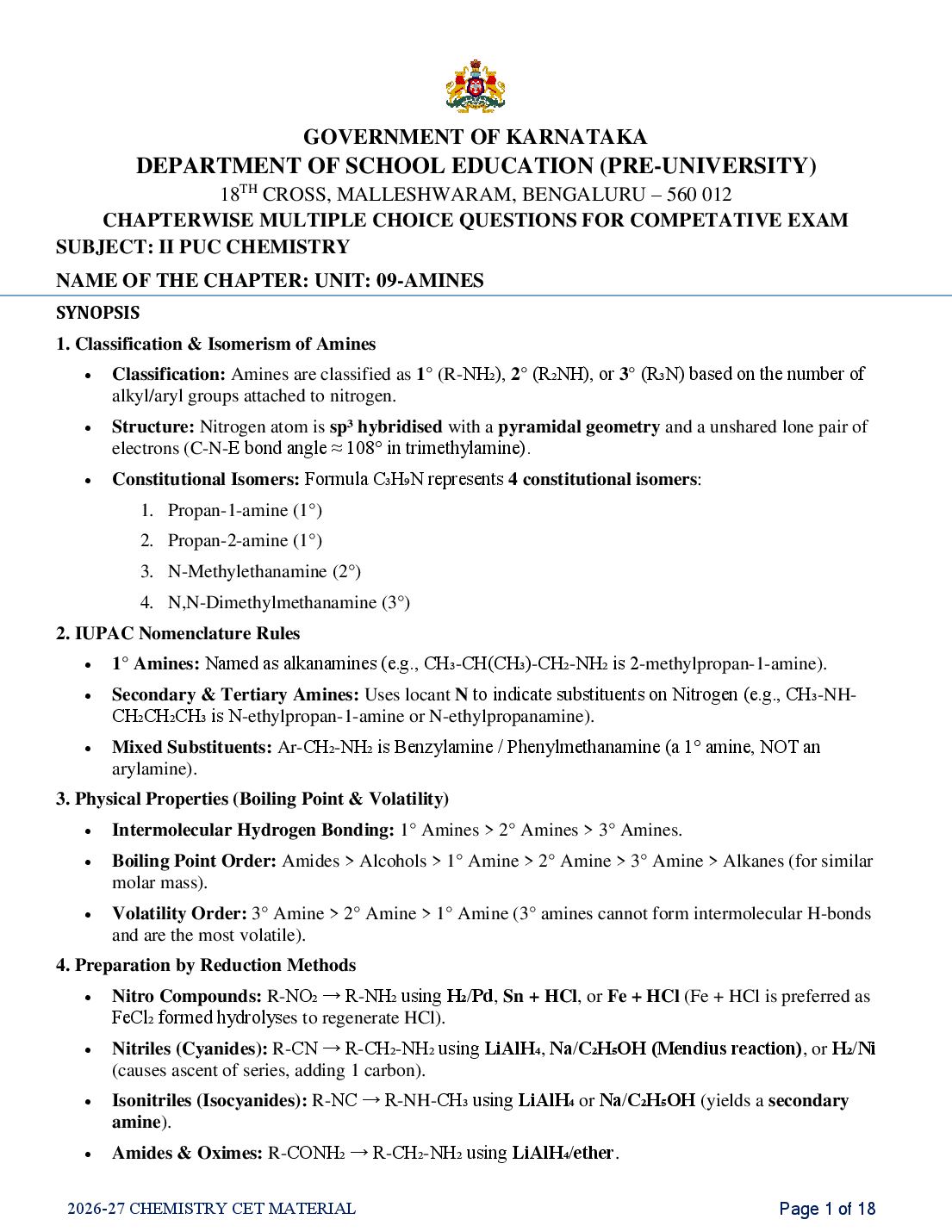
Page 1
DEPARTMENT OF SCHOOL EDUCATION (PRE-UNIVERSITY)
18TH CROSS, MALLESHWARAM, BENGALURU – 560 012
CHAPTERWISE MULTIPLE CHOICE QUESTIONS FOR COMPETATIVE EXAM
SUBJECT: II PUC CHEMISTRY
NAME OF THE CHAPTER: UNIT: 09-AMINES
SYNOPSIS
1. Classification & Isomerism of Amines
• Classification: Amines are classified as 1° (R-NH₂), 2° (R₂NH), or 3° (R₃N) based on the number of
alkyl/aryl groups attached to nitrogen.
• Structure: Nitrogen atom is sp³ hybridised with a pyramidal geometry and a unshared lone pair of
electrons (C-N-E bond angle ≈ 108° in trimethylamine).
• Constitutional Isomers: Formula C₃H₉N represents 4 constitutional isomers:
1. Propan-1-amine (1°)
2. Propan-2-amine (1°)
3. N-Methylethanamine (2°)
4. N,N-Dimethylmethanamine (3°)
2. IUPAC Nomenclature Rules
• 1° Amines: Named as alkanamines (e.g., CH₃-CH(CH₃)-CH₂-NH₂ is 2-methylpropan-1-amine).
• Secondary & Tertiary Amines: Uses locant N to indicate substituents on Nitrogen (e.g., CH₃-NH-
CH₂CH₂CH₃ is N-ethylpropan-1-amine or N-ethylpropanamine).
• Mixed Substituents: Ar-CH₂-NH₂ is Benzylamine / Phenylmethanamine (a 1° amine, NOT an
arylamine).
3. Physical Properties (Boiling Point & Volatility)
• Intermolecular Hydrogen Bonding: 1° Amines > 2° Amines > 3° Amines.
• Boiling Point Order: Amides > Alcohols > 1° Amine > 2° Amine > 3° Amine > Alkanes (for similar
molar mass).
• Volatility Order: 3° Amine > 2° Amine > 1° Amine (3° amines cannot form intermolecular H-bonds
and are the most volatile).
4. Preparation by Reduction Methods
• Nitro Compounds: R-NO₂ → R-NH₂ using H₂/Pd, Sn + HCl, or Fe + HCl (Fe + HCl is preferred as
FeCl₂ formed hydrolyses to regenerate HCl).
• Nitriles (Cyanides): R-CN → R-CH₂-NH₂ using LiAlH₄, Na/C₂H₅OH (Mendius reaction), or H₂/Ni
(causes ascent of series, adding 1 carbon).
• Isonitriles (Isocyanides): R-NC → R-NH-CH₃ using LiAlH₄ or Na/C₂H₅OH (yields a secondary
amine).
• Amides & Oximes: R-CONH₂ → R-CH₂-NH₂ using LiAlH₄/ether.
2026-27 CHEMISTRY CET MATERIAL Page 1 of 18
Page 2
• Reaction of R-X with ethanolic NH₃ at 373 K yields a mixture of 1°, 2°, 3° amines and quaternary
ammonium salt (R₄N⁺X⁻).
• Excess NH₃: Primary amine (R-NH₂) becomes the major product.
• Excess Alkyl Halide: Quaternary ammonium salt becomes the major product.
• Halide Reactivity Order: R-I > R-Br > R-Cl. Aryl halides do NOT undergo ammonolysis easily.
6. Gabriel Phthalimide Synthesis
• Used for the exclusive preparation of pure primary aliphatic amines.
• Reagents: Phthalimide + KOH (ethanolic) → Potassium phthalimide + R-X → N-Alkylphthalimide +
NaOH(aq) → 1° Amine (R-NH₂) + Sodium phthalate.
• Limitation: Aromatic primary amines (Aniline) CANNOT be prepared by this method because aryl
halides do not undergo nucleophilic substitution with the phthalimide anion.
7. Hofmann Bromamide Degradation Reaction
• Converts a primary amide into a 1° primary amine containing one carbon atom less than the amide:
o R-CONH₂ + Br₂ + 4NaOH → R-NH₂ + Na₂CO₃ + 2NaBr + 2H₂O
• Mechanism: Intramolecular migration of alkyl/aryl group from carbonyl carbon to nitrogen.
• Example: 2-phenylpropanamide gives 1-phenylethanamine.
8. Basic Strength Trends of Amines (pK_b Values)
• Rule: Smaller pK_b = Larger K_b = Stronger Base.
• Aliphatic Amines vs Ammonia vs Aniline:
o Alkylamines > Ammonia > Arylamines (Aniline).
• In Gaseous Phase: 3° Amine > 2° Amine > 1° Amine > NH₃ (+I effect dominates).
• In Aqueous Phase (Interplay of +I effect, Solvation & Steric Hindrance):
o Methyl group (-CH₃): 2° > 1° > 3° > NH₃ [(CH₃)₂NH > CH₃NH₂ > (CH₃)₃N > NH₃]
o Ethyl group (-C₂H₅): 2° > 3° > 1° > NH₃ [(C₂H₅)₂NH > (C₂H₅)₃N > C₂H₅NH₂ > NH₃]
9. Basicity of Aromatic Amines (Aniline Derivatives)
• Aniline is a weaker base than ammonia/aliphatic amines because the lone pair on N is delocalised into
the benzene ring by resonance.
• Benzylamine (C₆H₅CH₂NH₂) is stronger than aniline because its lone pair is NOT in resonance with the
ring.
• Substituent Effects on Aniline Basicity:
o Electron Donating Groups (EDG) like -OCH₃, -CH₃, -NH₂ increase basicity (lower pK_b).
o Electron Withdrawing Groups (EWG) like -NO₂, -CN, -Cl, -Br decrease basicity (higher pK_b).
o Basicity Order: 4-Methoxyaniline > Aniline > 4-Nitroaniline.
10. Carbylamine Test (Isocyanide Test)
• Test Species: Given ONLY by 1° aliphatic and 1° aromatic amines.
• Reaction: R-NH₂ + CHCl₃ + 3KOH (ethanolic) + Heat → R-NC (Isocyanide / Carbylamine) + 3KCl +
3H₂O.
2026-27 CHEMISTRY CET MATERIAL Page 2 of 18
Page 3
• 2° and 3° amines do NOT show this reaction (used as a distinguishing test).
11. Reaction with Nitrous Acid (HNO₂ / NaNO₂ + HCl)
• Prepared in situ using NaNO₂ + HCl at 273-278 K (0-5°C).
• 1° Aliphatic Amines: Form unstable alkyldiazonium salts which immediately decompose to evolve N₂
gas (bubbles) and yield alcohols.
• 1° Aromatic Amines (Aniline): Form stable Benzenediazonium salts (C₆H₅N₂⁺Cl⁻) at 0-5°C.
• 2° Amines: Form yellow oily N-nitrosoamines.
• 3° Amines: Form soluble quaternary nitrite salts.
12. Hinsberg Test (Hinsberg's Reagent)
• Reagent: Benzenesulphonyl chloride (C₆H₅SO₂Cl) or p-Toluenesulphonyl chloride.
• 1° Amine: Forms N-alkylbenzenesulphonamide, which has an acidic H on N → Soluble in alkali
(NaOH).
• 2° Amine: Forms N,N-dialkylbenzenesulphonamide, which has NO acidic H on N → Insoluble in
alkali.
• 3° Amine: Does NOT react (no replacement H on N).
13. Acylation and Protection of Amino Group
• Amines react with acid chlorides/anhydrides in presence of pyridine to form amides.
o Example: CH₃NH₂ + C₆H₅COCl → N-Methylbenzamide + HCl.
• Protection: Direct nitration or bromination of aniline gives multiple substitution or tarry products.
• Protecting -NH₂ by acetylation with (CH₃CO)₂O/pyridine reduces the activating power of nitrogen,
allowing monosubstitution (e.g., p-bromoaniline or p-nitroaniline) after subsequent hydrolysis.
14. Electrophilic Substitution Reactions of Aniline
• Bromination: Aniline + Br₂(aq) → White precipitate of 2,4,6-Tribromoaniline (no catalyst needed).
• Nitration: Aniline + Conc. HNO₃ + Conc. H₂SO₄ at 288 K yields:
o 51% Para, 47% Meta, and 2% Ortho derivatives.
o Why Meta? In strongly acidic medium, aniline protonates to form Anilinium ion (-NH₃⁺), which is
strongly meta-directing.
• Sulphonation: Aniline + Conc. H₂SO₄ at 453-473 K → Sulphanilic acid, which exists as a Zwitter ion
(⁺H₃N-C₆H₄-SO₃⁻).
• Friedel-Crafts Reaction: Aniline DOES NOT undergo Friedel-Crafts reaction because Lewis acid
catalyst (AlCl₃) forms a salt with the -NH₂ group, turning it into a deactivating group.
15. Preparation of Benzenediazonium Chloride (Diazotisation)
• Reaction: C₆H₅NH₂ + NaNO₂ + 2HCl --(273 to 278 K)--> C₆H₅N₂⁺Cl⁻ + NaCl + 2H₂O.
• Stability: Arenediazonium salts are stable only in cold aqueous solutions (0-5°C) due to resonance
delocalisation of positive charge over the benzene ring.
• Must be used immediately after preparation; decomposes in dry state or upon warming.
16. Sandmeyer vs Gattermann Reactions
• Sandmeyer Reaction:
2026-27 CHEMISTRY CET MATERIAL Page 3 of 18
Page 4
o C₆H₅N₂⁺Cl⁻ + Cu₂Br₂/HBr → C₆H₅Br + N₂
o C₆H₅N₂⁺Cl⁻ + CuCN/KCN → C₆H₅CN (Cyanobenzene) + N₂
• Gattermann Reaction: Uses Copper powder (Cu/HCl or Cu/HBr) instead of Cu(I) salts. Yields are
lower than Sandmeyer reaction.
17. Replacement Reactions of Diazo Group (-N₂⁺Cl⁻)
• By Iodide (-I): Warm with KI → C₆H₅I + N₂ + KCl.
• By Fluoride (-F) [Schiemann Reaction]: Treat with HBF₄ to form C₆H₅N₂⁺BF₄⁻, then heat → C₆H₅F +
BF₃ + N₂.
• By Hydrogen (-H) [Reduction to Benzene]: React with H₃PO₂ (Hypophosphorous acid) + H₂O or
C₂H₅OH (Ethanol) → Benzene (C₆H₆) + N₂.
• By Hydroxyl (-OH): Warm with H₂O up to 283 K (10°C) → Phenol (C₆H₅OH) + N₂ + HCl.
• By Nitro (-NO₂): Treat with HBF₄, then heat with NaNO₂/Cu → Nitrobenzene (C₆H₅NO₂).
18. Coupling Reactions (Azo Dye Formation)
• Diazonium salts act as electrophiles and react with electron-rich aromatic rings at p-position with
retention of the diazo group (-N=N-).
• Coupling with Phenol: Reaction occurs in mildly basic medium (pH 9-10) → p-Hydroxyazobenzene
(Orange Dye).
• Coupling with Aniline: Reaction occurs in mildly acidic medium (pH 4-5) → p-Aminoazobenzene
(Yellow Dye).
• Reaction is an example of Electrophilic Aromatic Substitution.
19. Distinguishing Tests Summary
Pair of Compounds Reagent / Test Observation / Result
1° Amine vs 2°/3° Carbylamine Test (CHCl₃ + Only 1° amine gives foul-smelling Isocyanide.
Amine KOH)
1°, 2° vs 3° Amine Hinsberg Reagent (C₆H₅SO₂Cl) 1° derivative soluble in NaOH; 2° insoluble; 3° no
reaction.
Aniline vs Aliphatic Azo Dye Test (NaNO₂/HCl then Aniline forms a bright Red/Orange Azo Dye;
Amine 2-Naphthol) Aliphatic amine evolves N₂ gas.
Aniline vs Azo Dye Test OR Br₂(aq) Aniline gives Azo Dye / White ppt; Benzylamine
Benzylamine does not.
20. Important Multi-Step Synthetic Sequences (Quick Sheet)
1. Acylation Degree Calculation:
Each acetylation replace -H with -COCH₃, increasing molar mass by 42 g/mol.
2. Conversion of p-Toluidine to p-Toluic Acid:
o p-Toluidine → (1) NaNO₂/HCl → (2) CuCN/KCN → (3) H₃O⁺/Heat → p-Toluic Acid.
3. Ascent of Series (Increasing 1 Carbon):
o R-Cl → (1) KCN → R-CN → (2) Na/Ethanol or LiAlH₄ → R-CH₂NH₂.
4. Descent of Series (Decreasing 1 Carbon):
2026-27 CHEMISTRY CET MATERIAL Page 4 of 18
Page 5
MULTIPLE CHOICE QUESTIONS
9.1 Classification and Nomenclature
1. The total number of constitutional isomers having molecular formula𝐶3 𝐻9 𝑁 is [KCET 2011]
a) three b) four
c) five d) two
2. 𝐶2 𝐻7 𝑁 represents
a) secondary amine b) tertiary amine
c) both primary amine and secondary amine d) primary amine
3. Secondary amine(s) from the following is/are [KCET 2012]
(I) CH3 CH2 CHCH3
|
NH2
(II) CH3 CHNH2
|
C6 H5
(III) CH2 = CHCH2 NHCH3
(IV) C6 H5 NHC6 H5
a) (i) only b) (i) and (iii)
c) (iii) and (iv) d) (i), (ii) and (iii)
4. IUPAC name of the compound CH3 − CH − CH2 NH2 is [NCERT EXEMPLAR]
|
CH3
a) 2 - methylpropan - 1 - amine b) 2 - methylethan - 1 - amine
c) methylpropanamine d) 2 - methylbutan - 1 - amine
5. What will be the IUPAC name of compound when imino group is attached to ethyl and𝑛 - propyl group?
a) N - ethyl propanamine b) N - ethyl - 1 - butanamine
c) Ethyl isopropylamine d) Ethyl - 2 - propanamine
6. The IUPAC name of the following compound is [KCET 2019]
2026-27 CHEMISTRY CET MATERIAL Page 5 of 18
Page 6
c) 3 - amino - 2 - methylbutane d) 2 - methyl - 3 - butanamine
𝑅𝑒𝑑𝑢𝑐𝑡𝑖𝑜𝑛
7. 𝐴 → 1∘ amine. The compound A may be [AIPMT 2007]
(I) 𝑅 - NC
(II) 𝑅 − 𝐶𝑁
(III) 𝑅 − 𝐶𝑂𝑁𝐻2
(IV) 𝑅 − 𝑁𝑂2
a) 1, 2 b) 2, 3, 4
c) 2 d) 3, 4
8. IUPAC name of the following compound is [KCET 2014]
a) 3 - hydroxybenzenediazonium chloride b) 3 - nitrochlorophenol
c) 4 - hydroxybenzenediazonium chloride d) 3 - oxobenzenediazonium chloride
9. An aromatic compound𝐴(𝐶7 𝐻9 𝑁) on reacting with 𝑁𝑎𝑁𝑂2 /𝐻𝐶𝑙 at 0∘ 𝐶 forms benzyl alcohol and nitrogen
gas. The number of 1∘ amines among the isomers for the compound 𝐴 is [JEE MAIN 2019]
a) 7 b) 4
c) 5 d) 3
9.2 Methods of Preparation
10. Identify the compound ’F’ in the following series of reactions. [KCET 2014]
red P/Br2 NH3
CH3 CH2 CH2 OH → ′E′ → ′F′
a) Methylamine b) 𝑛 - Propylamine
c) 2 - Aminopropane d) 𝑛 - Ethylamine
𝑎𝑙𝑐.𝐴𝑔𝐶𝑁 𝐿𝑖𝐴𝑙𝐻4
11. In the given set of reactions: 2 - Bromopropane → 𝑋 → 𝑌 the IUPAC name of product Y is
ℎ𝑒𝑎𝑡
a) butan - 2 - amine b) N - isopropylmethanamine
c) N - methylpropan - 2 - amine d) N - methylpropanamine [NEET 2019]
2026-27 CHEMISTRY CET MATERIAL Page 6 of 18
Page 7
a) propionaldoxime b) nitroethane
c) 𝑛 - propyl cyanide d) acetoxime
𝑆𝑂𝐶𝑙2 𝑁𝐻3
13. Starting from propanoic acid, the following reactions were carried out. Propanoic acid → 𝑋 → 𝑌
𝐵𝑟2 +𝐾𝑂𝐻
→ 𝑍. What is the compound Z? [KCET 2013]
a) 𝐶𝐻3 − 𝐶𝐻2 − 𝑁𝐻2 b)
c) 𝐶𝐻3 − 𝐶𝐻2 − 𝐵𝑟 d) 𝐶𝐻3 − 𝐶𝐻2 − 𝐶𝐻2 − 𝑁𝐻2
𝑅
14. Consider the reaction, 𝐶𝐻3 𝐶𝐻2 𝐶 ≡ 𝑁 → 𝐶𝐻3 𝐶𝐻2 𝐶𝐻2 𝑁𝐻2 . The reagent R is [KCET 2017]
a) 𝐿𝑖𝐴𝑙𝐻4 b) all of these
c) (𝑁𝑎 + 𝐶2 𝐻5 𝑂𝐻) d) 𝑁𝑖/𝐻2
15. Hoffmann rearrangement during the conversion of an amide to amine is
a) intermolecular b) intramolecular
c) both intermolecularand intramolecular d) none of these
16. Alkanamide, which on Hoffmann’s reaction gives 1 - phenyl ethylamine, is [JEE MAIN 2014]
a) 2 - phenylpropanamide b) 2 - phenylethanamide
c) N - phenylethanamide d) 3 - phenylpropanamide
17. Identify the compound ’T’ in the following series of reactions: [KCET 2016]
HBr KCN Na/𝑒𝑡ℎ𝑎𝑛𝑜𝑙
CH3 CH2 CH2 OH → ′𝐺 ′ → ′𝐻′ → ′𝑇′
a) CH3 CH2 NCH2 CH3 b) 𝐶𝐻3 𝐶𝐻2 𝐶𝐻2 𝐶𝐻2 𝑁𝐻2
|
H
c) CH3 CH2 CHCH3 d) 𝐶𝐻3 𝐶𝐻2 𝐶𝐻2 𝑁𝐻𝐶𝐻3
|
NH2
18. When ethyl bromide reacts with excess of alcoholic ammonia, the major product is [KCET 2015]
a) ethylamine b) tetraethylammonium bromide
c) diethylamine d) trimethylamine
19. During ammonolysis, 1𝑜 amines act as [KCET 2020]
a) nucleophiles b) electrophiles
2026-27 CHEMISTRY CET MATERIAL Page 7 of 18
Page 8
9.3 Physical properties
20. Which amine does not form hydrogen bonding? [KCET 2018]
a) All form hydrogen bonding b) Tertiary
c) Secondary d) Primary
21. Which among the following has the highest boiling point? [KCET 2017]
CH3
|
a) CH3 − N − CH3 b) CH3 CH2 − NH
|
CH3
c) 𝐶𝐻3 𝑁𝐻2 d) 𝐶𝐻3 𝐶𝐻2 𝐶𝐻2 𝑁𝐻2
22. Boiling points are normally the highest for
a) tertiary amides b) primary amides
c) secondary amides d) amines
23. Which of the following should be most volatile? [KCET 2021]
𝐼. 𝐶𝐻3 𝐶𝐻2 𝐶𝐻2 𝑁𝐻2 𝐼𝐼. (𝐶𝐻3 )3 𝑁 III. IV. 𝐶𝐻3 𝐶𝐻2 𝐶𝐻3
a) III b) I
c) II d) IV
9.4 Chemical reactions of Amines
24. Which of the following species are involved in the carbylamine test? [KCET 2019]
(I) RNC
(II) CHCI3
(III) COCI2
(IV) NaNO2 + HCI
a) (ii) and (iii) only b) (ii) and (iv) only
c) (i) and (iv) only d) (i) and (ii) only
25. Which of the following statements is correct? [NEET 2016]
(I) Aniline is a stronger base than ethylamine.
(II) Aniline is a weaker base than𝑝 - methoxyaniline.
2026-27 CHEMISTRY CET MATERIAL Page 8 of 18
Page 9
(IV) Aniline is soluble in an ammonium hydroxide solution.
a) Statement (b) is correct. b) Statement (d) is correct.
c) Statement (c) is correct. d) Statement (a) is correct.
26. Which of the following has lowest𝑝𝐾𝑏 value? [NEET 2020]
a) 2 - Nitroaniline b) Aniline
c) 4 - Methoxyaniline d) 4 - Nitroaniline
27. Which of the following reactions is not correctly matched?
[KCET 2018]
a) Only (d) b) Only (b)
c) Only (c) d) Only (a)
28. Benzylamine is a stronger base than aniline because [KCET 2016]
a) the lone pair of electrons on the nitrogen atom in aniline is not involved in resonance
b) the lone pair of electrons on the nitrogen atom in benzylamine is delocalised
c) the lone pair of electrons on the nitrogen atom in aniline is delocalised
d) benzylamine has a higher molecular mass than aniline
29. Identify product D in the following reaction sequence: [JEE MAIN 2017]
CH3 CH3 O
| | ∥
a) CH3 − C − CH2 C ≡ N b) CH3 − C − CH2 CN(CH3 )2
| |
CH3 CH3
2026-27 CHEMISTRY CET MATERIAL Page 9 of 18
Page 10
| | |
c) CH3 − C − CH2 CH2 N(CH3 )2 d) CH3 − C − CH2 CHN(CH3 )2
| |
CH3 CH3
30. The reagent which could distinguish aniline from cyclohexylamine is [KCET 2015]
a) 𝑁𝑎𝑁𝑂2 , 𝐻𝐶𝑙, 5∘ 𝐶 , then 2 - naphthol b) 𝐶𝐻3 𝐶𝑂𝑂𝐻, 𝑁𝐻2 𝑂𝐻, 𝐻2 𝑂
c) cold, dil.𝑁𝑎𝐻𝐶𝑂3 d) cold, dil. HCl
31. Iso - propylamine on acetylation gives [KCET 2014]
a) (𝐶𝐻3 )2 𝐶𝐻 − 𝑁𝐻𝐶𝑂𝐶𝐻3 b) (𝐶𝐻3 )2 𝐶𝐻𝑁(𝑂𝐶𝐻3 )2
c) 𝐶𝐻3 𝐶𝐻2 − 𝑁𝐻𝐶𝑂𝐶𝐻3 d) (𝐶𝐻3 )2 𝐶𝐻𝑁(𝐶𝑂𝐶𝐻3 )2
32. In the following sequence of reactions, [JEE MAIN 2020]
the compound (𝐶) formed will be
a) butanol - 2 b) 2 - methylpropanol - 1
c) 1, 1 - dimethylethanol d) butanol - 1
33. Among the following [KCET 2013]
(I) 𝐶𝐻3 𝑁𝐻2
(II) (𝐶𝐻3 )2 𝑁𝐻
(III) (𝐶𝐻3 )3 𝑁
(IV) 𝐶6 𝐻5 𝑁𝐻2
which will give the positive carbylamine test?
a) I and IV b) I and II
c) II and IV d) II and III
34. The reaction of 𝐻𝑁𝑂2 with ’A’ gives quaternary ammonium salt. A is [KCET 2011]
a) trimethylamine b) methylamine
c) aniline d) dimethylamine
35. When methanamine is treated with benzoyl chloride, the major product is [KCET 2020]
a) N - phenylethanamide b) benzanilide
2026-27 CHEMISTRY CET MATERIAL Page 10 of 18
Page 11
36. The reaction of benzenesulphonyl chloride with ethylamine yields [KCET 2018]
a) N,N - diethylbenzenesulphonamide, soluble in alkali
b) N - ethylbenzenesulphonamide, soluble in alkali
c) 𝑁, 𝑁 - diethylbenzenesulphonamide, insoluble in alkali
d) 𝑁 - ethylbenzenesulphonamide, insoluble in alkali
37. Identify ’Z’ in the given sequence of reactions. [KCET 2015]
𝑁𝑎𝑁𝑂2 +𝐻𝐶𝑙 𝐶𝑢𝐶𝑁 𝐻 + /𝐻2 𝑂
𝐶6 𝐻5 𝑁𝐻2 → 𝑋 → 𝑌 → 𝑍
273 𝐾 𝐵𝑜𝑖𝑙
a) 𝐶6 𝐻5 𝐶𝑂𝑂𝐻 b) 𝐶6 𝐻5 𝐶𝑁
c) 𝐶6 𝐻5 𝐶𝑂𝑁𝐻2 d) 𝐶6 𝐻5 𝐶𝐻2 𝑁𝐻2
38. Positive carbylamine test is shown by [NEET 2018]
a) p - methylbenzylamine b) N,N - dimethylaniline
c) trimethylamine d) N - methylaniline
39. What kind of amines can be tested by reaction with chloroform under basic conditions? [NEET 2021]
a) Primary aliphatic amines b) All kinds of available amines
c) Primary aromatic amines d) Both primary aliphatic and aromatic amines
40. The amine of highest basic strength among the following is [KCET 2019]
a) N,N - dimethylaniline b) N - methylaniline
c) benzylamine d) p - toluidine
41. Which of the suggested tests can be used to differentiate the given compounds? [KCET 2016]
a) 𝐶𝐻3 𝑂𝐻 and 𝐶𝐻3 𝐶𝐻2 𝑂𝐻 (Lucas test)
b) 𝐶𝐻3 𝐶𝐻𝑂 and 𝐶𝐻3 𝐶𝐻2 𝐶𝐻𝑂 (Tollens’ test)
c) 1∘ and 2∘ amines (Carbylamine test)
d) 𝐶𝐻3 𝐶𝑂𝐶𝐻3 and 𝐶𝐻3 𝐶𝐻2 𝐶𝑂𝐶𝐻3 (Brady’s reagent)
42. What is Z in the following sequence of reactions? [KCET 2014]
(𝐶𝐻3 𝐶𝑂2 𝑂 𝐵𝑟2 /𝐶𝐶𝑙4 𝐻𝑂𝐻
𝐶6 𝐻5 𝑁𝐻2 → 𝑋 → 𝑌 →+ 𝑍
𝐻
2026-27 CHEMISTRY CET MATERIAL Page 11 of 18
Page 12
c) 𝑜 - Bromoacetanilide d) Bromoacetophenone
43. Which of the following statements is not correct? [NEET 2018]
(I) Replacement of halogen by−𝑁𝐻2 in alkyl halide is a nucleophilic substitution reaction.
(II) Aryl halides show more reactivity as compared to alkyl halides in the replacements of halogen by
the−𝑁𝐻2 group.
(III) During the replacement of halogen by−𝑁𝐻2 group, ammonia is taken in large excess so as to avoid
the formation of 2∘ and 3∘ amines.
(IV) Tertiary alkyl halide generally produces alkene instead of the replacement of halogen by−𝑁𝐻2 group.
a) Statement (c) is not correct. b) Statement (a) is not correct.
c) Statement (d) is not correct. d) Statement (b) is not correct.
44. In the reaction shown below, the major product(s) formed is/are
a) b)
c) d)
45. Which of the following amines is most basic in nature?
a) 2, 4 - Dibromoaniline b) 2,4 - Dimethylaniline
c) 2, 4 - Dichloroaniline d) 2, 4 - Dinitroaniline
46. Benzylamine may be alkylated as shown in the following equation:
𝐶6 𝐻5 𝐶𝐻2 𝑁𝐻2 + 𝑅 − 𝑋 → 𝐶6 𝐻5 𝐶𝐻2 𝑁𝐻𝑅. Which of the following alkyl halides is best suited for this
reaction through 𝑆𝑁 1 mechanism?
2026-27 CHEMISTRY CET MATERIAL Page 12 of 18
Page 13
c) 𝐶6 𝐻5 𝐶𝐻2 𝐵𝑟 d) 𝐶𝐻3 𝐵𝑟
47. Identify ’X’. [KCET 2017]
a) b)
c) d)
48. Product (B) of the following reaction is
a) b)
c) d)
49. A compound with molecular mass 180 is acylated with𝐶𝐻3 𝐶𝑂𝐶𝑙 to get a compound with molecular mass
390. The number of amino groups present per molecule of the former compound is
a) 4 b) 5
c) 6 d) 2
50. Comparing basic strength of𝑁𝐻3 , 𝐶𝐻3 𝑁𝐻2 and 𝐶6 𝐻5 𝑁𝐻2 it may be concluded that
a) basic strength of𝑁𝐻3 is highest b) basic strength remains unaffected
c) basic strength of aryl amines is lowest d) basic strength of alkyl amines is lowest
9.5 Diazonium salts
51. Diazonium salts are the reaction products between nitrous acid and [KCET 2016]
2026-27 CHEMISTRY CET MATERIAL Page 13 of 18
Page 14
c) primary aliphatic amine d) secondary amines
52. Benzenediazonium chloride cannot be stored and is used immediately after its preparation because
a) it reacts with all the containers in which it is stored
b) it is very unstable and dissociates to give nitrogen
c) it gets oxidised in air hence cannot be stored
d) it slowly evaporates on storage [KCET 2015]
53. Which resonance structure among the following is wrong? [KCET 2020]
a) b)
c) d)
54. The preparation of diazonium salts from primary amines is known as
a) benzoylation b) diazotisation
c) acylation d) alkylation
55. What is the most suitable temperature for the diazotisation reaction to take place? [KCET 2018]
a) 0∘ 𝐶 b) 10∘ 𝐶
c) 22∘ 𝐶 d) 30∘ 𝐶
56. Which of the following properties is suitable for all diazonium salts?
a) Coloured solid b) Water soluble
c) Unreactive d) Explosive
57. When a blue litmus paper is dipped in a aqueous solution of benzenediazonium bromide the litmus paper
________. [KCET 2019]
a) turns orange b) remains unchanged
c) turns red d) turns black
58. Which of the following is a property of benzene diazonium chloride? [KCET 2016]
2026-27 CHEMISTRY CET MATERIAL Page 14 of 18
Page 15
c) It is a colourless crystalline solid. d) It is soluble in water.
59. The structure of product X in the following reaction is
a) b)
c) d)
60. Which of the following forms yellow dye with benzenediazonium chloride in acidic medium?
a) Phenol b) Aniline
c) 𝛽 - Naphthol d) Methylamine
61. Which of the following compounds on treatment with𝑁𝑎𝑁𝑂2 /𝐻𝐶𝑙 and then coupled with phenol produces
an orange dye? [KCET 2017]
a) Benzaldehyde b) Aniline
c) Toluene d) Benzene
62. The final product in the following sequence of reaction is
a) b)
c) d)
2026-27 CHEMISTRY CET MATERIAL Page 15 of 18
Page 16
a) 𝐶𝐻3 𝑂𝐻 b) 𝐿𝑖𝐴𝑙𝐻4
c) 𝐻3 𝑃𝑂2 d) 𝐵𝑟2 − 𝐻2 𝑂
64. Sandmeyer reaction is used to convert [KCET 2018]
a) chlorobenzene to phenol b) benzene to chlorobenzene
c) aromatic aldehyde to aldol d) benzenediazonium chloride to cyanobenzene
65. Coupling of benzenediazonium chloride with phenol occurs in ________ medium and with aniline occurs
in ________ medium. [KCET 2019]
a) basic, acidic b) neutral, basic
c) acidic, basic d) acidic, neutral
66. Coupling reaction is an example of
a) nucleophilic addition reaction b) nucleophilic substitution reaction
c) electrophilic addition reaction d) electrophilic substitution reaction
67. Which of the following is correct method to convert𝑝 - toluidine to 𝑝 - toluic acid?
a) Diazotisation,𝐶𝑢𝐶𝑁, 𝐻2 /𝑃𝑑 b) Diazotisation,𝑁𝑎𝐶𝑁, 𝑁𝑎𝑂𝐻
c) 𝐶𝐻𝐶𝑙3 /𝑁𝑎𝑂𝐻, 𝐾𝐶𝑁, 𝑆𝑛/𝐻𝐶𝑙 d) Diazotisation,𝐶𝑢𝐶𝑁/𝐾𝐶𝑁, 𝐻2 𝑂/𝐻 +
68. Replacement of−𝑁2+ 𝐶𝑙 − from benzenediazonium chloride by hydrogen atom can be done by using
a) both𝐻3 𝑃𝑂2 and 𝐶2 𝐻5 𝑂𝐻 b) 𝐶2 𝐻5 𝑂𝐻
c) 𝐶𝐻3 𝐶𝐻𝑂 d) 𝐻3 𝑃𝑂2 [KCET 2020]
69. Diazonium salts are very good intermediate for the introduction of
a) - OH b) - CN
c) −𝑁𝑂2 d) all of these
70. Which of the following compounds gives dye?
a) Methylamine b) Ethylamine
c) Aniline d) Diphenylamine
71. Which group cannot be introduced in an aromatic ring by the nucleophilic substitution of halide group?
a) - OH b) Both of these
2026-27 CHEMISTRY CET MATERIAL Page 16 of 18
Page 17
72. Coupling of diazonium salts of following takes place in the order
(I) (II) (III) (IV)
a) IV< II < III < I b) IV> III < II < I
c) II< IV < I < III d) I< II < III < IV
73. In the following sequence of reactions;
𝑅𝑒𝑑𝑢𝑐𝑡𝑖𝑜𝑛 𝐻𝑁𝑂2
𝐴 → 𝐵 → 𝐶𝐻3 𝐶𝐻2 𝑂𝐻. The compound A is
a) ethane nitrile b) methyl isocyanate
c) propane nitrile d) nitromethane
74. Aniline in a set of reactions yielded a product D.
. The structure of the product ’D’ would be
a) 𝐶6 𝐻5 𝐶𝐻2 𝑂𝐻 b) 𝐶6 𝐻5 𝑁𝐻𝑂𝐻
c) 𝐶6 𝐻5 𝐶𝐻2 𝑁𝐻2 d) 𝐶6 𝐻5 𝑁𝐻𝐶𝐻2 𝐶𝐻3
75. . The final product R is
a) b)
c) d)
2026-27 CHEMISTRY CET MATERIAL Page 17 of 18
Page 18
Q.No Key Q.No Key Q.No Key Q.No Key Q.No Key
1 B 2 C 3 C 4 A 5 A
6 B 7 B 8 A 9 B 10 B
11 B 12 A 13 A 14 B 15 B
16 A 17 B 18 A 19 A 20 B
21 D 22 B 23 C 24 D 25 A
26 C 27 A 28 C 29 C 30 A
31 A 32 C 33 A 34 A 35 C
36 B 37 A 38 A 39 D 40 C
41 C 42 A 43 D 44 A 45 B
46 C 47 A 48 B 49 B 50 C
51 A 52 B 53 D 54 B 55 A
56 B 57 C 58 A 59 B 60 B
61 B 62 D 63 C 64 D 65 A
66 D 67 D 68 A 69 D 70 C
71 D 72 A 73 A 74 A 75 D
***********
2026-27 CHEMISTRY CET MATERIAL Page 18 of 18
Document Details
| Board / Org | Karnataka Board |
| Exam | Class 12 |
| Type | Question Bank |
| Pages | 18 |
| Updated | 24 Sep 2026 |