ISC Class 12 Specimen Paper 2022 Chemistry Semester 2
Finished viewing? Save it for later —
Download ISC Class 12 Specimen Paper 2022 Chemistry Semester 2 (PDF · 5 pages)About ISC Class 12 Specimen Paper 2022 Chemistry Semester 2
ISC Class 12 Specimen Paper 2022 Chemistry Semester 2 is available here for free download. Published by CISCE for Class 12, this sample paper can be viewed online or downloaded as a PDF (5 pages). Candidates preparing for Class 12 can use ISC Class 12 Specimen Paper 2022 Chemistry Semester 2 to understand the exam pattern, the type of questions asked, and the overall difficulty level.
Frequently Asked Questions
How can I download ISC Class 12 Specimen Paper 2022 Chemistry Semester 2?
Open this page and click the Download button to save ISC Class 12 Specimen Paper 2022 Chemistry Semester 2 as a PDF. It is completely free on AglaSem Docs.
Is ISC Class 12 Specimen Paper 2022 Chemistry Semester 2 free to download?
Yes. ISC Class 12 Specimen Paper 2022 Chemistry Semester 2 can be viewed online and downloaded as a PDF free of cost on AglaSem Docs.
How many pages does ISC Class 12 Specimen Paper 2022 Chemistry Semester 2 have?
ISC Class 12 Specimen Paper 2022 Chemistry Semester 2 contains 5 pages, which you can read online or download together as a single PDF.
Where can I find more Class 12 study material?
You can find more Class 12 question papers, sample papers, syllabus, and answer keys on AglaSem Docs.
ISC Class 12 Specimen Paper 2022 Chemistry Semester 2 – Text
Read the full text of this sample paper below — useful to quickly search, copy and reference the content online without downloading the PDF.
📄 View text version (5 pages)
Page 1
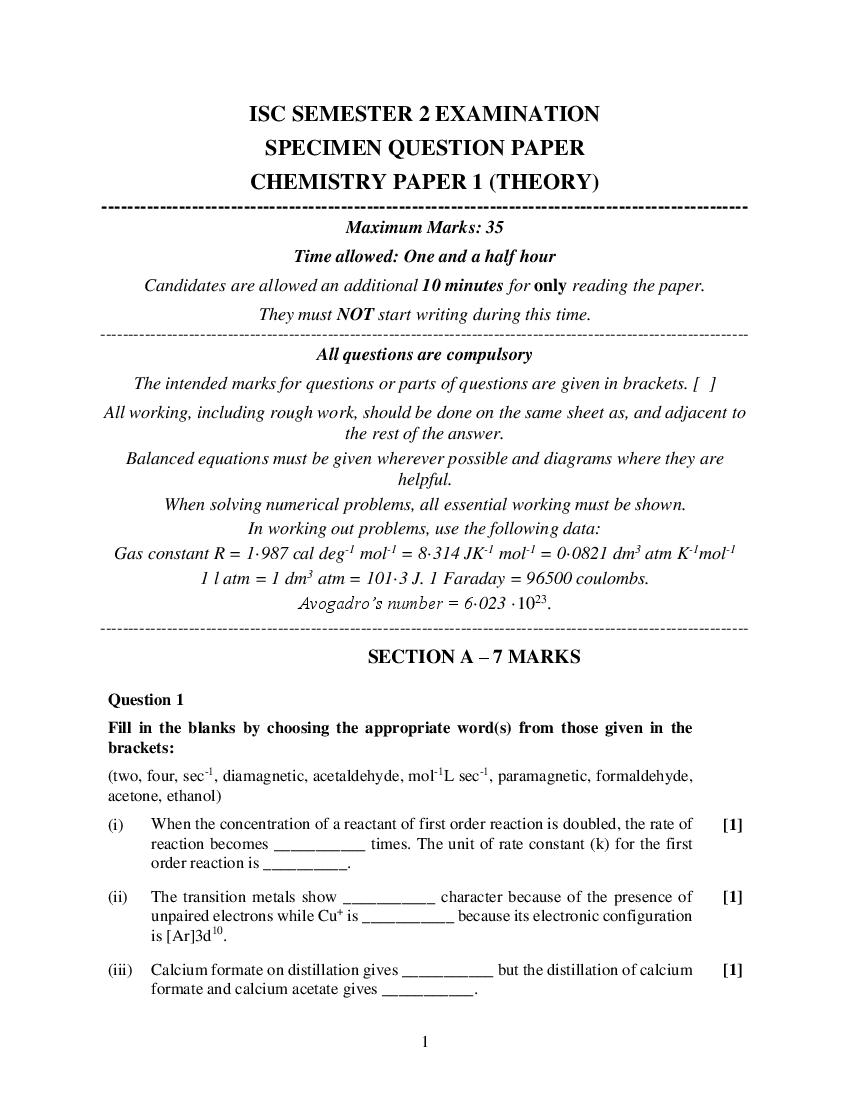
SPECIMEN QUESTION PAPER
CHEMISTRY PAPER 1 (THEORY)
----------------------------------------------------------------------------------------------------
Maximum Marks: 35
Time allowed: One and a half hour
Candidates are allowed an additional 10 minutes for only reading the paper.
They must NOT start writing during this time.
---------------------------------------------------------------------------------------------------------------------
All questions are compulsory
The intended marks for questions or parts of questions are given in brackets. [ ]
All working, including rough work, should be done on the same sheet as, and adjacent to
the rest of the answer.
Balanced equations must be given wherever possible and diagrams where they are
helpful.
When solving numerical problems, all essential working must be shown.
In working out problems, use the following data:
Gas constant R = 1·987 cal deg-1 mol-1 = 8·314 JK-1 mol-1 = 0·0821 dm3 atm K-1mol-1
1 l atm = 1 dm3 atm = 101·3 J. 1 Faraday = 96500 coulombs.
Avogadro’s number = 6·023 ·1023.
---------------------------------------------------------------------------------------------------------------------
SECTION A – 7 MARKS
Question 1
Fill in the blanks by choosing the appropriate word(s) from those given in the
brackets:
(two, four, sec-1, diamagnetic, acetaldehyde, mol-1L sec-1, paramagnetic, formaldehyde,
acetone, ethanol)
(i) When the concentration of a reactant of first order reaction is doubled, the rate of [1]
reaction becomes ___________ times. The unit of rate constant (k) for the first
order reaction is __________.
(ii) The transition metals show ___________ character because of the presence of [1]
unpaired electrons while Cu+ is ___________ because its electronic configuration
is [Ar]3d10.
(iii) Calcium formate on distillation gives ___________ but the distillation of calcium [1]
formate and calcium acetate gives ___________.
1
Page 2
Select and write the correct alternative from the choices given below.
(i) The type of hybridization involved in Octahedral complexes is: [1]
(a) sp3
(b) dsp2
(c) sp3d
(d) d2sp3
(ii) One mole of a symmetrical alkene on ozonolysis gives two moles of an aldehyde [1]
having a molecular mass of 44 amu. The alkene is:
(a) ethene
(b) propene
(c) 1-butene
(d) 2-butene
(iii) Primary amine when warmed with chloroform and alc. KOH yields: [1]
(a) cyanides
(b) isocyanides
(c) benzene diazonium chloride
(d) secondary amines
(iv) Assertion: The conversion of fresh precipitate to colloidal state is called [1]
peptization.
Reason: It is caused by addition of common ions.
(a) Both assertion and reason are true and reason is the correct explanation
of assertion.
(b) Both assertion and reason are true but reason is not the correct
explanation for assertion.
(c) Assertion is true but reason is false.
(d) Assertion is false but reason is true.
2
Page 3
Question 3 [2]
Name the type of isomerism shown by each of the following pairs of compounds:
(i) [CoCl2(NH3)4]Cl.H2O and [CoCl(H2O)(NH3)4]Cl2
(ii) [Cr(NH3)5Br]SO4 and [Cr(NH3)5SO4]Br
Question 4 [2]
(i) Write chemical equations to illustrate each of the following name reactions:
(a) Rosenmund’s reduction
(b) Clemmensen’s reduction
OR
(ii) How will you bring about the following conversions? (Give equation).
(a) Acetic acid to acetone
(b) Formaldehyde to urotropine
Question 5 [2]
What is a zwitter ion? Represent the zwitter ion of glycine.
Question 6 [2]
(i) Arrange the following in the increasing order of their basic strength: C2H5NH2,
C6H5NH2, (C2H5)2NH.
(ii) What are the products formed when benzene diazonium chloride reacts with
phenol in weak alkaline medium? (Give equation).
Question 7 [2]
Give reasons for the following:
(i) Diabetic patients are advised to take artificial sweeteners instead of natural
sweeteners.
(ii) The use of aspartame is limited to cold foods and drinks.
3
Page 4
The rate of reaction becomes four times when the temperature changes from 293K to
313K. Calculate the energy of activation (Ea) of the reaction assuming that it does not
change with temperature. (R = 8·314 JK-1mol-1)
Question 9 [2]
Give balanced equation for each of the following:
(i) Ethylamine and nitrous acid
(ii) Aniline and acetyl chloride
Question 10 [2]
Give one chemical test for each to distinguish between the following pairs of compound:
(i) Acetaldehyde and benzaldehyde
(ii) Acetone and acetic acid
SECTION C – 12 MARKS
Question 11 [3]
(i) Answer the following:
(a) Define molecularity of a reaction. Give one difference between the order of
reaction and its molecularity.
(b) The rate constant (k) of a first order reaction is 4·5 x 10-2 sec-1. What will be
the time required for the initial concentration of 0·4 M of the reactant to be
reduced to 0·2 M?
OR
(ii) Answer the following:
(a) For a first order reaction, show that the time required for the completion of
99% reaction is twice the time required for the completion of 90% of the
reaction.
(b) For a reaction, rate = k[A]1[B]1.5[C]0. What is the overall order of reaction?
4
Page 5
(i) What is the basic difference between the electronic configuration of transition
and inner transition elements?
(ii) Why are Zn2+ ions colourless while Ni2+ ions are green in colour?
Question 13 [3]
(i) Write the formula of each of the following compounds:
(a) Potassium trioxalatoaluminate (III)
(b) Triammine triaquachromium (III) chloride
(ii) For the complex ion [Co(NH3)6]3+, state the oxidation state of central metal atom
and the coordination number of the complex ion.
Question 14 [3]
Give reason for each of the following:
(i) For ferric hydroxide sol. the coagulating power of phosphate ion is more than
chloride ion.
(ii) Lyophilic colloidal solutions are more stable than lyophobic colloidal solutions.
(iii) Gelatin is added to ice cream.
5
Document Details
| Board / Org | CISCE |
| Exam | Class 12 |
| Type | Sample Paper |
| Pages | 5 |
| Language | english |
| Updated | 30 Apr 2026 |