Karnataka 2nd PUC Chemistry Coordination Compounds MCQ with Answers
Finished viewing? Save it for later —
Download Karnataka 2nd PUC Chemistry Coordination Compounds MCQ with Answers (PDF · 11 pages)About Karnataka 2nd PUC Chemistry Coordination Compounds MCQ with Answers
Karnataka 2nd PUC Chemistry Coordination Compounds MCQ with Answers is available here for free download. Published by Karnataka Board for Class 12, this question bank can be viewed online or downloaded as a PDF (11 pages). Candidates preparing for Class 12 can use Karnataka 2nd PUC Chemistry Coordination Compounds MCQ with Answers to understand the exam pattern, the type of questions asked, and the overall difficulty level.
Frequently Asked Questions
How can I download Karnataka 2nd PUC Chemistry Coordination Compounds MCQ with Answers?
Open this page and click the Download button to save Karnataka 2nd PUC Chemistry Coordination Compounds MCQ with Answers as a PDF. It is completely free on AglaSem Docs.
Is Karnataka 2nd PUC Chemistry Coordination Compounds MCQ with Answers free to download?
Yes. Karnataka 2nd PUC Chemistry Coordination Compounds MCQ with Answers can be viewed online and downloaded as a PDF free of cost on AglaSem Docs.
How many pages does Karnataka 2nd PUC Chemistry Coordination Compounds MCQ with Answers have?
Karnataka 2nd PUC Chemistry Coordination Compounds MCQ with Answers contains 11 pages, which you can read online or download together as a single PDF.
Where can I find more Class 12 study material?
You can find more Class 12 question papers, sample papers, syllabus, and answer keys on AglaSem Docs.
Karnataka 2nd PUC Chemistry Coordination Compounds MCQ with Answers – Text
Read the full text of this question bank below — useful to quickly search, copy and reference the content online without downloading the PDF.
📄 View text version (11 pages)
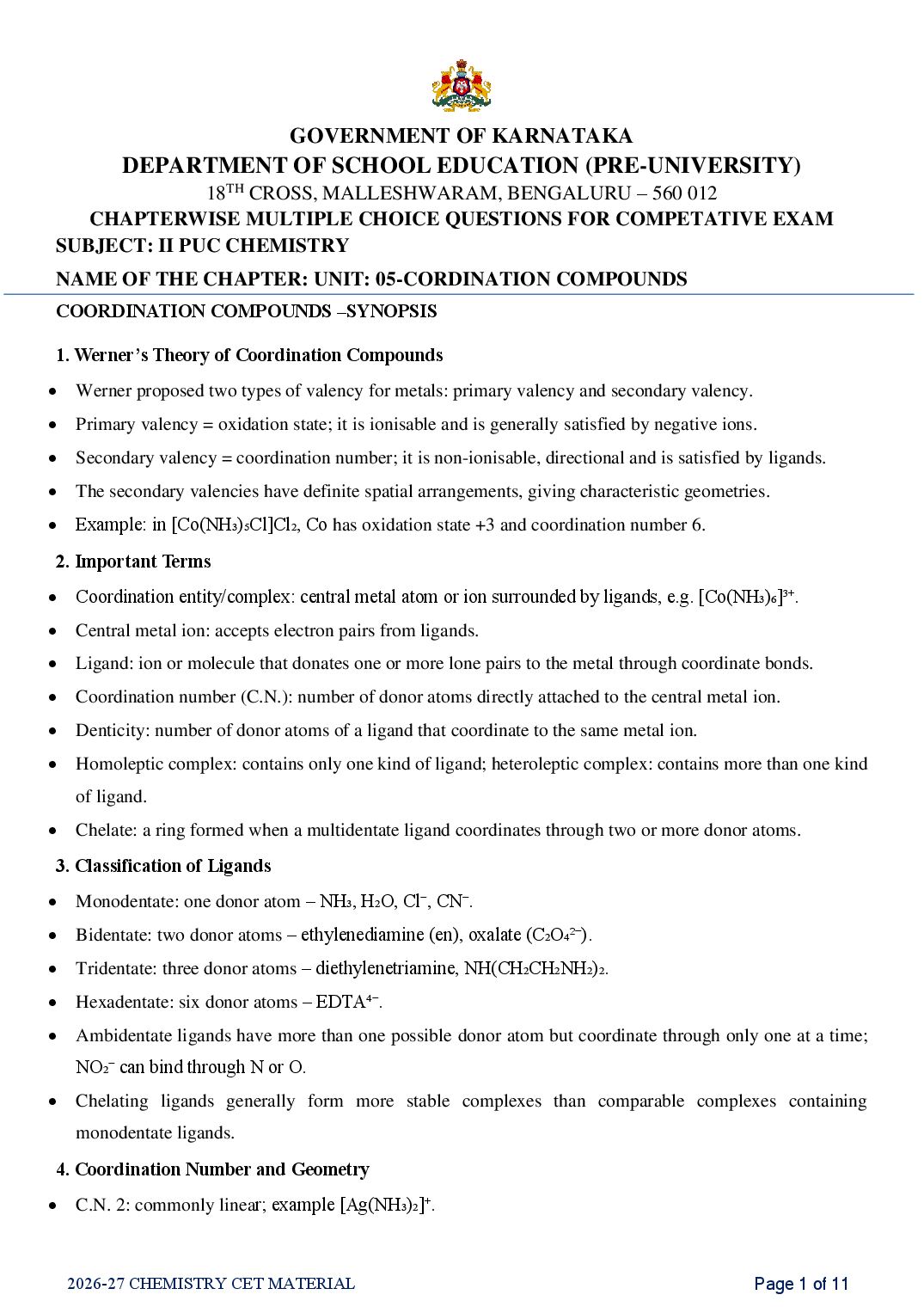
Page 1
DEPARTMENT OF SCHOOL EDUCATION (PRE-UNIVERSITY)
18TH CROSS, MALLESHWARAM, BENGALURU – 560 012
CHAPTERWISE MULTIPLE CHOICE QUESTIONS FOR COMPETATIVE EXAM
SUBJECT: II PUC CHEMISTRY
NAME OF THE CHAPTER: UNIT: 05-CORDINATION COMPOUNDS
COORDINATION COMPOUNDS –SYNOPSIS
1. Werner’s Theory of Coordination Compounds
• Werner proposed two types of valency for metals: primary valency and secondary valency.
• Primary valency = oxidation state; it is ionisable and is generally satisfied by negative ions.
• Secondary valency = coordination number; it is non-ionisable, directional and is satisfied by ligands.
• The secondary valencies have definite spatial arrangements, giving characteristic geometries.
• Example: in [Co(NH₃)₅Cl]Cl₂, Co has oxidation state +3 and coordination number 6.
2. Important Terms
• Coordination entity/complex: central metal atom or ion surrounded by ligands, e.g. [Co(NH₃)₆]³⁺.
• Central metal ion: accepts electron pairs from ligands.
• Ligand: ion or molecule that donates one or more lone pairs to the metal through coordinate bonds.
• Coordination number (C.N.): number of donor atoms directly attached to the central metal ion.
• Denticity: number of donor atoms of a ligand that coordinate to the same metal ion.
• Homoleptic complex: contains only one kind of ligand; heteroleptic complex: contains more than one kind
of ligand.
• Chelate: a ring formed when a multidentate ligand coordinates through two or more donor atoms.
3. Classification of Ligands
• Monodentate: one donor atom – NH₃, H₂O, Cl⁻, CN⁻.
• Bidentate: two donor atoms – ethylenediamine (en), oxalate (C₂O₄²⁻).
• Tridentate: three donor atoms – diethylenetriamine, NH(CH₂CH₂NH₂)₂.
• Hexadentate: six donor atoms – EDTA⁴⁻.
• Ambidentate ligands have more than one possible donor atom but coordinate through only one at a time;
NO₂⁻ can bind through N or O.
• Chelating ligands generally form more stable complexes than comparable complexes containing
monodentate ligands.
4. Coordination Number and Geometry
• C.N. 2: commonly linear; example [Ag(NH₃)₂]⁺.
2026-27 CHEMISTRY CET MATERIAL Page 1 of 11
Page 2
planar).
• C.N. 6: commonly octahedral; examples [Co(NH₃)₆]³⁺ and [Fe(CN)₆]³⁻.
• Square-planar complexes commonly show geometrical (cis/trans) isomerism.
5. Nomenclature – Key Rules
• Name the ligands first, followed by the central metal and its oxidation state in Roman numerals.
• Ligands are named in alphabetical order; numerical prefixes are not considered for alphabetising.
• Common ligand names: NH₃ = ammine, H₂O = aqua, Cl⁻ = chlorido, CN⁻ = cyanido, OH⁻ = hydroxido.
• Use di-, tri-, tetra- etc. for simple ligand names; bis-, tris- etc. are used for complex ligand names such as
en.
• For anionic complexes, the metal name generally ends in -ate; e.g. ferrate, chromate.
• Example: [Co(NH₃)₆]Cl₃ = hexaamminecobalt(III) chloride.
• K₃[Cr(C₂O₄)₃] = potassium tris(oxalato)chromate(III).
6. Isomerism in Coordination Compounds
• Geometrical isomerism: different relative positions of ligands, especially cis/trans and fac/mer forms.
• Optical isomerism: non-superimposable mirror-image forms; commonly associated with suitable
octahedral chelate complexes.
• Linkage isomerism: ambidentate ligand coordinates through different donor atoms, e.g. –NO₂/–ONO or –
SCN/–NCS.
• Ionisation isomerism: interchange between a ligand inside the coordination sphere and a counter ion outside
it.
• Coordination isomerism: interchange of ligands between cationic and anionic complex entities.
• Solvate/hydrate isomerism: solvent molecules occur either inside or outside the coordination sphere.
7. Bonding and Magnetic Behaviour
• Valence Bond Theory explains complexes using hybridisation and inner-/outer-orbital concepts.
• Inner-orbital octahedral complexes use d²sp³ hybridisation; outer-orbital complexes use sp³d² hybridisation.
• Strong-field ligands can cause pairing of d-electrons; weak-field ligands generally favour maximum
unpaired electrons.
• Paramagnetic species contain one or more unpaired electrons; diamagnetic species have all electrons paired.
• Spin-only magnetic moment: μ = √[n(n+2)] BM, where n = number of unpaired electrons.
• Crystal Field Theory: the five d-orbitals split into groups of different energies when ligands approach the
metal ion.
• In an octahedral field: t₂g orbitals are lower in energy and e_g orbitals are higher. Splitting energy is Δ₀.
• In a tetrahedral field, splitting is smaller than in octahedral complexes; Δₜ ≈ 4/9 Δ₀.
2026-27 CHEMISTRY CET MATERIAL Page 2 of 11
Page 3
transitions.
8. Metal Carbonyls
• CO is a strong-field ligand and forms metal carbonyl complexes through σ donation and π back-bonding.
• Ni(CO)₄ is tetrahedral and contains Ni in oxidation state 0.
• Fe(CO)₅ is mononuclear.
• Mn₂(CO)₁₀ contains a metal–metal bond and terminal CO groups; it has no bridging CO groups.
• Co₂(CO)₈ can contain bridging CO groups.
9. Important Applications
• Coordination compounds are important in biological systems, analytical chemistry, metallurgy,
photography and catalysis.
• Haemoglobin contains iron; chlorophyll contains magnesium; vitamin B₁₂ (cyanocobalamin) contains
cobalt.
• Wilkinson’s catalyst, [Rh(PPh₃)₃Cl], is used for catalytic hydrogenation of alkenes.
• In photography, hypo (thiosulfate) dissolves undecomposed AgBr by forming a soluble silver-thiosulfate
complex.
10. High-Yield Exam Points
• Always distinguish primary valency (oxidation state) from secondary valency (coordination number).
• For AgNO₃ tests, only chloride ions outside the coordination sphere are immediately available to form
AgCl.
• Determine oxidation state first, then coordination number and geometry.
• For magnetic questions, calculate d-electron count and identify ligand strength/high-spin or low-spin
behaviour.
• For wavelength questions, remember: larger Δ means higher-energy absorption and therefore shorter
wavelength (λ = hc/Δ).
• Check the charge on the entire coordination entity carefully before calculating the metal oxidation state.
Prepared from the uploaded Coordination Compounds question-bank material.
1 Werner’s theory of coordination compounds
1. Which of the following is NOT a postulate of Werner's theory of coordination compounds?
(a) Metals possess two types of valency – primary and secondary
(b) Primary valency is ionizable and satisfied by negative ions
(c) Secondary valency is non-directional in nature
(d) Secondary valency is equal to the coordination number
2026-27 CHEMISTRY CET MATERIAL Page 3 of 11
Page 4
(a) +2 (b) +3
(c) +1 (d) +4
3. The secondary valence of nickel in [Ni(CN)₄]²⁻ is
(a) 2 (b) 4
(c) 6 (d) 8
4. Which of the following is a double salt and not a coordination compound?
(a) K₄[Fe(CN)₆] (b) [Cu(NH₃)₄]SO₄
(c) FeSO₄·(NH₄)₂SO₄·6H₂O (d) [Co(NH₃)₆]Cl₃
5. The total number of ions produced when one mole of K₄[Fe(CN)₆] is dissolved in water is
(a) 2 (b) 4
(c) 5 (d) 6
6. The conductivity of [CoCl2(NH3)4]Cl in solution corresponds to
(a) 1 mole of ions (b) 2 mole of ions
(c) 3 mole of ions (d) 4 mole of ions
7. Which among the following has highest molar conductivity?
(a) K4[Fe(CN)6] (b) [Co(NH3)6]Cl3
(c) [Cu(NH3)4]SO4 (d) [Ni(CO)4]
8. The compound does not give test of sulphate ion in aqueous solution is
(a) K2SO4.Al2(SO4)3.24H2O (b) [Cu(H2O)4]SO4.H2O
(c) FeSO4.(NH4)2SO4.6H2O (d) [CoSO4(NH3)5]Br
9. A purple compound ‘M’ has a formula Co(NH3)6Cl3, on adding excess AgNO3 to one mole of ‘M’ produces 2
moles of AgCl. If secondary valence of Co is 6 then correct formula of the complex will be?
(a) [CoCl3(NH3)6] (b) [Co(NH3)6]Cl3
(c) [Co(NH3)5Cl]Cl2.NH3 (d) [Co(NH3)6Cl]Cl2
10. Cobalt(III)chloride forms several octahedral complexes with ammonia. Which of the following will not
give test chloride ions with silver nitrate at 25oC? [NEET-2015]
a) CoCl3.6H2O b) CoCl3.3H2O
c) CoCl3.5H2O d) CoCl3.4H2O
5.2 Definitions of some important terms pertaining to coordination compounds
11. Which of the following is an ambidentate ligand?
(a) en (b) NO₂⁻
(c) EDTA⁴⁻ (d) C₂O₄²⁻
12. The denticity of EDTA⁴⁻ ion is
(a) 2 (b) 4
(c) 6 (d) 8
13. H2N -CH2-CH2-NH2 is a:
2026-27 CHEMISTRY CET MATERIAL Page 4 of 11
Page 5
(c) ambidentate ligand (d) Cationic ligand
14. Which of the following complex does not have chelation?
(a) K3[Al(C2O4)3] (b) [Pt(en)2]Cl2
(c) K2[Ni(EDTA)] (d) [Ag(NH3)2]Cl
15. Match the ligand given in column I with property in column II:
Ligand Property
(A) H2NCH2CH2NH2 (P) bidentate
(B) EDTA4- (Q) ambidentate
(C) NO2 (R) Tridentate
(D) NH(CH2CH2NH2)2 (S) hexadentate
(a) a) A→R, B→P, C→P, D→Q (b) A→P, B→R, C→P, D→P
(c) A→P, B→S, C→Q, D→R (d) A→P, B→ Q, C→P, D→ R
16. Homoleptic complexes among the following are
(A) K3[Al(C2O4)3] (B) [CoCl2(en)2] + (C) K2[Zn(OH)4] [KCET-2021]
(a) C only (b) A and B only
(c) A only (d) A and C only
17. Given below are two statements:
Statement I: Ambidentate ligands have more than one donor atom but coordinate through only one donor
atom at a time.
Statement II: NO₂⁻ can coordinate through either nitrogen or oxygen atom
In the light of the above statements, choose the correct answer from the options given below.
a) Statement I is true but Statement II is false
b) Both Statement I and Statement II are false
c) Statement I is false but Statement II is true
d) Both Statement I and Statement II are true
18. Given below are two statements:
Statement I: Chelate complexes are generally more stable than corresponding complexes with
monodentate ligands.
Statement II: Chelation increases entropy of the system
In the light of the above statements, choose the correct answer from the options given below.
a) Statement I is true but Statement II is false
b) Both Statement I and Statement II are false
c) Statement I is false but Statement II is true
d) Both Statement I and Statement II are true
19. The correct order of the stoichiometries of AgCl formed when AgNO3 in excess is treated with the
complexes : CoCl3.6NH3, CoCl3.5NH3, CoCl3.4NH3 respectively is : [2017]
2026-27 CHEMISTRY CET MATERIAL Page 5 of 11
Page 6
c) 2 AgCl, 3 AgCl, 1 AgCl d) 1 AgCl, 3 AgCl, 2 AgCl
20. The sum of coordination number and oxidation number of the metal M in the complex [M(en)2(C2O4)]Cl
(where en is ethylenediamine) is: [2015]
a) 9 b) 6
c) 7 d) 8
5.3 Nomenclature of coordination compounds
21. Which formula and its name combination is incorrect? [KCET-2025]
(a) [Pt(NH3)2Cl(NO2)], Diamine chloridonitrito−N− Platinum (II)
(b) [CoCl2(en)2]Cl, Dichloridobis (ethane - 1,2 - dimine) cobalt (III) chloride
(c) K3[Cr(C2O4)3], Potassium trioxalatochromate (III)
(d) [Co(NH3)5(CO3)]Cl, Pentaamine carbonylcobalt (III) chloride
22. The IUPAC name of [Co(NH₃)₆]Cl₃ is
(a) Cobalt hexaammine chloride (b) Hexaamminecobalt(III) chloride
(c) Hexaamminecobalt(II) chloride (d) Cobalt(III) hexaammine trichloride
23. What is the correct IUPAC name of the complex [Cr(NH3)4Cl2]Cl?
(a) Tetraamminedichloridochromium(III) chloride
(b) Dichloridotetraamminechromium(III) chloride
(c) Tetraamminedichlorochromium(II) chloride
(d) Tetraamminedichloridocobalt(III) chloride
24. The correct IUPAC name of cis-platin is [KCET-2022]
(a) diamminedichloridoplatinum (II) (b) dichloridodiammineplatinum (IV)
(c) diamminedichloridoplatinum (IV) (d) diamminedichloridoplatinum (0)
25. In IUPAC nomenclature, ligands in a complex are named in
(a) Order of increasing charge (b) Alphabetical order
(c) Order of decreasing size (d) Order they appear in the formula
26. The multiplying prefix used for two ethylenediamine ligands in a complex name is
(a) di (b) bis
(c) bi (d) two
27. The name used for the ligand CN⁻ in coordination nomenclature is
(a) cyano (b) cyanido
(c) nitrilo (d) carbonado
28. The name of complex ion, [Fe(CN)6]3– is : [2015]
a) Hexacyanoiron (III) ion b) Hexacyanitoferrate (III) ion
c) Tricyanoferrate (III) ion d) Hexacyanidoferrate (III) ion
5.4 Isomerism in coordination compounds
29. The type of isomerism shown by the complex [CoCl2(en)2] is [2018]
2026-27 CHEMISTRY CET MATERIAL Page 6 of 11
Page 7
(c) Linkage isomerism (d) Ionization isomerism
30. Number of possible isomers for the complex [Co(en)2Cl2]Cl will be (en = ethylenediamine) [2015]
(a) 2 (b) 1
(c) 3 (d) 4
31. Which of the following type of isomerism is shown by given complex compound?
(a) Facial (b) Meridional
(c) Cis (d) Both b and c
32. The tetrahedral complex [M(A)(B)(X)(Y)], where A,B,X and Y are different ligands and M is a metal
ion is
a) optically inactive b) rotate plane polarized light
c) incomplete information d) can’t be said
33. Which of the following will give maximum number of isomers?
a) [Ni (C2O4) (en)2]2– b) [Ni (en) (NH3)4]2+
+
c) [Cr (SCN)2 (NH3)4] d) [Co (NH3)4 Cl2]
34. Which of the following compounds shows optical isomerism?
3− 3−
a) Co ( CN )6 b) Cr ( C2 O 4 )3
2+
c) ZnCl4 d) Cu ( NH3 )4
2−
35. The ionisation isomer of [Cr(H2O)4Cl(NO2)]Cl is
a) [Cr(H2O)4(O2N)]Cl2 b) [Cr(H2O)4Cl2](NO2)
c) [Cr(H2O)4Cl(ONO)]Cl d) [Cr(H2O)4Cl2(NO2)].H2O
36. Which one of the following complexes is not expected to exhibit isomerism?
2+
b) Ni ( NH3 )4 ( H 2O )2
2+
a) Ni ( en )3
c) Pt ( NH3 )2 Cl2 d) Ni ( NH3 )2 Cl2
37. The complexes [Co(NH3)6] [Cr(CN)6] and [Cr(NH3)6] [Co(CN)6] are the examples of which type of
isomerism?
a) Linkage isomerism b) Ionization isomerism
c) Coordination isomerism d) Geometrical isomerism
38. For which value of the x, and y, the following square planar compound shows geometrical isomers
[Pt (Cl)x (Br)y]2–
a) 1, 3 b) 3, 1
c) 2, 2 d) 1, 1
39. The optical active complex is
a) trans -[PtCl2(en)2]2+ b) Cis -[PtCl2(en)2]2+
c) trans- [CrCl2(ox)2]3- d) both a) and c)
40. Linkage isomerism arises in a coordination compound containing
a) ambidentate ligand b) unidentate ligand
c) bidentate ligand d) Chelate ligand
2026-27 CHEMISTRY CET MATERIAL Page 7 of 11
Page 8
different metal ions present in a complex is
a) Linkage isomerism b) ionisation isomerism
c) Solvate isomerism d) co-ordination isomerism
42. The complex compounds [Co(NH3)5SO4]Br and [Co(NH3)5Br]SO4 are [KCET-2024]
a) optical isomers b) coordination isomers
c) ionisation isomers d) geometrical isomers
43. Match the coordination compounds given in column I with type of isomerism exhibited by them in column
II:
Column I (Coordination compound) Column II (Isomerism)
i. [Co(en)3]Cl3 A. Linkage isomerism
ii. [Co(NH3)6][Cr(CN)6] B. Optical isomerism
iii. [Co(NH3)5(SCN)]+2 C. Geometrical isomerism
iv. [Co(NH3)3Cl2]+ D. Coordination isomerism
a) i→ B, ii→ D, iii→ A, iv→ C b) i→C, ii→ D, iii→ A, iv→ B
c) i→ D, ii→ A, iii→ A, iv→ C d) i→ B, ii→ A, iii→ C, iv→ D
44. Number of stereoisomers exhibited by [Co(en)2Cl2]+ is [KCET-2020]
a) 5 b) 2
c) 3 d) 4
5.5 Bonding in coordination compounds
45. The structure of which of the following chloro species can be explained on the basis of dsp2
hybridization?
a) PdCl 24 − b) FeCl 24 −
c) CoCl 24 − d) NiCl 24 −
46. Which of the following complex compound is low spin, inner orbital, diamagnetic complex?
a) [Ni(NH3)6]Cl2 b) K3[Fe(CN)6]
c) K2[PtCl6] d) [Cr(H2O)6]Cl3
47. As aqueous solution of titanium bromide shows zero magnetic moment. Assuming the complex as
octahedral in aqueous solution, the formula of the complex is
a) [TiBr6]3– b) [Ti(H2O)6]Br4
c) [TiBr6]2– d) [Ti(H2O)4Br2]
48. Which of the following option is having maximum number of unpaired electrons –
a) A tetrahedral d6 ion
b) [Co(NH3)6]3+
c) A square planar d7 ion
d) A co-ordination compound with magnetic moment of 5.92 B.M.
49. The degeneracy of d-orbitals is lost under :
2026-27 CHEMISTRY CET MATERIAL Page 8 of 11
Page 9
(III) Mixed field ligand (IV) Chelated ligand field
a) I, II and IV b) I and II
c) I, II, III and IV d) I, II and III
50. Relative to the average energy in the spherical crystal field, the t2g orbitals in tetrahedral field is
a) raised by (2/5) t b) lowered by (2/5) t
c) raised by (3/5) t d) lowered by (1/5) t
51. Which of the following outer orbital complex has highest magnetic moment?
a) [Mn(NH3)6]Cl2 b) [Cr(NH3)6]Cl3
c) [Ni(NH3)6]Cl2 d) [Co(NH3)6]Cl3
52. Which of the following are inner orbital complex (i.e., involving d2sp3 hybridisation) and is
paramagnetic in nature?
a) [Mn(CN)6]3– , [Fe(CN)6]3–, [Co(C2O4)3]3– b) [MnCl6]3–, [FeF6]3–, [CoF6]3–
c) [Mn(CN)6]3–, [Fe(CN)6]3– d) [MnCl6]3– , [Fe(CN)6]3–, [Co(C2O4)3]3–
53. The wavelength in nm of light absorbed in case of I and III are respectively [KCET-2023]
a) 300nm and 475nm b) 600nm and 535nm
c) 475nm and 310nm d) 310nm and 500nm
54. Which of the following system in an octahedral complex has maximum unpaired electrons?
[KCET-2023]
6 9
a) d (low spin) b) d (high spin)
7
c) d (high spin) d) d4 (low spin)
55. The correct order for wavelengths of light absorbed in the complex ions [CoCl(NH3)5]2+ , [Co(NH3)6]3+
and [Co(CN)6]3− is [KCET-2021]
a) [Co(NH3)6]3+ > [CoCl(NH3)5]2+ > [Co(CN)6]3−
b) [Co(CN)6]3− > [CoCl(NH3) 5]2+ > [Co(CN)6]3−
c) [Co(NH3)6]3+ >[Co(CN)6]3− > [CoCl(NH3)5 ]2+
d) [CoCl(NH3) 5]2+ > [Co(NH3)6]3+ > [Co(CN)6]3−
56. Which of the following are paramagnetic? [NEET-2025]
A. [NiCl4]2− B. Ni(CO)4 C. [Ni(CN)4] 2− D. [Ni(H2O)6]2+ E. Ni(PPh3)4
Choose the correct answer from the options given below:
a) B and E only b) A and C only
c) A, D and E only d) A and D only
57. The correct order of the wavelength of light absorbed by the following complexes is, [NEET-2025]
A. [Co(NH3)6]3+ B. [Co(CN)6 ]3− C. [Cu(H2O)4] 2+ D. [Ti(H2O)6 ]3+
Choose the correct answer from the options given below:
a) B<A<D<C b) B<D<A<C
c) C<A<D<B d) C<D<A<B
2026-27 CHEMISTRY CET MATERIAL Page 9 of 11
Page 10
Statement I: Both [Co(NH3)6]3+ and [CoF6]3− complexes are octahedral but differ in their magnetic
behaviour.
Statement II: [Co(NH3)6]3+ is diamagnetic whereas [CoF6]3− is paramagnetic.
In the light of the above statements, choose the correct answer from the options given below:
a) Statement I is false but Statement II is true
b) Both Statement I and Statement II are true
c) Statement I is true but Statement II is false
d) Both Statement I and Statement II are false
5.6 Bonding in metal carbonyls
59. The number of bridged CO groups in Octacarbonyldicobalt (0) is
a) 2 b) 3
c) 4 d) 0
60. No. of Bridging CO ligands in Mn2(CO)10 is
a) Zero b) two
c) one d) three
61. The structure of tetracarbonyl nickel(0) is,
a) tetrahedral b) trigonal bipyramidal
c) octahedral d) square pyramidal
62. [Mn2(CO)10] and [Co2(CO)8] structures have [NEET-2024]
A. Metal-Metal linkage B. Terminal CO groups
C. Bridging CO groups D. Metal in zero oxidation state
Choose the correct answer from the options given below
a) Only A, B, C b) Only B, C, D
c) Only A, B, D d) Only A, C, D
63. Iron carbonyl, Fe(CO)5 is:
a) tetranuclear b) dinuclear
c) mononuclear d) trinuclear
5.7 Importance and applications of coordination compounds
64. In black and white photography, the developed film is fixed by washing with hypo solution which dissolves
the undecomposed AgBr to form a complex ion, the formed complex ion is:
a) [Ag(S2O3)2]3– b) [Ag(SO4)2]3–
c) [Ag(S2O8)2]3– d) [Ag(S2O4)2]3–
65. Match the coordination compounds given in column I with central metal atom in column II:
Column I (Coordination compound) Column II (Central metal atom)
1. Chlorophyll A. Rhodium
2. Blood B. Cobalt
2026-27 CHEMISTRY CET MATERIAL Page 10 of 11
Page 11
4. Vitamin B12 D. Iron
a) 1→ B, 2→ D, 3→ A, 4→ C b) 1→C, 2→ D, 3→ A, 4 → B
c) 1→ D, 2→ A, 3→ A, 4→ C d) 1→ B, 2→ A, 3→ C, 4→ D
66. Wilkinsons catalyst, [Rh (PPh3)3 Cl] is used for
a) Hydrogenation of oils b) Polymerisation of alkenes
c) Hydrogenation of alkenes d) Hydrogenation of alkynes
67. Coordination compounds have great importance in biological systems. In this context which of the
following statements is incorrect?
a) Cyanocobalamin is B12 and contains cobalt
b) Haemoglobin is the red pigment of blood and contains iron
c) Chlorophylls are green pigments in plants and contain calcium
d) Carboxypeptidase - A is an exzyme and contains zinc.
Key Answer:
1 c 2 b 3 b 4 c 5 C 6 C 7 b 8 d 9 d 10 b
11 b 12 c 13 b 14 d 15 c 16 d 17 d 18 d 19 b 20 d
21 a 22 b 23 a 24 a 25 b 26 b 27 b 28 d 29 a 30 c
31 d 32 a 33 a 34 c 35 b 36 c 37 c 38 c 39 c 40 a
41 d 42 c 43 a 44 d 45 a 46 b 47 b 48 d 49 d 50 c
51 a 52 c 53 b 54 c 55 d 56 d 57 b 58 b 59 a 60 a
61 a 62 c 63 c 64 a 65 b 66 c 67 c
*********
2026-27 CHEMISTRY CET MATERIAL Page 11 of 11
Document Details
| Board / Org | Karnataka Board |
| Exam | Class 12 |
| Type | Question Bank |
| Pages | 11 |
| Updated | 24 Sep 2026 |