GSEB HSC Model Question Paper for Physics - Set 4
Finished viewing? Save it for later —
Download GSEB HSC Model Question Paper for Physics - Set 4 (PDF · 24 pages)About GSEB HSC Model Question Paper for Physics - Set 4
GSEB HSC Model Question Paper for Physics - Set 4 is available here for free download. Published by Gujarat Board for Class 12, this sample paper can be viewed online or downloaded as a PDF (24 pages). Candidates preparing for Class 12 can use GSEB HSC Model Question Paper for Physics - Set 4 to understand the exam pattern, the type of questions asked, and the overall difficulty level.
Frequently Asked Questions
How can I download GSEB HSC Model Question Paper for Physics - Set 4?
Open this page and click the Download button to save GSEB HSC Model Question Paper for Physics - Set 4 as a PDF. It is completely free on AglaSem Docs.
Is GSEB HSC Model Question Paper for Physics - Set 4 free to download?
Yes. GSEB HSC Model Question Paper for Physics - Set 4 can be viewed online and downloaded as a PDF free of cost on AglaSem Docs.
How many pages does GSEB HSC Model Question Paper for Physics - Set 4 have?
GSEB HSC Model Question Paper for Physics - Set 4 contains 24 pages, which you can read online or download together as a single PDF.
Where can I find more Class 12 study material?
You can find more Class 12 question papers, sample papers, syllabus, and answer keys on AglaSem Docs.
GSEB HSC Model Question Paper for Physics - Set 4 – Text
Read the full text of this sample paper below — useful to quickly search, copy and reference the content online without downloading the PDF.
📄 View text version (24 pages)
Page 1
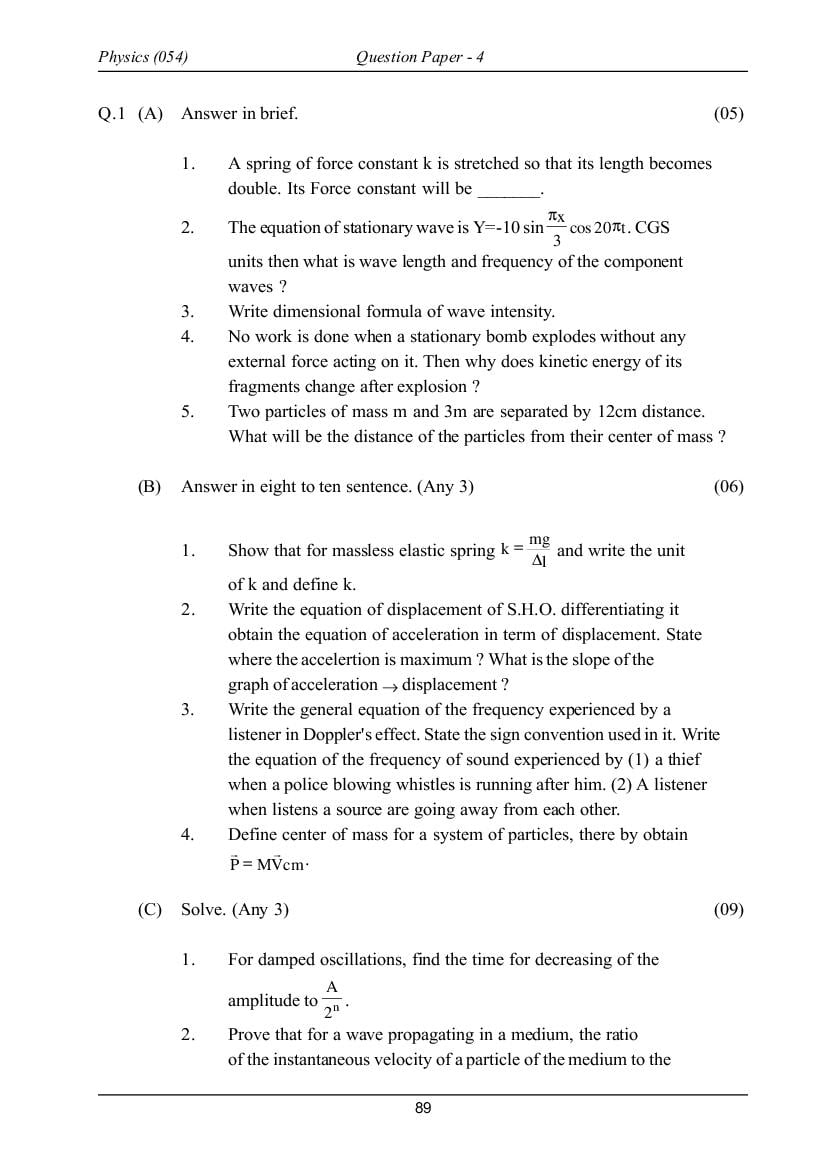
Q.1 (A) Answer in brief. (05)
1. A spring of force constant k is stretched so that its length becomes
double. Its Force constant will be _______.
2. The equation of stationary wave is Y=-10 sin cos 20 πt . CGS
πx
units then what is wave length and frequency of the component
3
waves ?
3. Write dimensional formula of wave intensity.
4. No work is done when a stationary bomb explodes without any
external force acting on it. Then why does kinetic energy of its
fragments change after explosion ?
5. Two particles of mass m and 3m are separated by 12cm distance.
What will be the distance of the particles from their center of mass ?
(B) Answer in eight to ten sentence. (Any 3) (06)
1. Show that for massless elastic spring k = ∆ and write the unit
mg
of k and define k.
l
2. Write the equation of displacement of S.H.O. differentiating it
obtain the equation of acceleration in term of displacement. State
where the accelertion is maximum ? What is the slope of the
graph of acceleration → displacement ?
3. Write the general equation of the frequency experienced by a
listener in Doppler's effect. State the sign convention used in it. Write
the equation of the frequency of sound experienced by (1) a thief
when a police blowing whistles is running after him. (2) A listener
when listens a source are going away from each other.
4. Define center of mass for a system of particles, there by obtain
r r
P = MVcm .
(C) Solve. (Any 3) (09)
1. For damped oscillations, find the time for decreasing of the
amplitude to .
A
2. Prove that for a wave propagating in a medium, the ratio
2n
of the instantaneous velocity of a particle of the medium to the
89
Page 2
wave velocity is equal to the negative value of the slope of the wave form
at that point.
3. In a lake, a person is standing on a stationary raft. The distance
between the person and the bank is 20m. Mass of the person is 50 kg.
and that of the raft is 40 kg. The person now starts running towards
the bank with a velocity of 2.5 m/s with respect to the raft. How far
will ther person be from the bank after 1 sec ?
4. A ball of 6kg. Mass hits a wall at an angle of 40o and is then
reflected making an angle of 80o with its original direction of the
duration of contact between the ball and the wall is 0.1 sec. Calculate
the force exerted on the wall. The initial and the final Velocities
of the ball are 2m/s.
Q.2 (A) Answer in brief. (05)
1. Define Torque.
2. Write units and dimensional equation of momentum of ineritia.
3. Why is total energy of a satellite negative ?
4. Heat is flowing through two cylindrical rods of the same material.
The diameter of the rods are in the ratio 1:2 and their length are
in the ratio 2:1 of the temperature difference between their ends
is the same then the ratio of heat currents through them is _______.
5. Give two examples of irreversible processes.
(B) Answer in eight to ten sentences. (Any 3) (06)
1. Draw the diagram of a simple pendulum showing the forces acting
on its bob in a displaced position and hence derive
d 2θ
+ ϖ 2θ = 0
for it.
2
dt
2. Define inertial mass and gravitational mass and write the
formulas to obtain them.
3. Write the stages of Carnot's cycle and state the relation between
pressure and volume of each stage.
dQ dT
4. Identify the different terms in = − kA and define them.
dt dx
(C) Solve. (Any 3) (09)
1. A rigid body experiences an angular displacement of 300
radians is 6 secnds, and attains an angular velocity of 1000
rad/sec. Find its initial angular velocity and its angular
acceleration (assumed to be constant).
90
Page 3
2. Prove that the ratio of the linear orbital velocity of a satellite
orbiting close to the surface of the earth, to the escape velocity
of a stationary body on the earth is .
1
3. Two sheres each of mass equal to 6 kg. Are placed at points A and
2
B as shown in the figure.
P
10 cm 10 cm
A B
75cm 75cm
If a small sphere of 10 gm is placed at a point P, what will
be the acceleration experienced by it due to the gravitational forces
of masses only the force due to gravitation of masses A and B.
4. One mole of ideal gas at NTP is expanded adiabatically to twice its
initial volume and its temperature becomes 250 k. Calculate the
change in the internal energy of the gas during this expansion.
(Use γ =1.4, R=8.3 Joule/mole k).
Q.3 (A) Answer in brief. (05)
1. A carbon register has only three bands of color. What will be its
tolerance ?
2. Under what condition will the EMF of a cell become equal to its
terminal voltage.
3. What is the unit of magnetic flux ?
4. What is Inductor ?
5. One square coil has area of 10-2 met2 ? It is kept perpendicular to
uniform magnetic field of intensity 103 tesla. The flux passing
through the coil will be _______.
(B) Answer in eight to ten sentence. (06)
1. By accepting single valuedness of electropotential in an appropriate
circuit diagram, derive kirchoffs second rule.
2. Write an explain Faraday's second law of electrolysis and also
define chemical equivlent.
3. A stright conductor of infinite length, carries electric current I
along X-axis. Derive the formula for the magnetic field at a point laying
on X-Y plane whose position co-ordinates are (x,y).
4. On what factor does mutual Inductance of a system of two coil depends.
91
Page 4
(C) Solve. (Any 3) (09)
1. When a circuit is completed by connecting a resistance of 10 ohms
to an electrical cell, a current of 5mA is obtained. Now if an
unknown resistance X is connected in series. With the 10 ohm
resistance the current obtained is 4mA. Find the value of X.
(neglect internal resistance of the cell).
2. A DC motor is connected to a 110V direct voltage supply and draw
5amp. current. If its mechanical efficiency is 40% find the resistance of its
windings.
3. A circular coil havig a average radius of 6cm has 1000 turns. A
current of 5 amp passes through it. Find the magnetic field at a
tesla − meter
point on its axis 8 cm from the center µ 0 = 4 π × 10 .
FG −7 IJ
H Amp K
4. Flux linked per each turn of a coil of N turns changes from φ1 to φ 2
If the total resistance of the circuit including the coil, is R, Prove that
N ( φ 2 − φ1 )
charge Q induces is given by Q =
R
Q.4 (A) Answer in brief. (05)
1. If the phase lag between V and I in and a.c. circuit is δ , what is
the time lag ?
2. The ratio of the number of turns in primary coil to that in the
secondary coil is 5:1 if the current in the primary coil is 200mA
then the current in the secondary coil will be _______.
3. What is the frequency of waves generated in Hertz Experiment ?
4. Define plane of Oscillations.
5. The ratio of amplitude of two interfering waves is 3:2 what is the
ratio of maximum resultant intensity to the minimum resultant
intensity ?
(B) Answer in eight to ten sentences. (Any 3) (06)
1. Draw a neat diagram of A.C. dynamo or generator. Derive
expression of flux linked with the coil at time 't'.
2. Explain the generation of oscillating eletric and magnetic fields
in Hertz experiment.
3. Explain 'sky waves' and 'space wave' with necessary figure.
4. State the condition for mth order minima and maximum in
fraunhoffer diffraction by a single slit and plot graph of intensity.
(C) Solve. (Any 3) (09)
1
1. For an A.C. generator V=0 at t=0 and V=2 volt at t = second.
100π
92
Page 5
The voltage reaches a peak value of 100 volt. Find the frequency
of voltage.
2. Velocity of electromagnetic waves in vaccum is 3x10s km/sec. If the
permeability of vacuum is 4 π × 10−7 Weber / amp-met. Find its
permittivity.
3. In young's double slit experiment the separation of slits is 0.05cm
and a screen is placed at a distance of 100cm. Find the separation
between centers of the third bright and the fifth dark fringes. For
light of wave length 5000 A.
4. The ratio of intensities of rays emitted from two different
coherent sources is α . For the interference pattern formed by them
prove that : , I max = maximum of intensity
Im ax + Im in α + 1
=
Im ax − Im in 2 α
in the interference pringes, I min = minimum of intensity in the
interference fringe.
Q.5 (A) Answer in brief. (05)
1. The electric and magnetic field applied in Thomson's experiment
of e/m are 4900 v/m and 3.5 x 10⁻⁴ tesla. What is the horizontal
velocity of electrons.
2. The ratio of velocity of cathode ray in Thomson's experiment to
that of velocity of light in vacuum is _______.
3. What idea regarding the nucleus is obtained from the binding
energy per nucleon ?
4. What is avalanche current in. Reverse bias condition of PN junction diode.
5. α =0.98 for a transistor if Ic=4.9mA then find base current.
(B) Answer in eight to ten sentences. (Any 3) (06)
1. Describe the apparatus of Millikan's experiment of finding charge
of an electron with necessary diagram.
2. Obtain the equation of the radius of the orbit of electron in nth
orbit in Bohr model.
3. Derive exponential law of radioactive disintegration. Using the equation
draw the decay curve.
4. Draw the circuit diagram of half wave rectifier and explain the
process of rectification taking place during one complete cycle of
Input A.C.
(C) Solve. (Any 3) (09)
1. A 100 watt bulb converts 5% of electrical energy consumed by
it into light energy of the wagelength emitted by the bulb is
6625 Ao, Calculate number of photons emitted per second.
[h=6.625x10⁻³⁴ joule-sec, c = 3x10⁸ m/sec].
93
Page 6
2. Show that in a hydrogen atom angular speed of an electron is
πme 4
given by ω =
2 ε 0 2 n 3h 3
3. At a specific time the rate of radioactive decay of a substance
is 8000 nuclei/sec. At that time the undecayed number of nuclei is
8x10⁷. Find the decay constant and the half-life.
4. If the collector current of an NPN common emitter amplifier
shows a change in its collector current by 4.5mA when the input
voltage changes by 25 milli volt. Find its Tranconductance.
94
Page 7
SOLUTION
Q.1 (A) 1. 2K
2π π
k= = ⇒ λ = 6cm,
π
2. 3 3
⇒
λ
w = 20π ⇒ 2πf ⇒ f = 10 Hz.
3. M1L0T-3.
4. Because internal energy associated with the chemical bonding is
released which appears in the form of Kintu energy of its pragments.
5. m1 = m; m2 = 3m
r r
r m1 r1 + m2 r2
rcm = (Taking center of mass as origin).
m1 + m2
r r
m1 r1 + m 2 r2
0=
m1 + m 2
0 = m( r1 ) + 3m( r2 ) (ignoring negative sign)
∴ r1 = 3r2
but r1 + r2 = 12 cm
3r2 + r2 = 12
r2 = 3 cm and r1 = 9cm (Q r1 + r2 = 12)
(B) 1. A mass-less plastic spring obeying Hooke's law, is suspended in
normal position, vertically from a rigid support as shown in Fig.
* When a body of mass in is suspended from its lower end,
length of the spring increase by ∆ l under the influence of
weight (mg) and the body comes into equilibrium.
* The suspended mass is acted upon the two forces.
(i) Its weight mg acting down ward and
(ii) The restoring force (K ∆ l) due to the elasticity of the
spring acting upwards.
* For the equilibrium condition mg = K ∆ l where K = force
constant of the spring.
95
Page 8
Definition :
The force required (OR restoring force produced in the spring)
per unit change in the legnth of the spring is called force constant (k)
of the spring. Unit of K= N/m (MKS) dyne/cm in C.G.S. system.
2. The displacement of a S.H.O. is given by
y = Asin ( ω t+ φ ) ...(1)
velocity of S.H.O.; v =
dy
[ A sin(ωt + φ )]
dt
= d
dt
A ω cos( wt + φ) ... (2)
the time derivative of velocity of SHO is called acceleration.
dv
a=
dt
d [ Aw cos( ωt + φ )]
a= → from eqp. .....(2)
dt
a = − ω 2 ASin ( ωt + ϕ ) - from eq. ...(1)
a = − w 2 . y ...(3)
Eq. (3) shows that a α − y , i.e. the acceleration is directly proportional
to the displacement and it is in opp. direction.
Graph of Acceleration → displacement. :
Slope of the graph is −ω 2
ω2 A
t
3. Sign convention :-
Velocity in the direction from listener to the source is considered
positive and velocity in opposite direction is considered negative.
"Velocity of sound is always positive".
fL fS
V + VL V + VS ....(1)
=
V = velocity of sound in still air.
VS = velocity of the source.
96
Page 9
VL = Velocity of the listener to the source.
fS = Frequency of sound waves emitted by the source.
(i) Both listerner and source are moving away from each other.
the frequency of sound heared by the listener is smaller than
FG V − V IJ
the frequency emitted by the source. f L = V + V fs
L
H K
S
(ii) Frequency of sound heared by a thief when a policeman is
blowing whistle and running after him. Here the thief is the
FG V − V IJ
listener and policeman is the source of sound. f L = V + V fs .
L
S H K
4. Consider a system n particles of mass M1, M2, M3 ....Mn. If
r r r r
r1 , r2 , r3 ,....... rn are their respetive position vectors with respects to
some origin then the center of mass of the system is defined as a
r
point whose position vector rcm is given by the following equation.
r r r
r
....(1)
M1 r1 + M 2 r2 +.... + M n rn
rcm =
M1 + M 2 + .... + M n
Taking M1 + M2 + M3 + ....Mn=M=total mass of the system then
from above equation.
r r r r
differentiating above equation with respect to time, taking masses constant.
Mrcm = M1 r1 + M 2 r2 +.... + M n rn
r r r r
drcm dr1 dr2 drn
M = 1
M + 2
M + + n
.... M
r r r r r
dr dr dr r
dt dt dt dt
But 1 = V1 2 = V2 .... n − Vn
dt dt dt
r r
and n − Vcm velocity of the center of mass then.
dr
r r r r
MVcm = M1V1 + M 2 V2 + .... + M n Vn ;
dt
r r r r
are the linear momenter of n particles resp. and
M1V1 = P1.... M n Vn = Pn
r r
MVcm = P = linear momentum.
r r r r r
Thus linear momentum of center of mass of a system of particles is
∴ MVcm = P = P1 + P2 + .... Pn
equal to the vector sum of linear momentum of all particles and it is
equal to the product of total mass and velocity of center of mass.
FG bt IJ
(C) 1. A(t) = Ae -btn = A exp − H 2mK
FG − btn IJ ∴ 2 = ExpFG − btn IJ
H Qm K H QmK
A −n
= A exp
n
2
btn 2m
n ln 2 = ∴ tn = n. ln 2
2m b
97
Page 10
FG 2 m IJ (n)(2. 303) log 2
HbK
tn = G
F 2 m IJ (n)(0. 693)
tn =
HbK
2. The equation of propagating harmonic wave is y = A sin (ω t - kx)
Instantaneous velocity of particle is given by
= A ω cos (wt - kx) ..... 1
dy
ϑp =
dt
Slope of the wave form is given by = -A(k) cos ( ω t - kx) ....(2)
dy
from eq. (1) ÷ (2)
dx
But, = ϑ = wave velocity
ϑp w w
=−
slope k k
ϑp ϑp
∴ = −v ∴ = − slope
slope v
3.
Here no external force is acting on the system comprising of the pason and
the raft. Therefore momentum of this system is conserved. As shown in
v v
figure, let ϑ be the velocity of the person relative of the raft. A let ϑ be the
velocity of the raft relative to the bank.
v
Velocity of the person relative to the bank = ϑ − vr
Momentum of the person with respect
v
to the bank = M ( ϑ − vr )
M = mass of the person.
Momentum of the raft = M νr (M being the mass of the raft)
v
Acc to law of convervation of linear momentium m ( ϑ − vr ) = M νr
M νr = (m + M) νr ∴ 50 x 2.5 = (50 + 40)
∴ V = 1.38 m/sec.
Velocity of person with respect to bank = (2.5 - 1.38) = 1.12 met/sec.
Initially the person is 20 m away from the bank.
After 1 second he will be 20 - 1.12 = 18.87 meter away from the bank.
98
Page 11
4.
Q.2 (A) 1. The cross product of position vector of a particle with respect to a
reference point and force acting on it is called torque acting on the
particle.
2. Unit : kg - m2 dimensional equatio M1L2T0.
3. Because its negative potential energy is more than its kinetic energy.
dθ ∆T ∆T
4. = − kA = − kπr 2
dt ∆x l
( dθ / dt )1 FG IJ l = F 1 I 1 = 1
r
2 2
= 1 2
( dθ / dt )2 H K l H 2K 2 8
r2 1
5. Rusting of iron and errosion of the rocks.
99
Page 12
(B) 1. Consider simple pendulum as shown in pig. let m - mass of the bob
l = OA = OB length of the pendulum.
B = displaced position.
(i) mg = weight of the bob is vertically downword direction
(ii) T = tension in the string acting parallel to string.
the line of action of the tension T passes through the point of
suspension, hence the toque due to it is zero.
r r r
τ = l × mg
τ = − mglsin θ
-ve sign shows that torque is in oppditn to the angular displacement θ
of the bob,
dw d 2θ
τ = Iα = I = I 2 and I = ml 2
dt d θ
d 2θ
ml 2
= − lmg sin θ
dt 2
d 2θ g sin θ
dt l
⇒ 2 =−
- Angular displacement is very small then Sinθ ≅ θ
d 2θ g
hence
dt l
2
=− θ
−g
substituting by = ω 2
l
we get
d 2θ
+ w2 θ = 0
dt 2
This is the diff. Eqn. of angular harmonic motion.
2. In Newton's second law of motion. Force = Mass x accelaation the term
"mass" appears as a parameter, which "opposes" the action of applied force.
Accln, which represents the change in the state of motion, is inversely
proportionaly to this mass.
- "The mass which tends to oppose the change in the state of Motion of a body
is called the inertial mass of the body. "The enertial mass is denoted by mi and
is give by equation;
F = Mi x a ........1
- The force acting on a body in the gravitional field of another body is
proportional to its mass. This force acting on the body is given by
100
Page 13
GMemg
F= .......2
Re 2
mg in the above equation is called gravitational mass.
3. Four stages of carnot's cyclic process & their corresponding equation are as
follows :-
V2
1. Isothermal expansion : Q1 = nRT1ln V ......1
1
and PV
1 1 = PV
.......2
2. Adiabatic Expansion :
2 2
P2 γ 2 = P3 γ 3 ......3
3. Isothermal Compression :
V3
Q2 = nRT2 ln ......4
V4
P3 γ 3 = P4 γ 4 ......5
4. Adiabatu compression : P4 γ 4 = P1γ 1 ......6
dQ dT
4. In equation = − kA
dt dx
K = Thermal conductivity of the substance at a given temp.
A = Area of coss section.
dT
= temp gradient at distance x from the hot end.
dx
Defination : "The temp deference (or change in temp) per unit length
(distance)"
- Ve sign indicates that as x increases, the temp of successive part
descrease.
dQ
= rate of heat flow or heat current.
dt
Defination : The amount of heat energy passing normally through a unit area
FG w + w0 IJ t
of cross section in the unit length is called heat current in the rod.
(C) 1. θ = 300 radians. H 2 K
300 = G
F 100 + w0 IJ 6
θ=
t = 6 Sec. H 2 K
w = 100 rad/sec. ∴ 100 = 100 + wo
wo = ? ∴ wo = 0rad / sec.
α=?
w − wo 100 − 0 100
= 16. 6 rad / sec 2
t 6 6
α= =α= =
101
Page 14
MV 2 GMem
2. = gm
Re Re 2
=
∴Orbital velocity V = g Re
Escape Velocity on surface of the earth is
2GMe 2GMe Re
v= = g Re
Re Re2
=
v 1
ve 2
=
3. M1 = M2 = 6Kg. = Masses of two spheres of points A & B.
M = 10 x 10-3 Kg = Mass of the sphere at PtP.
r = 0.1m = 10-1m
G = 6.67 x 10⁻¹¹ Nm2/Kg2
Suppose F1 & F2 are force acting on melue
to M1 & M2 respectively.
GM1 M GM2 M
F1 = & F2 = (m1 = m2)
r 2
r2
6. 67 × 10 −11 × 6 × 10 × 10 −3
F1 = F2 = = 4. 00 × 10 −10 N .
10 −2
5 1
From Pig ∆PCA Cosθ =
10 2 ∴ θ = 60
= 0
r r
∴ angle between F1 & F2 is 2θ = 1200
r r r
resultant porce F = F1 + F2
r r
∴ F = F1 + F2 + 2 F1 F2 Cos1200
1
F = F12 + F2 2 + 2 F1 ( − ) (Q F1 = F2 )
2
F = 4. 00 × 10 −10 N .
Now,
F 4 . 00 × 10−10
a= = 40. 0 × 10−9
M 10 × 10−3
=
meter
a = 40. 0 × 10 −9
sec 2
4. Here n=1, V2 = 2V1, T1 = 27oC = 300 K
T2 = 250 K γ = 1.4 R = 8.3 J/mole
K∆U=?
The equation of work done during an adiabatic process is
nR 1 × 8. 3 8. 3 × 50
w= T1 − T2 = (300 − 250) =
γ −1 0. 4 0. 4
102
Page 15
= 8. 3 × 125 = 1037 .5 Joule
Now for an adiabatic process ∆ Q = 0 ∴ from 1st law of thermodynamics.
∆ u = -Dw ∴ ∆ u = -1037.5 J
∆ u = -1037 x 5J i.e. the internal energy decrease by 1037.53.
Q.3. (A) 1. 20%
2. When no current is flowing.
3. Unit of magnetic flux is weber.
4. a component which has self inductance is called an
"inductor"
5. A = 10-2 mt2
B = 103 tesla
φ=?
φ = area x magnetic field.
φ = 10-2 x 10³
φ = 10 weber.
(B) 1. Consider a loop ABCDEFA as shown in fig.
The loop is formal by resistance R1, R2, R3, R4 & R5 and batteries of
e.m.f., E1, & E2. Suppose electric potential at Pt A is VA.
Suppose positive change are moved in the loop in clock wise direction.
The value of electric potential increases or decrease according to the
direction of current the connection of cells.
On the direction of current potential decreases IR after passing
through resistance R in opposite directon of the current the potential
increases by IR.
Insasteadly circuit due to single valued ness of electripotential, value
of potential becomes equal to VA again.
using
103
Page 16
VA = I1 R1 + ∈1 + I2 R2 − ∈2 − I3 R3 + Iu Ru + I5 R5 = VA
∑ IR = ∑ ∈
These equation represent kirchhof's second law.
Kirchhoff's Second Law :- "Along aclosed circuit loop the algebraic sum
of the product of resistance with the corresponsding value of current
flowing through them is equal to the algebraic sum of the e.m.f. applied along
the loop."
2. Law : 2
"When same current is passed for same time through different electrolytes
the masses of elements deposided from the electrolytes are in proportion to
the chemical requivalents.
Chemical equivalent of any element is the ratio of atomic weight the
valency of that element :
atomicweight
e=
valancy
Wt M1 & M2 be masses of two substance liberated at the electrodes when
same current I is passed theough two chemical cells, for same time interval
e1, e2 are their chemical equivalents resp. then according to Faraday's
Second law of electrolyses.
M 1 e1
M 2 e2
= ........ 1
3. In equation
r µ 0 I ∞ ydx
B= 3 K$
4π ∞ ( x2 + y2 ) 2
z
x = y tanθ
dx = y sec2 θdθ
- x = −∞ ⇒
−π
2
x=∞⇒
π
2
r µ 0 I π/2 ySec2θdθ 3 $
B= K
4 π − π / 2 ( y 2 tan 2 θ + y 2 ) 2
z
µ0 I y 2 Sec2θ $
+π /2
= dθK
4 π − π / 2 y 3 Sec3θ
z
µ0 I
π/2
= Cosθ • dθ
4 πy − π / 2
z
µ0 I
= [ Sinθ]π− π/ 2/ 2 K$
4 πy
µ0 I
= [1 + 1]K$
4 πy
104
Page 17
r µ I
| B| = 0
2 πy
4. Mutual inductance of a coild depends upon
1. Shapes of the coil
2. Size of the coil
3. Number of lines of the coil
4. Distance between them.
5. Their mutual encilination angle.
6. Material on which they are wound.
Q.5. (A) 1. R1 = 10 ohm R2 = (10 + x) ohm
I1 = 5 Milliamp. I2 = 4 milliamp
= 5 x 10⁻³ amp. x=?
I1 R1 = I 2 R2
5 × 10−3 × 10 = 4 × 10⁻³ × ( 10 + x )
5.0 = 40 + 4x
4x = 10
x = 2.5 Ohm.
2. V = 110 Volt, Mechanical efficiency = 40 %
I = 5 amp = 0.4 R=?
Power being consumed P = VI = (110) (5)
= 550 watt
Mechanical Power = Efficiency electric power
0.4 x 550 = 220 Watt.
Power dissipated in the form of heat
= 550 - 220 = 330 Watt.
R = Resistance of Motor Windeng's
330
R= = 13. 2Ω
25
3. a = 6 cm = 10-2m.
N = 1000
I = 5A
x = 8 cm = 8 x 10⁻² m.
r0 = 4T × 10−7 T − m / A
B=?
µ 0 Ia2 N 4 π × 10 −7 × 5 × 36 × 10 −4 × 1000
= B=
2( a 2 + x 2 ) 3 / 2 2 C 36 × 10 −4 + 64 × 10 −4
= 3/ 2
m r
= 11. 3 × 10⁻³ T
N∆φ
4.
∆t
∈=
We ingnore the negative sign in the problem)
N ( ∅ 2 − ∅1 )
Dt
∈=
105
Page 18
∈ N ( ∅ 2 − ∅1 )
∴I =
R Rt
=
Q = It
( ∅ 2 − ∅1 )
= N
R
N ( ∅2 − ∅1 )
Q =
R
Hence proneel.
(B) 1. Time lag is .
δ
ω
N1 5
2. = ; I1 , = 200 × 10−3 amp
N2 1
N1 5
I2 = = ; I1 , = 5 × 200 × 10 −3 = 1 amp.
N2 1
3. The frequency of the waves generate is same as the frequency of the
oscillation of the change between the spheres. (along the spark gap)
4. The plane containing the direction of the beam and the direction of the
r
E vectors of plane polarized light is called the plane of oscillation.
A1 3 A max A1 + A2 5
5.
FG IJ = 25
A2 2 A min A1 − A2 1
= ∴ = =
H K 1
Im ax A max
2
Im in A min
⇒ =
∴ Im ax : Im in = 25:1
(B) 1.
A.C. Dynamo or A.C. generator.
* Conducting coil PQRS having N then is kept in a uniform magnetic
r
field B .
* The coil is rotating with uniform angular speed to about x-axis.
r
* Mangite field ( B ) is directed along y-axis.
* A1 and A2 are slip rings connected with the two ends of the coil,
making sliding contacts with Bruches B1 and B2.
r r
If ever vector A of the coil makes angle with magnite field B at time t=0
then the magnetic flux linked with the coil at t=0 is
106
Page 19
φ o = NAB cos 0 = NAB
If the coil is rotating with angular velocity to then at time 't' φ = ωt hence
the magneti flux at time 't' can be given by.
φ = NAB cos ωt
2.
* As shown in figure suppose sphere Q1 in the appratus of
Hertz's experiment is negatively changed and Q2 is positively
charged at an instant.
* The intensity of electric field at points C and D are in upward direction
as shown in fig.
* When the spark passes through S the electrons on Q1 are
transferred to Q2.
* The oscillating electrons from periodically changing electric
current which gives rise to Periodically changing magnetic fields
at point C and D.
3.
Sky Waves :- HF waves gets absorbed by the soil. But the part of these
waves entering the atmosphere gets reflected back by the ionosphere and
can be received by the receiver. Such wave are called Sky Waves.
Space Waves :- The VHF and frequencies more propagates on
straight path from the transmitter to the receiver as shown in figure where
as some waves reach the receive after being reflected from earth surface.
mλ
4. For mth order minimum we can show that Sin φ m= where m = 1,2,3....
d
The graph of intensity I φ → φ for different points on the screen is
shown in the fig.
107
Page 20
1
(C) 1. Here, t = sec, v = 2volt , vm = 100volt , f = ? here value of
100π
1
t= is small then value of ωt is small. Then Sinωt = ωt .
100π
Now, V = Vm Sinωt
V = Vm cot
V V
= 2 πf ⇒ f =
Vm t 2 πVm t
ω=
2 1
2 × π × 100 100π
= ×
∴ f = 1Hz .
2. Given C = 3 x 10⁵ km/sec Co = 4 π x 10-7 weber/amp mt.
= 3 x 10⁸ m/sec
1 1
C= ⇒ 3 × 10 8 =
µ 0 ∈0 4 π × 10 −7
1
∴ ( 3 × 10⁸ ) =
4 π × 10−1 ∈ 0
1 1
× 10−9
9 × 10 × 4 π × 10 36 × 3.14
∈0 = 16 −7
=
log ∈0 = log 1 − ( log 36 − 1log 3.145 × 10−9
= [ 0.0000 − ( 1.5563 + 0.4969 ) ] × 10−9
= [ 0.0 − 2.0532 ] × 10−9
= [ 3.9468 ] × 10−9
∈0 = anti log[ 3 . 9468 ] × 10−9
= 0. 008847 × 10−9
∈0 = 8.847 × 10⁻¹² coulonub2 / N . mt 2
3. Given d = 0.05 cm = 5 x 10⁻⁴ m
D = 100 cm = 1m; λ = 5000 × 10−10 m
n = 3 (Bright f); 1 = 5 x 10⁻⁷ m.
n = 5 (Dark f); x5 - x3 = ?
→ n=3
xnd 3λD
= nλ ⇒ x3 =
D d
n=5
xnd 9λD 4 .5λD
= ( 2n − 1 ) ⇒ x5 =
λ
D 2 rd d
=
Distance between 3rd 5th fringe.
108
Page 21
λD 3λD
x5 − x3 = 4 .5
d d
−
λD
( 4 .5 − 3 ) = 1.5
d
=
5 × 10 −7 × 1
= 1.5 × = 1.5 × 10⁻³ m
5 × 10 −4
x5 − x3 = 1.5 × 10⁻³ m
I
4. Given I = α ; φ α
1
2
I 1 A 21 A
= 2 = α; 1 = α
I2 A 2 A2
A1 + A2 1 + α A max 1 + α
;
A1 + A2 α − 1 A min α −1
= =
Im ax A2 max ( 1 + 2 )2 1 + 2 2 + 2
Im in A min ( α − 1 )2 α − 2 2 + 1
→ = 2 = =
Im ax + Im in 1+ 2 2 + α + 2 − 2 2 +1
Im ax − Im in 1 − 2 α + α + 2 − C + 2 2 − 1
=
2( α + 1 ) α + 1
4 α α 2
= =
E 4900
Q.5 (A) 1. Velocity V = =
B 3.5 × 10⁻⁴ 1. 4 × 10 Met / Sec.
= 7
2. 1:10
3. Binding energy per nucleons is a measure of the stability of the nucleus.
4. The sudden increase in the current at breakdown voltage in reverse based
R N junction diode is known as avalenche.
5. 0.1 mA.
(B) 1.
109
Page 22
A & B are circular metallic disc of diameter about 22cm aranged parallel to each
other at a distance 1.5 cm. At the center of the upper dis.
- P is an atomizer with the help of which a liquid can be sprayed.
- The region betn the hoo plates can be illuminated with a light source S. The
shinning drop of liquid can be observed with the help of a telescope T.
2. A showin Fig. electron moving around the nucleus in a hydrogen atom suppose
M = mass
r = radius of the orbit of electron
v = linear velocity resp.
e = value of charge on 1 electron
Ze = Change of the nucleus.
Mv2 1 Zc 2
∴
r
=
4π ∈0 r 2
.......... 1
∈o = the permittivity of vaccum.
Acc to Bohr's first postulate.
nh
Mvr = , n = 1,2, 3..............
2π
Principle quantum Number
nh
2 2
M 2V 2 r 2 = ................. 3
4π2
Eliminating V from equation
n2 h 2 ∈ 0
r= ..................... 4
MπZe2
3. Instantaneous activity of a radioactive element
dN
= −λN .................... 1
dt
λ = radioactive constant of given element.
dN
= − λdt
dt
∴
Integrating on both sides,
lnN = − λt + C .................... 2
C = Constant of integration
Now N = No at t=0
we get
lnN = C ..................... 3
lnN = λt + lnNo
lnN − lNo = −λt
N = Noe−λt
I = Ioe−λt ..................... 4
110
Page 23
Equation [4] is called the exponential law of radioactive dis integration.
The graph of N → t is shown in fig. which is called decen / culve.
4.
- The primary coit of a lense former is connected to the source of A.C.
Voltage (Mains). One of the terminals of the secondary coil (Scy A) is
connected to the anode and the terminal B to the cathode via the resistor RL
working.
c
(C) 1. E = nhf = nh
λ
Eλ 5
n= = × 1034 −15
hc 3
= 1.66 x 10¹⁷ Photons
Mv 2 1 Ze2
2. For Z = 1 hydrogen atom.
r 4 π ∈0 r 2
=
Mr 2 w2 1 Ze2
r 4 π ∈0 r 2
=
1 Ze2
ω2 = ........... 1
4 π ∈ 0 mr 3
111
Page 24
nh nh
Now Mrv = ; mr 2ω =
2π 2π
nh
r2 =
2 πmω
r3 = LM nh OP 3/ 2
N 2πmω Q
Putting this in Eq. (1) we get
4 πme 4
2 ∈o 2 n 3 h 3
ω=
dN
3. = λN (-ve sign ignored)
dt
dN
8000
λ = dt = = 10−4 Sec−1
N 8 × 10⁷
0. 693 0. 693
C1 = = 6930Sec.
10−4
=
2
λ
4. Given δVBE = 25 milivolt
= 25 x 10-3 volt
δIc = 4.5 Mili Amp. = 4.5 x 10 Amp.
-3
gm = ?
RlδIc
Av = − Av = − gm RL
δVBE
δIc 4 .5 × 10−3
gm = − = 0.18 Mho.
δVBE 25 × 10−3
=
gm = 0.18 mho.
112
Document Details
| Board / Org | Gujarat Board |
| Exam | Class 12 |
| Type | Sample Paper |
| Pages | 24 |
| Updated | 22 Jul 2026 |