Karnataka 2nd PUC Chemistry Chemical Kinetics MCQ with Answers
Finished viewing? Save it for later —
Download Karnataka 2nd PUC Chemistry Chemical Kinetics MCQ with Answers (PDF · 17 pages)About Karnataka 2nd PUC Chemistry Chemical Kinetics MCQ with Answers
Karnataka 2nd PUC Chemistry Chemical Kinetics MCQ with Answers is available here for free download. Published by Karnataka Board for Class 12, this question bank can be viewed online or downloaded as a PDF (17 pages). Candidates preparing for Class 12 can use Karnataka 2nd PUC Chemistry Chemical Kinetics MCQ with Answers to understand the exam pattern, the type of questions asked, and the overall difficulty level.
Frequently Asked Questions
How can I download Karnataka 2nd PUC Chemistry Chemical Kinetics MCQ with Answers?
Open this page and click the Download button to save Karnataka 2nd PUC Chemistry Chemical Kinetics MCQ with Answers as a PDF. It is completely free on AglaSem Docs.
Is Karnataka 2nd PUC Chemistry Chemical Kinetics MCQ with Answers free to download?
Yes. Karnataka 2nd PUC Chemistry Chemical Kinetics MCQ with Answers can be viewed online and downloaded as a PDF free of cost on AglaSem Docs.
How many pages does Karnataka 2nd PUC Chemistry Chemical Kinetics MCQ with Answers have?
Karnataka 2nd PUC Chemistry Chemical Kinetics MCQ with Answers contains 17 pages, which you can read online or download together as a single PDF.
Where can I find more Class 12 study material?
You can find more Class 12 question papers, sample papers, syllabus, and answer keys on AglaSem Docs.
Karnataka 2nd PUC Chemistry Chemical Kinetics MCQ with Answers – Text
Read the full text of this question bank below — useful to quickly search, copy and reference the content online without downloading the PDF.
📄 View text version (17 pages)
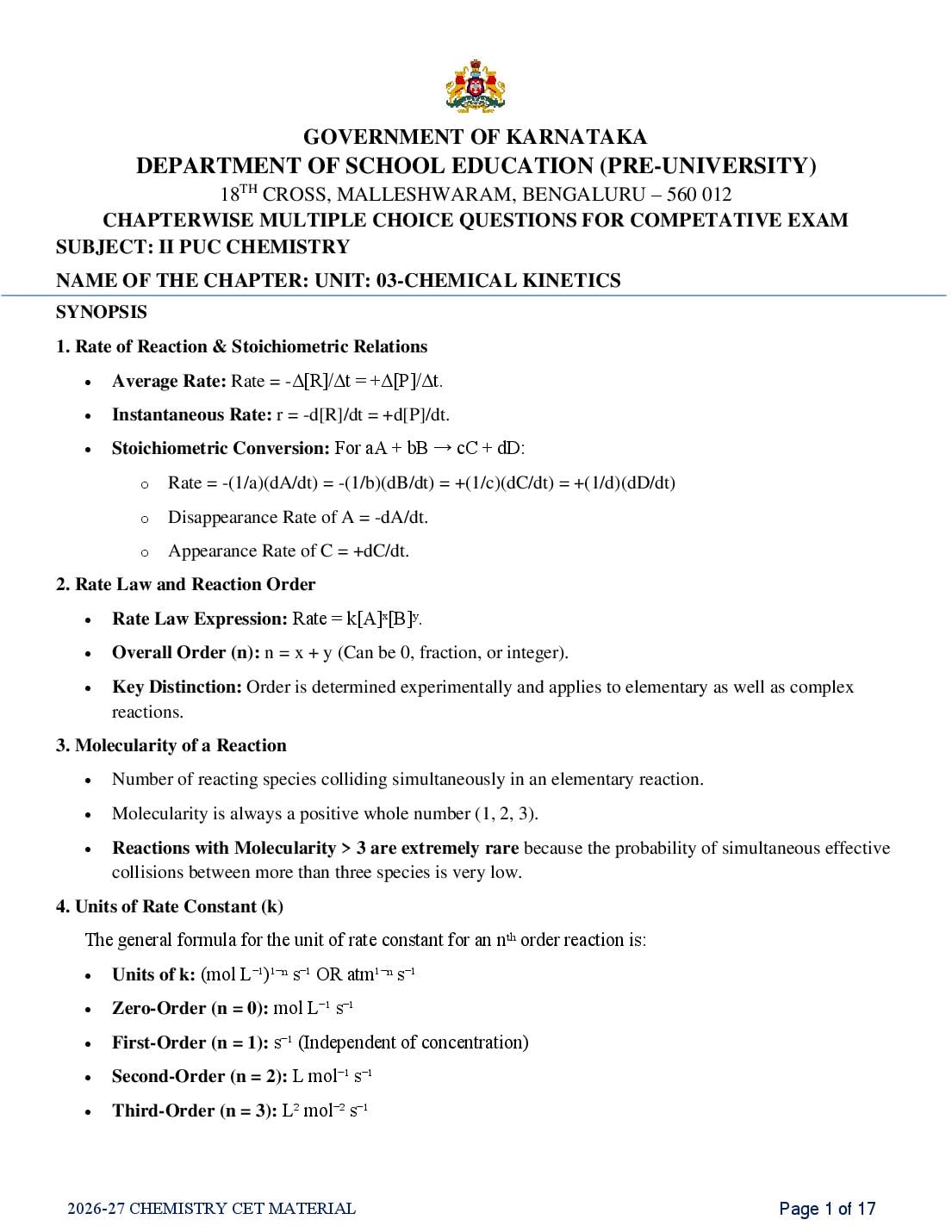
Page 1
DEPARTMENT OF SCHOOL EDUCATION (PRE-UNIVERSITY)
18TH CROSS, MALLESHWARAM, BENGALURU – 560 012
CHAPTERWISE MULTIPLE CHOICE QUESTIONS FOR COMPETATIVE EXAM
SUBJECT: II PUC CHEMISTRY
NAME OF THE CHAPTER: UNIT: 03-CHEMICAL KINETICS
SYNOPSIS
1. Rate of Reaction & Stoichiometric Relations
• Average Rate: Rate = -Δ[R]/Δt = +Δ[P]/Δt.
• Instantaneous Rate: r = -d[R]/dt = +d[P]/dt.
• Stoichiometric Conversion: For aA + bB → cC + dD:
o Rate = -(1/a)(dA/dt) = -(1/b)(dB/dt) = +(1/c)(dC/dt) = +(1/d)(dD/dt)
o Disappearance Rate of A = -dA/dt.
o Appearance Rate of C = +dC/dt.
2. Rate Law and Reaction Order
• Rate Law Expression: Rate = k[A]ˣ[B]ʸ.
• Overall Order (n): n = x + y (Can be 0, fraction, or integer).
• Key Distinction: Order is determined experimentally and applies to elementary as well as complex
reactions.
3. Molecularity of a Reaction
• Number of reacting species colliding simultaneously in an elementary reaction.
• Molecularity is always a positive whole number (1, 2, 3).
• Reactions with Molecularity > 3 are extremely rare because the probability of simultaneous effective
collisions between more than three species is very low.
4. Units of Rate Constant (k)
The general formula for the unit of rate constant for an nᵗʰ order reaction is:
• Units of k: (mol L⁻¹)¹⁻ⁿ s⁻¹ OR atm¹⁻ⁿ s⁻¹
• Zero-Order (n = 0): mol L⁻¹ s⁻¹
• First-Order (n = 1): s⁻¹ (Independent of concentration)
• Second-Order (n = 2): L mol⁻¹ s⁻¹
• Third-Order (n = 3): L² mol⁻² s⁻¹
2026-27 CHEMISTRY CET MATERIAL Page 1 of 17
Page 2
• Differential Rate Equation: -d[A]/dt = k
• Integrated Rate Equation:
o [A] = [A]₀ - k × t ⇒ k = ([A]₀ - [A]) / t
• Half-Life Period (t₁/₂):
o t₁/₂ = [A]₀ / 2k
o t₁/₂ is directly proportional to initial concentration [A]₀.
• Graphical Representation: Plot of [A] vs t gives a straight line with slope = -k and intercept = [A]₀.
6. First-Order Kinetics Summary
• Differential Rate Equation: -d[A]/dt = k[A]
• Integrated Rate Equations:
o k = (2.303 / t) × log₁₀([A]₀ / [A]) OR [A] = [A]₀ × e⁻ᵏᵗ
• Half-Life Period (t₁/₂):
o t₁/₂ = ln(2) / k = 0.693 / k
o t₁/₂ is completely independent of initial concentration [A]₀.
• Useful Relations for Completion Times:
o t99.9% ≈ 10 × t₁/₂
o t75% = 2 × t₁/₂
7. Amount Left After n Half-Lives
For any 1ˢᵗ order reaction, after n half-life periods (t = n × t₁/₂):
• Remaining Amount [A] = [A]₀ / (2ⁿ)
8. First-Order Gas-Phase Reactions
For a gas-phase reaction A(g) → B(g) + C(g) with initial pressure Pᵢ and total pressure Pₜ at time t:
• k = (2.303 / t) × log₁₀[ Pᵢ / (2Pᵢ - Pₜ) ]
9. Pseudo-First-Order Reactions
• Reactions that are bimolecular but follow first-order kinetics because one reactant is present in large
excess.
• Examples:
1. Acid hydrolysis of ethyl acetate:
CH₃COOC₂H₅ + H₂O → CH₃COOH + C₂H₅OH (Rate = k[CH₃COOC₂H₅])
2. Inversion of cane sugar: C₁₂H₂₂O₁₁ + H₂O → C₆H₁₂O₆ + C₆H₁₂O₆
10. Rate-Determining Step (RDS)
• In a multi-step (complex) reaction, the slowest step determines the overall reaction rate and rate law.
2026-27 CHEMISTRY CET MATERIAL Page 2 of 17
Page 3
11. Temperature Dependence & Temperature Coefficient
• Temperature Coefficient (γ): Ratio of rate constants at temperatures differing by 10°C:
o γ = k(T+10) / kT ≈ 2 to 3
• For a temperature increase of ΔT, the new rate becomes:
o New Rate = Initial Rate . γ(ΔT / 10)
12. Arrhenius Equation
Relates the rate constant (k) with absolute temperature (T) and activation energy (Eₐ):
• k = A × e(-Eₐ / RT)
• A = Arrhenius factor / Pre-exponential factor / Frequency factor
• Eₐ = Activation Energy (J mol⁻¹)
• e^(-Eₐ/RT) = Fraction of molecules having kinetic energy ≥ Eₐ
13. Logarithmic Forms of Arrhenius Equation
• Natural Log Form: ln(k) = ln(A) - (Eₐ / RT)
• Base-10 Log Form: log₁₀(k) = log₁₀(A) - [ Eₐ / (2.303 × R × T) ]
• Graphical Plot: Plot of log₁₀(k) vs 1/T yields a straight line with:
o Slope = -Eₐ / (2.303 × R)
o Y-intercept = log₁₀(A)
• Two-Temperature Form:
o log₁₀(k₂ / k₁) = [ Eₐ / (2.303 × R) ] × [ (T₂ - T₁) / (T₁ × T₂) ]
14. Concept of Activation Energy (Eₐ) and Threshold Energy
• Threshold Energy: Minimum total energy required by colliding molecules to form products.
• Activation Energy (Eₐ): Extra energy needed by reactant molecules to reach threshold energy:
o Eₐ = Ethreshold - Ereactants(average)
15. Energetics of Exothermic and Endothermic Reactions
• Enthalpy Change (ΔH):
o ΔH = Eₐ(forward) - Eₐ(backward)
• Exothermic Reaction (ΔH < 0): Eₐ(forward) < Eₐ(backward)
• Endothermic Reaction (ΔH > 0): Eₐ(forward) > Eₐ(backward)
• If Eₐ(forward) = Eₐ(backward), then ΔH = 0.
16. Effect of Catalyst on Reaction Rate
• A catalyst increases the reaction rate by providing an alternative reaction pathway with a lower
Activation Energy (Eₐ).
2026-27 CHEMISTRY CET MATERIAL Page 3 of 17
Page 4
energies of reactants and products.
• Lowers Eₐ for both forward and backward reactions by the exact same amount.
17. Collision Theory of Chemical Reactions
• According to Collision Theory, rate depends on collision frequency (Z) and fraction of effective
collisions:
o Rate = Z_AB × e(-Eₐ / RT)
• Effective Collision Requirements:
1. Colliding molecules must possess sufficient kinetic energy (≥ Eₐ).
2. Colliding molecules must have proper steric orientation at the moment of impact.
18. Probability / Steric Factor (P)
Modifies Collision Theory to account for molecular orientation:
• k = P × Z_AB × e(-Eₐ / RT)
• P = Probability factor or steric factor (reflects orientation requirement).
• Even if molecules have energy > Eₐ, reaction rate can be slow if P is very small due to improper
orientation or complex molecular structures.
19. Dilution Effect on Reaction Rate
• Diluting a liquid reaction mixture by adding equal volume of solvent halves the concentration of
reactants.
• For an nᵗʰ order reaction, new rate relative to initial rate becomes:
o New Rate = Initial Rate × (1/2)ⁿ
20. Quick Problem-Solving Summary Table
Parameter Zero Order (n = 0) First Order (n = 1)
Integrated Equation k = ([A]₀ - [A]) / t k = (2.303 / t) × log([A]₀ / [A])
Half-Life (t₁/₂) t₁/₂ = [A]₀ / 2k (∝ [A]₀) t₁/₂ = 0.693 / k (Independent of [A]₀)
Completion Time t100% = [A]₀ / k t100% = ∞
Units of k mol L⁻¹ s⁻¹ s⁻¹
Straight-Line Plot [A] vs t (Slope = -k) log[A] vs t (Slope = -k / 2.303)
2026-27 CHEMISTRY CET MATERIAL Page 4 of 17
Page 5
3.1 Rate of a Chemical Reaction
1. For the reaction 4𝐴 + 𝐵 → 2𝐶 + 2𝐷 , which of the following statement is not correct?
a) The rates of formation of𝐶 and 𝐷 are equal.
b) The rate of formation of𝐶 is one - half of the rate of consumption of 𝐴 .
c) The rate of appearance of𝐷 is half of the rate of disappearance of 𝐵 .
d) The rate of disappearance of𝐵 is one fourth of the rate of disappearance of 𝐴 .
2. For the reaction,2 𝑁2 𝑂5 → 4𝑁𝑂2 + 𝑂2 , the rate of reaction can be expressed in terms of time and
concentration by the expression:
𝑑[ 𝑁2 𝑂5 ] 1 𝑑[𝑁𝑂2 ] 1 𝑑[𝑂 ] 1 𝑑[ 𝑁2 𝑂5 ] 1 𝑑[𝑁𝑂2 ] 𝑑[𝑂2 ]
a) Rate= − = −4 = 2 𝑑𝑡2 b) Rate= − 2 =4 =
𝑑𝑡 𝑑𝑡 𝑑𝑡 𝑑𝑡 𝑑𝑡
1 𝑑[ 𝑁2 𝑂5 ] 1 𝑑[𝑁𝑂2 ] 𝑑[𝑂2 ] 1 𝑑[ 𝑁2 𝑂5 ] 1 𝑑[𝑁𝑂2 ] 1 𝑑[𝑂 ]
c) Rate= − 4 =2 = d) Rate= − 2 =2 = 2 𝑑𝑡2
𝑑𝑡 𝑑𝑡 𝑑𝑡 𝑑𝑡 𝑑𝑡
3. The rate expression for the following reaction in terms of rate of consumption of reactants and formation of
products is𝐹2( 𝑔) + 2𝐶𝑙𝑂2( 𝑔) → 2𝐹𝐶𝑙𝑂2( 𝑔) [KCET 2014]
𝑑[ 𝐹2 ] 1 𝑑[𝐹𝐶𝑙𝑂2 ]
a) b) 2
𝑑𝑡 𝑑𝑡
𝑑[𝐹𝐶𝑙𝑂2 ] 1 𝑑[𝐶𝑙𝑂2 ]
c) −2 d) 2
𝑑𝑡 𝑑𝑡
4. For the reaction,2 𝑁2 𝑂5 → 4𝑁𝑂2 + 𝑂2 rate and rate constant are 1.02 × 10⁻⁴ 𝑚𝑜𝑙 𝐿−1 𝑠 −1 and 3.4 ×
10−5 𝑠 −1 respectively. The concentration of 𝑁2 𝑂5 in 𝑚𝑜𝑙𝐿−1 will be
a) 5.2 b) 3.2 × 10⁻⁵
c) 3.4 × 10⁻⁴ d) 3.0
5. Nitrogen dioxide(𝑁𝑂2 ) dissociates into nitric oxide (𝑁𝑂) and oxygen (𝑂2 ) as follows: 2𝑁𝑂2 → 2𝑁𝑂 + 𝑂2
If the rate of decrease of concentration of 𝑁𝑂2 is 6.0 × 10⁻¹² 𝑚𝑜𝑙 𝐿−1 𝑠 −1 . What will be the rate of
increase of concentration of 𝑂2 ? [KCET 2015]
a) 3 × 10⁻¹² 𝑚𝑜𝑙 𝐿−1 𝑠 −1 b) 1 × 10⁻¹² 𝑚𝑜𝑙 𝐿−1 𝑠 −1
c) 6 × 10⁻¹² 𝑚𝑜𝑙 𝐿−1 𝑠 −1 d) 1.5 × 10⁻¹² 𝑚𝑜𝑙 𝐿−1 𝑠 −1
6. The rate of disappearance of𝑆𝑂2 in the reaction, 2𝑆𝑂2 + 𝑂2 → 2𝑆𝑂3 is 1.28 × 10⁻⁵ 𝑀𝑠 −1 . The rate of
appearance of 𝑆𝑂3 is [KCET 2016]
a) 0.32 × 10⁻⁵ 𝑀𝑠 −1 b) 1.28 × 10⁻⁵ 𝑀𝑠 −1
c) 2.56 × 10⁻⁵ 𝑀𝑠 −1 d) 0.64 × 10⁻⁵ 𝑀𝑠 −1
7. In the reaction,2 𝑁2 𝑂5 → 4𝑁𝑂2 + 𝑂2 , the rate of formation of 𝑁𝑂2 is 0.0072 𝑚𝑜𝑙 𝐿−1 𝑠 −1 . What is the
rate of change of [𝑁2 𝑂5 ] at the same time? [KCET 2013]
a) 0.0144 b) 0.0072
c) 0.0036 d) 0.0018
2026-27 CHEMISTRY CET MATERIAL Page 5 of 17
Page 6
a) Rate of disappearance of𝑃 = Rate of appearance of 𝑆
b) Rate of disappearance of𝑃 = Rate of disappearance of 𝑄
1
c) Rate of disappearance of𝑄 = 2 × 𝑅𝑎𝑡𝑒𝑜𝑓𝑎𝑝𝑝𝑒𝑎𝑟𝑎𝑛𝑐𝑒𝑜𝑓𝑅
d) Rate of disappearance of𝑄 = 2 × Rate of appearance of 𝑅
−𝑑[ 𝑁2 𝑂4 ] 𝑑[𝑁𝑂2 ]
9. Consider the reaction2 𝑁2 𝑂4 ⇌ 4𝑁𝑂2 and given that = 𝑘 and = 𝑘 ′ , then
𝑑𝑡 𝑑𝑡
a) 𝑘 ′ = 𝑘 b) 𝑘 ′ = 2𝑘
c) none of these d) 2𝑘 ′ = 𝑘
10. For the reaction,2𝑋 + 3𝑌 → 4𝑍 , the rate of reaction may be represented as [NEET 2021]
1 𝑑[𝑋] 1 𝑑[𝑌] 1 𝑑[𝑍] 1 𝑑[𝑋] 1 𝑑[𝑌] 1 𝑑[𝑍]
a) rate= 2 𝑑𝑡 = − 3 𝑑𝑡 = − 4 𝑑𝑡 b) rate= − 2 𝑑𝑡 = − 3 𝑑𝑡 = 4 𝑑𝑡
1 𝑑[𝑋] 1 𝑑[𝑌] 1 𝑑[𝑍] 1 𝑑[𝑋] 1 𝑑[𝑌] 1 𝑑[𝑍]
c) rate= 2 𝑑𝑡 = 3 𝑑𝑡 = 4 𝑑𝑡 d) rate= − 2 𝑑𝑡 = 3 𝑑𝑡 = 4 𝑑𝑡
11. In the reaction2 𝑁2 𝑂5 → 4𝑁𝑂2 + 𝑂2 , the rate is expressed as [KCET 2019]
𝑑[ 𝑁2 𝑂5 ]
1. − = 𝑘1 [ 𝑁2 𝑂5 ]
𝑑𝑡
𝑑[𝑁𝑂2 ]
2. = 𝑘2 [ 𝑁2 𝑂5 ]
𝑑𝑡
𝑑[𝑂2 ]
3. = 𝑘3 [ 𝑁2 𝑂5 ]. Relation between𝑘1 , 𝑘2 and 𝑘3 is
𝑑𝑡
a) 2𝑘1 = 𝑘2 = 4𝑘3 b) 2𝑘1 = 4𝑘2 = 𝑘3
c) 𝑘1 = 4𝑘2 = 2𝑘3 d) 2𝑘1 = 𝑘2 = 2𝑘3
1
12. For a chemical reaction𝑌2 + 2𝑍 → product, rate controlling step is 𝑌 + 2 𝑍 → 𝑄. If the concentration of 𝑍 is
doubled, the rate of reaction will [KCET 2015]
a) become√2 times b) remain the same
c) become double d) become four times
13. For an elementary reaction,2𝐴 + 3𝐵 → 4𝐶 + 𝐷 the rate of appearance of 𝐶 at time ’ 𝑡 ’ is 2.8 ×
10−3 𝑚𝑜𝑙 𝐿−1 𝑠 −1 . Rate of disappearance of 𝐵 at ’ 𝑡 ’, 𝑡 will be [KCET 2020]
3 4
a) 4 (2.8 × 10⁻³ )𝑚𝑜𝑙𝐿−1 𝑠 −1 b) 3 (2.8 × 10⁻³ )𝑚𝑜𝑙𝐿−1 𝑠 −1
1
c) 4 (2.8 × 10⁻³ )𝑚𝑜𝑙𝐿−1 𝑠 −1 d) 2(2.8 × 10⁻³ )𝑚𝑜𝑙𝐿−1 𝑠 −1
3.2 Factors Influencing Rate of a Reaction
14. The reaction,2𝑆𝑂2(𝑔) + 𝑂2(𝑔) → 2𝑆𝑂3(𝑔) is carried out in a 1𝑑𝑚3 vessel and 2𝑑𝑚3 vessel separately. The
ratio of reaction velocities will be
a) 1: 8 b) 4: 1
2026-27 CHEMISTRY CET MATERIAL Page 6 of 17
Page 7
15. The unit of rate constant for the reaction,2𝐻2 + 2𝑁𝑂 → 2𝐻2 𝑂 + 𝑁2 which has rate = 𝑘[𝐻2 ][𝑁𝑂]2 , is
a) 𝑚𝑜𝑙𝐿−1 𝑠 −1 b) 𝑚𝑜𝑙 −2 𝐿2 𝑠 −1
c) 𝑚𝑜𝑙𝐿−1 d) 𝑠 −1 [NEET 2016]
16. For the reaction,𝑎𝐴 → 𝑥𝑃 , when = 2.2𝑚𝑀 the rate was found to be 2.4𝑚𝑀𝑠𝑒𝑐 −1 . On reducing
concentration of 𝐴 to half, the rate changes to 0.6𝑚𝑀𝑠𝑒𝑐 −1 . The order of reaction with respect to 𝐴 is
a) 2.0 b) 3.0
c) 1.5 d) 2.5 [KCET 2014]
17. The rate of a gaseous reaction is given by𝑘[𝐴][𝐵] . If the volume occupied by the reacting gases is
suddenly reduced to half the original volume, the rate of the reaction relative to the initial rate will be
a) 1/4 b) 1/8
c) 8/1 d) 4 [KCET 2016]
18. The rate of formation of a dimer in a second order dimerisation reaction is9.1 × 10−6 𝑚𝑜𝑙 𝐿−1 𝑠 −1 at
0.01 𝑚𝑜𝑙 𝐿−1 monomer concentration. What will be the rate constant for the reaction? [KCET 2017]
a) 9.1 × 10⁻² 𝐿 𝑚𝑜𝑙 −1 𝑠 −1 b) 3 × 10⁻⁴ 𝐿 𝑚𝑜𝑙 −1 𝑠 −1
c) 9.1 × 10⁻⁶ 𝐿 𝑚𝑜𝑙 −1 𝑠 −1 d) 27.3 × 10⁻² 𝐿 𝑚𝑜𝑙 −1 𝑠 −1
19. Match the rate law given in column I with the dimensions of rate constants given in column II and mark the
appropriate choice. [KCET 2018]
a) (A)→ (iv), (B) → (iii), (C) → (ii), (D) → (i) b) (A)→ (i), (B) → (ii), (C) → (iv), (D) → (iii)
c) (A)→ (i), (B) → (ii), (C) → (iii), (D) → (iv) d) (A)→ (ii), (B) → (i), (C) → (iv), (D) → (iii)
20. For the reaction, 𝐴 + 𝐵 → 𝑃 . If B is doubled at constant A, the rate of the reaction doubles. If A is tripled
and B is doubled, the rate of the reaction increases by a factor of 6. What is the overall order of the
reaction? [KCET 2019]
a) 1 b) 2
c) 0.5 d) 3
21. The reaction 𝐴 + 2𝐵 + 𝐶 → 𝑍 , occurs by the following mechanism : [KCET 2021]
1. 𝐴 + 𝐵 → 𝑋 (Fast)
2. 𝑋 + 𝐶 → 𝑌 (Slow)
3. 𝑌 + 𝐵 → 𝑍 (Very fast)
2026-27 CHEMISTRY CET MATERIAL Page 7 of 17
Page 8
a) 𝑘[𝐴][𝐵]2 [𝐶] b) 𝑘[𝑋][𝑌][𝑍]
c) 𝑘[𝐶] d) 𝑘[𝑍]
22. The rate constant for a first order reaction is equal to the initial rate of reaction when the initial
concentration of the reactant is [NEET 2017]
a) 1 × 10⁻² 𝑀 b) 1.0 M
c) 0.1 M d) 100 M
23. The following data pertains to reaction between𝐴 and 𝐵 .
Which of the following inferences can be drawn from the above data?
1. Rate constant of the reaction is1.0 × 10−4 .
2. Rate law of the reaction is : rate= 𝑘[𝐴][𝐵]
3. Rate of reaction increases four times on doubling the concentration of both the reactants.
a) III only b) I, II and III
c) I and II only d) II and III only
24. From the following data for the reaction between 𝐴 and 𝐵, the order of reaction with respect to𝐴 is 2 and
with respect to 𝐵 is 1. Using the value of activation energy 55.3 𝑘𝐽 𝑚𝑜𝑙 −1 , calculate the pre - exponential
factor. Given 𝑇 = 27∘ 𝐶 . [JEE MAIN 2015]
a) 1.140 × 10¹⁸ b) 1.140 × 10¹⁵
c) 2.280 × 10¹⁸ d) 2.280 × 10¹⁵
25. The rate of the reaction: 𝐶𝐻3 𝐶𝑂𝑂𝐶2 𝐻5 + 𝑁𝑎𝑂𝐻 → 𝐶𝐻3 𝐶𝑂𝑂𝑁𝑎 + 𝐶2 𝐻5 𝑂𝐻 is given by the equation
Rate = 𝑘[𝐶𝐻3 𝐶𝑂𝑂𝐶2 𝐻5 ][𝑁𝑎𝑂𝐻]. If concentration is expressed in 𝑚𝑜𝑙𝐿−1 , the unit of 𝑘 is
a) 𝑚𝑜𝑙 −2 𝐿2 𝑠 −1 b) 𝐿𝑚𝑜𝑙 −1 𝑠 −1
c) 𝑚𝑜𝑙𝐿−1 𝑠 −1 d) 𝑠 −1
26. For an exothermic chemical process occurring in two steps as follows:
2026-27 CHEMISTRY CET MATERIAL Page 8 of 17
Page 9
2. 𝑋 → 𝐴𝐵 (fast). The process of reaction can be best described by
a) b)
c) d)
27. 100 𝑐𝑚3 of 1𝑀𝐶𝐻3 𝐶𝑂𝑂𝐻 was mixed with 100 𝑐𝑚3 of 2𝑀𝐶𝐻3 𝑂𝐻 to form an ester. The change in the
initial rate if each solution is diluted with equal volume of water would be [KCET 2018]
a) 0.5 times b) 4 times
c) 0.25 times d) 2 times
28. 1 L of2𝑀𝐶𝐻3 𝐶𝑂𝑂𝐻 is mixed with 1 L of 3𝑀𝐶2 𝐻5 𝑂𝐻 to form an ester. The rate of the reaction with
respect to the initial rate when each solution is diluted with an equal volume of water will be [KCET 2020]
a) 0.5 times b) 4 times
c) 0.25 times d) 2 times
29. Higher order(> 3) reactions are rare due to
a) loss of active species on collision
b) increase in entropy as more molecules are involved.
c) shifting of equilibrium towards reactants due to elastic collisions
d) low probability of simultaneous collision of all reacting species
30. An exothermic chemical reaction proceeds by two stages.
𝑠𝑡𝑎𝑔𝑒1 𝑠𝑡𝑎𝑔𝑒2
Reactants → Intermediate → Products. The activation energy of state 1 is 50 𝑘𝐽 𝑚𝑜𝑙 −1 . The overall
enthalpy change for the reaction is −100 𝑘𝐽 𝑚𝑜𝑙 −1 . Which diagram could represent the energy level
diagram for the reaction? [JEE MAIN 2018]
a) b)
c) d)
2026-27 CHEMISTRY CET MATERIAL Page 9 of 17
Page 10
fraction of sucrose undergoes hydrolysis in 11 hrs? [KCET 2016]
a) 0.8511 b) 0.412
c) 0.9345 d) 0.6122
1
32. The rate constant,𝑘 of the reaction, 𝑁2 𝑂5( 𝑔) → 2𝑁𝑂2( 𝑔) + 2 𝑂2( 𝑔) is 2.3 × 10⁻² 𝑠𝑒𝑐 −1 . Which equation
given below describes the change of [𝑁2 𝑂5 ] with time? [𝑁2 𝑂5 ]0 and [𝑁2 𝑂5 ]𝑡 correspond to concentration
of 𝑁2 𝑂5 initially and at time 𝑡 . [KCET 2019]
[𝑁 𝑂 ]
a) ln [ 𝑁2 𝑂5 ]0 = 𝑘𝑡 b) log10 [ 𝑁2 𝑂5 ]𝑡 = log10 [ 𝑁2 𝑂5 ]0 − 𝑘𝑡
2 5 𝑡
c) [𝑁2 𝑂5 ]0 = [𝑁2 𝑂5 ]𝑡 𝑒 𝑘𝑡 d) [𝑁2 𝑂5 ]𝑡 = [𝑁2 𝑂5 ]0 + 𝑘𝑡
3.3 Integrated Rate Equations
33. If initial concentration is reduced to1/4𝑡ℎ in a zero order reaction, the time taken for half the reaction to
complete [NEET 2020]
a) remains same b) doubles.
c) becomes 4 times d) becomes one - fourth
34. In a first order reaction, the concentration of reactant is reduced to 1/8 of the initial concentration in 75
minutes at 298 K. What is the half - life period of the reaction in minutes?
a) 25 min. b) 50 min.
c) 30 min. d) 15 min.
35. The half - life of a first order reaction is 10 minutes. If initial amount is 0.08 𝑚𝑜𝑙/ litre and concentration
at time 𝑡 is 0.01 𝑚𝑜𝑙/ litre. Then value of 𝑡 is
a) 10 minutes b) 40 minutes
c) 30 minutes d) 20 minutes
36. The rate constant of a first order reaction is 15 × 10−3 𝑠 −1 . How long will 5.0 g of this reactant take to
reduce to 3.0 g? [KCET 2016]
a) 34.07 s b) 7.57 s
c) 15 s d) 10.10 𝑠
37. For a first order reaction, the ratio of the time for 99.9% completion of the reaction to half of the reaction
to complete is [NEET 2018]
a) 10 b) 4
c) 8 d) 2
38. The rate constant for a first order reaction is2 × 10−2 𝑚𝑖𝑛−1 . The half - life period of reaction is
a) 17.37 min b) 34.65 min
c) 3.46 min d) 69.3 min [KCET 2017]
2026-27 CHEMISTRY CET MATERIAL Page 10 of 17
Page 11
Which one is true for rate of three reactions, if concentration of reactant is greater than 1 M?
a) 𝑟1 > 𝑟2 > 𝑟3 b) All of these
c) 𝑟1 = 𝑟2 = 𝑟3 d) 𝑟1 < 𝑟2 < 𝑟3 [KCET 2018]
𝑑𝑐
40. The rates of a certain reaction(− 𝑑𝑡 ) at different times are as follows :
The reaction is
a) third order b) zero order
c) first order d) second order
41. Half - life period of a first order reaction is 10 min. What percentage of the reaction will be completed in
100 min? [KCET 2021]
a) 25% b) 50%
c) 99.9% d) 75%
42. The half - life period of a first order reaction is 15 minutes. The amount of substance left after one hour
will be [KCET 2019]
a) one fourth b) one half
c) one eighth d) one sixteenth
43. For a first - order reaction 𝑃 → 𝑄 , if 𝑘 is rate constant and initial concentration of the reactant 𝑃 is 1.5 M,
then the half - life is [KCET 2020]
log2 log2
a) b) 𝑘√0.5
𝑘
ln2 0.693
c) 𝑘 d) 0.5𝑘
44. The rate of first order reaction is1.5 × 10−2 𝑚𝑜𝑙𝐿𝐿−1 𝑚𝑖𝑛−1 at 0.5 M concentration of the reactant. The
half - life of the reaction is
a) 0.383 min b) 7.53 min
c) 23.1 min d) 8.73 min
45. Which of the following statements is true?
1. For first order reaction, straight - line graph of log𝐶 𝑣𝑠 𝑡 is obtained, slope = −𝑘/2.303 .
2. A plot of log𝑘 vs 1/𝑇 gives a straight - line graph for which slope = −𝐸𝑎 /2.303𝑅 .
3. Units of𝑘 for the first order reaction are independent of concentration units.
2026-27 CHEMISTRY CET MATERIAL Page 11 of 17
Page 12
a) Statement d is true. b) Statement a is true.
c) Statement c is true. d) Statement b is true.
46. Time required for 99.9% completion of a first order reaction is nearly [NEET 2018]
a) 20 times that required for 50% of the reaction b) 10 times that required for 50% of the reaction
c) 100 times that required for 90% of the reaction d) 10 times that required for 25% of the reaction
47. A first order reaction is half completed in 45 min. How long it need99.9% of the reaction to be completed?
a) 7.5 hours b) 10 hours
c) 5 hours d) 20 hours [KCET 2018]
48. The following data were obtained during the first order thermal decomposition of𝑆𝑂2 𝐶𝑙2 at a constant
volume. 𝑆𝑂2 𝐶𝑙2( 𝑔) → 𝑆𝑂2( 𝑔) + 𝐶𝑙2(𝑔) . What is the rate of reaction when total pressure is 0.65 atm?
a) 0.35 𝑎𝑡𝑚 𝑠 −1 b) 2.235 × 10⁻³ 𝑎𝑡𝑚 𝑠 −1
c) 1.55 × 10⁻⁴ 𝑎𝑡𝑚 𝑠 −1 d) 7.8 × 10⁻⁴ 𝑎𝑡𝑚 𝑠 −1
3.4 Temperature dependence of the Rate of a Reaction
49. When a graph oflog10 𝑘 is plotted against 1/𝑇 , the inverse of slope of the line is
𝐸 𝐸
a) − 𝑅𝑎 𝑎
b) − 2.303𝑅
𝑎𝐸 2.303𝑅
c) − 2.303 d) − 𝐸𝑎
50. Effect of temperature on reaction rate is given by
a) Claisen - Clapeyron equation b) Arrhenius equation
c) Kirchoff’s equation d) Gibb’s - Helmholtz equation
51. The rate constant of a reaction
a) is independent of 𝐸𝑎 b) decreases with increasing 𝐸𝑎
c) decreases with decreasing 𝐸𝑎 d) decreases with increasing temperature.
52. Which of the following statements is not correct? [JEE MAIN 2017]
1. For a zero order reaction,𝑡1/2 is proportional to initial concentration.
𝑘 𝐸 𝑇 −𝑇
2. The relationship of variation of rate constant with temperature is given bylog 𝑘2 = 2.303𝑅
𝑎
[ 𝑇2 𝑇 1 ]
1 1 2
3. The unit of rate constant for a reaction is𝑚𝑜𝑙1−𝑛 𝐿𝑛−1 𝑠 −1 where 𝑛 is order of the reaction.
2026-27 CHEMISTRY CET MATERIAL Page 12 of 17
Page 13
a) Statement c is not correct. b) Statement a is not correct.
c) Statement b is not correct. d) Statement d is not correct.
53. Which one of the following does not represent Arrhenius equation? [KCET 2018]
𝐸
a) ln𝑘 = − 𝑅𝑇𝑎 + ln𝐴 b) 𝑘 = 𝐴𝑒 𝐸𝑎 /𝑅𝑇
𝐸
c) 𝑘 = 𝐴𝑒 −𝐸𝑎/𝑅𝑇 𝑎
d) log𝑘 = log𝐴 − 2.303𝑅𝑇
54. The temperature coefficient of a reaction is 2. When the temperature is increased from30∘ 𝐶 to 90∘ 𝐶 , the
rate of reaction is increased by
a) 72 times b) 410 times
c) 150 times d) 64 times
55. The first order rate constant for the decomposition of ethyl iodide by the reaction, 𝐶2 𝐻5 𝐼(𝑔) → 𝐶2 𝐻4( 𝑔) +
𝐻𝐼(𝑔) at 600 K is 1.60 × 10⁻⁵ 𝑠 −1 . Its energy of activation is 209 𝑘𝐽/𝑚𝑜𝑙 . The rate constant of the
reaction at 700 K is
a) 5 × 10⁻³ 𝑠 −1 b) 3.5 × 10⁻² 𝑠 −1
c) 7.36 × 10⁻² 𝑠 −1 d) 6.36 × 10⁻³ 𝑠 −1
1
56. According to Arrhenius equation which of the following options represents the graph ofln𝑘𝑣𝑠 𝑇 ?
a) b)
c) d) [KCET 2019]
3.5 Collision Theory of Chemical reactions
57. When the activation energies of the forward and reverse reactions are equal, then [KCET 2020]
a) 𝛥𝑈 = 0, 𝛥𝑆 = 0 b) only𝛥𝑈 = 0
c) 𝛥𝐺 = 0, 𝛥𝑈 = 0 d) 𝛥𝑈 = ∞, 𝛥𝑆 = 0
58. Rate constant 𝑘 of a reaction is dependent on temperature as: 𝑘 = 𝐴𝑒 −𝐸𝑎/𝑅𝑇 , 𝑘 has the least value at
a) high 𝑇 and small 𝐸𝑎 b) high 𝑇 and high 𝐸𝑎
c) low 𝑇 and low 𝐸𝑎 d) low 𝑇 and high 𝐸𝑎
59. For an exothermic reaction,𝛥𝐻 represents the enthalpy of the reaction in 𝑘𝐽𝑚𝑜𝑙 −1 . The minimum amount
of activation energy will be [KCET 2016]
a) can be predicted b) equal to𝛥𝐻
2026-27 CHEMISTRY CET MATERIAL Page 13 of 17
Page 14
60. The activation energy in a chemical reaction is defined as,
a) the sum of energies of reactants and products
b) the difference in energy of intermediate complex with the average energy of reactants and products
c) the difference in energy of intermediate complex and the average energy of reactants
d) the difference in energies of reactants and products
61. An exothermic reaction𝐴 → 𝐵 has an activation energy of 17 kJ per mole of 𝐴 . The heat of the reaction is
40 kJ . Calculate the activation energy for the reverse reaction 𝐵 → 𝐴 .
a) 75 kJ b) 57 kJ
c) 60 kJ d) 90 kJ
62. Consider the following reaction profile: For the reaction 𝐴 → 𝐵 , the activation energy is [KCET 2017]
a) 𝑐 b) 𝑎
c) 𝑑 d) 𝑏
63. The activation energy necessary for a reaction, may be lowered by
a) adding a catalyst b) reducing the potential energy.
c) increasing the temperature d) decreasing the temperature
64. For a certain reaction a large fraction of molecules has energy more than the threshold energy, still the rate
of reaction is very slow. The possible reason for this could be that [KCET 2019]
a) the rate of reaction could be independent of the energy
b) one of the reactants could be in excess.
c) the colliding molecules could be large in size
d) the colliding molecules must not be properly oriented for effective collisions
65. The rate constant is given by the equation𝑘 = 𝑃𝑍𝑒 −𝐸𝑎 /𝑅𝑇 . Which factor should register a decrease for the
reaction to proceed more rapidly? [KCET 2021]
a) 𝑃 b) 𝑇
c) 𝐸 d) 𝑍
66. Rate of a general reaction𝐴 + 𝐵 → products can be expressed as follows on the basis of collision theory.
Rate = 𝑍𝐴𝐵 𝑒 −𝐸𝑎/𝑅𝑇 . Which of the following statements is not correct for the above expression?
2026-27 CHEMISTRY CET MATERIAL Page 14 of 17
Page 15
mixture.
b) 𝑒 −𝐸𝑎/𝑅𝑇 is the fraction of molecules with kinetic energy equal to or greater than 𝐸𝑎 .
c) All the molecules which collide with one other are effective collisions.
d) 𝐸𝑎 is activation energy of the reaction.
67. Collision theory is applicable to
a) pseudo first order reactions b) bimolecular reactions
c) zero order reactions d) first order reactions
68. For effective collisions, colliding molecules must have
a) sufficient potential energy b) sufficient kinetic energy
c) maximum energy of activation d) minimum potential energy
69. Chemical reaction occurs as a result of collisions between reacting molecules. Therefore, the reaction rate
is given by
a) total number of effective collisions
b) fraction of molecules which possess energy less than the threshold energy
c) none of these
d) total number of collisions occurring in a unit volume per second
70. Which of the following statements is incorrect about the collision theory of chemical reaction? [KCET 2020]
a) Molecules should collide with sufficient threshold energy and proper orientation for the collision to be
effective.
b) Number of effective collisions determines the rate of reaction.
c) It considers reacting molecules or atoms to be hard spheres and ignores their structural features.
d) Collision of atoms or molecules possessing sufficient threshold energy results into the product
formation.
71. In the given diagram,𝐸𝑅 , 𝐸𝑃 and 𝐸𝑋 represent the energy of the reactants, products and activated complex
respectively. Which of the following is the activation energy for the backward reaction?
a) 𝐴 b) 𝐷
c) 𝐶 d) 𝐵
72. According to collision theory, collision rate= 𝑍 [ reactants] where 𝑍 is
a) activation energy b) potential energy
2026-27 CHEMISTRY CET MATERIAL Page 15 of 17
Page 16
73. The rate constant is given by the equation𝑘 = 𝑃. 𝑍𝑒 −𝐸𝑑 /𝑅𝑇 . Which factor should register a decrease for the
reaction to proceed more rapidly? [KCET 2017]
a) 𝑍 b) 𝐸𝑎
c) 𝑇 d) 𝑃
74. Which of the following graphs represents endothermic reaction? [NEET 2018]
a) (ii) only b) (iii) only
c) (i) only d) (i) and (ii)
75. In a hypothetical reaction𝑋 → 𝑌 , the activation energy for the forward and backward reactions are 15 and
9 𝑘𝐽 𝑚𝑜𝑙 −1 respectively. The potential energy of 𝑋 is 10 𝑘𝐽 𝑚𝑜𝑙 −1 . Which of the following statements
is/are correct? [KCET 2019]
1. The threshold energy of the reaction is25 𝑘𝐽 𝑚𝑜𝑙 −1 .
2. The potential energy of𝑌 is 16 𝑘𝐽 𝑚𝑜𝑙 −1 .
3. Heat of reaction is6 𝑘𝐽 𝑚𝑜𝑙 −1 .
4. The reaction is endothermic.
a) Only (ii) and (iii) b) Only (i) and (ii)
c) Only (i) d) All are correct
2026-27 CHEMISTRY CET MATERIAL Page 16 of 17
Page 17
Q.No Key Q.No Key Q.No Key Q.No Key Q.No Key
1 C 2 B 3 B 4 D 5 A
6 B 7 C 8 D 9 B 10 B
11 A 12 A 13 A 14 D 15 B
16 A 17 D 18 A 19 B 20 B
21 C 22 B 23 D 24 A 25 B
26 A 27 C 28 C 29 D 30 C
31 A 32 A 33 D 34 A 35 C
36 A 37 A 38 B 39 D 40 B
41 C 42 D 43 C 44 C 45 A
46 B 47 A 48 D 49 D 50 B
51 B 52 D 53 B 54 D 55 D
56 B 57 B 58 D 59 A 60 C
61 B 62 A 63 A 64 D 65 C
66 C 67 B 68 B 69 A 70 D
71 A 72 C 73 B 74 A 75 D
*********
2026-27 CHEMISTRY CET MATERIAL Page 17 of 17
Document Details
| Board / Org | Karnataka Board |
| Exam | Class 12 |
| Type | Question Bank |
| Pages | 17 |
| Updated | 24 Sep 2026 |