Karnataka 2nd PUC Chemistry d and f Block Elements MCQ with Answers
Finished viewing? Save it for later —
Download Karnataka 2nd PUC Chemistry d and f Block Elements MCQ with Answers (PDF · 17 pages)About Karnataka 2nd PUC Chemistry d and f Block Elements MCQ with Answers
Karnataka 2nd PUC Chemistry d and f Block Elements MCQ with Answers is available here for free download. Published by Karnataka Board for Class 12, this question bank can be viewed online or downloaded as a PDF (17 pages). Candidates preparing for Class 12 can use Karnataka 2nd PUC Chemistry d and f Block Elements MCQ with Answers to understand the exam pattern, the type of questions asked, and the overall difficulty level.
Frequently Asked Questions
How can I download Karnataka 2nd PUC Chemistry d and f Block Elements MCQ with Answers?
Open this page and click the Download button to save Karnataka 2nd PUC Chemistry d and f Block Elements MCQ with Answers as a PDF. It is completely free on AglaSem Docs.
Is Karnataka 2nd PUC Chemistry d and f Block Elements MCQ with Answers free to download?
Yes. Karnataka 2nd PUC Chemistry d and f Block Elements MCQ with Answers can be viewed online and downloaded as a PDF free of cost on AglaSem Docs.
How many pages does Karnataka 2nd PUC Chemistry d and f Block Elements MCQ with Answers have?
Karnataka 2nd PUC Chemistry d and f Block Elements MCQ with Answers contains 17 pages, which you can read online or download together as a single PDF.
Where can I find more Class 12 study material?
You can find more Class 12 question papers, sample papers, syllabus, and answer keys on AglaSem Docs.
Karnataka 2nd PUC Chemistry d and f Block Elements MCQ with Answers – Text
Read the full text of this question bank below — useful to quickly search, copy and reference the content online without downloading the PDF.
📄 View text version (17 pages)
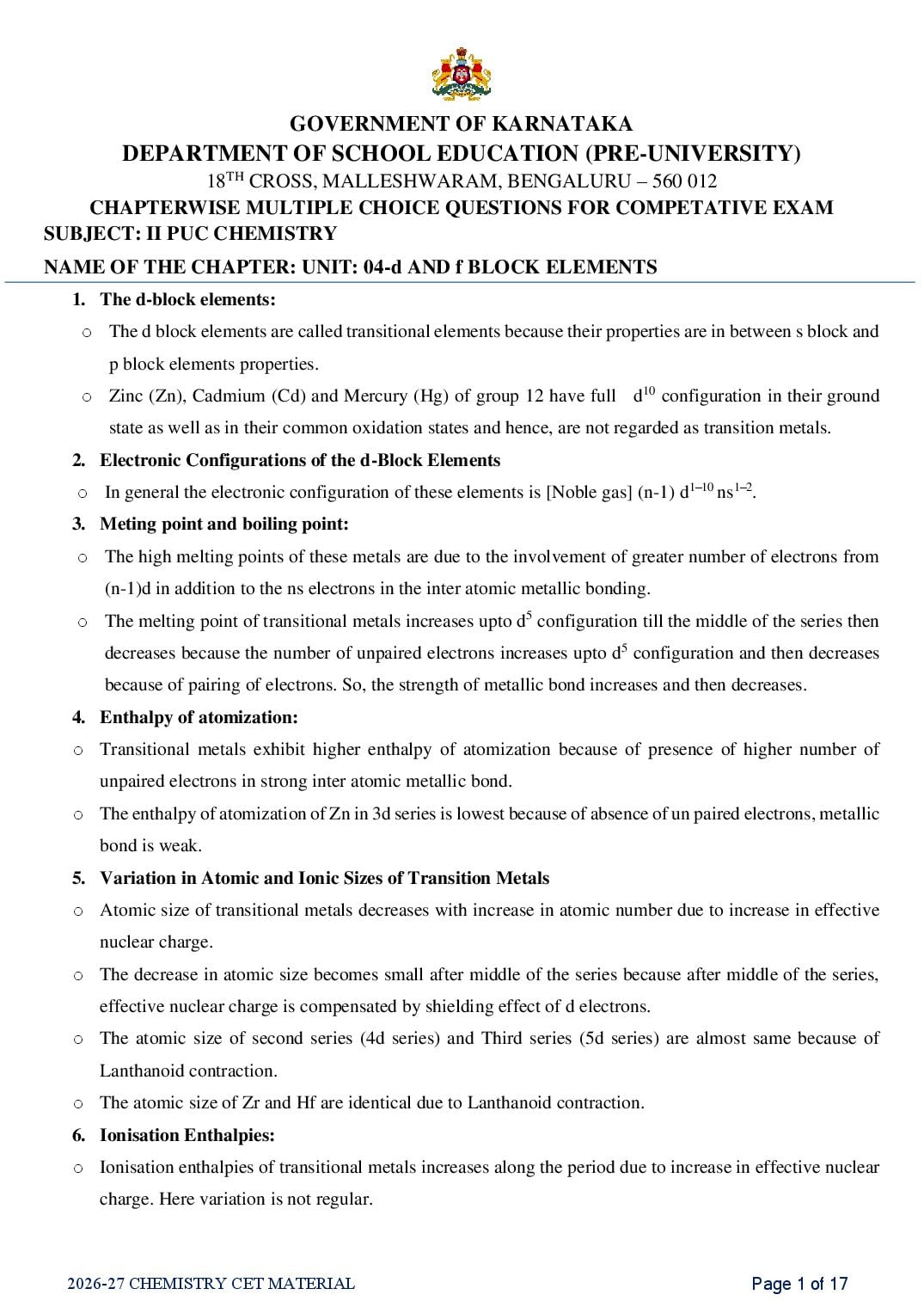
Page 1
DEPARTMENT OF SCHOOL EDUCATION (PRE-UNIVERSITY)
18TH CROSS, MALLESHWARAM, BENGALURU – 560 012
CHAPTERWISE MULTIPLE CHOICE QUESTIONS FOR COMPETATIVE EXAM
SUBJECT: II PUC CHEMISTRY
NAME OF THE CHAPTER: UNIT: 04-d AND f BLOCK ELEMENTS
1. The d-block elements:
o The d block elements are called transitional elements because their properties are in between s block and
p block elements properties.
o Zinc (Zn), Cadmium (Cd) and Mercury (Hg) of group 12 have full d10 configuration in their ground
state as well as in their common oxidation states and hence, are not regarded as transition metals.
2. Electronic Configurations of the d-Block Elements
o In general the electronic configuration of these elements is [Noble gas] (n-1) d1–10 ns1–2.
3. Meting point and boiling point:
o The high melting points of these metals are due to the involvement of greater number of electrons from
(n-1)d in addition to the ns electrons in the inter atomic metallic bonding.
o The melting point of transitional metals increases upto d5 configuration till the middle of the series then
decreases because the number of unpaired electrons increases upto d5 configuration and then decreases
because of pairing of electrons. So, the strength of metallic bond increases and then decreases.
4. Enthalpy of atomization:
o Transitional metals exhibit higher enthalpy of atomization because of presence of higher number of
unpaired electrons in strong inter atomic metallic bond.
o The enthalpy of atomization of Zn in 3d series is lowest because of absence of un paired electrons, metallic
bond is weak.
5. Variation in Atomic and Ionic Sizes of Transition Metals
o Atomic size of transitional metals decreases with increase in atomic number due to increase in effective
nuclear charge.
o The decrease in atomic size becomes small after middle of the series because after middle of the series,
effective nuclear charge is compensated by shielding effect of d electrons.
o The atomic size of second series (4d series) and Third series (5d series) are almost same because of
Lanthanoid contraction.
o The atomic size of Zr and Hf are identical due to Lanthanoid contraction.
6. Ionisation Enthalpies:
o Ionisation enthalpies of transitional metals increases along the period due to increase in effective nuclear
charge. Here variation is not regular.
2026-27 CHEMISTRY CET MATERIAL Page 1 of 17
Page 2
stable configurations (d5 and d10)
o First ionization energy of Cr is lower because removal of one electron produces extra stable d 5
configuration.
7. Oxidation States:
o Transitional metals shows variable oxidation state because of comparable energies of (n-1) d and ns
orbitals. So they lose electrons from both (n-1) d and ns orbitals.
o 3d series elements shows variable oxidation states because of comparable energies of 3d and 4s orbitals.
8. Magnetic Properties: Paramagnetism is expressed in magnetic moment (µ) (Spin only magnetic
moment) and measured in Bohr Magneton (BM) units.
Here n is the number of unpaired electrons.
9. Formation of Coloured Ions: Transitional metals forms coloured compounds because of (i) Presence of
unpaired electrons. (ii) d-d transition of electrons in the visible region.
10. Formation of Complex Compounds:
Transitional metals form complex compounds because of
o Presence of d orbitals for bond formation.
o High charge and small size of metal atom (High polarizing power)
11. Catalytic Properties:
Transitional metals are good catalysts because of
o Their ability to adopt variable oxidation states.
o Their ability to form complexes
o They provide large surface area for catalytic activity.
12. Formation of Interstitial Compounds:
Interstitial compounds: Interstitial compounds are those which are formed when small atoms like H, C or
N are trapped inside the crystal lattices of metals. Examples: TiC, Mn4N, Fe3H, VH0.56 and TiH1.7, etc.
o They have high melting points, higher than those of pure metals.
o They are very hard, some borides approach diamond in hardness.
o They retain metallic conductivity.
o They are chemically inert.
13. Alloys: Alloys are homogeneous mixture of two or more than two metals or metals and nonmetals.
Transitional metals can form alloys because they have similar size and in the crystal lattice one metal can be
replaced by other.
14. Oxides and Oxoanions of Metals:
o All transitional metals except Sc forms oxides which are generally basic in nature.
o Higher oxidation state oxides like Mn2O7 are covalent and acidic in nature.
o Some metal oxides are amphoteric in nature (Cr2O3 , V2O5 )
15. Manufacturing of Potassium dichromate:
4 FeCr2O4 + 8 Na2CO3 + 7 O2 → 8 Na2CrO4 + 2 Fe2O3 + 8 CO2
2026-27 CHEMISTRY CET MATERIAL Page 2 of 17
Page 3
Na2Cr2O7 + 2 KCl → K2Cr2O7 + 2 NaCl
2 CrO4 2– + 2H+ → Cr2O7 2– + H2O
Cr2O7 2– + 2 OH- → 2 CrO4 2– + H2O
Sodium and potassium dichromates are strong oxidising agents. In acidic solution, its oxidising action can
be represented as follows:
Cr2O7 2– + 14H+ + 6e– → 2Cr3+ + 7H2O
Thus, acidified potassium dichromate will oxidise iodides to iodine, sulphides to sulphur, tin(II) to tin(IV)
and iron(II) salts to iron(III).
6 I– → 3I2 + 6 e– ; 3 Sn2+ → 3Sn4+ + 6 e–
3 H2S → 6H+ + 3S + 6e– ; 6 Fe2+ → 6Fe3+ + 6 e–
▪ Cr2O7 2– + 14H+ + 6 I– → 2Cr3+ + 7H2O + 3I2
▪ Cr2O7 2– + 14H+ + 3 Sn2+ → 2Cr3+ + 7H2O + 3Sn4+
▪ Cr2O7 2– + 14H+ + 6 Fe2+ → 2Cr3+ + 7H2O + 6Fe3+
▪ Cr2O7 2– + 8H+ + 3 H2S → 2Cr3+ + 7H2O + 3S
16. Manufacturing of Potassium permanganate:
2MnO2 + 4KOH + O2 → 2K2MnO4 + 2H2O
3MnO4 2– + 4H+ → 2MnO4 – + MnO2 + 2H2O
Action of heat : When heated Potassium permanganate decomposes at 513 K.
2KMnO4 → K2MnO4 + MnO2 + O2
17. Oxidising reactions of KMnO4:
➢ In acid solutions:
▪ 10 I– + 2MnO4 – + 16H+ → 2Mn2+ + 8H2O + 5I2
▪ 5Fe2+ + MnO4 – + 8H+ → Mn2+ + 4H2O + 5Fe3+
▪ 5C2O4 2– + 2MnO4 – + 16H+ → 2Mn2+ + 8H2O + 10CO2
▪ H2S —> 2H+ + S2–
▪ 5S2– + 2MnO 4-- + 16H+ → 2Mn2+ + 8H2O + 5S
▪ 5SO3 2– + 2MnO4 – + 6H+ → 2Mn2+ + 3H2O + 5SO4 2–
▪ 5NO2 – + 2MnO4 – + 6H+ → 2Mn2+ + 5NO3 – + 3H2O
➢ In neutral or faintly alkaline solutions:
▪ 2MnO4 – + H2O + I– → 2MnO2 + 2OH– + IO3 –
▪ 8MnO4 – + 3S2O3 2– + H2O → 8MnO2 + 6SO4 2– + 2OH–
▪ 2MnO4 – + 3Mn2+ + 2H2O → 5MnO2 + 4H+
2026-27 CHEMISTRY CET MATERIAL Page 3 of 17
Page 4
The f block elements: The elements in which last electrons are filling to (n-2) [Pre-penultimate] f sub
shell are called f – block elements.
➢ There are two series in f block elements. They are (1) Lanthanoids (2) Actinoids
They are called as inner transitional elements because last electrons are filling to innermost(n-2) f subshell.
They kept separately in periodic table because they have similarity in properties along the row and not
along the columns (groups).
The general electronic configuration of f – block elements is [Noble gas](n-2)f1-14(n-1)d0-1ns2.
I. Lanthanoids: The elements in which added electrons fills into 4f [4f1-14] subshell are called
Lanthanoids.
o The elements from Cerium(Ce)[Z=58] to Lutetium(Lu)[Z=71] belongs to Lanthanoids.
1. Electronic Configuration:
The general electronic configuration of lanthanoids is [Xe]4f1-145d0-16s2
2. Lanthanoid contraction: The gradual decrease in the atomic and ionic radius of lanthanoids with
increase in their atomic number is called lanthanoid contraction.
o Lanthanoid contraction is due to poor shielding effect of 4f electrons.
3. Consequences of Lanthanoid contraction:
o Radius of 4d series (second series) and 5d series (Third series) elements are identical.
o Radii of Zirconium (Zr)[ 160 pm] and Hafnium (Hf) [ 159 pm] are identical.
4. Oxidation States:
Lanthanoids shows variable oxidation state due to comparable energies of 4f, 5d and 6s orbitals.
Common oxidation state of lanthanoids is +3. Cerium shows +4 oxidation state because it can attain stable
noble gas (Xe) configuration.
5. General Characteristics:
➢ The lanthanoid ions other than the f 0 type (La3+ and Ce4+) and the f 14 type (Yb2+ and Lu3+) are all
paramagnetic. The paramagnetism rises to maximum in Neodymium.
➢ The best single use of the lanthanoids is for the production of alloy steels for plates and pipes. A well
known alloy is mischmetal which consists of a lanthanoid metal (~ 95%) and iron (~ 5%) and traces of S,
C, Ca and Al. A good deal of mischmetal is used in Mg-based alloy to produce bullets, shell and lighter
flint. Mixed oxides of lanthanoids are employed as catalysts in petroleum cracking. Some individual Ln
oxides are used as phosphors in television screens and similar fluorescing surfaces.
6. Chemical reactions of the lanthanoids:
➢ Lanthanoids(Ln) burns with Oxygen to form oxides of the form Ln2O3
4 Ln + 3 O2 → 2 Ln2O3.
➢ Lanthanoids(Ln) heated with Carbon to form carbides of the form Ln3C, Ln2C3, LnC2
3 Ln + C → Ln3C
2026-27 CHEMISTRY CET MATERIAL Page 4 of 17
Page 5
Ln + 2 C → LnC2
➢ Lanthanoids(Ln) reacts with halogen(X) to form halides.
Ln + 3 X → LnX3
➢ Lanthanoids(Ln) reacts with Nitrogen to form nitrides.
2Ln + N2 → 2LnN
➢ Lanthanoids(Ln) reacts with Sulphur to form Sulphides .
2Ln + 3S → Ln2S3
➢ Lanthanoids(Ln) reacts with water to form hydroxides to liberating hydrogen gas.
2Ln + 6 H2O → 2 Ln(OH)3 + 3 H2
➢ Lanthanoids(Ln) reacts with dilute acids and liberates hydrogen gas.
Ln + Dilute acids → Liberates hydrogen.
II. The Actinoids: The elements in which added electrons fills into 5f [5f1-14] subshell are called
Actinoids. The elements from Thorium (Th)[Z=90] to Lawrencium (Lr)[Z=103] belongs to Actinoids.
1. Electronic Configuration: The general electronic configuration of Actinoids is [Rn]5f1-146d0-17s2
2. Actinoid contraction: The gradual decrease in the atomic and ionic radius of actinoids with increase in
their atomic number is called actinoid contraction.
o Actinoid contraction is due to poor shielding effect of 5f electrons.
o Actinoid contraction is greater than lanthanoid contraction because shielding effect of 5f electrons are
comparatively less than that of shielding effect of 4f electrons.
3. Oxidation States:
Actinoids shows variable oxidation state due to comparable energies of 5f , 6d and 7s orbitals.
Common oxidation state of actinoids is +3.
4. General Characteristics :(1)
➢ The actinoid metals are all silvery in appearance.
➢ Study of actinoids is difficult because
• All of them radioactive.
• Many of them have very short half-life.
• They could be prepared in nanograms.
➢ Actinoids are more reactive than lanthanoids because 5f electrons of actinoids are less firmly held by
nucleus than 4f electrons of lanthanoids.
5. Some Applications of d- and f-Block Elements:
o Iron and steel are used as construction material.
o Some oxides like TiO used in pigment industry.
o MnO2 used in dry cell, Zn and Ni/Cd also required in battery cells.
o Cu/Ni alloys used in making coins.
o Ziegler-Natta catalyst [ TiCl4 with (CH3)3Al] used in manufacturing of Polythene.
2026-27 CHEMISTRY CET MATERIAL Page 5 of 17
Page 6
o Transitional metals are used as catalysts in many industrial productions.
The d-block elements
1. Which of the following is non typical transitional element?
(a) Cr (b) Mn
(c) Fe (d)Zn
Electronic Configurations of the d-Block Elements
2. The electronic configuration of Cu(II) is 3d 9 whereas that of Cu(I) is 3d10. Which of the
following is correct?
a) Cu (II) is more stable
b) Cu (II) is less stable
c) Cu(I) and Cu (II) are equally stable
d) Stability of Cu(I) and Cu (II) depends on nature of copper salts
3. The electron configuration of element with Z = 24 is
a) 3d4 4s2 b) 3d5 4s1
c) 3d6 4s1 d) none of the above
4. Which one of the following ions has electronic configuration [Ar]3d6?
(a) Ni 3+ (b) Mn 3+
(c) Co 3+ (d) Fe 3+
Meting point and boiling point
5. In general, the melting and boiling points of transition metals
(a) increases gradually across the period from left to right.
(b) decreases gradually across the period from left to right.
(c) first increases till the middle of the period and then decreases towards the end.
(d) first decreases regularly till the middle of the period and then increases towards the end.
6. Among the transition elements the element with lower melting point belongs to
a) Group 3 b) Group 11
c) Group 6 d) Group 12
Enthalpy of atomization
7. Transition elements exhibit higher enthalpies of atomization
a) Because they exhibit variable oxidation state
b) Because of availability of higher number unpaired electron for metallic bonding
c) Because of magnetic nature
d) Because they are radioactive
8. The E M2+/M value for copper is positive (+ 0.34V). What is possible reason for this?
a) Copper has a high value of atomization enthalpy and low hydration enthalpy.
b) Copper has small size
c) Because of Lanthanoid contraction
2026-27 CHEMISTRY CET MATERIAL Page 6 of 17
Page 7
9. In the series Sc (Z = 21) to Zn (Z = 30), the enthalpy of atomization of zinc is the lowest,
i.e., 126 kJ mol–1, because
a) Zinc shows only one oxidation state b) Zinc has small size
c) Zinc has one unpaired electron d) Zinc has no unpaired electron
Ionisation Enthalpies
10. The second ionisation enthalpy value of Cr and Cu is exceptionally high because,
a) Both contains 1 unpaired electron
b) No unpaired electrons
c) M+ ions have the d5 and d10 configurations respectively.
d) Because of Lanthanoid contraction
Oxidation States
11. Of the following outer electronic configuration, highest oxidation state is achieved by
(a) (n-1) d3ns2 (b) (n-1) d5ns1
(c) (n-1) d8ns2 (d) (n-1) d5ns2
12. The element that usually does not show variable oxidation states is
(a) Sc (b) Cu
(c) Ti (d) V
13. The pair of elements which show + 1 oxidation state
(a) Cr & Zn (b) Fe & Zn
(c) Cr & Cu (d) Cu & Zn
14. The element showing oxidation state +7 is
a) Cr b) Mn
c) Co d) V
15. Of the following elements which is not expected to display an oxidation state of +6 in any of its
compounds?
a) Ti b) Cr
c) Mn d) W
16. A transition metal exists in its highest oxidation state. It is expected to behave as
(a) an oxidising agent (b) a chelating agent
(c) a reducing agent (d) a central metal in a co-ordination
17. Which one of the following is correct for all elements from Sc to Cu?
a) The lowest oxidation state shown by them is +2.
b) 4s orbital is completely filled in the ground state.
c) 3d orbital is not completely filled in the ground state.
d) The ions in +2 oxidation states are paramagnetic.
18. Match the followings aspects with the respective metal.
Aspects Metal
2026-27 CHEMISTRY CET MATERIAL Page 7 of 17
Page 8
number of oxidation states
B. The metal although placed in 3d block II. Copper
is considered not as a transition element
C. The metal which does not exhibit III. Manganese
variable oxidation states
D. The metal which in +1 oxidation state IV. Zinc
in aqueous solution undergoes disproportionation
Select the correct option.
A B C D
a) I IV II III
b) III IV I II
c) III I IV II
d) III V I III
19. Copper is a d-block element because
a) It contains partially filled d-orbital in its ground state
b) It contains partially filled d-orbital in its stable oxidation state
c) It contains partially filled d-orbital both in its ground state & stable oxidation state
d)It doesn’t contain partially filled d-orbital in its ground state
20. Which of the following has the maximum number of unpaired electrons?
a) Ti2+ b) Fe2+
c) Cr+ d) Cu+
Magnetic Properties
21. Match the metal ions given in Column I with the spin magnetic moments of the
ions given in Column II and assign the correct code
Column I Column II
1. Co3+ i. √8
2. Cr3+ ii. √35
3. Fe3+ iii. √3
4. Ni2+ iv. √24
v. √15
Select the correct option.
1 2 3 4
a) iv i ii iii
b) i ii iii iv
c) iv v ii i
d) iii v I ii
2026-27 CHEMISTRY CET MATERIAL Page 8 of 17
Page 9
(a) 4.90 BM (b) 2.84 BM
(b) 5.92 BM (d) 3.87 BM
23. Which one of the following will exhibit minimum paramagnetic behavior?
(a) [Fe(H2O)6]2+ (b) [Co(H2O)6]2+
(c) [Cr(H2O)6]2+ (d) [Mn(H2O)6]2+
24. Which one of the following ions exhibits d-d transition and paramagnetism as well?
(a) MnO4 – (b) Cr2O7 2 –
(c) CrO4 2 – (d) MnO4 2 –
25. Among the following lowest degree of paramagnetism per mole of compound at 298K
will be shown by
(a) MnSO4.4 H2O (b) NiSO4.6 H2O
(c) FeSO4.6 H2O (d) CuSO4.5 H2O
26. In transition series, with increase in atomic number, the paramagnetism
(a) Increases gradually
(b) Decreases gradually
(c) First increases to maximum then decreases
(d) First decreases to minimum and then increases
27. Chloro compound of vanadium has only spin magnetic moment of 1.73 BM. This vanadium chloride has
the formula:
a) VCl2 b) VCl4
c) VCl3 d) VCl5
28. Which of the following ions has maximum magnetic moment
a) Mn+2 b) Fe+2
c) Ti+2 d) Cr+2
29. Identify the set of paramagnetic ions among the following
a) Ti3+,Cu2+, Mn3+ b) Sc3+, Ti3+, V3+
c) V2+, Co2+, Zn2+ d) Ni2+, Cu2+, Zn2+
30. A magnetic moment of 1.73 BM will be shown by one of the following
(a) [Cu(NH3)4]+2 (b) [TiCl4 ]-2
(c) [Ni(CN)4 ]-2 (d) [CoCl6 ]-4
31. The value of spin only magnetic moment for one of the following is 2.84 BM.
The correct one is
(a) d5 in strong field (b) d4 in strong field
(c) d4 in weak field (d) d3 in weak field
Formation of Coloured Ions
32. The d-block elements form-coloured ions because
a) They absorb some energy for d- s transition
2026-27 CHEMISTRY CET MATERIAL Page 9 of 17
Page 10
c) They absorb some energy for d-d transition
d) They do not absorb any energy
33. Which of the following ions are coloured?
(a) Cu+ (b) Zn2+
(c) Ti4+ (d)V3+
34. Cuprous ion is colourless while cupric ion is coloured because
(a) cuprous ion has incomplete d-orbital and cupric ion has a complete d-orbital
(b) both have half-filled p and d-orbitals
(c) cuprous ion has a complete d-orbital and cupric ion has an incomplete d- orbital
(d) both have unpaired electrons in the d-orbitals
Formation of Complex Compounds
35. Which of the following is not a condition for complex formation?
(a) Small atomic size (b) High nuclear charge
(c) Variable oxidation states (d) Availability of vacant d orbital
36. Which of the following complex ion is not expected to absorb visible light?
(a) [Ni(CN)4 ]-2 (b) [Cr(NH3)6 ]+3
(c) [Fe(H2O)6 ]+2 (d) [Ni(H2O)6 ]+2
Formation of Interstitial Compounds
37. Which of the following statements about the interstitial compounds is incorrect?
(a) They retain metallic conductivity
(b) They are chemically reactive
(c) They are much harder than the pure metal
(d) They have higher melting points than the pure metals
38. Which transition metal has lowest density?
(a) Sc (b) Ti
(c) Zn (d) La
39. Which of the following ions has the maximum magnetic moment?
a) Mn+2 b) Fe+2
c) Ti+2 d) Cr+2
40. Which one of the following does not correctly represent the correct
order of the property indicated against it?
a) Ti < V < Cr < Mn: increasing number of oxidation states
b) Ti3+< V3+< Cr3+< Mn3+: increasing magnetic moment
c) Ti < V < Cr < Mn: increasing melting points
d) Ti < V < Mn < Cr: increasing 2nd ionization enthalpy
Catalytic Properties
2026-27 CHEMISTRY CET MATERIAL Page 10 of 17
Page 11
a) their magnetic behaviour b) their unfilled d-orbitals
c) their ability to adopt variable oxidation state d) their chemical reactivity
42. Identify the incorrect statement.
(a) The transition metals and their compounds are known for their catalytic
activity due to their ability to adopt multiple oxidation states and to form
complexes.
(b) Interstitial compounds are those that are formed when small atoms like H, C or
N are trapped inside the crystal lattices of metals.
(c) The oxidation states of chromium in CrO42− and Cr2O72− are not the same.
(d) Cr2+ (d4) is a stronger reducing agent than Fe 2+ (d6) in water.
Alloys
43. Transition elements form alloys readily because they have
(a)similar properties (b) same outer electronic configurations
(c) similar crystal structure (d) same incompletely filled d-orbitals
44. Bronze is an alloy of
a) Manganese – zinc b) Copper – tin
c) Copper – nickel d) Scandium – Titanium
45. Cu+ ion is not stable in aqueous solutions, due to
a) It has high hydration enthalpy b) It has low hydration enthalpy
c) small size d) None of the above
Oxides and Oxoanions of Metals
46. The acidic, basic or amphoteric nature of Mn2O7, V2O5 and CrO are respectively
(a) Acidic, acidic and basic (b) Basic, amphoteric and acidic
(c) Acidic, amphoteric and basic (d) Acidic, basic and amphoteric
47. Which of the following is an amphoteric oxide? CET 2018
(a) V2O5, Cr2O3 (b) Mn2O7, Cr2O3
(c) CrO, V2O5 (d) V2O5, V2O4
48. The basic character of the transition metal monoxide follows the order
(a) VO > CrO > TiO > FeO (b) CrO > VO > FeO > TiO
(c) TiO > FeO > VO > CrO (d) TiO > VO > CrO > FeO
Potassium dichromate
49. Which of the following statements is correct when SO2 is passed through acidified K2Cr2O7 solution?
(a) SO2 is reduced (b) Green Cr2(SO4)3 is formed
(c) The solution turns blue (d) The solution is decolorized
50. A mixture of NaCl and K2Cr2O7 is heated with Con. H2SO4, deep red vapors are formed. Which of the
following statements is false? CET 2019
(a) The vapors give a yellow solution with NaOH
2026-27 CHEMISTRY CET MATERIAL Page 11 of 17
Page 12
(c) The vapors contain CrO2Cl2 and Cl2
(d) The vapors when passed into lead acetate in acetic acid gives a yellow precipitate
51. How many moles of acidified K2Cr2O7 is required to liberate 6 moles of I2 from an aqueous solution of
I– ? CET 2020
(a) 1 (b) 0.25
(c) 0.5 (d) 2
52. In the dichromate anion
(a) 4 Cr – O bonds are equivalent (b) 6 Cr – O bonds are equivalent
(c) All Cr – O bonds are equivalent (d) All Cr – O bonds are not equivalent
Potassium permanganate
53. KMnO4 acts as an oxidising agent in alkaline medium. When alkaline KMnO4 is treated with KI, iodide
ion is oxidised to CET 2018
(a) I2 (b) IO–
(c) IO3– (d) IO4–
54. aMnO4– + bS2O3– 2 + H2O → xMnO2 + ySO4– 2 + zOH–. a and y respectively are CET 2023
(a) 3; 6 (b) 8;8
(c) 8;3 (d) 8;6
55. In the reaction between moist SO2 and acidified permanganate solution: CET 2024
(a) SO2 is oxidised to SO4– 2, MnO4– is oxidised to MnO4
(b) SO2 is reduced to S, MnO4– is reduced to Mn+2
(c) SO2 is oxidised to SO3– 2, MnO4– is oxidised to MnO4
(d) SO2 is reduced to H2S, MnO4– is reduced to MnO2
56. In the reaction between hydrogen sulphide and acidified permanganate solution, CET 2025
(a) H2S is reduced to S, MnO4– is oxidised to Mn+2
(b) H2S is oxidised to SO2, MnO4– is reduced to MnO2
(c) H2S is reduced to SO2, MnO4– is oxidised to Mn+2
(d) H2S is oxidised to S, MnO4– is reduced to Mn+2
57. aC2O4– 2 + bMnO4– + c H+ → xMn2+ + yH2O + zCO2. a and x respectively are CET 2026
(a) 5,2 (b) 4,1
(c) 3,2 (d) 4,2
58. KMnO4 is a strong oxidizing agent in acid medium. To provide acid medium H2SO4 is used instead of
HCl this is because
(a) H2SO4 is stronger acid than HCl (b) HCl is oxidized by KMnO4 to Cl2
(c) H2SO4 is a dibasic acid (d) rate is faster in the presence of H2SO4
59. Aqueous solution of a salt A forms a dense white precipitate with BaCl2 solution. The precipitate
dissolves in dilute HCl to produce a gas B which decolorizes acidified KMnO4 solution. A and B
respectively are CET 2020
2026-27 CHEMISTRY CET MATERIAL Page 12 of 17
Page 13
(c) BaSO4, SO2 (d) BaSO3, SO2
60. On heating potassium permanganate, one of the following compounds is not obtained CET 2015
(a) 2MnO2 (b) O2
(c) K2MnO4 (d) MnO
61. The man and permanganate ions are tetrahedral due to NEET 2019
(a) The Л bonding involves overlap of d orbitals of oxygen with d orbitals of manganese
(b) The Л bonding involves overlap of p orbitals of oxygen with d orbitals of manganese
(c) There is no Л bonding
(d) The Л bonding involves overlap of p orbitals of oxygen with p orbitals of manganese
62. Name the gas that can readily decolorize acidified KMnO4 solution NEET 2017
(a) SO2 (b) NO2
(c) P2O5 (d) CO2
63. The incorrect statement is
(a) In manganate and permanganate ions the Л bonding takes place by overlap of p orbitals of oxygen
and d orbitals of manganese
(b) Manganate ion is green in color and permanganate ion is purple in color
(c) Manganate and permanganate ions are paramagnetic
(d) Manganate and permanganate ions are tetrahedral
64. The color and magnetic nature of manganate ion MnO4–2 is
(a) Green, paramagnetic (b) Purple, diamagnetic
(c) Green, diamagnetic (d) Purple, paramagnetic
65. Which of the following ions contains a bridging oxygen atom?
(a) MnO₄⁻ (b) MnO₄²⁻
(c) CrO₄²⁻ (d) Cr₂O₇²⁻
THE INNER TRANSITION ELEMENTS (f-BLOCK)
66. Reduction in atomic size with increase in atomic number is a characteristic of elements of
(a) high atomic masses (b) d-block
(c) f-block (d) radioactive series
Lanthanoids
67. The radius of La3+(Z=57) is 106pm. Which one of the following given values will be closest to the
radius of Lu3+(Z=71)?
(a) 160pm (b) 140 pm
(c) 106 pm (d) 85pm
68. Non – lanthanoid atom is
(a) La (b) Lu
(c) Pr (d) Pm
2026-27 CHEMISTRY CET MATERIAL Page 13 of 17
Page 14
69. The electronic configurations of Eu(Atomic No.63), Gd(Atomic No.64) and Tb(Atomic No.65) are
(a) [Xe]4f76s2 [Xe]4f8 6s2 and [Xe]4f85d16s2 (b) [Xe]4f85d16s2[Xe]4f75d16s2and [Xe]4f86s2
(c) [Xe]4f65d16s2[Xe]4f7 5d16s2 and [Xe]4f85d16s2 (d) [Xe]4f76s2[Xe]4f7 5d16s2and [Xe]4f96s2
70. Gadolinium belongs to 4f series. Its atomic number is 64. Which of the following is the correct
electronic configuration of gadolinium?
(a) [Xe]4f86d2 (b) [Xe]4f9 5s1
(c) [Xe]4f75d16s2 (d) [Xe]4f65d26s2
Lanthanoid contraction
71. Lanthanoid contraction can be observed in
(a) La (b) Lu
(c) Gd (d) Ac
72. Which of the following factors may be regarded as the main cause of lanthanoid contraction?
(a) Greater shielding of 5d electrons by 4f – electrons
(b) Poorer shielding of 5d electrons by 4f – electrons
(c) Effective shielding of one of 4f – electrons by another in the subshell
(d) Poorer shielding of one of 4f – electrons by another in the subshell
73. Reason of lanthanoid contraction is:-
(a) Negligible screening effect of ‘f ’ orbitals. (b) Increasing nuclear charge
(c) Decreasing nuclear change. (d) Decreasing screening effect
74. Which one of the following statements concerning Lanthanoids elements is false?
(a) Lanthanoids are separated from one another by ion exchange methods.
(b) The ionic radii of trivalent Lanthanoids steadily increase with increase in atomic number.
(c) All Lanthanoids are highly dense metals.
(d) Most typical oxidation of Lanthanoids is +3
Consequences of Lanthanoid contraction
75. Identify the incorrect statement among the following:
(a) Zirconium and Hafnium have identical radii of 160pm and 159 pm, respectively as a consequence of
lanthanoid contraction.
(b) Lanthanoids reveal only +3 oxidation state.
(c) The lanthanoid ions other than f 0 type and the f 14 type are are all paramagnetic.
(d) lanthonoid contraction.
76. Because of Lanthanoid contraction, which of the following pairs of elements have nearly same atomic
radii? (Numbers in the parenthesis are atomic numbers).
(a) Zr(40) and Nb(41) (b) Zr(40) and Hf(72)
(c) Zr(40) and Ta(73) (d) Ti(22) and Zr(40)
Oxidation States
77. Which of the following oxidation states is the most common among the lanthanoids?
2026-27 CHEMISTRY CET MATERIAL Page 14 of 17
Page 15
(c) +2 (d) +5
78. Although +3 is the characteristic oxidation state for lanthanoids but cerium also shows +4 oxidation
state +4 oxidation state because----------------------
(a) it has variable ionization enthalpy
(b) it has a tendency to attain noble gas configuration
(c) it has a tendency to attain f 0 configuration
(d)it resembles Pb4+
79. Which of the following exhibit only +3 oxidation state?
(a) U (b) Th
(c) Ac (d) Pa
80. Cerium (Z=58) is an important member of lanthanoids. Which of the following statements about cerium
is not correct
(a) The common oxidation states of Ce are +3 and +4
(b) +3 oxidation state is more stable than +4 oxidation state.
(c) +4 oxidation state is not known in solution.
(d) Ce(IV) acts as an oxidizing agent.
81. The +3 ion of which one of the following has half-filled 4fsubshell?
(a) La (b) Lu
(c) Gd (d) Ac
82. The reaction for the stability of Gd3+ ion is
(a) 4f subshell ––half filled
(b) 4f subshell ––completely filled
`(c) Possesses the general electronic configuration of noble gases
(d) 4f subshell ––completely filled
83. The correct order of ionic radii of Y3+, La3+, Eu3+, and Lu3+ is (Atomic nos Y=39, La=57, Eu=63, Lu=71)
(a) La3+<Eu3+< Lu3+ <Y3+ (b) Y3+ <La3+ <Eu3+< Lu3+
(c) Y3+< Lu3+< Eu3+< La3+ (d) Lu3+<Eu3+< La3+ <Y3+
General Characteristics
84. Which one of the following elements shows maximum number of different oxidation states in its
compounds
(a) Eu (b) La
(c) Gd (d) Am
85. Which of the following is the use of mischmetall?
(a) In bullets (b) In lighter flint
(c) As catalyst in petroleum cracking (d) Both 1) and 2)
86. What is the approximate percentage of lanthanoid metal in mischmetall?
(a) 90% (b) 20%
2026-27 CHEMISTRY CET MATERIAL Page 15 of 17
Page 16
87. Gun metal is an alloy of
(a) Cu and AI (b) Cu and Sn
(c) Cu, Zn and Sn (d) Cu, Zn and Ni
88. Which of the following lanthanoid ions is diamagnetic? (At nos. Ce=58, Sm=62, Eu=63 Yb=70)
(a) Sm2+ (b) Eu2+
(c) Yb2+ (d) Ce2+
89. Among the lanthanoids, the one obtained by synthetic method is
(a) Lu (b) Pm
(c) Pr (d) Gd
90. The approximate percentage of iron in mischmetal is
(a) 10 (b) 20
(c) 50 (d) 5
91. The heaviest atom amongst the following is
(a) Uranium (b) Radium
(c) Europium (d) Cerium
The Actinoids
92. The reason for greater range of oxidation states in actinoids is attributed to:
(a) Actinoid contraction. (b) 5f, 6d and 7s levels having comparable energies.
(c) 4f, and 5d levels being clse in energies. (d)The radioactive nature of actinoids
93. Identify the incorrect statement among the following:
(a) Most of the trivalent Lanthanoid ions are colorless in the solid state
(b) Lanthanoid are good conductors of heat and electricity
(c) Actinoids are highly reactive metals, especially when finely divided
(d) Actinoid contraction is greater for element to element than lanthanoid contraction
94. Identify the incorrect statement among the following:
(a) 4f and 5f orbitals are equally shielded.
(b) d- Block elements show irregular and erratic chemical properties among themselves
(c) La and Lu have partially filled d-orbitals and no other partially filled orbitals.
(d) The chemistry of various lanthanoids is very similar.
Some Applications of d- and f-Block Elements
95. Which one of the following is coinage metal?
(a) Zn (b) Cu
(c) Sn (d)Pb
96. Which of the following reactions represents “developing” in photography?
(a) AgNO3+NaBr––>AgBr + NaNO3 (b) AgBr+2Na2S2O3––>Na3[Ag(S3O3)2]+NaBr
(c) AgBr+hv––>AgBr* (d)C6H4(OH)2++2AgBr*––>C6H4O2+2HBr+2Ag
97. Brass is an alloy of
2026-27 CHEMISTRY CET MATERIAL Page 16 of 17
Page 17
(c) Cu, Zn and Sn (d) Cu and Sn
ANSWER KEY:
1. d 2. a 3.b 4.c 5.c 6.b 7.b 8.a 9.d 10.c
11.d 12.a 13.c 14.b 15.a 16.a 17.c 18.d 19.b 20.b
21.a 22.a 23.b 24.d 25.d 26.c 27.b 28.a 29.a 30.a
31.b 32.c 33.d 34.c 35.c 36.a 37.b 38.a 39.a 40.c
41.c 42.c 43.a 44.b 45.b 46.c 47.a 48.d 49.b 50.c
51.a 52.b 53.c 54.d 55.a 56.d 57.a 58.b 59.d 60.d
61.b 62.a 63.c 64.a 65.d 66.c 67.d 68.a 69.d 70.c
71.b 72.d 73.a 74.b 75.b 76.b 77.a 78.b 79.c 80.c
81.c 82.a 83.c 84.d 85.d 86.d 87.c 88.c 89.b 90.d
91.a 92.b 93.a 94.a 95.b 96.d 97.b
************
2026-27 CHEMISTRY CET MATERIAL Page 17 of 17
Document Details
| Board / Org | Karnataka Board |
| Exam | Class 12 |
| Type | Question Bank |
| Pages | 17 |
| Updated | 24 Sep 2026 |