GSEB HSC Model Question Paper for Physics - Set 3
Finished viewing? Save it for later —
Download GSEB HSC Model Question Paper for Physics - Set 3 (PDF · 29 pages)About GSEB HSC Model Question Paper for Physics - Set 3
GSEB HSC Model Question Paper for Physics - Set 3 is available here for free download. Published by Gujarat Board for Class 12, this sample paper can be viewed online or downloaded as a PDF (29 pages). Candidates preparing for Class 12 can use GSEB HSC Model Question Paper for Physics - Set 3 to understand the exam pattern, the type of questions asked, and the overall difficulty level.
Frequently Asked Questions
How can I download GSEB HSC Model Question Paper for Physics - Set 3?
Open this page and click the Download button to save GSEB HSC Model Question Paper for Physics - Set 3 as a PDF. It is completely free on AglaSem Docs.
Is GSEB HSC Model Question Paper for Physics - Set 3 free to download?
Yes. GSEB HSC Model Question Paper for Physics - Set 3 can be viewed online and downloaded as a PDF free of cost on AglaSem Docs.
How many pages does GSEB HSC Model Question Paper for Physics - Set 3 have?
GSEB HSC Model Question Paper for Physics - Set 3 contains 29 pages, which you can read online or download together as a single PDF.
Where can I find more Class 12 study material?
You can find more Class 12 question papers, sample papers, syllabus, and answer keys on AglaSem Docs.
GSEB HSC Model Question Paper for Physics - Set 3 – Text
Read the full text of this sample paper below — useful to quickly search, copy and reference the content online without downloading the PDF.
📄 View text version (29 pages)
Page 1
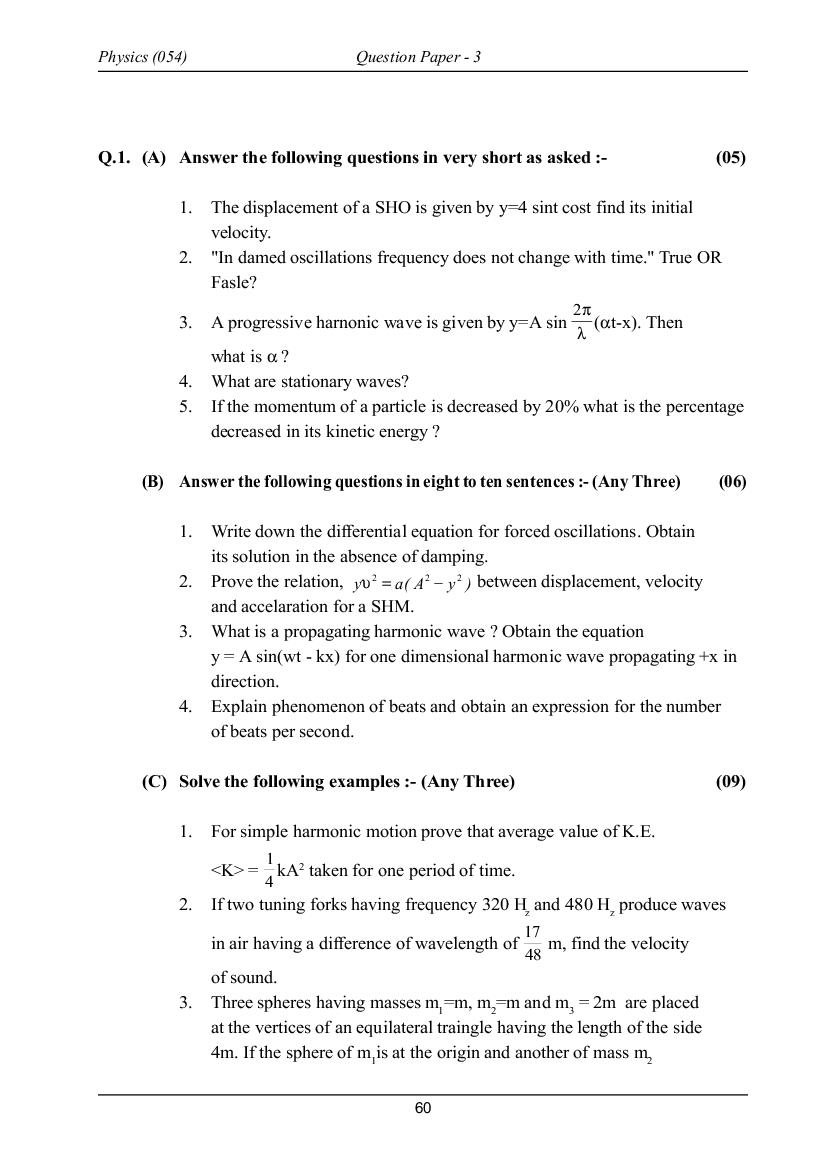
Q.1. (A) Answer the following questions in very short as asked :- (05)
1. The displacement of a SHO is given by y=4 sint cost find its initial
velocity.
2. "In damed oscillations frequency does not change with time." True OR
Fasle?
2π
3. A progressive harnonic wave is given by y=A sin (αt-x). Then
λ
what is α ?
4. What are stationary waves?
5. If the momentum of a particle is decreased by 20% what is the percentage
decreased in its kinetic energy ?
(B) Answer the following questions in eight to ten sentences :- (Any Three) (06)
1. Write down the differential equation for forced oscillations. Obtain
its solution in the absence of damping.
2. Prove the relation, yυ 2 = a ( A2 − y 2 ) between displacement, velocity
and accelaration for a SHM.
3. What is a propagating harmonic wave ? Obtain the equation
y = A sin(wt - kx) for one dimensional harmonic wave propagating +x in
direction.
4. Explain phenomenon of beats and obtain an expression for the number
of beats per second.
(C) Solve the following examples :- (Any Three) (09)
1. For simple harmonic motion prove that average value of K.E.
1 2
<K> = kA taken for one period of time.
4
2. If two tuning forks having frequency 320 Hz and 480 Hz produce waves
17
in air having a difference of wavelength of m, find the velocity
48
of sound.
3. Three spheres having masses m1=m, m2=m and m3 = 2m are placed
at the vertices of an equilateral traingle having the length of the side
4m. If the sphere of m1is at the origin and another of mass m2
60
Page 2
is on the x - axis. find the position of centre of mass of this system
with respect to origin.
4. A ball of 4 kg mass hits a wall at an angle of 30o and is then reflected
making an angle of 120o with its original direction. If the duration of
contact between the ball and the wall is 0.1 sec. Calculate the force
exerted on the wall. The initial and the final velocities of the ball is
1 met / sec.
Q.2.(A) Answer the following questions in very short :- (05)
1. If the angular momentum of a rotating rigid body with a stationalry axis
increases by 10%. Find the percentage change in its rotational kinetic energy.
2. Write the unit of angular momentum.
3. A body is projected first at angle θ with horizontal direction and then at
same angle θ with vertical direction. Will their ranges be equal ?
4. The maximum range of a proejectile is equal to 0.5 km then the initial
velocity of the projectile will be .....
5. In which event heat energy is transferred through electromagnetic waves ?
(B) Answer the following questions in eight or ten sentences :- (Any Three) (06)
1. Describe the motion of a solid cylinder rolling down a slope
without sliding, and obtain expression for its acceleariton.
2. Prove that the escape velocity for a body on the surface of Earth is
2g Re
3. Define total emissive power and give Stephen - Boltzmann law
giving its mathematical expression. Write value of constants in
the expression.
4. Prove Kapler's second law of planetory motion.
(C) Solve the following examples :- (Any Three) (09)
1. A ring of radius 25 cm and mass 40 kg rotates about an axis passing
through its centre and perpedicular to its plane. The angular velocity
of this ring is found to increase from 5 rad/sec to 25 rad/sec in 5 second
calculate the work done by the force in 5 second.
2. Prove that the ratio of the change of 'g' at a height "Re" above the
surface of earth to the value of g at the surface of the earth is equal to
1
- 4R
e
61
Page 3
3. The efficiency of a carnot engine is 1/6. By decresing the temperature
of the cooling arrangement by 65oC, its efficiency is doubled. Find
initial temperature of the source and the sink.
4. In an isothermal process, the pressure of 1 mole of an ideal gas is
increased and made five times its original pressure. Find the work
done during the process. Temperature is 300o K. R =8.3 J/mol 0K.
Q.3. (A) Answer the following questions in very short :- (05)
1. 5 mA current is following in a wire. No of electrons passing through
each cross section of this wire per second is ............
2. Write Kirchhoff's second law.
3. In thermocouple, when referance junction is at 0oC and test junction is
t2
at t c, the emf is given by e = 4t −
o
then what is the neutral
20
temperature?
4. On connecting a shunt of 40 Ω deflection of galvanometer becomes
half of initial. What is the resistance of galvanometer ?
5. If the planes of two concentric coils is perpendicular to each other,
then what will be the value of the mutual inductance of the system ?
(B) Answer the following questions in eight OR ten sentences (Any Three)(06)
1. Write a note on "Thermistor".
2. Write down the two laws of faraday relating to electrolysis. Discuss
the second law.
3. Explain the principle of a potentiometer with a necessary circuit diagram.
4. Explain "mutual inductance".
(C) Solve the following examples :- (Any Three) (09)
1. Unkonw resistance x is joined parallel to a resistance of 20 Ω. To this
connection a battery of 2 volt and resistance of 10 Ω are joined in series.
If the current passing through x is 0.05 Amp. Find the value of x.
2. 4 batteries, each of 1.5 volts are connected in series so that they are
helping each other. Internal resistance of each is 0.5Ω they are being
charged using a direct voltage supply of 110 volts. To control the current
a resistance of 49 Ω is used in the series. Obtain (i) Power drawn
from the supply (ii) power dissipated as a heat.
62
Page 4
3. The resistance of galvanometer is 18 Ω find the resistance of the
shunt which when connected in paralled with the galvanometer coil
allows only 10% of the total current flow through the galvanometer.
4. A conducting loop of radius r is placed concentric with another loop
of a much larger radius R, so that both the loops are coplaner. Find
the mutual inductance of the system of the two loops. Take R>>>r.
Q.4. (A) Answer the following questions in very short as asked :- (05)
1. In L-C-R series circuit, ω 20 LC = _______ in reasonance.
2. The number of turns in the primary coil is 100 and that in the
secondary coil is 400. If 1.0 Amp current flows in the primary coil,
then how much will be the current flowing in the secondary coil of
the transformer ?
3. Indicate the wavelength in meter of the radiation having frequency
1 MHz.
4. Light waves are transverse waves. Which phenomenon gives proof of
this fact ?
5. What are inductive components ?
(B) Answer the following questions in eight to ten sentences :- (Any Three) (06)
1. Derive the expression of power for L-C-R series a.c. circuit
Peff = Vrms Irms Cosδ.
2. State the characteristics of electromagnetic waves.
3. Explain how diffraction imposes a limit on useful magnification by
lens.
4. Giving the necessary figures and obtain the condition for the minima
in fraunhofer diffraction.
(C) Solve the following examples :- (Any Three) (09)
1. An a.c. circuit with L-C-R in series has voltage and current
respectively given by V = 200 2 Cos (3000t - 55o) and
I = 10 2 Cos (3000t - 10o)
Find the impendance of the circuit and the value of R.
2. Human eye is most sensitive for light of wavelength 5600 Ao. Find
the frequency of this light c=3x10⁸ met/sec.
3. The ratio of intensities of rays emitted from two different coherent
sources is α. For the interference pattern formed by them prove that
63
Page 5
I max + I Min I + α
I max − I Min 2 α
=
4. In young's double slit experament, the seperation of slits is 0.05 cm and
a screen is placed at a distance of 100 cm. The seperation between
centres of the third bright and Nine bright fringe is 6 mm. Find the
wavelength of light.
Q.5. (A) Answer the following questions in very short as asked :- (05)
1. Dimensional formula of E/B is ______.
2. The radius r1 of the electron of the hydrogen atom in the first orbit
is equal to 0.531Ao what will be the radius (r3)of the third orbit ?
3. Write the diamonsional formula of constant K in Millikun's
experiment.
4. State the electronic configuration of Germanium.
5. In common emitter N-P-N transistor circuit current gain = ______.
(a) β > 1 (b) β < 1 (c) β + 1 (d) β ≤ 1
(B) Answer the following questions in eight to ten sentences :- (Any Three) (06)
1. Give Einstein's explaination for photo - electric effect.
2. Explain the term "decay constant" giving necessary expressions.
Deduce the exponential law for the radioactive decay.
3. Write the reactions involved in proton - proton fusion process, giving
the values of energy released at each stage.
4. Write a note on transistor oscillator.
(C) Solve the following examples :- (any Three) (09)
1. In Milikan's oil drop experiment, radius of an oil drop is 7.25 x 10⁻⁷ m.
It is hold stationary between two parallel plates 6.0 mm apart kept at a
potential difference of 103 V. Find the charge on the drop. Density of oil
is 880 kg/m3, density of air 1.29 kg/m3, g=9.8 m/s2.
2. Prove that in a hydrogen atom, square of the orbital period of an
electron is proporational to the cube of the radius of that orbit.
3. Half life of Na24 is 15 hours, in what time its 93.75% would decay ?
4. The current gain of a transistor is 0.98. It is used as power amplifier to
get a power gain of 10. What is the ratio of input resistance to output
resistance ?
64
Page 6
ANSWERS
Q.1. (A) 1. v0= 4 unit.
2. Yes
3. α= Wave Velocity v
4. Waves travelling in the mutually opposite directions and having same
amplitudes, same frequencies, same wavelengths and experienceing
superposition, lose the property of progressiveness as the resultant
effect. Thus the waves obtained in such a way are called stationary
waves.
5. 36%.
d2y dy
(B) 1. + r + ω o 2 y = a0 sin( ωt )
dt 2
dt
In absence of dumping (r=0)
d2y
+ ω 0 2 y = a0 sin( ωt ) ......(1)
dt 2
Let the solution of above eq-n be
y = A sin ( ωt ) ...... (2)
dy
= Aω Cos ( ωt ) ..... (3)
dt
∴
d2y
2 = -Aω Sin ( ωt ) ..... (4)
2
dt
∴
Substituting equation (4), (3) and (2) in equation (1), we get
- Aω 2 Sin( ωt ) + ω 20 ASin( ωt ) = a0 Sin( ωt )
dividing above eqn by Sin( ωt )
∴ Aω 2 + ω 20 A = a0
∴ A [ ω 02 − ω 2 ] = a0
a0
∴ A = ω2 − ω2 ............... (5)
0
Substituting equation (5) in equation (2), we get
y = A sin( ωt )
a0
∴y = 2 Sin ( ωt ) ................ (4)
ω0 − ω2
65
Page 7
2. v = ± ω A2 − y 2
a = ω2 y ⇒ ω = ± a / y
v= a/ y A2 − y 2
∴ yv 2 = a( A2 − y 2 )
3. The wave form generated is a sinusoidal type and the waves
continiously moving ahead in the medium, are called propagating
harmonic wave.
Let the particle located at x=0 start the SHO at time t=0, with phase equal
to zero.
The equation of motion of this particle will be
y = A sin (ωt) .......... (1)
The wave orginating at t=0 covers a distance x, at that time the particle
located at x begins its oscillations and its phase will be lagging behind
the phase of oscillations of the particle at x then located x=0 by an
amount δ. The eqn of oscillations of particle at x=x is
y = A sin( ωt − δ ) ............. (2)
Let λ be the wave length associated with this wave. At λ seperation
the corresponding phase difference is 2π . Hence the particle located at
2πx
a distance x from x=0 will have less phase by .
λ
2 πx
∴δ = ........... (3)
FG IJ
Sub. eqn. - 3 in eqn. (2)
λ
H K
2 πx
y = A sin ωt −
λ
2π
but = k (wave vector)
λ
∴ y = A sin( ωt − kx )
66
Page 8
4. Consider two harmonic waves with their frequencies differing by a
small amount, passing through the same region of a medium.
y1 = ASin( ω 1t ) and y2 = ASin( ω 2t )
where ω 1 = 2 πf 1 and ω 2 = 2 πf 2
(Here both the waves having same Amplitude)
Above two waves are superposed at a point, so according to the
superposition theroem.
y = y1 + y2
A Sin( ω 1t ) + Sin( ω 2 t )
F ω − ω IJ • SinFG ω − ω IJ ........... (1)
y = 2 ACosG
H 2 K H 2 K
2 t
1 2 1 2
From Eqn.1 we can say, the resultant wave is having angular
frequency and the Amplitude of the wave changes
FG ω − ω IJ
ω1 − ω 2
2
periodically with angular frequency H 2 K
1 2
2 π 2 π( 2 ) 2
∴ the period T = ω = ω − ω = f − f
1 2 1 2
From above eqn. we can say that the Amplitude of the resultant wave
becomes
two times. MAXIMUM and two times MINIMUM, and correspondingly
the loudness of the sound is also changes periodically.
∴ The no. of beats heard in 1 Sec. is ( f 1 − f 2 )
Def. : The phenomenon of periodic increase and decrease occuring in the
londness of sound, when two sound waves having same amplitude and a
small difference of frequency are superposed, is called Beats.
Beats : The phenomenon of periodic increase and decrease occuring in
the loundness of sound, when two sound waves having same
amplitude and a small difference of freq. are superposed is called
the Beats.
67
Page 9
(C) 1. K = 1 2 mv 2 = 12 mA2ω −1Cos2ωt
z z
1 2
K = E cos 2 ωt (Q E = kA )
2
ECos2 ωt E ( 1 + cos 2 ωt )
T T
< K >= dt = dt
T T 0 2
LM OP
o
N Q
E Sin 2ωt
T
< K >= t+
E L Sin2ωt O
2T 2ω 0
= M
2T N
T+
2ω PQ
E
= T
2T
E
< K >=
2
1
< K >= KA2
4
17
2. Here λ1 − λ 2 =
48
but v = fλ ⇒ λ = v f
v v 17
FG 1 − 1 IJ = 17
f 1 f 2 48
− =
v
H f f K 48
1 2
17 × 320 × 480
v=
160 × 48
v = 340m / s
r
3. m1 = m kg. r1 = 0
r
m2 = m kg. r2 = 4i$
m3 = 2m kg. r
r3 = 2i$ + 2 3 $j
r r r
r m1r1 + m2 r2 + m3r3
rem = m1 + m2 + m3
68
Page 10
m( 0 ) + m( 4i$ ) + 2m( 2i$ + 2 3 $j )
=
4m
= ( 2i$ + 3 $j )m
r
4. P1 = ( mvSin30i$ + mvCos30i$ ) N.Sec.
r
P2 = ( −mvSin30i$ + mvCos30 $j ) N.Sec.
r
Change in Momentum of Sphare dp = −2 mvSin30 i$
= -2 (4) (1) (1/2) i$
= -4 i$ N.Sec.
r dp
Change in momamtum of Wall = 4 i$ but F =
dt
4i$
Force =
0.1
= 40 i$ N.
Q.2. (A) 1. 21 %
2. Joule - Second
3. Yes
4. 70 m/sec.
5. Thermal Radiation
(B) 1.
69
Page 11
As shown in fig. consider a solid cylinder, rolling down a slope of heigh
h, without sliding. Let the radius of the cylinder be r and θ be the agnel
of inclination.
Here, as the cylinder is rolling down its kinetic energy is partly in
rotational and partly in the linear motion.
The centre of mass of the cylinder is executing a linear motion, and the
cylinder is rotating about its geometrical axis. These two motions can be
treated independently.
Potential energy lost by the cylinder when it reaches the bottom of the
slope = Mgh.
Let the linear velocity of the centre of mass be v when the cylinder has
reached the bottom, and let ω be its angular velocity at that time.
1 1
∴ Kinetic energy at the bottom = Mv 2 + Iω 2
2 2
Applying the principle of conservation of the mechanical energy
1 1
Mgh = Mv 2 + Iω 2 ........... (1)
2 2
v 1
Substituting ω = and using I = Mr for a solid cylinder, we get
2
r 2
from eqn. (1)
4
v2 = gh ......... (2)
3
If the length of the slope is d; the cylinder starting from zero velocity
attains a velocity v after moving over the distance d.
v2 = 2ad, a being its linear acceleration.
h h
But = sin θ ⇒ d = ........ (3)
d sin θ
∴ v2 = 2a h / sin θ ......... (4)
Substituting this value for v in the eqn. (2)
2
2 ah 4
= gh ......... (5)
sin θ 3
2
∴ a = g sin θ
3
70
Page 12
2. Particle of mass m has a gravitational potential energy (-Gmem/Re)
on the surface of the earth, and its gravitational potential energy is zero
at the infinite distance. This particle has to be taken to an infinite
distance from the earth, starting from its stationary position on the
surface of the arth, it must be given kinetic energy equal to
+(Gmem/Re). This energy is called the escape energy (Ee).
GM e • m
∴ Ee = .......... (1)
Re
If a body of mass m stationary on the surface of the earth is given
this amount of energy, it will escape from the field of gravitation of earth.
Let the corresponding velocity needed the Ve. Then Ve is called the
escape velocity.
1 GM e m
Now 2 mve = .......... (2)
2
Re
2GM e
∴ ve =
Re
2GM e
Now g = R 2
FG IJ
e
H K
2GM e Re GM e
∴Ve = = 2 Re
Re × Re Re 2
= 2g Re
3. The amount of energy radiated per second per unit area at a
given temperature is called the total emissive power.
Stephen experimentally showed that "the amount of energy radiated
by a surface, in the form of power of its absolute temperature". This
is called Stephen - Boltzmann Law.
W = eσ T4
Here T, is the absolute temperature, e is known as the emmissivity
of the radiating surface. σ is called the Stephen - Boltzmann constant.
71
Page 13
It is a universal constant and have value of σ = 5.67 × 10⁻⁸ watt/met2 K4
4.
Figure shows, by a broken line, a part of the orbit of a planet going around
the sun S. Let the linear velocity of the planet be vr when it is at a position P.
The perpendicular distance between the sun S and the direction of vr is d.
Let m be the mass of the planet. Angular momentum of the planet with
reference to the point S is given by
L = mvd .......... (1)
Now area of the traingle SQP is given by
1
A= ( SQ ) ( PQ )
2
1
= ( d )s (Q PQ = s )
2
∴ The area swept by the planet in time dt is
1
dA = ( d ) ds
2
dA 1 ds 1
= ( d ) = ( d )v
dt 2 dt 2
∴
Multiplying both sides by m, we get
dA 1
m = mvd ........... (2)
dt 2
Substituting the value of mvd from the eqn. (1) into equ. (2)
dA 1
m = L ......... (3)
dt 2
Now, the force of gravitation due to sun on the planet is always
directed along the line joining the sun and the planet. Hence the torque
due to this force taken about the sun is always zero. Therefore the
72
Page 14
angular momentum of the planet is its orbital motion will be conserved.
dA
= constant .......... (4)
dt
∴
Kepler's statement of second law for the planetary motion is "The line
joining the planet and the sun sweeps equal area in equal time, as the
planet moves in its orbit around the sun". The rate at which area is swept
is called the "areal velocity". That is proved.
(C) 1. r = 25cm = 25 × 10−2 m
M = 40 Kg
rad
ω0 = 5
sec
rad
ω 0 = 25
sec
FG w + wo IJ t
+ = 5 Sec
θ=
H 2 K
θ = 75rad
ω − ω 0 25 − 5
t 5
α= =
α = 4rad / s 2
FG ω + ω IJ t
I = Mr 2 = 25 × 10−2 × 25 × 10−2 × 40 = 2.5 Kg m2
H 2 K
F 25 + 5IJ 5
0
= GH
θ=
2 K
= 75 rad.
W = τ. θ
= (Ι α) θ (Qτ = 1α )
= 2.5 x 4 x 75
∴ W = 750 Joule
73
Page 15
2. The acceleration due to gravity "g" is
GM e
g( r ) =
r2
dg( r ) −2 GM e
dr r3
=
At r = 2Re
FG dg IJ
H dr K
(r ) −2GM e 1 g
8 Re • Re 4 Re
∴ = 2
=−
2 Re
FG dg IJ
H dr K
(r )
2 Re 1
g 4 Re
∴ =−
T2
3. n1 = 1 −
T1
1 T
= 1− 2 ............ (1)
6 T1
T21
n2 = 1 − from data. T21 = T2 − 65
T1
1 ( T − 65 )
= 1− 2
FG IJ
3 T1
H K
1 T 65
= 1− 2 + from Eqn. (1)
3 T1 T1
1 1 65 1 T
(Q = 1 − 2 )
3 6 T1 6 T1
= +
∴ T1 = 390 K
1 T
= 1− 2
6 390
T2 5
390 6
=
T2 = 3250 K
V2 P1
4. PV
1 1 = PV
V1 P2
2 2 ⇒ =
74
Page 16
FG P IJ
W = 2.303nRT log P
H K
1
b g
2
= 2.303 x 1 x 83 x 300 x log 1 / 5
= -4008 Joule
Q.3. (A) 1. 5 x 6.25 x 1015
= 31.25 x 10¹⁵
2. Kirchoofs Second Rule
In a closed circuit, the algebraic sum of the products of
resistances with the corresponding values of currents flowing through
them is equal to the algebraic sum of the emfs appliied in the Loop."
3. t = 40o C
4. 40 Ω
5. Zero
(B) 1. On increasing the temp. of semi conductor 3oC near the room temp.
its resistance decreases by about 13%. It is a special type semi-
conductor. It is made up two words thermal and resistor.
- Thermistor are made from mixture of oxides of manganese, nickle,
cobalt, copper, iron and uranium.
- beads about 0.015 cm to 0.25 cm diameter.
- Thermisters are available in range of resistance 100 Ω to 10 m Ω
fig.
This property makes thermistors useful in controlling temperatures
in the industrial applications. It has been possible to achieve a control
75
Page 17
of temperature to a precision of ± 0.00050 C .
The temperature co-efficient of a thermistor is given by :
1 ∆ R 0 −1
( C)
R0 ∆T
α=
Here Ro is the resistance of the thermistor at 25oC with no current
flowing through it.
2. Faraday's first law :
The mass "m" of an element deposited on the cathode on passing
an electric current through electrolyte is directly proportional to
the amount of charge passing through the electrolyte.
Faraday's second law
When the same amount of current is passed for the same time, (i.e.
the same amount of charge is conducted) through different electrolytes,
the masses of elements deposited from the electrolytes, the masses
of elements deposited from the electrolytes are in proportion to their
respective chemical equivalents. The chemical equivalent is the ratio
of the atomic weight of the element to its valency.
Thus, from Faraday's second law, when equal currents are passed
through two eleccrochemical cells for the same time, the masses m1
and m2 of the elements are proportional to their respective chemical
equivalents and e1 and e2. That is
m1 e1
m2 e2
= ............. (1)
m1 e1 It Z1
m2 e2 It Z2
= =
e z
∴ 1 = 1
e2 z2 ........... (2)
e e
∴ 1= 2
z1 z2 ............ (3)
Equation (3) shows that for all elements the ratio of the chemical
equivalent to the electrochemical equivalent has a constant value.
This constant is called the Faraday constant. Its value is
96,500 coulomb/mole.
76
Page 18
3. Circuit diagram
The principle of a Potentiometer : Consider a circuit such as the one
shown in fig. Here, a battery of emf ε and an internal resistance r is
connected in series with a resistance box R, and a conducting
(resistive) wire having a uniform crossection.
Suppose that the length of wire is L and its resistance per unit length
is ρ; so that the total resistance of the wire is Lρ. If the resistance in
the resistance box is R, the current through the wire is
I= ........ (1)
ε
R + Lρ + r
If the length of the wire from A to C is l, then the difference of
potential between A and C will I / ρ . Writing this as V1.
V1 = Iρl ........... (2)
Substituting for I from the equn. (1)
LM ερ OPl
N R + Lρ + r Q
Vl = .............. (3)
Vl
The potential difference per unit length of the wire is called its
l
potential gradient and is represented by σ.
∴Vl = σl
77
Page 19
∴Vl α l
Principle : The potential difference betn any two points of the
potentiometer wire is directly proportional to the distance betn them.
4.
Consider two conducting coils having arbitary shapes, placed near
each other as shown in Fg. The coils may also have an arbitary
inclination with respect to each other.
Suppose that the coil 1 has N1 turns and the coil 2 has N2 turns.
Now when a current I1 is passed through the coil 1, some of the
magnetic flux generated by the coil 1 will be lined with the coil 2.
Also, for any specified position of the coils, it readily follows from
Biot-Savart Law, that the flux Φ 2 likned with the coil 2 will be
proportional to the current in the coil 1.
∴Φ 2 α I1
∴ Φ 2 = M 21 I1 ............ (1)
The constant of proportionality M21 which appears in the equations
is termed as the mutual inductance of the system formed by the
two coils.
Taking I1 = 1 unit in the equation, Φ 2 = M 21 . So one can define the
mutual inductance of the system formed by the two coils as the amount
of flux linked with the other coild when a unit current passes through
one of the coils.
78
Page 20
(C) 1.
In ABCDEA - 20I1 - 10 I = -2
20 (I - 0.05) + 10 I =2 (Q I1 = 1 − 0. 05 )
20 I - 1 + 10 I = 2
30 I = 2 + 1 = 3
I = 0.1 Amp.
In BCDEB -20 I1 + 0.05 x = 0
20 I 20 × 0. 05
x=
0. 05 0. 05
=
x = 20Ω
2.
V = 4ε + 4Ir + 1R
V − 4ε
∴ I= I1
4r + R
79
Page 21
110 − ( 4 × 1.5 ) 104
∴ I=
4 × 0.5 + 49 51
=
∴ I = 2.039 Amp.
∴ Power drawn from the suppy P = V1
= 110 x 2.039
P = 224.3 Watt
Power dissipated in the circuit } P = 4I2r +I2R
= 4 (2.039)2 x 0.5 + (2.039)3 x 49
= 8.315 + 203.7
P = 212.0 Watt
3. G = 18 Ω
10 I
Ig =
100
∴ I g = 0.1I
Ig
∴ S=G I−I
g
0.1I
∴ S = 18
I − 0.1I
0.1
= 18 × =2Ω
0. 9
4.
r
R
80
Page 22
Consider a current I passing through the larget loop. The magnetic
field at the center of this loops due to this current is
µ 0 1R 2 µ01
B=
2( R 2 ) 2 2R
3
=
It is given that R > > r. ∴ The filed in the region of the smaller loop
can be considered to be uniform and of the above value.
∴ The flux linked with the smaller loop is given by
µ 0 1 2 µ 0 1r 2
. πr =
2R 2R
Φ=
Φ µ 0 πr 2
∴M =
I 2R
=
Q.4. (A) 1. 1
2. 0.25 Ampere
3. 300 m
4. Polarisation
r r
5. Near the oscillator the phase difference betn E & B is π / 2 and their
Values decrease rapidly according to 1r 3 with distance. Such
components of field are called inductive component.
(B) 1. For example in a L - C - R circuit, instantaneous power is
P = VI
= Vmcosωt. Im Cos (ωt - δ)
= Vm Im Cosωt Cos (ωt - δ)
But cosωt cos ( ωt - δ)
1 1
cos δ + cos( 2ωt − δ )
2 2
=
∴ Instantneous power
Vm I m
P= [ Cosδ + Cos( 2ωt − δ ) ]
N z z
2
LM OP
∴ Effective power
Q
V I 1 1
T T
N z
P= m m Cosδdt + Cos( 2ωt − δ )dt
2 T 0 T0
LMQ Cos( 2ωt − δ )dt = 0OP
Q
V I
T
P = m m Cosδ
2 0
Vm I m
P= Cosδ
2 2
P = Vrms Irms Cosδ
81
Page 23
Where cos δ = power factor.
2. (1) At region far from the source the electric and the magnetic field
vectors oscillate in the same phase.
(2) The directions of oscillations of the electric and the magnetic field
are mutually propendicular and are in a plane perpendicular to the
direction of propagaztion of the wave.
(3) These waves are non-mechanical and of transverse type
1
(4) C = µ ∈ Velocity
0 o
(5) The velocity of electromegnetic waves depends upon the
electromagnetic properties of that medium.
3. When an image of an object is formed with a lens, only a limited portion
of the wavefront of light passes through the lens, to form an image. This
"limitation of the wavefront produces diffraction effects as explained
earlier, and to that extent, sharpness of the image is reduced.
Usually one uses a convex lens to obtain a magnified image, and it is
normally disired to have both magnified and a sharp. (i.e. clear) image.
For more magnification, focal length of the lens used must be smaller but
a smaller focal length in general also means smaller size (i.e. diameter) for
the lens. The smaller diameter d will increase the value of so that there
λ
d
is more diffraction, which reduces the sharpness of the image obtained.
Thus, we see that one cannot indefinitely reduce the focal length to obtain
increased magnification and at the same time maintain the sharpness of
the image - such a magnification is not useful. Thus, we see that
diffraction imposes a limit on useful magnification by a lens.
4.
82
Page 24
Consider a set of parallel rays associated with the secondary waves
emerging from the incident wavefront at AB, with their direction of
propagation at an angle θ to the central line XPo. The optical path
difference between these rays can be calculated as follows :
Let us divide the slit into two equal parts.
From A, draw AM perpendicular to the ray BL.
This perpendicular intersects the central ray XP1 at Y.
Now the optical path lengths for the sections AP1, YP1, MP1, are all equal.
So the path difference between the rays AP1 and BP1 is equal to BM;
and the path difference between AP1 and XP1 is XY.
Suppose the angle θ selected is such that BM = λ.
BM λ
= = sin θ ∴ λ = d sin θ (Q AB = d )
AB d
∴
and XY = ; X being the midpoint of AB.
λ
d
So, generalising this formula for mth order minimum.
mλ
sin θ m =
d
where m = 1, 2, 3 ..........
(C) 1. δ = 45 ∴ tanδ = 1
1
ωL −
∴ tan δ = ωC = 1
R
∴ R = ωL − 1 ωC
1 2
∴ | z| = R + ( ωL − )
2
ωC
= R2 + R 2 = R 2
Vm 20
∴ | z| = = 20Ω
Im 1
=
∴ R 2 = 20Ω
∴ R = 14.14Ω
2. C = λf
∴ f = Cλ
3 × 10⁸
5600 × 10−10
=
83
Page 25
∴ f = 5. 357 × 1014 Hz
I1
3. I2
= α and ∴ IαA2
I1 A12 A1 α
I 2 A2 2 A2 1
∴ = =α ⇒ =
For Constructive Intorfarance A1 + A2 = α + 1
∴ A1 − A2 = α − 1 (For destructive Interference)
∴ Imax α ( A1 + A2 )2 α ( α − 1 )2
∴ Imin α ( A1 − A 2 )2 α ( α − 1 )2
I max ( α + 1 )2 α + 2 α + 1
I min ( α − 1 )2 α − 2 α + 1
∴ = =
I max + I min 2α + 2 2( α + 1 ) 1 + α
∴ I −I =
4 α
=
4 α
=
2 α
by taking Comp. and dividen.
max min
3λD 9λ D
4. x3 = x9 =
d d
x9 - x3 = ( 9 − 3)
λD
d
λ × 100
0. 6 = ×6
0. 05
0. 6 × 0. 05
100 × 6
λ=
λ = 5000 Ao
Q.5. (A) 1. M 0 L1T −1
2. 4.779 Ao
3. M 1 L0T −1
4. 1S2 2S2 2P6 3S2 3P6 3d10 4S2 4P2
5. β > 1
(B) 1. Planck had proposed that the electromagnetic radiation is emitted
in discrete quanta of energy but it propagates only as waves. Einstein
went further to propose that the electromagnetic radiation propagates
in form of particles which he callled photons.
Suppose the incident electromagnetic radiation (light) is of frequency
84
Page 26
f. So energy of its photon is hf. When this photon in incident on a
metal either if gets entirely absorbed or it does not lose any energy.
If an electron in the metal absorbs a photon it will gain an energy hf.
Out of this energy it will use an amount equal to its binding energy
in coming out of the metal, and the remaining will be the kinetic
energy with which it is emitted.
If work function of a metal is W0 (=hf0), only those electrons wchich
can be liberated on acquiring energy equal to the work function will
be emitted witht he maximum kinetic energy.
1 2
∴ mvmax = hf − W0 ........... (1)
2
FG h IJ f − hf = FG h IJ ( f − f ) ............. (3)
∴ eV0 = hf − hf 0 ........... (2)
∴V0 =
H eK e H eK
0
0
This equation shows that the graph of V0 vs f should be a straight
h
line graph with a slope of and an intercept along f-axis equal to fo.
e
This conclusion is in a perfect agreemtn with he observations.
2. Suppose thre are N nuclei of a radioactive element at time t. Let dN
of them decay in time (dt) Then
dN
is called the decay rate of that element (or its activity).
dt
This rate is proportional to the existing number of nuclei of that
element at that time.
dN
α− N (-ve) sign means that the number decreases with time)
dt
∴
dN
= −λN
dt
∴
Here λ is a constant called the "radioactive constant" or the "decay
constant" of that element.
z z
Integrating this equation
dN
= − λ dt
N
∴
∴ ln N = − λt + C
At t = 0 ⇒ N = No
∴ lnN0 = C
85
Page 27
∴ ln N = − λt + lnN 0
N
∴ ln N = −λt
0
N
∴ N =e
−λt
0
∴ N = N 0 e − λt
3. Sun's centre is at a temp. of about 20 million degrees. Sun preduces
energy mostly through the following sequence of reaction. Which is
called fusion.
1 H 1+ 1H 2→ 2 He3 + 5 Mev .
Two of such reactions are then followed by
2 He 3+ 2 He 3→ 2 He 4 + 2( 1H 1 ) + 12. 9 Mev .
So total energy released 2 (0.4) + 2(5.5) + 12.9 = 24.9 Mev.
The stars with central temp. as in the sun or somewhat lower produce
the fusion energy through the above reaction called proton - proton
reaction.
The stars with central temp. significantly higher than that at the
centre of Sun produce energy by another reaction called C-N cycle.
4.
- Such oscillations are generated by folding part of the output of an
ampitified back to its input using an appropriate netwrok.
- For transistor oscillator circuit it is not necessary that the input a.c.
signal should be given to the oscillator.
- Part of the output signal of an amplifier A is fed to suitable L-C
network B and then fed back to the input amplifier A.
- Such electronic oscillators generate oscillatory voltage with precise
86
Page 28
and steady freq.
- The oscillation freq. can be obtained ranging from few Hz to 109 Hz.
- Useful in communication, T. V. and radio receivers and transmitters.
(C) 1. mg = m0g + qE
g
q= ( m − mo )
LM OP
E
N Q
g 4 3 4 3
q= πr ρ − πr ρ0
V 3 3
d
9.8 × 6 × 10−3 4
q= × × 3.14 × ( 7 . 25 × 10−7 )3 × ( 880 − I − 29 )
10 3
3
q = 8. 003 × 10−19 C
mv 2 1 2e2
2. r
=
4 π ∈0 r 2
mr 2ω 2 1 e2
.
r 4 π ∈0 r 2
∴ =
1 e2
∴ω2 = . 3
4 π ∈0 mr
4π 2 1 e2
FG 16π ∈ m IJ r
T2 4π ∈0 mr 3
∴ =
H e K
3
∴T2 = 2
0 3
16 π 3 ∈0 m
∴ T αr
2 3
where = cons tan t .
e2
3. t = 0 100% present
15 Hour 50 % Present
30 Hour 25 % present
45 Hour 12.5% present
60 Hour 6.24% present
100 - 6.25 = 93.75% decay.
Power Gain : Voltage gain x Current gain
87
Page 29
δVCE
10 = × 0. 98
δVBE
R L δI C
∴10 = × 0. 98
ri δI B
ri 0. 98 × 0. 98
RL 10
∴ =
ri
∴ R = 0. 096
L
88
Document Details
| Board / Org | Gujarat Board |
| Exam | Class 12 |
| Type | Sample Paper |
| Pages | 29 |
| Updated | 22 Jul 2026 |