GSEB HSC Model Question Paper for Physics - Set 2
Finished viewing? Save it for later —
Download GSEB HSC Model Question Paper for Physics - Set 2 (PDF · 26 pages)About GSEB HSC Model Question Paper for Physics - Set 2
GSEB HSC Model Question Paper for Physics - Set 2 is available here for free download. Published by Gujarat Board for Class 12, this sample paper can be viewed online or downloaded as a PDF (26 pages). Candidates preparing for Class 12 can use GSEB HSC Model Question Paper for Physics - Set 2 to understand the exam pattern, the type of questions asked, and the overall difficulty level.
Frequently Asked Questions
How can I download GSEB HSC Model Question Paper for Physics - Set 2?
Open this page and click the Download button to save GSEB HSC Model Question Paper for Physics - Set 2 as a PDF. It is completely free on AglaSem Docs.
Is GSEB HSC Model Question Paper for Physics - Set 2 free to download?
Yes. GSEB HSC Model Question Paper for Physics - Set 2 can be viewed online and downloaded as a PDF free of cost on AglaSem Docs.
How many pages does GSEB HSC Model Question Paper for Physics - Set 2 have?
GSEB HSC Model Question Paper for Physics - Set 2 contains 26 pages, which you can read online or download together as a single PDF.
Where can I find more Class 12 study material?
You can find more Class 12 question papers, sample papers, syllabus, and answer keys on AglaSem Docs.
GSEB HSC Model Question Paper for Physics - Set 2 – Text
Read the full text of this sample paper below — useful to quickly search, copy and reference the content online without downloading the PDF.
📄 View text version (26 pages)
Page 1
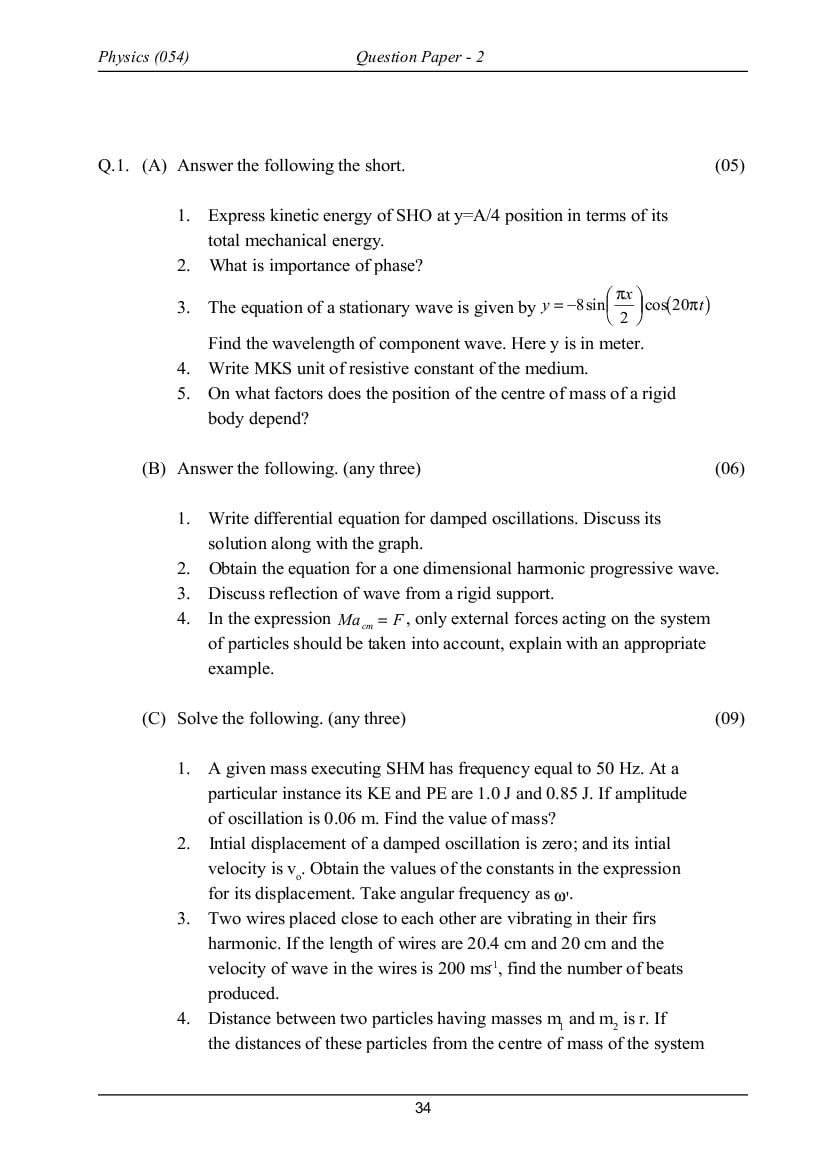
Q.1. (A) Answer the following the short. (05)
1. Express kinetic energy of SHO at y=A/4 position in terms of its
total mechanical energy.
2. What is importance of phase?
3. The equation of a stationary wave is given by y = −8 sin
FG πx IJ cosb20πt g
H 2K
Find the wavelength of component wave. Here y is in meter.
4. Write MKS unit of resistive constant of the medium.
5. On what factors does the position of the centre of mass of a rigid
body depend?
(B) Answer the following. (any three) (06)
1. Write differential equation for damped oscillations. Discuss its
solution along with the graph.
2. Obtain the equation for a one dimensional harmonic progressive wave.
3. Discuss reflection of wave from a rigid support.
4. In the expression Ma cm = F , only external forces acting on the system
of particles should be taken into account, explain with an appropriate
example.
(C) Solve the following. (any three) (09)
1. A given mass executing SHM has frequency equal to 50 Hz. At a
particular instance its KE and PE are 1.0 J and 0.85 J. If amplitude
of oscillation is 0.06 m. Find the value of mass?
2. Intial displacement of a damped oscillation is zero; and its intial
velocity is vo. Obtain the values of the constants in the expression
for its displacement. Take angular frequency as ω '.
3. Two wires placed close to each other are vibrating in their firs
harmonic. If the length of wires are 20.4 cm and 20 cm and the
velocity of wave in the wires is 200 ms-1, find the number of beats
produced.
4. Distance between two particles having masses m1 and m2 is r. If
the distances of these particles from the centre of mass of the system
34
Page 2
LM m OP and
are respectively are r1 and r2. Show that : r1 = r m + m
2
N 1 Q 2
r2 = r
LM m OP
1
Nm + m Q
1 2
Q.2. (A) Answer the following in short. (05)
1. Radial and tangential components of acceleration of a particle of
rigid body change the ..... and the ...... of linear velocity of the
particle. Fill in the blanks.
2. Write dimentional formula of areal velocity.
3. If the ratio of range to maximum height for a projectile is 4 3 . What
is the angle of projection?
4. Write the relation between temperature and volume for a gas
undergoing adiabatic change.
5. The emmissive power of two substance are in the ratio of 16:1. If
the substance with higher emmissive power is at 527oC. What is the
temperature of the other substance?
(B) Answer the following (any three) (06)
1. Explain angular momentum of a particle.
2. Why roads are banked? Draw the necessary diagram and describe
forces acting on a vehicle moving through a banked road. Write the
expression for the maximum safe velocity on a horizontal curved
road?
3. Obtain the expression for acceleration due to gravity at a distance
r (r>Re) from the centre of the earth. Obtain an expression for the
changes in its value with the height.
4. What is cyclic process? Write first law of thermodynamics for its
and obtain expression for its efficiency.
(C) Solve the following (any three) (09)
1. The second hand of a watch is 5 cm long. Find
(a) linear velocity (b) the radial acceleration
(c) the tangential accelaration
2. A metalic disc has radius 10 cm. and thickness 1 cm Find its moment
of inertia about
35
Page 3
an axis which is perpendicular to its plane and touching the edge.
Density of material is 8900 kg/m3 (Thickness of disc = 1 cm)
3. The escape velocity for a body at earth's surface is 11.2 kms/sec.
If a body is projected with a velocity 2 times this velocity, obtain
its velocity beyond earth's gravitational field.
4. An ideal gas is isothermally expanded so that its volume becomes
double. Then it is adiabatically compressed to its original volume.
Find the pressure after the adiabatic compression.
(Original pressure = 1 atmosphere; γ = 1.4)
Q.3. (A) Answer the following in short. (05)
1. A 5 Ω and 10Ω resistances are connected in parallel, if current
passing through 10Ω resistance is 2 ampere. What is total current
through the circuit. (Parallel combination is connected to a battery
of negligible internal resistance)
2. A 40 W and a 60 W bulb, both rated at the same voltage are joined in
parallel. Which bulb will glow more?
3. An electron revolves along a circle of radius r with velocity v, what
is magnetic field created at the centre.
4. Terminal voltage of a cell is always less than its emf. State true or
false with reason.
5. Define henry.
(B) Answer the following. (any three) (06)
1. Show that for a parallel combination of three resistances,
1 1 1 1
+ . Where R is equivalent resistance.
R R1 R2 R3
= +
2. Draw schematic diagram of fuel cell and name oxidiser and fuel in
it and also give advantage of it over other cells.
3. Define shunt and give any three uses of it in construction of an ameter.
4. Write a note on "self induction".
(C) Solve the following (any three) (09)
1. A conducting wire has a resistance of 20 ohms. Its length is now
stretched to increase by 4%. Calculate the resulting value of the
resistance of the wire.
36
Page 4
2. A battery having an emf E and an internal resistance r is connected
with a resistance R. Prove that the power in the external resistance
R is maximum when R = r.
3. A very long straight wire carries a current of 50 amp. At what
distance from this wire will the intensity of the magnetic field become
2.0 x 10⁻⁴ tesla?
RSµ = 4π × 10 tesla − m UV
−7
Ampere W
0
T
4. A rectangular coil 20 cm long and 10 cm wide is suspended such that
its area vector makes an angle 60o with the uniform magnetic field of
intensity 20 tesla. If the coil has 100 turns and current of 5 mA is
passing through it. Calculate the torque. Also find the maximum
torque at an appropriate inclination.
Q.4. (A) Answer the following in short. (05)
1. What will be power factor of an AC circuit having only a capacitor?
2. What will be phase difference in a L-C-R series AC circuit at resonance
frequency?
3. What is modulation?
4. Define plane polarised light.
5. What is red shift?
(B) Answer the following (any three) (06)
1. What is formula for impedance of L-C-R series AC circuit?
Represent it on the complex plane.
2. Explain arrangement of Hertz experiment with necessary diagram
and how circuit is formed oscillatory circuit?
3. Giving necessary figure, obtain the condition for the mth order
maximum in Fraunhoffer diffraction at single slit.
4. Draw the figure showing plane of oscillation and plane of polarization
and define them.
(C) Solve the following (any three) (09)
1. L-R series circuit is connected to a source of A.C. voltage. The maximum
voltage of the source is 220 V and maximum current is 1A. Find the
power and power factor. Reactance of the coil is 40Ω and R=30Ω .
37
Page 5
2. An A.C. supply of 150 V and 159.2 Hz frequency is connected to an
inductance of 2H. Obtain the equation for the current in the circuit.
The applied voltage V=Vm cosω t.
3. In Young's experiment, if the separation of the slits is 0.1 mm and the
light used is of 6000 Ao wave length. Find the angular distance between
the central fringe and the second bright fringe.
4. A parallel beam of light is incident normally on a slit of width 0.01 cm.
Its Fraunhoffer diffraction pattern is formed with a lens of 100 cm focal
length on a screen. If the width of central maximum is 1 cm, find the
wavelength of incident light.
Q.5. (A) Answer the following questions in very short. (05)
1. Express 5eV (electron-volt) energy in Erg.
2. What is the atomic mass unit (amu)?
3. What is multiplication factor?
4. Mention two uses of transistor.
5. Draw the circuit of half wave rectifier.
(B) Answer the following (any three) (06)
1. Mention limitations of the Bohr model.
2. Write exponential law of radio active distintegration. Obtain the
expression for half life time from it.
3. What is nuclear chain reaction? Name three necessary
precautions that have to be taken to get a sustained chain reaction.
4. Draw the circuit of a PN Junction in forward bias. Explain the
working and diode characteristic of PN junction in forward bias.
(C) Solve the following (any three) (09)
1. How many photons of 6000 Ao wavelength of light will have the
energy equal to energy of one gamma ray photon of 1.5 x 10⁻¹⁴ m
wavelength?
2. Half life of a radioactive element is 15 minutes. Find after what time
its velocity becomes 64th of the intial activity.
3. In a hydrogen atom, the frequency of an electron in an orbit of
me 4
quantum number n is given by f = . Prove that for large
4 ∈o 2 n 3h 3
values of quantum number n, the radiation emitted in transition from
38
Page 6
me 4
a level (n+1) to a level n has the same frequency R = .
8 ∈o 2 ch 3
4. In an NPN transistor when emitter current is 5mA, collector current
is 4.9 mA. If this transistor is used as common base, calculate the
currrent gain and also the current gain when it is used as common
emitter.
39
Page 7
SOLUTION
1 2 1 A FG IJ = 1 FG 1 kA IJ = E
2
A.1. (A) 1. P.E. = ky = k
2
2 2 4 H K 16 H 2 K 16
E 15
∴ K. E .= E − = E
16 16
2. To find position of reference particle and no. of revolutions complited
by it to reach that position also to find position of SHO and no. of
oscillations complited by it before reaching to that position, phase is
defined.
3. y = −8 sin
FG πx IJ cosb20πt g
H2K
k= ,
π
2
2π π
But k =
2
=
λ
∴ λ = 4m
4. F= -bv
F
∴b =
v
Newton − sec
∴ unit of b = .
m
5. It depends on (i) shape of the body (ii) distribution of mass.
(B) 1. When ever a body perfoms oscillations in a fluid medium, resistive
force of the medium acts on the oscillator. For not very large velocities,
the resistive force (Fv) is found to be directly proportional to the velocity.
i.e. Fv = -bv where b is a constant and is called the damping coefficient of
the medium.
Thus in practice a body oscillates under the influence of two forces:
dy
(i) restoring force = - k.y. and (ii) resistive force Fv = −b. v = −b
dt
d2y dy
Then from Newton's 2nd law of motion m = − ky − b
dt 2
dt
d 2 y b dy k
+ y = 0 ...(1)
dt 2 m dt m
+
Equation (1) is called the differential equation of a damped oscillations.
Solution of equation (1) is :
y(t ) = Ae 2m sin(ω ' t + φ ) .....(2)
bt
−
40
Page 8
k b
2
where ω' =
FG IJ .....(3)
m 2m
−
H K
Equation shows that at any time 't' the amplitude of such oscillations
is A( t ) = Ae − 2m i.e. the amplitude decreases exponentially with increase
bt
in time.
The graph of displacement y(t)→ t for such an oscillator is shown
in the figure. The dotted line shows decrease in amplitude with
increase in time.
2. Consider particles of one dimensional elastic medium, at rest as shown
in figure below.
Now at t=0 suppose a disturbance is produced in such a way that particle
at x=0 starts its S.H.M. about its mean position with amplitude
A and angular frequency ω . Here obviously ∅ = 0, hence equation of
displacement of particle at x=0 is given by.
y = A sin(ωt )
When the wave travels distance x, then particle P starts performing
S.H.M. The phase of successive particles decreases as we go in
direction of propagation.
Hence at any time the phase of particle P is less than the phase of O.
The phase difference is say δ . The equation of displacement of P can
be written as,
y = A sin(ωt − δ ) .....(1)
For distance between two particles equal to λ , phase difference is
2 π so for distance x between two particles phase differences is equal
2 πx
to δ = .
λ
41
Page 9
.....(2)
taking in equation (1) .....(3)
3. Consider a one-dimensional elastic string tied from one end with a
ridig support at x=0 as shown in fig.1. Suppose a progressive harmonic
wave travelling in negative x direction arrives at x=0. The incident wave
is represented by .
Incident Wave <-- Reflected Wave -->
Displacement of paricle at x=0 due to the incident wave is given by,
yi = A sin(ωt ) .....(1)
But since this particle is firmly tied with the regid support its
displacement is always zero. Now wave is reflected. If 'yr' is the
displacement of the particle at x=0 due to reflected wave then
yi + yr = 0 hence yi = − yr . yr = − A sin(ωt )
OR
yr = A sin( ωt + π ) .....(2)
From equation (2) it is clear that on reflection from a rigid support
phase of the wave increases by π .
Thus after reflection from a rigid support the crest becomes through
and vice versa.
For any other particle on the wave, the displacement due to reflected
wave can be given by
yr = A sin(ωt + π − kx ) = − A sin(ωt − kx )
4. Two types of forces act on a system (i) external and (ii) internal forces
of mutual interaction having same magnitude but opposite direction.
According to Newton's third law of motion, internal forces acting
among the particles are equal in magnitude and opposite in direction
hence resultant of all the internal forces becomes zero. This can be easily
understood with the help following example.
r r
Consider two particles of a system. Suppose F1ext and F2ext
are the particle 1 and particle 2 external forces acting on the two
42
Page 10
r r
particles respectively as shown in fig. 1. Also suppose F12 and F21 are
the forces of mutual attraction. All these forces can be considered to be
acting on the center of mass of the system of particles as shown in fig.2.
r r
It is clear from fig.2 that F21 + F12 = 0 . Thus resultant force acting on
the system is the vector sum of only external forces.
For a single particle Newton's 2nd law can be written independently of
3rd law of motion. But from above discussion it is clear that in order to
derive Newton's second law of motion for a system of particles, we
have to make use of Newton's third law of motion. This is known as
mutual dependence of Newton's laws of motion.
(C) 1. Given Frequency f = 50 Hz;
∴ ω = 2 πf = 100π rad/sec.
But M.E. = K.E. + P.E.
E = 1.0 + 0.85 = 1.85 J.
A = 0.06m.
But
2. For a damped oscillator, .... (1)
here at
from equation (1),
Using this value of in equation (1),
43
Page 11
dy(t ) bt
F b IJ e bt
= Ae ω 'cos(ω ' t ) + AG −
2m 2m
sin( ω ' t )
dt H 2m K
− −
∴ν = (t )
but at t = 0, v(t) = v0, hence from above equation,
v0 = Ae 0ω' cos( 0) + A −
FG b IJ e sin(0)
0
H 2m K
v0
∴ v0 = A ω ' ⇒ A =
ω'
3. Here, v = 200 m/s,
L1 = 20 x 10-2m,
L2 = 20.4 x 10⁻² m
Let number of beats = x.
f1 - f2 = x.
v v v 1 1
∴x = 2 L − 2 L = 2 L − L
FG IJ FGQ f = ν IJ
1 2 1 2 H K H 2 LK
500
x= ≈ 10 beats.
51
4. Given r = r1 + r2 ...... (1)
If origin is taken on the centre of mass then rcm = 0. Hence from
r r
r m1r1 + m2 r2
equation rcm = m + m we get
r r
1 2
m r + m2 r2 r r r r
0= 1 1 ⇒ m1r1 + m2 r2 = 0 ⇒ m1r1 − m2r2 ,
m1 + m2
(neglecting negative sign)
Now by doing componendo
and by using dividendo
44
Page 12
A. 2 (A)
1. Radial and tangential components of accelaration of a particle of
rigid body change the direction and the magnitude of linear velocity
of the particle.
dA
2. Areal velocity= = M 0 L2 T −1 .
dt
ν0 2 sin 2θ
3. R=
g
and
ν 02 sin θ
H=
2g
R sin 2θ 4
=4 3
H sin θ tan θ
∴ = 2
=
2
1
∴ tan θ =
3
⇒
∴ θ = 300
4. TV γ −1 = constant.
W1 T14
5. W2 T2 4
=
W1 1
∴ T14 = × T2 4 = × (800) 4
W2 ( 2) 4
cQT = 527 + 273 = 800 K h
2
0
800
T1 = = 4000 K ∴ T1 = 400 − 273 = 1270 C .
2
(B) 1. As shown in figure suppose a particle Q having mass m has a
position vector , with reference to a point O. Let be the
linear velocity of this particle, so that its linear mementum is .
Let be the angle between and . For convenience, we shall assume
that the motion of the particle is in the (x,y) plane. The vector product
of and is then defined as the angular momentum of the particle
with reference to point O; i.e.
45
Page 13
r r r
l=r×p
r
Unit of l is kg-m2/s
r
(i) Direction of the vector l is obtained by applying the right hand
r r r
screw rule to the vector product r × p . In the case illustrated, l is
directed along OZ.
r
(ii) The magnitude of l is rpsin θ . If θ is either 0 or π ; i.e. the line of
r
action of p passess through the reference point O; or if r=0, then the
angular momentum is zero. When defining the angular momentum,
one must specify the point about which it is taken.
2. When a vehicle moves on a curved path, the necessary centripetal force
FG mν IJ is obtained from the frictional forces between the tyres and the
2
H rK
road. For more speed at turns, sometimes such centripetal force may not
be sufficient and the vehicle is thrown off the road. Hence to provide
more centripetal force the roads are kept slightly inclined (banked)
at the turn.
Figure shows the cross-section of a curved road having radius of
curvature "r" and an angle of inclination across the road.
Let us assume that the maximum saft speed is v.
Following forces are acting on the vehicle.
(1) Weight of the vehicle Mg acting downwards.
(2) Force of the normal reaction R acting perpendicular to the surface
of the road, i.e. at an angle to the vertical.
(3) Force of friction F acting parallel to the surface of the road.
For maximum safe velocity on a horizontal curved road is .
3. Acceleration produce in a body due to gravitational force of the earth
on it is called gravitational acceleration.
Let mass of earth be Me and its radius be Re.
46
Page 14
Let m = mass of a body and its distance from the center of the earth
r (r > Re) then from Newton's law of gravitation the gravitational force
acting on the body due to the earth is,
Mem
F =G .....(1)
r2
But according to Newton's 2nd law of motion.
F = mg .....(2)
Mem GMe
From (1) and (2) mg = G g= ......(3)
r2 r2
dg −2GMe
Differentiating above equation with respect to r,
dr r3
=
GM dr dr
∴ dg = −2 2 e = −2 g .
r r r
4. Cyclic Process : "In heat engine, the working substance, starting from
specific equilibrium state, is allowed to undergo a series of changes
and brought back to its original state." Such a process is called Cyclic
proces..
In cyclic process, since initial and final states are same, at the end of
the cyclic process change in internal energy ( ∆U = U 2 − U 1 ) is zero.
Thus from the 1st law of thermodynamics, Q = (U 2 − U 1 ) + W thus
Q=W ...(1)
Now the heat lost Q2 into the sink is of no significance hence work
can be said to be done at the cost of heat Q1. Therefore efficiency
of any heat engine based on cyclic process per cycle is defined as,
...(3)
But here
Substituting the value of W from equation,
(C) 1. Give r = 5cm,
(a) /sec.
47
Page 15
v2 π2 cm
(b) radial acceleration = ar = = ω 2r = × 5 ≈ 0. 0548 2
r 900 sec
(c) tangential acceleration = 0 as ω = constant.
2. r = 10cm = 10-1 meter,
thickness of disc x = 1 cm = 10-2 meter,
Density ρ = 8900 kg/m3.
MR 2 3
I= + R 2 = MR 2
2 2
M = V ρ = πR 2 x ρ = π 10−1
c h × 10 × 8900 kg
2
−2
3 4 3
∴I = πR × ρ = × 3.14 × 10−4 × 10 −2 × 8900 = 4.19 × 10⁻² kgm 2
2 2
3. Suppose the body is projected with a velocity v. Its kinetic energy at
1
the surface of earth is = mv . Its potential energy at the surface of
2
2
GM e m GMe m 1
earth is − R and = mv e 2
e Re 2
1 2 GM e
∴ Its total energy on the surface of the earth is = 2 mv − R . (1)
e
Now on leaving gravitational field of the earth velocity is v',
1
so kinetic energy will be mv' 2 .
2
4. Original
...(1)
48
Page 16
p1V2 γ = p3V3 γ γ
∴ p2 2 γ V1γ = p3V1γ ∴ γ
= ∴ =
∴ p2 2 γ = p3 ∴ =
p1 γ
. 2 = p3
2
∴
∴ p1 2 γ −1 = p3
∴ log p1 + ( γ − 1) log 2 = log p3 ∴ (1. 4 − 1) log 2 = log p3
∴ (0. 4)( 0. 3010) = log p3 ∴ 0.1204 = log p3
∴ p3 = Antilog 0.1204=1.319 atmosphere.
A.3 (A) 1. I1 R1 = I2 R2
∴ 5I1 = 10 x 2
∴ I1 = 4A
2. 60W bulb will glow more as power consumed in it is more.
µ 0ev
3. B= .
4 πr 2
4. False, when a cell is charged terminal voltage becomes more than emf.
[V = E + Ir].
dI amp
5. If =1 and induced emf 1 volt, the self inductance of
dt sec
the circuit is 1 Henry.
(B) 1. In parallel connection one end of all the resistances meet at one
point and other end at another common point.
Suppose three resistances R1, R2 and R3 are connected in parallel
and potential difference V is applied across them by connecting a
battery.
Let I = the electric current passing through the battery. At point
A this current divides into three branches.
Let I1, I2 and I3 be the currents passing through resistances R1, R2
49
Page 17
and R3 respetively, then by applying Kirchhoff's first law at
junction A, I = I1 + I2 + I3 ...(1)
Now applying Kirchhoff's 2nd law in loops V-A-R1-B-V,
V-A-R2-B-V, V-A-R3-B-V respectively we get,
V
I1 = R
1
V V
Similarly I2 = R and I3 = R substituting these values in equation (1),
2 3
V V V I 1 1 1
I=
R1 R2 R3 V R1 R2 R3
+ + ⇒ = + +
If parallel combination of R1, R2 and R3 is replaced by a single
resistance R such that the current passing through the circuit
remains the same then it is called equivalent resistance of the
combination.
If R is the equivalent resistance of the circuit then according to
I 1
the Ohm's law, = Using this in equation (2)
V R
1 1 1 1
R R1 R2 R3
= + +
1 1
For n such resistances in parallel R = ∑ R .
1
2. Construction of Hydrogen - Oxygen fuel cell is shown in fig.
Fuel cell is a type of an electrochemical cell. A schematic diagram
of a fuel cell using hydrogen as a fuel and oxygen as a oxisider is
shown in the figure.
Advantage: In this cell it is not necessary to change chemical
substance like primary cells or to recharge the cell as in case of
secondary cells.
50
Page 18
3. A small resistance connected in parallel with a galvanometer to convert
it in an ammeter is called shunt.
Uses:
(1) It protects galvanometer
(2) By connecting shunt, range of the ammeter can be increased
(3) When shunt is connected resistance of the ammeter is decreasing
so we can measure almost exact current.
4. Lenz's Law: If an agency generates an induced emf through its
action (such as motion of the megnet) the induced emf would be
such that the current produced by this emf would generate a magnetic
field such as to oppose the action of the agency.
Faraday's Law: The negative time rate of change of magnetic flux
linked with a circuit is equal to the induced emf in the circuit.
(C) 1. R1 = 20Ω,
dR dl
× 100 = 2 × 100
FG IJ
R lH K
20 × 8
so change in resistance is 8% so increase in resistance is = 1. 6Ω
100
so final resistance will be 21.6Ω
2. Power in the external resistance = I2R.
2
P=
FG ε IJ R
H R + rK
dP −2ε 2 R ε2
=0
dR ( R + r ) 3 ( R + r ) 2
= +
(being the condition for maximum or minimum P)
∴R = r
3. Here I=50 Amp.
B = 2.0 x 10⁻⁴ T,
y=?
T ×m
µ 0 = 4 π × 10−7
Amp .
µ0 I
∴B =
2 πy
4 π × 10−7 × 50
∴ 2 × 10 =
−4
2π × y
∴y=5cm
51
Page 19
4. Here A = l × b = 20 × 10 = 200cm2 , A = × −
= =
A = 200 × 10 m
−4 2
= =
, θ = 600 ,
B = 20web / m2
N = 100,
I = 5 × 10⁻³ A, = =
τ = ?,
τ max = ?
3
τ = BINA sin θ = 20 × 5 × 10−3 × 100 × 200 × 10−4 sin 600 = 2 × 10−1 ×
2
∴ τ = 0.173 Nm.
when θ = 900 , τ τ τ
= τ max = BINA ∴ τ max = 20 × 5 × 10 × 100 × 200 × 10−4
−3
∴ τ max = 0. 2 Nm.
Q.4. (A) 1. Power factor cosδ = 0 as δ = − red.
π
2
1
2. Phase difference, δ =0. QωL − =0
FG IJ
H ωc K
3. The technuque of impressing the audio waves on the radio
frequency waves is called the modulation, and the radio waves
which carry the modulation are called the carrier waves.
r
4. The beam of light in which the electric field intensity vectors (E ) are
oscillating along a fixed direction is called a plane polarized light beam.
5. In the spectrum (due to some of its element) of a star moving away
from the earth is observed, the lines in the spectrum would appear at
frequencies which are lower then that observed for the same element
in the laboratory, due to the Doppler shift; i.e. the lines would appear
shifted to the red side of the spectrum. This is called the "red shift".
(B) 1. Complex impedance of L-C-R series A.C. circuit is given by equation.
.....(1)
52
Page 20
Real part of this resistance is R which is taken on the real axis in
the complex plane and it is represented by OD in the figure.
1
In figure, OA = ω L and OF = are taken on the imaginary axis
ωC
of the complex plane.
1
In figure, OG = ωL − = imaginary part of Z.
ωC
Point H in the fig. represents the complex number Z in the complex
plane.
L 1 OP .....(2)
| Z | = R + MωL −
2
2
N ωC Q
Equation (2) give the magnitude of the impedance.
By following the same method δ and Z can be determined for any
A.C. circuit.
2. Hertz demonstrated production of such waves in laboratory. His
arrangement is schematically shown in figure.
Here, Q1 and Q2 are two metallic sphereas. Joined to them are two
metallic rods M and N with some space between called spark gap S.
The rods are connected to the two terminals of an induction coil to
provide high intermittant voltage. The spheres Q1 and Q2 act as
capacitors and the rods acts as inductors. This arrangement therefore,
acts as an oscillating circuit in which alternately Q1 and Q2 acquire
positive and negative charge which reverse in their polarity each time
a sark passes across the gap S.
3. In figure the rays going parallel to each other in a direction making
angle with X Po are shown. These rays converage at point P2 by a
convex lens.
53
Page 21
Draw AM ⊥ BL. Consider points X and X' trisecting AB. Thus
AX=d/3.
It is clear from the figure that the path difference between the rays
emerging from A and X and reaching P2 is XY. Now suppose that the
angle θ is such that XY= λ /2 then X'Y'= λ and BM = 3 λ /2. Thus at P2
the path difference between the rays coming from A and X is λ /2 and
they interfere destructively. Similarly corresponding to every point in
section AX, we can find a point in section XX' such that the path
difference between the rays emerging from them is λ /2. Thus they
nullify each other. But the effect of X'B section is not nullified hence
there is some intensity of light at point P2 which is very much less than
at P0. Point P2 is called first maximum.
Now from fig., m∠ BAM = θ hence from, ∆AMB
=
Similarly for mth order maxima we can show that,
where m=1,2,3....
4. Plane of oscillations (vibration): The plane containing the direction of
the beam and the direction of oscillations of the vectors is called the
plane of oscillations. In the figure abcd is the plane of oscillations.
54
Page 22
Plane of polarization: A plane containing the direction of the beam and
r
which is perpendicular to the E vectors of a plane polarized light is
called the plane of polarization. In fig. a'b'c'd' is the plane of polarization.
(C) 1. Given Vmax = 220V XL = 40 ohm
I max = 1 A R = 30 ohm
The impedance of L-R series AC circuit is
| Z | = R 2 + X L 2 = ( 30) 2 + (40) 2 = 50Ω
R 30
For L-R circuit, power factor is cosδ = == 0. 6
| Z | 50
=
I m Vm (1)( 220)( 0. 6)
Power P = I rms × Vrms cos δ = . cos δ = = 66 watt
2 2 2
2. Here f = 159.2 Hz, Vm = 150 Volt, L = 2H, I = ?,
ω = 2πf = 2x3.14x159.2 = 1000 rad/sec.
As the circuit contains only an inductor, δ = rad
π
2
Vm cos ωt −
F π I 150 cosF1000t − π I
2 2K
∴I = ∴ I = 0. 075 cosG 1000t − J Amp .
H K= H F πI
ωL 2000 H 2K
3. d = 0.1mm = 10−4 m, λ = 6000 A0 = 6 × 10 −7 m
here n=2,
For radian.
4.
For minima
But m = 1,
Q.5. (A) 1. erg.
2. The twelfth part of the mass of a neutral and unexcited C12 atom is
called 1 amu.
3. The ratio of the neutrons produced to the neutrons incident at a given
stage is called the multiplication factor.
4. (i) as an amplifier (ii) as an oscillator.
55
Page 23
5.
(B) 1. i) If a single line of hydrogen spectrum is observed with a more
powerful spectrometer, it appears to be consisting of more then
one lines. This can not be explained by Bohr's model.
ii) The theory gives no idea about the intensity of spectral lines.
iii) Electrons are considered to be moving in circular orbits which is not
necessary. Electrons can also move in elliptical orbits.
iv) The theory combines principles of quantum physics and classical
mechanics which do not match with each other.
2. N = N 0e − λt
N = number of nuclei, which have not disintiegrated at time t.,
No = The number of nuclei of the element not
disintegrated at t = 0 time,
λ = Decay constant for radioactive element,
e = base of natural log
N0
when t = τ 1 , N = where No = number of nuclei present at t =0.
2 2
Substituting above values in the exponential law, N = N 0e −λt
3. The fission of a uranium nucleus is affected by a single neutron, but
more than one neutrons are released as a result of fission of a single
nucleus. Under favourable circumstances, these neutrons can afect
further fissions in more uranium nuclei; and thuys such a fission
reaction can progress as a self sustaining chain. The energy released
through such a chain reaction under controlled conditions is the source of
56
Page 24
nuclear energy in a nuclear reactor. The important points to be taken
care of is given below.
(1) The neutrons which are released during the fission are fast neutrons,
and can esacpe from the volume of the reacting mass without initiating
further fissions. To slow down the neutrons meterials known as
"moderators" are used in the nuclear reactors. Heavy water (D2O),
carbon in the form of graphite, Berylium and ordinary water are used
as moderators. To confine the neutrons to the reaction region, neutron
reflecting surface are used.
(2) For the chain reaction to proceed in an uninturrupted manner, a
definite mass of fissile material (material which undergoes fission) is
required, which is called its "critical mass". If the mass exceeds the
critical mass, the reaction may proceed too fast and can go out of control.
4. Forward bias:
Suppose the P-side of the junction is connected to the positive terminal
of a battery and the N-side is connected to its negative terminal, as
shown in the figure. This is called forward bias connection.
When connected in this way, the potential difference across the
depletion layer is in a direction which is opposite to the applied
voltage. Therefore, the "height" of the depletion layer potential is
reduced, and its width is also simultaneously reduced. Hence the
electron can now easily move from N to P side. Therefore, under
the influence of the external voltage applied in this sense, the
electrons move from the N side to the P-side and finally reach the
positive terminal of the battery, to emerge from the negative termal
and continue their circulation. Thus, a curent can be established in
the circuit easily. If the voltage applied by the battery is increased,
the current also increases as shown in figure. Note that the current
shown in the external circuit of the figure is the conventional
current which is opposite to the direction of the flow of electrons.
57
Page 25
(C) 1. Given λ = 6000 A0 = 6 × 10⁻⁷ m., λ γ = 1.5 × 10⁻¹⁴ m, n = ?
Suppose n number of photons of wavelength 6000 Ao have energy
equal to the energy of 1 photon of γ -ray then, E γ = nE
∴ hf γ = nhf
hc hc 6 × 10 −7
=n ⇒n= = 4 × 10⁷
λ
λ γ 1. 5 × 10⁻¹⁴
⇒ =
λy λ
2. If halflife = x minutes. Where x = 15 minute.
substituting value of in equation (1)
3.
58
Page 26
4.
Common base current gain
Common emitter current gain
59
Document Details
| Board / Org | Gujarat Board |
| Exam | Class 12 |
| Type | Sample Paper |
| Pages | 26 |
| Updated | 22 Jul 2026 |