Karnataka 2nd PUC Chemistry Electrochemistry MCQ with Answers
Finished viewing? Save it for later —
Download Karnataka 2nd PUC Chemistry Electrochemistry MCQ with Answers (PDF · 13 pages)About Karnataka 2nd PUC Chemistry Electrochemistry MCQ with Answers
Karnataka 2nd PUC Chemistry Electrochemistry MCQ with Answers is available here for free download. Published by Karnataka Board for Class 12, this question bank can be viewed online or downloaded as a PDF (13 pages). Candidates preparing for Class 12 can use Karnataka 2nd PUC Chemistry Electrochemistry MCQ with Answers to understand the exam pattern, the type of questions asked, and the overall difficulty level.
Frequently Asked Questions
How can I download Karnataka 2nd PUC Chemistry Electrochemistry MCQ with Answers?
Open this page and click the Download button to save Karnataka 2nd PUC Chemistry Electrochemistry MCQ with Answers as a PDF. It is completely free on AglaSem Docs.
Is Karnataka 2nd PUC Chemistry Electrochemistry MCQ with Answers free to download?
Yes. Karnataka 2nd PUC Chemistry Electrochemistry MCQ with Answers can be viewed online and downloaded as a PDF free of cost on AglaSem Docs.
How many pages does Karnataka 2nd PUC Chemistry Electrochemistry MCQ with Answers have?
Karnataka 2nd PUC Chemistry Electrochemistry MCQ with Answers contains 13 pages, which you can read online or download together as a single PDF.
Where can I find more Class 12 study material?
You can find more Class 12 question papers, sample papers, syllabus, and answer keys on AglaSem Docs.
Karnataka 2nd PUC Chemistry Electrochemistry MCQ with Answers – Text
Read the full text of this question bank below — useful to quickly search, copy and reference the content online without downloading the PDF.
📄 View text version (13 pages)
Page 1
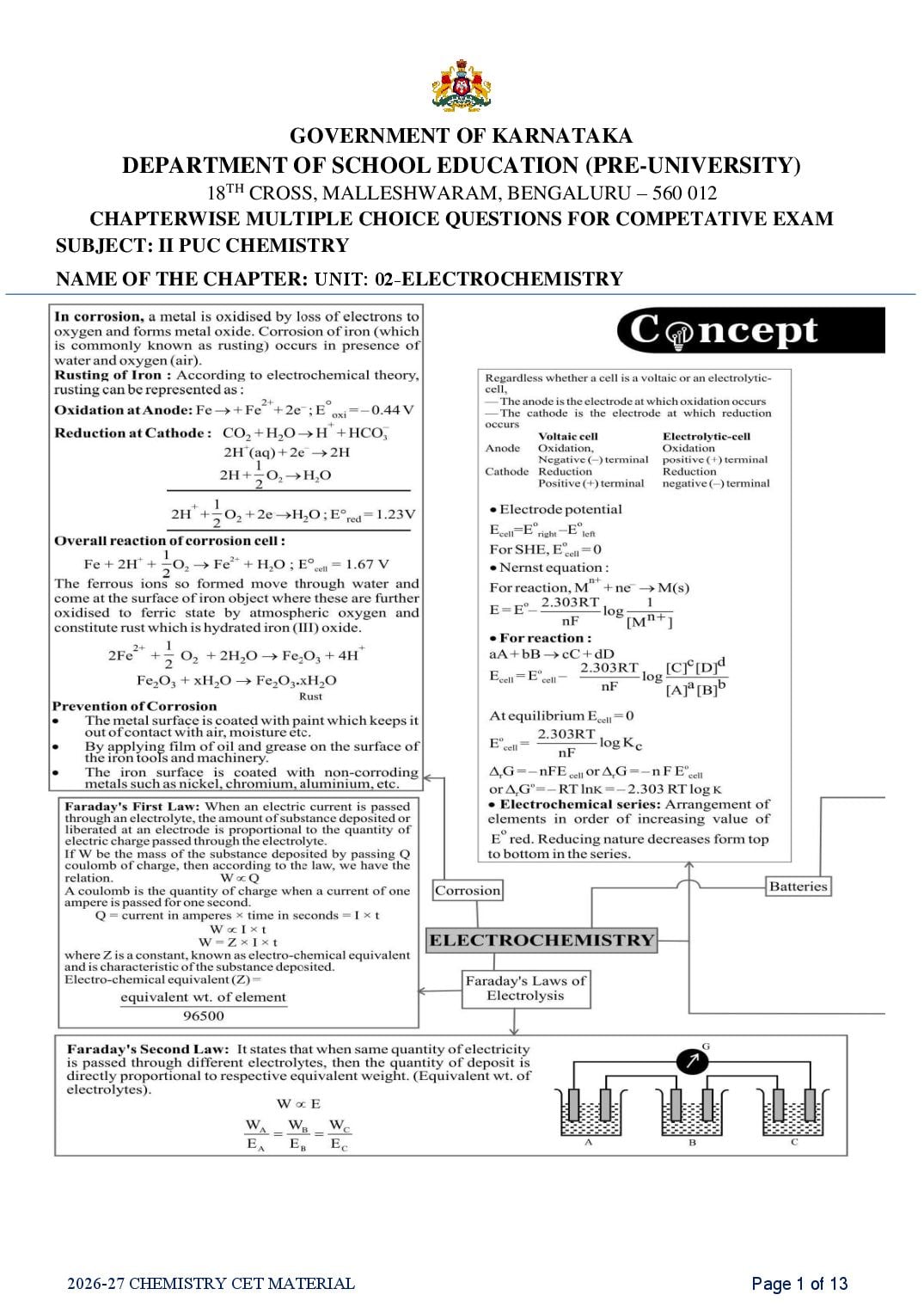
DEPARTMENT OF SCHOOL EDUCATION (PRE-UNIVERSITY)
18TH CROSS, MALLESHWARAM, BENGALURU – 560 012
CHAPTERWISE MULTIPLE CHOICE QUESTIONS FOR COMPETATIVE EXAM
SUBJECT: II PUC CHEMISTRY
NAME OF THE CHAPTER: UNIT: 02-ELECTROCHEMISTRY
2026-27 CHEMISTRY CET MATERIAL Page 1 of 13
Page 2
Page 3
The least active ion (ions having lower discharge potential) is discharged first at the respective
electrode. The decreasing order of activity or increasing order of deposition of few ions is as below.
For cations : Li+, K+, Na+, Ca2+, Mg2+, Al3+, Zn2+, Fe2+, Ni2+, H+, Cu2+, Hg2+, Ag+, Au3+.
Thus in aqueous solution containing any of the cation Li+, Na+, K+, Ba2+, Ca2+, Mg2+ or Al3+, it is water
which is reduced at the cathode and not the metal cations.
For anions : SO24− , NO3− ,OH− ,Cl− ,Br − ,I− Thus in aqueous solution of the SO 24 − and NO3− , it is the
water
which is oxidised at the anode and not the anions.
Degree of Dissociation ( )
For weak electrolytes
KOHLRAUSCH'S LAW
At infinite dilution the molar conductivity of an electrolyte is the sum of the ionic conductivities of
the cations and anions. e.g. for Ax By.
(i) Primary cells : They cannot be recharged and used again. Examples are :
1) Dry cell or Leclanche cell : Anode - Zinc Container
Cathode - graphite rod surrounded by MnO2 powder
Electrolyte - paste of NH4Cl + ZnCl2
2) Mercury Cell :
Anode - Zn-Hg amalgam
Cathode - paste of (HgO + C)
Electrolyte - moist paste of KOH-ZnO
(ii) Secondary cells : It can be recharged and can be used again and again. Examples are :
1) Lead storage battery :
Anode - Spongy lead
Cathode - grid of lead packed with PbO2
Electrolyte - 38% H2SO4 by mass
2) Nickel-cadmium storage cell
Anode - Cadmium
Cathode - metal grid containing NiO2
Electrolyte - KOH solution
Relationship between Ecell and K eq
0.0591
E cell = log K eq
n
2026-27 CHEMISTRY CET MATERIAL Page 3 of 13
Page 4
states:
If two half reactions having potentials E1− and E −2 are combined to give a half reaction having a
potential E3− ,then
Electrode concentration cells: Identical electrodes at different concentrations are dipped in the
same solution of the electrolyte
2.0 INTRODUCTION
1. KCl is used in salt bridge because
(a) it forms a good jelly with agar‐agar (b) it is a strong electrolyte
(c) it is a good conductor of electricity (d) the transport number of K+ and Cl− ions are
almost equal
2.1 ELECTROCHEMICAL CELLS:
2.2 GALVANIC CELLS
2. The standard potential at 25oC for the following half reactions are given
Zn2+ + 2e → Zn, Eo = -0.762 V , Mg2+ + 2e → Mg, Eo = -2.37 V, when zinc dust is added to the solution
of MgCl2
(a) ZnCl2 is formed (b) Zinc dissolves in the solution
(c) No reaction takes place (d) Mg is precipitated
3. Fluorine is the best oxidising agent because it has
(a) highest electron affinity (b) highest 𝐸 0 𝑟𝑒𝑑
(c) highest 𝐸 0 𝑜𝑥𝑑 (d) lowest electron affinity
2026-27 CHEMISTRY CET MATERIAL Page 4 of 13
Page 5
MgCl2 solution will
(a) Have no effect (b) Precipitate Mg metal
(c) Precipitate MgO (d) Lead to dissolution of Be metal
5. The standard reduction electrode potentials of the three electrodes P, Q and R are respectively -1.76 V,
0.34 V and 0.8 V. Then,
(a) Metal Q will displace the cation of P from its aqueous solution and deposit the metal P.
(b) Both metals Q and R displace the cation of P from its aqueous solution and displace the metal P
(c) Metal R will displace the cation of P from its aqueous solution and deposit the metal R
(d) Metal P will displace the cation of R from its aqueous solution and deposits the metal R.
6. The following observation does not occur when an iron rod is dipped in CuSO4 solution,
(a) Blue colour of the solution turns green (b) Brown layer is deposited on iron rod
(c) No change occurs in the colour of the solution (d) Blue colour of the solution vanishes
7. Which of the following liberate hydrogen on reaction with dilute H2SO4
(a) Au (b) Cu
(c) Al (d) Hg
8. When a copper wire is placed in a solution of AgNO3, the solution acquires blue colour. This is due to the
formation of
(a) Cu2+ ions (b) Cu+ ions
(c) Soluble complex of copper with AgNO3 (d) Cu- ions by the reduction of Cu.
9. Reduction potential of A, B, C and D are 0.8 V, 0.79 V, 0.34 V and -2.37 V respectively. Which element
displaces all the other three elements
(a) B (b) A
(c) D (d) C
10. A student set up the following apparatus to determine the hydrogen ion concentration of solution X.
The cell is 𝑀│𝐻2(𝑔) │2𝐻 +(𝑎𝑞) ││𝐶𝑢2+(𝑎𝑞) │𝐶𝑢(𝑠) . The best material for electrode M would be
(a) Polished copper metal (b) Platinum metal coated which platinum oxide
(c) Copper metal coated with oxide (d) Platinum metal coated with finely divided platinum
11. If half-cell reaction 𝐴 + 𝑒 − → 𝐴− has a large negative reduction potential, it follows that
(a) A is readily reduced (b) A is readily oxidized
2026-27 CHEMISTRY CET MATERIAL Page 5 of 13
Page 6
12. A solution of potassium bromide is treated with each of the following. Which one would liberate
bromine?
(a) Hydrogen iodide (b) Sulphur dioxide
(c) Chlorine (d) Iodine
13. Zinc gives H2 with H2SO4 and HCl but not with HNO3 because
(a) Zinc acts as oxidizing agent when reacts with HNO3
(b) HNO3 is an oxidizing agent
(c) In electrochemical series zinc is above hydrogen
(d) NO− 3 is reduced in preference to hydronium ion
2.2.1 MEASUREMENT OF ELECTRODE POTENTIAL
14. Standard electrode potential for Sn4+/Sn2+ couple is +0.15 V and that for the Cr3+/Cr couple is -0.74 V. These two
couples in their standard state are connected to make a cell. The cel potential will be
(a) +1.19V (b) +0.89V
(c) +0.18V (d) +1.83V
15. A solution contains Fe2+, Fe3+ and I- ions. This solution was treated with iodine at 35oC. Eo for Fe3+/Fe2+ is +0.77V
and Eo for I2/2I- = 0.536 V. The favourable redox reaction is
(a) I2 will be reduced to I- (b) There will be no redox reaction
(c) I- will be oxidized to I2 (d) Fe2+ will be oxidized to Fe3+.
16. Electrode potential data are given below
3+ 2+ 3+
𝐹𝑒(𝑎𝑞) + 𝑒 − → 𝐹𝑒(𝑎𝑞) ; 𝐸° = +0.77 V 𝐴𝑙(𝑎𝑞) + 3𝑒 − → 𝐴𝑙(𝑠) ; 𝐸° = −1.66 V
−
𝐵𝑟2(𝑎𝑞) + 2𝑒 − → 2𝐵𝑟(𝑎𝑞) ; 𝐸° = +1.08 V. Based on the data, the reducing power of Fe2+, Al and 𝐵𝑟 − will
increase in the order
(a) 𝐵𝑟 − < 𝐹𝑒 2+ < 𝐴𝑙 (b) 𝐹𝑒 2+ < 𝐴𝑙 < 𝐵𝑟 −
(c) 𝐴𝑙 < 𝐵𝑟 − < 𝐹𝑒 2+ (d) 𝐴𝑙 < 𝐹𝑒 2+ < 𝐵𝑟 −
1
17. The standard electrode potential (Eo) for OCl-/Cl- and Cl-/ 2 Cl2 respectively are 0.94 V and -1.36 V. The Eo value
1
for OCl- / 2Cl2 will be
(a) -0.42 V (b) -2.20 V
(c) 0.52 V (d) 1.04 V
18. Consider the half-cell reduction reaction : Mn2+ + 2e- → Mn, Eo = -1.18 V, Mn2+ → Mn3+ +e-, Eo = -1.51 V
The Eo for the reaction, 3Mn2+ → Mn + 2Mn3+, and possibility of the forward reaction are respectively
(a) -4.18 V and yes (b) +0.33 V and yes
(c) +2.69 V and No (d) -2.69 V and No
19. Standard electrode potential for Fe electrode are given by :
Fe2+ + 2e− → Fe, E° = −0.44 V & Fe3+ + e− → Fe2+ E° = +0.77 V. Fe2+, Fe3+ and Fe blocks are kept together
then
(a) [Fe3+ ] decreases (b) [Fe3+ ] increases
(c) [Fe /Fe ] remains unchanged
2+ 3+
(d) [Fe2+ ] decreases
2026-27 CHEMISTRY CET MATERIAL Page 6 of 13
Page 7
Given 𝑃𝑡 2+ + 2𝐶𝑙 − → Pt + 𝐶𝑙2 , 𝐸°cell = −0.15 V and 𝑃𝑡 2+ + 2𝑒 − → Pt, 𝐸° = 0.20 V
(a) 1.50 V (b) –1.05
(c) – 0.35 V (d) 0.35 V
21. 𝐸°𝐹𝑒 2+/𝐹𝑒 = −0.441V and 𝐸°𝐹𝑒 3+/𝐹𝑒 2+ = 0.771V, the standard EMF of the reaction Fe+ 2𝐹𝑒 3+ → 3𝐹𝑒 2+ will be
(a) 0.111 V (b) 0.330 V
(c) 1.653 V (d) 1.212 V
22. Given (i) 𝐶𝑢2+ + 2𝑒 − → 𝐶𝑢, 𝐸° = 0.337 V , (ii) 𝐶𝑢2+ + 𝑒 − → 𝐶𝑢+ , 𝐸° = 0.153 V
Electrode potential 𝐸° for the reaction, 𝐶𝑢+ + 𝑒 − → 𝐶𝑢, will be
(a) 0.90 V (b) 0.30 V
(c) 0.38 V (d) 0.52 V
23. The standard redox potentials for the reactions Mn2+ + 2e- →Mn and Mn3+ + e- → Mn2+ are – 1.18 V and 1.51 V
respectively. What is the redox potential for the reaction, Mn3+ + 3e- → Mn
(a) 0.33 V (b) 1.69 V
(c) - 0.28 V (d) - 0.85 V
2.3 NERNST EQUATION:
24. In the electrochemical cell: Zn│ZnSO4(0.01 M)││CuSO4(1.0M)│Cu, the emf of this Daniell cell is E1. When the
concentration of ZnSO4 is changed to 1.0 M and that of CuSO4 changed to 0.01 M, the emf changes to E2. From
the followings, which one is the relationship between E1 and E2? (Given, RT/F = 0.059)
(a) E1 < E2 (b) E1 > E2
(c) E2 = 0 ≠ E1 (d) E1 = E2
25. If hydrogen electrode dipped in 2 solution of pH = 3 and pH = 6 and salt bridge is connected the e.m.f
of resulting cell is
(a) 0.177 V (b) 0.3 V
(c) 0.052 V (d) 0.104 V
26. Which will increase the voltage of the cell ,Sn(s) + 2Ag+(aq) → Sn2+(aq) + 2 Ag(s)
(a) Increase in the concentration of Ag+ ions (b) Increase in size of the silver rod
(c) Increase in the concentration of Sn2+ ions (d) Decrease in the size of the Sn rod
27. The emf of a Daniel cell at 298 K is E1. The cell is , Zn│ZnSO4(0.01 M) ││ CuSO4(1 M)│Cu .When the
concentration of ZnSO4 is changed to 1 M and that of CuSO4 to 0.01 M, the emf changes to E2. The relationship
between E1 and E2 will be
(a) E1 – E2 = 0 (b) E1 > E2
(c) E1 < E2 (d) E1 = 102 E2
28. The pressure of H2 required to make the potential of H2 electrode zero in pure water at 298 K is
(a) 10-10 atm (b) 10-14 atm
(c) 10-4 atm (d) 10-12 atm
29. Hydrogen electrode is placed in the solution where pH is 10. The potential of this electrode will be
2026-27 CHEMISTRY CET MATERIAL Page 7 of 13
Page 8
(c) 0 V (d) + 0.0591 V
30. An electrochemical cell is set up as follows: Pt (H2, 1atm)/0.1 M HCl ││0.1 M acetic acid / (H2, 1 atm) Pt
E.M.F of this cell will not be zero because
(a) The pH of 0.1 M HCl and 0.1 M acetic acid is not the same
(b) Acids used in two compartments are different
(c) E.M.F of a cell depends on the molarities of acids used
(d) The temperature is constant
31. A solution contains 𝐹𝑒 2+ , 𝐹𝑒 3+ and I − ions. This solution was treated with iodine at 35℃. 𝐸° for 𝐹𝑒 3+ , 𝐹𝑒 2+
is + 0.77 V and 𝐸° for I2 /2I− = 0.536 V. the favorable redox reaction is
(a) I2 will be reduced to I − (b) there will be no redox reaction
(c) I − will be oxidized to I2 (d) 𝐹𝑒 2+ will be oxidized to 𝐹𝑒 3+
32. The electrode potential for 𝐶𝑢2+ − + + −
(𝑎𝑞) + 𝑒 → 𝐶𝑢 (𝑎𝑞) and 𝐶𝑢 (𝑎𝑞) + 𝑒 → 𝐶𝑢(𝑠) Are + 0.15 V and +0.50 V
respectively. the value of 𝐸°𝐶𝑢2+/𝐶𝑢 will be
(a) 0.500 V (b) 0.325 V
(c) 0.650 V (d) 0.150 V
2+ −
33. A button cell used in watches function as following. Zn(s) + 𝐴𝑔2 𝑂(𝑠) + 𝐻2 𝑂(𝑙) ⇌ 2𝐴𝑔(𝑠) + 𝑍𝑛(𝑎𝑞) + 2𝑂𝐻(𝑎𝑞) If
half-cell potential are
2+
𝑍𝑛(𝑎𝑞) + 2𝑒 − → Zn(s) ; E° = −0.76 V
−
𝐴𝑔2 𝑂(𝑠) + 𝐻2 𝑂(𝑙) + 2𝑒 − → 2𝐴𝑔(𝑠) + 2𝑂𝐻(𝑎𝑞) , E° = 0.34 V, The cell potential will be
(a) 0.84 V (b) 1.34 V
(c) 1.10 V (d) 0.42 V
2.3.1 EQUILIBRIUM CONSTANT FROM NERNST EQUATION:
34. For a reaction A(s) + 2B+(aq) → A2+(aq) + 2B(s) Kc has been found to be 1012 . The 𝐸 0 𝑐𝑒𝑙𝑙 is
(a) 0.354 V (b) 0.708 V
(c) 0.0098 V (d) 1.36 V
35. Eo of a cell aA + bB → cC + dD is,
𝑅𝑇 [𝐶]𝑐 [𝐷]𝑑 𝑅𝑇 [𝐶]𝑐 [𝑑]𝐷
(a) + 𝑛𝐹 𝑙𝑜𝑔 [𝐴]𝑎 [𝐵]𝑏 (b) + 𝑛𝐹 𝑙𝑜𝑔 [𝐴]𝑎[𝐵]𝑏
[𝑎]𝐴 [𝑏]𝐵 𝑅𝑇 [𝐶]𝑐 [𝑑]𝐷
(c) + 𝑅𝑇 𝑙𝑜𝑔 [𝑎]𝐶 [𝑑]𝐷 (d) + 𝑛𝐹 𝑙𝑜𝑔 [𝑎]𝐴[𝐵]𝑏
36. The 𝐸° for the cell reaction Cu(s) + 2Ag +(aq) → Cu2+
(aq) + 2Ag (s) is 0.46 V, what is its equilibrium constant?
(a) 15.6 (b) 4 × 10¹⁶
(c) 4 × 10¹⁵ (d) 1.56 × 10¹⁵
2.3.2. ELECTROCHEMICAL CELL AND GIBBS ENERGY OF THE REACTION:
37. The reaction is spontaneous if the cell potential is
(a) Positive (b) Negative
2026-27 CHEMISTRY CET MATERIAL Page 8 of 13
Page 9
38. Which of the following expression is correct
(a) ) ΔGo = -nFEocell (b) ΔGo = +nFEocell
(c) ΔGo = -2.303RT nFEocell (d) ΔGo = -nF logKc
39. For the feasibility of a redox reaction in a cell, the e.m.f should be
(a) Positive (b) Fixed
(c) Zero (d) Negative
40. The Gibbs’ energy for the decomposition of Al2O3 at 500oC is as follows
2 4
3
Al2O3 → 3 Al + O2, ΔrG = +960 kJ mol-1
The potential difference needed for the electrolytic reduction of aluminium oxide ( Al2O3) at 500oC is at least
(a) 4.5 V (b) 3.0 V
(c) 2.5 V (d) 5.0 V
41. Standard free energies of formation (in kJ/mol) at 298K are -237.2, -394.4 and -8.2 for H2O(l), CO2(g) and
pentane(g) respectively. The value of Eocell for the pentane-oxygen fuel cell is
(a) 1.0968 V (b) 0.0968 V
(c) 1.968 V (d) 2.0968 V
42. On the basis of the information available from the reaction,
4/3 Al + O2 → 2/3 Al2O3, ΔG = -827 kJ mol-1 of O2, the minimum e.m.f. required to carry out an electrolysis of
Al2O3 is (F = 96500 C mol-1)
(a) 2.14 V (b) 4.28 V
(c) 6.42 V (d) 8.56 V
43. For the reduction of silver ions with copper metal, the standard cell potential was found to be + 0.46 V at 25℃.
The value of standard Gibb’s energy, ∆𝐺° will be (F = 96500 C mol-1)
(a) – 89.0 kJ (b) – 89.0 J
(c) – 44.5 kJ (d) – 98.0 Kj
2.4 CONDUCTANCE OF ELECTROLYTIC SOLUTIONS:
44. On heating one end of a piece of a metal, the other end becomes hot because of
(a) Energised electrons moving to the other end (b) Minor perturbation in the energy of atoms
(c) Resistance of the metal (d) Mobility of atoms in the metal.
2.4.1MEASUREMENT OF THE CONDUCTIVITY OF IONIC SOLUTIONS:
45. The electrode of a conductivity cell are 3 cm apart and have a cross-sectional area of 4 cm2. The cell constant of
the cell (in cm-1) is
(a) 4 x 3 (b) 3/4
(c) 4/3 (d) 9/4
46. The specific conductance of a 0.1 M KCl solution at 230C is 0.012 ohm-1cm-1. The resistance of cell containing the
solution at the same temperature was found to be 55 ohm. The cell constant will be
(a) 0.918 cm-1 (b) 1.142 cm-1
(c) 0.66 cm-1 (d) 1.12 cm-1
2026-27 CHEMISTRY CET MATERIAL Page 9 of 13
Page 10
H2O will be added to the above solution?
(a) Increases (b) Remains unchanged
(c) Decreases (d) First increases and then decreases
48. The specific conductance in ohm−1cm−1 of four electrolytes P, Q, R and S are given below: P= 5×10⁻⁵
Q= 7×10⁻⁸ R= 1×10⁻¹⁰ S= 9.2×10⁻³ The one that offers highest resistance to the passage current is
(a) P (b) S
(c) R (d) Q
2.4.2 VARIATION OF CONDUCTIVITY AND MOLAR CONDUCTIVITY WITH
CONCENTRATION:
49. Following limiting molar conductivities are given as: 𝜆𝑜𝑚(𝐻2𝑆𝑂4) = x Scm2mol-1
𝜆𝑜𝑚(𝐾2𝑆𝑂4) = y Scm2mol-1, 𝜆𝑜𝑚(𝐶𝐻3𝐶𝑂𝑂𝐾) = z Scm2mol-1. 𝜆𝑜𝑚 (in Scm2mol-1) for CH3COOH will be
(a) x – y + 2z (b) x – y + z
𝑥−𝑦
(c) x + y – z (d) 2
+z
50. The molar conductivity of M/32 solution of a weak monobasic acid is 8.0 Scm2mol-1 and at infinite dilution is 400
Scm2mol-1. The dissociation constant of this acid is
(a) 1.25 x 10⁻⁶ (b) 1.25 x 10⁻⁴
(c) 6.25 x 10⁻⁴ (d) 1.25 x 10⁻⁵
51. Limiting molar conductivity of Ba2+ and Cl- ions are 127 and 76 Scm2mol-1 respectively. Molar conductivity of
BaCl2 at infinite dilution is
(a) 139.5 Scm2mol-1 (b) 101.5 Scm2mol-1
(c) 203 Scm2mol-1 (d) 279 Scm2mol-1
52. The correct order of equivalent conductances at infinite dilution in water at room temperature for H+, K+,
CH3COO- and HO- ions is
(a) HO- > H+ > K+ > CH3COO- (b) H+ > HO- > K+ > CH3COO-
(c) H+ > K+ > HO- > CH3COO- (d) H+ > K+ > CH3COO- > HO-
53. The molar conductance of NH4OH at 0.01 M concentration is 11.3 ohm-1cm2 mol-1. The degree of
dissociation of NH4OH is (molar conductance at infinite dilution = 271.1 ohm-1cm2 mol-1).
(a) 4.16% (b) 1.3%
(c) 12.6% (d) 41%
54. Specific conductance of 0.1 M nitric acid is 6.3 × 10⁻² ohm−1 cm−1. The molar conductance of the solution is
(a) 630 ohm−1 cm2 mol−1 (b) 315 ohm−1 cm2 mol−1
(c) 6300 ohm−1 cm2 mol−1 (d) 36.0 ohm−1 cm2 mol−1
55. Molar conductivity (Λ°𝑚 ) at infinite dilution of NaCl, HCl and CH3COONa are 126.4, 425.9 and 91.0 S
cm2 mol−1 respectively. (Λ°𝑚 ) for CH3COOH will be
(a) 425.5 S cm2 mol−1 (b) 180.5 S cm2 mol−1
(c) 290.8 S cm2 mol−1 (d) 390.5 S cm2 mol−1
2026-27 CHEMISTRY CET MATERIAL Page 10 of 13
Page 11
298 K is
(a) 2.88 Scm2 /mol (b) 11.52 Scm2 /mol
(c) 0.086 Scm2 /mol (d) 28.8 Scm2 /mol
2.5 ELECTROLYTIC CELLS AND ELECTROLYSIS:
57. Consider the following : (i) 2H2 O(i) → O2 (g) + 4H +(aq) + 4e− E°cell = +1.23V
(ii) 2𝑆𝑂42− (𝑎𝑞) → 𝑆2 O+ −
8 (aq) + 2e E°cell = +1.96V. Which of the following statement is true?
(a) In the electrolysis of dil. H2SO4, (i) is preferred at the anode
(b) In the electrolysis of conc. H2SO4, (i) is preferred at the anode
(c) In the electrolysis of dil. H2SO4, (ii) is preferred at the anode
(d) In the electrolysis of conc. H2SO4, both (i) and (ii) occur at anode
2.5.1PRODUCTS OF ELECTROLYSIS:
58. When CuSO4 is electrolysed using platinum electrodes,
(a) Copper is liberated at cathode, sulphur at anode (b) Copper is liberated at cathode, oxygen at anode
(c) sulphur is liberated at cathode, oxygen at anode (d) oxygen is liberated at cathode, copper at anode.
59. When electric current is supplied through an ionic hydride of fused state, then
(a) Hydrogen is obtained at anode (b) Hydrogen is obtained at cathode
(c) Hydride ion moves towards cathode (d) Hydride ion present in solution
60. Which of the following will give H2(g) at cathode and O2(g) at anode on electrolysis using platinum electrodes
(a) Molten NaCl (b) Concentrated aq. Solution of NaCl
(c) Dilute aq. Solution of NaCl (d) Solid NaCl
61. The number of coulombs required to reduce 12.3 g of nitrobenzene to aniline
(a) 115800 C (b) 5790 C
(c) 28950 C (d) 57900 C
62. Which of the following reaction is possible at anode
(a) 2 Cr3+ + 7 H2O → Cr2O7 2- + 14H+ (b) F2 → 2 F-
(c) ½ O2 + 2 H+ → H2O (d) both a and b
63. The required charge for one equivalent weight of silver deposited on cathode is
(a) 9.65 x 10⁷ C (b) 9.65 x 10⁴ C
(c) 9.65 x 10³ C (d) 9.65 x 10⁵ C
64. How long (approximate) should water be electrolysed by passing through 100 amperes current so that the oxygen
released can completely burn 27.66 g of diborane
(a) 0.8 hrs (b) 3.2 hrs
(c) 1.6 hrs (d) 6.4 hrs
65. The quantity of charge required to obtain one mole of aluminum from Al2O3 is
(a) 1 F (b) 6 F
(c) 3 F (d) 2 F
2026-27 CHEMISTRY CET MATERIAL Page 11 of 13
Page 12
(a) 96500 C (b) 2× 96500C
(c) 9650 (d) 96.50 C
67. During the electrolysis of molten sodium chloride, the time required to produce 0.10 mol of chlorine gas using a
current of 3 amperes is
(a) 55 minutes (b) 110 minutes
(c) 220 minutes (d) 330 minutes
68. The number of electrons delivered at the cathode during electrolysis by a current of 1 ampere in 60 seconds is
(charge on electron = 1.60 x 10⁻¹⁹ C)
(a) 6 x 10²³ (b) 6 x 10²⁰
(c) 3.75 x 10²⁰ (d) 7.48 x 10²³
69. How many grams of cobalt metal will be deposited when a solution of cobalt(II) chloride is electrolyzed with a
current of 10 amperes for 109 minutes? (1 Faraday = 96,500 C; Atomic mass of Co = 59 u)
(a) 4.0 (b) 20.0
(c) 40.0 (d) 0.66
70. 4.5 g of aluminium (at mass 27 amu) is deposited at cathode from Al 3+ solution by a certain quantity of electric
charge. The volume of hydrogen produced at STP from H+ ions in solution by the same quantity of electric charge
will be
(a) 22.4 L (b) 44.8 L
(c) 5.6 L (d) 11.2 L
71. When 9.65 coulombs of electricity is passed through a solution of silver nitrate (atomic weight of Ag = 107.87
takes as 108) the amount of silver deposited is
(a) 10.8 mg (b) 5.4 mg
(c) 16.2 mg (d) 21.2 mg
72. Three electrolytic cells A, B, C containing solutions of ZnSO4, AgNO3, and CuSO4 respectively were
connected in series. A steady current of 1.5 amperes was passed through them until 1.45 g of Ag
deposited at the cathode of cell ‘B’. what mass of Cu and Zn were deposited?
(a) 0.831 g, 0.439 g (b) 0.426 g, 0.824 g
(c) 0.426 g, 0.439 g (d) 0.831 g, 0.824 g
73. In an electroplating experiment m g of silver is deposited when 4 amperes of current flows for 2 minutes.
The amount (in g) of silver deposited by 6 amperes of current flowing for 40 seconds will be
(a) 4 m (b) m/2
(c) m/4 (d) 2m
74. On passing 3 ampere of electricity for 50 minutes, 1.8 g metal is deposited. The equivalent mass of metal is
(a) 20.5 (b) 25.8
(c) 19.3 (d) 30.7
75. A current 2.0 A passed for 5 hours through a molten metal salt deposits 22.2 g of metal (At. wt. = 177). The
oxidation state of the metal in the metal salt is
(a) + 1 (b) + 2
2026-27 CHEMISTRY CET MATERIAL Page 12 of 13
Page 13
76. During electrolysis of fused aluminum chloride 0.9 g of aluminum was deposited on the cathode. The volume of
chloride liberated at the anode will be
(a) 2.24 liters (b) 11.2 liters
(c) 1.12 liters (d) 5.6 liters
FUEL CELLS :
77. The electrode reaction that takes place at the anode of CH4- O2 fuel cell is
(a) 2O2 + 8 H+ + 8 e- → 4H2O (b)CH4 + 2 H2O → CO2 + 8H+ + 8e-
(c) CH4 + 2O2 → CO2 + 2H2O (d) 2H+ + 2e- → H2
CORROSION:
78. On the basis of electrochemical theory of aqueous corrosion, the reaction occurring at the cathode is,
(a) O2(g) + 4H+(aq) + 4e- → 2H2O(l) (b) Fe(s) → Fe2+(aq) + 2e-
2+ 3+ -
(c) Fe (aq) → Fe (aq) + e (d) H2(g) + 2 OH-(aq) → 2H2O(l) + 2e-
Answer Key:
1. 2. 3. 4. 5. 6. 7. 8. 9. 10.
d c b a d a c a c d
11. 12. 13. 14. 15. 16. 17. 18. 19. 20.
c d b c a c d a d
b
21. 22. 23. 24. 25. 26. 27. 28. 29. 30.
d c b a a b b b a
d
31. 32. 33. 34. 35. 36. 37. 38. 39. 40.
c b c a b c a a a c
41. 42. 43. 44. 45. 46. 47. 48. 49. 50.
a a a b c c c d d
a
51. 52. 53. 54. 55. 56. 57. 58. 59. 60.
b a a d b a b a c
d
61. 62. 63. 64. 65. 66. 67. 68. 69. 70.
d a b b c c b c b c
71. 72. 73. 74. 75. 76. 77. 78.
a c b c c c b a
*************
2026-27 CHEMISTRY CET MATERIAL Page 13 of 13
Document Details
| Board / Org | Karnataka Board |
| Exam | Class 12 |
| Type | Question Bank |
| Pages | 13 |
| Updated | 24 Sep 2026 |