NIOS Class 10 Sample Paper 2023 Economics
Finished viewing? Save it for later —
Download NIOS Class 10 Sample Paper 2023 Economics (PDF · 10 pages)About NIOS Class 10 Sample Paper 2023 Economics
NIOS Class 10 Sample Paper 2023 Economics is available here for free download. Published by NIOS for National Institute of Open Schooling Class 10, this sample paper can be viewed online or downloaded as a PDF (10 pages). Candidates preparing for National Institute of Open Schooling Class 10 can use NIOS Class 10 Sample Paper 2023 Economics to understand the exam pattern, the type of questions asked, and the overall difficulty level.
Frequently Asked Questions
How can I download NIOS Class 10 Sample Paper 2023 Economics?
Open this page and click the Download button to save NIOS Class 10 Sample Paper 2023 Economics as a PDF. It is completely free on AglaSem Docs.
Is NIOS Class 10 Sample Paper 2023 Economics free to download?
Yes. NIOS Class 10 Sample Paper 2023 Economics can be viewed online and downloaded as a PDF free of cost on AglaSem Docs.
How many pages does NIOS Class 10 Sample Paper 2023 Economics have?
NIOS Class 10 Sample Paper 2023 Economics contains 10 pages, which you can read online or download together as a single PDF.
Where can I find more National Institute of Open Schooling Class 10 study material?
You can find more National Institute of Open Schooling Class 10 question papers, sample papers, syllabus, and answer keys on AglaSem Docs.
NIOS Class 10 Sample Paper 2023 Economics – Text
Read the full text of this sample paper below — useful to quickly search, copy and reference the content online without downloading the PDF.
📄 View text version (10 pages)
Page 1
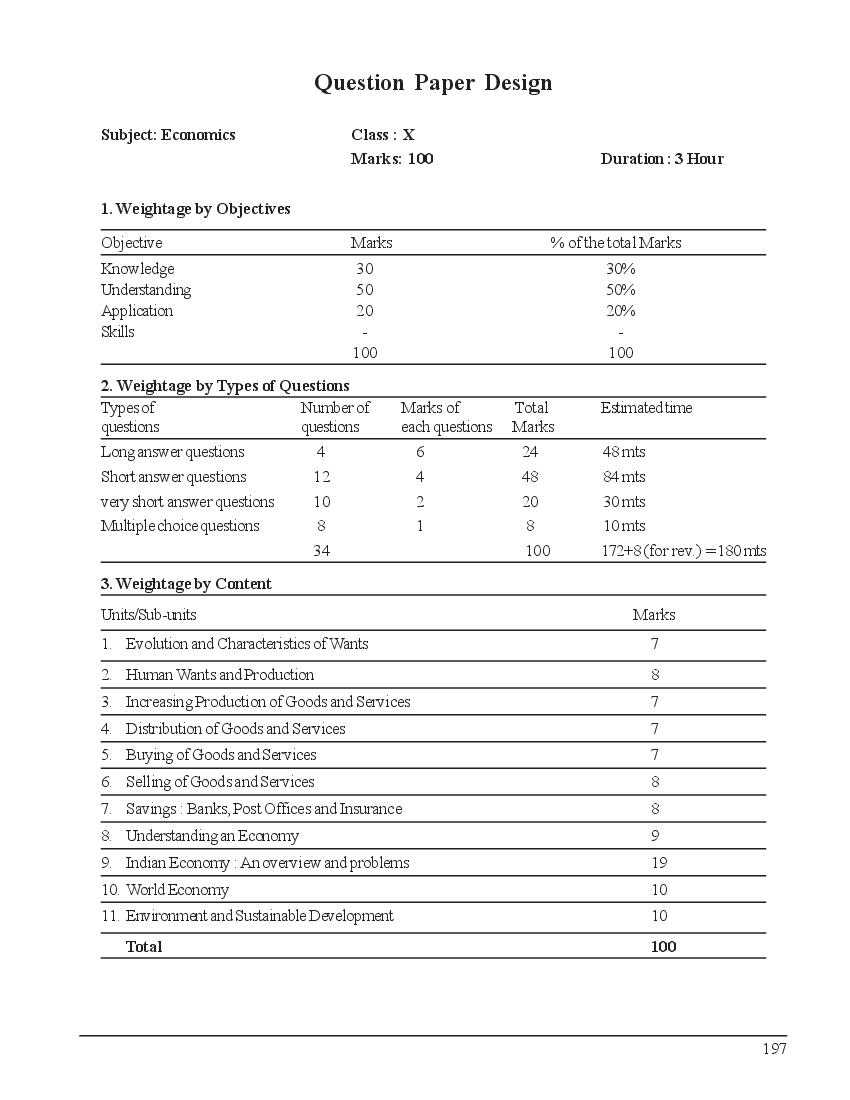
Subject: Economics Class : X
Marks: 100 Duration : 3 Hour
1. Weightage by Objectives
Objective Marks % of the total Marks
Knowledge 30 30%
Understanding 50 50%
Application 20 20%
Skills - -
100 100
2. Weightage by Types of Questions
Types of Number of Marks of Total Estimated time
questions questions each questions Marks
Long answer questions 4 6 24 48 mts
Short answer questions 12 4 48 84 mts
very short answer questions 10 2 20 30 mts
Multiple choice questions 8 1 8 10 mts
34 100 172+8 (for rev.) = 180 mts
3. Weightage by Content
Units/Sub-units Marks
1. Evolution and Characteristics of Wants 7
2. Human Wants and Production 8
3. Increasing Production of Goods and Services 7
4. Distribution of Goods and Services 7
5. Buying of Goods and Services 7
6. Selling of Goods and Services 8
7. Savings : Banks, Post Offices and Insurance 8
8. Understanding an Economy 9
9. Indian Economy : An overview and problems 19
10. World Economy 10
11. Environment and Sustainable Development 10
Total 100
197
Page 2
Sample Question Paper
Class X Duration : 3 Hours
Maximum Marks : 100
Instructions
1. All questions are compulsory.
2. Marks allotted to each question are indicated against it.
Note :- Each question from No. 1 to 8 has four alternatives A, B, C and D out of which one is the most
appropriate. Select the correct answer and write it in your answer sheet against the number of
question
1. Which of the following are the example of wants? 1
(A) Text Book
(B) Shoes
(C) Roads
(D) Computer
2. A production unit having investments of less than Rs. 25 lakhs is 1
(A) a large scale industry
(B) a small scale industry
(C) an ancillary industry
(D) a ting industry
3. Profit is the reward of 1
(A) Land
(B) Labour
(C) Capital
(D) Enterprise
198
Page 3
(A) Land
(B) Industry
(C) Mining
(D) Service
5. The main objective of seller is 1
(A) to become popular
(B) to earn profit
(C) to serve the buyers
(D) to take care of the welfare of people
6. Price of a commodity means 1
(A) the amount of money given by a buyer to a seller
(B) the amount of money buyer is getting
(C) profit earned by the seller
(D) cost of the commodity
7. A production unit owned and controlled by government comes under 1
(A) Joint sector
(B) Public sector
(C) Co-operative sector
(D) Private sector
8. The demand for a commodity increases when its 1
(A) price increases
(B) price decreases
(C) price is constant
(D) none of the above
9. State any four characteristics of wants. 2
10. Write the meaning of investment. 2
11. State the sources of aggregate domestic savings. 2
12. Distinguish between private and public sectors 2
199
Page 4
13. Explain any two advantages of globalisation to the Indian Economy. 2
14. Why do people make saving? 2
15. Distinguish between capitalist and socialist economy. 2
16. Why do rich become rich and poor become poorer in our country?
17. Suppose the cost of production of a quintal of fertilizers is Rs. 500/ and Taxes imposed amounting
to Rs. 50 and subsidies amounting to Rs. 100/-. Calculate the market price of fertilizers per
quintal?
2
18. If person’s income has increased to a great extent, but he does not make any changes in his
standard of living. Will you categorise this situation as economic growth or economic development?
2
19. What are the factors of production? Explain any two factors of production. 4
20. Describe any four causes of high birth rate in India. 4
21. What is World Trade Organization (WTO)? State its any four principles. 4
22. Explain the relationship between wants and resources. 4
23. Explain any four economic factors affecting “Distribution Process”. 4
24. Differentiate with examples between buying for consumption and buying for production. 4
25. Distinguish with examples between a wholesaler and retailer. 4
26. Explain the main features of ‘New Economic Policy’ (NEP) 1991 in India. 4
27. Explain ‘carrying-capacity’ of environment with examples 4
28. What are the reasons of declinig sex-ratio in India? 4
29. “Life-insurance provides both savings and security”. Discuss. 4
30. What are the central problems of an economy? How does planning help in solving them? 4
31. Differentiate between developed and developing economy. 6
32. Explain the importance of increasing production of goods and services in an economy. 6
33. Explain how industrialisation is responsible for the pollution of environment. 6
34. Why do we need poverty alleviation programmes? Explain any two of them. 6
200
Page 5
S. No. Expected Value Points Distribution of Total Marks
1. C 1 1
2. D 1 1
3. D 1 1
4. D 1 1
5. B 1 1
6. A 1 1
7. B 1 1
8. B 1 1
9. Any four characteristics of wants ½ mark for each 2
- Wants are unlimited correct
- Some wants arise again and again characteristics of
- Varying nature of wants wants
- Single want is satiable ½×4 = 2
- Present wants are more important than future wants
- Wants change and expand with development
10. Meaning of investment 2 Marks for 2
The difference between production of goods and correct meaning
consumption of goods in a given year is called investment
I=P–C
11. Any two sources of aggregate domestic savings 1 mark for each 2
-Household correct point
- Government (1+1=2)
- Firm
201
Page 6
S. No. Expected Value Points Distribution of Total Marks
12. Any two distinction between Private and Public Sectors: 1 mark for each 2
- Private sector refers to the sector in which ownership correct point
of producing units remains in the hands of private (1+1=2)
individual or group of individuals whereas Public sector
is one in which ownership of producing units remained
in hands of central government, State government or
local government.
- In private sectors production units are in the form of
partnership, joint stock company and sole
properietership whereas in public sector government
acts as enterpreneure.
- In private sector production units may be unorganised
while in public sector production units are organised
and registered under the companies Act.
- Any other correct point.
13. Any two advantages of globalisation
- Globalisation views the entire world as a single market. 1 mark for each 2
- Through globalisation there is global sourcing of factors correct answer
of production. (1+1=2)
14. Importance of saving
- They save for a difficult time in future.
- They save for future expenditure such as education of 1 mark for each 2
children. correct answer
- Any other correct point. (1+1=2)
15. Distinction between capitalist and socialist economy 1 mark for each 2
- In capitalist economy there is freedom to consumers correct answer
and producers whereas in socialist economy full control (1+1=2)
is in the hands of government.
- In capitalist economy the main motive is profit whereas
in socialist economy the main motive is welfare.
- Any other relevant point.
16. Rich become richer and poor becomes poorer because 1 mark for each 2
of correct answer
- differences in the ownership of wealth and property. (1+1=2)
- differences in inherent capabilities.
- Any other relevant point.
17. Cost of production + Taxes – Subsidies 1 mark for each 2
= Rs. 500 + Rs. 50 – Rs. 100 correct answer
= Rs. 450 (1+1=2)
202
Page 7
18. Economic Growth 1 mark for each 2
increase in national income and per capita income correct answer
(1+1=2)
19. Factors of Production are 2(½+½+½+½) 4
- Land +2(1+1+1) =4
- Labour
- Capital
- Enterpreneurship
explanation of any two.
20. Any four causes of High Birth rate 1+1+1+1=4 4
- Illiteracy
- Supersition
- Poverty
- Unemployment
- Low standard of living
Any other relevant point with explanation
21. World Trade Organisation and principles (W.T.O.) is a
forum for international population on trade and trade 2+2 (1+1) 4
related policies. It acts as a watch dog of international = 4
trade.
Any four Principles
- Non discriminatory
- Reciprocity
- Binding commitment
- Transparency
- Safety values
22. Wants and resources
- Wants are unlimited and resources are limited. 1+1+1+1=4 4
- Wants are ever increasing and resources are fixed. 1 mark for each
- People should limit their wants otherwise resources correct point
will get completely wiped out.
- Any other relevant point.
203
Page 8
S. No. Expected Value Points Distribution of Total Marks
23. Any four factors affecting distribution process: 1+1+1+1=4 4
- Purchasing Power
- Existence of market
- Affordable price
- Market Structure
- Economic infrastructure
- Stocks and their management.
- Any other relevant points with explanation.
24. Buying for consumption and buying for production: 2+2 = 4 4
- When goods and services are bought for directly
satisfying wants, they are said to have been bought for
consumption whereas when goods and services are
bought for producing goods/services, they are said
buying for production (with example)
- Any other relevant point.
25. Wholesaler and Retailer 2+2=4 4
- Wholesaler is one who sells in bulk where as retailer
sells in small quantities.
- Wholesaler is a business unit who buys and resells
commodities to retailers and other commercial users
whereas retailers are middleman who directly sell goods
to final consumers.
- Any other relevant point.
26. Any two featuers of economic policy 2+2=4 4
- Liberalisation: This means liberation of the economy
from unwanted government controls and restrictions.
- Privatisation: This refers to a process that reduces the
participation of state/public sector in economic activities
of the country.
- Globalisation : This means opening up of the economy
to the world market. It encourages both foreign trade
and foreign investment.
- Any two correct points with explanation.
27. Carrying capacity 2+2=4 4
The carrying capacity of the environemnt is defined in
terms of the maximum amount of natural resources which
can be drawn from it and in terms of the maximum
amount of pollutants that can be discharged it without
damaging it severely.
- Explanation with examples.
204
Page 9
28. Low status of women in the society, preference of male 1 + 1 +1 + 1= 4 4
child, low level of girl’s education, any other correct
point
29. Yes, it provides both savings and security-explanation 1+1½+1½ = 4 4
about savings: it generates savings.
- Explanation about secutrity of life Insurance provides
security rise of any loss due to happeining of uncertain
events.
30. Central problems of an economy (2 + 2) = 4 4
1. What to produce.
2. How to produce.
3. For whom to produce
The planning authorities decide what, how and for whom
goods are to be produced and in what quantity. These
problems are solved by planning authorities through
command system rather than price system
31. Difference between the developed and developing
countries is as follows:
Developed Developing
1. High per capita 1. Low per capita 1 6
income income.
2. Standard of living is 2. People are poor and 1
high. have low level of
3. Modern and latest living standard.
technology is used 3. Back ward 1
4. Industries are fully technology is used.
developed. 4. Main occupation is 1
5. Developed agriculture.
economic and social 5. Underdveloped 1
infrastructure. socio-economic
infrastructure.
6. People have better 6. People have less 1
opportunities of opportunities of
employment employment.
32. Importance of increasing production of goods and
services can be measured by the following:
1. Increase in National and per-capita income. 1 6
205
Page 10
S. No. Expected Value Points Distribution of Total Marks
2. Basic necessities, comforts and luxuries required by 1
people will be easily available.
3. Public services such as education, health etc. will 1
also be improved.
4. Employment level will be increased so will be 1
standard of living.
5. There will be development in agriculture as well as 1
industries.
6. It will bring stability in the economy. 1
33. 1. Various industries emit pollutants. A pollutant is a 6
material, such as smoke, that endanger life on earth. 2
2. Industries emit harmful gases, dust, chemical, waste
water etc. 2
3. Industries produce a great noise and spoil air and
water. All these pollutants are harmful to human life 2
(Brief explanation can also be given)
34. A large number of people in India (25%) live below
poverty line and their number is more in rural areas. 2 6
The generation of more employment opportunities for
the economically and socially backward commodities
is the need of the day. It will reduce the number of
peope living below poverty live. So we need poverty
alleviation programmes.
Explanation of any two poverty alleviation programmes:
1. Programmes generating self-employment – such as 2
Integrated Rural Development Programme (IRDP) etc.
(more explanation)
2. Programmes generating wage-employment such as
Jawahar Rojgar Yojana, Jawahar Gram Samaridhi 2
Yojana.
3. Programmes providing social-security.
4. System of public distribution of essential
commodities.
(Any two)
206
Document Details
| Board / Org | NIOS |
| Exam | National Institute of Open Schooling Class 10 |
| Type | Sample Paper |
| Pages | 10 |
| Updated | 22 Jul 2026 |