DUET Question Paper 2019 for B.Ed Spl Edu (Visual Impairment)
Finished viewing? Save it for later —
Download DUET Question Paper 2019 for B.Ed Spl Edu (Visual Impairment) (PDF · 27 pages)About DUET Question Paper 2019 for B.Ed Spl Edu (Visual Impairment)
DUET Question Paper 2019 for B.Ed Spl Edu (Visual Impairment) is available here for free download. Published by NTA for DUET, this question paper can be viewed online or downloaded as a PDF (27 pages). Candidates preparing for DUET can use DUET Question Paper 2019 for B.Ed Spl Edu (Visual Impairment) to understand the exam pattern, the type of questions asked, and the overall difficulty level.
Frequently Asked Questions
How can I download DUET Question Paper 2019 for B.Ed Spl Edu (Visual Impairment)?
Open this page and click the Download button to save DUET Question Paper 2019 for B.Ed Spl Edu (Visual Impairment) as a PDF. It is completely free on AglaSem Docs.
Is DUET Question Paper 2019 for B.Ed Spl Edu (Visual Impairment) free to download?
Yes. DUET Question Paper 2019 for B.Ed Spl Edu (Visual Impairment) can be viewed online and downloaded as a PDF free of cost on AglaSem Docs.
How many pages does DUET Question Paper 2019 for B.Ed Spl Edu (Visual Impairment) have?
DUET Question Paper 2019 for B.Ed Spl Edu (Visual Impairment) contains 27 pages, which you can read online or download together as a single PDF.
Where can I find more DUET study material?
You can find more DUET question papers, sample papers, syllabus, and answer keys on AglaSem Docs.
DUET Question Paper 2019 for B.Ed Spl Edu (Visual Impairment) – Text
Read the full text of this question paper below — useful to quickly search, copy and reference the content online without downloading the PDF.
📄 View text version (32 pages)
Page 1
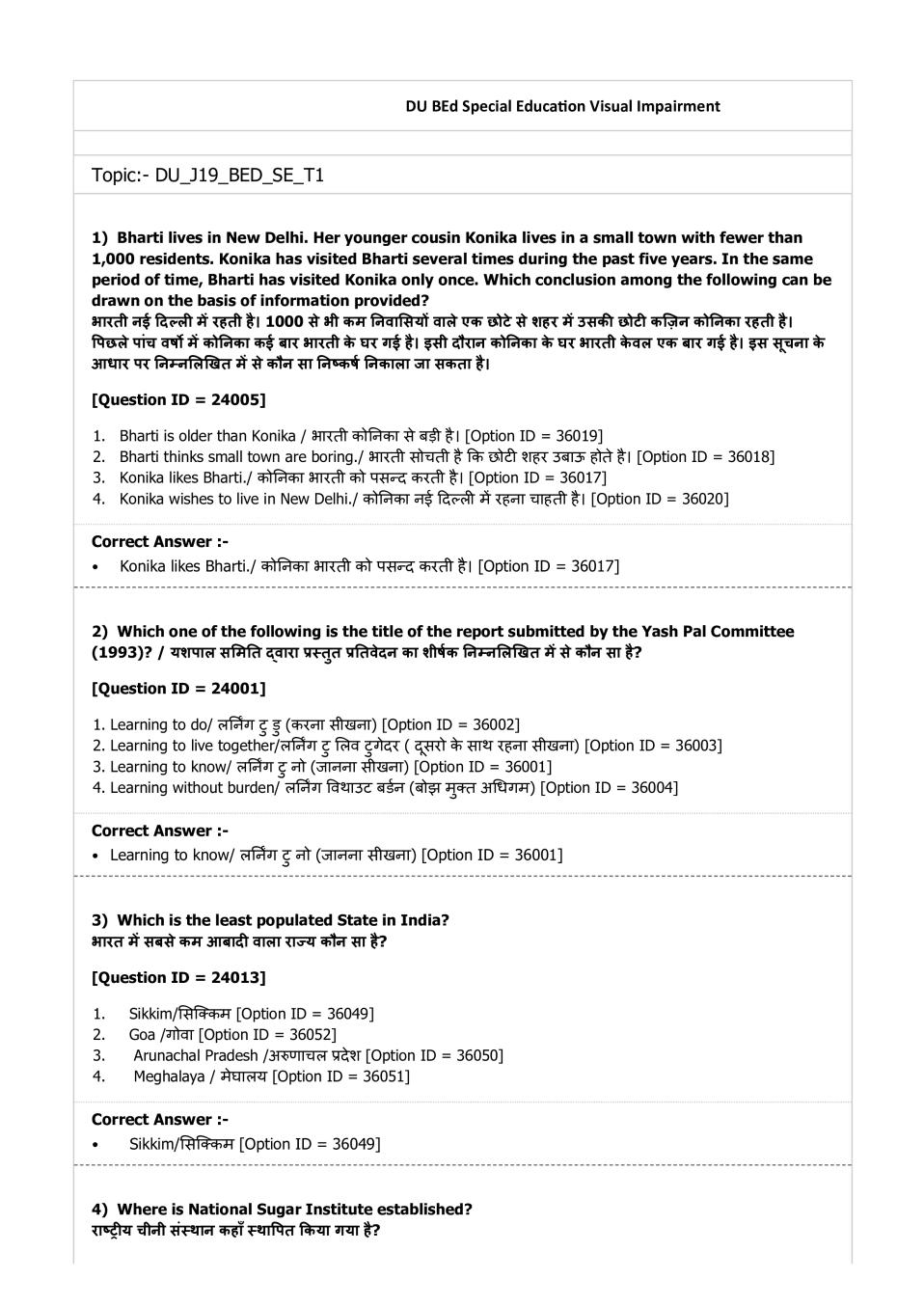
Topic:- DU_J19_BED_SE_T1
1) Bharti lives in New Delhi. Her younger cousin Konika lives in a small town with fewer than
1,000 residents. Konika has visited Bharti several times during the past five years. In the same
period of time, Bharti has visited Konika only once. Which conclusion among the following can be
drawn on the basis of information provided?
भारती नई द ल म रहती है । 1000 से भी कम नवा सय वाले एक छोटे से शहर म उसक छोट किज़न को नका रहती है ।
पछले पांच वष म को नका कई बार भारती के घर गई है । इसी दौरान को नका के घर भारती केवल एक बार गई है । इस सच
ू ना के
आधार पर न न ल खत म से कौन सा न कष नकाला जा सकता है ।
[Question ID = 24005]
1. Bharti is older than Konika / भारती को नका से बड़ी है । [Option ID = 36019]
2. Bharti thinks small town are boring./ भारती सोचती है क छोट शहर उबाऊ होते है । [Option ID = 36018]
3. Konika likes Bharti./ को नका भारती को पस द करती है । [Option ID = 36017]
4. Konika wishes to live in New Delhi./ को नका नई द ल म रहना चाहती है । [Option ID = 36020]
Konika likes Bharti./ को नका भारती को पस द करती है । [Option ID = 36017]
2) Which one of the following is the title of the report submitted by the Yash Pal Committee
(1993)? / यशपाल स म त वारा तत ु तवेदन का शीषक न न ल खत म से कौन सा है ?
[Question ID = 24001]
1. Learning to do/ ल नग टु डु (करना सीखना) [Option ID = 36002]
2. Learning to live together/ल नग टु लव टुगेदर ( दस
ू रो के साथ रहना सीखना) [Option ID = 36003]
3. Learning to know/ ल नग टु नो (जानना सीखना) [Option ID = 36001]
4. Learning without burden/ ल नग वथाउट बडन (बोझ मु त अ धगम) [Option ID = 36004]
Learning to know/ ल नग टु नो (जानना सीखना) [Option ID = 36001]
3) Which is the least populated State in India?
भारत म सबसे कम आबाद वाला रा य कौन सा है ?
[Question ID = 24013]
1. Sikkim/ सि कम [Option ID = 36049]
2. Goa /गोवा [Option ID = 36052]
3. Arunachal Pradesh /अ णाचल दे श [Option ID = 36050]
4. Meghalaya / मेघालय [Option ID = 36051]
Sikkim/ सि कम [Option ID = 36049]
4) Where is National Sugar Institute established?
रा य चीनी सं थान कहाँ था पत कया गया है ?
Page 2
1. New Delhi / नई द ल [Option ID = 36062]
2. Lucknow /लखनऊ [Option ID = 36063]
3. Kanpur / कानपरु [Option ID = 36061]
4. Gajrola/ गजरोला [Option ID = 36064]
Kanpur / कानपरु [Option ID = 36061]
5) From the number 13758925, a new number is generated by interchanging the digits in the
odd and even positions. How many digits will be there in the new number?
सं या 13758925 म सम और वषम ि थ त म आने बाले अंक को आपस म बदल कर एक नई सं या बनाया गया। नई सं या
म कतने अंक ह गे?
[Question ID = 24010]
1. 6 [Option ID = 36038]
2. 7 [Option ID = 36039]
3. 8 [Option ID = 36040]
4. 5 [Option ID = 36037]
5 [Option ID = 36037]
6) In which part of the Indian Constitution, special provisions have been made for National
Scheduled Castes and Scheduled Tribes, Other Backward Classes and Anglo Indians?
भारतीय सं वधान के कस भाग म, रा य अनस
ु ू चत जा त और अनस
ु ू चत जनजा त, अ य पछड़ा वग और एं लो इं डयन के
लए वशेष ावधान कए गए ह?
[Question ID = 23991]
1. Part XXI [Option ID = 35963]
2. Part XI [Option ID = 35962]
3. Part XIII [Option ID = 35964]
4. Part XVI [Option ID = 35961]
Part XVI [Option ID = 35961]
7) Which of the following city is the Headquarter of SAARC?
न न ल खत म से कौन सा शहर साक का मु यालय है ?
[Question ID = 23997]
1. Islamabad / इ लामाबाद [Option ID = 35986]
2. Colombo / कोलंबो [Option ID = 35987]
3. New Delhi / नई द ल [Option ID = 35985]
4. Kathmandu / काठमांडू [Option ID = 35988]
New Delhi / नई द ल [Option ID = 35985]
8)
Page 3
सतलज
ु नद त बत से हमाचल दे श म कस थान से वेश करती है ?
[Question ID = 23993]
1. Makodi/ मकोडी [Option ID = 35970]
2. Shipki/ शपक [Option ID = 35969]
3. Hadsar Jot/ हड़सर जोट [Option ID = 35972]
4. Loori/ लू र [Option ID = 35971]
Shipki/ शपक [Option ID = 35969]
9) Which is the 8th letter to the right of 15th letter from your left in the English alphabet?
अं ेजी वणमाला म आपके बाएं से 15 व अ र के दा ओर 8 वां अ र कौन सा है ?
[Question ID = 24009]
1. Z [Option ID = 36034]
2. G [Option ID = 36035]
3. H [Option ID = 36036]
4. W [Option ID = 36033]
W [Option ID = 36033]
10) The Instrument of measuring height is called:
ऊँचाई मापने के उपकरण को कहा जाता है :
[Question ID = 23995]
1. Vernier calipers/व नयर कै लपस [Option ID = 35980]
2. Stadiometer/ टै डयो मीटर [Option ID = 35978]
3. Goniometer/ गो नयो मीटर [Option ID = 35979]
4. Dynaometer/ डायनाओ मीटर [Option ID = 35977]
Dynaometer/ डायनाओ मीटर [Option ID = 35977]
11) In Gujarat, Makar Sankranti is celebrated as:
गुजरात म मकर सं ां त _______ के प म मनाया जाता है :
[Question ID = 23992]
1. Haldi-Kumkum/ ह द -कुमकुम [Option ID = 35966]
2. Magha Saaji/माघ साजी [Option ID = 35967]
3. Uttarayan/ उ तरायण [Option ID = 35965]
4. Khicheri/ खचर [Option ID = 35968]
Uttarayan/ उ तरायण [Option ID = 35965]
12) Five books are kept on each other. E is above A, C is below B. If A is above B and D is below
C, then which is at the top?
Page 4
सबसे ऊपर है ?
[Question ID = 24012]
1. D [Option ID = 36047]
2. B [Option ID = 36046]
3. A [Option ID = 36045]
4. E [Option ID = 36048]
A [Option ID = 36045]
13) Water lily is the National Flower of which country?
वाटर लल कस दे श का रा य फूल है ?
[Question ID = 23994]
1. Japan / जापान [Option ID = 35976]
2. Nepal/ नेपाल [Option ID = 35974]
3. Bangladesh/ बां लादे श [Option ID = 35975]
4. Pakistan/ पा क तान [Option ID = 35973]
Pakistan/ पा क तान [Option ID = 35973]
14) When was University Grant Commission formally established?
व व व यालय अनद
ु ान आयोग औपचा रक प से कब था पत कया गया था?
[Question ID = 24018]
1. January,1956/ जनवर , 1956 [Option ID = 36072]
2. September, 1956/ सतंबर, 1956 [Option ID = 36069]
3. November, 1956/ नवंबर,1956 [Option ID = 36070]
4. July, 1956/ जल
ु ाई , 1956 [Option ID = 36071]
September, 1956/ सतंबर, 1956 [Option ID = 36069]
15) When was the Central Information Commission established?
क य सच
ू ना आयोग क थापना कब क गई थी?
[Question ID = 23990]
1. 1991 [Option ID = 35960]
2. 2005 [Option ID = 35958]
3. 2001 [Option ID = 35959]
4. 2010 [Option ID = 35957]
2010 [Option ID = 35957]
16) When was the World Health Organization founded?
व व वा य संगठन क थापना कब हुई?
Page 5
1. 1948 [Option ID = 35990]
2. 1950 [Option ID = 35991]
3. 1961 [Option ID = 35992]
4. 1937 [Option ID = 35989]
1937 [Option ID = 35989]
17) In a Computer, a byte generally consists of:
एक कं यट
ू र म एक बाइट म सामा यत:....... होते ह:
[Question ID = 23999]
1. 4 bits / 4 ब स [Option ID = 35995]
2. 10 bits / 10 ब स [Option ID = 35994]
3. 8 bits / 8 ब स [Option ID = 35996]
4. 16 bits /16 ब स [Option ID = 35993]
16 bits /16 ब स [Option ID = 35993]
18) Who is the Chief Justice of India?
भारत के मु य यायाधीश कौन ह?
[Question ID = 24003]
1. Jagdish Singh Khehar/ जगद श संह खेहर [Option ID = 36010]
2. Ranjan Gogoi / रं जन गोगोई [Option ID = 36011]
3. Dipak Misra/ द पक म ा [Option ID = 36009]
4. T.S.Thakur / ट . एस.ठाकुर [Option ID = 36012]
Dipak Misra/ द पक म ा [Option ID = 36009]
19) Gobar gas contains mainly …
गोबर गैस म मु य प से शा मल ह
[Question ID = 24002]
1. Carbon dioxide/ काबन डाइऑ साइड [Option ID = 36005]
2. Carbon Monoxide/ काबन मोनोऑ साइड [Option ID = 36008]
3. Ethylene/ इथाइल न [Option ID = 36007]
4. Methane/ मीथेन [Option ID = 36006]
Carbon dioxide/ काबन डाइऑ साइड [Option ID = 36005]
20) Braille is related to ‘ Visually Impaired’ in the same way as ‘Sign Language’ is related to :
ेल ि टबा धत से उसी तरह संबं धत है िजस तरह साइन ल वेज----- से संबं धत है :
[Question ID = 24006]
1. Spasticity / पेस ट सट [Option ID = 36022]
Page 6
3. Intellectual disability / बौ क वकलांगता [Option ID = 36021]
4. Muscular Dystrophy / म कुलर ड ॉफ [Option ID = 36024]
Intellectual disability / बौ क वकलांगता [Option ID = 36021]
21) Match List-I and List-II and identify the correct code:
List-I List-II
a. World Yoga Day i. 16th September
b. World Population Day ii. 1st December
c. World Ozone Day iii. 11th July
d. World AIDS Day iv. 21st June
Codes:
सचू ी-I को सच
ू ी-II से सम
ु े लत कर और सह कूट क पहचान करे :
सच ू ी-I सचू ी-II
a. व व योगा दवस i. 16 सत बर
b. व व जनसं या दवस ii. 1 दस बर
c. व व ओजोन दवस iii. 11 जल ु ाई
d. व व ए स दवस iv. 21 जन ू
कूट:
[Question ID = 24017]
1. a-i, b- ii, c- iii, d- iv [Option ID = 36065]
2. a- iii, b- iv, c- ii, d- i [Option ID = 36068]
3. a-iv, b- iii, c- i, d- ii [Option ID = 36066]
4. a-ii, b- iii, c- iv, d- i [Option ID = 36067]
a-i, b- ii, c- iii, d- iv [Option ID = 36065]
22) Full form of RTE Act-2009 is :
आर. ट . ई.अ ध नयम -2009 का परु ा नाम है :
[Question ID = 23996]
1. Right to Education of Children-2009/ ‘राइट टू ऐजकू े शन ऑफ च न े -2009’ [Option ID = 35981]
2. Right to Education of Children for Free and Compulsory Education Act, 2009/ ‘राइट टू ऐजक ू े शन ऑफ च न
े
फॉर ए ड क पलसर ऐजक ू े शन ए ट-2009’ [Option ID = 35983]
3. Right of Children to Free and Compulsory Education Act, 2009./‘राइट ऑफ च न े टू ए ड क पलसर
ऐजकू े शन ए ट-2009’ [Option ID = 35984]
4. Right of Children for Free and Compulsory Education Act-2009/‘राइट ऑफ च न े फॉर ए ड क पलसर
ऐजक ू े शन ए ट-2009’ [Option ID = 35982]
Right to Education of Children-2009/ ‘राइट टू ऐजक
ू े शन ऑफ च न
े -2009’ [Option ID = 35981]
23) What is the next alphabet in the series B,D,G, H, P…………
B,D,G, H, P……… ंखृ ला म अगला अ र या ह ?
[Question ID = 24007]
1. S [Option ID = 36028]
2. V [Option ID = 36025]
Page 7
4. W [Option ID = 36026]
V [Option ID = 36025]
24) What is the next number in the series 4, 9, 20, 43,…
4, 9, 20, 43,…… ंख
ृ ला म अगल सं या या ह ?
[Question ID = 24008]
1. 84 [Option ID = 36030]
2. 96 [Option ID = 36031]
3. 95 [Option ID = 36032]
4. 90 [Option ID = 36029]
90 [Option ID = 36029]
25) MOOC stands for
MOOC का पण
ू प है
[Question ID = 23989]
1. Myrind Online Open Course / माय रंड ऑनलाइन ओपन कोस [Option ID = 35956]
2. Massachusetts Open Online Course/मेसाचस
ु े स ओपन ऑनलाइन कोस [Option ID = 35954]
3. Media Online Open Course/मी डया ऑनलाइन ओपन कोस [Option ID = 35953]
4. Massive Open Online Course / मै सव ओपन ऑनलाइन कोस [Option ID = 35955]
Media Online Open Course/मी डया ऑनलाइन ओपन कोस [Option ID = 35953]
26) A is brother of B. B is brother of C. C is the husband of D. E is the father of A. D is related to E
as
A, B का भाई है । B, C का भाई है । C, D का प त है । E, A का पता है । D का E से संबंध या होगा-
[Question ID = 24014]
1. Sister in-law/भाभी [Option ID = 36055]
2. Sister/बहन [Option ID = 36056]
3. Daughter /बेट [Option ID = 36053]
4. Daughter in -law / पु वधू [Option ID = 36054]
Daughter /बेट [Option ID = 36053]
27) The title ‘Punjab Kesari’ was conferred on
'पंजाब केसर ' क उपा ध से कसे स मा नत कया गया?
[Question ID = 24000]
1. Sardar Baldev Singh/ सरदार बलदे व संह [Option ID = 36000]
2. Bhagat Singh/ भगत संह [Option ID = 35998]
3. Lala Lajpat Rai/ लाला लाजपत राय [Option ID = 35999]
4. Ranjit Singh/ रणजीत संह [Option ID = 35997]
Page 8
28) The octal number system consists of the following symbols :
ऑ टल सं या णाल म न न ल खत तीक शा मल ह:
[Question ID = 24011]
1. 0 – 9 [Option ID = 36042]
2. 0 – 9, A – F [Option ID = 36043]
3. 0 – 7 [Option ID = 36041]
4. None of these/ उपरो त मे से कोई नह ं [Option ID = 36044]
0 – 7 [Option ID = 36041]
29) The term ‘TRP’ as associated with TV shows stands for:
ट वी शो के साथ जड़
ु े श द ‘ट आरपी’ का या अथ है ?
[Question ID = 24004]
1. Thematic Rating Points/ थीमे टक रे टंग पॉइं स [Option ID = 36015]
2. Time Rating Points/ टाइम रे टंग पॉइं स [Option ID = 36014]
3. Television Rating Points/ टे ल वजन रे टंग पॉइं स [Option ID = 36016]
4. Total Rating Points/ टोटल रे टंग पॉइं स [Option ID = 36013]
Total Rating Points/ टोटल रे टंग पॉइं स [Option ID = 36013]
30) Justice Verma Commission had called for bringing structure reforms in:
यायमू त वमा आयोग ने कस संरचना यव था म सध
ु ार क मांग क थी?
[Question ID = 24015]
1. Teacher Education/ श क श ा [Option ID = 36060]
2. Technical Education/ तकनीक श ा [Option ID = 36059]
3. Higher Education/ उ च श ा [Option ID = 36058]
4. School Education/ कूल श ा [Option ID = 36057]
School Education/ कूल श ा [Option ID = 36057]
Topic:- DU_J19_BED_SE_T2
1) नीचे दए गए ग यांश को पढ़कर पछ ू े गए न के सह /सबसे उ चत उ तर वाले वक प को चु नए|
श ा आज द ु वधा के अजब दोराहे पर खड़ी है | एक रा ता चकाच ध का है , मग ृ त ृ णा का है | बाजार क मग ृ त ृ णा श ाथ को
लोभ-लालच दे कर अपनी तरफ दौड़ाते रहने को ववश करने को उता खड़ी है | बाजार के इन ललचाने वाले रा त पर आकषण है ,
चकाच ध है स मो हत कर दे ने वाले सपने ह| दसू र तरफ श ा का साधना माग है , जो शाि त दे सकता है , स तोष दे सकता है
और हमारे आ म व को बल करता हुआ वमल ववेक दे सकता है | नि चत ह वह माग ेय कर है , मगर अपनी ओर आक षत
करने वाले बाजार का माग ेय कर है | इस दोराहे पर खड़ा श ाथ बाजार को चन ु लेता है | लाख -करोड़ लोग आज इसी रा ते के
लालच म आ गए ह और श ा के भँवरजाल म फँस गए ह| बाजार क खब ू ी यह है क वह फँसने का अहसास कसी को नह ं होने
दे ता और मनु य लगातार फँसता चला जाता है | कसी को यह महसस ू नह ं होता क वह दलदल म है , बि क महसस ू यह होता है
क बाजार वारा दए गए पैकेज के कारण वह सख ु ी है | अब यह अलग बात है क स चा सख ु या है ? और सखु का म या है ?
Page 9
ं
ग यांश के अनस
ु ार लोग बाजार को चन
ु ते ह, य क
[Question ID = 24023]
1. बाजार म आकषण है [Option ID = 36091]
2. सभी लोग लालची है [Option ID = 36089]
3. लोग बाजार से ेम करते है [Option ID = 36090]
4. लोग के पास धन-संपि त क कमी है [Option ID = 36092]
सभी लोग लालची है [Option ID = 36089]
2) नीचे दए गए ग यांश को पढ़कर पछ ू े गए न के सह /सबसे उ चत उ तर वाले वक प को चु नए|
श ा आज द ु वधा के अजब दोराहे पर खड़ी है | एक रा ता चकाच ध का है , मग ृ त ृ णा का है | बाजार क मग ृ त ृ णा श ाथ को
लोभ-लालच दे कर अपनी तरफ दौड़ाते रहने को ववश करने को उता खड़ी है | बाजार के इन ललचाने वाले रा त पर आकषण है ,
चकाच ध है स मो हत कर दे ने वाले सपने ह| दसू र तरफ श ा का साधना माग है , जो शाि त दे सकता है , स तोष दे सकता है
और हमारे आ म व को बल करता हुआ वमल ववेक दे सकता है | नि चत ह वह माग ेय कर है , मगर अपनी ओर आक षत
करने वाले बाजार का माग ेय कर है | इस दोराहे पर खड़ा श ाथ बाजार को चन ु लेता है | लाख -करोड़ लोग आज इसी रा ते के
लालच म आ गए ह और श ा के भँवरजाल म फँस गए ह| बाजार क खब ू ी यह है क वह फँसने का अहसास कसी को नह ं होने
दे ता और मनु य लगातार फँसता चला जाता है | कसी को यह महसस ू नह ं होता क वह दलदल म है , बि क महसस ू यह होता है
क बाजार वारा दए गए पैकेज के कारण वह सख ु ी है | अब यह अलग बात है क स चा सख ु या है ? और सखु का म या है ?
ज रत वचार करने क है | सवाल यह है क बाजार वचार करने का भी अवकाश दे ता है या नह | ं
ग यांश के आधार पर कहा जा सकता है क
[Question ID = 24020]
1. भौ तकतावाद सोच हावी हो रह है [Option ID = 36079]
2. भौ तकतावाद सोच हावी नह ं हो रह है [Option ID = 36077]
3. लोग दस
ू र को ठगने म आनि दत होते ह [Option ID = 36078]
4. लोग सांसा रक जीवन जीना पस द करते ह [Option ID = 36080]
भौ तकतावाद सोच हावी नह ं हो रह है [Option ID = 36077]
3) नीचे दए गए ग यांश को पढ़कर पछ ू े गए न के सह /सबसे उ चत उ तर वाले वक प को चु नए|
श ा आज द ु वधा के अजब दोराहे पर खड़ी है | एक रा ता चकाच ध का है , मग ृ त ृ णा का है | बाजार क मग ृ त ृ णा श ाथ को
लोभ-लालच दे कर अपनी तरफ दौड़ाते रहने को ववश करने को उता खड़ी है | बाजार के इन ललचाने वाले रा त पर आकषण है ,
चकाच ध है स मो हत कर दे ने वाले सपने ह| दसू र तरफ श ा का साधना माग है , जो शाि त दे सकता है , स तोष दे सकता है
और हमारे आ म व को बल करता हुआ वमल ववेक दे सकता है | नि चत ह वह माग ेय कर है , मगर अपनी ओर आक षत
करने वाले बाजार का माग ेय कर है | इस दोराहे पर खड़ा श ाथ बाजार को चन ु लेता है | लाख -करोड़ लोग आज इसी रा ते के
लालच म आ गए ह और श ा के भँवरजाल म फँस गए ह| बाजार क खब ू ी यह है क वह फँसने का अहसास कसी को नह ं होने
दे ता और मनु य लगातार फँसता चला जाता है | कसी को यह महसस ू नह ं होता क वह दलदल म है , बि क महसस ू यह होता है
क बाजार वारा दए गए पैकेज के कारण वह सख ु ी है | अब यह अलग बात है क स चा सख ु या है ? और सखु का म या है ?
ज रत वचार करने क है | सवाल यह है क बाजार वचार करने का भी अवकाश दे ता है या नह | ं
'आकषण' का वलोम श द है
[Question ID = 24021]
1. संघषण [Option ID = 36083]
2. उ कष [Option ID = 36084]
3. गु वाकषण [Option ID = 36081]
4. वकषण [Option ID = 36082]
गु वाकषण [Option ID = 36081]
Page 10
श ा आज द ु वधा के अजब दोराहे पर खड़ी है | एक रा ता चकाच ध का है , मग ृ त ृ णा का है | बाजार क मग ृ त ृ णा श ाथ को
लोभ-लालच दे कर अपनी तरफ दौड़ाते रहने को ववश करने को उता खड़ी है | बाजार के इन ललचाने वाले रा त पर आकषण है ,
चकाच ध है स मो हत कर दे ने वाले सपने ह| दसू र तरफ श ा का साधना माग है , जो शाि त दे सकता है , स तोष दे सकता है
और हमारे आ म व को बल करता हुआ वमल ववेक दे सकता है | नि चत ह वह माग ेय कर है , मगर अपनी ओर आक षत
करने वाले बाजार का माग ेय कर है | इस दोराहे पर खड़ा श ाथ बाजार को चन ु लेता है | लाख -करोड़ लोग आज इसी रा ते के
लालच म आ गए ह और श ा के भँवरजाल म फँस गए ह| बाजार क खब ू ी यह है क वह फँसने का अहसास कसी को नह ं होने
दे ता और मनु य लगातार फँसता चला जाता है | कसी को यह महसस ू नह ं होता क वह दलदल म है , बि क महसस ू यह होता है
क बाजार वारा दए गए पैकेज के कारण वह सख ु ी है | अब यह अलग बात है क स चा सख ु या है ? और सखु का म या है ?
ज रत वचार करने क है | सवाल यह है क बाजार वचार करने का भी अवकाश दे ता है या नह | ं
न न म से कौन-सी वशेषता बाजार क नह ं है ?
[Question ID = 24024]
1. बाजार सख
ु ी होने का म पैदा करता है [Option ID = 36096]
2. बाजार लोग को सख ु -शाि त दे ता है [Option ID = 36094]
3. बाजार लोग को अपने आकषण से बाँधता है [Option ID = 36093]
4. बाजार एक दलदल क तरह है [Option ID = 36095]
बाजार लोग को अपने आकषण से बाँधता है [Option ID = 36093]
5) नीचे दए गए ग यांश को पढ़कर पछ ू े गए न के सह /सबसे उ चत उ तर वाले वक प को चु नए|
श ा आज द ु वधा के अजब दोराहे पर खड़ी है | एक रा ता चकाच ध का है , मग ृ त ृ णा का है | बाजार क मग ृ त ृ णा श ाथ को
लोभ-लालच दे कर अपनी तरफ दौड़ाते रहने को ववश करने को उता खड़ी है | बाजार के इन ललचाने वाले रा त पर आकषण है ,
चकाच ध है स मो हत कर दे ने वाले सपने ह| दसू र तरफ श ा का साधना माग है , जो शाि त दे सकता है , स तोष दे सकता है
और हमारे आ म व को बल करता हुआ वमल ववेक दे सकता है | नि चत ह वह माग ेय कर है , मगर अपनी ओर आक षत
करने वाले बाजार का माग ेय कर है | इस दोराहे पर खड़ा श ाथ बाजार को चन ु लेता है | लाख -करोड़ लोग आज इसी रा ते के
लालच म आ गए ह और श ा के भँवरजाल म फँस गए ह| बाजार क खब ू ी यह है क वह फँसने का अहसास कसी को नह ं होने
दे ता और मनु य लगातार फँसता चला जाता है | कसी को यह महसस ू नह ं होता क वह दलदल म है , बि क महसस ू यह होता है
क बाजार वारा दए गए पैकेज के कारण वह सख ु ी है | अब यह अलग बात है क स चा स ख
ु या है ? और सखु का म या है ?
ज रत वचार करने क है | सवाल यह है क बाजार वचार करने का भी अवकाश दे ता है या नह | ं
"दस ू र तरफ श ा का साधना माग है " तो पहल तरफ या है ?
[Question ID = 24022]
1. बाजार क चकाच ध, स मोहनऔर सपने [Option ID = 36087]
2. द ु वधा का दोराहा और भटकाव [Option ID = 36085]
3. एकअ छा पैकेज और सख ु -शाि त [Option ID = 36088]
4. दलदल म फँसे होने का अहसास [Option ID = 36086]
द ु वधा का दोराहा और भटकाव [Option ID = 36085]
Topic:- DU_J19_BED_SE_T3
1) नीचे दए गए प यांश को पढ़कर पछ
ू े गए न के सह /सबसे उ चत उ तर वाले वक प को चु नए|
मन मोहनी कृ त क गोद म जो बसा है
सख
ु - वग सा जहाँ है वह दे श कौन सा है
िजसका चरण नरं तर र नेश धो रहा है
िजसका मक
ु ु ट हमालय वह दे श कौन सा है
Page 11
ु ा क धारा बहा रह है
सींचा हुआ सलोना वह दे श कौन सा है
िजसके बड़े रसीले फल क द नाज मेवे
सब अंग म सजे है वह दे श कौन सा है
िजसम सग
ु ंध वाले सु दर सन
ू यारे
दन रात हँस रहे है वह दे श कौन सा है
क व के अनस
ु ार ‘र नेश' कसको कहा गया है ?
[Question ID = 24030]
1. वषा के जल को [Option ID = 36119]
2. रतन को [Option ID = 36117]
3. इं को [Option ID = 36120]
4. सागर को [Option ID = 36118]
रतन को [Option ID = 36117]
2) नीचे दए गए प यांश को पढ़कर पछ
ू े गए न के सह /सबसे उ चत उ तर वाले वक प को चु नए|
मन मोहनी कृ त क गोद म जो बसा है
सख
ु - वग सा जहाँ है वह दे श कौन सा है
िजसका चरण नरं तर र नेश धो रहा है
िजसका मक
ु ु ट हमालय वह दे श कौन सा है
न दयाँ जहाँ सध
ु ा क धारा बहा रह है
सींचा हुआ सलोना वह दे श कौन सा है
िजसके बड़े रसीले फल क द नाज मेवे
सब अंग म सजे है वह दे श कौन सा है
िजसम सग
ु ंध वाले सु दर सन
ू यारे
दन रात हँस रहे है वह दे श कौन सा है
दन- रात कौन हँस रहे है ?
[Question ID = 24028]
1. यारे संद
ू र सग
ु ि धत पु प [Option ID = 36111]
2. सनू [Option ID = 36109]
3. संद
ू र सन ू [Option ID = 36110]
4. पेड़-पौधे [Option ID = 36112]
सन
ू [Option ID = 36109]
3) नीचे दए गए प यांश को पढ़कर पछ
ू े गए न के सह /सबसे उ चत उ तर वाले वक प को चु नए|
Page 12
सख
ु - वग सा जहाँ है वह दे श कौन सा है
िजसका चरण नरं तर र नेश धो रहा है
िजसका मक
ु ु ट हमालय वह दे श कौन सा है
न दयाँ जहाँ सध
ु ा क धारा बहा रह है
सींचा हुआ सलोना वह दे श कौन सा है
िजसके बड़े रसीले फल क द नाज मेवे
सब अंग म सजे है वह दे श कौन सा है
िजसम सग
ु ंध वाले सु दर सन
ू यारे
दन रात हँस रहे है वह दे श कौन सा है
यह क वता है
[Question ID = 24027]
1. शंगृ ार से स बं धत [Option ID = 36105]
2. दे शभि त से स बं धत [Option ID = 36108]
3. क णा से यु त [Option ID = 36106]
4. नवेद भाव से यु त [Option ID = 36107]
शंग
ृ ार से स बं धत [Option ID = 36105]
4) नीचे दए गए प यांश को पढ़कर पछ
ू े गए न के सह /सबसे उ चत उ तर वाले वक प को चु नए|
मन मोहनी कृ त क गोद म जो बसा है
सख
ु - वग सा जहाँ है वह दे श कौन सा है
िजसका चरण नरं तर र नेश धो रहा है
िजसका मक
ु ु ट हमालय वह दे श कौन सा है
न दयाँ जहाँ सध
ु ा क धारा बहा रह है
सींचा हुआ सलोना वह दे श कौन सा है
िजसके बड़े रसीले फल क द नाज मेवे
सब अंग म सजे है वह दे श कौन सा है
िजसम सग
ु ंध वाले सु दर सन
ू यारे
दन रात हँस रहे है वह दे श कौन सा है
यहाँ ' सब अंग म सजे है ' का आशय है
[Question ID = 24029]
1. अंग अंग म लगे है [Option ID = 36114]
2. शर र के येक भाग म सजे है [Option ID = 36113]
3. उपरो त म से कोई नह ं [Option ID = 36116]
4. दे श के येक भू -भाग म सजे है [Option ID = 36115]
Page 13
5) नीचे दए गए प यांश को पढ़कर पछ
ू े गए न के सह /सबसे उ चत उ तर वाले वक प को चु नए|
मन मोहनी कृ त क गोद म जो बसा है
सख
ु - वग सा जहाँ है वह दे श कौन सा है
िजसका चरण नरं तर र नेश धो रहा है
िजसका मक
ु ु ट हमालय वह दे श कौन सा है
न दयाँ जहाँ सध
ु ा क धारा बहा रह है
सींचा हुआ सलोना वह दे श कौन सा है
िजसके बड़े रसीले फल क द नाज मेवे
सब अंग म सजे है वह दे श कौन सा है
िजसम सग
ु ंध वाले सु दर सन
ू यारे
दन रात हँस रहे है वह दे श कौन सा है
मक
ु ु ट पी या है ?
[Question ID = 24026]
1. मनमोहक पु प [Option ID = 36104]
2. वग [Option ID = 36101]
3. हमालय [Option ID = 36103]
4. र न से जड़ा पहाड़ [Option ID = 36102]
वग [Option ID = 36101]
Topic:- DU_J19_BED_SE_T4
1) Read the following passage carefully and answer the questions
The popular view of towns and cities in developing countries and of urbanization process is that
despite the benefits and comforts it brings, the emergence of such cities connotes environmental
degradation, generation of slums and squatters, urban poverty, unemployment, crimes,
lawlessness, traffic chaos etc. but what is reality? Given the unprecedental increase in urban
population over the last 50 years from 300 million in 1950 to 2 billion in 2002 in developing
countries, the wonder really is how well the world has coped , and not how badly.
In general, the urban quality of life has improved in terms of availability of water and sanitation,
power, health and education, communication and transport. By way of illustration , a large
number of urban residents have been provided with improved water in urban areas in Asia’s
largest countries such as China, India, Indonesia and Philippines. Despite that, the access to
improved water in terms of percentage of total urban population seems to have declined during
the last decade of 20th century, though in absolute numbers, millions of additional urbanities,
have been provided improved services. These countries have made significant progress in the
provision of sanitation services too, together, providing for an additional population of more than
293 million citizens within a decade (1990-2000). These improvements must be viewed against
the backdrop of rapidly increasing urban population, fiscal crunch and strained human resources
and efficient and quality oriented public management.
The popular view about the process of urbanization in developing countries is
Page 14
1. Neutral [Option ID = 36127]
2. Positive [Option ID = 36125]
3. Negative [Option ID = 36126]
4. Unspecified [Option ID = 36128]
Positive [Option ID = 36125]
2) Read the following passage carefully and answer the questions
The popular view of towns and cities in developing countries and of urbanization process is that
despite the benefits and comforts it brings, the emergence of such cities connotes environmental
degradation, generation of slums and squatters, urban poverty, unemployment, crimes,
lawlessness, traffic chaos etc. but what is reality? Given the unprecedental increase in urban
population over the last 50 years from 300 million in 1950 to 2 billion in 2002 in developing
countries, the wonder really is how well the world has coped , and not how badly.
In general, the urban quality of life has improved in terms of availability of water and sanitation,
power, health and education, communication and transport. By way of illustration , a large
number of urban residents have been provided with improved water in urban areas in Asia’s
largest countries such as China, India, Indonesia and Philippines. Despite that, the access to
improved water in terms of percentage of total urban population seems to have declined during
the last decade of 20th century, though in absolute numbers, millions of additional urbanities,
have been provided improved services. These countries have made significant progress in the
provision of sanitation services too, together, providing for an additional population of more than
293 million citizens within a decade (1990-2000). These improvements must be viewed against
the backdrop of rapidly increasing urban population, fiscal crunch and strained human resources
and efficient and quality oriented public management.
The reality of urbanization is reflected in
[Question ID = 24034]
1. How well the situation has been managed [Option ID = 36133]
2. How fast the environment has degraded [Option ID = 36136]
3. How fast has been the tempo of urbanization [Option ID = 36135]
4. How badly the situation has gone out of control [Option ID = 36134]
How well the situation has been managed [Option ID = 36133]
3) Read the following passage carefully and answer the questions
The popular view of towns and cities in developing countries and of urbanization process is that
despite the benefits and comforts it brings, the emergence of such cities connotes environmental
degradation, generation of slums and squatters, urban poverty, unemployment, crimes,
lawlessness, traffic chaos etc. but what is reality? Given the unprecedental increase in urban
population over the last 50 years from 300 million in 1950 to 2 billion in 2002 in developing
countries, the wonder really is how well the world has coped , and not how badly.
In general, the urban quality of life has improved in terms of availability of water and sanitation,
power, health and education, communication and transport. By way of illustration , a large
number of urban residents have been provided with improved water in urban areas in Asia’s
largest countries such as China, India, Indonesia and Philippines. Despite that, the access to
improved water in terms of percentage of total urban population seems to have declined during
the last decade of 20th century, though in absolute numbers, millions of additional urbanities,
have been provided improved services. These countries have made significant progress in the
provision of sanitation services too, together, providing for an additional population of more than
293 million citizens within a decade (1990-2000). These improvements must be viewed against
Page 15
and efficient and quality oriented public management.
Which one of the following is not considered as an indicator of urban quality of life?
[Question ID = 24035]
1. Tempo of urbanization [Option ID = 36137]
2. Provision of basic services [Option ID = 36138]
3. Access to social amenities [Option ID = 36139]
4. All of these [Option ID = 36140]
Tempo of urbanization [Option ID = 36137]
4) Read the following passage carefully and answer the questions
The popular view of towns and cities in developing countries and of urbanization process is that
despite the benefits and comforts it brings, the emergence of such cities connotes environmental
degradation, generation of slums and squatters, urban poverty, unemployment, crimes,
lawlessness, traffic chaos etc. but what is reality? Given the unprecedental increase in urban
population over the last 50 years from 300 million in 1950 to 2 billion in 2002 in developing
countries, the wonder really is how well the world has coped , and not how badly.
In general, the urban quality of life has improved in terms of availability of water and sanitation,
power, health and education, communication and transport. By way of illustration , a large
number of urban residents have been provided with improved water in urban areas in Asia’s
largest countries such as China, India, Indonesia and Philippines. Despite that, the access to
improved water in terms of percentage of total urban population seems to have declined during
the last decade of 20th century, though in absolute numbers, millions of additional urbanities,
have been provided improved services. These countries have made significant progress in the
provision of sanitation services too, together, providing for an additional population of more than
293 million citizens within a decade (1990-2000). These improvements must be viewed against
the backdrop of rapidly increasing urban population, fiscal crunch and strained human resources
and efficient and quality oriented public management.
The author in this passage has tried to focus on
[Question ID = 24036]
1. Analytical Reasoning [Option ID = 36143]
2. Descriptive Statement [Option ID = 36144]
3. Extension of knowledge [Option ID = 36141]
4. Generation of Environmental Consciousness [Option ID = 36142]
Extension of knowledge [Option ID = 36141]
5) Read the following passage carefully and answer the questions
The popular view of towns and cities in developing countries and of urbanization process is that
despite the benefits and comforts it brings, the emergence of such cities connotes environmental
degradation, generation of slums and squatters, urban poverty, unemployment, crimes,
lawlessness, traffic chaos etc. but what is reality? Given the unprecedental increase in urban
population over the last 50 years from 300 million in 1950 to 2 billion in 2002 in developing
countries, the wonder really is how well the world has coped , and not how badly.
In general, the urban quality of life has improved in terms of availability of water and sanitation,
power, health and education, communication and transport. By way of illustration , a large
number of urban residents have been provided with improved water in urban areas in Asia’s
largest countries such as China, India, Indonesia and Philippines. Despite that, the access to
improved water in terms of percentage of total urban population seems to have declined during
Page 16
have been provided improved services. These countries have made significant progress in the
provision of sanitation services too, together, providing for an additional population of more than
293 million citizens within a decade (1990-2000). These improvements must be viewed against
the backdrop of rapidly increasing urban population, fiscal crunch and strained human resources
and efficient and quality oriented public management.
The average annual increase in the number of urbanites in developing countries, from 1950 to
2000 A.D. was close to
[Question ID = 24033]
1. 50 million [Option ID = 36131]
2. 30 million [Option ID = 36129]
3. 60 million [Option ID = 36132]
4. 40 million [Option ID = 36130]
30 million [Option ID = 36129]
Topic:- DU_J19_BED_SE_T5
1) Read the following passage carefully and answer questions
Traditional Indian Values must be viewed both from the angle of the individual and from that of
the geographically delimited agglomeration of peoples or groups enjoying a common system of
leadership which we call the ‘State’. The Indian ‘State’s’ special feature is the peaceful, or
perhaps mostly peaceful, co-existence of social groups of various historical provenances which
mutually adhere in a geographical, economic, and political sense, without ever assimilating to
each other in social terms, in ways of thinking, or even in language. Modern Indian law will
determine certain rules, especially in relation to the regime of the family, upon the basis of how
the loin- cloth is tied, or how the turban is worn, for this may identify the litigants as members of
a regional group, and therefore as participants in its traditional law, though their ancestors left
the region three or four centuries earlier. The use of the word, ‘State’ above must not mislead us.
There was no such thing as a conflict between the individual and the State, at least before
foreign governments became established, just as there was no concept of state ‘sovereignty’ or
of any church- and – state dichotomy.
Modern Indian ‘secularism’ has an admittedly peculiar feature: It requires the state to make a
fair distribution of attention and support amongst all religions. These blessed aspects of India’s
famed tolerance (Indian Kings so rarely persecuted religious groups that the exceptions prove
the rule) at one struck Portuguese and other European visitors to the West Coast of India in the
sixteen century, and the impression made upon them in this and other ways gave rise, at one
remove, to the basic constitution of Thomas More’s Utopia. There is little about modern India
that strikes one at once as Utopian: but the insistence upon the inculcation of norms, and the
absence of bigotry and institutionalised exploitation of human or natural resources, are two very
different features which link the realities of India and her tradition with the essence of all
Utopians.
Which one is the peculiar feature of modern Indian ‘Secularism’?
[Question ID = 24042]
1. No discrimination on religious considerations [Option ID = 36165]
2. Total indifference to religion [Option ID = 36166]
3. Disregard for social law [Option ID = 36168]
4. No space for social identity [Option ID = 36167]
Page 17
2) Read the following passage carefully and answer questions
Traditional Indian Values must be viewed both from the angle of the individual and from that of
the geographically delimited agglomeration of peoples or groups enjoying a common system of
leadership which we call the ‘State’. The Indian ‘State’s’ special feature is the peaceful, or
perhaps mostly peaceful, co-existence of social groups of various historical provenances which
mutually adhere in a geographical, economic, and political sense, without ever assimilating to
each other in social terms, in ways of thinking, or even in language. Modern Indian law will
determine certain rules, especially in relation to the regime of the family, upon the basis of how
the loin- cloth is tied, or how the turban is worn, for this may identify the litigants as members of
a regional group, and therefore as participants in its traditional law, though their ancestors left
the region three or four centuries earlier. The use of the word, ‘State’ above must not mislead us.
There was no such thing as a conflict between the individual and the State, at least before
foreign governments became established, just as there was no concept of state ‘sovereignty’ or
of any church- and – state dichotomy.
Modern Indian ‘secularism’ has an admittedly peculiar feature: It requires the state to make a
fair distribution of attention and support amongst all religions. These blessed aspects of India’s
famed tolerance (Indian Kings so rarely persecuted religious groups that the exceptions prove
the rule) at one struck Portuguese and other European visitors to the West Coast of India in the
sixteen century, and the impression made upon them in this and other ways gave rise, at one
remove, to the basic constitution of Thomas More’s Utopia. There is little about modern India
that strikes one at once as Utopian: but the insistence upon the inculcation of norms, and the
absence of bigotry and institutionalised exploitation of human or natural resources, are two very
different features which link the realities of India and her tradition with the essence of all
Utopians.
What is the striking feature of modern India?
[Question ID = 24039]
1. Uniform laws. [Option ID = 36154]
2. Absence of Bigotry. [Option ID = 36156]
3. A replica of Utpoian State. [Option ID = 36153]
4. Adherence to traditional values. [Option ID = 36155]
A replica of Utpoian State. [Option ID = 36153]
3) Read the following passage carefully and answer questions
Traditional Indian Values must be viewed both from the angle of the individual and from that of
the geographically delimited agglomeration of peoples or groups enjoying a common system of
leadership which we call the ‘State’. The Indian ‘State’s’ special feature is the peaceful, or
perhaps mostly peaceful, co-existence of social groups of various historical provenances which
mutually adhere in a geographical, economic, and political sense, without ever assimilating to
each other in social terms, in ways of thinking, or even in language. Modern Indian law will
determine certain rules, especially in relation to the regime of the family, upon the basis of how
the loin- cloth is tied, or how the turban is worn, for this may identify the litigants as members of
a regional group, and therefore as participants in its traditional law, though their ancestors left
the region three or four centuries earlier. The use of the word, ‘State’ above must not mislead us.
There was no such thing as a conflict between the individual and the State, at least before
foreign governments became established, just as there was no concept of state ‘sovereignty’ or
of any church- and – state dichotomy.
Modern Indian ‘secularism’ has an admittedly peculiar feature: It requires the state to make a
fair distribution of attention and support amongst all religions. These blessed aspects of India’s
famed tolerance (Indian Kings so rarely persecuted religious groups that the exceptions prove
the rule) at one struck Portuguese and other European visitors to the West Coast of India in the
Page 18
remove, to the basic constitution of Thomas More’s Utopia. There is little about modern India
that strikes one at once as Utopian: but the insistence upon the inculcation of norms, and the
absence of bigotry and institutionalised exploitation of human or natural resources, are two very
different features which link the realities of India and her tradition with the essence of all
Utopians.
Which of the following is a special feature of the Indian state?
[Question ID = 24040]
1. Social integration of all groups [Option ID = 36159]
2. Peaceful co-existence of people under a common system of leadership [Option ID = 36157]
3. Peaceful co-existence of social groups of different historical provenances attached to each other in a
geographical, economic and political sense [Option ID = 36158]
4. Cultural assimilation of all social groups. [Option ID = 36160]
Peaceful co-existence of people under a common system of leadership [Option ID = 36157]
4) Read the following passage carefully and answer questions
Traditional Indian Values must be viewed both from the angle of the individual and from that of
the geographically delimited agglomeration of peoples or groups enjoying a common system of
leadership which we call the ‘State’. The Indian ‘State’s’ special feature is the peaceful, or
perhaps mostly peaceful, co-existence of social groups of various historical provenances which
mutually adhere in a geographical, economic, and political sense, without ever assimilating to
each other in social terms, in ways of thinking, or even in language. Modern Indian law will
determine certain rules, especially in relation to the regime of the family, upon the basis of how
the loin- cloth is tied, or how the turban is worn, for this may identify the litigants as members of
a regional group, and therefore as participants in its traditional law, though their ancestors left
the region three or four centuries earlier. The use of the word, ‘State’ above must not mislead us.
There was no such thing as a conflict between the individual and the State, at least before
foreign governments became established, just as there was no concept of state ‘sovereignty’ or
of any church- and – state dichotomy.
Modern Indian ‘secularism’ has an admittedly peculiar feature: It requires the state to make a
fair distribution of attention and support amongst all religions. These blessed aspects of India’s
famed tolerance (Indian Kings so rarely persecuted religious groups that the exceptions prove
the rule) at one struck Portuguese and other European visitors to the West Coast of India in the
sixteen century, and the impression made upon them in this and other ways gave rise, at one
remove, to the basic constitution of Thomas More’s Utopia. There is little about modern India
that strikes one at once as Utopian: but the insistence upon the inculcation of norms, and the
absence of bigotry and institutionalised exploitation of human or natural resources, are two very
different features which link the realities of India and her tradition with the essence of all
Utopians.
The basic construction of Thomas More’s Utopia was inspired by
[Question ID = 24038]
1. Indian tradition of religious tolerance. [Option ID = 36149]
2. Social inequality in India. [Option ID = 36151]
3. European perception of Indian State. [Option ID = 36152]
4. Persecution of religious groups by Indian rulers. [Option ID = 36150]
Indian tradition of religious tolerance. [Option ID = 36149]
5)
Page 19
Traditional Indian Values must be viewed both from the angle of the individual and from that of
the geographically delimited agglomeration of peoples or groups enjoying a common system of
leadership which we call the ‘State’. The Indian ‘State’s’ special feature is the peaceful, or
perhaps mostly peaceful, co-existence of social groups of various historical provenances which
mutually adhere in a geographical, economic, and political sense, without ever assimilating to
each other in social terms, in ways of thinking, or even in language. Modern Indian law will
determine certain rules, especially in relation to the regime of the family, upon the basis of how
the loin- cloth is tied, or how the turban is worn, for this may identify the litigants as members of
a regional group, and therefore as participants in its traditional law, though their ancestors left
the region three or four centuries earlier. The use of the word, ‘State’ above must not mislead us.
There was no such thing as a conflict between the individual and the State, at least before
foreign governments became established, just as there was no concept of state ‘sovereignty’ or
of any church- and – state dichotomy.
Modern Indian ‘secularism’ has an admittedly peculiar feature: It requires the state to make a
fair distribution of attention and support amongst all religions. These blessed aspects of India’s
famed tolerance (Indian Kings so rarely persecuted religious groups that the exceptions prove
the rule) at one struck Portuguese and other European visitors to the West Coast of India in the
sixteen century, and the impression made upon them in this and other ways gave rise, at one
remove, to the basic constitution of Thomas More’s Utopia. There is little about modern India
that strikes one at once as Utopian: but the insistence upon the inculcation of norms, and the
absence of bigotry and institutionalised exploitation of human or natural resources, are two very
different features which link the realities of India and her tradition with the essence of all
Utopians.
The author uses the word ‘State’ to highlight
[Question ID = 24041]
1. The concept of state sovereignty. [Option ID = 36163]
2. Dependence on religion. [Option ID = 36164]
3. Antagonistic relationship between the state and the individual throughout the period of history. [Option ID
= 36161]
4. Absence of conflict between the state and the individuals upto a point in time. [Option ID = 36162]
Antagonistic relationship between the state and the individual throughout the period of history. [Option
ID = 36161]
Topic:- DU_J19_BED_SE_T6
1) नीचे लखे वा य म एक शु वा य है तथा शेष अशु है | शु वा य को चु नए –
[Question ID = 24051]
1. वह वलापने लगी [Option ID = 36202]
2. वह वलाप करके रोने लगी [Option ID = 36201]
3. वह वलाप भरने लगी [Option ID = 36203]
4. वह वलाप करने लगी [Option ID = 36204]
वह वलाप करके रोने लगी [Option ID = 36201]
2) ‘मै थल को कल’ कसको कहा जाता है
[Question ID = 24052]
Page 20
2. सरहया [Option ID = 36205]
3. जयदे व [Option ID = 36206]
4. व याप त [Option ID = 36208]
सरहया [Option ID = 36205]
3) ‘कुशा ’ श द का वलोम है -
[Question ID = 24049]
1. नीच [Option ID = 36193]
2. े ठ [Option ID = 36196]
3. मंद [Option ID = 36195]
4. चंचल [Option ID = 36194]
नीच [Option ID = 36193]
4) बाजीगर श द प म त त यय का कौन सा भेद है ?
[Question ID = 24045]
1. संबंधवाचक [Option ID = 36177]
2. कतवाचकृ [Option ID = 36178]
3. गण ु वाचक [Option ID = 36180]
4. भाववाचक [Option ID = 36179]
संबंधवाचक [Option ID = 36177]
5) व व म सबसे अ धक बोल जाने वाल भाषाओं म हंद का थान है ः
[Question ID = 24046]
1. पहला [Option ID = 36181]
2. चौथा [Option ID = 36184]
3. तीसरा [Option ID = 36183]
4. दस
ू रा [Option ID = 36182]
पहला [Option ID = 36181]
6) ह द भाषा के वकास म म पहल ई वी से पांच सौ ई वी तक क भाषा को कहा जाता था-
[Question ID = 24053]
1. वै दक सं कृत [Option ID = 36209]
2. पा ल [Option ID = 36210]
3. ाकृत [Option ID = 36211]
4. लौ कक सं कृत [Option ID = 36212]
Page 21
7) भि तकाल को वणयग
ु मानने का कारण है ः
[Question ID = 24044]
1. इस काल क मु य भाषा अवधी थी । [Option ID = 36174]
2. इस काल म सबसे अ धक सा ह य रचा गया। [Option ID = 36176]
3. इस काल के सा ह य म न हत सम वय क भावना । [Option ID = 36175]
4. इसम अनेक संत क वय ने धम का चार कया । [Option ID = 36173]
इसम अनेक संत क वय ने धम का चार कया । [Option ID = 36173]
8) ‘रं ग’ श द से कौनसी भाववाचक सं ा बनेगी ?
[Question ID = 24050]
1. रं गबाज़ [Option ID = 36200]
2. रं गत [Option ID = 36199]
3. रं गीला [Option ID = 36197]
4. रं गमंच [Option ID = 36198]
रं गीला [Option ID = 36197]
9) ‘पवत पर कुआँ खोदना’ मह
ु ावरे का अथ है -
[Question ID = 24048]
1. बेसहारा को सहारा दे ना [Option ID = 36192]
2. पानी क यव था करना [Option ID = 36190]
3. असंभव को संभव बना दे ना [Option ID = 36189]
4. वथृ ा प र म करना [Option ID = 36191]
असंभव को संभव बना दे ना [Option ID = 36189]
10) न न ल खत म व य वण ह:
[Question ID = 24047]
1. प ,फ ,ब [Option ID = 36185]
2. क, ल, व [Option ID = 36186]
3. थ, द, स [Option ID = 36188]
4. ज, र ,ल [Option ID = 36187]
प ,फ ,ब [Option ID = 36185]
Topic:- DU_J19_BED_SE_T7
Page 22
Busy
[Question ID = 24055]
1. Secure [Option ID = 36219]
2. Quiet [Option ID = 36218]
3. Active [Option ID = 36217]
4. Bold [Option ID = 36220]
Active [Option ID = 36217]
2) Choose the one which best expresses the same meaning of the given word.
Deny
[Question ID = 24056]
1. Disagree [Option ID = 36223]
2. Differ [Option ID = 36222]
3. Negate [Option ID = 36221]
4. Vary [Option ID = 36224]
Negate [Option ID = 36221]
3) Choose the one which best expresses the same meaning of the given word.
Grief
[Question ID = 24057]
1. Cheerful [Option ID = 36225]
2. Sorrow [Option ID = 36227]
3. Happy [Option ID = 36226]
4. Injury [Option ID = 36228]
Cheerful [Option ID = 36225]
Topic:- DU_J19_BED_SE_T8
1) Fill in the blanks by selecting appropriate alternative.
I met him only a week __________________
[Question ID = 24059]
1. ago [Option ID = 36235]
2. previous [Option ID = 36236]
3. back [Option ID = 36233]
4. past [Option ID = 36234]
back [Option ID = 36233]
Page 23
Ramesh told his wife that __________from England.
[Question ID = 24062]
1. he will like to visit France [Option ID = 36245]
2. he was liking to visit France [Option ID = 36246]
3. he would like to visit France [Option ID = 36247]
4. he is liking to visit France [Option ID = 36248]
he will like to visit France [Option ID = 36245]
3) Fill in the blanks by selecting appropriate alternative.
Vishal asked me ___________________ .
[Question ID = 24060]
1. why I was angry [Option ID = 36239]
2. why was I angry [Option ID = 36240]
3. why are you angry [Option ID = 36237]
4. why I am angry [Option ID = 36238]
why are you angry [Option ID = 36237]
4) Fill in the blanks by selecting appropriate alternative.
Even after repeated warnings, she__________to office on time.
[Question ID = 24061]
1. have never come [Option ID = 36244]
2. is never coming [Option ID = 36243]
3. never come [Option ID = 36241]
4. never comes [Option ID = 36242]
never come [Option ID = 36241]
Topic:- DU_J19_BED_SE_T9
1) Choose the one opposite in meaning to the given word.
Density
[Question ID = 24065]
1. Rarity [Option ID = 36257]
2. Brightness [Option ID = 36260]
3. Intelligence [Option ID = 36258]
4. Clarity [Option ID = 36259]
Rarity [Option ID = 36257]
Page 24
Equanimity
[Question ID = 24064]
1. Excitement [Option ID = 36256]
2. Duplicity [Option ID = 36255]
3. Dubiousness [Option ID = 36254]
4. Resentment [Option ID = 36253]
Resentment [Option ID = 36253]
3) Choose the one opposite in meaning to the given word.
Defiance
[Question ID = 24066]
1. Dismay [Option ID = 36264]
2. Anxiety [Option ID = 36261]
3. Suspicion [Option ID = 36263]
4. Obedience [Option ID = 36262]
Anxiety [Option ID = 36261]
Topic:- DU_J19_BED_SE_T10
1) Which of the following is a noble gas?
न न ल खत म से कौन एक अ य गैस है ?
[Question ID = 24092]
1. Oxygen/ऑ सीजन [Option ID = 36366]
2. Nitrogen/ नाइ ोजन [Option ID = 36365]
3. Argon/ आगन [Option ID = 36367]
4. Carbon dioxide/ काबन डाइऑ साइड [Option ID = 36368]
Nitrogen/ नाइ ोजन [Option ID = 36365]
2) Which of these is a physical and irreversible change?
इनम से कौन सा एक भौ तक और अ यावतनीय प रवतन है ?
[Question ID = 24090]
1. burning of a paper/ एक कागज का जलना [Option ID = 36357]
2. evaporation of water/ पानी का वा पीकरण [Option ID = 36358]
3. lighting of an electric bulb / बजल के ब ब का जलना [Option ID = 36360]
4. breaking of a glass tumbler/ एक गलास का टूटना [Option ID = 36359]
burning of a paper/ एक कागज का जलना [Option ID = 36357]
Page 25
न न ल खत म से कौन सा कथन स य है ?
[Question ID = 24078]
1. The sum of three odd numbers is even/तीन वषम सं याओं का जोड़ सम सं या होती है । [Option ID = 36309]
2. All rational numbers are odd./सभी प रमेय सं याएँ वषम सं याएँ होती ह [Option ID = 36311]
3. All pairs of consecutive composite numbers have no prime number between them./ मागत भा य सं याओं के
सभी जोड़ के बीच कोई भी अभा य सं या नह ं होती [Option ID = 36312]
4. The product of three odd numbers is odd./ तीन वषम सं याओं का गुणनफल एक वषम सं या होती है । [Option ID
= 36310]
The sum of three odd numbers is even/तीन वषम सं याओं का जोड़ सम सं या होती है । [Option ID =
36309]
4) Which statement is true?
कौन सा कथन स य है ?
[Question ID = 24086]
1. Two obtuse angles can form a linear pair./दो अ धक कोण एक रै खक यु म बनाते ह। [Option ID = 36344]
2. A rhombus is a parallelogram/समचतभ ु ज
ु एक समानांतर चतभ ु ज
ु भी होता है । [Option ID = 36342]
3. In every triangle median is also an angle bi-sector./ येक भज ु म माि यका एक कोण वभाजक भी होती है ।
[Option ID = 36341]
4. The sum of the interior angles of a quadrilateral is 180˚./एक चतभु ज
ु के अ तः कोण का योग 180˚ होता है ।
[Option ID = 36343]
In every triangle median is also an angle bi-sector./ येक भज
ु म माि यका एक कोण वभाजक भी होती है ।
[Option ID = 36341]
5) Which one of the following did not originally contain in the Constitution of India?
न न ल खत म से कौन सा मल
ू प से भारत के सं वधान म शा मल नह ं था?
[Question ID = 24072]
1. Directive Principles/ नदशक स ांत [Option ID = 36286]
2. Fundamental Duties/ मौ लक कत य [Option ID = 36285]
3. Fundamental Rights/मौ लक अ धकार [Option ID = 36287]
4. None of these. /इन म से कोई नह ं [Option ID = 36288]
Fundamental Duties/ मौ लक कत य [Option ID = 36285]
6) Which one of the following lakes in India is made by an asteroid collide?
भारत क न न ल खत झील म से कौन सी एक ु ह टकराने से बनी है ?
[Question ID = 24075]
1. Lonar Lake, Maharashtra/ लोनार झील, महारा [Option ID = 36297]
2. Dal Lake, Kashmir/डल झील, क मीर [Option ID = 36300]
3. Wular Lake, Kashmir/वल
ु र झील, क मीर [Option ID = 36298]
4. Sambhar Lake, Rajasthan/सांभर झील, राज थान [Option ID = 36299]
Page 26
7) Which Articles of the Indian Constitution guaranteed the complete equality of men and
women?
भारतीय सं वधान के कन अनु छे द ने पु ष और म हलाओं क पण
ू समानता क गारं ट द ?
[Question ID = 24071]
1. Articles 45 and 46/ अनु छे द 45 और 46 [Option ID = 36283]
2. Articles 22 and 23/ अनु छे द 22 और 23 [Option ID = 36282]
3. Articles 14 and 15/ अनु छे द 14 और 15 [Option ID = 36281]
4. None of these./ इनमे से कोई भी नह ं। [Option ID = 36284]
Articles 14 and 15/ अनु छे द 14 और 15 [Option ID = 36281]
8) Which element is present in all organic compounds?
सभी ऑरगे नक कमपौउ डस म कौन सा त व मौजद ू है ?
[Question ID = 24093]
1. Oxygen / ऑ सीजन [Option ID = 36369]
2. Nitrogen/ नाइ ोजन [Option ID = 36371]
3. Hydrogen/ हाइ ोजन [Option ID = 36370]
4. Carbon/ काबन [Option ID = 36372]
Oxygen / ऑ सीजन [Option ID = 36369]
9) Which inequality is true among the following?
न न ल खत म से कौन सी असमानता स य है ?
[Question ID = 24099]
1. [Option ID = 36396]
2. [Option ID = 36395]
3. [Option ID = 36394]
4. [Option ID = 36393]
[Option ID = 36393]
10) At midnight, what is happening in the leaf of a plant?
एक पौधे क प ती म आधी रात मे कौन सी या होती है ?
[Question ID = 24094]
1. Photosynthesis and respiration/ काश सं लेषण और वसन [Option ID = 36375]
Page 27
3. Respiration/ वसन [Option ID = 36373]
4. None of these/ इनमे से कोई भी नह ं [Option ID = 36376]
Respiration/ वसन [Option ID = 36373]
11) Animal protein is called first class protein because it is
पशु ोट न को थम ेणी का ोट न कहा जाता है य क यह है
[Question ID = 24097]
1. Cheaper in the market/बाजार म स ता [Option ID = 36385]
2. Rich in essential amino acids/ आव यक अमीनो ए सड म सम ृ वाद म वा द ट [Option ID = 36387]
3. Easily digestible/आसानी से पचने यो य [Option ID = 36386]
4. Delicious in taste/ वाद म वा द ट [Option ID = 36388]
Cheaper in the market/बाजार म स ता [Option ID = 36385]
12) Length of a tangent to a circle from a point A is 24cm and distance of A from the centre is
25cm. What will be the length of the radius of this circle?
एक ब द ु A से एक व ृ त पर खींची गई पश रे खा क ल बाई 24सट मीटर है और A क के से दरू 25 सट मीटर है । इस व ृ त
क या का माप या होगी?
[Question ID = 24082]
1. 12 cm./12सट मीटर [Option ID = 36326]
2. 13 cm./13सट मीटर [Option ID = 36328]
3. 7 cm./7 सट मीटर [Option ID = 36325]
4. 15 cm./15सट मीटर [Option ID = 36327]
7 cm./7 सट मीटर [Option ID = 36325]
13) If an atom has 13 electrons, how many orbit will it have ?
य द कसी परमाणु म 13 इले ॉन ह तो उसम कतने .......क ाएँ ह गी ?
[Question ID = 24091]
1. Three/तीन [Option ID = 36363]
2. Two/दो [Option ID = 36362]
3. Four/चार [Option ID = 36364]
4. One/एक [Option ID = 36361]
One/एक [Option ID = 36361]
14) How many three digit numbers are divisible by 7?
तीन अंक वाल कतनी सं याएँ 7 से वभािजत होती ह?
[Question ID = 24079]
1. 904 [Option ID = 36316]
2. 128 [Option ID = 36313]
Page 28
4. 127 [Option ID = 36314]
128 [Option ID = 36313]
15) How many terms are there in the arithmetic progression 7, 13,19,25, …. , 205?
समांतर ेणी 7, 13,19,25, …. , 205 म कतने पद ह?
[Question ID = 24084]
1. 33 [Option ID = 36334]
2. 34 [Option ID = 36333]
3. 32 [Option ID = 36335]
4. 30 [Option ID = 36336]
34 [Option ID = 36333]
16) Who said that “If religion did not sanction social reforms then religion should be
changed.”?
कसने कहा क "अगर धम समाज का सधु ार नह ं मानता, तो उस धम का ह प रवतन होना चा हए"?
[Question ID = 24068]
1. Gopal Hari Deshmukh / गोपाल हर दे शमखु [Option ID = 36271]
2. None of these./ इनम से कोई नह ं [Option ID = 36272]
3. R. G. Bhandarkar/आर. जी. भंडारकर [Option ID = 36269]
4. Mahadev Govind Ranade/ महादे व गो व द रानाडे [Option ID = 36270]
R. G. Bhandarkar/आर. जी. भंडारकर [Option ID = 36269]
17) When the Jat peasants around Mathura first time revolted under the leadership of their Jat
zamindars?
कस सन म जाट कसान ने उनके जमींदार के नेत ृ व म मथरु ा केआसपास पहल बार व ोह कया था?
[Question ID = 24069]
1. 1678/1678 म [Option ID = 36274]
2. 1669/1669 म [Option ID = 36273]
3. 1688/1688 म [Option ID = 36275]
4. 1689/1689 म [Option ID = 36276]
1669/1669 म [Option ID = 36273]
18) In a solution of common salt in water, the ratio of salt to water was 30:70 as per weight. If
we evaporate 100 gms. of water from one kilogram of this solution, what will be the ratio of the
salt to water by weight?
साधारण नमक व पानी के म ण म भार के अनसु ार नमक और पानी का अनप ु ात 30:70 है । इस तरह के एक कलो ाम म ण
म से य द 100 ाम पानी भाप बन कर उड़ जाये , तो भार के अनस
ु ार नमक और पानी का अनप ु ात या हो जाएगा?
[Question ID = 24081]
Page 29
2. 7:3 [Option ID = 36324]
3. 2:1 [Option ID = 36322]
4. 3:7 [Option ID = 36323]
1:2 [Option ID = 36321]
19) If price of tea increases by 20%, by what percent must the consumption be reduced to keep
the expense the same?
य द चाय का मू य 20% बढ़ जाए तो खच को पहले िजतना ह रखने के लए सेवन को कतने तशत घटाया जाए?
[Question ID = 24083]
1. 16% [Option ID = 36329]
2. 16 2/3% [Option ID = 36331]
3. 20% [Option ID = 36332]
4. 16.26% [Option ID = 36330]
16% [Option ID = 36329]
20) Who wrote in 1813 that the Indians had in general “Superior endowments in reading,
writing and arithmetic than the common people of any nation in Europe”?
1813 म कसने लखा था क सामा यतः भारत के लोग “पढ़ाई, लखाई तथा ग णत म यरू ोप के आम लोगो से काफ बेहतर है ”?
[Question ID = 24070]
1. Lord Bentinck/ लाड ब टंक [Option ID = 36277]
2. None of these/ इनम से कोई नह ं [Option ID = 36280]
3. Lord Mountbatten/ लाड मौ टबेटन [Option ID = 36279]
4. Warren Hastings/ वारे न है ि टं स [Option ID = 36278]
Lord Bentinck/ लाड ब टंक [Option ID = 36277]
21) Who wrote the book “Studies in the Theory of International Trade”?
" टडीज इन द थओर ऑफ़ इंटरनेशनल े ड” पु तक कसने लखी है ?
[Question ID = 24077]
1. Lionel Robbins/ लयोनेल रॉ ब स [Option ID = 36307]
2. Amartya Sen/ अम य सेन [Option ID = 36306]
3. Jacob Viner/जैकब वयनर [Option ID = 36305]
4. None of these/ इनमे से कोई भी नह ं [Option ID = 36308]
Jacob Viner/जैकब वयनर [Option ID = 36305]
22)
Page 30
1. [Option ID = 39878]
2. [Option ID = 39876]
3. [Option ID = 39875]
4. [Option ID = 39877]
[Option ID = 39875]
23) What does a light year measure?
काश वष या मापता है ?
[Question ID = 24088]
1. Distance /दरू [Option ID = 36351]
2. Time/समय [Option ID = 36350]
3. Weight /भार [Option ID = 36352]
4. Brightness/चमक [Option ID = 36349]
Brightness/चमक [Option ID = 36349]
24) What is the full form of IUGG?
IUGG का पण
ू प या है ?
[Question ID = 24074]
1. Indian Union of Geodesy and Geophysics/ इं डयन यू नयन ऑफ िजयोडेसी एंड िजयो फिज स [Option ID =
36296]
2. Indian Union of Geodesy and Geography/इं डयन यू नयन ऑफ िजयो डेसी एंड िजयो ाफ [Option ID = 36294]
3. International Union of Geodesy and Geography/ इंटरनेशनल यू नयन ऑफ िजयो डेसी एंड िजयो ाफ [Option ID =
36293]
4. International Union of Geodesy and Geophysics/इंटरनेशनल यू नयन ऑफ िजयोडेसी एंड िजयो फिज स [Option ID
= 36295]
International Union of Geodesy and Geography/ इंटरनेशनल यू नयन ऑफ िजयो डेसी एंड िजयो ाफ [Option ID
= 36293]
Page 31
sin 2 47˚ + sin 2 43˚?
यंजक sin 2 47˚ + sin 2 43˚का मान या होगा?
[Question ID = 24087]
1. 1 [Option ID = 36346]
2. 2 [Option ID = 36348]
3. -1 [Option ID = 36347]
4. 0 [Option ID = 36345]
0 [Option ID = 36345]
26) Cotyledons are present in which part of a plant?
बीजप (Cotyledons)एक पौधे के कस भाग म मौजदू होते ह?
[Question ID = 24095]
1. Leaf/ प ता [Option ID = 36377]
2. Branch/शाखा [Option ID = 36379]
3. Embryo/ ण ू [Option ID = 36380]
4. Flower/ फूल [Option ID = 36378]
Leaf/ प ता [Option ID = 36377]
27) The loudness of sound is determined by what property of a sound wave?
व न का जोर व न तरं ग के कस गण
ु से नधा रत होती है ?
[Question ID = 24089]
1. Wavelength /तरं गदै य [Option ID = 36354]
2. Velocity /वेग [Option ID = 36355]
3. Amplitude/आयाम [Option ID = 36356]
4. Frequency/ आविृ त [Option ID = 36353]
Frequency/ आविृ त [Option ID = 36353]
28) The ecosystem of the ocean is called:
समु के पा रि थ तक तं को कहा जाता है :
[Question ID = 24076]
1. Aquatic ecosystem /जल य पा रि थ तक तं [Option ID = 36301]
2. Terrestrial ecosystem / थल य पा रि थ तक तं [Option ID = 36302]
3. None of these/ इनमे से कोई भी नह ं [Option ID = 36304]
4. Microbial ecosystem /माइ ो बयल पा रि थ तक तं [Option ID = 36303]
Aquatic ecosystem /जल य पा रि थ तक तं [Option ID = 36301]
29)
Page 32
भारत के रा प त के पास है :
[Question ID = 24073]
1. Absolute veto power/ पण
ू वीटो शि त [Option ID = 36289]
2. All of the these/ ये सभी [Option ID = 36292]
3. Pocket veto power/ पॉकेट वीटो शि त [Option ID = 36290]
4. Suspensive veto power/ नलंबनकार वीटो शि त [Option ID = 36291]
Absolute veto power/ पण
ू वीटो शि त [Option ID = 36289]
30) Alfa- toxins are produced by
अ फ़ा- वषा त पदाथ कसके वारा न मत होते ह?
[Question ID = 24096]
1. Bacteria/जीवाणु [Option ID = 36381]
2. Algae/शैवाल [Option ID = 36384]
3. Fungi/कवक [Option ID = 36382]
4. Viruses/ वषाणु [Option ID = 36383]
Bacteria/जीवाणु [Option ID = 36381]
Document Details
| Board / Org | NTA |
| Exam | DUET |
| Type | Question Paper |
| Pages | 27 |
| Updated | 30 Apr 2026 |