WB SET 2018 Question Paper 2 Economics
Finished viewing? Save it for later —
Download WB SET 2018 Question Paper 2 Economics (PDF · 16 pages)About WB SET 2018 Question Paper 2 Economics
WB SET 2018 Question Paper 2 Economics is available here for free download. Published by Default for Govt Jobs Exams, this question paper can be viewed online or downloaded as a PDF (16 pages). Candidates preparing for Govt Jobs Exams can use WB SET 2018 Question Paper 2 Economics to understand the exam pattern, the type of questions asked, and the overall difficulty level.
Frequently Asked Questions
How can I download WB SET 2018 Question Paper 2 Economics?
Open this page and click the Download button to save WB SET 2018 Question Paper 2 Economics as a PDF. It is completely free on AglaSem Docs.
Is WB SET 2018 Question Paper 2 Economics free to download?
Yes. WB SET 2018 Question Paper 2 Economics can be viewed online and downloaded as a PDF free of cost on AglaSem Docs.
How many pages does WB SET 2018 Question Paper 2 Economics have?
WB SET 2018 Question Paper 2 Economics contains 16 pages, which you can read online or download together as a single PDF.
Where can I find more Govt Jobs Exams study material?
You can find more Govt Jobs Exams question papers, sample papers, syllabus, and answer keys on AglaSem Docs.
WB SET 2018 Question Paper 2 Economics – Text
Read the full text of this question paper below — useful to quickly search, copy and reference the content online without downloading the PDF.
📄 View text version (15 pages)
Page 1
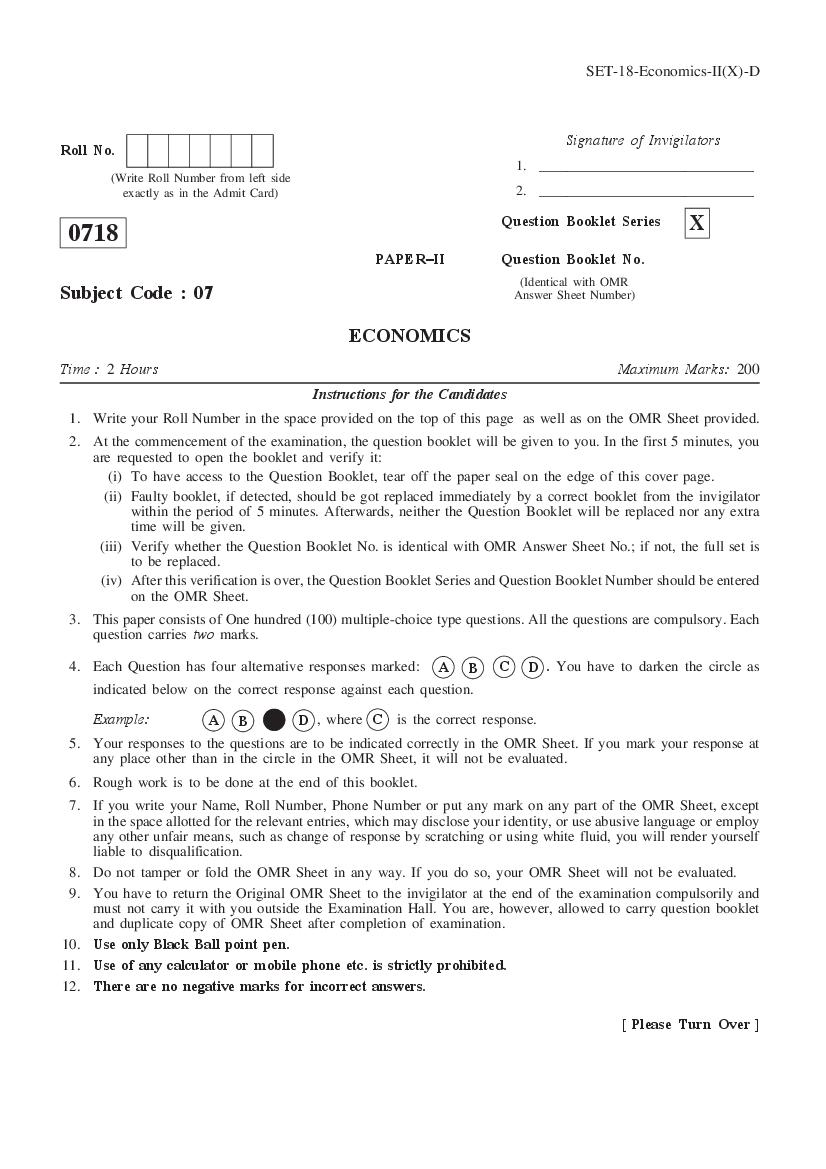
Signature of Invigilators
Roll No.
1. _______________________________
(Write Roll Number from left side
exactly as in the Admit Card) 2. _______________________________
Question Booklet Series X
0718
PAPER–II Question Booklet No.
(Identical with OMR
Subject Code : 07 Answer Sheet Number)
ECONOMICS
Time : 2 Hours Maximum Marks: 200
Instructions for the Candidates
1. Write your Roll Number in the space provided on the top of this page as well as on the OMR Sheet provided.
2. At the commencement of the examination, the question booklet will be given to you. In the first 5 minutes, you
are requested to open the booklet and verify it:
(i) To have access to the Question Booklet, tear off the paper seal on the edge of this cover page.
(ii) Faulty booklet, if detected, should be got replaced immediately by a correct booklet from the invigilator
within the period of 5 minutes. Afterwards, neither the Question Booklet will be replaced nor any extra
time will be given.
(iii) Verify whether the Question Booklet No. is identical with OMR Answer Sheet No.; if not, the full set is
to be replaced.
(iv) After this verification is over, the Question Booklet Series and Question Booklet Number should be entered
on the OMR Sheet.
3. This paper consists of One hundred (100) multiple-choice type questions. All the questions are compulsory. Each
question carries two marks.
4. Each Question has four alternative responses marked: A B C D . You have to darken the circle as
indicated below on the correct response against each question.
Example: A B C D , where C is the correct response.
5. Your responses to the questions are to be indicated correctly in the OMR Sheet. If you mark your response at
any place other than in the circle in the OMR Sheet, it will not be evaluated.
6. Rough work is to be done at the end of this booklet.
7. If you write your Name, Roll Number, Phone Number or put any mark on any part of the OMR Sheet, except
in the space allotted for the relevant entries, which may disclose your identity, or use abusive language or employ
any other unfair means, such as change of response by scratching or using white fluid, you will render yourself
liable to disqualification.
8. Do not tamper or fold the OMR Sheet in any way. If you do so, your OMR Sheet will not be evaluated.
9. You have to return the Original OMR Sheet to the invigilator at the end of the examination compulsorily and
must not carry it with you outside the Examination Hall. You are, however, allowed to carry question booklet
and duplicate copy of OMR Sheet after completion of examination.
10. Use only Black Ball point pen.
11. Use of any calculator or mobile phone etc. is strictly prohibited.
12. There are no negative marks for incorrect answers.
[ Please Turn Over ]
Page 3
ECONOMICS
PAPER II
1. Consider two utility functions U = q11·5 q2 and 5. Marginal Cost (MC) is given by
V = q16 q24 + 1·5 ln q1 + ln q2. Choose the correct answer. (A) the slope of the TFC curve.
(A) V is a log linear transformation of U (B) the slope of the TVC curve but not by the
(B) V is an increasing monotonic transformation slope of the TC curve.
of U (C) the slope of the TC curve but not by the slope
(C) V is a decreasing monotonic transformation of the TVC curve.
of U (D) either the slope of TC or the slope of the
(D) V is a Cobb-Douglus transformation of U TVC.
6. At equilibrium under monopoly
2. In a two good economy x and y, if x be Giffen (A) total expenditure and price are inversely
good, then which of the following must be satisfied related.
in case of good y. (B) total expenditure and price are directly
y related.
(A) p 0 (C) total expenditure and price are independent.
y
(D) price elasticity of demand is positive.
y
(B) p 0
y
7. Consider U = f(w). Choose the correct statement.
y (Here w stands for wealth)
(C) 0
M
(A) If f "( w) 0, the utility function is concave
y p y
(D) p . y 0 and the consumer is risk loving.
y
(B) If f "( w) 0, the utility function is concave
and the consumer is risk averter.
(C) If f "( w) 0, the utility function is strictly
3. In the Bertrand two good model with homogenous
concave and the consumer is risk averter.
output
(D) If f "( w) 0, the utility function is straight
(A) p1 p2 c at equilibrium
line and the consumer is risk loving.
(B) p1 p2 c at equilibrium
(C) p1 p2 c at equilibrium 8. In case of price consumption curve parallel to the
(D) p1 p2 at equilibrium horizontal axis
(A) the price elasticity of demand of the
concerned good is one.
(B) the price elasticity of demand of the
4. External economies are witnessed in
concerned good is greater than one.
(A) a rising supply curve (C) the concerned good has income elasticity
(B) a rising demand curve equal to one.
(C) a falling supply curve (D) the demand for the concerned good changes
(D) a falling demand curve directly proportional to price.
Page 4
9. When MRS xy is increasing, the consumer 12. Consider the following Assertion (A) and
Reason (R)
MU x p
(A) satisfies x at equilibrium. Assertion (A) : If the monopolist faces identical
MU y py
demand curve for his commodity
(B) does not reach any equilibrium. in two separate markets, by
(C) consumes only one commodity at practising third degree price
discrimination he cannot increase
equilibrium.
his total revenue and profits.
(D) consumes only commodity x at equilibrium.
Reason (R) : As the marginal revenue curves
are identical in two markets when
the demand curves are same, the
monopolist will not charge
different prices in each market to
maximise profits.
Codes:
10. When an enterprise owner is the sole purchaser (A) Both (A) and (R) are true and (R) is the
in input market and seller in a perfectly competitive correct explanation of (A).
market, we have the case of (B) Both (A) and (R) are true and (R) is not the
(A) Monopolistic exploitation correct explanation of (A).
(B) Monopolistic as well as monopsonistic (C) (A) is true but (R) is false.
exploitation (D) (A) is false but (R) is true.
(C) Oligopolistic exploitation
(D) Monopsonistic exploitation
13. In Friedman’s Permanent Income Hypothesis,
transitory income can be positive or negative, which
occurs on account of
(A) long-term changes in income.
(B) temporary and unanticipated changes in
current income.
11. Given the consumer’s utility function U X12 X 23
(C) income remaining unchanged.
and the budget constraint M p1x1 p2 x2 , the demand
(D) long-term changes in relative prices.
function for x2 will be
3M
(A) 5 p
2
M 14. In an open economy, international capital mobility
(B) 2 p and a fixed exchange rate will imply
2
(A) coordinated fiscal policies with rest of the
M world.
(C) p p
1 2 (B) inflation targetting.
M (C) no monetary policy autonomy.
(D) 2 p
1 (D) exchange rate devaluation.
Page 5
15. In IS-LM model, effectiveness of expansionary 19. The New Keynesian models explain involuntary
fiscal policy is maximum when the LM curve is unemployment through real rigidities arising out of
(A) downward sloping and steep (A) money and credit market
(B) vertical (B) capital market
(C) upward rising and backward bending (C) foreign exchange market
(D) horizontal (D) wage- and price-setting process
16. The Keynesian view of an increase in government
spending results in an increase in interest rate and
income. However, the money stock remains unchanged, 20. In the labour demand-supply framework, at the
with velocity of money employment level below the equililbrium employment,
(A) increasing there is incentive for the firm/employer to put more
workers to work as
(B) decreasing
(A) marginal product of labour exceeds the real
(C) remaining unchanged
wage.
(D) increasing in the first phase and decreasing
(B) marginal product of labour is lower than the
thereafter
real wage.
(C) marginal product of labour is equal to real
17. In Real Business Cycle Models, real, not wage.
monetary, factors are responsible for fluctuations in (D) marginal product of labour is not related to
output and employment. If at all monetary policy is real wage.
considered, it focuses on
(A) lowering employment when the economy is
above full employment.
(B) increasing employment when the economy x2 x 2 x 2
is at less than full employment. 21. The production function y 13 23 33 is
x1 x2 x3
(C) controlling inflation and maintaining
homogeneous of degree
stability.
(D) increasing domestic credit to increase output. (A) 1
(B) 2
(C) –1
18. The distinctive feature of the New Classical
(D) 0
Model is that the aggregate supply and labour supply
schedules depend on
(A) backward-looking nature of expectations of
monetary and fiscal policy variables along
with oil prices and other supply side factors. 22. In case of inflation tax, government’s real
(B) contemporaneous monetary and fiscal policy seignorage revenue is the product of inflation tax and the
variables along with oil prices and other tax base. While the tax rate is the rate of inflation, the tax
supply side factors. base is the
(C) rational expectations of monetary and fiscal (A) real output
policy variables along with oil prices and (B) nominal output
other supply side factors. (C) real money supply
(D) rigidities in the output and money market. (D) capital stock
Page 6
23. Match List I with List II and select the correct 26. In the Heckscher-Ohlin framework, at the free-
answer using the codes given below the lists: trade world equilibrium price
List I List II (A) quantity of the good that the Home exports
is less than the quantity of that good the
(a) Theory of Opportunity cost 1. Chenery
Foreign imports.
(b) Empirical validity of 2. Hicks-Kaldor- (B) quantity of the good that the Home exports
Heckscher-Ohlin theorem Scitovsky and the quantity of the same good that the
(c) Welfare Criterion 3. Leontief Foreign imports move in opposite direction.
(d) Two Gap model of Foreign Aid 4. Haberler (C) quantity of the good that the Home exports
5. Adam Smith is greater than the quantity of that good the
Foreign imports.
Codes:
(D) quantity of the good that the Home exports
(a) (b) (c) (d) is same as the quantity of that good the
(A) 1 5 3 4 Foreign imports.
(B) 4 3 2 1
27. Stolper-Samuelson Theorem states that, under
(C) 3 1 2 5 free-trade, the real income
(D) 5 4 1 3 (A) rises for the factor used relatively intensively
in the exporting industry as well as the
import-competing industry.
(B) rises for the factor used relatively intensively
24. In the presence of repercussion effect, a shift in in exporting industry and falls for the factor
the pattern of expenditure towards more of imports will used relatively intensively in the import
result in competing industry.
(A) higher import and higher domestic output. (C) falls for the factor used relatively intensively
(B) lower import and higher domestic output. in both exporting as well as import competing
industries.
(C) improved balance of trade and lower
(D) falls for the factor used relatively intensively
domestic output.
in exporting industry and rises for the factor
(D) deteriorating balance of trade and lower used relatively intensively in the import
domestic output. competing industry.
28. In the presence of increasing returns, if both
countries participating in international trade specialize
25. The Foreign Trade Policy 2015-20 focusses on in the same commodity, then the
two special schemes to promote exports. These include (A) volume of trade will be higher for both the
countries and overall welfare for each country
(A) Merchandise Exports from India Scheme
will be higher.
(MEIS) and Scheme for Ease of Doing
(B) volume of trade will be same for both the
Business.
participating countries and overall welfare
(B) Merchandise Exports from India Scheme for each of them will remain unchanged.
(MEIS) and Service Exports from India (C) there will be no trade among the participating
Scheme (SEIS). countries and overall welfare for each country
(C) Service Exports from India Scheme (SEIS) will remain unchanged.
and Scheme for Ease of Doing Business. (D) there will be no trade among the two
(D) Ease of Doing Business and Niryat Bandhu participating countries and overall welfare
Scheme. for each country will fall.
Page 7
29. As a measure of protection, voluntary export 33. In moving average method we cannot find trend
restraint (VER) is equivalent to import quota, except values of
that (A) Starting periods only
(A) the quota rent is non-existent in this case. (B) End periods only
(B) the quota rent is effectively ceded to the (C) Both Starting and End periods
foreign exporter. (D) Middle periods
(C) the quota rent is partly taken by the importing
country and partly by the exporting country. 34. If a card is chosen from a standard pack of cards,
(D) the quota rent is higher in this case. what is the probability of getting a five or a seven?
(A) 4/52
(B) 1/26
30. In statistical hypothesis testing, a ‘Type I’ error (C) 8/52
occurs when there happens (D) 1/169
(A) correct rejection of a true null hypothesis.
35. When both population mean and variance are not
(B) incorrect rejection of a true null hypothesis.
known, for the comparison of two sample means, which
(C) failure to reject a false null hypothesis. of the following test is applied?
(D) rejecting a false null hypothesis. (A) Chi2 test
(B) Student t test
(C) F test
31. Fisher’s ideal price index is equal to (D) Z test
pn qn pn qo 36. If one regression coefficient is greater than one,
(A)
po qn po qo the other must be
(A) greater than one
pn qn p q (B) equal to zero
(B) n o
po qn po qo (C) less than one
(D) inverse of it
pn qo pn qo
(C)
po qn po qo 37. Match the following from List I to List II:
List-I List-II
pn qn pn qo (i) Granger Test 1. Heteroscedasticity
(D)
po qn po qn (ii) Chow Test 2. Causality
(iii) Breusch Pagan Test 3. Stability
(iv) Phillips-Perron Test 4. Stationarity
32. If standard deviation of a variable x is 10, the Codes
value of standard deviation of 50 + 5x would be (i) (ii) (iii) (iv)
(A) 10 (A) 1 2 3 4
(B) 50 (B) 2 3 1 4
(C) 100 (C) 3 2 4 1
(D) 500 (D) 4 1 2 3
Page 8
38. For the linear regression model, Y X U . 42. Omission of relevant variables or ‘underfitting’ a
Which of the following statements is incorrect, where R2 model has several consequences. Select the correct
is the coefficient of determination? statements using codes given below:
(A) 0 R 2 1 1. If omitted variables are correlated with the
variables, the coefficients of the estimated model
(B) 0 R 1 are biased.
(C) R 2 (Yi Y ) 2 ˆ 2 ( X i X ) 2 2. The disturbance variance 2 is incorrectly
estimated.
2
(Yi Yˆ ) 2 3. Even when excluded variables are not correlated
(D) R 1 with the variables included in the model, the
(Yi Y )2
intercept of the estimated model is unbiased.
4. Forecasts will be reliable.
Codes:
39. Let the coefficient of determination computed be
0·39 in a problem involving one independent variable (A) 1 and 2
and one dependent variable. This result means that (B) 1 and 3
(A) the relationship between two variables is (C) 1 and 4
negative. (D) 3 and 4
(B) the correlation coefficient is 0·39.
(C) 39% of total variation in dependent variable 1 1
is explained by the independent variable. 43. Characteristic roots of A 1 1 are
(D) 39% of the total variation is explained by the
(A) 1, 0
dependent variable.
(B) 1, 1
(C) 2, 0
40. Which of the following is not used for the solution (D) –1, 1
of multi-collinearity?
(A) Ridge regression analysis 44. Given the following problem
(B) Dropping variable technique Max Z c1 x1 c2 x2
(C) Principal component analysis
(D) Indirect least square method a a x b
S.t. 11 12 1 1
a21 a22 x2 b2
41. Choose the correct statement: x1 0
In a simultaneous equation system 1. It constitutes an LPP.
(A) if an equation is exactly identified then ILS 2. It does not constitute an LPP.
and 2SLS would give same result.
3. Non-negativity restriction is incomplete.
(B) if an equation is over identified then ILS and
4. It has its dual problem.
2SLS technique would give same result.
(A) Only 4 is true
(C) if an equation is under identified then OLS
technique can be appliled. (B) Both 2 and 3 are true
(D) if an equation is exactly identified then only (C) Only 3 is true
ILS technique can be applied. (D) Both 1 and 4 are true
Page 9
45. In the following game 50. The following was constituted to examine the
P-II centre state relation:
B1 B2 B3 B4 (A) Chelliah Committee
(B) Sarkaria Commission
A1 2 4 1 6
P-I (C) Narsimham Committee
A2 3 1 5 10
(D) Wanchoo Committee
(A) Only the third column is dominated.
(B) Only the fourth column is dominated. 51. The concentration effect explained in Peacock-
(C) Both third and fourth columns are dominated. Wiseman hypothesis implies
(D) Neither column is dominated. (A) Public expenditure does not increase in
smooth and continuous manner.
1 (B) Public expenditure increases the necessity
46. Given S '( y ) 0·3 0·1y 2
of increased revenue.
S ( y ) is equal to (C) Central Government’s economic activity to
1 grow faster than that of subnational
(A) ·3 y 0·1 y 2 c Governments.
1
(D) Absolute level of public expenditure
(B) 3 y 0·2 y 2 c
increases.
1
(C) ·3 y 0·2 y 2 c
1 52. Which of the following is not a source of state
(D) ·3 y 0·2 y 2 c revenue?
(A) Taxes on agriculture
47. If the Marginal Propensity to consume is 0·8,
(B) Taxes on road vehicles
then the value of Investment Multiplier will be
(A) 05 (C) Taxes on advertisement and sale of goods
(B) 10 (D) Taxes on income
(C) 1·25
(D) 01 53. Which one of the following statement is correct?
(A) The marginal cost of providing a private
48. VAT is imposed
good to an additional individual is always
(A) directly on consumers. positive, while that of public good is zero.
(B) on final stage of production.
(B) The marginal cost of providing a public
(C) on first stage of production. good to an additional individual is always
(D) on all stages between production and final negative, while that of private good is
stages. positive.
(C) The marginal cost of providing a public
49. Income tax in India is a good to an additional individual is always
(A) progressive tax. zero, while that of private good is negative.
(B) proportional tax. (D) The marginal costs of providing both, a
(C) value added tax. public good and a private good to an
(D) part of goods and services tax. additional individual are always zero.
Page 10
54. Which one of the following is not a property of a 59. Identify the incorrect assumption of the Solow
public good? Model (Long-run growth model):
(A) Non excludability (A) One composite commodity is produced.
(B) Non rivalry in consumption (B) Output is measured is net terms.
(C) Demand curve is derivable (C) Variable returns to scale.
(D) Marginal cost of supplying the commodity (D) The two factors-labour and capital are paid
is zero according to their marginal physical
productivities.
55. As economic development proceeds, income
inequality tends to follow ________ curve.
(A) convex
60. State the correct code based on the following
(B) inverted U-shaped
statement:
(C) L-shaped
Concept of disembodied technical change is
(D) S-shaped
associated with
(i) A.C. Pigou
s
56. In the Harrod-Domar equation g , is (ii) Abramovitz
(iii) J.W. Kendrick
defined as
(iv) R.M. Solow
(A) the value of the country’s capital stock.
(B) the ratio of the country’s capital stock to its Codes
output. (A) (i) and (ii)
(C) the change in the country’s capital stock. (B) (i), (ii) and (iii)
(D) the change in capital labour ratio in the (C) (i), (ii) and (iv)
country.
(D) (ii), (iii) and (iv)
57. Fei-Ranis’s theory of development is not
based on
(A) dualistic approach of development. 61. Capital deepening is a process in which
(B) presence of disguised unemployment. (A) output remains constant
(C) importance attached to agricultural (B) capital intensity remains constant
development. (C) technology changes with an increase in
(D) no plough back of industrial surplus for output per worker
capital formation.
(D) capital output ratio falls
58. In Kaldor’s growth model it is assumed that
(A) capital output ratio is constant.
62. The proponent of the Doctrine of Unbalanced
(B) share of factor is determined by the respective
Growth is
marginal productivities.
(C) saving ratio is assumed to be variable (A) R. Nurkse
depending on per capita capital. (B) H. Leibenstein
(D) natural rate of growth is variable. (C) Albert O. Hirschman
Which of the above assumptions is incorrect? (D) J. Robinson
Page 11
63. Based on Mankiw, Romer and Weil (1992), with 67. The field of sustainable development can be
conditional convergence, holding fertility rates, conceptualised as
education and government spending as a share of GDP (A) environmental sustainability only.
constant
(B) economic sustainability only.
(A) income per capita is the same regardless of
(C) sociopolitical sustainability only.
poor or rich countries.
(D) environmental, economic and sociopolitical
(B) income per capita in rich countries grows
sustainability.
faster than in poor countries.
(C) income per capita in poor countries grows
faster than in rich countries.
(D) income per capita in poor countries grows 68. Environmental Audit is the procedure to
conditional upon foreign aid. (A) analyse the use of natural resources by all.
(B) analyse the use of natural resources by
industry.
64. Kendrick measure is used to calculate
(C) assess the impact of industrial operations.
(1) Partial productivity
(2) Single factor productivity (D) analyse the use of natural resources by
industry and also assess the impact of
(3) Total factor productivity
industrial operations on environment.
(4) Multifactor productivity
State which one is correct?
(A) Only 3 is true
(B) Both 3 and 4 are true 69. In Ricardian theory the relation between Rent
and Price can be expressed as
(C) Only 1 is true
(A) higher rent is associated with higher price.
(D) Only 2 is true
(B) price is determined by economic rent.
(C) higher the rent, lower is the market price.
65. Industrial location theory has been developed by (D) rent does not enter into price determination.
(A) Weber
(B) Marshall
(C) Williamson
70. Based on Kuznets identification of four possible
(D) Bain types of contribution of agriculture to economic growth,
which one of the following is not considered within
the four?
66. The industrial sector in India consists of the (A) Product contribution, i.e., making available
following subsectors: food and raw materials.
(A) Manufacturing, Mining and Communication (B) Market contribution, i.e. providing the
(B) Manufacturing, Electricity and Transport market for producer goods and consumer
(C) Manufacturing, Communication and goods produced in the non-agricultural
Transport sector.
(D) Manufacturing, Electricity, Gas and Water (C) Foreign exchange contribution.
supply (D) Rural banking contribution.
Page 12
71. Neo-Classical production function has which of 75. Growth rate of per capita income is equal to
the following characteristics? (A) growth rate of population minus growth rate
(1) Constant returns to scale of income.
(2) It is convex to the origin (B) growth rate of income minus growth rate of
(3) Positive and diminishing marginal population.
productivity of factors (C) growth rate of income minus growth rate of
(4) It satisfies Inada condition capital.
Choose the correct answer from the codes given (D) growth rate of income minus growth rate of
below: labour force.
(A) 1 and 2 76. In the WTO, tariff escalation by developed
(B) 2 and 4 countries refers to
(C) 3 and 4 (A) increase in average and peak tariff rates.
(D) 3 only (B) increase in the number of tariff rate slabs
across products.
72. The New Agricultural Policy of the Indian (C) increase in the tariff rate with the level of
Government of the 1960s (Green Revolution) did not processing of the product.
lead to
(D) increase in the tariff rate for raw materials as
(A) Increase in food production in the country against the final products.
(B) Inequality in farmers’ income
(C) Commercialisation of agriculture 77. Which of the following is not matching correctly?
(D) More equality in foodgrain production (A) W.A. Lewis — Dual Economy Model
among different regions of the country (B) S. Kuzuets — Modern Economic
Growth
73. Which of the following does not come under land (C) J.M. Keynes — Wealth of Nations
reform? (D) Jagdish Bhagwati — In Defence of
(A) Consolidation of land holding Globalization
(B) Providing security to tenure
78. Which of the following statements about ‘farm
(C) Drip irrigation subsidies’ are correct?
(D) Abolition of intermediaries 1. The input subsidies in India such as on fertilisers
fall under indirect farm subsidies.
74. Which of the following are functions of
NABARD? 2. Reduction in power and irrigation bills offered to
farmers fall under direct farm subsidies.
(i) Monitoring flow of ground level credit to
3. The agricultural provisions of the WTO though
agriculture.
allow direct farm subsidies, prohibits indirect
(ii) Credit planning and monitoring.
subsidies.
(iii) Formulation of operational guidelines for 4. All subsidies forwarded by the government of
rural financial institutions. India fall under the indirect category.
(iv) Fixing repo rate
Select the correct statements using the code given
Codes: below:
(A) (i), (ii) and (iii) (A) 1 and 2
(B) (i) and (iv) (B) 2 and 3
(C) (ii), (iii) and (iv) (C) 3 and 4
(D) (i), (ii) and (iv) (D) 1 and 4
Page 13
79. Which of the following is not matched correctly? 84. Consider the following statements:
(A) Ryotwari system : Karnataka 1. RBI takes recourse to Open Market Operations
(B) Zamindari system : Bengal, Bihar, Uttar (OMOs) to manage liquidity in the system.
Pradesh 2. MCLR has been introduced to improve
(C) Mahalwati system : Awadh transmission of policy rates into the lending rates
(D) Operation Barga : West Bengal of banks.
3. MSF functions as the last resort for banks to
borrow short-term funds.
80. In the currency market, to ensure that the same
4. Non-monetary liabilities of the RBI form India’s
amount of foreign currency is transacted at a future
‘Reserve Money’.
specified date the buyer and seller of foreign currency
can enter into the following alternate contracts: Which of the above statements are correct?
(A) Spot exchange and futures contract (A) Only 1 and 3
(B) Forward and futures contracts (B) Only 1, 2 and 3
(C) Forward contract and spot exchange (C) Only 1 and 2
(D) Foreign exchange option (D) All four are correct
81. Which factor among the following creates obstacle
in measuring correct estimate of national income?
(A) Existence of non-monetised sector
(B) Low rate of savings 85. Based on Narasimhan Committee-I in 1991, the
(C) Under employment RBI has been given autonomy in
(D) Inflation (A) Open Market Operations (OMO).
(B) Issuing fresh currency notes.
82. Which of the following statements is correct (C) Regulating All India Financial Institutions.
about the term ‘bank run’? (D) Working autonomy in announcing the Credit
(A) Bond holders and depositors both suffer due and Monetary Policy.
to increased inflation.
(B) A panic situation when deposit holders start
withdrawing cash from the banks.
(C) The ratio maintained by commercial banks
of bank’s total deposits and its total liabilities.
(D) The period in which a bank creates the 86. Among the following what causes market failure:
highest credit in the market. 1. Externality
2. Asymmetry of information
83. The Regional Rural Banks (RRBs) in India are 3. Perfect competition
being restructured by the GoI under the recommendations Choose the correct answer from the codes given
of the below:
(A) Kelkar Expert Committee (A) 1, 2 and 3 are correct
(B) Vyas Committee (B) 1 and 2 are correct
(C) Nair Committee (C) Only 1 is correct
(D) Chaturvedi Committee (D) 2 and 3 are correct
Page 14
87. The Village and Small Industries Committee 92. Reference Period for the Neonatal Mortality Rate
(Karve Committee) reported in the year in India is
(A) 1965 (A) three months after birth
(B) one month after birth
(B) 1975
(C) 28 days after birth
(C) 1955 (D) 15 days after birth
(D) 1985
93. With which country India is exploring shale gas
88. The NITI Aayog replacing the Planninig reserves?
Commission will follow a (A) France
(A) top down approach (B) Germany
(B) a bottom up approach (C) United Kingdom
(C) a state level approach (D) USA
(D) a mixture of all the above
94. Consider the following statements about the idea
89. Pradhanmantri Bharat Jodo Pariyojona is of ‘inclusive growth’:
related to 1. The idea of ‘inclusive growth’ entered into the
domain of planning with the XIth Plan.
(A) Tele-Communication
2. The idea of ‘decentralised’ development planning
(B) Social Integration is parallel to the idea of inclusive growth.
(C) Linking of Rivers 3. It is about ‘social’ inclusion too.
(D) Development of Highways 4. 3rd generation economic reforms were found to
be inclusive in nature.
90. The current method of calculating HDI is Select the correct statements using the code given
below:
(A) Life expectancy index + Education index + Income index
3 1 (A) 1 and 2
(B) (Life expectancy index × Education index × Income index) 3 (B) 1 and 3
1
(C) (Life expectancy index2 + Education index2 + Income index2) 2 (C) 1 and 4
1 (D) 1, 2 and 3
(D) (Life expectancy index2 × Education index2 × Income index2) 3
91. Match List I with List II and select the correct 95. Gender development index does not address
answers using the codes given below the lists: (A) education
List I (Event) List II (Year) (B) life expectancy
(C) incomes
(a) Year of Great Divide 1. 1950
(D) nutrition level
(b) Industrial Policy Resolution 2. 1921
(c) Setting up of Planning 3. 1969 96. Effective literacy rate in India in census 2011 has
Commission been calculated as
(d) Nationalisation of 14 4. 1956 Number of literate persons
Commercial Banks (A)
Total population
(a) (b) (c) (d) Number of literate persons aged 6 and above 100
(B)
Total population
(A) 1 2 4 3
Number of literate persons aged 7 and above 100
(B) 2 4 1 3 (C)
Population aged 7 and above
(C) 4 2 3 1 Number of literate persons aged 7 and above 100
(D) 4 3 2 1 (D)
Total population
Page 15
97. The Work Participation Rate (WPR) for male and 99. Which statement of the following is true for
female in Census 2011 data has been estimated at IMF?
(A) 46·6% and 25·5% respectively. (A) It is not an agency of UNO.
(B) 49·2% and 25·5% respectively. (B) It can grant loan to any country of the world.
(C) 53·3% and 25·5% respectively. (C) It can grant loan to state government of a
(D) 58·3% and 25·5% respectively. country.
(D) It grants loan to member nations only.
98. In Census 2011 data, the proportion of Scheduled
Tribe and Scheduled Caste population in country’s total 100. Arabari experiment in joint forest management
population stand at was launched in the year
(A) 7·5% and 15·2% respectively. (A) 1975
(B) 8·1% and 17·8% respectively. (B) 1972
(C) 8·6% and 16·6% respectively. (C) 1980
(D) 9·3% and 18·3% respectively. (D) 1988
Page 16
ROUGH WORK
Document Details
| Board / Org | Default |
| Exam | Govt Jobs Exams |
| Type | Question Paper |
| Pages | 16 |
| Updated | 30 Apr 2026 |