Karnataka 2nd PUC Chemistry Haloalkanes and Haloarenes MCQ with Answers
Finished viewing? Save it for later —
Download Karnataka 2nd PUC Chemistry Haloalkanes and Haloarenes MCQ with Answers (PDF · 12 pages)About Karnataka 2nd PUC Chemistry Haloalkanes and Haloarenes MCQ with Answers
Karnataka 2nd PUC Chemistry Haloalkanes and Haloarenes MCQ with Answers is available here for free download. Published by Karnataka Board for Class 12, this question bank can be viewed online or downloaded as a PDF (12 pages). Candidates preparing for Class 12 can use Karnataka 2nd PUC Chemistry Haloalkanes and Haloarenes MCQ with Answers to understand the exam pattern, the type of questions asked, and the overall difficulty level.
Frequently Asked Questions
How can I download Karnataka 2nd PUC Chemistry Haloalkanes and Haloarenes MCQ with Answers?
Open this page and click the Download button to save Karnataka 2nd PUC Chemistry Haloalkanes and Haloarenes MCQ with Answers as a PDF. It is completely free on AglaSem Docs.
Is Karnataka 2nd PUC Chemistry Haloalkanes and Haloarenes MCQ with Answers free to download?
Yes. Karnataka 2nd PUC Chemistry Haloalkanes and Haloarenes MCQ with Answers can be viewed online and downloaded as a PDF free of cost on AglaSem Docs.
How many pages does Karnataka 2nd PUC Chemistry Haloalkanes and Haloarenes MCQ with Answers have?
Karnataka 2nd PUC Chemistry Haloalkanes and Haloarenes MCQ with Answers contains 12 pages, which you can read online or download together as a single PDF.
Where can I find more Class 12 study material?
You can find more Class 12 question papers, sample papers, syllabus, and answer keys on AglaSem Docs.
Karnataka 2nd PUC Chemistry Haloalkanes and Haloarenes MCQ with Answers – Text
Read the full text of this question bank below — useful to quickly search, copy and reference the content online without downloading the PDF.
📄 View text version (12 pages)
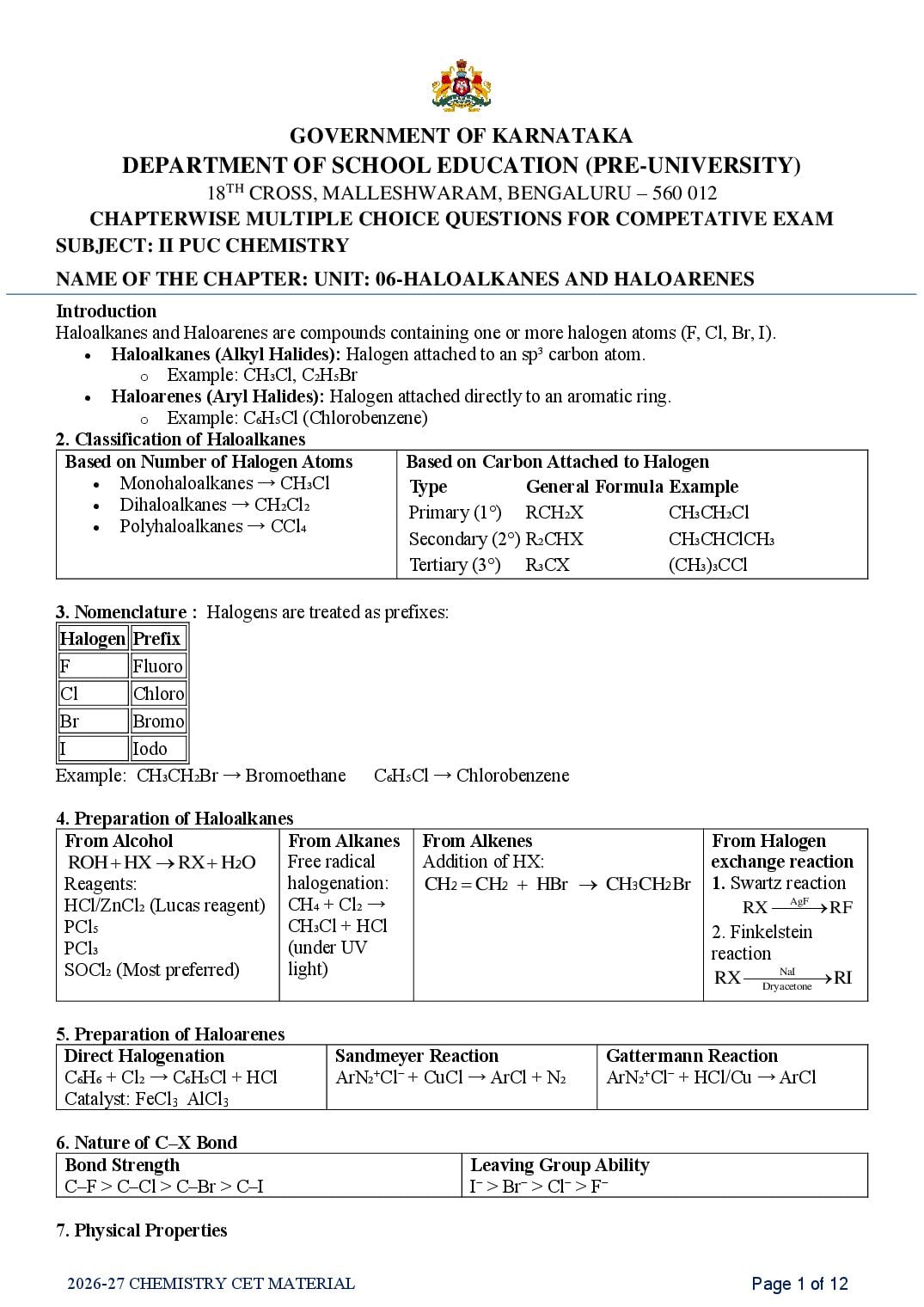
Page 1
DEPARTMENT OF SCHOOL EDUCATION (PRE-UNIVERSITY)
18TH CROSS, MALLESHWARAM, BENGALURU – 560 012
CHAPTERWISE MULTIPLE CHOICE QUESTIONS FOR COMPETATIVE EXAM
SUBJECT: II PUC CHEMISTRY
NAME OF THE CHAPTER: UNIT: 06-HALOALKANES AND HALOARENES
Introduction
Haloalkanes and Haloarenes are compounds containing one or more halogen atoms (F, Cl, Br, I).
• Haloalkanes (Alkyl Halides): Halogen attached to an sp³ carbon atom.
o Example: CH₃Cl, C₂H₅Br
• Haloarenes (Aryl Halides): Halogen attached directly to an aromatic ring.
o Example: C₆H₅Cl (Chlorobenzene)
2. Classification of Haloalkanes
Based on Number of Halogen Atoms Based on Carbon Attached to Halogen
• Monohaloalkanes → CH₃Cl Type General Formula Example
• Dihaloalkanes → CH₂Cl₂
Primary (1°) RCH₂X CH₃CH₂Cl
• Polyhaloalkanes → CCl₄
Secondary (2°) R₂CHX CH₃CHClCH₃
Tertiary (3°) R₃CX (CH₃)₃CCl
3. Nomenclature : Halogens are treated as prefixes:
Halogen Prefix
F Fluoro
Cl Chloro
Br Bromo
I Iodo
Example: CH₃CH₂Br → Bromoethane C₆H₅Cl → Chlorobenzene
4. Preparation of Haloalkanes
From Alcohol From Alkanes From Alkenes From Halogen
ROH + HX → RX + H₂O Free radical Addition of HX: exchange reaction
Reagents: halogenation: CH₂ = CH₂ + HBr → CH₃CH₂Br 1. Swartz reaction
HCl/ZnCl₂ (Lucas reagent) CH₄ + Cl₂ → RX ⎯⎯ AgF
⎯
→ RF
PCl₅ CH₃Cl + HCl 2. Finkelstein
PCl₃ (under UV reaction
SOCl₂ (Most preferred) light) RX ⎯⎯⎯⎯ NaI
→ RI
Dryacetone
5. Preparation of Haloarenes
Direct Halogenation Sandmeyer Reaction Gattermann Reaction
C₆H₆ + Cl₂ → C₆H₅Cl + HCl ArN₂⁺Cl⁻ + CuCl → ArCl + N₂ ArN₂⁺Cl⁻ + HCl/Cu → ArCl
Catalyst: FeCl3 AlCl3
6. Nature of C–X Bond
Bond Strength Leaving Group Ability
C–F > C–Cl > C–Br > C–I I⁻ > Br⁻ > Cl⁻ > F⁻
7. Physical Properties
2026-27 CHEMISTRY CET MATERIAL Page 1 of 12
Page 2
1. RI > RBr > RCl > RF (Boiling Point increases • Insoluble in water
with size of halogen for same alkyl group). • Soluble in organic solvents
2. For same halogen atom boiling point increases Reason: Cannot form hydrogen bonds with water.
with increase in carbon atom in parent chain.
3. For same halogen and same number of carbon
boiling point decreases with branching,
8. Chemical Reactions of Haloalkanes
A. Nucleophilic Substitution Reactions
SN1 Mechanism SN2 Mechanism
Characteristics: Characteristics:
• Two-step reaction • One-step reaction
• Carbocation intermediate • Backside attack
• First-order kinetics • Inversion of configuration
Order: 3° > 2° > 1° Order: CH₃X > 1° > 2° > 3°
Example: (CH₃)₃CCl + OH⁻ → (CH₃)₃COH Example: CH₃Br + OH⁻ → CH₃OH
B. Elimination Reaction
Using alcoholic KOH: CH₃CH₂Br → CH₂=CH₂
Rule: Saytzeff Rule
Major product = More substituted alkene.
9. Important Named Reactions
Wurtz Reaction
2R – X + 2Na ⎯⎯⎯ ⎯
Dryether
→ R – R + 2NaX
Wurtz-Fittig Reaction
ArX + RX + 2Na ⎯⎯⎯ ⎯
Dryether
→ Ar – R
Fittig Reaction
2ArX + 2Na ⎯⎯⎯→ Dryether
Ar – Ar
10. Haloarenes
Haloarenes Are Less reactive towards nucleophilic reaction?
Because: CH₂ = CH₂ + HBr → CH₃CH₂Br
1. Resonance gives partial double bond character.
2. C–X bond is shorter and stronger.
3. Difficult bond cleavage.
11. Electrophilic Substitution in Haloarenes
Halogens are:
• Deactivating
• Ortho-para directing
Examples:
• Nitration
• Sulphonation
• Halogenation
12. Polyhalogen Compounds
Chloroform (CHCl3) : Uses: Solvent , Preparation of Freon-22
Carbon Tetrachloride (CCl4) Uses: Dry cleaning , Fire extinguishers
Freons: Example: CF₂Cl₂ Use: Refrigerants. Problem: Cause ozone depletion.
DDT Dichlorodiphenyltrichloroethane: Use: Insecticide,
Disadvantage:
• Non-biodegradable
• Biomagnification
2026-27 CHEMISTRY CET MATERIAL Page 2 of 12
Page 3
Leaving Group Ability
I⁻ > Br⁻ > Cl⁻ > F⁻
C–X Bond Strength
C–F > C–Cl > C–Br > C–I
SN1 Reactivity
3° > 2° > 1° > CH₃
SN2 Reactivity
CH₃ > 1° > 2° > 3°
Boiling Point
RI > RBr > RCl > RF
SOME Important NEET/JEE Topics
SN1 and SN2 mechanisms
Wurtz, Finkelstein and Swarts reactions
Sandmeyer and Gattermann reactions
Reactivity of Haloarenes
Chlorobenzene resonance
DDT and Freons
Saytzeff Rule
Leaving group order
Polyhalogen compounds
Electrophilic substitution in haloarenes
6.1 Classification:
1. The hybridisation of carbon atom in haloalkanes that contain halogen atom(s) attached to the
(a) sp (b) sp2
(c) sp3 (d) sp4
2. A dibromo derivative of an alkene reacts with sodium metal to form an alicyclic hydrocarbon. The
derivative is
(a) 1,1-dibromopropane. (b) 2,2-dibromopropane.
(c) 1,2-dibromoethane. (d) 1,4-dibromobutane
3. The organic compound C6H5C(CH3)2Cl can be classified as _____________ (2025)
(a) Allylic halide (b) Benzyl halide
(c) Aryl halide (d) Alkyl halide.
4. Which of the following is a primary alkyl halide?
(a) (CH₃)₃CBr (b) CH₃CH₂CH₂Br
(c CH₃CHBrCH₃ (d) (CH₃)₂CHBr.
5. Ethyl chloride belongs to which class?
(a) Benzylic halide (b) Primary alkyl halide
(c) Allylic halide (d) Vinyl halide
6. In haloarenes, the halogen atom is directly attached to:
(a) Alkyl carbon (b) Allylic carbon
(c) Benzene ring carbon (d) Benzylic carbon
2026-27 CHEMISTRY CET MATERIAL Page 3 of 12
Page 4
(a) Benzylic halide (b) Primary alkyl halide
(c) Allylic halide (d) Vinyl halide.
8. The compound CH₂=CH–CHBr–CH₃ is:
(a) Vinylic halide (b) Benzylic halide
(c) Allylic halide (d) Haloarene.
6.2 Nomenclature
9. IUPAC name of Sym-Tribromobenzene is
(a) 1,2,3-Tribromobenzene (b) 2,4,6-Tribromobenzene
(c 1,3,5-Tribromobenzene (d) 1,2,4-Tribromobenzene
10. The correct IUPAC name of following compound is
(a) 4-ethyl-1-fluro-2-nitrobenzene (b) 1-ethyl-4-fluro-3-nitrobenzene
(c) 3-ethyl-6-fluronitrobenzene (d) 5-ethyl-2-fluronitrobenzene (2021)
11. The correct representation of isobutylchloride is
(a) CH3CH(CH3)CH2Cl (b) CH3CH2 CH(CH3)Cl
(c) CH3C(CH3)2CH2Cl (d) CH3CH2CH2CH2Cl
12. The dihaloalkanes having the same type of halogen atom on same carbon atom are named as
(a) alkylidene dihalides (b) alkylene dihalides
(c) vicinal dihalides (d) alkyne dihalides
13. Alkylene dihalides among the following is
(a) XCH2-CH2X (b) X2CH-CH3
(c) CH≡CX (d) XCH=CHX
6.3 Nature of C-X Bond
14. The n-propyl bromide on treating with alcoholic KOH produces
(a) propyne (b) propanol
(c propane (d) propene
15. The compound having longest C-Cl bond is
2026-27 CHEMISTRY CET MATERIAL Page 4 of 12
Page 5
(a) Longer and stronger (b) Shorter and stronger
(c) Shorter and weaker (d) Longer and weaker
17. The correct order of bond enthalpy is
(a) CH3-F > CH3-Cl > CH3-Br > CH3-I (b) CH3-F < CH3-Cl < CH3-Br < CH3-I
(c) CH3-I < CH3-Br < CH3-Cl < CH3-F (d) CH3-F < CH3-Cl = CH3-Br < CH3-I
18. The correct order of dipole moment is
(a) CH3-F > CH3-Cl > CH3-Br > CH3-I (b) CH3-Cl < CH3-F < CH3-Br < CH3-I
(c) CH3-Cl > CH3-F > CH3-Br > CH3-I (d) CH3-F < CH3-Cl = CH3-Br < CH3-I
19. In alkyl halide, as the size of halogen atom increases bond length________
(a) increases (b) decreases
(c) remains same (d) may increase or decrease.
20. The correct order of bond length is
(a) CH3-F > CH3-Cl > CH3-Br > CH3-I (b) CH3-F < CH3-Cl < CH3-Br < CH3-I
(c) CH3-I < CH3-Br < CH3-Cl < CH3-F (d) CH3-F < CH3-Cl = CH3-Br < CH3-I
6.4 Methods of Preparation of Haloalkanes:
21. Ethyl chloride can be prepared from ethanol by treating it with:
(a) Cl2 / UV (b) HCl
(c) ZnCl2 (d) HCl / ZnCl2
22. The major product of the following reaction is
(a) CH3-CHBr-CH2Br (b) CH2=CH-CH2Br
(c) CH3-CHBr-CH2OH (d) CH3-CHOH-CH2OH
23. Which reagent converts alcohols into alkyl chlorides most efficiently?
(a) SOCl₂ (b) HNO3
(c) NaCl (d) H₂O
24. (Z)-but-2-ene reacts with Br2 in CCl4 to give: (2024)
(a) (2R, 3S)-2,3-dibromobutane
(b) (2R, 3S)-2,3-dibromobutane
(c) (2S, 3S)-2,3-dibromobutane
2026-27 CHEMISTRY CET MATERIAL Page 5 of 12
Page 6
25. Chlorination of toluene in the presence of sunlight mainly gives:
(a) o-Chlorotoluene (b) p-Chlorotoluene
(c) Benzyl chloride (d) Chlorobenzene.
26. In the absence of peroxide HBr reacts with propene to give:
(a) 1-Bromopropane (b) 2-Bromopropane
(c) Propanol (d) Propane
6.5 Preparation of Haloarenes
27. Aryl halides cannot be prepared by the reaction of aryl alcohols with PCl3, PCl5 or SOCl2 because
(a) Phenols are highly stable compounds
(b) carbon-oxygen bond in phenols has a partial double bond character.
(c) carbon-oxygen bond is highly polar
(d) all of these
28. In the preparation of chlorobenzene from aniline, the most suitable reagent is
(a) Chlorine in the presence of ultraviolet light (b) Chlorine in the presence of AlCl3
(c) Nitrous acid followed by heating with Cu2Cl2 (d) HCl and Cu2Cl2
29. The compound from which chlorobenzene cannot be prepared easily is (2026)
(a) Aniline (b) Benzene
(c) Phenol (d) Benzene diazonium chloride
30.
The compound A (major product) is (2021)
(a) (b)
(c) (d)
6.6 Physical Properties:
31. The arrangement of the following compounds:
(i) bromomethane (ii) bromoform (iii) chloromethane (iv) dibromomethane
In the increasing order of boiling point
(a) iv < iii < i < ii (b) I < ii < iii < iv
(c) iii < i < iv < ii (d) ii < iii < i < iv
32. In pure state alkyl halides are __________
2026-27 CHEMISTRY CET MATERIAL Page 6 of 12
Page 7
(c) Brown in colour (d) Pinkf in colour
33. Statement 1: bromides and iodides develop colour when exposed to light
Statement II: Many volatile halogen compounds have sweet smell
Consider the above statements and choose the correct options from the following
a) Both statement I and Statement II are correct
b) Statement I is correct but statement II is incorrect.
c) Statement I is incorrect but Statement II is correct.
d) Both statement I and Statement II are correct.
34. Which is the correct order of boiling points of the following compounds?
o - dichlorobenzene, m – dichlorobenzene, p - dichlorobenzene
(a) o – dichlorobenzene < m – dichlorobenzene < p - dichlorobenzene
(b) p – dichlorobenzene > m – dichlorobenzene > o - dichlorobenzene
(c) o – dichlorobenzene < p – dichlorobenzene < m - dichlorobenzene
(d) p – dichlorobenzene < o – dichlorobenzene < m - dichlorobenzene
35. Which has the highest boiling point?
(a) n-Butyl chloride (b) Isobutyl chloride
(c) tert-Butyl chloride (d) Neopentyl chloride.
36. Which is the correct increasing order of boiling points of the following compounds?
1 - bromoethane, 1 - bromopropane,1 - bromobutane, Bromobenzene
(a) Bromobenzene < 1 - bromobutane < 1 – bromopropane < 1- bromoethane
(b) Bromobenzene < 1 - bromobutane < 1 – bromopropane < 1- bromobutane
(c) 1 - bromopropane < 1 - bromorpropane < 1 – bromoethane < Bromobenzene
(d) 1 - bromoethane < 1 - bromopropane < 1 – bromobutane < Bromobenzene
37. Haloarenes have higher boiling points than corresponding hydrocarbons due to:
(a) Hydrogen bonding (b) Increased molecular mass and polarity
(c) Ionic bonding (d) Resonance only
6.7 Chemical Reactions
38. An organic compound on heating with CuO produces CO2 but no water. The organic compound may be
(a) Chloroform (b) Methane
(c) Ethyl iodide (d) Carbon tetrachloride
39. Reaction of methyl bromide with aqueous sodium hydroxide involves
(a) racemisation (b) SN1 mechanism
(c) inversion of configuration (d) SN2 mechanism
40. The maximum number of possible optical isomers in 1-bromo-2-methyl cyclobutene is
(a) 4 (b) 2
(c) 8 (d) 16
41. Which one of the following is not true for the hydrolysis of t-butyl bromide with aqueous NaOH?
(a) Reaction occurs through the SN1 mechanism
(b) The intermediate formed is a carbocation.
(c) Rate of the reaction doubles when the concentration of alkali is doubled.
2026-27 CHEMISTRY CET MATERIAL Page 7 of 12
Page 8
42. Following is the substitution reaction in which -CN replaces -Cl
R − Cl + KCN ⎯⎯
→ R − CN + KCl
Alcoholic
To obtain propanitrile, R-Cl should be
(a) chloroethane (b) 1-chloropropane
(c) chloromethane (d) 2-chloropropane
43. Which of the following is not true for SN1 reaction?
(a) Favored by polar solvents.
(b) 30- alkyl halides generally react through SN1 reaction.
(c) The rate of the reaction does not depend upon the molar concentration of the nucleophile.
(d) 10- alkyl halides generally react through SN1 reaction
44. The number of optical isomers of the compound, CH3-CHBr-CHBr-COOH is
(a) 0 (b) 1
(c) 3 (d) 4
45. Meso compounds do not show optical activity because
(a) They do not contain chiral carbon atoms
(b) They have non-superimposable mirror images
(c) They contain plane of symmetry
(d) They do not contain plane of symmetry
46. An alkyl bromide (X) reacts with sodium in ether to form 4,5-diethyloctane, the compound ‘X’ is
(a) CH3(CH2)3Br (b) CH3(CH2)5Br
(c) CH3(CH2)3CH(Br)CH3 (d) CH3(CH2)3CH(Br)CH2CH3
47. Which of the following pairs are correctly matched?
Reactants Products
I. RX + AgOH(aq) RH
II. RX + AgCN(alc) RNC
III. RX + KCN(alc) RNC
IV. RX + Na (ether) R-R
(a) I alone (b) I and II
(c) II and III (d) II and IV
48. Cycloalkane formed when 1,4-dibromo-pentane is heated with sodium is
(a) methyl cyclobutane (b) cyclopentane
(c) cyclobutane (d) methyl cyclopentane
49. An incorrect statement with respect to SN1 and SN2 mechanisms for alkyl halide is
(a) a strong nucleophile in an aprotic solvent increases the rate or favours SN2 reaction
(b) competing reaction for an SN2 reaction is rearrangement
2026-27 CHEMISTRY CET MATERIAL Page 8 of 12
Page 9
(d) a weak nucleophile and a protic solvent increase the rate or favours SN1 reactions
50. The hydrolysis of optically active 2-bromobutane with aqueous NaOH results in the formation of
(a) (-) -butan-2-ol (b) ± -butan-2-ol
(c) (+) -butan-2-ol (d) ± -butan-1-ol
51. The product ‘B’ is
(a) (b)
(c) (d)
52. Reactivity order of halides for dehydrohalogenation is
(a) R-F > R-Cl > R-Br > R-I (b) R-I > R-Br > R-Cl > R-F
(c) R-I > R-Cl > R-Br > R-F (d) R-F > R-I > R-Br > R-Cl
53. Which of the following statements is true in case of alkyl halides?
(a) They are polar in nature (b) They can form hydrogen bonds
(c) They are highly soluble in water (d) They undergo addition reactions.
54. Tertiary alkyl halide is practically inert to substitution by SN2 mechanism because of
(a) insolubility (b) instability
(c) inductive effect (d) steric hindrance.
55. Which of the following halides undergoes hydrolysis on warming with water/aqueous NaOH?
(a) (b)
(c) (d)
56. Which of the following halide shows highest reactivity towards SN1 reaction?
(a) CH3-CH2Cl (b) CH3-CH2 - CH2 -CH2I
(c) C6H5Cl (d) C6H5CH2Cl
57. In the reaction
2026-27 CHEMISTRY CET MATERIAL Page 9 of 12
Page 10
(a) 5 (b) 3
(c) 2 (d) 4
58. The order of reactivity of the compounds C6H5CH2Br, C6H5CH(C6H5)Br, C6H5CH(CH3)Br and
C6H5C(CH3)(C6H5)Br in SN2 reaction is (2021)
(a) C6H5C(CH3)(C6H5)Br < C6H5CH(C6H5)Br < C6H5CH(CH3)Br < C6H5CH2Br
(b) C6H5C(CH3)(C6H5)Br > C6H5CH(C6H5)Br > C6H5CH(CH3)Br > C6H5CH2Br
(c) C6H5CH(CH3)Br < C6H5CH2Br < C6H5CH(C6H5)Br < C6H5C(CH3)(C6H5)Br
(d) C6H5CH(CH3)Br > C6H5CH2Br > C6H5CH(C6H5)Br > C6H5C(CH3)(C6H5)Br
59. Identify the products A and B in the reactions:
(a) A = RNC , B=RCN (b) A = RNC , B=RNC
(c) A = RCN , B=RCN (d) A = RCN , B=RNC (2022)
60. Chlorobenzene reacts with bromine gas in the presence of anhydrous AlBr3 to yield p-
Bromochlorobenzene. This reaction is classified as_______________ (2025)
(a) Elimination reaction (b) Nucleophilic substitution reaction
(c) Electrophilic substitution reaction (d) Addition reaction
61. The organometallic compound (CH3)3CMgBr on reaction with D2O produces
(a) (CH3)3COD (b) (CD3)3CD
(c) (CD3)3COD (d) (CH3)3CD (2025)
62. The major product formed when 1-bromo-3-chlorocyclobutane reacts with metallic sodium in dry ether
is (2025)
(a) (b)
(c) (d)
63. In SN1 reaction, the alkyl halide that on hydrolysis produces racemic mixture (2026)
(a) Tertiary butyl bromide (b) 2-bromobutane
(c) Isopropyl bromide (d) Methyl bromide
64. The decreasing order of reactivity of m-nitrobromobenzene (I); 2,4,6-trinitrobromobenzene (II); p-
nitrobromobenzene (III); and 2,4-dinitrobromobenzene (IV) towards OH– ions is
2026-27 CHEMISTRY CET MATERIAL Page 10 of 12
Page 11
(c) IV > II > III > I (d) II > IV > I > III
65. Which of the following pairs is/are correctly matched?
Reaction Product
I. RX +AgCN RNC
II. RX +KCN RCN
III. RX + KNO2 R-NO2
IV. RX + AgNO2 R-ONO
(a) Only I (b) I and II
(c) III and IV (d) I, II, III and IV
66. Which of the following statements is/are correct?
(a) SN2 reactions of optically active halides are accompanied by inversion of configuration
(b) SN1 reactions of optically active halides are accompanied by racemisation
(c) Carbocation formed in SN1 reaction is sp2 hybridized
(d) All of the above
67. Which is a true statement concerning the transition state of an SN2 reaction?
(a) Closely resembles a carbocation intermediate.
(b) The electrophile is responsible for the reaction.
(c) Involves both the nucleophile and electrophile.
(d) Lower is energy than the starting materials.
6.8 Polyhalogen Compounds
68. Prolonged exposure of chloroform in humans may cause damage to liver. It is due to the formation of the
following compound
(a) COCl2 (b) CH2Cl2
(c) Cl2 (d) CCl4
69. Match the compounds of list-I with their effects in List-II (2026)
List-I List-II
(a) Chloramphenicol (i) Malaria
(b) Thyroxime (ii) Anesthetic
(c) Chloroquine (iii) Goiter
(d) Chloroform (iv) Typhoid fever
(1) a – i, b – ii, c – iii, d – iv (II) a - iv, b - iii, c - i, d - ii
III) a – i, b – iii, c – iv, d – ii (IV) a – iv, b – iii, c – ii, d – i
70. Phosgene is a common name for
2026-27 CHEMISTRY CET MATERIAL Page 11 of 12
Page 12
(c) carbon dioxide and phosphine (d) carbonyl chloride
71. Which of the following is used in fire extinguishers
(a) CH4 (b) CHCl3
(c) CH2Cl2 (d) CCl4.
72. Methylene chloride is
(a) CH3Cl (b) CH2Cl2
(c) CHCl3 (d) CCl4
73. The antiseptic properties of triiodo methane is due to
(a) liberation of free iodine (b) Formation of iodoform
(c) Formation of iodates (d) Formation of iodide.
74. Freon 12 is manufactured from
(a) Tetrachloromethane by Swarts reaction. (b) Tetrachloromethane by Finkelstein reaction
(c) Monochloromethane by Swarts reaction (d) Monochloromethane by Finkelstein reaction
75. Number of same type of halogen atom present in DDT is/are
(a) 3 (b) 5
(c) 2 (d) 4
KEY ANSWER:
1 c 2 b 3 b 4 b 5 c 6 d 7 c 8 c 9 a 10 b
11 a 12 a 13 d 14 b 15 d 16 a 17 c 18 a 19 b 20 d
21 a 22 a 23 d 24 c 25 b 26 b 27 c 28 c 29 b 30 c
31 a 32 a 33 c 34 a 35 d 36 b 37 d 38 d 39 a 40 c
41 a 42 d 43 d 44 c 45 d 46 d 47 d 48 b 49 b 50 b
51 d 52 b 53 a 54 d 55 d 56 d 57 c 58 a 59 a 60 c
61 d 62 c 63 b 64 b 65 d 66 d 67 a 68 a 69 II 70 a
71 d 72 b 73 a 74 a 75 b
***********
2026-27 CHEMISTRY CET MATERIAL Page 12 of 12
Document Details
| Board / Org | Karnataka Board |
| Exam | Class 12 |
| Type | Question Bank |
| Pages | 12 |
| Updated | 24 Sep 2026 |