JNUEE 2021 Question Paper COP PALC SCLC YOPC VECC SANC
Finished viewing? Save it for later —
Download JNUEE 2021 Question Paper COP PALC SCLC YOPC VECC SANC (PDF · 18 pages)About JNUEE 2021 Question Paper COP PALC SCLC YOPC VECC SANC
JNUEE 2021 Question Paper COP PALC SCLC YOPC VECC SANC is available here for free download. Published by NTA for JNUEE, this question paper can be viewed online or downloaded as a PDF (18 pages). Candidates preparing for JNUEE can use JNUEE 2021 Question Paper COP PALC SCLC YOPC VECC SANC to understand the exam pattern, the type of questions asked, and the overall difficulty level.
Frequently Asked Questions
How can I download JNUEE 2021 Question Paper COP PALC SCLC YOPC VECC SANC?
Open this page and click the Download button to save JNUEE 2021 Question Paper COP PALC SCLC YOPC VECC SANC as a PDF. It is completely free on AglaSem Docs.
Is JNUEE 2021 Question Paper COP PALC SCLC YOPC VECC SANC free to download?
Yes. JNUEE 2021 Question Paper COP PALC SCLC YOPC VECC SANC can be viewed online and downloaded as a PDF free of cost on AglaSem Docs.
How many pages does JNUEE 2021 Question Paper COP PALC SCLC YOPC VECC SANC have?
JNUEE 2021 Question Paper COP PALC SCLC YOPC VECC SANC contains 18 pages, which you can read online or download together as a single PDF.
Where can I find more JNUEE study material?
You can find more JNUEE question papers, sample papers, syllabus, and answer keys on AglaSem Docs.
JNUEE 2021 Question Paper COP PALC SCLC YOPC VECC SANC – Text
Read the full text of this question paper below — useful to quickly search, copy and reference the content online without downloading the PDF.
📄 View text version (17 pages)
Page 1
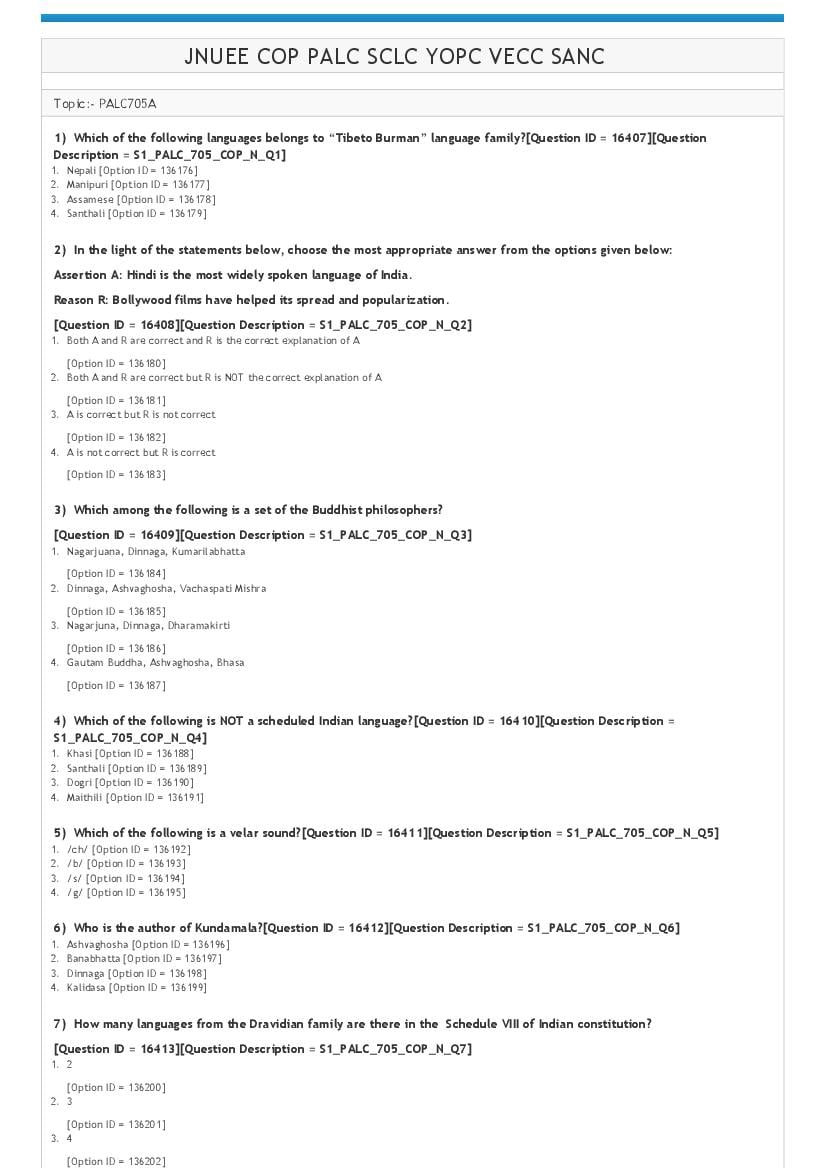
Topic:‐ PALC705A
1) Which of the following languages belongs to “Tibeto Burman” language family?[Question ID = 16407][Question
Description = S1_PALC_705_COP_N_Q1]
1. Nepali [Option ID = 136176]
2. Manipuri [Option ID = 136177]
3. Assamese [Option ID = 136178]
4. Santhali [Option ID = 136179]
2) In the light of the statements below, choose the most appropriate answer from the options given below:
Assertion A: Hindi is the most widely spoken language of India.
Reason R: Bollywood films have helped its spread and popularization.
[Question ID = 16408][Question Description = S1_PALC_705_COP_N_Q2]
1. Both A and R are correct and R is the correct explanation of A
[Option ID = 136180]
2. Both A and R are correct but R is NOT the correct explanation of A
[Option ID = 136181]
3. A is correct but R is not correct
[Option ID = 136182]
4. A is not correct but R is correct
[Option ID = 136183]
3) Which among the following is a set of the Buddhist philosophers?
[Question ID = 16409][Question Description = S1_PALC_705_COP_N_Q3]
1. Nagarjuana, Dinnaga, Kumarilabhatta
[Option ID = 136184]
2. Dinnaga, Ashvaghosha, Vachaspati Mishra
[Option ID = 136185]
3. Nagarjuna, Dinnaga, Dharamakirti
[Option ID = 136186]
4. Gautam Buddha, Ashvaghosha, Bhasa
[Option ID = 136187]
4) Which of the following is NOT a scheduled Indian language?[Question ID = 16410][Question Description =
S1_PALC_705_COP_N_Q4]
1. Khasi [Option ID = 136188]
2. Santhali [Option ID = 136189]
3. Dogri [Option ID = 136190]
4. Maithili [Option ID = 136191]
5) Which of the following is a velar sound?[Question ID = 16411][Question Description = S1_PALC_705_COP_N_Q5]
1. /ch/ [Option ID = 136192]
2. /b/ [Option ID = 136193]
3. /s/ [Option ID = 136194]
4. /g/ [Option ID = 136195]
6) Who is the author of Kundamala?[Question ID = 16412][Question Description = S1_PALC_705_COP_N_Q6]
1. Ashvaghosha [Option ID = 136196]
2. Banabhatta [Option ID = 136197]
3. Dinnaga [Option ID = 136198]
4. Kalidasa [Option ID = 136199]
7) How many languages from the Dravidian family are there in the Schedule VIII of Indian constitution?
[Question ID = 16413][Question Description = S1_PALC_705_COP_N_Q7]
1. 2
[Option ID = 136200]
2. 3
[Option ID = 136201]
3. 4
[Option ID = 136202]
Page 2
[Option ID = 136203]
8) What is the motto of University Grants Commission?[Question ID = 16414][Question Description =
S1_PALC_705_COP_N_Q8]
1. Sa vidya ya vimuktaye [Option ID = 136204]
2. Jnana‐vijnana vimuktaye [Option ID = 136205]
3. Aharnisham sevamahe [Option ID = 136206]
4. Satyameva jayate [Option ID = 136207]
9) ”Ramo vigrahavan dharmah” is a statement taken from which of the following texts?
[Question ID = 16415][Question Description = S1_PALC_705_COP_N_Q9]
1. Uttararamacharitam
[Option ID = 136208]
2. Ramayana Darshane
[Option ID = 136209]
3. Valmiki Ramayanam
[Option ID = 136210]
4. Ramacharitamanasa
[Option ID = 136211]
10) Match the philosophical systems which their exponents:
List I list II
A. Pratyabhijna I. Adi Shankara
B. Mimamsa II. Abhinavagupta
C. Vedanta III. Patanjali
D. Yoga IV. Jaimini
Choose the correct answer from the options given below:
[Question ID = 16416][Question Description = S1_PALC_705_COP_N_Q10]
1. A‐I,B‐II, C‐III, D‐IV
[Option ID = 136212]
2. A‐II, B‐IV, C‐I, D‐III
[Option ID = 136213]
3. A‐III, B‐IV, C‐II, D‐I
[Option ID = 136214]
4. A‐IV, B‐III, C‐I, D‐II
[Option ID = 136215]
11) Match the books with their authors:
List I List II
A. Pratima‐Natakam I. Bhavabhuti
B. Mrichchakatikam II. Vishakhadatta
C. Mudrarakshasam III. Bhasa
D. Uttararamacharitam IV. Shudraka
Choose the correct answer from the option given below:
[Question ID = 17426][Question Description = S1_PALC_705_COP_N_Q11]
1. A‐I, B‐II, C‐III, D‐IV
[Option ID = 136216]
2. A‐II, B‐I, C‐III, D‐IV
[Option ID = 136217]
3. A‐III, B‐IV, C‐II, D‐I
[Option ID = 136218]
4. A‐IV, B‐III, C‐II, D‐I
[Option ID = 136219]
12) Which one of the following places is associated with the enlightenment of Mahatma Buddha?[Question ID = 17427]
Page 3
1. Kushinagar [Option ID = 136220]
2. Sarnath [Option ID = 136221]
3. Bodhagaya [Option ID = 136222]
4. Vaishali [Option ID = 136223]
13) In which of the following states the famous Nataraja temple is located?
[Question ID = 17428][Question Description = S1_PALC_705_COP_N_Q13]
1. Karnataka
[Option ID = 136224]
2. Telangana
[Option ID = 136225]
3. Tamil Nadu
[Option ID = 136226]
4. Kerala
[Option ID = 136227]
14) Where is the famous Shankaracharya Hills located?
[Question ID = 17429][Question Description = S1_PALC_705_COP_N_Q14]
1. Dharamashala
[Option ID = 136228]
2. Srinagar
[Option ID = 136229]
3. Shringeri
[Option ID = 136230]
4. Kaladi
[Option ID = 136231]
15) What is the full form of ESMA?
[Question ID = 17430][Question Description = S1_PALC_705_COP_N_Q15]
1. External Services Management Act
[Option ID = 136232]
2. Essential Services Management Act
[Option ID = 136233]
3. Essential Services Maintenance Act
[Option ID = 136234]
4. External Services Maintenance act
[Option ID = 136235]
16) What is the full form of FIFA?[Question ID = 17431][Question Description = S1_PALC_705_COP_N_Q16]
1. Federation of Inter‐country Football Association [Option ID = 136236]
2. Formation of International Football Association [Option ID = 136237]
3. Federation Internationale de Football Association [Option ID = 136238]
4. Felicitation of International Football Association [Option ID = 136239]
17) “Shri Durgasaptashati” is a part of which of the following texts?[Question ID = 17432][Question Description =
S1_PALC_705_COP_N_Q17]
1. Agnipuranam [Option ID = 136240]
2. Markandeyapuranam [Option ID = 136241]
3. Vishnupuranam [Option ID = 136242]
4. Shivapuranam [Option ID = 136243]
18) ‘Triratna’ in Buddhism refers to which of the following correct sets?
[Question ID = 17433][Question Description = S1_PALC_705_COP_N_Q18]
1. Sutta, Vinaya, Abhidhamma
[Option ID = 136244]
2. Hinayana, Mahayana, Vajrayana
[Option ID = 136245]
3. Shila, Samadhi, Prajna
[Option ID = 136246]
4. Dharana, Dhyana, Samadhi
[Option ID = 136247]
19) Which of the following texts is also known as the Fifth Veda?
Page 4
1. Arthashastra
[Option ID = 136248]
2. Natyashastra
[Option ID = 136249]
3. Ramayana
[Option ID = 136250]
4. Srimadbhagavat
[Option ID = 136251]
20) Who among the following is generally believed to have composed the Shakta text Saundaryalahari ?
[Question ID = 17435][Question Description = S1_PALC_705_COP_N_Q20]
1. Gorakshnatha
[Option ID = 136252]
2. Somanandanatha
[Option ID = 136253]
3. Adi Shankaracharya
[Option ID = 136254]
4. Ramanujacharya
[Option ID = 136255]
21) Arrange these texts chronologically:
A. Ashtadhyayi
B. Mahabhashya
C. Vakyapadiya
D. Siddhhantakaumudi
Choose the correct sequence from the options given below:
[Question ID = 17436][Question Description = S1_PALC_705_COP_N_Q21]
1. A,B,C,D
[Option ID = 136256]
2. D,C,B,A
[Option ID = 136257]
3. B,A,C,D
[Option ID = 136258]
4. D,B,C,A
[Option ID = 136259]
22) Which among the following is a set of epics?
A. Ramayana and Mahabharata
B. Abhjnanashakuntalam and Uttararamacharitam
C. Ramacharitamanasa and Manimekhalai
D. Kiratarjuniyam and Kadambari
Choose the correct set from the following options:
[Question ID = 17437][Question Description = S1_PALC_705_COP_N_Q22]
1. A and B only
[Option ID = 136260]
2. A and C only
[Option ID = 136261]
3. B and C only
[Option ID = 136262]
4. C and D only
[Option ID = 136263]
23) Arrange the following authors in the chronological order:
A. William Shakespeare
B. John Milton
Page 5
D. T. S. Eliot
Choose the correct answer from the following options:
[Question ID = 17438][Question Description = S1_PALC_705_COP_N_Q23]
1. C,D,B,A
[Option ID = 136264]
2. A,B,C,D
[Option ID = 136265]
3. D,B,A,C
[Option ID = 136266]
4. B,A,C,D
[Option ID = 136267]
24) Which among the following is a set of Noble Laureates?
A. W. B. Yeats
B. Premchand
C. Rabindranath Tagore
D. Maxim Gorky
Choose the correct answer from the options given below:
[Question ID = 17439][Question Description = S1_PALC_705_COP_N_Q24]
1. A and B only
[Option ID = 136268]
2. A and C only
[Option ID = 136269]
3. B and C only
[Option ID = 136270]
4. C and D only
[Option ID = 136271]
25) IAST stands for[Question ID = 17440][Question Description = S1_PALC_705_COP_N_Q25]
1. International Association for Sanskrit Texts [Option ID = 136272]
2. International Alphabet for Sanskrit Transliteration [Option ID = 136273]
3. International Association for Sanskrit Translation [Option ID = 136274]
4. Internal Army Station in Tibet [Option ID = 136275]
26) What does ASR expand to?
[Question ID = 17441][Question Description = S1_PALC_705_COP_N_Q26]
1. Automatic Speech Realization
[Option ID = 136276]
2. Automatic Sanskrit Recognition
[Option ID = 136277]
3. Automatic Speech Recognition
[Option ID = 136278]
4. All Sanskrit Resources
[Option ID = 136279]
27) What is the script for Santhali language?[Question ID = 17442][Question Description = S1_PALC_705_COP_N_Q27]
1. Assamese [Option ID = 136280]
2. Ol Chiki [Option ID = 136281]
3. Roman [Option ID = 136282]
4. Kaithi [Option ID = 136283]
28) Konkani language is the official language of which state?
[Question ID = 17443][Question Description = S1_PALC_705_COP_N_Q28]
1. Karnataka
[Option ID = 136284]
2. Kerala
[Option ID = 136285]
3. Goa
[Option ID = 136286]
4. Maharashtra
Page 6
29) How many languages from the Indo ‐ Aryan family are there in The Schedule VIII of Indian constitution?
[Question ID = 18739][Question Description = S1_PALC_705_COP_N_Q29]
1. 8
[Option ID = 136288]
2. 15
[Option ID = 136289]
3. 3
[Option ID = 136290]
4. None
[Option ID = 136291]
30) Identify the correct language–family pair:
[Question ID = 18740][Question Description = S1_PALC_705_COP_N_Q30]
1. Hindi – North Indian
[Option ID = 136292]
2. Tamil – South Indian
[Option ID = 136293]
3. Tulu – Dravidian
[Option ID = 136294]
4. Sinhalese – Sri Lankan
[Option ID = 136295]
31) Which of the following is NOT a verb‐root in Sanskrit?[Question ID = 18741][Question Description =
S1_PALC_705_COP_N_Q31]
1. bhu [Option ID = 136296]
2. ad [Option ID = 136297]
3. gam [Option ID = 136298]
4. akkl [Option ID = 136299]
32) Which is the most popular script for Konkani?[Question ID = 18742][Question Description = S1_PALC_705_COP_N_Q32]
1. Kannada [Option ID = 136300]
2. Devanagari [Option ID = 136301]
3. Roman [Option ID = 136302]
4. Arabic [Option ID = 136303]
33) What is the meaning of verb root yuj as used in the word yoga ?
[Question ID = 18743][Question Description = S1_PALC_705_COP_N_Q33]
1. to bind together
[Option ID = 136304]
2. to buy
[Option ID = 136305]
3. to rest
[Option ID = 136306]
4. to exercise
[Option ID = 136307]
34) What does the word ‘Tripitaka’ literally mean?[Question ID = 18744][Question Description =
S1_PALC_705_COP_N_Q34]
1. Three peethas [Option ID = 136308]
2. Three boxes [Option ID = 136309]
3. Three satisfactions [Option ID = 136310]
4. Three modes of life [Option ID = 136311]
35) UNICODE stands for [Question ID = 18745][Question Description = S1_PALC_705_COP_N_Q35]
1. Universal Character Encoding [Option ID = 136312]
2. University coding [Option ID = 136313]
3. Unimodal encoding [Option ID = 136314]
4. Unimodal coding [Option ID = 136315]
36) HTML is a
[Question ID = 18746][Question Description = S1_PALC_705_COP_N_Q36]
1. tag based Scripting language
[Option ID = 136316]
Page 7
[Option ID = 136317]
3. data transfer protocol
[Option ID = 136318]
4. data security and sharing platform
[Option ID = 136319]
37) HTTP stands for[Question ID = 18747][Question Description = S1_PALC_705_COP_N_Q37]
1. Hyper Text Transfer Protocol [Option ID = 136320]
2. Hyper Terminal Training Platform [Option ID = 136321]
3. Hindi Tamil Translation Protocol [Option ID = 136322]
4. Heavy Translation Terminal Placement [Option ID = 136323]
38) Which of the following scholars was the first to suggest a genealogical connection between Sanskrit, Latin and Greek?
[Question ID = 18748][Question Description = S1_PALC_705_COP_N_Q38]
1. Francis Bacon
[Option ID = 136324]
2. William Jones
[Option ID = 136325]
3. Max Mueller
[Option ID = 136326]
4. Warren Hastings
[Option ID = 136327]
39) “Indo European” was coined by whom?
[Question ID = 18749][Question Description = S1_PALC_705_COP_N_Q39]
1. Thomas Young
[Option ID = 136328]
2. William Jones
[Option ID = 136329]
3. Max Mueller
[Option ID = 136330]
4. Thomas Hardy
[Option ID = 136331]
40) “Buddhacharitam” was authored by
[Question ID = 18750][Question Description = S1_PALC_705_COP_N_Q40]
1. Kalidasa
[Option ID = 136332]
2. Bhasa
[Option ID = 136333]
3. Ashvaghosha
[Option ID = 136334]
4. Bhartrihari
[Option ID = 136335]
41) “Charudattam”, a Sanskrit play was authored by[Question ID = 18751][Question Description =
S1_PALC_705_COP_N_Q41]
1. Banabhatta [Option ID = 136336]
2. Shudraka [Option ID = 136337]
3. Bhasa [Option ID = 136338]
4. Shriharsha [Option ID = 136339]
42) Patanjali’s “Mahabhashya” is a commentary on[Question ID = 18752][Question Description =
S1_PALC_705_COP_N_Q42]
1. Ashtadhyayi [Option ID = 136340]
2. Panini shiksha [Option ID = 136341]
3. Chhandashastra [Option ID = 136342]
4. Siddhantakaumudi [Option ID = 136343]
43) Which of the following languages exhibits Subject‐Object‐Verb (SOV) word order?
[Question ID = 18753][Question Description = S1_PALC_705_COP_N_Q43]
1. Hindi
[Option ID = 136344]
Page 8
[Option ID = 136345]
3. French
[Option ID = 136346]
4. Spanish
[Option ID = 136347]
44) Which of the following languages does NOT use Devanagari script?[Question ID = 18754][Question Description =
S1_PALC_705_COP_N_Q44]
1. Maithili [Option ID = 136348]
2. Bodo [Option ID = 136349]
3. Nepali [Option ID = 136350]
4. Manipuri [Option ID = 136351]
45) Which of the following scripts has NOT evolved from Brahmi?[Question ID = 18755][Question Description =
S1_PALC_705_COP_N_Q45]
1. Sharada [Option ID = 136352]
2. Gurumukhi [Option ID = 136353]
3. Mithilakshara [Option ID = 136354]
4. Arabic [Option ID = 136355]
46) Rule based method in Machine Translation from English to Hindi will require [Question ID = 18756][Question Description
= S1_PALC_705_COP_N_Q46]
1. Parser for English and generator for Hindi [Option ID = 136356]
2. Parser for Hindi and generator for English [Option ID = 136357]
3. Only an English‐Hindi dictionary [Option ID = 136358]
4. Parser and generator both for each language [Option ID = 136359]
47) How many languages from the Austro‐Asiatic family are there in the Schedule VIII of Indian constitution?
[Question ID = 18757][Question Description = S1_PALC_705_COP_N_Q47]
1. 2
[Option ID = 136360]
2. 1
[Option ID = 136361]
3. 3
[Option ID = 136362]
4. None
[Option ID = 136363]
48) A Text to Speech System requires the following dataset
[Question ID = 18758][Question Description = S1_PALC_705_COP_N_Q48]
1. Grapheme to phoneme
[Option ID = 136364]
2. Phoneme to grapheme
[Option ID = 136365]
3. Sound to letters
[Option ID = 136366]
4. Sentences to words
[Option ID = 136367]
49) Which of the following is NOT a Machine Learning platform used in Artificial Intelligence?[Question ID = 17444]
[Question Description = S1_PALC_705_COP_N_Q49]
1. BERT [Option ID = 136368]
2. mBERT [Option ID = 136369]
3. MuRIL [Option ID = 136370]
4. Dependency [Option ID = 136371]
50) The sentence –
“He saw the girl with a telescope” can be interpreted as
(A) He saw the girl with his telescope
(B) He saw the girl who had a telescope in her hand
(C) The girl saw him with his telescope
(D) He saw the girl with her telescope
Page 9
1. Only A is correct
[Option ID = 136372]
2. Only B is correct
[Option ID = 136373]
3. Both A and B are correct
[Option ID = 136374]
4. None of them is correct
[Option ID = 136375]
51) S NP VP can be interpreted as[Question ID = 17446][Question Description = S1_PALC_705_COP_N_Q51]
1. A sentence is parsed as Noun Phrase and Verb Phrase [Option ID = 136376]
2. A sentence is parsed as New Phrase and Verified Phrase [Option ID = 136377]
3. A statement is reduced to New Postulate and Verifiable Postulate [Option ID = 136378]
4. A sign produces Noun Para and Verb Para [Option ID = 136379]
52) Which of the following programming languages is more popular for Machine Learning purposes?[Question ID = 17447]
[Question Description = S1_PALC_705_COP_N_Q52]
1. Python [Option ID = 136380]
2. Java [Option ID = 136381]
3. C++ [Option ID = 136382]
4. Lisp [Option ID = 136383]
53) /bh/ is an example of[Question ID = 17448][Question Description = S1_PALC_705_COP_N_Q53]
1. Voiced aspirated sound [Option ID = 136384]
2. Unvoiced aspirated sound [Option ID = 136385]
3. Unvoiced unaspirated sound [Option ID = 136386]
4. None of the above [Option ID = 136387]
54) “Catalogus Catalogorum” was authored by [Question ID = 17449][Question Description = S1_PALC_705_COP_N_Q54]
1. A B Keith [Option ID = 136388]
2. Warren Hastings [Option ID = 136389]
3. Theodor Aufrecht [Option ID = 136390]
4. H T Colebrook [Option ID = 136391]
55) Which of the following scholars was the first to point to “…some common source which perhaps no longer exists…”
regarding the origin of languages of India and Europe?
[Question ID = 17450][Question Description = S1_PALC_705_COP_N_Q55]
1. Max Mueller
[Option ID = 136392]
2. William Jones
[Option ID = 136393]
3. H T Colebrook
[Option ID = 136394]
4. Rudolf Roth
[Option ID = 136395]
56) Which of the following Western scholars wrote a history of Sanskrit literature?
[Question ID = 17451][Question Description = S1_PALC_705_COP_N_Q56]
1. Warren Hastings
[Option ID = 136396]
2. George Cardona
[Option ID = 136397]
3. A. B. Keith
[Option ID = 136398]
4. William Jones
[Option ID = 136399]
57) How many languages from the Tibeto Burman family are there in the Schedule VIII of Indian constitution?
[Question ID = 17452][Question Description = S1_PALC_705_COP_N_Q57]
1. 1
[Option ID = 136400]
2. 3
[Option ID = 136401]
3. 2
Page 10
4. None
[Option ID = 136403]
58) Which of the following languages is NOT considered belonging to the Indo European family?
[Question ID = 17453][Question Description = S1_PALC_705_COP_N_Q58]
1. Sanskrit
[Option ID = 136404]
2. Arabic
[Option ID = 136405]
3. Urdu
[Option ID = 136406]
4. Persian
[Option ID = 136407]
59) Which of the following languages does not belong to the Celtic family?[Question ID = 17454][Question Description =
S1_PALC_705_COP_N_Q59]
1. Irish [Option ID = 136408]
2. Welsh [Option ID = 136409]
3. German [Option ID = 136410]
4. Breton [Option ID = 136411]
60) Who authored the poetry titled “Meghadutam”?
[Question ID = 17455][Question Description = S1_PALC_705_COP_N_Q60]
1. Bhasa
[Option ID = 136412]
2. Banabhatta
[Option ID = 136413]
3. Kalidasa
[Option ID = 136414]
4. Shudraka
[Option ID = 136415]
61) Formation of “ability” from “able” will be an example of [Question ID = 17456][Question Description =
S1_PALC_705_COP_N_Q61]
1. Inflectional morphology [Option ID = 136416]
2. Derivational morphology [Option ID = 136417]
3. Compounding [Option ID = 136418]
4. Parsing [Option ID = 136419]
62) “agni” in Sanskrit simplifies to ‐‐‐‐‐‐‐‐ in Pali/ Prakrit.
[Question ID = 17457][Question Description = S1_PALC_705_COP_N_Q62]
1. aggi
[Option ID = 136420]
2. agyi
[Option ID = 136421]
3. aagi
[Option ID = 136422]
4. aag
[Option ID = 136423]
63) If “satyam” is “maytas” then “jalam” is ‐‐‐‐‐‐‐‐
[Question ID = 17458][Question Description = S1_PALC_705_COP_N_Q63]
1. amalaj
[Option ID = 136424]
2. malaj
[Option ID = 136425]
3. jamal
[Option ID = 136426]
4. alamaj
[Option ID = 136427]
64) Identify the palindromic data[Question ID = 17459][Question Description = S1_PALC_705_COP_N_Q64]
1. 1 [Option ID = 136428]
Page 11
3. ba [Option ID = 136430]
4. 1 [Option ID = 136431]
65) Match the authors with their books
Books Authors
(A) Kadambari (I) Kalidasa
(B) Kiratarjuniyam (II) Banabhatta
(C) Raghuvansham (III) Shudraka
(D) Mricchakatikam (IV) Bharavi
[Question ID = 17460][Question Description = S1_PALC_705_COP_N_Q65]
1. A‐II, B‐I, C‐IV, D‐III
[Option ID = 136432]
2. A‐II, B‐IV, C‐I, D‐III
[Option ID = 136433]
3. A‐IV, B‐II, C‐III, D‐I
[Option ID = 136434]
4. A‐III, B‐II, C‐IV, D‐I
[Option ID = 136435]
66) Match the following linguistic phenomena with their types:
Linguistic phenomenon Type
(A) a→aa (1) Morphology
(B) bhu→bhavati, bhavatah (2) Phonology
(C) k [kanthya, aghosha] (3) Syntax
(D) devadattah(S) odanam(O) pachati(V) (4) Phonetics
[Question ID = 17461][Question Description = S1_PALC_705_COP_N_Q66]
1. A‐2, B‐1, C‐4, D‐3
[Option ID = 136436]
2. A‐2, B‐4, C‐1, D‐3
[Option ID = 136437]
3. A‐4, B‐2, C‐3, D‐1
[Option ID = 136438]
4. A‐3, B‐2, C‐4, D‐1
[Option ID = 136439]
67) Who coined the term “Artificial Intelligence”?[Question ID = 18779][Question Description = S1_PALC_705_COP_N_Q67]
1. Joseph Weizenbaum [Option ID = 136440]
2. John McCarthy [Option ID = 136441]
3. Alan Turing [Option ID = 136442]
4. Noam Chomsky [Option ID = 136443]
68) Which of the following Sanskrit texts is/are categorized as mahakavya?
A) Kumarasambhavam
B) Meghadutam
C) Charudattam
D) Shishupalavadham
[Question ID = 18780][Question Description = S1_PALC_705_COP_N_Q68]
1. A only
[Option ID = 136444]
2. A and D only
[Option ID = 136445]
3. B and C only
[Option ID = 136446]
4. A and B only
[Option ID = 136447]
69) Match the sounds with their place of articulation
(A) /sh/ I. kantha
(B) /k/ II. taalu
(C) /m/ III. danta
(D) /s/ IV. oshtha
[Question ID = 18781][Question Description = S1_PALC_705_COP_N_Q69]
Page 12
[Option ID = 136448]
2. A‐II, B‐III, C‐I, D‐IV
[Option ID = 136449]
3. A‐II, B‐I, C‐IV, D‐III
[Option ID = 136450]
4. A‐IV, B‐II, C‐III, D‐I
[Option ID = 136451]
70) Which of the following is/are correct?
(A) krt, taddhita, stri, samasa are examples of derivational morphology.
(B) subanta and tinanta are examples of inflectional morphology.
[Question ID = 18782][Question Description = S1_PALC_705_COP_N_Q70]
1. Only A is correct
[Option ID = 136452]
2. Only B is correct
[Option ID = 136453]
3. Both A and B are correct
[Option ID = 136454]
4. Neither is correct
[Option ID = 136455]
71) Kalidasa is believed to have been a poet during the ‐‐‐‐‐‐‐ period[Question ID = 18783][Question Description =
S1_PALC_705_COP_N_Q71]
1. Gupta [Option ID = 136456]
2. Maurya [Option ID = 136457]
3. Post‐Gupta [Option ID = 136458]
4. Pre‐Maurya [Option ID = 136459]
72) Match the languages with their families
Language Family
(A) Hindi I. Austro Asiatic
(B) Tamil II. Tibeto Burman
(C) Bodo III. Indo Aryan
(D) Santhali IV. Dravidian
[Question ID = 18784][Question Description = S1_PALC_705_COP_N_Q72]
1. A‐II, B‐I, C‐IV, D‐III
[Option ID = 136460]
2. A‐II, B‐IV, C‐I, D‐III
[Option ID = 136461]
3. A‐IV, B‐II, C‐III, D‐I
[Option ID = 136462]
4. A‐III, B‐IV, C‐II, D‐I
[Option ID = 136463]
73) Identify the correct sequence of grammarians in chronological order[Question ID = 18785][Question Description =
S1_PALC_705_COP_N_Q73]
1. Panini, Patanjali, Katyayana, Bhartrihari [Option ID = 136464]
2. Panini, Katyayana, Patanjali, Bhartrihari [Option ID = 136465]
3. Panini, Bhartrihari, Patanjali, Katyayana [Option ID = 136466]
4. Panini, Patanjali, Bhartrihari, Katyayana [Option ID = 136467]
74) Match the countries with their languages
(A) Columbia I. English
(B) Shri Lanka II. Bahasa Indonesia
(C) Canada III. Sinhalese
(D) Indonesia IV. Spanish
[Question ID = 18786][Question Description = S1_PALC_705_COP_N_Q74]
1. A‐IV, B‐II, C‐I, D‐III
[Option ID = 136468]
2. A‐IV, B‐III, C‐I, D‐II
[Option ID = 136469]
3. A‐I, B‐II, C‐III, D‐IV
Page 13
4. A‐IV, B‐III, C‐II, D‐I
[Option ID = 136471]
75) “Sacred Books of the East” was edited by ‐‐‐‐‐‐‐‐‐‐‐
[Question ID = 18787][Question Description = S1_PALC_705_COP_N_Q75]
1. Sir Monier Williams
[Option ID = 136472]
2. Max Mueller
[Option ID = 136473]
3. Eugune Burnouf
[Option ID = 136474]
4. Rudolf Roth
[Option ID = 136475]
76) “Oupnekhat” was the Latin translation of which Sanskrit texts?[Question ID = 18788][Question Description =
S1_PALC_705_COP_N_Q76]
1. Brahamanas [Option ID = 136476]
2. Aranyakas [Option ID = 136477]
3. Upanishads [Option ID = 136478]
4. Vedic Samhitas [Option ID = 136479]
77) A famous translation of Kalidasa’s “Shakuntalam” published in 1789 led to the accidental “discovery” of Sanskrit.
Which of the following scholars got it published?
[Question ID = 18789][Question Description = S1_PALC_705_COP_N_Q77]
1. H.T. Colebrook
[Option ID = 136480]
2. Charles Wilkins
[Option ID = 136481]
3. William Jones
[Option ID = 136482]
4. Friedrich Schlegel
[Option ID = 136483]
78) Match the languages with families
(A) Sanskrit I. Middle Indo Aryan
(B) Pali II. Modern Indo Aryan
(C) Punjabi III. Old Indo Aryan
[Question ID = 18790][Question Description = S1_PALC_705_COP_N_Q78]
1. A‐III, B‐I, C‐II
[Option ID = 136484]
2. A‐II, B‐I, C‐III
[Option ID = 136485]
3. A‐I, B‐II, C‐III
[Option ID = 136486]
4. A‐III, B‐II, C‐I
[Option ID = 136487]
79) Match the languages with families
(A) Pashto I. Germanic
(B) Lithuanian II. Italic
(C) English III. Indo Iranian
(D) Latin IV. Baltic
[Question ID = 18791][Question Description = S1_PALC_705_COP_N_Q79]
1. A‐II, B‐III, C‐II, D‐IV
[Option ID = 136488]
2. A‐III, B‐IV, C‐I, D‐II
[Option ID = 136489]
3. A‐I, B‐II, C‐III, D‐IV
[Option ID = 136490]
4. A‐IV, B‐I, C‐II, D‐III
[Option ID = 136491]
Page 14
S1_PALC_705_COP_N_Q80]
1. Morphology [Option ID = 136492]
2. Syntax [Option ID = 136493]
3. Semantics [Option ID = 136494]
4. Phonetics [Option ID = 136495]
81) “Nirukta” by Yaska is a text dealing with______
[Question ID = 18793][Question Description = S1_PALC_705_COP_N_Q81]
1. Etymologies
[Option ID = 136496]
2. POS categories
[Option ID = 136497]
3. Inflectional morphology
[Option ID = 136498]
4. Cultural Rituals
[Option ID = 136499]
82) Which of the following statements is/are TRUE
(A) Shakatayana was a pre‐Paninian grammarian
(B) Nagesha Bhatta was a post‐Paninian grammarian
(C) Galava is among ten grammarians who preceded Panini
(D) Yaska was a post‐Paninian structuralist
[Question ID = 18794][Question Description = S1_PALC_705_COP_N_Q82]
1. Only A is true
[Option ID = 136500]
2. A and C are true
[Option ID = 136501]
3. A, B and C are true
[Option ID = 136502]
4. None of them is true
[Option ID = 136503]
83) Which of the following statements is/are correct about these Vedic texts ‐ Mandukya, Brihadaranyaka, Kena,
Chhandogya ?
(A) These are Ayurveda texts
(B) These are Upanishads
(C) These are Vyakarana texts
(D) These are Chhanda texts
[Question ID = 18795][Question Description = S1_PALC_705_COP_N_Q83]
1. B is correct
[Option ID = 136504]
2. D and C are correct
[Option ID = 136505]
3. A and D are correct
[Option ID = 136506]
4. None of them is correct
[Option ID = 136507]
84) “Shatapatha” is a/an ‐‐‐‐‐‐‐‐‐‐‐‐‐ text[Question ID = 18796][Question Description = S1_PALC_705_COP_N_Q84]
1. Brahmana [Option ID = 136508]
2. Upanishad [Option ID = 136509]
3. Vedanga [Option ID = 136510]
4. Vyakarana [Option ID = 136511]
85) “Deep Blue” is a/an ‐‐‐‐‐‐‐‐‐‐‐‐‐[Question ID = 18797][Question Description = S1_PALC_705_COP_N_Q85]
1. Color code for computer graphics [Option ID = 136512]
2. AI Chess player developed by IBM [Option ID = 136513]
3. AI Web crawler developed by Google [Option ID = 136514]
4. Machine Translation System developed by AltaVista [Option ID = 136515]
86) ASCII stands for –[Question ID = 18798][Question Description = S1_PALC_705_COP_N_Q86]
1. Association of Standards Community of India and Israel [Option ID = 136516]
Page 15
3. Association for Standard Codes for Information Interchange [Option ID = 136518]
4. American Standard Code for Information Interchange [Option ID = 136519]
87) “Sushruta Samhita” is primarily a text on
(A) Medical science
(B) Fine Arts
(C) Grammar
(D) Administration
[Question ID = 17462][Question Description = S1_PALC_705_COP_N_Q87]
1. A only
[Option ID = 136520]
2. A and B
[Option ID = 136521]
3. C and D
[Option ID = 136522]
4. All four
[Option ID = 136523]
88) Earliest inscriptions found in India are in which language?[Question ID = 17463][Question Description =
S1_PALC_705_COP_N_Q88]
1. Vedic [Option ID = 136524]
2. Sanskrit [Option ID = 136525]
3. Pali/Prakrit [Option ID = 136526]
4. Brahmi [Option ID = 136527]
89) ISCII stands for –[Question ID = 17464][Question Description = S1_PALC_705_COP_N_Q89]
1. Indian Script Code for Information Interchange [Option ID = 136528]
2. International Standard Code for Information Interchange [Option ID = 136529]
3. International Script Coding for Information Interchange [Option ID = 136530]
4. Indian Standard Code for Information Interchange [Option ID = 136531]
90) Match the Books with their Authors
Books Authors
(A) Saundarananda (I) Shriharsha
(B) Naishadhiyacharita (II) Asvaghosha
(C) Uttararamacharita (III) Bhasa
(D) Madhyama‐vyayoga (IV) Bhavabhuti
[Question ID = 17465][Question Description = S1_PALC_705_COP_N_Q90]
1. A‐II, B‐I, C‐IV, D‐III
[Option ID = 136532]
2. A‐II, B‐III, C‐IV, D‐I
[Option ID = 136533]
3. A‐IV, B‐II, C‐III, D‐I
[Option ID = 136534]
4. A‐III, B‐II, C‐IV, D‐I
[Option ID = 136535]
91) Identify the odd word in the following – [Question ID = 17466][Question Description = S1_PALC_705_COP_N_Q91]
1. Trivial [Option ID = 136536]
2. Unimportant [Option ID = 136537]
3. Insignificant [Option ID = 136538]
4. Important [Option ID = 136539]
92) Mahabharata has ‐‐‐‐‐‐‐ parvas
[Question ID = 17467][Question Description = S1_PALC_705_COP_N_Q92]
1. 19
[Option ID = 136540]
2. 21
[Option ID = 136541]
3. 18
[Option ID = 136542]
4. 108
[Option ID = 136543]
Page 16
[Question ID = 17468][Question Description = S1_PALC_705_COP_N_Q93]
1. 1 / 8
[Option ID = 136544]
2. 1/16
[Option ID = 136545]
3. 1/3
[Option ID = 136546]
4. 2/8
[Option ID = 136547]
94) Spot the odd one out[Question ID = 17469][Question Description = S1_PALC_705_COP_N_Q94]
1. Wing [Option ID = 136548]
2. Rudder [Option ID = 136549]
3. Fin [Option ID = 136550]
4. Beak [Option ID = 136551]
95) Which of the following sounds is a voiced‐aspirated consonant?[Question ID = 17470][Question Description =
S1_PALC_705_COP_N_Q95]
1. /b/ [Option ID = 136552]
2. /ph/ [Option ID = 136553]
3. /bh/ [Option ID = 136554]
4. /m/ [Option ID = 136555]
Topic:‐ PALC705B
1) Read the following passage carefully and answer questions
The vast field of Avadana literature presents a good and sufficient example of Sanskrit writing by Buddhist poets.
The word ‘avadana’ signifies a ‘great religious and moral achievement as well as the history of a great achievement’. Such
a great act may consist in the sacrifice of once own life or the founding of an institution for the supply of incense, flowers,
gold and jewels to, or building of, sanctuaries. Avadana stories are designed to inculcate that the dark (ignoble) deeds bear
dark (ignoble) fruits. Thus they are also called ‘karman’.
Now answer the following questions:
Which one of the following is the correct meaning of the word ‘avadana’:
[Question ID = 17471][Question Description = S1_PALC_705_COP_N_Q96]
1. Futility of donation
[Option ID = 136556]
2. Religious and moral achievements
[Option ID = 136557]
3. Rejection of rituals
[Option ID = 136558]
4. Importance of life after death
[Option ID = 136559]
2) Read the following passage carefully and answer questions
The vast field of Avadana literature presents a good and sufficient example of Sanskrit writing by Buddhist
poets. The word ‘avadana’ signifies a ‘great religious and moral achievement as well as the history of a great achievement’.
Such a great act may consist in the sacrifice of once own life or the founding of an institution for the supply of incense,
flowers, gold and jewels to, or building of, sanctuaries. Avadana stories are designed to inculcate that the dark (ignoble)
deeds bear dark (ignoble) fruits. Thus they are also called ‘karman’.
Now answer the following questions:
Avadana literature is mostly composed in which one of the following languages?
[Question ID = 17472][Question Description = S1_PALC_705_COP_N_Q97]
1. Pali
[Option ID = 136560]
2. Prakrit
[Option ID = 136561]
3. Sanskrit
[Option ID = 136562]
4. Apabhramsha
Page 17
3) Read the following passage carefully and answer questions
The vast field of Avadana literature presents a good and sufficient example of Sanskrit writing by Buddhist poets. The word
‘avadana’ signifies a ‘great religious and moral achievement as well as the history of a great achievement’. Such a great act
may consist in the sacrifice of once own life or the founding of an institution for the supply of incense, flowers, gold and
jewels to, or building of, sanctuaries. Avadana stories are designed to inculcate that the dark (ignoble) deeds bear dark
(ignoble) fruits. Thus they are also called ‘karman’.
Now answer the following questions:
Avadana literature belongs to which of the following domains?
[Question ID = 17473][Question Description = S1_PALC_705_COP_N_Q98]
1. Jain studies
[Option ID = 136564]
2. Buddhist studies
[Option ID = 136565]
3. Vedic studies
[Option ID = 136566]
4. Tantric Studies
[Option ID = 136567]
4) Read the following passage carefully and answer questions
The vast field of Avadana literature presents a good and sufficient example of Sanskrit writing by Buddhist poets. The word
‘avadana’ signifies a ‘great religious and moral achievement as well as the history of a great achievement’. Such a great act
may consist in the sacrifice of once own life or the founding of an institution for the supply of incense, flowers, gold and
jewels to, or building of, sanctuaries. Avadana stories are designed to inculcate that the dark (ignoble) deeds bear dark
(ignoble) fruits. Thus they are also called ‘karman’.
Now answer the following questions:
Which one of the following statements best signifies the moral of the Avadana literature?
[Question ID = 17474][Question Description = S1_PALC_705_COP_N_Q99]
1. One should simply enjoy the life in the world.
[Option ID = 136568]
2. One should follow the right path.
[Option ID = 136569]
3. One should seriously be engaged in the philosophical issues.
[Option ID = 136570]
4. Right or wrong may not be central issue in life.
[Option ID = 136571]
5) Read the following passage carefully and answer questions
The vast field of Avadana literature presents a good and sufficient example of Sanskrit writing by Buddhist poets. The word
‘avadana’ signifies a ‘great religious and moral achievement as well as the history of a great achievement’. Such a great act
may consist in the sacrifice of once own life or the founding of an institution for the supply of incense, flowers, gold and
jewels to, or building of, sanctuaries. Avadana stories are designed to inculcate that the dark (ignoble) deeds bear dark
(ignoble) fruits. Thus they are also called ‘karman’.
Now answer the following questions:
‘Karman’ in this passage signifies‐
[Question ID = 17475][Question Description = S1_PALC_705_COP_N_Q100]
1. Ignoble deed produces noble deeds
[Option ID = 136572]
2. There is no relationship between what we do and what we get.
[Option ID = 136573]
3. Ignoble acts produce ignoble fruits.
[Option ID = 136574]
4. ‘Karman’ has nothing to do with noble or ignoble deeds.
[Option ID = 136575]