Karnataka 2nd PUC Chemistry Solutions MCQ with Answers
Finished viewing? Save it for later —
Download Karnataka 2nd PUC Chemistry Solutions MCQ with Answers (PDF · 15 pages)About Karnataka 2nd PUC Chemistry Solutions MCQ with Answers
Karnataka 2nd PUC Chemistry Solutions MCQ with Answers is available here for free download. Published by Karnataka Board for Class 12, this question bank can be viewed online or downloaded as a PDF (15 pages). Candidates preparing for Class 12 can use Karnataka 2nd PUC Chemistry Solutions MCQ with Answers to understand the exam pattern, the type of questions asked, and the overall difficulty level.
Frequently Asked Questions
How can I download Karnataka 2nd PUC Chemistry Solutions MCQ with Answers?
Open this page and click the Download button to save Karnataka 2nd PUC Chemistry Solutions MCQ with Answers as a PDF. It is completely free on AglaSem Docs.
Is Karnataka 2nd PUC Chemistry Solutions MCQ with Answers free to download?
Yes. Karnataka 2nd PUC Chemistry Solutions MCQ with Answers can be viewed online and downloaded as a PDF free of cost on AglaSem Docs.
How many pages does Karnataka 2nd PUC Chemistry Solutions MCQ with Answers have?
Karnataka 2nd PUC Chemistry Solutions MCQ with Answers contains 15 pages, which you can read online or download together as a single PDF.
Where can I find more Class 12 study material?
You can find more Class 12 question papers, sample papers, syllabus, and answer keys on AglaSem Docs.
Karnataka 2nd PUC Chemistry Solutions MCQ with Answers – Text
Read the full text of this question bank below — useful to quickly search, copy and reference the content online without downloading the PDF.
📄 View text version (15 pages)
Page 1
DEPARTMENT OF SCHOOL EDUCATION (PRE-UNIVERSITY)
18TH CROSS, MALLESHWARAM, BENGALURU – 560 012
CHAPTERWISE MULTIPLE CHOICE QUESTIONS FOR COMPETATIVE EXAM
SUBJECT: II PUC CHEMISTRY
NAME OF THE CHAPTER: UNIT: 01-SOLUTIONS
Solutions are homogeneous mixtures of two or more substances where the composition and properties
are uniform throughout the mixture.
Components of a solution
A solution is a form of two components: solvent and solute.
Solvent is the substance present in the largest quantity that determines the physical state of the solution.
Water is the most common solvent.
Solute is the substance that is dissolved in the solvent, present in smaller quantities.
For example, when you dissolve salt in water, water is the solvent and salt is the solute, which creates a
saltwater solution.
Solutions can exist in all three states of matter: Gas solutions, Liquid solutions, and Solid solutions.
Solutions are present everywhere in daily life. Your blood is a solution containing various dissolved
substances, soft drinks are solutions of CO₂ and other compounds in water, and even the air you breathe is
a solution of different gases.
Types of Solution
In Solutions, composition and properties remain uniform throughout. The component present in the largest
quantity determines the physical state and is called the solvent, while other components are termed solutes.
In binary solutions containing two components, we can classify them based on the physical states of both
solute and solvent.
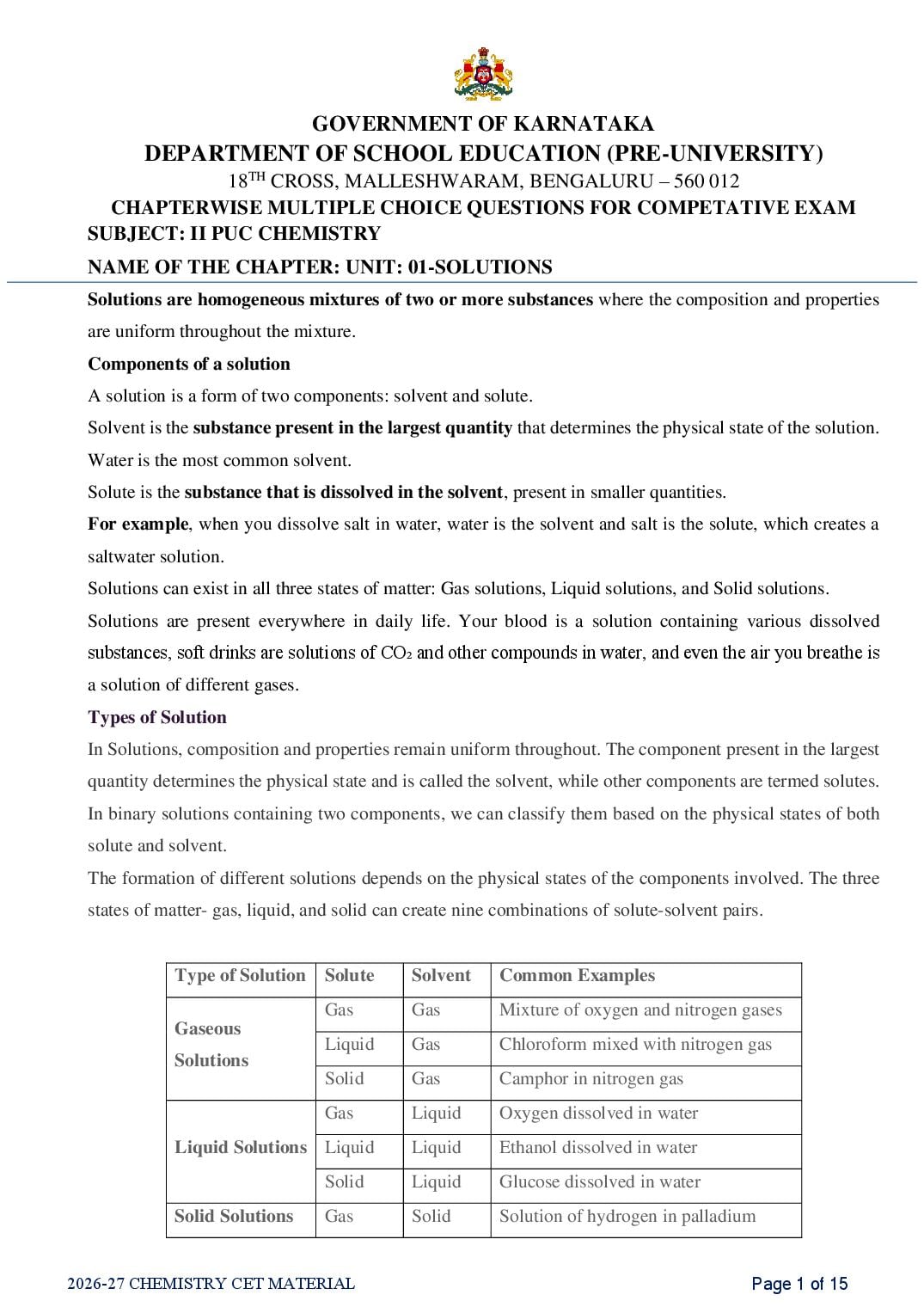
The formation of different solutions depends on the physical states of the components involved. The three
states of matter- gas, liquid, and solid can create nine combinations of solute-solvent pairs.
Type of Solution Solute Solvent Common Examples
Gas Gas Mixture of oxygen and nitrogen gases
Gaseous
Liquid Gas Chloroform mixed with nitrogen gas
Solutions
Solid Gas Camphor in nitrogen gas
Gas Liquid Oxygen dissolved in water
Liquid Solutions Liquid Liquid Ethanol dissolved in water
Solid Liquid Glucose dissolved in water
Solid Solutions Gas Solid Solution of hydrogen in palladium
2026-27 CHEMISTRY CET MATERIAL Page 1 of 15
Page 2
Solid Solid Copper dissolved in gold
Expressing Concentration of Solutions
The concentration of a solution is the amount of solute and solvent in a solution. We can calculate the
concentration of a solution in many ways, and each one is essential for scientific work and industrial
applications.
Mass Percentage (w/w):
The mass of a component in the solution as a percentage of the total mass of the solution is the mass
percentage.
Mass% of a component = (Mass of the component in the solution / Total mass of the solution) × 100
Volume Percentage (V/V):
The volume of a component is to the total solution volume. It is used with liquid-liquid solutions.
Volume % of a component = (Volume of the component / Total volume of solution) × 100
Mass by Volume Percentage (w/V):
The mass of solute dissolved in 100 mL of solution. This method is used in medical and pharmaceutical
applications for dosage calculation.
Parts Per Million (ppm):
When dealing with trace quantities of substances, parts per million provides a more manageable scale than
percentages.
Parts per million = (Number of parts of the component × 10⁶) / Total number of parts of all
components
Mole fraction:
The ratio of moles of one component to the total moles of all components. It is a dimensionless quantity,
valuable in thermodynamic calculations and gas mixture analysis.
Mole fraction of a component = Number of moles of the component / Total number of moles of all
components
For a binary mixture with nₐ moles of component A and nᵦ moles of component B:
nA
A =
nA + nB
An important property of mole fractions is that their sum always equals unity: x₁ + x₂ + … + xᵢ = 1
Molarity:
The number of moles of solute dissolved in one litre of solution. This is used in analytical chemistry and
laboratory preparations.
Molarity = Moles of solute / Volume of solution in litres
Molality:
2026-27 CHEMISTRY CET MATERIAL Page 2 of 15
Page 3
remains independent of temperature because mass doesn’t change with temperature.
Molality = Moles of solute / Mass of solvent in kg
Solubility
The maximum amount of a substance that can dissolve in a specified amount of solvent at a given
temperature and pressure is the Solubility. The amount dissolved depends on the nature of both solute
and solvent.
The dissolution process involves a dynamic equilibrium where solute particles continuously dissolve and
crystallize at equal rates. When this equilibrium is established, the solution becomes saturated, containing
the maximum possible amount of dissolved solute under those conditions.
Solute + Solvent ⇌ Solution
Solubility of a Solid in a Liquid
The amount of solid that can be dissolved in liquids depends on temperature and follows Le
Chatelier’s principle.
Le Chatelier’s principles state that at a dynamic equilibrium, when a reaction undergoes a change in
concentration, temperature, or pressure, it will counteract that and adjust itself to maintain the equilibrium.
For endothermic dissolution processes (ΔsolH > 0), solubility increases with an increase in temperature.
And for exothermic processes (ΔsolH < 0), solubility decreases as temperature increases.
Pressure has minimal effect on solid-liquid solubility because both phases are highly incompressible.
Solubility of a Gas in a Liquid
The solubility of a gas in a liquid depends on pressure and temperature. By increasing the pressure,
the solubility of the gas increases by forcing more gas molecules into the liquid phase. Higher temperature
decreases gas solubility.
Henry Law
Henry’s Law states that at constant temperature, the solubility of a gas in a liquid is directly
proportional to the partial pressure of the gas above the solution surface.
p = KH x
Where;
• p is the partial pressure of the gas
• KH is Henry’s law constant
• x is the mole fraction of gas in solution.
Higher KH values mean lower gas solubility. The increase in KH values with temperature for N₂ and O₂
confirms that gas solubility decreases with increasing temperature.
Applications of Henry’s Law
• Soft drinks are bottled under high CO₂ pressure to increase gas solubility.
• Scuba divers must manage high concentrations of dissolved nitrogen in their blood under pressure, and the
condition known as “bends” occurs when rapid pressure reduction causes nitrogen bubbles to form in blood
vessels.
2026-27 CHEMISTRY CET MATERIAL Page 3 of 15
Page 4
The vapour pressure of liquid solutions depends on the volatility of their components. Volatile
components add up to the total vapor pressure as per their concentration and individual characteristics.
Vapour Pressure of Liquid-Liquid Solutions
The two volatile liquids of a binary solution contribute to the total vapor pressure. Raoult’s Law
establishes the quantitative relationship between partial vapor pressures and mole fractions.
Raoult’s Law:
Raoult’s law states that for a solution of volatile liquids, the partial vapor pressure of each
component is directly proportional to its mole fraction in the solution.
p1 = x1 p1o
p2 = x2 p2o
Where;
• p₁⁰ and p₂⁰ = vapor pressures of pure components
• x₁ and x₂ are their mole fractions.
The total vapor pressure follows Dalton’s law:
ptotal = p1o + ( p2o − p1o ) x2
This linear relationship permits the calculation of total vapour pressure from the composition of any
binary volatile solution.
Raoult’s Law as a special case of Henry’s Law
If you compare Raoult's law (p = x × p⁰) with Henry's law ( p = K H x ), you will notice that both exhibit
direct proportionality between mole fraction and partial pressure. Raoult's law becomes a special case of
Henry's law when KH is equal to p⁰, the vapor pressure of the pure substance.
Ideal and Non-ideal Solutions:
Ideal solutions obey Raoult’s law over the entire concentration range and show two additional
characteristics, zero enthalpy of mixing (ΔmixH = 0) and zero volume of mixing (ΔmixV = 0).
These characteristics occur when intermolecular forces between different components (A-B interactions)
are nearly equal to those between like molecules (A-A and B-B interactions). No heat is absorbed or evolved
during mixing, and the solution volume equals the sum of component volumes.
Examples of ideal solutions: bromoethane and chloroethane, and benzene and toluene.
Non-ideal Solutions:
Non-ideal solutions oppose Raoult’s law, showing only one positive or negative deviation based on the
strength of intermolecular interactions.
When A-B interactions are weaker than A-A or B-B interactions, positive deviation occurs, resulting in
easier escape of molecules than in pure states, and an increase in vapor pressure than the ideal value.
2026-27 CHEMISTRY CET MATERIAL Page 4 of 15
Page 5
capabilities for molecules to escape and lowering vapor pressure below ideal values.
Colligative Properties and Determination of Molar Mass
Colligative properties depend on the number of solute particles present, regardless of their chemical
identity. These properties are used for determining molar masses and understanding solution behavior.
Relative Lowering of Vapour Pressure:
The vapor pressure of a solution is always lower than that of the pure solvent when a non-volatile solute is
present. The relative lowering of vapor pressure equals the mole fraction of the solute.
p1 p1o − p1
= = x2
p1o p1o
p1o − p1 n2
=
p1o
n1 + n2
For dilute solutions where n₂ << n₁:
p1o − p1 w2 M1
=
p1o M 2 w1
This relationship allows calculation of molar mass M₂ when other quantities are known.
Elevation of Boiling Point:
The boiling point of solutions is higher than pure solvents because of reduced vapor pressure, which
requires additional heating to reach atmospheric pressure. The boiling point elevation is directly
proportional to molal concentration.
Tb = Kb m
Where;
Kb is the boiling point elevation constant specific to each solvent.
For calculating molar mass:
1000 w2 Kb
M2 =
Tb w1
Depression of Freezing Point:
The freezing point of solutions is lower than pure solvents because the equilibrium between solid and liquid
phases shifts to lower temperatures. The freezing point depression is proportional to molal concentration.
Tf = K f m
Where Kf is the freezing point depression constant (cryoscopic constant).
For molar mass determination:
K f w2 1000
M2 =
T f w1
The constants Kf and Kb can be calculated from fundamental thermodynamic properties:
R M1 T f2
Kf =
1000 fus H
2026-27 CHEMISTRY CET MATERIAL Page 5 of 15
Page 6
Kb =
1000 vap H
Osmosis and Osmotic Pressure:
The process in which solvent molecules flow through semipermeable membranes from pure solvent to
solution is called Osmosis.
The pressure required to prevent this flow is called osmotic pressure.
π = CRT = (n₂/V) RT
For molar mass determination:
w2 RT
M2 =
V
Reverse osmosis occurs when pressure higher than the osmotic pressure is applied to solutions, forcing
solvent molecules to flow in the opposite direction. This process enables seawater desalination for
producing potable water.
When solutes have molar masses other than their expected values as a result of association or dissociation,
then it is an abnormal molar mass.
For instance, when ionic compounds like KCl dissociate in water, they yield more particles than the original
compound, thus having less molar mass than the true value.
In a similar way, when molecules such as acetic acid get associated through hydrogen bonding in benzene,
there are fewer particles present than calculated, and hence, the molar mass is greater than the actual molar
mass.
Van't Hoff factor (i) measures the degree of association or dissociation:
Normal molar mass
i=
Abnormal molar mass
Total number of moles of particles after association/dissociation
i=
Number of moles of particles before association/dissociation
The van't Hoff factor alters all the equations of colligative properties:
p2o − p1 n2
• Relative lowering of vapor pressure: =i
p1o n1
• Elevation of boiling point: Tb = i Kb m
• Depression of freezing point: Tf = i K f m
• Osmotic pressure: = i n2 RT / V
********
2026-27 CHEMISTRY CET MATERIAL Page 6 of 15
Page 7
1. Which of the following is a gaseous solution?
a) Oxygen dissolved in water b) Hydrogen dissolved in palladium
c) Air d) Brass
2. Air is an example of:
a) Gas in liquid b) Gas in gas
c) Liquid in gas d) Solid in gas
3. Which of the following represents a liquid-in-liquid solution?
a) Ethanol in water b) Hydrogen in palladium
c) Camphor in nitrogen d) Mercury in sodium
4. Fog is an example of:
a) Solid in gas b) Liquid in gas
c) Gas in liquid d) Solid in liquid
5. Which of the following is a solid solution?
a) Air b) Soda water
c) Brass d) Milk
6. Brass is a solution of:
a) Zn in Cu b) Cu in Zn
c) Fe in Cu d) Ni in Cu
7. Hydrogen gas absorbed by palladium is an example of:
a) Gas in gas b) Gas in liquid
c) Gas in solid d) Solid in gas
8. Which pair correctly represents a liquid-in-solid solution?
a) Mercury in sodium b) Sugar in water
c) Oxygen in water d) Ethanol in water
1.2 Expressing Concentration of Solutions.
9. Which of the following concentration terms is dependent of temperature?
a) Molarity b) mole fraction
c) Molality d) w/w %
10. The molarity of a glucose solution containing 36 g of glucose per 400 mL of the solution is-
a) 1.0 b) 0.5
c) 2.0 d) 0.05
11. The mole fraction of solute in a 1.00 molal aqueous solution is:
a) 0.0177 b) 0.0344
c) 1.7700 d) 0.1770
2026-27 CHEMISTRY CET MATERIAL Page 7 of 15
Page 8
a) 1000gm of the solution b) 1000c.c. of the solution
c) 1000c.c of the solvent d) 1000gm of the solvent
13. 10 g of glucose is dissolved in 90 g of water. The mass percentage of glucose in the solution is:
a) 11.11% b) 10%
c) 9% d) 1.1%.
14. Molarity of a solution relates the-
a) Moles of solute and solvent b) Moles of solute and mass of solution
c) Volume of solute and volume of solvent d) Volume of solution and moles of solute
15. The units of mole fraction of a compound in solution are-
a) mol kg–1 b) mol litre–1
c) g litre–1 d) No unit
16. The hardness of water is usually expressed in-
a) ppm b) g/litre
c) Mol/litre d) mol kg–1
17. Density of water is 1g/mL. The concentration of water in mol/litre is-
a) 1000 b) 18
c) 0.018 d) 55.5
18. How many grams of NaOH will be needed to prepare 250 mL of 0.1 M solution-
a) 1 g b) 10 g
c) 4 g d) 6 g.
19. The molality of 15% (wt./vol.) solution of H2SO4 of density 1.1 g/cm3 is approximately-
a) 1.2 b) 1.4
c) 1.8 d) 1.6
20. 5.85 g of NaCl are dissolved in 90 g of water. The mole fraction of NaCl is-
a) 0.1 b) 0.01
c) 0.2 d) 0.0196
21. H2O2 solution used for hair bleaching is sold as a solution of approximately 5.0 g H2O2 per 100 mL of
the solution. The molecular weight of H2O2 is 34. The molarity of this solution is approximately-
a) 3.0 b) 1.5
c) 0.15 d) 4.0
22. The amount of H2SO4 present in 400 mL of 0.1 M solution of the acid is -
a) 2.45 g b) 3.92 g
c) 9.80 g d) 4.9 g
23. All of the water in a 0.20 M solution of NaCl was evaporated and 0.150 mol of NaCl was obtained.
What was the original volume of the sample?
a) 30 mL b) 333 ml
c) 750 mL d) 1000 mL
2026-27 CHEMISTRY CET MATERIAL Page 8 of 15
Page 9
molarity of the final mixture would be-
a) 3.25 M b) 4.0 M
c) 3.75 M d) 3.50 M
25. 10 gram of glucose are dissolved in 150 grams of water. The mass % of glucose is-
a) 5% b) 6.25%
c) 93.75% d) 15%
26. What is the molality of pure water?
a) 18 m b) 55.5 m
c) 100 m d) 1 m
1.3 Solubility
27. According to Henry’s law, the partial pressure of a gas in vapour phase (p) is proportional to the mole
fraction of the gas (x) in the solution. The Henry’s law constant (KH) depends on:
a) Nature of gas only b) Nature of solvent only
c) Temperature only d) Nature of gas, solvent and temperature
28. Higher the value of KH at a given pressure, the:
a) Higher is the solubility of the gas in the liquid
b) Lower is the solubility of the gas in the liquid
c) Solubility remains unchanged
d) Gas becomes a liquid
29. Which of the following conditions is favourable for the solubility of a gas in a liquid?
a) High T, Low P b) Low T, High P
c) High T, High P d) Low T, Low P
30. Anoxia is a condition experienced by climbers at high altitudes due to:
a) High partial pressure of oxygen b) Low partial pressure of oxygen
c) High partial pressure of nitrogen d) Low partial pressure of nitrogen
31. Scuba divers carry cylinders filled with air di- luted with helium because:
a) Helium is lighter than air
b) Helium is highly soluble in blood
c) Helium has low solubility in blood at high pressure
d) Helium reacts with nitrogen to prevent bends
32. KH value for Ar(g), CO2(g), HCHO(g), and CH4(g) are 40.39, 1.67, 1.83 × 10⁻⁵ and 0.413
respectively. Arrange these gases in the or- der of their increasing solubility.
a) HCHO < CH4 < CO2 < Ar b) HCHO < CO2 < CH4 < Ar
c) Ar < CO2 < CH4 < HCHO d) Ar < CH4 < CO2 < HCHO
2026-27 CHEMISTRY CET MATERIAL Page 9 of 15
Page 10
a) Dilute solution b) Unsaturated solution
c) Saturated solution d) Colloidal solution
34. The effect of pressure on the solubility of solids in liquids is generally:
a) Very large b) Moderate
c) Negligible d) Unpredictable
35. If dissolution of a solid is endothermic, its solubility generally:
a) Decreases with rise in temperature b) Increases with rise in temperature
c) Remains constant d) Becomes zero
36. Solubility of KNO₃ in water increases sharply with temperature because its dissolution is:
a) Exothermic b) Endothermic
c) Isothermal d) Adiabatic.
1.4 Vapour Pressure of Liquid Solutions.
37. Vapour pressure of a solvent containing nonvolatile solute is -
a) More than the vapour pressure of a solvent b) Less than the vapour pressure of solvent
c) Equal to the vapour pressure of solvent d) None of these
38. The boiling point of C6H6 , CH3OH , C6H5NH2 and C6H5NO2 are 80ºC , 65ºC , 184ºC and 212ºC
respectively. Which will show highest vapour pressure at room temperature-
a) C6H6 b) CH3OH
c) C6H5NH2 d) C6H5NO2
39. When a substance is dissolved in a solvent, the vapour pressure of solvent decreases. This brings -
a) An increase in b.pt. of the solution b) A decrease in b.pt of a solution
c) An increase in f.pt of the solvent d) none
40. Boiling point of water is defined as the temperature at which –
a) Vapour pressure of water becomes equal to that of atmospheric pressure
b) Bubbles are formed
c) Steam comes out
d) None of the above
41. Pure water will boil at 101.5°C at which of the following pressure -
a) 76 cm of Hg b) 76 mm of Hg
c) > 76 cm of Hg d) < 76 cm of Hg
42. Solute when dissolved in water -
a) Increases the vapour pressure of water b) Decreases the boiling point of water
c) Decreases the freezing point of water d) All of the above
43. An aqueous solution of methanol in water has vapour pressure –
a) Equal to that of water b) Equal to that of methanol
c) More than that of water d) Less than that of water
2026-27 CHEMISTRY CET MATERIAL Page 10 of 15
Page 11
44. A solution of sulphuric acid in water exhibits -
a) Negative deviations from Raoult’s law b) Positive deviations from Raoult’s law
c) Ideal properties d) The applicability of Henry’s law
45. Binary liquid mixtures which exhibit positive deviations from Raoult’s law boil at ..... temperature
than the expected b.pt -
a) Lower b) Higher
c) Same d) Can’t be said
46. Which of the following is not correct for ideal solution -
a) Raoult's law is obeyed for entire concentration range and temperatures
b) ∆Smix = 0
c) ∆Vmix = 0
d) ∆Hmix = 0
47. Which of the following conditions is not correct for ideal solution-
a) no change in volume on mixing
b) no change in enthalpy on mixing
c) it obey's Raoult's law
d) Ionisation of solute should occurs to a small extent.
48. An ideal solution was obtained by mixing methanol and ethanol. If the partial vapour pressure of
methanol and ethanol are 2.619 KPa and 4.556 KPa respectively, the composition of vapour (in terms of
mole fraction) will be -
a) 0.635 MeOH, 0.365 EtOH b) 0.365 MeOH, 0.635 EtOH
c) 0.574 MeOH, 0.326 EtOH d) 0.173 MeOH, 0.827 EtOH
49. An ideal solution is that which-
a) Shows positive deviation from Raoult's law b) Shows negative deviation from Raoult's law
c) Has no connection with Raoult's law d) Obeys Raoult's law
50. Solutions distilled without change in composition at a temperature are called-
a) Amorphous b) Azeotropic mixture
c) Ideal solution d) Super saturated solution
51. Which pair shows a contraction in volume on mixing along with evolution of heat-
a) CHCl3 + C6H6 b) H2O + HCl
c) H2O + HNO3 d) All
52. Azeotropic mixture of water and HCl boils at 381.5 K. By distilling the mixture it is possible to obtain-
a) Pure HCl only b) Pure water only
c) Neither HCl nor water d) Both water and HCl in pure state
2026-27 CHEMISTRY CET MATERIAL Page 11 of 15
Page 12
53. The vapour pressures of ethanol and methanol are 42.0 mm and 88.5 mm Hg respectively. An ideal
solution is formed at the same temperature by mixing 46.0 g of ethanol with 16.0 g of methanol. The
mole fraction of methanol in the vapour is -
a) 0.467 b) 0.502
c) 0.513 d) 0.556
54. The elevation of boiling point method is used for the determination of molecular weight of-
a) Non-volatile and soluble solute b) Non-volatile and insoluble solute
c) Volatile and soluble solute d) Volatile and insoluble solute
55. In cold countries, ethylene glycol is added to water in the radiators of cars during winters. It results in-
a) Lowering in boiling point b) Reducing viscosity
c) Reducing specific heat d) Lowering in freezing point
56. The molal elevation/depression constant depends upon -
a) Nature of solvent b) Nature of solute
c) Temperature d) ∆H solution
57. An example of colligative property is-
a) Freezing point b) Boiling point
c) Vapour pressure d) Osmotic pressure
58. The passing of solvent particles through semipermeable membrane is called-
a) Osmosis b) Electrodialysis
c) Electrophoresis d) Electroplating
59. In the case of osmosis, solvent molecules move from-
a) Higher vapour pressure to lower vapour pressure
b) Higher concentration to lower concentration
c) Lower vapour pressure to higher vapour pressure
d) Higher osmotic pressure to lower osmotic pressure
60. If mole fraction of the solvent in a solution decreases then-
a) Vapour pressure of solution increases b) b.pt decreases
c) Osmotic pressure increases d) All are correct
61. Two solutions have different osmotic pressures. The solution of higher osmotic pressure is called-
a) Isotonic solution b) Hypotonic solution
c) Isotopic solution d) Hypertonic solution
62. A mixture of ethanol and acetone shows:
a) Positive deviation from Raoult’s law b) Negative deviation from Raoult’s law
c) Ideal behavior d) No deviation at specific concentrations
63. Which of the following liquid pairs shows a negative deviation from Raoult’s law?
a) Water and Nitric acid b) Benzene and Toluene
c) Ethanol and Water d) Chloroform and Carbon tetrachloride
2026-27 CHEMISTRY CET MATERIAL Page 12 of 15
Page 13
a) Mixtures of two solids
b) Liquid mixtures which boil at constant temperature without change in composition
c) Mixtures of gases
d) Mixtures of liquids which can be completely separated by fractional distillation
65. A maximum boiling azeotrope is formed by those liquid mixtures which show:
a) Large positive deviation from Raoult’s law
b) Large negative deviation from Raoult’s law
c) Ideal behaviour
d) No specific relationship with Raoult’s law
66. The relative lowering of vapour pressure is equal to:
a) Mole fraction of solvent b) Mole fraction of solute
c) Molality of the solution d) Molarity of the solution
67. Vapour pressure of pure water at 298 K is 23.8 mm Hg. 50 g of urea (NH2CONH2) is dissolved in 850 g
of water. The vapour pressure of water for this solution is:
a) 23.4 mm Hg b) 24.2 mm Hg
c) 20.0 mm Hg d) 25.0 mm Hg
68. Elevation in boiling point is a colligative property because it depends on:
a) The nature of the solute b) The nature of the solvent
c) The number of solute particles d) Both the number and nature of solute particles
69. The boiling point of 0.1 molal aqueous solution of urea is 100.052◦C. The molal elevation constant of
water is:
a) 0.52 K kg/mol b) 5.2 K kg/mol
c) 0.052 K kg/mol d) 52 K kg/mol
70. If the molal depression constant (Kf ) for water is 1.86 K kg/mol, the freezing point of a 0.05 molal
solution of a non-electrolyte in water is:
a) −1.86◦C b) −0.93◦C
c) −0.093◦C d) 0.093◦C
71. Ethylene glycol is used as an antifreeze in car radiators because:
a) It lowers the freezing point of water b) It raises the freezing point of water
c) It raises the boiling point of water d) Both a and c
72. Osmotic pressure of a solution can be in- creased by:
a) Decreasing the temperature b) Increasing the volume of the vessel
c) Increasing the concentration of solute d) Adding more solvent
73. Isotonic solutions must have the same:
a) Density b) Molar concentration
c) Elevation in boiling point d) Both b and c
74. Reverse osmosis is applied in:
2026-27 CHEMISTRY CET MATERIAL Page 13 of 15
Page 14
c) Swelling of raisins in water d) Preservation of meat by salting
75. A solution containing 10 g per dm3 of urea (molar mass = 60 g/mol) is isotonic with a 5% solution of a
non-volatile solute. The molar mass of this non-volatile solute is:
a) 300 g/mol b) 350 g/mol
c) 200 g/mol d) 250 g/mol
76. If 0.1 M solution of glucose and 0.1 M solution of urea are placed on two sides of a semipermeable
membrane to equal heights, then it will be correct to say that:
a) There will be no net movement across the membrane b) Glucose will flow towards urea
c) Urea will flow towards glucose d) Water will flow from urea to glucose
77. Blood cells placed in a hypertonic solution will:
a) Burst b) Shrink
c) Remain unchanged d) First shrink then burst
1.7 Abnormal Molar Masses
78. According to Boyle-Vant Hoff law for solutions, the osmotic pressure of a dilute solution is-
a) Inversely proportional to its volume b) Directly proportional to its volume
c) Equal to its volume d) None of the above
79. Which solution will show maximum elevation in b.pt-
a) 0.1 M KCl b) 0.1 M BaCl2
c) 0.1 M FeCl3 d) 0.1 M Fe2(SO4)3
80. Which of the following 0.1 m aqueous solutions will have the lowest freezing point-
a) Potassium sulphate b) Sodium chloride
c) Urea d) Glucose
81. The correct relationship between the boiling points of very dilute solutions of AlCl3 (t1) and CaCl2 (t2),
having the same molar concentration is-
a) t1 = t2 b) t1 > t2
c) t2 >/= t1 d) t2 < t1
82. 0.5 M solution of urea is isotonic with-
a) 0.5 M NaCl solution b) 0.5 M sugar solution
c) 0.5 M BaCl2 solution d) 0.5 M solution benzoic acid in benzene
83. Which salt may show the same value of Vant Hoff factor (i) as that of K4Fe(CN)6 in very dilute solution
state -
a) Al2 (SO4)3 b) NaCl
c) Al(NO3)3 d) Na2SO4
84. Which aqueous solution has minimum freezing point -
a) 0.01 m NaCl b) 0.005 m C2H5OH
c) 0.005 m MgI2 d) 0.005 m MgSO4
85. In which of the following, the Vant Hoff factor (i) is equal to one-
2026-27 CHEMISTRY CET MATERIAL Page 14 of 15
Page 15
c) Urea d) All
86. The freezing point of 0.05 molal solution of a weak acid is −0.1◦C. If Kf = 1.86 K kg/mol, the degree of
dissociation of the acid is ap- proximately:
a) 7.5% b) 10%
c) 5% d) 12.5%
87. The Vant Hoff factor (i) for a dilute aqueous solution of glucose is-
a) zero b) 1.0
c) 1.5 d) 2.0
88. The correct statement regarding Vant Hoff factor (i)-
a) Is more than one in case of dissociation
b) Is more than one in case of association
c) i is always 0
d) i is always 1
89. In case of electrolyte which dissociates in solution the Vant Hoff's Factor-
a) > unity b) < Unity
c) = Unity d) can be > or < 1
90. Which one of the following salts would have the same value of the Vant Hoff factor (i) as that of NaCl.
a) BaSO4 b) Na2SO4
c) Al2(SO4)3 d) Al(NO3)3
Key Answer:
1 c 2 b 3 a 4 b 5 c 6 b 7 c 8 a 9 a 10 b
11 a 12 d 13 b 14 d 15 d 16 a 17 d 18 a 19 d 20 d
21 b 22 b 23 c 24 c 25 b 26 b 27 d 28 b 29 b 30 b
31 c 32 c 33 c 34 c 35 b 36 b 37 b 38 b 39 a 40 a
41 c 42 c 43 c 44 a 45 a 46 b 47 d 48 b 49 d 50 b
51 d 52 c 53 c 54 a 55 d 56 a 57 d 58 d 59 a 60 c
61 d 62 a 63 a 64 b 65 b 66 b 67 a 68 c 69 a 70 c
71 d 72 c 73 d 74 a 75 a 76 a 77 b 78 a 79 d 80 a
81 d 82 b 83 a 84 c 85 c 86 a 87 a 88 a 89 a 90 a
************
2026-27 CHEMISTRY CET MATERIAL Page 15 of 15
Document Details
| Board / Org | Karnataka Board |
| Exam | Class 12 |
| Type | Question Bank |
| Pages | 15 |
| Updated | 24 Sep 2026 |