Karnataka 2nd PUC Mathematics Continuity and Differentiability MCQ with Answers
Finished viewing? Save it for later —
Download Karnataka 2nd PUC Mathematics Continuity and Differentiability MCQ with Answers (PDF · 19 pages)About Karnataka 2nd PUC Mathematics Continuity and Differentiability MCQ with Answers
Karnataka 2nd PUC Mathematics Continuity and Differentiability MCQ with Answers is available here for free download. Published by Karnataka Board for Class 12, this question bank can be viewed online or downloaded as a PDF (19 pages). Candidates preparing for Class 12 can use Karnataka 2nd PUC Mathematics Continuity and Differentiability MCQ with Answers to understand the exam pattern, the type of questions asked, and the overall difficulty level.
Frequently Asked Questions
How can I download Karnataka 2nd PUC Mathematics Continuity and Differentiability MCQ with Answers?
Open this page and click the Download button to save Karnataka 2nd PUC Mathematics Continuity and Differentiability MCQ with Answers as a PDF. It is completely free on AglaSem Docs.
Is Karnataka 2nd PUC Mathematics Continuity and Differentiability MCQ with Answers free to download?
Yes. Karnataka 2nd PUC Mathematics Continuity and Differentiability MCQ with Answers can be viewed online and downloaded as a PDF free of cost on AglaSem Docs.
How many pages does Karnataka 2nd PUC Mathematics Continuity and Differentiability MCQ with Answers have?
Karnataka 2nd PUC Mathematics Continuity and Differentiability MCQ with Answers contains 19 pages, which you can read online or download together as a single PDF.
Where can I find more Class 12 study material?
You can find more Class 12 question papers, sample papers, syllabus, and answer keys on AglaSem Docs.
Karnataka 2nd PUC Mathematics Continuity and Differentiability MCQ with Answers – Text
Read the full text of this question bank below — useful to quickly search, copy and reference the content online without downloading the PDF.
📄 View text version (19 pages)
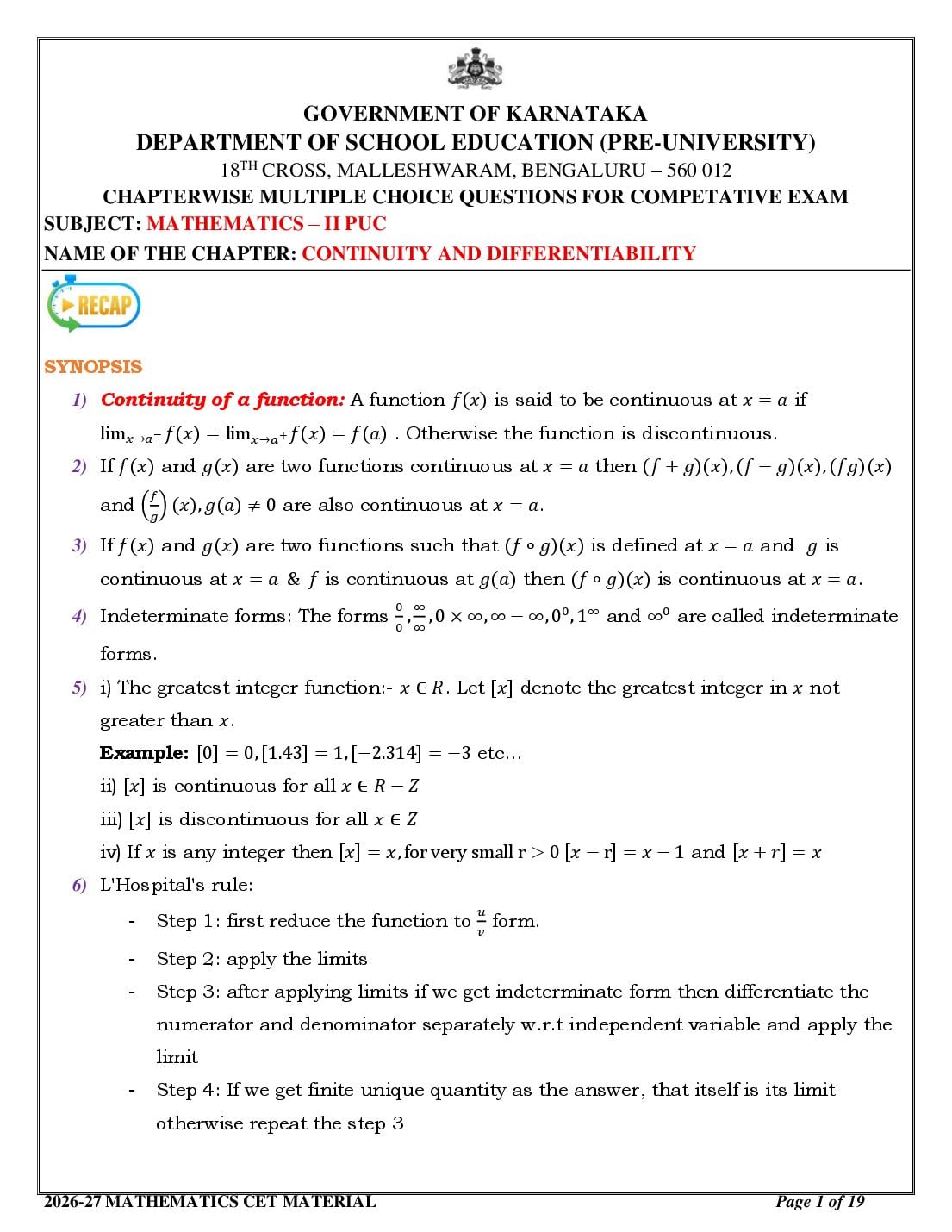
Page 1
DEPARTMENT OF SCHOOL EDUCATION (PRE-UNIVERSITY)
18TH CROSS, MALLESHWARAM, BENGALURU – 560 012
CHAPTERWISE MULTIPLE CHOICE QUESTIONS FOR COMPETATIVE EXAM
SUBJECT: MATHEMATICS – II PUC
NAME OF THE CHAPTER: CONTINUITY AND DIFFERENTIABILITY
SYNOPSIS
1) Continuity of a function: A function 𝑓(𝑥) is said to be continuous at 𝑥 = 𝑎 if
lim𝑥→𝑎− 𝑓(𝑥) = lim𝑥→𝑎+ 𝑓(𝑥) = 𝑓(𝑎) . Otherwise the function is discontinuous.
2) If 𝑓(𝑥) and 𝑔(𝑥) are two functions continuous at 𝑥 = 𝑎 then (𝑓 + 𝑔)(𝑥), (𝑓 − 𝑔)(𝑥), (𝑓𝑔)(𝑥)
𝑓
and (𝑔) (𝑥), 𝑔(𝑎) ≠ 0 are also continuous at 𝑥 = 𝑎.
3) If 𝑓(𝑥) and 𝑔(𝑥) are two functions such that (𝑓 ∘ 𝑔)(𝑥) is defined at 𝑥 = 𝑎 and 𝑔 is
continuous at 𝑥 = 𝑎 & 𝑓 is continuous at 𝑔(𝑎) then (𝑓 ∘ 𝑔)(𝑥) is continuous at 𝑥 = 𝑎.
0 ∞
4) Indeterminate forms: The forms 0 , ∞ , 0 × ∞, ∞ − ∞, 00 , 1∞ and ∞0 are called indeterminate
forms.
5) i) The greatest integer function:- 𝑥 ∈ 𝑅. Let [𝑥] denote the greatest integer in 𝑥 not
greater than 𝑥.
Example: [0] = 0, [1.43] = 1, [−2.314] = −3 etc...
ii) [𝑥] is continuous for all 𝑥 ∈ 𝑅 − 𝑍
iii) [𝑥] is discontinuous for all 𝑥 ∈ 𝑍
iv) If 𝑥 is any integer then [𝑥] = 𝑥, for very small r > 0 [𝑥 − r] = 𝑥 − 1 and [𝑥 + 𝑟] = 𝑥
6) L'Hospital's rule:
𝑢
- Step 1: first reduce the function to 𝑣 form.
- Step 2: apply the limits
- Step 3: after applying limits if we get indeterminate form then differentiate the
numerator and denominator separately w.r.t independent variable and apply the
limit
- Step 4: If we get finite unique quantity as the answer, that itself is its limit
otherwise repeat the step 3
2026-27 MATHEMATICS CET MATERIAL Page 1 of 19
Page 2
derivative at x = a is equal to right hand derivative x = a.
𝑓(𝑎 + ℎ) − 𝑓(𝑎) 𝑓(𝑎 + ℎ) − 𝑓(𝑎)
lim− = lim+ = 𝑓 ′ (𝑎)
ℎ→0 ℎ ℎ→0 ℎ
𝑓(𝑎 + ℎ) − 𝑓(𝑎)
i.e, lim = 𝑓 ′ (𝑎)
ℎ→0 ℎ
8) Derivatives of some standard functions:
d d −1
1. (x) = 1 13. dx (cos−1 x) = √1−x2
dx
d d 1
2. dx ( constant ) = 0 14. dx (tan−1 x) = 1+x2
d d −1
3. dx (log x) = 1/x 15. dx (cot −1 x) = 1+x2
d d 1
4. ax = ax . log a , (a > 0) 16. (sec −1 x) =
dx dx |x|√x2 −1
d
5. dx ex = ex d
17. dx (cosec −1 x) =
−1
|x|√x2 −1
d
6. dx (sin x) = cos x d d
18. dx (u ± v) = dx (u) ± dx (v)
d
d
7. dx (cos x) = −sin x d d
19. dx (Kf(x) = K dx f(x)(K is a scalar )
d
8. dx (tan x) = sec 2 x d d
20. dx (uv) = u dx (v) + v dx (u) where u
d
d
9. dx (sec x) = sec xtan x and v and functions of x
d d d
10. dx (cosecx) = −cosecxcot x d u
21. dx (v) = dx
v (u)−u
dx
(v)
where u and v
v2
d
11. dx (cot x) = −cosec 2 x are functions of x
d 1
12. dx (sin−1 x) = √1−x2
9) Derivative of parametric functions :
If x = g(t), y = f(t) are parametric equations of a relation
dy
dx dy dy f′ (t)
then dt = g ′ (t) and dt = f ′ (t) ⇒ dx = dx
dt
= g′ (t)
dt
10) Differentiation of a function with respect to another function
To find derivative of a function f(x) with respect to another function g(x),
du dy
Put u = f(x) and v = g(x), Then dx = f ′ (x) and dx = g ′ (x)
du du/dx f′ (x)
Therefore dv = dv/dx = g′ (x)
11) Implicit functions
Implicit functions are those in which y can't be expressed directly in terms of 'x' .
Ex: x 3 y + y 3 x = 5
2026-27 MATHEMATICS CET MATERIAL Page 2 of 19
Page 3
𝑑𝑦 𝜕𝑓
Note: If 𝑓(𝑥, 𝑦, 𝑐) = 0 and 𝑓(𝑥, 𝑦) = 𝑐 then 𝑑𝑥 = − 𝜕𝑥
𝜕𝑓 , where 𝜕𝑥 is the derivative of 𝑓 with
𝜕𝑦
𝜕𝑓
respect to 𝑥 treating 𝑦 as constant and is the derivative of 𝑓 with respect to 𝑦 treating
𝜕𝑦
𝑥 as constant
12) Differentiation of inverse trigonometric functions by substitution
Expression Substitution
√𝑎2 − 𝑥 2 x = asin 𝜃 or x = acos 𝜃
√𝑎2 + 𝑥 2 x = atan 𝜃 or x = acot 𝜃
√x 2 − a2 x = asec 𝜃 or x = acosec𝜃
a−x a+x
+ x = atan 𝜃
a+x a−x
a−x a+x
√a+x or √a−x x = acos 2𝜃
Use the suitable substitution in case of problems involving inverse trigonometric
functions and then differentiate. If no substitution is found, differentiate the function
directly.
13) Logarithmic differentiation: It is used in the following cases:
1. 𝑦 = 𝑓(𝑥) 𝑔(𝑥)
f(x)g(x)h(x)…..
2. 𝑦 = p(x)q(x)r(x)…..
3. 𝑦 = f(x)g(x)h(x) … ….
14) Successive differentiation:
dy
Let y = f(x) be a function. If we find dx, then it is the first order derivative of y w.r.t. x. If
𝑑𝑦 𝑑 𝑑𝑦 𝑑2 𝑦
we find the derivative of 𝑑𝑥 , w.r.t.x we get 𝑑𝑥 (𝑑𝑥 ) which is 𝑑𝑥 2 called as second order
derivative of 𝑦 w.r.t 𝑥. Successive differentiation is the process of getting the higher
order derivatives.
d
f ′ (x) = dx f(x) (First derivative of f(x) w.r.t.' x ′ )
𝑑2 𝑑 𝑑𝑓(𝑥)
′′
⇒ 𝑓 (𝑥) = 2 𝑓(𝑥) = [ ] (Second derivative of 𝑓(𝑥) w. r. t.' 𝑥 ′
𝑑𝑥 𝑑𝑥 𝑑𝑥
15) Note:
f(x) = |x − a0 | is continuous everywhere and not differentiable at 𝑥 = 𝑎0
dy x |𝑥|
If y = |x|, x ≠ 0 then dx = |x| = 𝑥
If y = [x], [x] is the greatest integer function then
𝑑𝑦 dy
i) = 0 if 𝑥 ∉ Z ii) does not exist if x ∈ Z
𝑑𝑥 dx
d
f(x)f(x) = f(x)f(x) [1 + log f(x)]f ′ (x)
dx
2026-27 MATHEMATICS CET MATERIAL Page 3 of 19
Page 4
5. dx (odd function) = even function
d
6. dx (even function) = odd function
dy y
7. If x m y n = (x + y)m+n then dx = x
dy
8. If ax + ay = ax+y then dx = −ay−x
dy f′ (x)
9. If y = √f(x) + √f(x) + √f(x) + ⋯ … … ∞ then dx = 2y−1
dy
10. If y = √f(x)√f(x)√f(x) … … … ∞ then dx = f ′ (x)
x2 x3
11. ex = 1 + x + + + ⋯ … ….
2! 3!
x3 x5
12. sin x = x − 3! + 5! + ⋯ … …..
𝑥2 𝑥4
13. cos x = 1 − 2! + 4! − ⋯ … …..
1
14. = 1 + 𝑥 + 𝑥2 + 𝑥3 + ⋯ …
1−𝑥
1
15. = 1 − x + x2 − x3 + x4 − ⋯ …
1+x
x2 x3
16. log(1 + x) = x − + − ⋯ . . . . , |x| < 1
2 3
CLASSROOM CHALLENGE
CONTINUITY
sin x
cos x, x 0
1. The function f x x is continuous at 𝒙 = 𝟎, then the value of k
k ,x 0
is (E)
(1) 3 (2) 2 (3) 1 (4) 1.5
Kx 2 , x 2
2. If f x is continuous at x =2, then the value of K is (KCET2017)(E)
3 , x2
(1) 4 (2) 4/3 (3) 3 /4 (4) 3
3sin x
,x 0
3. If f x 5x is continuous at x=0, then k= (A)
2k , x 0
3 3 3
(1) (2) (3) (4)
2 10 5 10
2026-27 MATHEMATICS CET MATERIAL Page 4 of 19
Page 5
x 2 2 x , x 0
4. If f x is continuous at x=0, then k= (D)
k1 , x0
2
(1) -2 (2) 1 (3) 1/2 (4) 2
5. The function 𝒇(𝒙) = |𝒙| + |𝒙 − 𝟏|𝒊𝒔 (E)
(1) continuous at 𝑥 = 0 as well as 𝑥 = 1 (2) continuous at 𝑥 = 1 but not at 𝑥 = 0
(3) discontinuous at 𝑥 = 0 as well as 𝑥 = 1 (4) continuous 𝑎𝑡 𝑥 = 0 𝑏𝑢𝑡 𝑛𝑜𝑡 𝑎𝑡 𝑥 = 1
x
6. f x x is (E)
x
x
(1) discontinuous at the origin , because is discontinuous there
x
x
(2) discontinuous at the origin , because x and are discontinuous there
x
(3) continuous at the origin
(4) discontinuous at the origin , because x is discontinuous there
7. The function f x x , where x denotes greatest integer function, is
(KCET2016) (E)
(1) continuous for all non-integral values of x
(2) continuous only at positive integral values of x
(3) continuous for all real values of x
(4) continuous only at rational values of x
8. The function f x x , where x denotes greatest integer function, is continuous
at… (E)
(1) 1.5 (2) 1 (3) -2 (4) 4
1
x sin , x 0
9. If f x x is continuous at x=0, then k= (E)
k , x0
(1) 1 (2) -1 (3) 0 (4) 2
𝟏
10. The number of points at which the function 𝒇(𝒙) = 𝒙−[𝒙] is not continuous
is (where x denotes greatest integer function) (A)
1) 1 2) 2 3) 3 4) infinite
𝟒−𝒙𝟑
11. The function 𝒇(𝒙) = 𝟒𝒙−𝒙𝟑 𝒊𝒔 (A)
1) discontinuous at only one point 2) discontinuous at exactly two points
3) discontinuous at exactly three points 4) not discontinuous
2026-27 MATHEMATICS CET MATERIAL Page 5 of 19
Page 6
12. If 𝒇(𝒙) = 𝒙−𝟏 ,then the points of discontinuity of 𝒇[𝒇(𝒙)] are (A)
1) 1 and 3 2) 1 and 2 3) 1 and -1 4) 1 and -2
𝒂𝒙 + 𝟕 if 𝒙 < 𝟏
13. If 𝒇(𝒙) = {𝟑𝒙 − 𝟏 if 𝒙 = 𝟏 is continuous at 𝒙 = 𝟏, then (KCET 2026) (A)
𝒙+𝟑
if 𝒙 > 𝟏
𝒃
(1) a = 5, b = 2 (2) a = −5, b = −2
(3) a = 5, b = −2 (4) 𝑎 = −5, 𝑏 = 2
14. The function 𝐟(𝐱) = 𝐜𝐨𝐭 𝐱 is discontinuous on every point of the set
(KCET 2023) (E)
𝜋 n𝜋
1) {x = (2n + 1) ; 𝜋 ∈ Z} 2) {x = n𝜋: n ∈ Z} 3) {x = ; n ∈ Z} 4) {x = 2n𝜋; n ∈ Z}
2 2
𝟏−𝐜𝐨𝐬 𝑲𝒙
, if 𝒙 ≠ 𝟎
15. If 𝒇(𝒙) = { 𝒙𝐬𝐢𝐧 𝒙 𝟏 is continuous at 𝒙 = 𝟎, then the value of K is
, if 𝒙 = 𝟎
𝟐
(KCET 2020) (D)
1
1) ±1 2) ± 2 3) 0 4) ±2
DIFFERENTIABILITY
16. The function represented by the graph is (E)
(1) continuous and differentiable at x=1
Y
(2) continuous but not differentiable at x=1
(3) neither continuous nor differentiable at x=1 1
(4) differentiable but not continuous at x=1 0 X
1 2
x2 , x 1
17. f x is (A)
2 x, x 1
(1) neither continuous nor differentiable at x = 1
(2) continuous and differentiable at x =1
(3) not continuous at x =1
(4) continuous but not differentiable at x=1
18. Let 𝒇(𝒙) = |𝐜𝐨𝐬 𝒙|. 𝑻𝒉𝒆𝒏 (KCET 2024) (A)
(1) 𝑓 is everywhere differentiable
(2) 𝑓 is everywhere continuous but not differentiable at 𝑥 = 𝑛𝜋, 𝑛 ∈ 𝑍
𝜋
(3) 𝑓 is everywhere continuous but not differentiable at 𝑥 = (2𝑛 + 1) 2 , 𝑛 ∈ 𝑍
(4) 𝑓 is nowhere differentiable
19. The set of points where the function 𝒇(𝒙) = |𝟐𝒙 − 𝟏|𝒔𝒊𝒏𝒙 is differentiable is (E)
1
1) ℝ 2) ℝ − {2} 3) (0, ∞) 4) ℝ − {0}
2026-27 MATHEMATICS CET MATERIAL Page 6 of 19
Page 7
(1) continuous everywhere but not differentiable at 𝑥 = 0
(2) continuous and differentiable at 𝑥 = 0
(3) not continuous at 𝑥 = 0
(4) nowhere differentiable
e x ax ,x 0
21. The function f x is differentiable at 𝒙 = 𝟎 .Then (KCET 2025) (D)
2
b x 1 , x 0
(1) 𝑎 = 3, 𝑏 = 1 (2) 𝑎 = −3, 𝑏 = 1 (3) 𝑎 = 3, 𝑏 = −1 (4) 𝑎 = 1, 𝑏 = 1
1x
e 1 , x 0
22. The function 𝒇 defined by f x 1x is (KCET 2025) (D)
e 1
0 , x 0
(1) not continuous at 𝑥 = 0
(2) differentiable at 𝑥 = 0
(3) differentiable at 𝑥 = 0, but not continuous at 𝑥 = 0
(4) continuous at 𝑥 = 0
23. Match the following: (KCET 2025) (D)
In the following, [𝒙] denotes the greatest integer less than or equal to 𝒙.
Column 1 Column 2
(a) x|x| (i) continuous in (−1,1)
(b) √|𝑥| (ii) differentiable in (-1,1)
(c) x + [x] (iii) strictly increasing in (−1,1)
(d)|𝑥 − 1| + |𝑥 + 1| (iv) not differentiable at, at least one point in (-1,1)
(1) a-iv, 𝑏 − 𝑖𝑖𝑖, 𝑐 − 𝑖, 𝑑 − 𝑖𝑖 (2) a - ii, b - iv, c - iii, d – i
(3) a - iii, 𝑏 − 𝑖𝑖, 𝑐 − i𝑣, 𝑑 − 𝑖 (4) 𝑎 − 𝑖, 𝑏 − 𝑖𝑖, 𝑐 − 𝑖𝑣, 𝑑 − 𝑖𝑖𝑖
DIFFERENTIATION
24. If the function g x is defined by g x
x 200 x199 x198 x2
...... x 5 , then 𝒈𝟏 (𝟎) =
200 199 198 2
(KCET2015) (A)
(1) 5 (2) 100 (3) 200 (4) 1
25. If f (x) is an even function and 𝒇𝟏 (𝒙) exists, then 𝒇𝟏 (𝒆) + 𝒇𝟏 (−𝒆) is (A)
(1) > 0 (2) 0 (3) < 0 (4) 0
2026-27 MATHEMATICS CET MATERIAL Page 7 of 19
Page 8
26. If 𝒂 and 𝒃 are fixed non-zero constants, then the derivative of 𝒙𝟒 − 𝒙𝟐 + 𝐜𝐨𝐬 𝒙
is 𝒎𝒂 + 𝒏𝒃 − 𝒑, where (KCET 2021) (A)
−2 −4 2
1). 𝑚 = 4𝑥 3 ; 𝑛 = 𝑥 3 ; 𝑝 = sin 𝑥 2). 𝑚 = 𝑥 5 ; 𝑛 = 𝑥 3 ; 𝑝 = sin 𝑥
−4 −2 2
3). 𝑚 = 𝑥 5 ; 𝑛 = 𝑥 3 ; 𝑝 = − sin 𝑥 4). 𝑚 = 4𝑥 3 ; 𝑛 = 𝑥 3 ; 𝑝 = −sin 𝑥
𝝅
27. If 𝒇(𝒙) = |𝒄𝒐𝒔 𝒙 − 𝒔𝒊𝒏 𝒙|, then 𝒇𝟏 (𝟔 ) = (KCET2018) (A)
−1 1 −1 1
(1) 2 (1 + √3) (2) 2 (1 + √3) (3) 2 (1 − √3) (4) 2 (1 − √3)
28. If [x] represents the greatest integer function and f(x) = x - [x] – cos x then f 1
2
(KCET2019) (A)
(1) 0 (2) 1 (3) 2 (4) does not exist
𝒅𝒚
29. If 𝒚 = (𝐜𝐨𝐬 𝒙𝟐 )𝟐 , then 𝒅𝒙 is equal to (KCET 2021) (A)
1) −4𝑥 sin 2𝑥 2 2) −𝑥sin 𝑥 2 3) −2𝑥 sin 2𝑥 2 4) −𝑥sin 2𝑥 2
30. If 𝐲 = 𝐚𝐬𝐢𝐧 𝐱 + 𝐛𝐜𝐨𝐬 𝐱, then 𝒚𝟐 + (𝒚′ )𝟐 is (KCET 2023) (D)
1) Function of x and y 2) Function of x
3) Constant 4) Function of 𝑦
𝐜𝐨𝐬 𝒙
31. If 𝒚 = 𝟏+𝐬𝐢𝐧 𝒙 then (KCET 2025) (D)
𝑑𝑦 −1 𝑑𝑦 1
(a) 𝑑𝑥 = 1+sin 𝑥 (b) 𝑑𝑥 = 1+sin 𝑥
𝑑𝑦 1 𝜋 𝑥 𝑑𝑦 1 𝜋 𝑥
(c) 𝑑𝑥 = − 2 sec 2 (4 − 2) (d) 𝑑𝑥 = 2 sec 2 ( 4 − 2)
(1) Only a is correct (2) Both a and c are correct
(3) Both b and d are correct (4) Only 𝑏 is correct
𝒅𝒚
32. If 𝒚 = (𝒙 − 𝟏)𝟐 (𝒙 − 𝟐)𝟑 (𝒙 − 𝟑)𝟓 then 𝒅𝒙 at 𝒙 = 𝟒 is equal to (KCET 2021) (D)
1) 108 2) 54 3) 36 4) 516
𝟏 𝟏
33. If 𝐟(𝐱) and 𝐠(𝐱) are two functions with 𝒈(𝒙) = 𝒙 − 𝒙 and 𝒇 ∘ 𝒈(𝒙) = 𝒙𝟑 − 𝒙𝟑, then 𝒇′ (𝒙) =
(KCET2023) (D)
1 1 3
1) 𝑥 2 − 𝑥 2 2)3𝑥 2 + 3 3)1 − 𝑥 2 4) 3𝑥 2 + 𝑥 4
34. Let the function satisfy the equation 𝒇(𝒙 + 𝒚) = 𝒇(𝒙)𝒇(𝒚) for all 𝒙, 𝒚 ∈ 𝑹, where
𝒇(𝟎) ≠ 𝟎. If 𝒇(𝟓) = 𝟑 and 𝒇′ (𝟎) = 𝟐, then 𝒇′ (𝟓) is (KCET 2024) (D)
1) 6 2) 0 3) 5 4) -6
2026-27 MATHEMATICS CET MATERIAL Page 8 of 19
Page 9
(KCET 2022) (D)
1) 10 2) 33 3) 35 4) 12
36. If 𝒚 = 𝒔𝒊𝒏[𝒕𝒂𝒏−𝟏 𝒙 + 𝒄𝒐𝒕−𝟏 𝒙] then dy (E)
dx
(1) π/2 (2)-1 (3) 1 (4) 0
37. Differential coefficient of 𝐬𝐞𝐜(𝐭𝐚𝐧−𝟏 𝒙) 𝒊𝒔 (A)
𝑥 𝑥 1
1) √1+𝑥 2 2) 1+𝑥 2 3) 𝑥√1 + 𝑥 2 4) √1+𝑥 2
𝒅 𝒂−𝒙
38. 𝒅𝒙 (𝐭𝐚𝐧−𝟏 (𝟏+𝒂𝒙)) 𝒊𝒔 (A)
1 1 1 1 1
(1) − 1+𝑥 2 2) 𝑎−𝑥 2
3) 2
4) 1+𝑎2 − 1+𝑥 2
1+ (
1+𝑎𝑥
) √1− ( 𝑎−𝑥 )
1+𝑎𝑥
𝒔𝒊𝒏 𝒙+𝒄𝒐𝒔 𝒙 dy
39. If 𝒚 = 𝒕𝒂𝒏−𝟏 (𝒄𝒐𝒔 𝒙−𝒔𝒊𝒏 𝒙) then (KCET2017) (A)
dx
(1) 0 2) 3) 1 4) 1/2
4
𝟐𝒙
40. If 𝒇(𝒙) = 𝐬𝐢𝐧−𝟏 (𝟏+𝒙𝟐 ), then 𝒇𝟏 (√𝟑) is (KCET2020) (A)
1 1 1 1
(1) − (2) − 2 (3) 2 (4)
√3 √3
𝒅𝒚
41. If 𝒚 = (𝟏 + 𝒙𝟐 )𝐭𝐚𝐧−𝟏 𝒙 − 𝒙 then 𝒅𝒙 is (KCET 2022) (A)
tan−1 𝑥
1) 2𝑥tan−1 𝑥 2) 3) 𝑥 2 tan−1 4) 𝑥tan−1 𝑥
𝑥
𝐝 𝟐+𝐱
42. 𝐝𝐱 [𝐜𝐨𝐬𝟐 (𝐜𝐨𝐭 −𝟏 √𝟐−𝐱)] is (KCET 2024) (D)
3 1 1 1
1) − 4 2) − 2 3) 2 4) 4
𝟐 𝒄𝒐𝒔 𝒙+𝟑 𝒔𝒊𝒏 𝒙 dy
43. If 𝒚 = 𝒄𝒐𝒔−𝟏 [ ], then is (D)
√𝟏𝟑 dx
1
(1) – 1 (2) 1 (3) (4) 2
2
𝟑𝒂𝟐 𝒙−𝒙𝟑 𝒅𝒚
44. If y = tan1 ( ) , 𝒕𝒉𝒆𝒏 = (D)
𝒂(𝒂𝟐 −𝟑𝒙𝟐 ) 𝒅𝒙
3a 2 3a a2 3
(1) (2) (3) (4)
a2 x2 a2 x2 a2 x2 a2 x2
𝟔𝒙
45. If 𝒇(𝒙) = 𝒔𝒊𝒏−𝟏 (𝟗𝒙𝟐 +𝟏), then f | (1) (D)
2 3 3 2
(1) (2) (3) (4)
3 5 5 3
2026-27 MATHEMATICS CET MATERIAL Page 9 of 19
Page 10
46. If 𝒇(𝒙) = 𝒔𝒊𝒏−𝟏 [𝟏+𝟒𝒙 ] , then 𝒇𝟏 (𝟎) = (KCET2019) (D)
2 log 2 4 log 2
(1) 2 log 2 (2) log 2 (3) (4)
5 5
𝟏−𝒕 𝒅𝒚
47. If 𝒚 = 𝒔𝒊𝒏−𝟏 (𝟏+𝒕) and 𝒙 = √𝒕 , then 𝒅𝒙 = (D)
2 1 1 2
(1) (2) (3) (4)
1 x 1 x 2 1 x 1 x2
𝒅𝒚
48. If 𝒚 = 𝒔𝒊𝒏−𝟏 (𝟑−𝒙 ) then 𝒅𝒙= (D)
log 3 3x log 3 3x log 3 log 3
(1) (2) (3) (4)
32 x 1 32 x 1 32 x 1 3x 32 x 1
𝟐𝒙 𝟏
49. If 𝒇(𝒙) = 𝐬𝐢𝐧−𝟏 (𝟏+𝒙𝟐 ), then 𝒇′ (𝟐) = (KCET 2026) (D)
8 5 4
(1) 5 (2) 8 (3) 5 (4) 0
𝒅𝒚
50. If 𝒚 = 𝟑√𝐭𝐚𝐧 𝒙 + 𝒚, then 𝒅𝒙 = (KCET 2026) (A)
tan 𝑥 sec2 𝑥 tan 𝑥 sec2 𝑥
(1) 3𝑦 2 −1 (2) 3𝑦−1 (3) 3𝑦−1 (4) 3𝑦 2 −1
𝒅𝒚
51. If 𝟐𝒙 + 𝟐𝒚 = 𝟐𝒙+𝒚 , then 𝒅𝒙 is (KCET2020) (A)
2𝑦 −1
(1) 2𝑥 −1 (2) 2𝑦−𝑥 (3) −2𝑦−𝑥 (4) 2𝑥−𝑦
dy
52. If 𝒄𝒐𝒔 𝒚 = 𝒙 𝒄𝒐𝒔(𝒂 + 𝒚) with 𝒄𝒐𝒔 𝒂 ≠ ±𝟏 then is equal to (KCET2018) (A)
dx
𝑠𝑖𝑛 𝑎 𝑐𝑜𝑠2 (𝑎+𝑦) 𝑐𝑜𝑠 𝑎 𝑐𝑜𝑠2 (𝑎+𝑦)
(1) 𝑐𝑜𝑠2 (𝑎+𝑦) (2) (3) 𝑠𝑖𝑛2 (𝑎+𝑦) (4)
𝑠𝑖𝑛 𝑎 𝑐𝑜𝑠 𝑎
𝒅𝒚
53. If 𝒚 = √𝒙 + √𝒙 + √𝒙+. . . . . . . . ∞, then 𝒅𝒙 is (KCET2018) (A)
1 𝑥 1 1
(1) 𝑥 𝑦 (2) 2𝑦−1 (3) 2𝑦+𝑥 (4) 2𝑦−1
√
dy
54. If 𝒚 = √𝒔𝒊𝒏 𝒙 + √𝒔𝒊𝒏 𝒙 + √𝒔𝒊𝒏 𝒙 +. . . . . . . . . . . 𝒕𝒐 𝒊𝒏𝒇 𝒊 𝒏𝒊𝒕𝒚, then (A)
dx
2 y 1 y2 sin x cos x
(1) (2) (3) (4)
cos x cos x 2 y 1 2 y 1
dy
55. If 𝒚 = 𝒆𝒍𝒐𝒈 √𝟏+𝒕𝒂𝒏 𝒙
𝟐
then (E)
dx
(1) sec2x (2) sec2x tan2x (3)-sin2x (4) secx tanx
2026-27 MATHEMATICS CET MATERIAL Page 10 of 19
Page 11
given by f x b x , where b 1? (E)
(1) The point (1,0) is always on the graph of the function.
(2) For very large negative values of x , the function is very close to 0.
(3) The range of the function is the set of all positive real numbers.
(4) The domain of the function is R (set of real numbers).
𝒅
57. For constant 𝒂, 𝒅𝒙 (𝒙𝒙 + 𝒙𝒂 + 𝒂𝒙 + 𝒂𝒂 ) is (KCET 2021) (E)
(1) 𝑥 𝑥 (1 + log 𝑥) + 𝑎𝑥 𝑎−1 (2) 𝑥 𝑥 (1 + log 𝑥) + 𝑎𝑥 𝑎−1 + 𝑎 𝑥 log 𝑎
(3) 𝑥 𝑥 (1 + log 𝑥) + 𝑎𝑎 (1 + log 𝑥) (4) 𝑥 𝑥 (1 + log 𝑥) + 𝑎𝑎 (1 + log 𝑎) + 𝑎𝑥 𝑎−1
d2y
58. If 𝒚 = 𝒍𝒐𝒈(𝒍𝒐𝒈 𝒙) then (KCET2017) (A)
dx 2
(1)
1 log x (2)
1 log x (3)
1 log x (4)
1 log x
x log x x log x
2 2 2 2
x log x x log x
𝒅𝒚
59. If 𝒚 = 𝒍𝒐𝒈𝟑 [ 𝒍𝒐𝒈𝒆 𝒙], then 𝒅𝒙 = (A)
log 3 log 3 e log 3 e log 3 e
(1) (2) (3) (4)
x log x 1 log x x log 3 x x log e x
60. Consider the following statements: (KCET 2021) (A)
𝑑𝑦 log10 𝑒 1
Statement 1: If 𝑦 = log10 𝑥 + log 𝑒 𝑥 then 𝑑𝑥 = +𝑥
𝑥
𝑑 log 𝑥 𝑑 log 𝑥
Statement 2: 𝑑𝑥 (log10 𝑥) = log 10 and 𝑑𝑥 (log 𝑒 𝑥) = log 𝑒
(1) Statement 1 is true; statement 2 is false
(2) Statement 1 is false; statement 2 is true
(3) Both statements 1 and 2 are true
(4)Both statements 1 and 2 are false
61. If f x log x2 log x , then f 1 e (D)
1 1
(1) (2) (3) 0 (4) 1
e 2e
dy
62. If 𝒙𝒎 𝒚𝒏 = (𝒙 + 𝒚)𝒎+𝒏 then (KCET2016) (A)
dx
𝑦 𝑥+𝑦
(1) 𝑥𝑦 (2) 𝑥 (3) 𝑥𝑦 (4) 0
63. If 3 y x 6 x y 5 , then
dy
(KCET2019) (A)
dx
𝑥 𝑦
(1) 𝑦 (2) x+y (3) x-y (4) 𝑥
2026-27 MATHEMATICS CET MATERIAL Page 11 of 19
Page 12
n 𝒅𝒚
64. If − 𝒚 = 𝟎, then 𝒏 = (KCET 2026) (A)
𝒅𝒙
6 5 4
(1) 1 (2) 5 (3) 6 (4) 9
𝒅𝒚
65. If 𝒙𝒙 = 𝒚𝒚 , then 𝒅𝒙 is (A)
1+𝑙𝑜𝑔 𝑥 𝑥 −𝑥 −𝑦
(1) 1+𝑙𝑜𝑔 𝑦 (2) 1 + 𝑙𝑜𝑔 (𝑦) (3) (4)
𝑦 𝑥
𝒅𝒚
66. If (𝒙𝒆)𝒚 = 𝒆𝒙 , then 𝒅𝒙 is (KCET2020) (A)
𝑒𝑥 log 𝑥 1 log 𝑥
(1) 𝑥(𝑦−1) (2) (1+log 𝑥)2 (3)(1+log 𝑥)2 (4) (1+log 𝑥)
√𝒙√𝒙√𝒙…….. 𝒅𝟐 𝒚
67. If 𝒚 = 𝒆 , 𝒙 > 𝟏 then 𝒅𝒙𝟐 at 𝒙 = 𝐥𝐨𝐠 𝟑𝒆 is (KCET 2022) (A)
1) 3 2) 5 3) 0 4) 1
𝒅𝒚
68. If 𝒚 = 𝟐(𝒙𝟑𝒙 ), then 𝒅𝒙 at 𝒙 = 𝟏 is (KCET 2024) (A)
1) 2 2) 6 3) 3 4) 1
dy 3
69. If x = a cos4 , y = a sin4 , then at = is (A)
dx 4
(1) 1 (2) 1 (3) a2 (4) a2
𝒅𝒚 𝟐
70. If 𝒙 = 𝒂 𝒄𝒐𝒔𝟑 𝜽 , 𝒚 = 𝒂 𝒔𝒊𝒏𝟑 𝜽 then 1+(𝒅𝒙) = (A)
(1) 1 (2) sec2θ (3) tan2θ (4) tanθ
𝟐𝒕 𝟐𝒕 dy
71. If 𝒔𝒊𝒏 𝒙 = 𝟏+𝒕𝟐 , 𝒕𝒂𝒏 𝒚 = 𝟏−𝒕𝟐 then (KCET2017) (A)
dx
(1) 0 (2) 2 (3) 1 (4) -1
72. The derivative of 𝐬𝐢𝐧 𝐱 with respect to 𝐥𝐨𝐠 𝒙 is (KCET 2025) (E)
cos 𝑥 cos 𝑥
(1) 𝑥cos 𝑥 (2) log 𝑥 (3) 𝑥
(4) cos 𝑥
𝟐𝐱 𝟐𝐱 𝐝𝐮
73. If 𝐮 = 𝐬𝐢𝐧−𝟏 (𝟏+𝐱𝟐 ) and 𝐯 = 𝐭𝐚𝐧−𝟏 (𝟏−𝐱𝟐 ), then 𝐝𝐯 = (KCET 2023) (A)
1−𝑥 2 1
1) 1+𝑥 2 2) 2 3) 1 4) 2
74. The differential coefficient of log10 x with respect to log x 10 is (KCET2016) (A)
(1) log10 x log 10
2 x2 2
(2) (3) 1 (4) x
100
𝒅𝒖
75. If 𝒖 = 𝒇(𝒙𝟑 ), 𝒗 = 𝒈(𝒙𝟐 ), 𝒇′ (𝒙) = 𝐜𝐨𝐬 𝒙 𝒂𝒏𝒅 𝒈′ (𝒙) = 𝐬𝐢𝐧 𝒙 𝒕𝒉𝒆𝒏 𝒅𝒗 = (D)
2
1) 𝑐𝑜𝑠 𝑥 3 𝑐𝑜𝑠𝑒𝑐 𝑥 3 2) 3 𝑠𝑖𝑛 𝑥 3 𝑠𝑒𝑐 𝑥 3
3
3) 𝑡𝑎𝑛 𝑥 4) 2 𝑥 𝑐𝑜𝑠 𝑥 3 𝑐𝑜𝑠𝑒𝑐 𝑥 2
2026-27 MATHEMATICS CET MATERIAL Page 12 of 19
Page 13
76. If 𝒚 = 𝒄𝒐𝒔𝟐 𝟐 − 𝒔𝒊𝒏𝟐 𝟐 , then 𝒅𝒙𝟐 is (A)
(1) 3 1 y 2 (2) – 9y (3)9 y (4) 3 1 y 2
𝒙𝟐 𝒙𝟑 𝒅𝟐 𝒚
77. If 𝒚 = 𝟏 − 𝒙 + 𝟐! − 𝟑! +. . . .. then 𝒅𝒙𝟐 = (A)
(1) -x (2) x (3) y (4) -y
𝒏(𝒏−𝟏) 𝒏(𝒏−𝟏)(𝒏−𝟐)
78. If 𝒇(𝒙) = 𝟏 + 𝒏𝒙 + 𝒙𝟐 + 𝒙𝟑 + ⋯ . . +𝒙𝒏
𝟐 𝟔
then 𝒇′′ (𝟏) = (KCET 2023) (A)
1) 𝑛(𝑛 − 1)2𝑛 2) (𝑛 − 1)2𝑛−1 3) 2n−1 4) 𝑛(𝑛 − 1)2𝑛−2
𝒅𝟐 𝒚
79. If 𝒙 = 𝒂 𝒔𝒆𝒄𝟐 𝜽 , 𝒚 = 𝒂 𝒕𝒂𝒏𝟐 𝜽 𝒕𝒉𝒆𝒏 𝒅𝒙𝟐 = (KCET2019) (A)
(1) 2a (2) 1 (3) 0 (4) 4
𝟑 𝒅𝟐 𝒚
80. If 𝒚 = 𝟐𝒙𝒏+𝟏 + 𝒙𝒏, then 𝒙𝟐 𝒅𝒙𝟐 is (KCET2020) (D)
𝑑𝑦
(1) 𝑦 (2) 6𝑛(𝑛 + 1)𝑦 (3) 𝑛(𝑛 + 1)𝑦 (4) 𝑥 𝑑𝑥 + 𝑦
CLASSROOM CHALLENGE
1 2 3 4 5 6 7 8 9 10
2 3 4 4 1 1 1 1 3 4
11 12 13 14 15 16 17 18 19 20
3 2 4 2 1 2 4 3 2 1
21 22 23 24 25 26 27 28 29 30
2 1 2 4 2 2 1 3 3 3
31 32 33 34 35 36 37 38 39 40
2 4 2 1 2 4 1 1 3 3
41 42 43 44 45 46 47 48 49 50
1 4 2 2 3 2 4 1 1 4
51 52 53 54 55 56 57 58 59 60
3 2 4 4 4 1 2 2 4 1
61 62 63 64 65 66 67 68 69 70
2 2 4 3 1 2 1 2 1 2
71 72 73 74 75 76 77 78 79 80
3 1 3 1 4 2 3 4 3 3
2026-27 MATHEMATICS CET MATERIAL Page 13 of 19
Page 14
𝒔𝒊𝒏 𝟑𝒙
; 𝒙≠𝟎
1. If 𝒇(𝒙) = {𝒆𝟐𝒙−𝟏 𝒊𝒔 continuous at x=0, then k= (KCET2019) (A)
𝒌 − 𝟐; 𝒙 = 𝟎
1 3 7 9
(1) 2 (2) 2 (3) 2 (4) 5
1 cos x
,x 0
2. If f x x is continuous at x=0, then k= (E)
k ,x 0
(1) 1/4 (2) -1/2 (3) 0 (4) 1/2
log x
,x 1
3. If f x x 1 is continuous at x=1, then k= (KCET2018) (E)
k , x 1
(1) e (2) 1 (3) -1 (4) 0
x, if x is irrational
4. Let f x then f is (A)
0, if x is rational
(1) continuous everywhere (2) discontinuous everywhere
(3) continuous only at x =0 (4) continuous at all rational numbers
1
sin , x 0
5. The value of k which makes the function f x x continuous at 𝒙 = 𝟎, 𝒊𝒔
k , x 0
(E)
1) 8 2) 1 3) −1 4) does not exist
√𝟏+𝒌𝒙−√𝟏−𝒌𝒙
𝒊𝒇 − 𝟏 ≤ 𝒙 < 𝟎
6. If 𝒇(𝒙) = { 𝒙
𝟐𝒙+𝟏
is continuous at x 0 then (KCET2018) (A)
𝒊𝒇 𝟎 ≤ 𝒙 ≤ 𝟏
𝒙−𝟏
(1) k=1 (2) k=-1 (3)k=0 (4) k=2
7. Let 𝒇(𝒙) = 𝟒𝒙−𝝅 , 𝒙 ≠ 𝟒 , 𝒙 ∈ 0, . If 𝒇(𝒙) is continuous in [𝟎, 𝟐 )
𝟏−𝐭𝐚𝐧 𝒙 𝝅 𝝅
2
𝝅
then 𝒇 (𝟒 )= (A)
1 1
1)− 2 2)2 3)1 4)−1
8. The function given by 𝒇(𝒙) = 𝐭𝐚𝐧 𝒙 𝒊𝒔 discontinuous on the set (E)
𝜋 𝑛𝜋
1) {𝑛𝜋: 𝑛 ∈ 𝑍} 2) {2𝑛𝜋 ∶ 𝑛 ∈ 𝑍} 3) {(2𝑛 + 1) 2 : 𝑛 ∈ 𝑍} 4) { 2 : 𝑛 ∈ 𝑍}
𝒙𝟐
9. If 𝒇(𝒙) = 𝟐𝒙 𝒂𝒏𝒅 𝒈(𝒙) = 𝟐 + 𝟏, then which of the following can be discontinuous
function? (E)
𝑔(𝑥)
1) 𝑓(𝑥) + 𝑔(𝑥) 2) 𝑓(𝑥) − 𝑔(𝑥) 3) 𝑓(𝑥). 𝑔(𝑥) 4) 𝑓(𝑥)
2026-27 MATHEMATICS CET MATERIAL Page 14 of 19
Page 15
10. If the function is 𝒇(𝒙) = 𝐱+𝟐, then one of the point of discontinuity of the
composite function 𝒚 = 𝒇(𝒇(𝒙)) is (KCET 2023) (A)
2 −5 1 5
1) 5 2) 2 3) 2 4) 2
2 a x, a x a
11. If f x then which of the following is true? (A)
3 x 2a, x a
(1) f x is not differentiable at x = a (2) f x is discontinuous at x = a
(3) f x is continuous at all x < a (4) f x is differentiable at all x a
12. The function 𝒇(𝒙) = 𝒙|𝒙|, ∀𝒙 ∈ 𝑹 𝒂𝒕 𝒙 = 𝟎 is (A)
1) continuous but not differentiable 2) not continuous
3) continuous and differentiable 4) differentiable but not continuous
𝐬𝐢𝐧{𝝅 [𝒙−𝝅]}
13. If f(𝒙) = , where [ .] denotes the greatest integer function. Then which of
𝟏+|𝒙|𝟐
the following is true (E)
1) 𝑓(𝑥) is not differentiable at 𝑥 = 0 2) 𝑓(𝑥) is not differentiable at 𝑥 = 𝜋
3) 𝑓(𝑥) is differentiable, ∀ 𝑥 ∈ 𝑅 3) 𝑓(𝑥) is not differentiable,∀ 𝑥 ∈ 𝐼
𝟏
𝒙 𝒔𝒊𝒏 (𝒙) , 𝒊𝒇 𝒙 ≠ 𝟎
14. If 𝒇(𝒙) = { , then at x = 0 the function f is (A)
𝟎, 𝒊𝒇 𝒙 = 𝟎
(1) not continuous (2) continuous and differentiable
(3) differentiable but not continuous (4) continuous but not differentiable
15. The function y = |x-1| + |x+1| is differentiable at all points except at 𝒙 = (A)
1) 0 2) ±1 3) 𝑅 4) ±2
16. The set of points where the function f given by 𝒇(𝒙) = |𝒙 − 𝟑| cos x is differentiable
is (E)
1) 𝑅 2) 𝑅 − {3} 3) (0, ∞) 4) 𝑅 − {1}
𝒙𝟑 − 𝟏, 𝟏 < 𝒙 < ∞
17. At 𝒙 = 𝟏, the function 𝒇(𝒙) = { is (KCET 2021) (A)
𝒙−𝟏, −∞<𝒙≤𝟏
(1) continuous and differentiable (2) continuous and non-differentiable
(3) discontinuous and differentiable (4) discontinuous and non-differentiable
𝒅𝒚
18. If 𝒚 = |𝒄𝒐𝒔 𝒙| + |𝒔𝒊𝒏 𝒙|then (𝒅𝒙) 𝟐𝝅 is (A)
𝒙=
𝟑
1 3
(1)
2
(2) 0 (3)
1
2
3 1 (4) -1
dy
19. If y f ( x 2 2) and 𝒇𝟏 (𝟑) = 5 then = (A)
dx x 1
(1)10 (2) 15 (3) 25 (4) 5
2026-27 MATHEMATICS CET MATERIAL Page 15 of 19
Page 16
20. If g is the inverse function of f and f (x) then g(x) is equal to (D)
1 xn
(1) 1 + (g(x))n (2) 1 g(x) (3) 1 + g(x) (4) 1 (g(x))n
𝟏+𝒙 𝒅𝒚
21. If 𝒔𝒆𝒄−𝟏 (𝟏−𝒚) = 𝒂, then 𝒅𝒙 = (A)
x 1 x 1 y 1 y 1
(1) (2) (3) (4)
y 1 y 1 x 1 x 1
22. If tan 1 x 2 y 2 then dy (KCET2016) (A)
dx
x x
(1) xy (2) xy (3) (4)
y y
1 (log x) 2
1
23. If f ( x) cos 2
, then f | (e) (D)
1 (log x)
1 2
(1) 1 (2) does not exist (3) (4)
e e
e2 x 1
24. If f x cos 2 x 1
, then f (0)
|
(D)
e 1
(1) – 2 (2) – 1 (3) 2 (4) 1
𝒅𝒚
25. If 𝒔𝒊𝒏 𝒚 = 𝒙 𝒔𝒊𝒏(𝒂 + 𝒚) , 𝒕𝒉𝒆𝒏 𝒅𝒙 is (A)
𝑠𝑖𝑛 𝑎 𝑠𝑖𝑛2 (𝑎+𝑦) 𝑠𝑖𝑛2 (𝑎−𝑦)
(1) (2) (3) 𝑠𝑖𝑛 𝑎 𝑠𝑖𝑛2 ( 𝑎 + 𝑦) (4)
𝑠𝑖𝑛2 (𝑎+𝑦) 𝑠𝑖𝑛 𝑎 𝑠𝑖𝑛 𝑎
𝒅𝒚
26. If 𝒚 = 𝟐𝐥𝐨𝐠 𝒙 , 𝒕𝒉𝒆𝒏 𝒅𝒙 𝒊𝒔 (A)
2log 𝑥 2log 𝑥 .log 2 2log 𝑥
(1) 2log 𝑥 . log 2 2) log 2 3) 4)
𝑥 𝑥
dy
27. If y = log | x | ( x 0) then (E)
dx
1 1 −1
(1) doesn’t exist (2) |𝑥| (3) 𝑥 (4) 𝑥
dy
28. If x = log [ log y ] , then (E)
dx
1 𝑥
(1) (2) 𝑒 𝑒 (3) y log y (4) 𝑒 𝑦 𝑙𝑜𝑔𝑦
y log y
𝒅𝒚
29. If yx = xy , then 𝒅𝒙 is (A)
y y(x log y y) x x log y
(1) (2) (3) (4)
x x(y log x x) y y log x
2026-27 MATHEMATICS CET MATERIAL Page 16 of 19
Page 17
1 1
(1) (2)
x(log 5)(log 7)(log 7 x) x(log 5)(log 7)
1
(3) (4) none of these
x(log x)
𝒅𝒚 𝝅
31. If 𝒚 = 𝒙𝐬𝐢𝐧 𝒙 + (𝐬𝐢𝐧 𝒙)𝒙 then 𝒅𝒙 at 𝒙 = 𝟐 is (KCET 2022) (D)
4 𝜋 𝜋2
1) 𝜋 2) 𝜋log 2 3) 1 4) 2
dy
32. If 𝒙𝒚 = 𝒆𝒙−𝒚 then (KCET2016) (D)
dx
ex 1 1 log x log x
(1) (2) (3) (4)
x x y y x y log x y 1 log x
2
1 x2 dy
33. If y log 2
then (D)
1 x dx
4 x 4 x3 1 4 x 3
(1) (2) (3) (4)
1 x4 1 x4 4 x4 1 x4
1 sin 4 x dy
34. If y log , then at x = 0 is (D)
1 sin 4 x dx
1
(1) 1 (2) 4 (3) – 4 (4)
4
𝒅𝒚 𝒅𝟐 𝒚
35. If 𝒆𝒚 + 𝒙𝒚 = 𝒆 the ordered pair (𝒅𝒙 , 𝒅𝒙𝟐 ) at 𝒙 = 𝟎 is equal to (KCET 2022) (D)
1 1 −1 −1 1 −1 −1 1
1) (𝑒 , 𝑒 2 ) 2) ( 𝑒 , 𝑒 2 ) 3) (𝑒 , 𝑒 2 ) 4) ( 𝑒 , 𝑒 2 )
𝒅𝒚 𝝅
36. If 𝒙 = 𝒆𝜽 𝐬𝐢𝐧 𝜽, 𝒚 = 𝒆𝜽 𝐜𝐨𝐬 𝜽 where 𝜽 is a parameter, then 𝒅𝒙 at 𝜽 = 𝟒 is equal to
(KCET 2022) (A)
1 1 1
1) 0 2) 2 3) − 2 4) − 4
𝒅𝒚 𝟑𝝅
37. If 𝒚 = 𝒂𝐬𝐢𝐧𝟑 𝒕, 𝒙 = 𝒂𝐜𝐨𝐬𝟑 𝒕, then 𝒅𝒙 at 𝒕 = 𝟒 is (KCET 2025) (A)
1
(1) (2) −√3 (3) 1 (4) -1
√3
𝐝𝐲
38. 𝐈𝐟 𝐱 = 𝐭 𝟐 + 𝐭 + 𝟏 𝐚𝐧𝐝 𝐲 = 𝐬𝐢𝐧 𝟐 𝐭 + 𝐜𝐨𝐬 𝟐 𝐭, 𝐭𝐡𝐞𝐧 𝐚𝐭 𝐭 = 𝟏, 𝐝𝐱 = (A)
(1) 2) 3) 4) −
3 4 2 6
𝒄 𝒅𝒚
39. If 𝒙 = 𝒄𝒕 and 𝒚 = 𝒕 then find 𝒅𝒙 at t = 2 (A)
(1) 0 (2)-1/4 (3) 4 (4) ¼
2026-27 MATHEMATICS CET MATERIAL Page 17 of 19
Page 18
40. If 𝒙 = 𝟏+ 𝒕𝟐 𝒂𝒏𝒅 𝒚 = 𝟏+ 𝒕𝟐 , 𝒕𝒉𝒆𝒏 𝒅𝒙 = (A)
𝑥 𝑥 𝑦 𝑦
1) − 𝑦 2) 𝑦 3) − 𝑥 4) 𝑥
𝟏−𝒙𝟐 𝟐𝒙
41. Differential co-efficient of 𝒄𝒐𝒔−𝟏 (𝟏+𝒙𝟐 ) with respect to 𝒔𝒊𝒏−𝟏 (𝟏+𝒙𝟐 ) is (A)
1
(1) 1 (2) 1 (3) (4) x
2
1 x2 1
42. Derivative of tan1 with respect to tan1 x is (A)
x
1
(1) 1 (2) 2 (3) (4) -1
2
𝟏−𝒙𝟐 𝟏−𝟑𝒙𝟐
43. The derivative of 𝒄𝒐𝒔−𝟏 (𝟏+𝒙𝟐 ) with respect to 𝒄𝒐𝒕−𝟏 (𝟑𝒙−𝒙𝟑 ) (A)
(1) 3/2 (2) 1 (3) 1/2 (4) 2/3
44. The derivative of 𝒂𝐬𝐞𝐜 𝒙 𝐰𝐢𝐭𝐡 𝐫𝐞𝐬𝐩𝐞𝐜𝐭 𝐭𝐨 𝒂𝐭𝐚𝐧 𝒙 , (𝒂 > 𝟎)𝒊𝒔 (A)
1)𝑠𝑖𝑛𝑥 𝑎 𝑠𝑒𝑐𝑥−𝑡𝑎𝑛𝑥 2) sec 𝑥 𝑎sec 𝑥−tan 𝑥
3) 𝑎 𝑠𝑒𝑐𝑥−tan 𝑥 4) sin 𝑥 𝑎𝑡𝑎𝑛 𝑥−sec 𝑥
𝟑
45. The differential coefficient of 𝒆𝒙 𝐰𝐢𝐭𝐡 𝐫𝐞𝐬𝐩𝐞𝐜𝐭 𝐭𝐨 𝐥𝐨𝐠 𝒙 𝒊𝒔 (A)
2 3 3 3 3
(1)3𝑥 𝑒 𝑥 + 3𝑥 2 2) 𝑒 𝑥 3) 3𝑥 3 𝑒 𝑥 4) 3𝑥 2 𝑒 𝑥
du
46. If u= f (x2) , v= g(x3) , f |(x)= sin x and g |(x)= cos x then (D)
dv
3x cos( x3 ) 2sin 2 x 2sin( x 2 ) 3x sin( x 2 )
(1) (2) (3) (4)
2sin( x 2 ) 3x cos( x3 ) 3x cos( x3 ) 2 x cos( x3 )
47. If f (x) is a function such that f” (x) + f (x) = 0 and 𝒈(𝒙) = [𝒇(𝒙)]𝟐 + [𝒇′(𝒙)]𝟐 and
g (3) = 8 then g (8) = (A)
(1) 8 (2) 3 (3) 0 (4) 5
48. If 𝒇(𝒙) = 𝒃𝒆𝒂𝒙 + 𝒂𝒆𝒃𝒙 , 𝒕𝒉𝒆𝒏 𝒇” (𝟎) = (A)
(1) ab 2) 𝑎𝑏 (𝑎 + 𝑏) 3) 2ab 4) 0
49. Let f be a polynomial. Then the second derivative of f(ex) is (A)
(1) f (ex) e2x + f (ex) ex (2) f (ex) ex + f(ex)
(3) f (ex) e2x + f (ex) ex (4) f (ex)
50. If y=(tan-1x)2,then (x2+1)2y2+2x(x2+1)y1= (A)
(1) 2 (2) 4 (3) 1 (4) 0
2026-27 MATHEMATICS CET MATERIAL Page 18 of 19
Page 19
51. If the parametric equation of a curve is given by 𝒙 = 𝐜𝐨𝐬 𝜽 + 𝐥𝐨𝐠 𝐭𝐚𝐧 𝟐 and 𝒚 = 𝐬𝐢𝐧 𝜽,
𝒅𝒚
then the points for which 𝒅𝒙 = 𝟎 are given by (KCET 2021) (D)
𝑛𝜋 𝜋
1)𝜃 = 2 , 𝑛 ∈ 𝑧 2)𝜃 = (2𝑛 + 1) 2 , 𝑛 ∈ 𝑧
3)𝜃 = (2𝑛 + 1)𝜋, 𝑛 ∈ 𝑧 4)𝜃 = 𝑛𝜋, 𝑛 ∈ 𝑧
𝒅𝟐 𝒚
52. If 𝒙 = 𝒂(𝒄𝒐𝒔 𝜽 + 𝜽 𝒔𝒊𝒏 𝜽), 𝒚 = 𝒂(𝒔𝒊𝒏 𝜽 − 𝜽 𝒄𝒐𝒔 𝜽), 𝒅𝒙𝟐 = (D)
𝑠𝑒𝑐 3 𝜃 𝑠𝑒𝑐 2 𝜃 𝑠𝑒𝑐 2 𝜃
(1) 𝑎𝜃 𝑐𝑜𝑠 3 𝜃 (2) (3) (4)
𝑎𝜃 𝜃 𝑎
𝒅𝟐 𝒚 𝝅
53. If 𝒙 = 𝟑 𝐜𝐨𝐬 𝒕 − 𝟐 𝒄𝒐𝒔𝟑 𝒕, 𝒚 = 𝟑 𝐬𝐢𝐧 𝒕 − 𝟐𝒔𝒊𝒏𝟑 𝒕 then 𝒅𝒙𝟐 at 𝒕 = 𝟔 𝒊𝒔 (D)
16 16 16 16
1) 3√3 2) − 3 3) 3 4) − 3√3
54. The second order derivative of 𝐜𝐨𝐬 −𝟏 (𝟒𝒙𝟑 − 𝟑𝒙) with respect to 𝐜𝐨𝐬 −𝟏 (𝟐𝒙𝟐 − 𝟏),
𝟏
where 𝟐 < 𝒙 < 𝟏 is (KCET 2026) (A)
−1 3 −3
(1) 0 (2) √1−x2 (3) 2 (4) 2
ADDITIONAL PROBLEMS
1 2 3 4 5 6 7 8 9 10
3 3 2 3 4 2 1 3 4 2
11 12 13 14 15 16 17 18 19 20
1 3 3 4 2 2 2 3 1 1
21 22 23 24 25 26 27 28 29 30
4 3 3 2 2 3 3 3 2 1
31 32 33 34 35 36 37 38 39 40
3 4 4 4 2 1 3 4 2 1
41 42 43 44 45 46 47 48 49 50
1 3 4 1 3 3 4 2 1 1
51 52 53 54
4 2 2 1
2026-27 MATHEMATICS CET MATERIAL Page 19 of 19
Document Details
| Board / Org | Karnataka Board |
| Exam | Class 12 |
| Type | Question Bank |
| Pages | 19 |
| Updated | 24 Sep 2026 |