AP ECET 2023 Syllabus for Civil Engineering
Finished viewing? Save it for later —
Download AP ECET 2023 Syllabus for Civil Engineering (PDF · 5 pages)About AP ECET 2023 Syllabus for Civil Engineering
AP ECET 2023 Syllabus for Civil Engineering is available here for free download. Published by APSCHE for Andhra Pradesh Engineering Common Entrance Test, this syllabus can be viewed online or downloaded as a PDF (5 pages). Candidates preparing for Andhra Pradesh Engineering Common Entrance Test can use AP ECET 2023 Syllabus for Civil Engineering to understand the exam pattern, the type of questions asked, and the overall difficulty level.
Frequently Asked Questions
How can I download AP ECET 2023 Syllabus for Civil Engineering?
Open this page and click the Download button to save AP ECET 2023 Syllabus for Civil Engineering as a PDF. It is completely free on AglaSem Docs.
Is AP ECET 2023 Syllabus for Civil Engineering free to download?
Yes. AP ECET 2023 Syllabus for Civil Engineering can be viewed online and downloaded as a PDF free of cost on AglaSem Docs.
How many pages does AP ECET 2023 Syllabus for Civil Engineering have?
AP ECET 2023 Syllabus for Civil Engineering contains 5 pages, which you can read online or download together as a single PDF.
Where can I find more Andhra Pradesh Engineering Common Entrance Test study material?
You can find more Andhra Pradesh Engineering Common Entrance Test question papers, sample papers, syllabus, and answer keys on AglaSem Docs.
AP ECET 2023 Syllabus for Civil Engineering – Text
Read the full text of this syllabus below — useful to quickly search, copy and reference the content online without downloading the PDF.
📄 View text version (5 pages)
Page 1
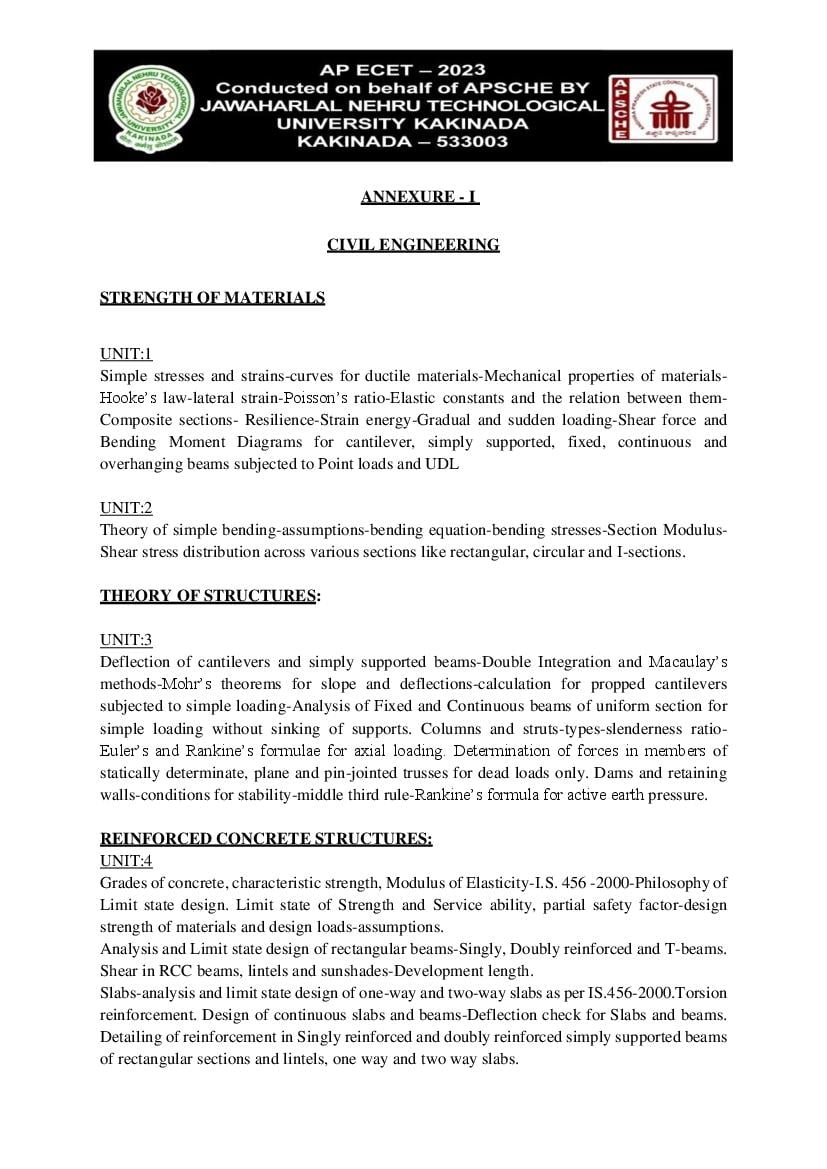
CIVIL ENGINEERING
STRENGTH OF MATERIALS
UNIT:1
Simple stresses and strains-curves for ductile materials-Mechanical properties of materials-
Hooke’s law-lateral strain-Poisson’s ratio-Elastic constants and the relation between them-
Composite sections- Resilience-Strain energy-Gradual and sudden loading-Shear force and
Bending Moment Diagrams for cantilever, simply supported, fixed, continuous and
overhanging beams subjected to Point loads and UDL
UNIT:2
Theory of simple bending-assumptions-bending equation-bending stresses-Section Modulus-
Shear stress distribution across various sections like rectangular, circular and I-sections.
THEORY OF STRUCTURES:
UNIT:3
Deflection of cantilevers and simply supported beams-Double Integration and Macaulay’s
methods-Mohr’s theorems for slope and deflections-calculation for propped cantilevers
subjected to simple loading-Analysis of Fixed and Continuous beams of uniform section for
simple loading without sinking of supports. Columns and struts-types-slenderness ratio-
Euler’s and Rankine’s formulae for axial loading. Determination of forces in members of
statically determinate, plane and pin-jointed trusses for dead loads only. Dams and retaining
walls-conditions for stability-middle third rule-Rankine’s formula for active earth pressure.
REINFORCED CONCRETE STRUCTURES:
UNIT:4
Grades of concrete, characteristic strength, Modulus of Elasticity-I.S. 456 -2000-Philosophy of
Limit state design. Limit state of Strength and Service ability, partial safety factor-design
strength of materials and design loads-assumptions.
Analysis and Limit state design of rectangular beams-Singly, Doubly reinforced and T-beams.
Shear in RCC beams, lintels and sunshades-Development length.
Slabs-analysis and limit state design of one-way and two-way slabs as per IS.456-2000.Torsion
reinforcement. Design of continuous slabs and beams-Deflection check for Slabs and beams.
Detailing of reinforcement in Singly reinforced and doubly reinforced simply supported beams
of rectangular sections and lintels, one way and two way slabs.
Page 2
Columns: Codal provisions of I.S 456-2000-short and long columns-different shapes-design of
short columns by limit state method-long columns- concept, effective lengthfor different end
conditions. Footings-Isolated column footings-one way shear and two-way shear. Stairs-types,
loads on stairs.
Working stress method of design: Basic principles, neutral axis, lever arm-Design and analysis
of Singly reinforced simply supported rectangular beams. Comparison of Limit
stateandWorking stress methods.
SURVEYING:
UNIT:6
Chain surveying- purpose and principle- errors and corrections- different operations in chain
surveying- obstacles – methods of calculation of area. Compass Surveying- purpose and
principle-bearings-traversing using prismatic compass-local attraction-errors. Levelling-
definitions-component parts-errors-classification of levelling-contouring-characteristics and
methods. Theodolite- principles and component parts- fundamental lines and relationship
among them- adjustments of theodolite- measurement of horizontal and vertical angles-errors-
traverse computations- bowditch and transit rule. Tacheometry-principle-stadiatacheometry-
tangential tacheometry, Total Station, Global positioning System – Importance, G.I.S – Use
and applications in Civil Engineering
HYDRAULICS.
UNIT:7
Fluid properties-specific weight–mass density-specific gravity-surfacetension-capillarity-
viscosity. Atmospheric pressure, gauge pressure and absolute pressure. Fluid pressure on plane
surfaces-Centre of pressure, measurement of fluid pressure using Piezometer and mano meters.
Types of flows-uniform, nonuniform, steady, unsteady, laminar and turbulent flows. Energies
of liquid in motion-continuity equation. Bernoulli’s theorem-Pitot tube-Venturi meter. Flow
thorough small and large orifices, free orifices, submerged orifices, co-efficients of orifices-
Cc, Cv and Cd. Flow through internal, external, convergent and divergent mouthpieces. Types
of Notches-rectangular and triangular, flowover notches. Types of Weirs-sharp crested and
broad crested-mathematical formulae for discharge-Francis and Bazin’s.
Page 3
Flow through pipes-major and minor losses-Chezy’s and Darcy’s formulae for loss of head due
to friction-HGL & TEL- Reynold’s number forlaminar and turbulent flows. Flow through open
channels-rectangular and trapezoidal-chezy’s formula for discharge -Kutter’s and Manning’s
equation for Chezy’s constants-Most economical sections. Centrifugal pumps without
problems. Classification of Turbines- Kaplan, Franci’s and Pelton wheel without problems-use
of Draft tube. Hydro-electricalinstallations-componentsand uses.
IRRIGATION ENGINEERING:
UNIT:9
Necessity of Irrigations- Perennial and inundation Irrigation, Flow and Lift Irrigation, Principal
crops-kharif and rabi seasons-Duty, delta and base period. Methods of Irrigation-check
flooding, basin flooding, contour bunding, furrow, sprinkler and drip Irrigations. Hydrology –
Rainfall, types of Rain gauges, types of catchments-rain fall and run off. Measurement of
velocity of flow in streams-Ryve’s and Dicken’s formulae for computing maximum flood
discharge. Classifications of Head works-component parts of diversion head works. Weirs and
Barrages. Percolation and uplift pressures. Types of Reservoirs-dead storage, live storage and
surcharge storage.
UNIT: 10
Storage Head works-different types of dams-rigid and non-rigid dams- gravity dams-low and
high dams. Elementary profile of a dam. Failures of gravity dams-drainage galleries. Ogee and
siphon spill ways. Earth dams— types, failures and precautions. Phreatic lines and drainage
arrangements in earthen dams. Distribution works-classifications and alignment of canals-
typical cross section of a canal-berm and balanced depth of cutting- canal lining. Lacey’s silt
theory. Cross drainage works–types and functions.
Page 4
Number of Questions to be set
CIVIL ENGINEERING
UNIT NO TOPICS MARKS
I & II Strength of Materials 20
III Theory of Structures 20
IV & V Reinforced Concrete Structures 20
VI Surveying 15
VII & VIII Hydraulics 15
IX & X Irrigation Engineering 10
Total 100
Page 5
MODEL QUESTIONS FOR CIVIL ENGINEERING
1. The Maximum Bending moment for a simply supported beam with uniformly
distributed load, ‘ω’ and a span of ‘l’ is
1)
2)
3)
4)
2. As per IS 456-2000, the least lateral dimension of a short column with effective length, l is
1) >
2) =
3) <
4)
3. The Reduced bearing with W.C.B =1200 is
1) N300E
2) S 600E
3) N300W
4) S 300W
4. The relation between cd, cv, cc for orifices is
1) cd=
2) cc=cvX cd
3) cd= ccXcv
4) cv=cc X cd
Document Details
| Board / Org | APSCHE |
| Exam | Andhra Pradesh Engineering Common Entrance Test |
| Type | Syllabus |
| Pages | 5 |
| Updated | 22 Jul 2026 |