Telangana Class 6 Syllabus Social Studies
Finished viewing? Save it for later —
Download Telangana Class 6 Syllabus Social Studies (PDF · 5 pages)About Telangana Class 6 Syllabus Social Studies
Telangana Class 6 Syllabus Social Studies is available here for free download. Published by Telangana Board for Class 6, this syllabus can be viewed online or downloaded as a PDF (5 pages). Candidates preparing for Class 6 can use Telangana Class 6 Syllabus Social Studies to understand the exam pattern, the type of questions asked, and the overall difficulty level.
Frequently Asked Questions
How can I download Telangana Class 6 Syllabus Social Studies?
Open this page and click the Download button to save Telangana Class 6 Syllabus Social Studies as a PDF. It is completely free on AglaSem Docs.
Is Telangana Class 6 Syllabus Social Studies free to download?
Yes. Telangana Class 6 Syllabus Social Studies can be viewed online and downloaded as a PDF free of cost on AglaSem Docs.
How many pages does Telangana Class 6 Syllabus Social Studies have?
Telangana Class 6 Syllabus Social Studies contains 5 pages, which you can read online or download together as a single PDF.
Where can I find more Class 6 study material?
You can find more Class 6 question papers, sample papers, syllabus, and answer keys on AglaSem Docs.
Telangana Class 6 Syllabus Social Studies – Text
Read the full text of this syllabus below — useful to quickly search, copy and reference the content online without downloading the PDF.
📄 View text version (5 pages)
Page 1
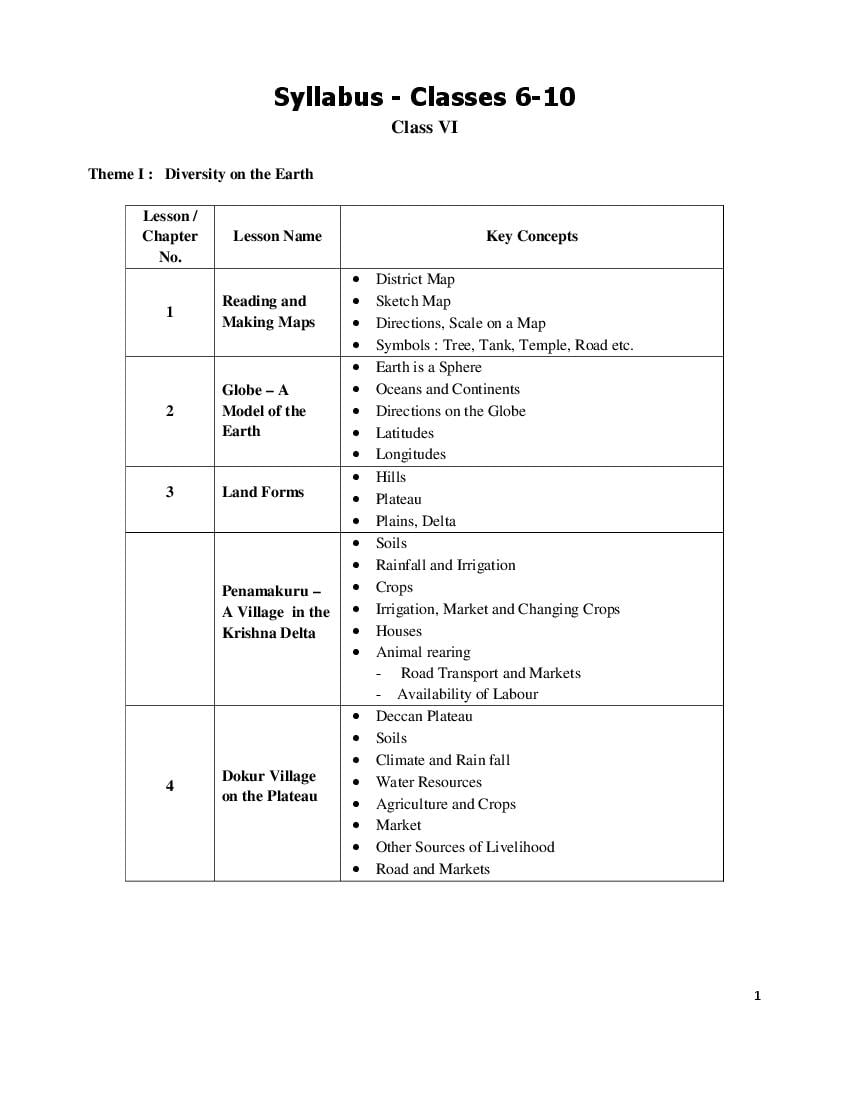
Class VI
Theme I : Diversity on the Earth
Lesson /
Chapter Lesson Name Key Concepts
No.
• District Map
Reading and • Sketch Map
1
Making Maps • Directions, Scale on a Map
• Symbols : Tree, Tank, Temple, Road etc.
• Earth is a Sphere
Globe – A • Oceans and Continents
2 Model of the • Directions on the Globe
Earth • Latitudes
• Longitudes
• Hills
3 Land Forms • Plateau
• Plains, Delta
• Soils
• Rainfall and Irrigation
Penamakuru – • Crops
A Village in the • Irrigation, Market and Changing Crops
Krishna Delta • Houses
• Animal rearing
- Road Transport and Markets
- Availability of Labour
• Deccan Plateau
• Soils
• Climate and Rain fall
Dokur Village • Water Resources
4
on the Plateau • Agriculture and Crops
• Market
• Other Sources of Livelihood
• Road and Markets
1
Page 2
• Podu Cultivation
Penugolu– A • Forest Products
5 Tribal Village in • Drinking Water
the Hills • Bamboo – Products
• Houses and Habitation
• Customs
• The Future of Konda Reddys
• Gathering Food and Hunting
From Gathering • Stone tools (stone-age sites of Telangana)
Food to • Fire
6 Growing Food – • Nomadic Life
The Earliest • Painting, Shared Living
People • Learning to grow Crops and tend Animals
• Domestication, Settled Life
Theme II. Production, Exchange and Livelihoods
• Venkatapuram – Agricultural Labourers in Groundnut
Fields
Agriculture in • Small Formers in Venkatapuram
7
Our Times • Contract Farming
• Small Farmers in Telangana
• Agriculture in Telangana
Trade in • Selling Vegetables on street – Case Study of Gouri –
Agricultural A small Vegetable Vendor
8 • Weekly Market (Santha)
Produce – Part
–A • A Case Study of dry Chilly Seller
• Rythu Bazars in Telangana
• Agriculture Market Yard
• Minimum Support Price
Part – B • Selling to a Rice Miller
• Selling through Brokers
• Trading Paddy in Telangana
• Indebtedness and Selling Paddy
Theme: III – Political Systems and Governance
Community • Tribes – Societies Where All People are Equal
Decision • Gond Panch and Patla
9
Making in a
• Village Headmen (Patla)
Tribe
2
Page 3
to Mahajanapadas
Emergence of • Villages and Cities and in the times of
10 Kingdoms and Mahajanapadas
Republics • Kings, Army and Tax System
• Magadha – a Powerful Kingdom
• Vajji – a Gana
• Mauryan Empire
• Ashoka, a Unique Ruler
• Ashoka’s War in Kalinga
11 First Empires • Ashoka’s Dharma
• Kingdom and Empires in the Deccan
• Some important empires of the Indian Sub-Continent
• What does a Government do?
• Types of Government
Democratic • Democracy – Democratic Governments
12 • Representative Democracy
Government
• Checks on elected Representatives
• Equality and Democracy
• Government at Different Levels
• Democracy at the Village level
• Gram Sabha
• Formation of Gram Panchayats – Gram Sabha
• Wards
• Reservations in Gram Panchyaths
Village • Elections
13 • Sarpanch, Upa-Sarpanch and Secretary
Panchayats
• Functions of Gram Panchyats
• Funds
• A Case Study of Jangamma, the Surpanch of
Hazipally
• A Case Study – Gangadevipally Panchyat
• Mandal and Zilla Parishad
• Formation of Municipalities – Vemulawada
Local Self – • Functions of Municipalities
14 Government in • Funds for the Municipalities
Urban Areas • Municipal Workers – Chinna and Nazma
• Vemulawada Municipality
3
Page 4
• Diversity in Our Neighbourhood
Diversity in Our • Diversity in India
15
Society • Study of Thar Desert and Sikkim
• Unity in Diversity
• Statement Regarding Women
• Statement on the Nature of both Men and Women
• Growing up as Boys and Girls
Towards • Sex Ratio / Fewer girls, Fewer Women
16
Gender Equality • Differences in Literacy Levels
• Right to Property
• Employment
• Unrecognized Work of Women
• Things are Changing Now
Theme – V : Religion and Society
• Hunter – Gatherers – Chenchus – Religious Practices
• Early Farmers and Herders
• Religion in the Indus Valley Civilization
• Religion of the Vedas – Hymns
Religion and • Worshiping dead ancestors – The Megaliths of the
17 Society in Early Deccan
Times • New Questions in the age of the Janapadas and Cities
• What happens after death ?
• What is it that will never Perish? (Atma)
• Parivrajakas
• Gautama Budha
• Early Religious Practices and Beliefs
• Hindu Religion
• Bhagawatas and Shaivas
Devotion and • Story Tellers
18 Love towards • Bhakti Movement
God • Alvars and Nayanars
• Christianity
• Islam
• The Belief in a Supreme God.
4
Page 5
• What is Language?
• Why are there so many Languages?
• Writing and Script – Different kinds of Scripts
• What did people write on?
Language, • Poems, Songs and Stories
19 Writing and • Vedas
Great Books
• The Great Epics – Ramayana and Mahabharata
• Sangam Literature in Tamil
• Books on Medicine, Surgery, Astronomy and
Mathematics
• Sanskrit literature
• Ancient Stone and Bronze Sculptures
Sculptures and • Harappa cities – The first cities of the Sub-Continent
20 • Mauryan period – Sculptures
Building
• Budhist Stupas and Viharas
• Rock cut Chaityas and Early Temples.
***
5