MAHA SET 2024 Paper II Chemical Sciences Set A Question Paper
Finished viewing? Save it for later —
Download MAHA SET 2024 Paper II Chemical Sciences Set A Question Paper (PDF · 44 pages)About MAHA SET 2024 Paper II Chemical Sciences Set A Question Paper
MAHA SET 2024 Paper II Chemical Sciences Set A Question Paper is available here for free download. Published by Maharashtra Exams for MAHA SET, this question paper can be viewed online or downloaded as a PDF (44 pages). Candidates preparing for MAHA SET can use MAHA SET 2024 Paper II Chemical Sciences Set A Question Paper to understand the exam pattern, the type of questions asked, and the overall difficulty level.
Frequently Asked Questions
How can I download MAHA SET 2024 Paper II Chemical Sciences Set A Question Paper?
Open this page and click the Download button to save MAHA SET 2024 Paper II Chemical Sciences Set A Question Paper as a PDF. It is completely free on AglaSem Docs.
Is MAHA SET 2024 Paper II Chemical Sciences Set A Question Paper free to download?
Yes. MAHA SET 2024 Paper II Chemical Sciences Set A Question Paper can be viewed online and downloaded as a PDF free of cost on AglaSem Docs.
How many pages does MAHA SET 2024 Paper II Chemical Sciences Set A Question Paper have?
MAHA SET 2024 Paper II Chemical Sciences Set A Question Paper contains 44 pages, which you can read online or download together as a single PDF.
Where can I find more MAHA SET study material?
You can find more MAHA SET question papers, sample papers, syllabus, and answer keys on AglaSem Docs.
MAHA SET 2024 Paper II Chemical Sciences Set A Question Paper – Text
Read the full text of this question paper below — useful to quickly search, copy and reference the content online without downloading the PDF.
📄 View text version (45 pages)
Page 1
MAHA SET 2024 Paper
II Chemical Sciences
Set A Question Paper
EXAM YEAR TYPE
MAHA SET 2024 Question Paper
Notes · Sample Papers · Previous Year Papers · Mock Tests
Page 2
.co s e m
s em l a
a ag
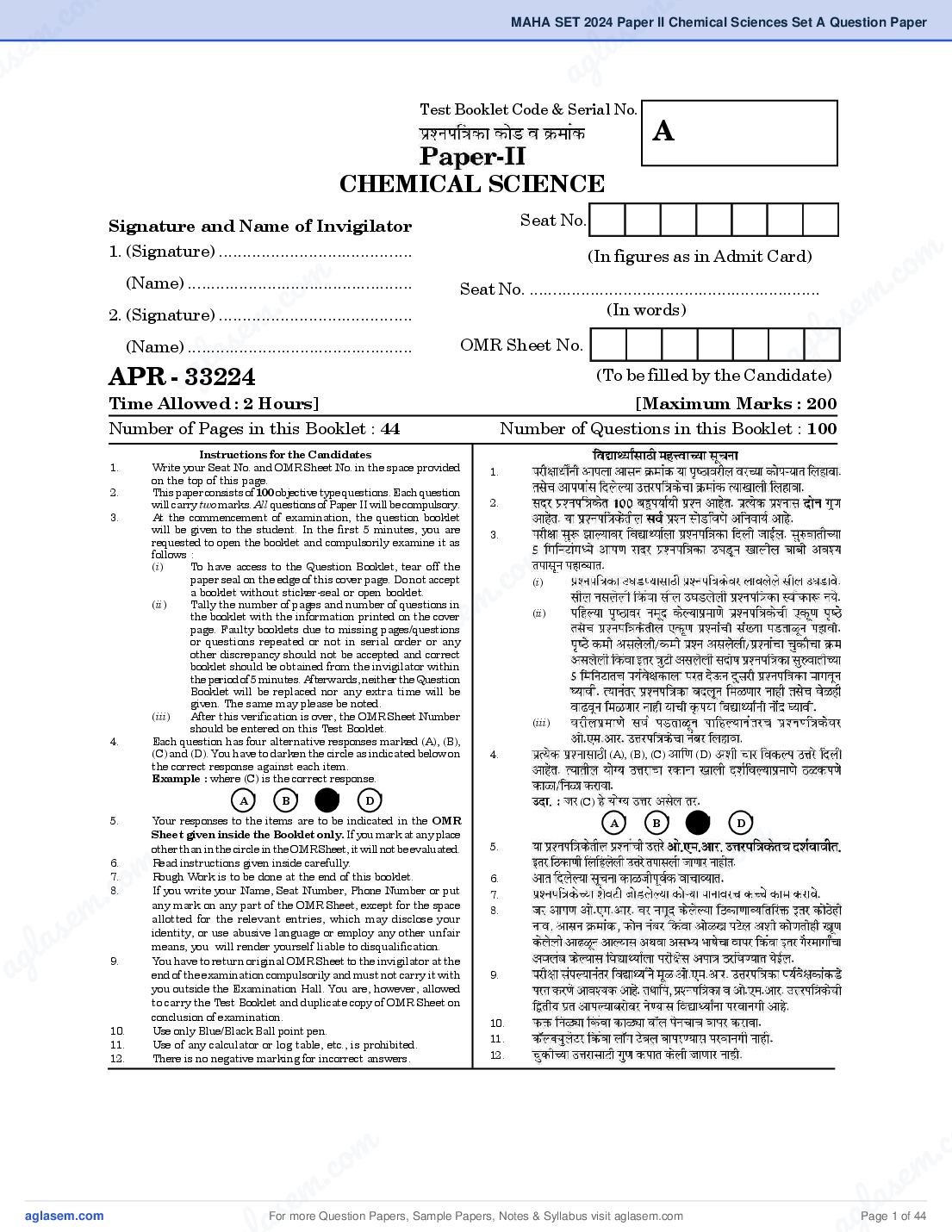
Test Booklet Code & Serial No.
A
CHEMICAL SCIENCE
Signature and Name of Invigilator Seat No.
m
co
1. (Signature) ......................................... (In figures as in Admit Card)
. c om
(Name) ................................................ Seat No. ..............................................................
e m .
em
2. (Signature) ......................................... (In words)
l as
s g
gla a
(Name) ................................................ OMR Sheet No.
APR - a33224 (To be filled by the Candidate)
Time Allowed : 2 Hours] [Maximum Marks : 200
Number of Pages in this Booklet : 44 Number of Questions in this Booklet : 100
Instructions for the Candidates
1. Write your Seat No. and OMR Sheet No. in the space provided 1.
on the top of this page.
2. This paper consists of 100 objective type questions. Each question
will carry two marks. All questions of Paper II will be compulsory. 2.
3. At the commencement of examination, the question booklet
will be given to the student. In the first 5 minutes, you are 3.
requested to open the booklet and compulsorily examine it as
m
.co
follows :
(i) To have access to the Question Booklet, tear off the
paper seal on the edge of this cover page. Do not accept (i)
m
a booklet without sticker-seal or open booklet.
(ii)
s
Tally the number of pages and number of questions in
e (ii)
a
the booklet with the information printed on the cover
l
page. Faulty booklets due to missing pages/questions
ag
or questions repeated or not in serial order or any
other discrepancy should not be accepted and correct
booklet should be obtained from the invigilator within
the period of 5 minutes. Afterwards, neither the Question
Booklet will be replaced nor any extra time will be
given. The same may please be noted.
(iii) After this verification is over, the OMR Sheet Number
(iii)
should be entered on this Test Booklet.
4. Each question has four alternative responses marked (A), (B),
(C) and (D). You have to darken the circle as indicated below on 4. (A), (B), (C) (D)
the correct response against each item.
Example : where (C) is the correct response.
A B D (C)
5. Your responses to the items are to be indicated in the OMR A B D
Sheet given inside the Booklet only. If you mark at any place
m
.co
other than in the circle in the OMR Sheet, it will not be evaluated. 5.
m
.co
6. Read instructions given inside carefully.
7. Rough Work is to be done at the end of this booklet. 6.
e m
s
8. If you write your Name, Seat Number, Phone Number or put
m
7.
e la
any mark on any part of the OMR Sheet, except for the space
s
8.
g
allotted for the relevant entries, which may disclose your
la a
identity, or use abusive language or employ any other unfair
g
means, you will render yourself liable to disqualification.
a 9. You have to return original OMR Sheet to the invigilator at the
end of the examination compulsorily and must not carry it with
you outside the Examination Hall. You are, however, allowed
9.
to carry the Test Booklet and duplicate copy of OMR Sheet on
conclusion of examination.
10.
10. Use only Blue/Black Ball point pen.
11.
11. Use of any calculator or log table, etc., is prohibited.
12. There is no negative marking for incorrect answers. 12.
m . c
c. o s e m
s em
For more Question Papers, Sample Papers, Notes & Syllabus visit
gl a
Page 1 of 44
Page 3
For more Question Papers, Sample Papers, Notes & Syllabus visit Page 2 of 44
Page 4
.co s e m
s em l a
a ag
Chemical Science
Paper II
Time Allowed : 120 Minutes] [Maximum Marks : 200
m
om
Note : This paper contains Hundred (100) multiple choice questions. Each question
. co
. c
carrying Two (2) marks. Attempt All questions.
e m
m
e of two lanthanoids easier than the others due to their redox
l as
1.
as
The recovery
l a g
ag
chemistry. These lanthanoids are :
(A) Pr4+, Tb4+ (B) Ce4+, Eu2+
(C) Nd4+, Ln2+ (D) Dy4+, Ln4+
2. Which one of the following is used for the formation of atomic vapours in Atomic
m
Absorption Spectroscopy ?
m .co
e
s (B) Electric arcs and sparks
l a
ag
(A) Flame atomization
(C) Sputtering devices (D) Ovens
3. The highest 10 Dq value obtained among the ligands Br–, PR3, en and H2O
in complexes will be for :
m
.co
(A) PR 3 (B) H2O
m
c. o (C) Br– s e m
m
(D) en
s e g lisa :
g la 4. a
The -ray source used in 57Fe Mössbauer spectroscopy
a (A) 57Co (B) 129Tc
(C) 119mSn (D) 121mSn
3 [P.T.O.
m . c
c. o s e m
s em
For more Question Papers, Sample Papers, Notes & Syllabus visit
gl a
Page 3 of 44
Page 5
0 for chromium (III) complexes [Cr(CN)6] , [Cr(en)3] ,
[Cr(H2O)6]3+ and [Cr(NH3)6]3+ is :
(A) [Cr(CN)6]3– > [Cr(en)3]3+ > [Cr(NH3)6]3+ > [Cr(H2O)6]3+
(B) [Cr(H2O)6]3+ > [Cr(NH3)6]3+ > [Cr(en)3]3+ > [Cr(CN)6]3–
(C) [Cr(H2O)6]3+ > [Cr(NH3)6]3+ [Cr(en)3]3+ > [Cr(CN)6]3–
(D) [Cr(en)3]3+ > [Cr(CN)6]3– > [Cr(NH3)6]3+ > [Cr(H2O)6]3+
6. The product of the following reaction is :
(A) (B)
(C) (D)
4
For more Question Papers, Sample Papers, Notes & Syllabus visit Page 4 of 44
Page 6
.co s e m
s em l a
a ag
7. The pair of compounds that are isoelectronic and isostructural is :
(i) C2B10H12
m
om . co
(ii) –
C2B9H12
. c e m
e m l as
as
(iii) C2B8NH 11
l ag
g
(iv)a C B SH 2
3 7 11
(A) (i), (ii) and (iii) (B) (ii), (iii) and (iv)
(C) (i), (iii) and (iv) (D) (i), (ii) and (iv)
59 7
8. The complex [Co(NH3)6]3+ will show NQR resonance lines due to Co; I =
2
m
and (14N; I = 1) :
m .co
s e
(A) 59Co only
l a
(B) 14N only
ag
(C) Both 59Co and 14N
(D) No resonance will be observed
9. In the 1H NMR spectrum of diborane number of resonance peaks obtained due
m
m
c. o to bridging hydrogens are : m.co
m s e
s e g la
la
(11B; I = 3/2)
g a
a (A) 21 (B) 7
(C) 3 (D) 35
5 [P.T.O.
m . c
c. o s e m
s em
For more Question Papers, Sample Papers, Notes & Syllabus visit
gl a
Page 5 of 44
Page 7
Octahedral structure ?
(A) [IF6]– (B) [SeBr6]2–
(C) [TeCl6]2– (D) [BrF6]–
11. Intramolecular oxidative coupling of the following organometallic species would
yield :
(A) (B)
(C) (D)
6
For more Question Papers, Sample Papers, Notes & Syllabus visit Page 6 of 44
Page 8
.co s e m
s em l a
a ag
12. The reactivities of halogen oxyanions and oxyacids are well understood by
studying Latimer diagram. The Latimer diagram for bromine species in acidic
m
om
medium is given below : . co
. c –s
e m
BrO4– e m BrO –
l a
s
HBrO Br2
a
3
l the correct statement(s) from the following : agBr
ag
Identify
(i) BrO3– is unstable with respect to disproportionation.
(ii) HBrO is more electrophilic.
(iii) Reactions of BrO4– are more rapid than BrO3– .
m
.co
(A) Statements (i) and (iii) are correct
e m
l as
(B) Statements (ii) and (iii) are correct
(C) Statements (i) and (ii) ag correct
are
(D) Only statement (ii) is correct
13. The point group of diborane is :
(A) D2h (B) C2 h
m
.co
(C) D h (D) D4h
m
c.14.o The Direct Synthesis method involving a reaction between a metal
s e mand an organic
s em halide is exothermic for : g l a
la a
ag (A) Mg and Pb (B) Bi and Hg
(C) Li and Mg (D) Li and Tl
7 [P.T.O.
m . c
c. o s e m
s em
For more Question Papers, Sample Papers, Notes & Syllabus visit
gl a
Page 7 of 44
Page 9
used as a catalyst. The cleavage of H2 on ZnO surface is of the type ..........
and produce .......................
(A) Heterolytic cleavage; hydrides and protons
(B) Homolytic cleavage; protons
(C) Homolytic cleavage; tiradicals
(D) Heterolytic cleavage; hydrides
16. In a non-aqueous medium, a weak acid gets dehydrated upon protonation.
Identify A and B in the equation given below :
HNO3 + 2H2SO4 [A] + [B] + [H3O]+
(A) A = [NO2]+, B = 2[HSO4]– (B) A = NO2, B = 2[HSO4]–
(C) A = [NO3]–, B = ½ SO3 (D) A = NO3– , B = 4SO3
17. Four different students reported % of bromine in an organic compound as 40.00,
40.10, 40.20 and 40.30. The mean deviation of their results is :
(A) 40.15 (B) 0.15
(C) 0.10 (D) –0.15
18. The incorrect statement about XeF6 is :
(A) It has 14 electrons around central xenon atom
(B) In condensed phase, it exists as an equilibrium mixture of 4 XeF 6
XeF5 F –
4
(C) It can be synthesized by reacting SbF 5 with XeF5 wherein XeF5 acts
as a fluoride ion acceptor
(D) It undergoes double-displacement reaction with SiO 2 to give xenon trioxide
8
For more Question Papers, Sample Papers, Notes & Syllabus visit Page 8 of 44
Page 10
.co s e m
s em l a
a ag
19. The trans-PtCl2(NH3)2 can be obtained from the transformation :
(A) [PtCl(NH3)3]+ + Cl– (B) [PtCl3(NH3)]– + NH3
o m
m . c
(C) [PtCl4] +co2NH3 m
2–
m . (D) Cis – [PtCl2(NH3)2] + Cl –
s e
s e g l a
la a
20. The allowed term symbol for microstate (1 – 0–) is :
ag
(A) 3 F (B) 3 P
(C) 1 P (D) 1G
21. In Frost diagram, NEº values for four different oxidation states of Thorium
m
is found to be Th(II) > Th(I) > Th(III) > Th(IV), then :
o
c
. state
e m
(A) Th(II) is the most stable oxidation
as
l to Th(I) and Th(IV)
a g
(B) Th(III) can disproportionate
(C) Th(II) can disproportionate to Th(I) and Th(III)
(D) Th(II) and Th(IV) can consproportionate to Th(III)
22. Bailar twist and Ray-Dutt twist pathways are observed for :
m
m .co
.co
(A) Octahedral complexes undergoing isomerization reaction
m s em
s e a
(B) Octahedral complexes undergoing electron-transferlreaction
g
g la a
a (C) Square-planar complexes undergoing substitution reaction
(D) Octahedral complexes undergoing substitution reaction
9 [P.T.O.
m . c
c. o s e m
s em
For more Question Papers, Sample Papers, Notes & Syllabus visit
gl a
Page 9 of 44
Page 11
be best explained by :
(A) Ferromagnetic coupling
(B) Spin-orbit coupling
(C) Temperature independent paramagnetism
(D) Antiferromagnetic coupling
24. Carbon monoxide poisoning happens due to :
(A) Binding of CO to deoxyhemoglobin leading to a paramagnetic complex
(B) Binding of CO to deoxyhemoglobin leading to a diamagnetic complex
(C) Binding of CO to oxidized cytochrome C oxidase
(D) Binding of two CO to heme leading to a diamagnetic complex
25. Which protein is NOT a part of e -transfer chain in photosystem II ?
(A) Plastocyanin (B) Plastoquinone
(C) Fe8S7 cluster (D) Cytochrome
26. For a hydrate alkali metal ion, [M(H2O)6]+, the rate of water exchange
increases :
(A) As the size of a metal ion decreases
(B) As the coordination number increases
(C) As the surface charge density increases
(D) As the electronegativity of the metal ion increases
10
For more Question Papers, Sample Papers, Notes & Syllabus visit Page 10 of 44
Page 12
.co s e m
s em l a
a ag
27. The g-value of a radical showing a four-line EPR signal centered at 3300
G in a spectrometer operating at 9.10 GHz is (Given Planck constant =
6.62608 × 10⁻³⁴ Js, Bohr magneton = 9.27402 × 10⁻²⁴ JT–1). m
om . co
(A) 1.97
. c (B) 2.1
e m
e m l as
(C) 2.2
l as (D) 2.4
ag
28. The g
a Jahn-Teller distortion in [Ti(H2O)6]3+ species leads to :
(A) No observed d-d transition
(B) Three Laporte-forbidden d-d transition
(C) Two spin forbidden d-d transition
(D) Only one Laporte-allowed d-d transition
o m
29. The species distribution diagram for phosphate is given below where y-axis
c
represents the fraction of the species ( .). The predominant species present at
e m
l as
pH 3.0, 5.0, 10.0 and 13.0 are respectively :
ag
m
m .co
m .co s e m
s e g la
g la a
a (A) H3PO4 , H2PO4– , HPO42– , PO3– (B) H2PO–4 , H2PO4– , HPO42– , PO3–
4 4
(C) H3PO4 , H2PO42– , HPO2– 3–
4 , PO4 (D) H3PO4 , HPO42– , HPO42– , PO3–
4
11 [P.T.O.
m . c
c. o s e m
s em
For more Question Papers, Sample Papers, Notes & Syllabus visit
gl a
Page 11 of 44
Page 13
is :
3a 2a
(A) r = (B) r =
4 4
a a
(C) r = (D) r
2 2 2
31. The line positions of a quartet signal of compound in 1H–NMR spectrum taken
on 200 MHz instrument are 791, 797, 803, 809 Hz respectively. The chemical
shift in ppm and coupling constant of same signal is :
(A) 4.0 , J = 6Hz (B) 4.3 , J = 9Hz
(C) 3.8 , J = 3Hz (D) 4.0 , J = 3Hz
32. Which of the structures given below do NOT follow isoprene rule ?
(A) (B)
(C) (D)
12
For more Question Papers, Sample Papers, Notes & Syllabus visit Page 12 of 44
Page 14
.co s e m
s em l a
a ag
33. The major product formed in the following reaction is :
m
om . co
. cC — H + e m
C6H13 — C
em l as
l as ag
ag
(A)
m
m .co
(B)
s e
l a
ag
(C)
m
m .co
m .co s e m
s e g la
g la a
a
(D)
13 [P.T.O.
m . c
c. o s e m
s em
For more Question Papers, Sample Papers, Notes & Syllabus visit
gl a
Page 13 of 44
Page 15
(A)
(B)
(C)
(D)
14
For more Question Papers, Sample Papers, Notes & Syllabus visit Page 14 of 44
Page 16
.co s e m
s em l a
a ag
35. Which of the following alcohols is NOT suitable substrate for sharpless
asymmetric epoxidation reaction ?
m
om . co
. c e m
s
(A)
em l a
l as ag
ag
(B)
m
(C)
m .co
s e
l a
(D)
ag
36. Predict the major product of the following reaction :
m
m
c. o (A) m.co
m s e
s e (B)
g la
g la a
a
(C) (D)
15 [P.T.O.
m . c
c. o s e m
s em
For more Question Papers, Sample Papers, Notes & Syllabus visit
gl a
Page 15 of 44
Page 17
at 150ºC, gives the following major product :
(A) 1-butene (B) 2-butene
(C) butane (D) 2-butanol
38. The major products of the following reaction is :
(A)
(B)
(C)
(D)
16
For more Question Papers, Sample Papers, Notes & Syllabus visit Page 16 of 44
Page 18
.co s e m
s em l a
a ag
39. The major products formed in the following reaction is :
m
om . co
. c e m
em l as
l as ag
ag
(A) X = Y =
m
m .co
s e
(B) X =
l a Y =
ag
(C) X = Y =
m
m .co
m .co s e m
s e g la
g la a
a (D) X = Y =
17 [P.T.O.
m . c
c. o s e m
s em
For more Question Papers, Sample Papers, Notes & Syllabus visit
gl a
Page 17 of 44
Page 19
(A)
(B)
(C)
(D) I & II =
18
For more Question Papers, Sample Papers, Notes & Syllabus visit Page 18 of 44
Page 20
.co s e m
s em l a
a ag
41. The major product of the following reaction is :
m
om . co
. c e m
em l as
l as ag
ag
(A)
m
m .co
s e
l a
ag
(B)
(C)
m
m .co
m .co s e m
s e g la
g la a
a (D)
19 [P.T.O.
m . c
c. o s e m
s em
For more Question Papers, Sample Papers, Notes & Syllabus visit
gl a
Page 19 of 44
Page 21
(A) P = Q =
(B) P = Q=
(C) P= Q =
(D) P = Q=
20
For more Question Papers, Sample Papers, Notes & Syllabus visit Page 20 of 44
Page 22
.co s e m
s em l a
a ag
43. The major products formed in the following reaction is :
m
om . co
. c e m
em l as
l as ag
ag
(A) P =
Q =
m
m .co
e
(B) P =
l as
ag
Q =
(C) P =
m
.co
Q =
m
m .co s e m
s e (D) P =
g la
g la a
a
Q =
21 [P.T.O.
m . c
c. o s e m
s em
For more Question Papers, Sample Papers, Notes & Syllabus visit
gl a
Page 21 of 44
Page 23
predict the major product ?
(A) II, (B) I,
(C) II, (D) I,
22
For more Question Papers, Sample Papers, Notes & Syllabus visit Page 22 of 44
Page 24
.co s e m
s em l a
a ag
45. The major product of the following reaction is :
m
om . co
. c e m
em l as
l as ag
ag
O
(A) (B)
NH
m
m (D) .co
s e
(C)
l a
ag
46. The compound that shows the following spectral data is,
IR : 1720 cm–1
1H-NMR (ppm) : 1.30 (t, J = 7Hz, 3H), 1.93(s, 3H), 4.19(q, J = 7Hz, 2H),
5.58 (d, J = 3Hz, 1H), 6.15(d, J = 3Hz, 1H) m
m .co
m .co s e m
s e (A) (B)
g la
g la a
a
(C) (D)
23 [P.T.O.
m . c
c. o s e m
s em
For more Question Papers, Sample Papers, Notes & Syllabus visit
gl a
Page 23 of 44
Page 25
1H-NMR (ppm) : 3.79 (s, 3H), 7.29 (d, J = 8Hz, 1H), 8.47 (dd, J = 8 and 2Hz,
1H), 9.11 (d, J = 2Hz, 1H).
(A) (B)
(C) (D)
48. The major product of the following reaction is :
(A) (B)
(C) (D)
24
For more Question Papers, Sample Papers, Notes & Syllabus visit Page 24 of 44
Page 26
.co s e m
s em l a
a ag
49. The major product(s) of the following reaction is/are :
m
om . co
. c e m
em l as
as ag
(A) gl
a
(B)
m
m .co
s e
a
(C)
l
ag
(D)
50. Predict the appropriate reagent for the following transformation :
m
m .co
m .co s e m
s e g la
g la a
a
(A) LiBH4, MeOH (B) LAH, THF
(C) BH3 . THF (D) NaCNBH3, THF
25 [P.T.O.
m . c
c. o s e m
s em
For more Question Papers, Sample Papers, Notes & Syllabus visit
gl a
Page 25 of 44
Page 27
C4H9—CH CH2 + C2H5—CH CH2 CH3—(CH2)5— —(CH2)5—CH3
(A) Thexylborane; CO; H2O2/NaOH
(B) Thexylborane; H2O2/NaOH
(C) 9-BBN; CO; H2O2/NaOH
(D) Triphenylborane; CO; H2O2/NaOH
52. Predict the major product of the following reaction :
(A) (B)
(C) (D)
26
For more Question Papers, Sample Papers, Notes & Syllabus visit Page 26 of 44
Page 28
.co s e m
s em l a
a ag
53. Predict the major product of the following reaction :
m
om . co
. c e m
em l as
l as ag
ag
(A) (B)
m
m (D) .co
s e
(C)
l a
ag
54. The correct order of reactivity of the following alcohols with p-nitrobenzoyl
chloride in a esterification reaction is :
m
m .co
m .co s e m
s e g la
g la a
a
(A) III > II > I (B) I > III > II
(C) II > III > I (D) II > I > III
27 [P.T.O.
m . c
c. o s e m
s em
For more Question Papers, Sample Papers, Notes & Syllabus visit
gl a
Page 27 of 44
Page 29
a
(A) (a), (b), (d) (B) (a), (b), (c)
(C) (a), (d), (e) (D) (a), (b), (e)
56. What will be the stereochemical outcome of the following reaction ?
(A) Starting material is ‘R’, while the product has ‘S’ configuration
(B) Starting material is ‘S’, while the product has ‘R’ configuration
(C) Starting material and product both have ‘S’ configuration
(D) Starting material and product both have ‘R’ configuration
28
For more Question Papers, Sample Papers, Notes & Syllabus visit Page 28 of 44
Page 30
.co s e m
s em l a
a ag
57. What position hydroxyl group of the alcohol will occupy in the most stable
conformation of the following molecule ?
m
om . co
. c e m
em l as
l as ag
ag
(A) Flagpole (B) Bowsprit
(C) Equatorial (D) Axial
m
m .co
e
58. Predict the major product of the following reaction :
s
l a
ag
(A) (B)
m
m .co
m .co s e m
s e g la
g la a
a (C) (D)
29 [P.T.O.
m . c
c. o s e m
s em
For more Question Papers, Sample Papers, Notes & Syllabus visit
gl a
Page 29 of 44
Page 31
(A) 2S, 3S, E (B) 2R, 3S, Z
(C) 2S, 3R, E (D) 2S, 3R, Z
60. The IUPAC name of the following compound is :
(A) 6–Bromo – 3-chloro – 4-methyl cyclohexene
(B) 3–Bromo – 6-chloro – 5-methyl cyclohexene
(C) 1–Bromo – 4-chloro – 5-methyl cyclohex – 2-ene
(D) 4–Bromo – 1-chloro – 6-methyl cyclohex – 2-ene
30
For more Question Papers, Sample Papers, Notes & Syllabus visit Page 30 of 44
Page 32
.co s e m
s em l a
a ag
61. The following diagrams represent the effect of ionic strength on relative free
energy of reactants and activated complex ( ). Which sketch, most appropriately
m
co
represents the gist of primary salt effect ?
. c om e m .
em l as
l as ag
g
(A) a
m
(B)
m .co
s e
l a
ag
(C)
m
m .co
m .co s e m
s e g la
g la a
a (D)
31 [P.T.O.
m . c
c. o s e m
s em
For more Question Papers, Sample Papers, Notes & Syllabus visit
gl a
Page 31 of 44
Page 33
reactions is expressed as :
A + B (AB) P
kenc rate constant associated to encounter of reactant pair.
kesc rate constant associated to escaping or separating pair.
The rate law is given as
d[P] kr kenc
= k + k [A][B]
dt esc r
The reaction would become diffusion controlled when :
(A) kr << kesc (B) kr >> kesc
(C) kr << kesc + kenc (D) kesc = kenc
63. In the following reaction mechanism
A + B X*
X* P
The rate constants have the relation
k2 << k1, k–1
The mechanism can be qualified as :
(A) steady state approximation (B) Pre-equilibrium approximation
(C) principle of mass balance (D) ACT approximation
32
For more Question Papers, Sample Papers, Notes & Syllabus visit Page 32 of 44
Page 34
.co s e m
s em l a
a ag
64. For the first order consecutive mechanism of the type
A B C,
m
the concentration m . co
. co [B] is expressed as s e m
s em k [A]
g l a
a a
1 0
l
– k1t
[B] = e – e– k2t .
ag
k –k 2 1
If k1 >> k2, then :
(A) [B] = [A]0 e– k1t (B) [B] = [A]0 e–k2t
– k1t
(C) [B] = [A]0 e – e– k2t (D) [B] = [A]0 e
– k1t
– ek2t
65. In 1.0 M H2SO4 solution, the mean activity coefficient of SO2–
m
4 ions can more
accurately estimated by :
m .co
e
sand base
l
(A) Debye-Huckel theory of acid
g a
(B) Debye-Huckel limiting a
law
(C) Debye-Huckel extended law
(D) Debye-Huckel theory for strong acids
66. Practically it is impossible to construct the standard hydrogen electrode (SHE)
because :
m
m
c. o (B) Due to vapour pressure of water, it is difficult to maintain
(A) It is difficult to get high purity H2 gas
m exact 1 atm .co
s e
s em g l a
la pressure of H2 gas
a
ag (C) Being inflammable, it is challenging to handle hydrogen gas in normal
laboratory condition
(D) It is impossible to measure the exact activity of H + ions
33 [P.T.O.
m . c
c. o s e m
s em
For more Question Papers, Sample Papers, Notes & Syllabus visit
gl a
Page 33 of 44
Page 35
The voltage was noted to be 1.10 V.
Based on this data, the equilibrium constant for the equilibrium (pK).
Zn(s) + Cu2+(aq) Zn2+(aq) + Cu(s)
will be,
(Given : RT (at room temp) = 2500 J.mol–1)
(A) pK = –80 (B) pK = –40
(C) pK = –30 (D) pK = –120
68. The following sketch represents the probability density distribution for :
(A) 3s orbital (B) 3d orbital
(C) 2p orbital (D) 1p orbital
34
For more Question Papers, Sample Papers, Notes & Syllabus visit Page 34 of 44
Page 36
.co s e m
s em l a
a ag
69. Born interpretation of wave function is based on :
(A) Probability of finding the particle (electron) in the region r and r + dr
m
is proportional to | |2 dr.
om . co
. c e m
m
e
(B) Continuous property of the chosen function throughout the limits
l as
l as ag
ag
(C) Mathematical representation of observable of the particle
(D) Normalization property of certain mathematical function
70. Degeneracy in rotational levels for H-atom along z-axis for l = 0, 1, 2, 3 are :
2
(Given : = 1.2 × 10⁻²¹ J)
2I
(A) 1, 2, 3, 4
m
(B) 1, 3, 5, 7
c.(D)o 1, 4, 9, 16
(C) 2, 4, 6, 8
e m
lasscattered from :
71. In X-ray diffraction, the raysgare
a
(A) atomic/ionic nuclei periodically arranged in crystal
(B) Lattice vibration (phonon) in the crystal
(C) Electrons cloud present in the crystal
m
.co
(D) Electrostatic potential among ions in the crystal
m
m .co s em
72. Due to symmetry consideration associated to crystals, some of the reflections
s e g la increases from
in X-ray diffraction are absent, systematically when symmetry
g la triclinic to cubic, the number of systematic absence a:
a
(A) increases (B) decreases
(C) no change (D) difficult to predict
35 [P.T.O.
m . c
c. o s e m
s em
For more Question Papers, Sample Papers, Notes & Syllabus visit
gl a
Page 35 of 44
Page 37
surface active molecules viz. stearic acid, isostearic acid and tri-p cresyl
phosphate :
Match the following :
(A) A D, B E, C F (B) A F, B E, C D
(C) A E, B F, C D (D) A E, B D, C F
74. The result of the following operation
d
A ( eikx ) A –i
dx
is :
(A) eikx (B) keikx
2
(C) k eikx (D) k eikx
36
For more Question Papers, Sample Papers, Notes & Syllabus visit Page 36 of 44
Page 38
.co s e m
s em l a
a ag
75. The change in the function (f) of two variables x and y will be exact if :
2 2
f f f f
m
(A) x y y x
om
(B) x 2
y 2
. co
m
y x
. c s e
e m l a
s g
2 2
f f
(C)
g l a
x. y y. x (D) ( f ) ( f) x y a
a
76. The partial pressure of NO (g) at 1 atm. of total pressure in the reaction given
2
below is :
( = degree of dissociation)
N2O4(g) 2NO2(g)
2 (1 – )
m
.co
(A) (B)
(1 ) (1 )
2(1 )
e m (D) (1 – )
(C)
(1 – )
l as 2
g
77. The normal boiling point ofaa liquid is 200 K. If the liquid behaves as ideal
H
liquid at 76 mm, then its boiling point will be close to : (Given : 2303K )
R
(A) 167 K (B) 20 K
(C) 200 K (D) 440 K
78. For Maxwell-Boltzmann statistics which of the following statements is
m
m
c. o incorrect ? m .co
m s e
s e la
(A) System has constant volume and constant total energy
g
g la a equation
a (B) The energy levels are eigen values of Schrodinger
(C) All possible distributions are equally probable
(D) Total energy depend upon the number of energy levels available
37 [P.T.O.
m . c
c. o s e m
s em
For more Question Papers, Sample Papers, Notes & Syllabus visit
gl a
Page 37 of 44
Page 39
constant energy condition, each system behaves as :
(A) Closed (B) Open
(C) Isolated (D) Condensed
80. At what temperature, the population in v = 1 level of I2 would become half
hcv
the population in ground energy level ? (Given : = 346.5 K)
k
(A) 773 K (B) 500 K
(C) 227 K (D) 300 K
81. The transmittance of a solution is 0.900 in 10 mm cell at certain wavelength.
What will be the transmittance of this solution in 5 cm cell at the same
wavelength ?
(A) 1.000 (B) 0.450
(C) 0.180 (D) 0.100
82. Every alternate line in Raman spectra of a symmetric top molecule has increased
intensity because of :
(A) Existence of nuclear spin
(B) Overlapping of S-branch lines with every alternate R-branch line
(C) Selection rule K = 0
(D) Combined rotational Raman spectra
38
For more Question Papers, Sample Papers, Notes & Syllabus visit Page 38 of 44
Page 40
.co s e m
s em l a
a ag
83. Assign the spectral lines given in the table to different vibrational modes of
A2B type molecule :
m
v(cm –1 )
om Description . co
. c e m
e m l as
s
(1) 590 IR-active (PQR branches)
l a ag
(2) g
a 1290 Raman active, polarized
IR-active (PR branches)
(3) 2220 Raman active, depolarized
IR-active (PR branches)
m
c. o
(A) 1 bending, 2 symmetric stretching, 3 asymmetric stretching
e m
s
(B) 1 bending, 2 asymmetric stretching, 3
symmetric stretching
l a
(C) 1
ag 2 asymmetric stretching, 3 bending
symmetric stretching,
(D) 1 asymmetric stretching, 2 bending, 3 symmetric stretching
84. For a free electron placed in magnetic field strength of 1.6 T, the value of magneton
will be :
(A) 9.273 × 10⁻²⁸ JT–1 (B) 9.273 × 10⁻²⁸ JG–1
o m
m . c
c. o (C) 9.273 × 10 JG m
–24 –1 (D) 0.9273 × 10⁻²⁸ JT–1
m 85. The molecular population is : s e
s e g la
g la a
a (A) Proportional to (2J + 1)–1 (B) Proportional to
(2J + 1)
e –E/kT
(C) Proportional to (2J + 1)e–E/kT (D) Proportional to (2J + 1)–1 eE/kT
39 [P.T.O.
m . c
c. o s e m
s em
For more Question Papers, Sample Papers, Notes & Syllabus visit
gl a
Page 39 of 44
Page 41
is incorrect ?
h
(Given : = 5.27 × 10⁻³⁵ kg. m2.s–1).
4
(A) Uncertainty in velocity is negligible
(B) Both position and velocity can be determined with reasonable precision
(C) Position of stone is precisely known
(D) Velocity cannot be measured accurately
87. The most probable distance of 1s electron in hydrogen like atom with atomic
number ‘z’ is given by :
z3
(A) (B) z.a0
a0
a0
(C) (D) z3.a0
z
88. By applying variation method, the ground state energy of the electron in
hydrogen atom is (in a.u.) :
(A) –2.75 (B) –0.5
(C) –2 (D) 0
89. In stepwise polymerization, the addition of a small amount of catalyst results
into :
(A) Increase in time required to reach high degree of polymerization
(B) No effect on molecular weight distribution
(C) Reduction in time required for reaching high degree of polymerization
(D) Lowering of esterification
40
For more Question Papers, Sample Papers, Notes & Syllabus visit Page 40 of 44
Page 42
.co s e m
s em l a
a ag
x 1
90. The adsorption of solution on a solid surface follows the equation = k.c n .
m
m
co
x
The plot of log
omm versus log (c) gives a horizontal line. It means :
m .
. c s e
(A) C = 0
e m (B) C = constant
l a
1
l as 1
ag
g
(C) 0 (D) C =
a n n
91. The strongest acid among the following is :
(A) H2SO4 (B) HNO3
(C) [SbF6]–H2F+ (D) HI
92. The following is the application of nanotechnology in recent years :
(A) Corona vaccines
m
(B) Pregnancy test kit
(C) Steel industry
m .co
(D) Paper industry
s e
l a
93. The ground state energy of hydrogen like species is proportional to :
(A)
–R ag (B)
–Rz 2
n2 n2
Rz2 Rz
(C) 2 (D)
n n
94. The point group of CO32– is :
m
m
(A) C3 h
c. o (C) C3v m
(B) D3h
.co
s e
em 95. According to molecular orbital theory, the correct order
(D) None of these
s g l a of energy for
g la a 2p
a orbital is :
(A) C2 < N2 < O2 (B) N2 < C2 < O2
(C) N2 < O2 > C2 (D) C2 < N2 > O2
41 [P.T.O.
m . c
c. o s e m
s em
For more Question Papers, Sample Papers, Notes & Syllabus visit
gl a
Page 41 of 44
Page 43
(A) 71.2539102 (B) 71.2539
(C) 71.25 (D) 71.2
97. The increasing order of acidity of pentafluorides (SbF 5, NbF5, PF5, AsF5 and
TaF5) in fluorosulphonic acid is :
(A) SbF5 > AsF5 > PF5 > TaF5 NbF5
(B) SbF5 > AsF5 > TaF5 NbF5 > PF5
(C) PF5 > NBF5 > TaF5 > AsF5 > SBF5
(D) SbF5 > AsF5 > TaF5 > NbF5 > PF5
98. Acetylene can be converted to 1-Bromo pentane via coupling of 1-Bromopropane.
The set of reagents required are :
(A) NaNH2, CH3CH2CH2Br; H2/Lindlar cut; HBr, H2O2
(B) NaNH2, CH3CH2CH2Br; H2, Pd/C; HBr
(C) NaNH2, CH3CH2CH2Br; LiAlH4; HBr, H2O2
(D) NaNH2, CH3CH2CH2Br; H2/Lindlar; HBr
99. A prodrug is :
(A) A protype member of a class of drugs
(B) The oldest member of a class of drugs
(C) An inactive drug that is transformed in the body to an active metabolite
(D) A drug that is stored in the body tissues and is gradually released in the
circulation
100. Which of the following compounds is an alkaloid ?
(A) Morphine (B) Tocopherol
(C) Carvone (D) Camphor
42
For more Question Papers, Sample Papers, Notes & Syllabus visit Page 42 of 44
Page 44
.co s e m
s em l a
a ag
ROUGH WORK
m
om . co
. c e m
em l as
l as ag
ag
m
m .co
s e
l a
ag
m
m .co
m .co s e m
s e g la
g la a
a
43 [P.T.O.
m . c
c. o s e m
s em
For more Question Papers, Sample Papers, Notes & Syllabus visit
gl a
Page 43 of 44
Page 45
44
For more Question Papers, Sample Papers, Notes & Syllabus visit Page 44 of 44
Document Details
| Board / Org | Maharashtra Exams |
| Exam | MAHA SET |
| Type | Question Paper |
| Pages | 44 |
| Updated | 17 Nov 2026 |