Odisha Board Class 12 Sample Question Botany
Finished viewing? Save it for later —
Download Odisha Board Class 12 Sample Question Botany (PDF · 37 pages)About Odisha Board Class 12 Sample Question Botany
Odisha Board Class 12 Sample Question Botany is available here for free download. Published by Odisha Board for Class 12, this question bank can be viewed online or downloaded as a PDF (37 pages). Candidates preparing for Class 12 can use Odisha Board Class 12 Sample Question Botany to understand the exam pattern, the type of questions asked, and the overall difficulty level.
Frequently Asked Questions
How can I download Odisha Board Class 12 Sample Question Botany?
Open this page and click the Download button to save Odisha Board Class 12 Sample Question Botany as a PDF. It is completely free on AglaSem Docs.
Is Odisha Board Class 12 Sample Question Botany free to download?
Yes. Odisha Board Class 12 Sample Question Botany can be viewed online and downloaded as a PDF free of cost on AglaSem Docs.
How many pages does Odisha Board Class 12 Sample Question Botany have?
Odisha Board Class 12 Sample Question Botany contains 37 pages, which you can read online or download together as a single PDF.
Where can I find more Class 12 study material?
You can find more Class 12 question papers, sample papers, syllabus, and answer keys on AglaSem Docs.
Odisha Board Class 12 Sample Question Botany – Text
Read the full text of this question bank below — useful to quickly search, copy and reference the content online without downloading the PDF.
📄 View text version (37 pages)
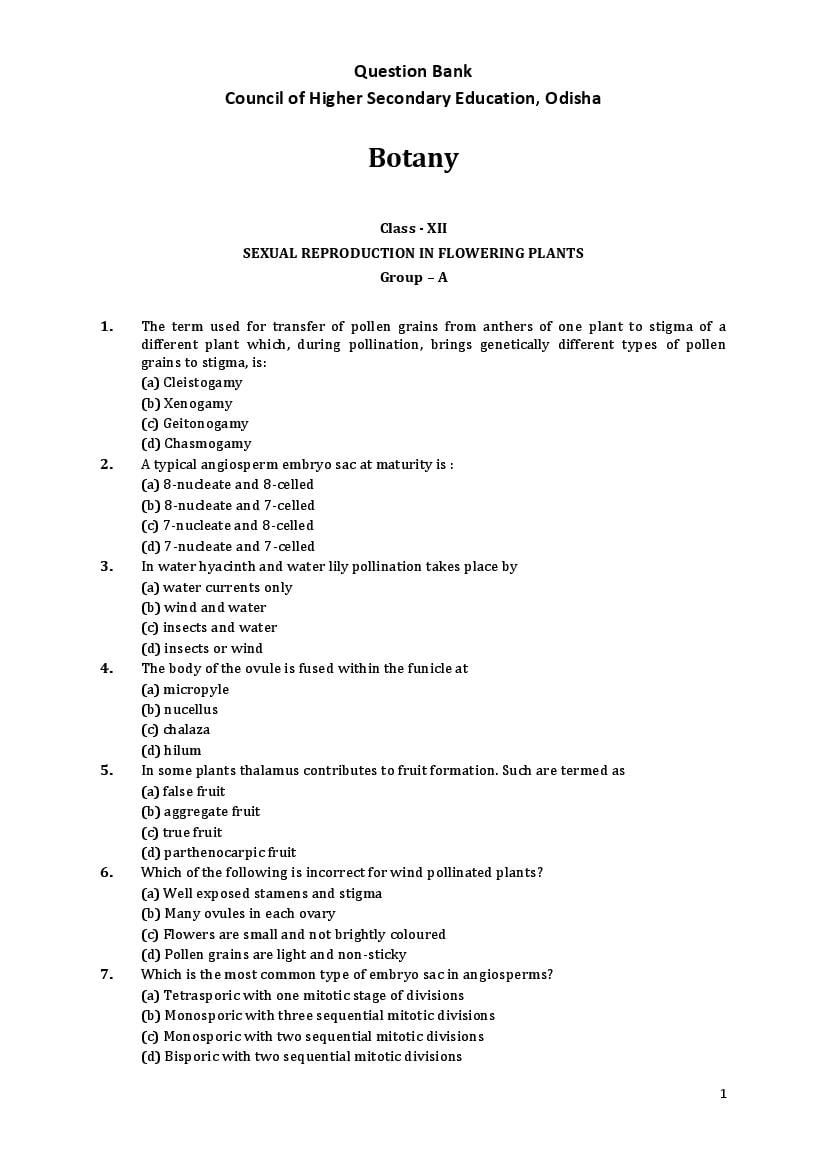
Page 1
Council of Higher Secondary Education, Odisha
Botany
Class - XII
SEXUAL REPRODUCTION IN FLOWERING PLANTS
Group – A
1. The term used for transfer of pollen grains from anthers of one plant to stigma of a
different plant which, during pollination, brings genetically different types of pollen
grains to stigma, is:
(a) Cleistogamy
(b) Xenogamy
(c) Geitonogamy
(d) Chasmogamy
2. A typical angiosperm embryo sac at maturity is :
(a) 8-nucleate and 8-celled
(b) 8-nucleate and 7-celled
(c) 7-nucleate and 8-celled
(d) 7-nucleate and 7-celled
3. In water hyacinth and water lily pollination takes place by
(a) water currents only
(b) wind and water
(c) insects and water
(d) insects or wind
4. The body of the ovule is fused within the funicle at
(a) micropyle
(b) nucellus
(c) chalaza
(d) hilum
5. In some plants thalamus contributes to fruit formation. Such are termed as
(a) false fruit
(b) aggregate fruit
(c) true fruit
(d) parthenocarpic fruit
6. Which of the following is incorrect for wind pollinated plants?
(a) Well exposed stamens and stigma
(b) Many ovules in each ovary
(c) Flowers are small and not brightly coloured
(d) Pollen grains are light and non-sticky
7. Which is the most common type of embryo sac in angiosperms?
(a) Tetrasporic with one mitotic stage of divisions
(b) Monosporic with three sequential mitotic divisions
(c) Monosporic with two sequential mitotic divisions
(d) Bisporic with two sequential mitotic divisions
1
Page 2
(a) emasculation
(b) bagging
(c) embryo rescue
(d) budding
9. What is the fate of the male gametes discharged in the synergid?
(a) All fuse with the egg
(b) One fuses with the egg, other (s) fuse (s) with synergid nucleus
(c) One fuses with the egg and other fuse with central cell nuclei
(d) One fuses with the egg other (s) degenerate (s) in the synergid
10. Which one of the following statements regarding post-fertilisation development in
flowering plants is incorrect?
(a) Zygote develops into embryo
(b) Central cell develops into endosperm
(c) Ovules develop into embryo sac
(d) Ovary develops into fruit
11. The cross pollination within the same species is also called
(a) Hybridization
(b) Xenogamy
(c) Allogamy
(d) Autogamy
12. During fertilization male gametes are carried by pollen tube. This is called:
(a) Syngamy
(b) Mesogamy
(c) Polygamy
(d) Siphonogamy
13. In Angiosperms, the common type of ovule is :
(a) Anatropous
(b) Orthotropous
(c) Hemianatropous
(d) Campylotropous
14. In a recently fertilized ovule, the haploid, diploid and triploid conditions are respectively
seen in
(a) Endosperm, Nucellus, Egg
(b) Egg, Nucellus, Endosperm
(c) Antipodals, Oospore, Primary Endosperm Nucleus
(d) Polar Nuclei, secondary nucleus, Endosperm
15. In sunflower, self pollination is avoided by
(a) Protogyny
(b) Unisexuality
(c) Self sterility
(d) Protandry
16. Sexual reproduction leads to :
(a) Polyploidy
(b) Recombination
2
Page 3
(d) Parthenogenesis
17. In an embryo sac, the cells that degenerate after fertilization are :
(a) Synergids and primary endosperm cell
(b) Synergids and antipodals
(c) Antipodals and primary endosperm cell
(d) Egg and antipodals.
18. While planning for an artificial hybridization programme involving dioecious plants,
which of the following steps would not be relevant:
(a) Bagging of female flower
(b) Dusting of pollen on stigma
(c) Emasculation
(d) Collection of pollen
19. In the embryos of a typical dicot and a grass, true homologous structures are :
(a) Coleorhiza and coleoptile
(b) Coleoptile and scutellum
(c) Cotyledons and scutellum
(d) Hypocotyl and radicle.
20. The phenomenon observed in some plants wherein parts of the sexual apparatus is used
for forming embryos without fertilization is called:
(a) Parthenocarpy
(b) Apomixis
(c) Vegetative propagation
(d) Sexual reproduction.
21. In a flower, if the megaspore mother cell forms megaspores without undergoing meiosis
and if one of the megaspores develops into an embryo sac, its nuclei would be :
(a) Haploid
(b) Diploid
(c) A few haploid and a few diploid
(d) With varying ploidy
22. The phenomenon wherein, the ovary develops into a fruit without fertilization is called:
(a) Parthenocarpy
(b) Apomixis
(c) Asexual reproduction
(d) Sexual reproduction
ANSWER
Q. No. Key Q. No. Key Q. No. Key
1 B 9 C 17 B
2 B 10 C 18 C
3 D 11 B 19 C
4 D 12 D 20 B
5 A 13 A 21 B
6 B 14 C 22 A
7 B 15 D
8 A 16 A
Answer the followings by changing the underlines words.
(i) Development of Pollen grain from microsporogenous tissue is known as male
gametophyte.
3
Page 4
(iii) Entry of Pollen tube through chalazal end is porogamy.
(iv) Seed develops from ovary.
(v) Remnant of nucellus is known as tapetum.
Answers:
(i)Microsporogenesis
(ii) Chalaza
(iii) Chalazogamy/Basigamy
(iv)Ovule
(v) Perisperm
Write the answer in one word:
(a) Opening of ovule
(b) Nutritive tissue supply food to ovule
(c) Nutritive tissue supply food for development of Pollen grain.
(d) Combination of egg &synergids.
(e) Pollination by wind.
(f) Pollination by bat.
Answers:
(a) Micropyle
(b) Placenta
(c) Tapetum
(d) Egg apparatus
(e) Anemophily
(f) Chiropterophily
Group - B
1. Write notes on the following in 2 to 5 important point.
(a) Self sterility
(b) Entomophily
(c) Embryo Sac
(d) Embryo
(e) Polyembryony
(f) Apomixis
(g) Self Incompatibility
(h) Self pollination
(i) Parthenocarpy
(j) Endosperm
(k) Structure of pollen grain
(l) Dichogamy
(m) Tapetum
(n) Triple Fusion
2. Differentiate between the following within 3 to 4 important point
(a) Zoophily and Anemophily
(b) Double fertilization and Triple fusion
(c) Microsporogeneis and microgametogenesis
4
Page 5
(e) Pollination and fertilization
(f) Self pollination and cross pollination
(g) Gamete and zygote
(h) Parthenogenesis and Pantherocarpy
(i) Cleistogamy and Herkogamy
(j) Coleoptile and Coleorrhiza
(k) Perisperm and Pericarp
Group – C
1. Explain double fertilization and triple fusion in angiosperm.
2. What is pollination? Describe the contrivances / adaptations (out breeding division) of
cross pollination
3. Describe the development of male gametophyte in angiosperms
4. Describe the development of female gametophyte in angiosperms
5. Describe different types of agents with adaptations of flowers for cross pollination.
6. Briefly explain the pattern of development of monosporic type of Embryo sac.
***
PRINCIPLES OF INHERITANCE
Group – A
1. How many true breeding pea plant varieties did Mendel select as pairs, which were
similar except in one character with contrasting traits?
(a) 2
(b)14
(c) 8
(d) 4
2. Identify the indirect statement with reference to the gene ‘I’ controls ABO blood groups.
(a) A person will have only two of the three alleles
(b) When IA and IB are present together, they express same type of sugar
(c) Allele ‘I’ does not produce any sugar
(d) The gene (I) has three alleles
3. The number of contrasting characters studied by Mendel for his experiments was
(a) 14
(b) 4
(c) 2
(d) 7
4. The best example for pleiotropy is
(a) skin colour
(b) phenylketonuria
(c) colour blindness
(d) ABO blood group
5. Match the following columns and choose the correct option from the codes given below.
Column-I Column-II
A. Pleiotropic gene 1. Both alleles express equally
B. Codominance 2. Change in nucleotides
5
Page 6
phenotypic expression
D. Mutation 4. Non-allelic gene inheritance
Codes
A B C D
(a) 1 2 3 4
(b) 2 3 4 1
(c) 3 1 4 2
(d) 1 3 4 2
6. The production of gametes by the parents, the formation of zygotes, the F1 and F2 plants,
can be understood using
(a) pie diagram
(b) a pyramid diagram
(c) Punnett square
(d) Venn diagram
7. In Antirrhinum (snapdragon), a red flower was crossed with a white flower and in
F1-generation, pink flowers were obtained. When pink flower were selfed, the F 2-
generation showed white, red and pink flowers.
Choose the incorrect statement from the following:
(a) Pink colour in F1is due to incomplete dominance
(b) Ratio of F2 is 1/4 (Red) : 2/4 (Pink) : 1/4 (White)
(c) Law of segregation does not apply in this experiment
(d) This experiment does not follow the principle of dominance
8. Which one of the following pairs is incorrectly matched?
(a) XO type sex-determination - Grasshopper
(b) ABO blood grouping - Codominance
(c) Starch synthesis in pea - Multiple alleles
(d) TH Morgan - Linkage
9. Select the correct statement.
(a) Spliceosomes take part in translation
(b) Punnett square was developed by a British scientist
(c) Franklin Stahl coined the term ‘linkage’
(d) Transduction was discovered by S Akman
10. Which of the following characteristics represents ‘inheritance of blood groups’ in
humans?
1. Dominance
2. Codominance
3. Multiple allele
4. Incomplete dominant
Polygenic inheritance
Choose the correct option:
(a) 2, 1 and 5
(b) 1, 2 and 3
(c) 2, 3 and 5
(d) 1, 3 and 5
11. AB blood group shows
6
Page 7
(b) incomplete dominance
(c) polygenic inheritance
(d) pleiotropy
12. In pea plants, green pod colour is dominant over yellow pods. 1000 seeds taken from a
pea plant on germination produce 760 green pod and 210 yellow pod plants. The parental
genotype and phenotype of the seed plant are
(a) heterozygous and yellow
(b) heterozygous and green
(c) homozygous and yellow
(d) homozygous and green
13. Which one from those given below is the period of Mendel’s hybridization experiments?
(a) 1856-1863
(b) 1840-1850
(c) 1857-1869
(d) 1870-1877
14. The genotypes of a husband and wife are and one among the blood types of their children,
how many different genotypes and phenotypes are possible?
(a) 3 genotypes, 3 phenotypes
(b) 3 genotypes, 4 phenotypes
(c) 4 genotypes, 3 phenotypes
(d) 4 genotypes, 4 phenotypes
15. If two people with AB blood group marry and have sufficient large number of children,
these children could be classified as A blood group, AB blood group and B blood group in
1 : 2 : 1 ratio.Modern technique of protein electrophoresis reveals the presence of both A
and B type proteins in AB blood group individuals. This is an example of
(a) codominance
(b) incomplete dominance
(c) partial dominance
(d) complete dominance
16. A true breeding plant is
(a) one that is able to breed on its own
(b) produced due to cross-pollination among unrelated plants
(c) homozygous and produces offspring of its own kind
(d) always homozygous recessive in its genetic constitution
17. A tall true breeding garden pea plant is crossed with a dwarf true breeding garden pea
plant. When the F1 plants were selfed the resulting genotypes were in the ratio of :
(a) 1 : 2 : 1 :: Tall heterozygous : Tall homogenous Dwarf
(b) 3 : 1 :: Tall : Dwarf
(c) 3 : 1 :: Dwarf : Tall
(d) 1 : 2 : 1 :: Tall homogenous : Tall heterogenous : Dwarf
18. Match the terms in column I with their description in Column II and choose the correct
option.
Column-I Column-II
A. Dominance 1. Many genes govern a single character
7
Page 8
expresses itself
C. Pleiotropy 3. In a heterozygous organism, both alleles
express themselves fully
D. Polygenic inheritance 4. A single gene influences many characters
Codes:
A B C D
(a) 2 3 4 1
(b) 4 1 2 3
(c) 4 3 1 2
(d) 2 1 4 3
19. Chromosomal theory of inheritance was proposed by
(a) Sutton and Boveri
(b) Bateson and Punnett
(c) TH Morgan
(d) Watson and Crick
20. Experimental verification of the chromosomal theory of inheritance was done by
(a) Sutton
(b) Boveri
(c) Morgan
(d) Mendel
21. To make chromosomal studies easier, chromosomes are classified into certain groups. So,
the chromosome number 21, 22 and Y are listed in
(a) A
(b) D
(c) E
(d) G
22. What map unit (centimorgan) is adopted in the construction of genetic maps?
(a) A unit of distance between two expressed genes representing 100% crossover
(b) A unit of distance between genes on chromosomes, representing 1 % crossover
(c) A unit of distance between genes on chromosomes, representing 50% crossover
(d) A unit of distance between two expressed genes representing 10% crossover
23. The frequency of recombination between gene pairs on the same chromosome as a
measure of the distance between genes was explained by
(a) Gregor J Mendel
(b) Alfred Sturtevant
(c) Sutton -Boveri
(d) TH Morgan
24. The production of gametes by the parents, formation of zygotes, the F 1 and F2 plants, can
be understood from a diagram called:
(a) Net square
(b) Bullet square
(c) Punch square
(d) Punnett square
25. Given below are two statements:
8
Page 9
the Laws of Inheritance
Statement II: Seven characters examined by Mendel in his experiment on pea plants
were seed shape and colour, flower colour, pod shape and colour, flower position and
stem height.
In the light of the above statements, choose the correct answer from the options given
below:
(a) Both Statement I and Statement II are incorrect.
(b) Statement I is correct but Statement II is incorrect.
(c) Statement I is incorrect but Statement II is correct.
(d) Both Statement I and Statement II are correct.
ANSWER
Q. No. Key Q. No. Key Q. No. Key
1 B 10 B 19 A
2 B 11 A 20 C
3 D 12 B 21 D
4 B 13 A 22 B
5 C 14 C 23 B
6 C 15 A 24 D
7 C 16 C 25 B
8 C 17 D
9 B 18 A
Answer the following questions by changing the underlined words.
(a) Phenotypic and genotypic ratio in monohybrid test cross is 3 : 1.
(b) When F1 hybrid crosses to both the parent is known as reciprocal cross.
(c) Accepted law of Mendel is Law of dominance.
(d) If the genotype is AaBbCc then it will producesix different types of gametes.
(e) Father of Modern Genetics is Mendel.
Answers:
(a) 1 : 1
(b) Back cross
(c) Law of Segregation
(d) 8
(e) Bateson
Fill in the blanks.
(a) Mendel’s laws of inheritance were first published in__________ and rediscovered in_________
(b) A trait that always appears in two contrasting conditions is called a___________ trait.
(c) A breeding experiment dealing with a single trait is called a__________ cross.
(d) An organism in which both the genes for a character are similar is known as____________
(e) Mendel noted ___________pairs of contrasting traits in pea plants.
(f) A____________ cross illustrates the principle of Independent assortment.
(g) An allele of T is_________________
(h) Monohybrid cross in F2 generation yields _____________ types of phenotype.
(i) Monohybrid cross in F2 generation yields _____________ types of genotype.
9
Page 10
(k) Dihybrid cross in F2 generation yields _____________ number of genotypes.
(l) Genotype of a plant showing the dominant phenotype can be determined by ____________
cross.
(m) In a cross between AaBB and aaBB, the genotypic ratio in F 1 generation will be ___________
(n) The experimental plant material used by Mendel was ______________
Answers:
(a) 1866, 1900
(b) Contrasting
(c) Monohybrid
(d) Homozygous (pure)
(e) Seven
(f) Dihybrid
(g) ‘t’
(h) Dominant
(i) Heterozygous (hybrid)
(h) two
(i) three
(j) four
(k) nine
(l) test
(m) 1:1
(n)Pisumsativum
Write one word answer for the following statements.
(a) Alternating form of gene present in homologous chromosome.
(b) Study about heredity and variation
(c) Morphological appearance of organisms
(d) Identical allele in homologous chromosome
(e) Many gene control one character.
Answers:
(a) Allele or Allelomorph
(b) Genetics
(c) Phenotype
(d) Homozygous
(e) Polygene
Correct the statement of each bit, if necessary changing the underlined word only:
1. The process of transfer of characters through generation is known as variation.
2. In Mendel’s monohybrid cross, the dwarf phenotype is alwayshomozygous.
3. In Mendel’s dihybrid cross in F2 generation nine phenotypes are produced.
4. The phenomenon of linkage disproved the principle of independent assortment.
5. In a text cross, always dominant parent is used.
6. The distance between genes in a constructed gene map is expressed as Mendel unit.
10
Page 11
8. There is crossing over between the members of a multiple alleles group.
Group - B
1. Write notes on the following in 2 to 5 valid & relevant point.
(a) Law of segregation
(b) Law of dominance
(c) law of independent assortment
(d) multiple alleles
(e) Co-dominance
(f) Recombination
(g) pleiotropy
(h) genes
(i) Chromosome theory of inheritance
2. Differentiate between the following with 3 to 4 important point
(a) Homozygous& Heterozygous
(b) Genotype & Phenotype
(c)Test cross & Back Cross
(d) Qualitative and Quantitative inheritance
(e) Codominance and Incomplete dominance
(f) Monohybrid and Dihybrid cross
Group – C
1. Describe Mendel’s dihybrid cross with a cheker board.
2. Describe Mendel’s monohybrid cross and explain the law derived from it.
3. State and explain Mendel’s laws of inheritance.
***
MOLECULAR BASIS OF INHERITANCE
Group - A
1. In a DNA strand the nucleotides are linked together by:
(a) glycosidic bonds
(b) phosphodiester bonds
(c) peptide bonds
(d) hydrogen bonds
2. A nucleoside differs from a nucleotide. It lacks the:
(a) base
(b) sugar
(c) phosphate group
(d) hydroxyl group
3. Both deoxyribose and ribose belong to a class of sugars called:
(a) Trioses
(b) hexoses
(c) pentoses
(d) polysaccharides
4. The fact that a purine base always pairs through hydrogen bonds with a pyrimidine base
in the DNA double helix leads to:
(a) the antiparallel nature
11
Page 12
(c) uniform width throughout the DNA
(d) uniform length in all DNA
5. The net electric charge on DNA and histones is:
(a) both positive
(b) both negative
(c) negative and positive respectively
(d) zero
6. The promoter site and the terminator site for transcription are located at:
(a) 3' (downstream) end and 5' (upstream) end respectively of the transcription unit
(b) 5' (upstream) end and 3' (downstream) end respectively of the transcription unit
(c) the 5' (upstream) end
(d) the 3' (downstream) end
7. Which of the following statements is the most appropriate for sickle cell anemia?
(a) It cannot be treated with iron supplements
(b) It is a molecular disease
(c) It confers resistance to acquiring malaria
(d) All of the above
8. Which of the following is true with respect to AUG?
(a) It codes for methionine only
(b) It is an initiation codon
(c) It codes for methionine in both prokaryotes and eukaryotes
(d) All of the above
9. The first genetic material might be:
(a) protein
(b) carbohydrates
(c) DNA
(d) RNA
10. With regard to mature mRNA in eukaryotes:
(a) exons and introns do not appear in the mature RNA
(b) exons appear but introns do not appear in the mature RNA
(c) introns appear but exons do not appear in the mature RNA
(d) both exons and introns appear in the mature RNA
11. The human chromosome with the highest and least number of genes in them are
respectively:
(a) Chromosome 21 and Y
(b) Chromosome 1 and X
(c) Chromosome 1 and Y
(d) Chromosome X andY
12. Who amongst the following scientists had no contribution in the development of the
double helix model for the structure of DNA?
(a) Rosalind Franklin
(b) Maurice Wilkins
(c) Erwin Chargaff
(d) Meselson and Stahl
13. DNA is a polymer of nucleotides which are linked to each other by 3'-5' phosphodiester
bond to prevent polymerization of nucleotides, which of the following modifications
would you choose?
(a) Replace purine with pyrimidine
(b) Remove/Replace 3' OH group in deoxyribose
(c) Remove/ Replace 2-OH group with some other group in deoxyribose
12
Page 13
14. Discontinuous synthesis of DNA occurs in one strand, because:
(a) DNA molecule being synthesized is very long
(b) DNA dependent DNA polymerase catalyzespolymerization only in one direction (5'-3')
(c) It is a more efficient process
(d) DNA ligase joins the short stretches of DNA
15. Which of the following steps in transcription is catalyzed by RNA polymerase?
(a) Initiation
(b) Elongation
(c) Termination
(d) All of the above
16. Control of gene expression in prokaryotes take place at the level of:
(a) DNA replication
(b) Transcription
(c) Translation
(d) None of the above
17. Which of the following statements is correct about the role of regulatory proteins in
transcription in prokaryotes?
(a) They only increase expression
(b) They only decrease expression
(c) They interact with RNA polymerase but do not affect the expression
(d) They can act both as activators and as repressors
18. Which was the last human chromosome to be completely sequenced ?
(a) Chromosome 1
(b) Chromosome 11
(c) Chromosome 21
(d) Chromosome X
19. Which of the following are the functions of RNA?
(a) It is a carrier of genetic information from DNA to ribosomes synthesizing
polypeptides.
(b) It carries amino acids to ribosomes.
(c) It is a constituent component of ribosomes.
(d) All of the above.
20. While analyzing the DNA of an organism a total number of 5386 nucleotides were found
out of which the proportion of different bases were: Adenine = 29%, Guanine = 17%,
Cytosine = 32%, Thymine = 17%.
Considering the Chargaff as rule it can be concluded that:
(a) It is a double stranded circular DNA
(b) It is single stranded DNA
(c) It is a double stranded linear DNA
(d) No conclusion can be drawn
21. In some viruses, DNA is synthesized by using RNA as template. Such a DNA is called:
(a) A-DNA
(b) B-DNA
(c) c-DNA
(d) r-DNA
22. If Meselson and Stahl’s experiment is continued for four generations in bacteria, the ratio
of N15/N14: N15/N14: N14/N14 containing DNA in the fourth generation would be:
(a) 1:1:0
(b) 1:4:0
(c) 0:1:3
13
Page 14
23. If the sequence of nitrogen bases of the coding strand of DNA in a transcription unit is: 5'-
ATGAATG-3', the sequence of bases in its RNA transcript would be;
(a) 5'-AUGAAUG-3'
(b) 5'-UACUUAC-3'
(c) 5'-CAUUCAU-3'
(d) 5'-GUAAGUA-3'
24. The RNA polymerase holoenzyme transcribes:
(a) the promoter, structural gene and the terminator region
(b) the promoter and the terminator region
(c) the structural gene and the terminator region
(d) the structural gene only.
25. If the base sequence of a codon in mRNA is 5'-AUG-3', the sequence of t-RNA pairing with
it must be:
(a) 5'-UAC-3'
(b) 5'-CAU-3'
(c) 5'-AUG-3'
(d) 5'-GUA-3'
26. The amino acid attaches to the t-RNA at its:
(a) 5'-end
(b) 3'-end
(c) Anticodon site
(d) DHU loop
27. To initiate translation, the mRNA first binds to:
(a) The smaller ribosomal sub-unit
(b) The larger ribosomal sub-unit
(c) The whole ribosome
(d) No such specificity exists.
28. In E.coli, the lac operon gets switched on when:
(a) lactose is present and it binds to the repressor
(b) repressor binds to operator
(c) RNA polymerase binds to the operator
(d) lactose is present and it binds to RNA polymerase
29. Which of the following is a correct sequence of steps in a PCR (Polymerase Chain
Reaction) ?
(a) Annealing, Denaturation, Extension
(b) Denaturation, Annealing, Extension
(c) Denaturation, Extension, Annealing
(d) Extension, Denaturation, Annealing
30. Complete the flow chart on central dogma.
(a) (a)-Transduction; (b)-Translation; (c)-Replication; (d)-protein
(b) (a)-Replication; (b)-Transcription; (c)-Transduction; (d)-protein
(c) (a)-Translation; (b)-Replication; (c)-Transcription; (d)-Transduction
(d) (a)-Replication; (b)-Transcription; (c)-Translation; (d)-protein
ANSWER
Q. No. Key Q. No. Key Q. No. Key
1 B 11 C 21 C
2 C 12 D 22 D
14
Page 15
4 C 14 B 24 C
5 C 15 B 25 B
6 B 16 B 26 B
7 D 17 D 27 A
8 D 18 A 28 A
9 D 19 D 29 B
10 B 20 B 30 D
Answer the followings by changing the underlined words.
(a) Smallest unit of gene is cistron
(b) Kornberg Enzyme is DNA Polymerase-III.
(c) m-RNA is known as soldier of the cell.
(d) Knicking and resealing enzyme is unwindase
(e) Initiation codon + stop codon is known as Nonsense codon
(f) Griffith proposed the double helical structure of DNA.
(g) A nucleoprotein is building block of all nucleic acids.
(h) In B DNA the helical turns are left handed.
(i) The term transforming principle was proposed by Avery.
(j)The enzyme, ligase is responsible for transcription.
(k) The enzyme gyrase is responsible for synthesis of new DNA stand on template DNA.
Answers:
(a)Muton
(b) DNA polymerase-I
(c) t-RNA
(d)Topoisomerase
(e) Punctuation codon
(f)James Watson and Francis Crick
(g)Nucleotide
(h)Z- DNA
(i)Fredric Griffith
(j)DNA dependent RNA polymerase
(k)DNA polymerase
Write the answer in one technical word.
(a) The biosynthesis process of proteins.
(b) Sites of protein synthesis.
(c) Acts as a carrier of genetic information from the nucleus to the ribosomes for the
synthesis of proteins.
15
Page 16
attached to a specific t-RNA.
(e) The process of synthesis of mRNA from DNA.
(f) Triplets of bases on DNA.
(g) Triplets of bases on mRNA.
(h) Triplets of bases on t-RNA
(i) Charging of t-RNA is catalyzed by enzyme.
(j) Primer producing enzyme
(k) Enzyme responsible for polymerization of DNA
(l) Fragments of DNA formed in the lagging strand
(m) Synthesis of protein from DNA via RNA
(n) Functional unit of gene
(o) Non-coding sequence of DNA
Answers:
(a)Translation
(b) Ribosomes
(c) m-RNA
(d)charging of t-RNA
(e) Transcription
(f)Codogen
(g) Codon
(h)Anticodon
(i)Aminoacyl t-RNA
(j)RNA primase
(k)DNA polymerase
(l) Okazaki fragments
(m) Central dogma
(n) Cistron
(o) Intron
Correct the statement of each bit, if necessary changing the underlined word only:
1. The coding sequences in between the DNA are called introns.
2. The non coding sequences are called exons.
3. Mendel and Griffithproposed the double helical structure of DNA.
4. Mendel proposed the transforming principle.
5. A-site in prokaryotes only accepts t-RNA met.
6. Avery, MC Carty and Macleod experimentally proved that the transforming principle is a
protein.
Answer:
1. Exons
2. Intron
16
Page 17
4.Fredric Griffith
5. P-site
6. DNA
Fill in the blanks.
(a) Protein synthesis is translation of__________
(b) Information in DNA in the nucleus is transferred to the ribosomes by__________
(c) A sequence of three nucleotides in DNA corresponds to the____________
(d) The synthesis of RNA on DNA template is called_________________
(e) Transcription begins when__________ binds to a promoter site.
(f) Elongation of RNA polynucleotide chain always takes place in_______direction with new
nucleotide always added at___________
(g) Termination signals on DNA template during formation of mRNA, lies in the region rich
in__________
(h) Each codon on mRNA consists of_____________
(i) Activation of amino acids during protein synthesis requires________________
(j) Aminoacyl synthetase enzyme takes part in___________
(k) Peptidyl and aminoacyl sites are associated with__________
(l) The first t-RNA that is brought to the initiating codon is always____________
(m) ___________ codons are not recognized by any aminoacyl t-RNA.
(n) The major function of mRNA is to__________
(o) In protein synthesis, the codon used as a start signal is____________
(p) To identify criminals DNA ____________ is done.
(q) The enzyme _________________ hydrolyses DNA molecules.
(r) The enzyme ________________ helps to join nucleotides.
(s) The segment of DNA that expresses specific character is called ______________.
Answers:
(a)genetic code
(b)mRNA
(c) three nucleotides in mRNA
(d) transcription
(e)RNA polymerase
(f) 5’-3’direction and 3’ end
(g) GC
(h) three nucleotides
(i) ATP
(j)activation of amino acid
(k) 70S subunit of ribosome
(l) t-RNA met-f
(m) UAA, UAG, UGA
(n)transfer genetic information into protein
(o) AUG
(p)DNA finger printing
17
Page 18
(r)ligase
(s)gene
Group – B
1. Write notes on the following in 2 to 5 valid and relevant point
(i)t-RNA
(ii)m-RNA
(iii)r-RNA
(iv) Split gene
(v) Central dogma
(vi) RNA- splicing
(vii) Genetic code
(viii) Nucleosome
(ix)Genetic code
(x) Transcription
(xi)Codon
(xii)Anticodon
(xiii)Translation
(xiv)Base pairing
(xv)Activation of amino acids
(xvi)Activation of ribosomes
(xvii)Role of nonsense codons in protein synthesis
(xviii) Flow of information in living organisms
(xix)Central dogma
(xx)Reverse transcription
(xxi) Operon
(xxii) HGP(Human Genome Project)
(xxiii) DNA – finger printing
2. Differentiate between the following with 3 to 4 important point
(a) Genes & Chromosomes
(b) DNA & RNA
(c) Exons & Introns
(d) Replication & Transcription
(e) Transcription & Translation
(f) Chromosomes and Chromatin
(g) m-RNA and t-RNA
(h) Codon and anti-codon
(i)Muton and Recon
(j)Replication and Transcription
Group – C
1. Describe double helical structure of DNA with a labeled diagram.
2. Explain an evidence of proof DNA as a genetic material
3. Explain the mechanism of translation in prokaryotes
4. Explain the mechanism of transcription in prokaryotes.
5. Describe the process of DNA replication
18
Page 19
7. What do we mean by Genetic Code. Give properties of the genetic code.
8. List the various components of protein synthesis. Briefly outline the mode of protein
synthesis in plants.
9. Describe in detail the process of translation in plants. Give appropriate diagrams
wherever necessary.
10. Describe the mechanism of Replication of DNA in prokaryotes.
11. DNA as genetic material. Justify it.
12. What are three types of RNA molecules? How is each related to the concept of
information flow?
13. What are major differences in protein synthesis in prokaryotes and eukaryotes?
***
MICROBES IN HUMAN WELFARE
Group - A
1. Removal of large pieces of floating debris, oily substances, etc, during sewage treatment
called
(a) Primary treatment
(b) Secondary treatment
(c) Final treatment
(d) Amplification
2. During Biogas production, species used to bring about anaerobic digestion are of
(a) Sacchharomyces
(b) Pseudomonas
(c) Rhizopus
(d)Methanococcus
3. The microorganism used to produce enzyme pectinase is
(a) Saccharomyces
(b) Scrertiana
(c) Rhizopus
(d) Trichoderma
4. Which one of the following is free living bacterial biofertilizer?
(a) Azotobactor
(b)Scirotiana
(c) Rhizopus
(d) Bacillus thuringiensis
5. Which of the following is not an advantage of biogas?
(a) In burns with blue flame without smoke
(b) It helps to improve sanitation of the surroundings
(c) It is highly expensive
(d) It can be used for domestic lighting
6. Most commonly used substance for industrial production of beer is
(a) Barley
(b) Wheat
(c) Corn
19
Page 20
7. The vitamin whose content increases following the conversion of milk into curd by lactic
acid bacteria is :
(a) digesters
(b) activated sludge
(c) chemicals
(d) oxidation pond
8. In olden days cheese was prepared by
(a) Aspergillus
(b) Rennet enzyme
(c) Clostridium bacteria
(d) None of the above
9. Which micro-organism is used in the formation of cheese
(a) Streptococcus
(b) Aspergillus
(c) Acetic acid bacteria
(d) Lactic add bacteria
10. Big holes in Swiss cheese are made by :
(a) a machine
(b) a bacterium that produces methane gas
(c) a bacterium producing a large amount of carbon dioxide
(d) a fungus that releases a lot of gases during its metabolic activities.
11. The residue left after methane production from cattle dung is :
(a) burnt
(b) burned in land fills
(c) used as manure
(d) used in civil construction.
12. Methanogens do not produce:
(a) oxygen
(b) methane
(c) hydrogen sulfide
(d) carbon dioxide
13. Activated sludge should have the ability to settle quickly so that it can :
(a) be rapidly pumped back from sedimentation tank to aeration tank
(b) absorb pathogenic bacteria present in waste water while sinking to the bottom of the
settling tank
(c) be discarded and anaerobically digested
(d) absorb colloidal organic matter.
14. Match the items in Column ‘A’ and Column ‘ B’ and choose correct answer.
Column A Column B
(i)Ladybird (a) Methano bacterium
(ii)Mycorrhiza (b) Trichoderma
(iii) Biological control (c) Aphids
(iv) Biogas (d) Glomus
The correct answer is :
20
Page 21
(b) (i) (c) (ii) (d) (iii) (b) (iv) (a)
(c) (i) (d) (ii) (a) (iii) (b) (iv) (c)
(d) (i) (c) (ii) (b) (iii) (a) (iv) (d)
15. Conversion of milk to curd improves its nutritional value by increasing the amount of
(a) Vitamin B12
(b) vitamin-A
(c) vitamin-D
(d) vitamin-E
16. Azollais used as a biofertilizer because it
(a) has association of mycorrhiza
(b) Multiplies at faster rate to product; massive biomass
(c) has association of nitrogen-fixing Rhizobium
(d) has association of nitrogen-fixing cyanobacteria
17. Roquefort cheese is ripened by using a
(a) type of yeast
(b) fungus
(c) bacterium
(d) cyanobacteria
18. Which of the following is incorrect matched in the given table?
Microbes Products Applications
(a) Monascus Statins Lowering of blood purpureus
cholesterol
(b) Streptococcus Streptokinase Removal of clot from blood vessel
(c) Clostridium Lipase Removal of oil stains butylicum
(d) Trichoderma Cyclosporin-A Immunosuppressive drug
Polysporum
19. Match Column I with Column II and select the correct option using the codes given below:
Column-I Column-II
A. Citric acid 1. Trichoderma
B. Cyclosporin 2. Clostridium
C. Statins 3. Aspergillus
D. Butyric acid 4. Monascus
Codes:
ABCD
(a) 3 1 2 4
(b)3 3 4 2
(c) 1 4 2 3
(d) 3 4 1 2
20. Which of the following is not used as a biopesticide?
(a) Bacillus thurigiensis
(b) Xanthonomuscampestris
(c) Nuclear Polyhedrosis Virus (NPV)
(d)Trichodermaharzianum
21. Which of the following in sewage treatment removes suspended solids?
(a) Tertiary treatment
21
Page 22
(c) Primary treatment
(d) Sludge treatment
ANSWER
Q. No. Key Q. No. Key
1 A 12 A
2 D 13 A
3 B 14 B
4 A 15 A
5 B 16 D
6 D 17 B
7 C 18 C
8 B 19 B
9 D 20 B
10 C 21 C
11 C
Answer the followings by changing the underlined words.
(a) The source of Acetic acid is Aspergillusniger
(b) VAM is seen in Ectomycorrhiza
(c) Swiss cheese is formed by the Fungi
(d) Antibiotics term was coined by Flemming
(e) Streptokinase produces from Yeast
Answers:
(a)Acetobacteracetii
(b) Endomycorrhiza
(c) Bacterium (propioni bacterium sharmanii)
(d) Waksman
(e) Streptococcus
Answer in one word.
(a) Bioactive molecule use as immunosupressive agent during organ transplantation.
(b) Association between higher plant root and fungi
(c) Enzyme removes oily stains in laundry
(d) Chemical retards the growth of bacteria
(e) Weeds control by fungal extracts
Answer:
(a)Cyclosporin-A
22
Page 23
(c) Lipase
(d) Antibiotics
(e) Weedicide
Fill in the Blanks.
(a) Statins is produced by____________
(b) Clot buster is_____________
(c) ____________represent the amount of dissolved oxygen consumed by micro organisms
growing due to sewage water
(d) ____________ discovered the penicillin.
(e) Antibiotic term was given by________________
Answers:
(a)Monascus
(b)Streptokinase
(c) BOD
(d) Alexander Flemming
(e) Waksman
Group – B
1. Write notes on the following in 2 to 5 valid & relevant point
(a) Biopesticide
(b) Biofertilizer
(c) Microbes in industry
(d) Microbes in antibiotic production
(e) Microbes in sewage treatment
(f) Biogas.
(g) BOD
(h) Microbe in household
2. Differentiate between the following with 3 to 4 important point
(a)Symbiotic Nitrogen fixation &asymbiotic nitrogen fixation
(b) Chemical fertilizer and biofertilizer
(c) Ectomycorrhiza and Endomycorrhiza
***
Biotechnology and its application
Group – A
1. What is antisense technology?
(a) When a place of RNA that is complementary in sequence is used to stop expression of
a specific gene.
(b) RNA polymerase producing DNA.
(c) A cell displaying a foreign antigen used for synthesis of antigens.
23
Page 24
2. Cry I endotoxins obtained from Bacillus thuringiensis are effective against
(a) nematodes
(b) bollworms
(c) mosquitoes
(d) flies
3. Human insulin is being commercially produced from a transgenic species of
(a) Rhizobium
(b) Saccharomyces
(c) Escherichia
(d) Mycobacterium
4. Which one of the following is commonly used in transfer of foreign DNA into crop
plants?
(a) Meloidogyne incognita
(b) Agrobacterium tumefaciens
(c) Penicilliumexpansum
(d) Trichodermaharzianum
5. What is true about Bt toxin?
(a) Bt protein exists as active toxin in the Bacillus.
(b) The activated toxin enters the ovaries of the pest to sterilize it and thus prevent its
multiplication.
(c) The concerned Bacillus has antitoxins.
(d) The inactive protoxin gets converted into active form in the insect gut.
6. Genetic engineering has been successfully used for producing
(a) Transgenic mice for testing safety of polio vaccine before use in humans
(b) Transgenic models for studying new treatments for certain cardiac diseases
(c) Transgenic insect for pest control
(d) Transgenic potato of more amount of starch
7. Bt cotton is not
(a) a GM plant
(b) insect resistant
(c) a bacterial gene expressing system
(d) resistant to all pesticides
8. C-peptide of human insulin is
(a) a part of mature insulin molecule
(b) responsible for formation of disulphide bridges
(c) removed during maturation of proinsulin to insulin
(d) responsible for its biological activity.
9. GEAC stands for
(a) Genome Engineering Action Committee
(b) Ground Environment Action Committee
(c) Genetic Engineering Approval Committee
(d) Genetic and Environment Approval Committee
10. α-1-antitrypsin is
(a) an antacid
(b) an enzyme
(c) used to treat arthritis
(d) used to treat emphysema
11. Human insulin is being commercially produced from a transgenic species of
(a) Rhizobium
(b) Saccharomyces
(c) Escherichia
(d) Mycobacterium
12. A probe which is a molecule used to locate homologous sequences in a mixture of DNA
or RNA molecules could be:
(a) a ssRNA
(b) a ssDNA
24
Page 25
(d) can be ssDNA but not ssRNA
13. Choose the correct option regarding retrovirus.
(a) An RNA virus that synthesizes DNA during infection
(b) A DNA virus that synthesizes RNA during infection
(c) A ssDNA virus
(d) A dsRNA virus
14. The site of production of ADA in the body is
(a) erythrocytes
(b) lymphocytes
(c) blood plasma
(d) osteocytes
15. A protoxin is
(a) a primitive toxin
(b) a denatured toxin
(c) toxin produced by protozoa
(d) inactive toxin
16. Pathophysiology is the
(a) study of physiology of pathogen
(b) study of normal physiology of host
(c) study of altered physiology of host
(d) none of the above
17. The trigger for activation of toxin of Bacillus thuringiensis is
(a) acidic PH of stomach
(b) high temperature
(c) alkaline PH of gut
(d) mechanical action in the insect gut
18. ‘Cry protein’ coded by gene Cry IAb controls
(a) Cotton bollworm
(b) Corn borer
(c) Tobacco budworm
(d) Mosquito
19. Nematode specific genes were introduced into the tobacco host plant using a vector
(a) pBR322
(b) plasmid
(c) bacteriophage
(d) Agrobacterium
20. In RNAi, genes are silenced using
(a) ssDNA
(b) dsDNA
(c) dsRNA
(d) ssRNA
21. The first clinical gene therapy was done for the treatment of
(a) AIDS
(b) Cancer
(c) Cystic fibrosis
(d) SCID(Severe CombinedImmuno Deficiency resulting from deficiency of ADA)
22. ADA is an enzyme which is deficient in a genetic disorder SCID. What is the full form of
ADA?
(a) Adenosine deoxyaminase
(b) Adenosine deaminase
(c) Aspartate deaminase
(d) Arginine deaminase
23. Silencing of a gene could be achieved through the use of
(a) RNAi only
(b) antisense RNA only
(c) both RNAi and antisense RNA
25
Page 26
24. Biopiracy means
(a) use of biopatents
(b) thefts of plants and animals
(c) stealing of bioresources
(d) exploitation of bioresources without authentic permission
25. Which one of the following is not the product of transgenic experiments?
(a) Pest-resistant crop variety
(b) High nutritional value in grains
(c) Production of insulin by rDNA technique
(d) Drought-resistant crops
ANSWER
Q. No. Key Q. No. Key Q. No. Key
1 A 10 D 19 D
2 B 11 C 20 C
3 C 12 C 21 D
4 B 13 A 22 B
5 D 14 B 23 C
6 A 15 D 24 D
7 D 16 C 25 C
8 C 17 C
9 C 18 B
Group - B
1. Write notes on the following in 2 to 5 valid & relevant point
(a) Humulin
(b) Recombinant vaccine
(c) Gene therapy
(d) Bio pesticide
(e) Bio piracy
(f) Bio Patent
(g) Bio pesticide
(h) Bt Colton
(i) Sem cell technology
(j) Genetically Modified Organism(GMO)
********************
ORGANISM & POPULATION
Group - A
1. To which population category India belongs?
(a) High birth rate and high mortality rate
(b) Low birth rate and low mortality rate
(c) Low birth rate and high mortality rate
(d) High birth rate and low mortality rate
26
Page 27
(a) Xerophytes
(b) Halophytes
(c) Hydrophytes
(d) Mesophytes
3. Which of the following is not a hydrophytic angiosperm?
(a) Chara
(b) Hydrilla
(c) Lotus
(d) Water lettuce
4. Mechanical tissue is undeveloped in
(a) Xerophytes
(b) Hydrophytes
(c) Halophytes
(d) Mesophytes
5. Which one is partially submerged and fixed in mud?
(a) Marsilea
(b) Cyperus
(c) Eichhornia
(d) Typha
6. Xerophytes are mostly
(a) Succulents
(b) Water related
(c) Mesophytes
(d) None of these
7. Some organisms are tolerant to a narrow range of salinity and are termed as
(a) Euryhaline
(b) Stenohaline
(c) Neither (a) nor (b)
(d) Saline
8. A nonsucculent xerophyte with thick leathery leaves having white sticky waxy coating
(a) Nerium
(b) Calotropis
(c) Bryophyllum
(d) Ruscus
9. The feature of the xerophytic plant leaves are
(i) Leathery surface
(ii) Large surface area
(iii) Waxy cuticle
(iv) Sunken stomata on upper epidermis
(a) (i), (ii) and (iv)
(b) (ii) and (iii)
(c) (i), (iii) and (iv)
(d) (i) and (iv)
10. Xeric environment is characterized by
(a) Precipitation
27
Page 28
(c) Extremes of temperature
(d) High rate of vaporization
11. What is wrong about xerophytes?
(a) Sunken stomata
(b) Small spiny leaves
(c) Thick Cuticle
(d) Larger number of stomata
12. Which one is not a trait of xerophytes?
(a) Thick cuticle
(b) Sunken stomata
(c) Aerenchyma
(d) Well developed mechanical tissue
13. The vegetation of Rajasthan is
(a) Arctic
(b) Alpine
(c) Deciduous
(d) Xerophytic
14. Type of plants having adaptations to check transpiration is
(a) Xerophytes
(b) Lithophytes
(c) Halophytes
(d) Epiphytes
15. Which one of the following statements cannot be connected to Predation ?
(a) It might lead to extinction of a species
(b) Both the interacting species are negatively impacted
(c) It is necessitated by nature to maintain the ecological balance
(d) It helps in maintaining species diversity in a community
16. While explaining interspecific interaction of population, (+) sign is assigned for beneficial
interaction, (–) sign is assigned for detrimental interaction and (0) for neutral interaction.
Which of the following interactions can be assigned (+) for one species and (–) for
another species involved in the interaction?
(a) Amensalism
(b) Commensalism
(c) Competition
(d) Predation
17. Amensalism can be represented as :
(a) Species A (+) ; Species B (0)
(b) Species A (–) ; Species B (0)
(c) Species A (+) ; Species B (+)
(d) Species A (–) ; Species B (–)
18. Which of the following is not an attribute of a population?
(a) Natality
(b) Mortality
(c) Species interaction
(d) Sex ratio
28
Page 29
Column-I Column-II
A. Herbivores 1. Commensalism
B. Mycorrhiza 2. Mutualism
C. Sheep Cattle 3. Predation
D. Orchid Tree 4. Competition
Codes:
A B C D
(a) 4 2 13
(b) 3 2 4 1
(c) 2 1 3 4
(d) 1 3 4 2
20. The impact immigration on population density is
(a) negative
(b) positive
(c) Both a (a) and (b)
(d) Neutralized by natality
21. Match Column I with Column II
Column-I Column-II
A. Saprophyte 1. Symbiotic association of fungi with plant roots
B. Parasite 2. Decomposition of dead organic materials
C. Lichens 3. Living on living plants or animals
D. Mycorrhiza 4. Symbiotic association of algae and fungi
Codes:
ABCD
(a) 3 2 1 4
(b) 2 1 3 4
(c) 2 3 1 1
(d) 1 2 3 4
22. Carnivorous animals like lions and leopards, occupy the same niche but lions predate
mostly larger animals and leopards take smaller ones. This mechanism of competition is
referred to as
(a) character displacement
(b) altruism
(c) resource partitioning
(d) competitive exclusion
23. Between which among the following, the relationship is not an example of
commensalism?
(a) Orchid and the tree on which it grows
(b) Cattle egret and grazing cattle
(c) Sea animal and clown fish
(d) Female wasp and Fig species
24. Natality refers to
(a) number of individuals leaving the habitat
(b) birth rate
(c) death rate
(d) number of individuals entering a habitat
29
Page 30
the production of antibiotics?
(a) Parasitism
(b) Mutualism
(c) Commenalism
(d) Amensalism
26. In a growing population of a country,
(a) reproductive and pre-reproductive individuals are equal in number
(b) reproductive individuals are less than the post-reproductive individuals
(c) pre-reproductive individuals are more than the reproductive individuals
(d) pre-reproductive individuals are less than the reproductive individuals
27. What is true about the isolated small tribal populations?
(a) Wrestlers who develop strong body muscles in their lifetime pass this character on
their progeny
(b) There is no change in population size as they have a large gene pool
(c) There is a decline in population as boys marry girls only from their own tribe
(d) Hereditary diseases like colour blindness do not spread in the isolated population
28. Asymptote in a logistic growth curve. It is obtained, when
(a) The value of V approaches zero
(b) K=N
(c) K > S
(d) K < S
29. Mycorrhiza is the example of
(a) fungistasis
(b) amenalism
(c) antibiosis
(d) mutualism
30. Which of the following is correct for r-selected species?
(a) Large number of progeny with small size
(b) Large number of progeny with large size
(c) Small number of progeny with small size
(d) Small number of progeny with large size
31. If ‘+’ sign is assigned to beneficial interaction. ”–” sign to detrimental and ‘0’ sign to
neutral represented by ‘+’ ‘-’ refers to
(a) mutualism
(b) amensalism
(c) commensalism
(d) parasitism
ANSWER
Q. No. Key Q. No. Key Q. No. Key
1 D 12 C 23 C
2 B 13 D 24 C
3 A 14 A 25 B
4 B 15 C 26 D
5 D 16 B 27 A
6 A 17 B 28 D
7 B 18 C 29
8 B 19 C 30 D
30
Page 31
10 B 21 B
11 D 22 D
Answer the followings by changing the underlined words
(a) Aerenchyma tissue is very common to Xerophyte.
(b) Stable population pyramid is urn shape
(c) Symbolically predation is +, +
(d) Association between algae and fungi is Amensalism.
(e) Parthenium root releases butyric acid
Answers:
(a) Hydrophyte
(b) Bell shape
(c) +, –
(d) Symbiosis
(e)transcinnamic Acid
Write the answer in one technical word.
(a) Plant growing on waste land.
(b) Plant growing on cold soil.
(c) Plant growing on saline soil.
(d) Plants living in water.
(e) Plants growing on sand and gravel.
(f) Plant faces only external dryness but not internal dryness.
(g) Xerophytes face both external and internal dryness.
Answers:
(a)Chresophytes
(b) Psychrophytes
(c) Halophytes
(d) Hydrophytes
(e)Psammophytes
(f) Succulent
(g) Non-succulent
Fill in the blanks.
(a) When the population pyramid is triangular, it represents___________
(b) Annual plant complete their life cycle is _____________
(c) Rolling of leaves in monocot leaf is due to_____________
(d) Symbolically amensalism is____________
(e) Father of Indian Ecology is_______________
Answers:
(a)Population is growing
(b) Ephemerals
(c) –, 0
31
Page 32
Group – B
1. Write notes on the following in 2 to 5 valid & relevant point
(a) Mutualism
(b) Competition
(c) Predation
(d) Parasitism
(e) Camouflage
(f) Population
(g) Population density
(h) Age distribution graph/ pyramid
(i) Commensalism
2. Differentiate between the following with 3 to 4 important point
(a) Habitat
(b) Mutualism & Parasitism
(c) Birth rate & death rate
(d) Fertility & fecundity
(e) Logarithmic & Exponential growth
(f) S – shape and J – shape curve
Group – C
1. What is population? Describe different features of population.
2. Explain different types of population interactions found in the nature.
3. Describe logistic growth model of a population with curve.
*******************
Ecosystem
Group - A
1. Detritus food chain starts from
(a) Dead organic matter
(b) Green plants
(c) Zooplanktons
(d) None of the above
2. In ecological crisis, whose interference play an important role
(a) Green plants
(b) Human
(c) Biotic and abiotic components
(d) None of these
3. Whale is
(a) Primary producer
(b) Carnivorous secondary consumer
(c) A decomposer
(d) Herbivorous
32
Page 33
(a) Herbivores
(b) Carnivores
(c) Producers
(d) Decomposers
5. A plant being eaten by an herbivorous which in turn is eaten by a carnivorous makes
(a) Food chain
(b) Food web
(c) Omnivorous
(d) Interdependent
6. The bacteria these good on dead organic matter are
(a) Producers
(b) Herbivores
(c) Carnivores
(d) Decomposers
7. The ecosystem consists of
(a) Producers
(b) Consumers
(c) Decomposers
(d) All of these
8. Green plants constitute
(a) First trophic level
(b) Second trophic level
(c) Third trophic level
(d) Complete food chain
9. An ecosystem is a complex interacting system of
(a) Individual
(b) Population
(c) Communities and their physical environment
(d) Communities and their soil conditions
10. Eutrophic lakes means
(a) Lake poor in nutrients
(b) Lake rich in nutrients
(c) Lake poor in flora and fauna
(d) Lake lacking in water
11. First link in any food chain is a green plant because
(a) Green plants can synthesize food
(b) They can eat everything
(c) Fixed at one place
(d) None of the above
12. An ecosystem resists changes because it is in a state of
(a) Imbalance
(b) Homeostasis
(c) Shortage of components
(d) Deficiency of light
13. In an ecosystem, the population of
(a) Primary producers are more than that of primary consumers
33
Page 34
(c) Primary consumers out number primary producers
(d) Primary consumers are least dependent upon primary producers
14. Which of the following acts as ‘‘nature’s scavengers’’
(a) Man
(b) Animals
(c) Insects
(d) Micro-organisms
15. Which is the correct sequence in the food chain in grassland?
(a) Grass wolf deer buffalo
(b) Bacteria grass rabbit wolf
(c) Grass insect birds snakes
(d) Grass snake insect deer
16. The pyramid that cannot be inverted in a stable ecosystem, is pyramid of
(a) Number
(b) Energy
(c) Biomass
(d) All the above
17. In an ecosystem decomposer include
(a) Bacteria and fungi
(b) Only microscopic organisms
(c) Above two
(d) Above two plus macro-organisms
18. If phytoplankton are destroyed in the sea, then
(a) Algae will get more space to grow
(b) Primary consumers will grow luxuriantly
(c) It will affect the food chain
(d) No effect will be seen
19. In a tree ecosystem, the pyramid of number is
(a) Upright
(b) Inverted
(c) Both of the above
(d) None of the above
20. Largest ecosystem of the world are
(a) Grasslands
(b) Great lakes
(c) Oceans
(d) Forests
21. Energy store at consumer level is called
(a) Gross primary productivity
(b) Secondary productivity
(c) Net primary productivity
(d) Net productivity
22. An Ecosystem is
(a) Open
(b) Closed
(c) Both open and close
34
Page 35
23. If the plant producer dies in the ecosystem, then the system is
(a) Seriously affected
(b) Cannot produce food
(c) Can have more producers
(d) Hardly affected
24. The character of an ecosystem is determined by the environmental factor which is
shortest supply. This is the
(a) Law of minimum
(b) Law of diminishing returns
(c) Law of limiting factors
(d) Law of supply and demand
25. The trophic level of lion in a forest ecosystem is
(a) T3
(b) T4
(c) T2
(d) T1
26. What energy percentage can be captured by the organisms of next trophic level
(a) 20%
(b) 30%
(c) 90%
(d) 10%
27. In a pond if there is too much wastage, then the BOD of pond will
(a) Increase
(b) Decrease
(c) Remain same
(d) (a) and (b)both
28. Which of the following abundantly occurs in pond ecosystem?
(a) Producer
(b) Consumer
(c) Top consumer
(d) Decomposers
29. Which of the following is the most stable ecosystem?
(a) Mountain
(b) Desert
(c) Forest
(d) Ocean
30. Transfer of energy from one trophic level to other trophic level is according to the second
law of thermodynamics. The efficiency of energy transfer from herbivorous to carnivorous
is
(a) 25%
(b) 50%
(c) 10%
(d) 5%
31. The living organisms of all ecosystems collectively constitute
(a) Producers
35
Page 36
(c) Consumers
(d) Biosphere
32. The rate at which light energy is converted into chemical energy of organic molecules
inthe ecosystems
(a) Net primary productivity
(b) Gross secondary productivity
(c) Net secondary productivity
(d) Gross primary productivity
33. When spontaneous process occurs then free energy of system
(a) Decrease
(b) Increase
(c) Remains same
(d) Either can increase or decrease
34. The maximum biomass of living diatoms to be found in
(a) Marine pelagic habitats
(b) Moist soil and swamps
(c) Deep coastmines
(d) Salt lakes
35. These belong to the category of primary consumers.
(a) Snakes and frogs
(b) Water insects
(c) Eagle and snakes
(d) Insects and cattle
36. In an ecosystem
(a) Cycling of energy and nutrients is a coupled process
(b) Cycling of energy is an independent process
(c) Movement of energy is unidirectional
(d) Macro and micronutrients cycle at the same pace
37. Given below is one of the types of ecological pyramids
This type represents
(a) Pyramid of numbers in a grassland
(b) Pyramid of biomass in a fallow land
(c) Pyramid of biomass in a lake
(d) Energy pyramid in a spring
Q. No. Key Q. No. Key Q. No. Key Q. No. Key
1 C 11 A 21 C 31 D
2 B 12 C 22 B 32 D
3 B 13 B 23 A 33 D
4 C 14 A 24 A 34 A
36
Page 37
6 D 16 D 26 B 36 C
7 D 17 B 27 D 37 C
8 A 18 C 28 A
9 C 19 D 29 A
10 B 20 C 30 D
Group – B
1. Write notes on the following within 2 to 5 valid & relevant point
(a) Ecosystem
(b) Food chain
(c) Food web
(d) Ecological pyramid
(e) Phytoplankton
(f) Energy flow
(g) Decomposition
2. Differentiate between the following with 3 to 4 important point
(a)Producer & consumer
(b) Food chain & food web
(c) Primary & secondary productivity
(d) Pyramid of biomass& Pyramid of number
Group – C
1. What is ecosystem? Describe different components of ecosystem
2. Describe Lindeman’s energy flow model/ Give an account of energy flow in an
ecosystem.
3. Explain different types of ecological pyramid found in the nature.
***
37
Document Details
| Board / Org | Odisha Board |
| Exam | Class 12 |
| Type | Question Bank |
| Pages | 37 |
| Updated | 24 Sep 2026 |