Karnataka 2nd PUC Mathematics Linear Programming MCQ with Answers
Finished viewing? Save it for later —
Download Karnataka 2nd PUC Mathematics Linear Programming MCQ with Answers (PDF · 10 pages)About Karnataka 2nd PUC Mathematics Linear Programming MCQ with Answers
Karnataka 2nd PUC Mathematics Linear Programming MCQ with Answers is available here for free download. Published by Karnataka Board for Class 12, this question bank can be viewed online or downloaded as a PDF (10 pages). Candidates preparing for Class 12 can use Karnataka 2nd PUC Mathematics Linear Programming MCQ with Answers to understand the exam pattern, the type of questions asked, and the overall difficulty level.
Frequently Asked Questions
How can I download Karnataka 2nd PUC Mathematics Linear Programming MCQ with Answers?
Open this page and click the Download button to save Karnataka 2nd PUC Mathematics Linear Programming MCQ with Answers as a PDF. It is completely free on AglaSem Docs.
Is Karnataka 2nd PUC Mathematics Linear Programming MCQ with Answers free to download?
Yes. Karnataka 2nd PUC Mathematics Linear Programming MCQ with Answers can be viewed online and downloaded as a PDF free of cost on AglaSem Docs.
How many pages does Karnataka 2nd PUC Mathematics Linear Programming MCQ with Answers have?
Karnataka 2nd PUC Mathematics Linear Programming MCQ with Answers contains 10 pages, which you can read online or download together as a single PDF.
Where can I find more Class 12 study material?
You can find more Class 12 question papers, sample papers, syllabus, and answer keys on AglaSem Docs.
Karnataka 2nd PUC Mathematics Linear Programming MCQ with Answers – Text
Read the full text of this question bank below — useful to quickly search, copy and reference the content online without downloading the PDF.
📄 View text version (10 pages)
Page 1
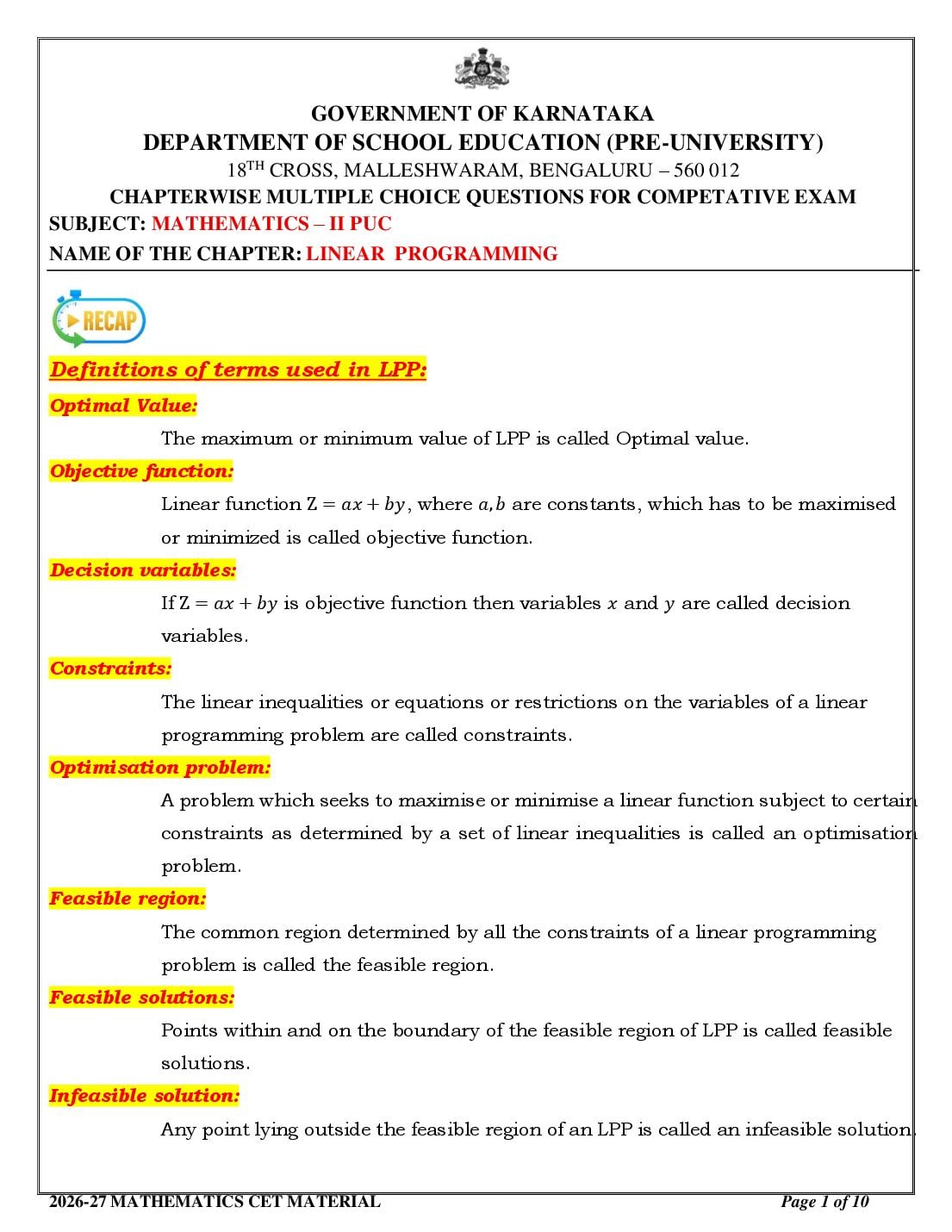
DEPARTMENT OF SCHOOL EDUCATION (PRE-UNIVERSITY)
18TH CROSS, MALLESHWARAM, BENGALURU – 560 012
CHAPTERWISE MULTIPLE CHOICE QUESTIONS FOR COMPETATIVE EXAM
SUBJECT: MATHEMATICS – II PUC
NAME OF THE CHAPTER: LINEAR PROGRAMMING
Definitions of terms used in LPP:
Optimal Value:
The maximum or minimum value of LPP is called Optimal value.
Objective function:
Linear function Z = 𝑎𝑥 + 𝑏𝑦, where 𝑎, 𝑏 are constants, which has to be maximised
or minimized is called objective function.
Decision variables:
If Z = 𝑎𝑥 + 𝑏𝑦 is objective function then variables 𝑥 and 𝑦 are called decision
variables.
Constraints:
The linear inequalities or equations or restrictions on the variables of a linear
programming problem are called constraints.
Optimisation problem:
A problem which seeks to maximise or minimise a linear function subject to certain
constraints as determined by a set of linear inequalities is called an optimisation
problem.
Feasible region:
The common region determined by all the constraints of a linear programming
problem is called the feasible region.
Feasible solutions:
Points within and on the boundary of the feasible region of LPP is called feasible
solutions.
Infeasible solution:
Any point lying outside the feasible region of an LPP is called an infeasible solution.
2026-27 MATHEMATICS CET MATERIAL Page 1 of 10
Page 2
Any point in the feasible region that gives the optimal value (maximum or minimum)
of the objective function is called an optimal solution.
Bounded and unbounded feasible region:
A feasible region of a system of linear inequalities is said to be bounded if it can be
enclosed within a circle. Otherwise, it is called unbounded.
Corner point:
A corner point of a feasible region is a point in the region which is the intersection
of two boundary lines.
METHOD FOR SOLVING LPP:
STEP1:
Find the feasible region of the LPP and determine its corner points by solving the two
equations of the line intersecting at that point.
STEP2:
Evaluate the objective function 𝑍 = 𝑎𝑥 + 𝑏𝑦 at each corner point. Let M and m be the
largest and smallest values these points.
STEP3:
If the feasible region is bounded, then M and m are the maximum and minimum values
of the objective function Z.
STEP4:
In case, the feasible is unbounded then we have,
i) M is the maximum value of Z , if the open half plane determined by 𝑎𝑥 + 𝑏𝑦 > 𝑀 has no
common point with the feasible region; otherwise, Z has no maximum value.
ii) m is the minimum value of Z, if the open half plane determined by 𝑎𝑥 + 𝑏𝑦 < 𝑚 has no
common point with the feasible region; otherwise, Z has no minimum value.
2026-27 MATHEMATICS CET MATERIAL Page 2 of 10
Page 3
(a) Bounded feasible space (b) Unbounded feasible space
(c) Both bounded and unbounded feasible space (d) None of these
2. A vertex of bounded region of inequalities 𝒙 ≥ 𝟎, 𝐲 ≥ 𝟎, 𝒙 + 𝟐𝒚 ≥ 𝟎 and 𝟐𝒙 + 𝒚 ≤ 𝟒 is
(a) (1,1) (b) (0,1) (c) (3,0) (d) (0,2)
3. The inequalities 𝟓𝒙 + 𝟒𝒚 ≥ 𝟐𝟎, 𝒙 ≤ 𝟔, 𝒚 ≤ 𝟒 form
(a) A square (b) A rhombus (c) A triangle (d) A quadrilateral
4. The maximum value of 𝑷 = 𝒙 + 𝟑𝒚 such that 𝟐𝒙 + 𝒚 ≤ 𝟐𝟎, 𝒙 + 𝟐𝒚 ≤ 𝟐𝟎, 𝒙 ≥ 𝟎, 𝒚 ≥ 𝟎 is
(a) 10 (b) 60 (c) 30 (d) None of these
5. Which of the following is not a vertex of the positive region bounded by the
inequalities 𝟐𝒙 + 𝟑𝒚 ≤ 𝟔, 𝟓𝒙 + 𝟑𝒚 ≤ 𝟏𝟓 and 𝒙, 𝒚 ≥ 𝟎
(a) (3,2) (b) (0,0) (c) (3,0) (d) (0,2)
6. The maximum value of 𝒛 = 𝟔𝒙 + 𝟖𝒚 subject to constraints 𝟐𝒙 + 𝒚 ≤ 𝟑𝟎, 𝒙 + 𝟐𝒚 ≤ 𝟐𝟒 and
𝒙 ≥ 𝟎, 𝒚 ≥ 𝟎 is
(a) 90 (b) 120 (c) 96 (d) 240
7. Corner points of feasible region of inequalities gives
(a) optimal solution of L.P.P. (b) objective function
(c) constraints. (d) linear assumption
8. The solution set of constraints 𝒙 + 𝟐𝒚 ≥ 𝟏𝟏, 𝟑𝒙 + 𝟒𝒚 ≤ 𝟑𝟎, 𝟐𝒙 + 𝟓𝒚 ≤ 𝟑𝟎 and 𝒙 ≥ 𝟎, 𝒚 ≥ 𝟎,
includes the point
(a) (2,3) (b) (3,2) (c) (3,4) (d) (4,3)
9. For the following feasible region, the linear constraints are
(a) 𝑥 ≥ 0, 𝑦 ≥ 0,3𝑥 + 2𝑦 ≥ 12, 𝑥 + 3𝑦 ≥ 11
(b) 𝑥 ≥ 0, 𝑦 ≥ 0,3𝑥 + 2𝑦 ≤ 12, 𝑥 + 3𝑦 ≥ 11
(c) 𝑥 ≥ 0, 𝑦 ≥ 0,3𝑥 + 2𝑦 ≤ 12, 𝑥 + 3𝑦 ≤ 11
(d) None of these
10. The maximum value of 𝒛 = 𝟓𝒙 + 𝟐𝒚, subject to the constraints
𝒙 + 𝒚 ≤ 𝟕, 𝒙 + 𝟐𝒚 ≤ 𝟏𝟎, 𝒙, 𝒚 ≥ 𝟎 is
(a) 10 (b) 26 (c) 35 (d) 70
2026-27 MATHEMATICS CET MATERIAL Page 3 of 10
Page 4
(a) 4𝑥 − 2𝑦 ≤ 3
(b) 4𝑥 − 2𝑦 ≤ −3
(c) 4𝑥 − 2𝑦 ≥ 3
(d) 4𝑥 − 2𝑦 ≥ −3
12. The feasible region for an LPP is shown shaded in the figure. Let 𝒁 = 𝟑𝒙 − 𝟒𝒚 be the
objective function. Minimum of 𝒁 occurs at
(a) (0,0)
(b) (0, 8)
(c) (5,0)
(d) (4, 10)
13. Feasible region for an LPP is shown shaded in the following
figure. Minimum of 𝒁 = 𝟒𝒙 + 𝟑 y occurs at the point.
(a) (0,8)
(b) (2,5)
(c) (4,3)
(d) (9,0)
14. The optimal value of the objective function is attained at the points
(a) Given by intersection of in equations with axes only
(b) Given by intersection of in equations with 𝑥 - axis only
(c) Given by corner points of the feasible region
(d) None of these.
15. For the constraint of a linear optimizing function 𝒛 = 𝒙𝟏 + 𝒙𝟐 , given by 𝒙𝟏 + 𝒙𝟐 ≤ 𝟏,
𝟑𝒙𝟏 + 𝒙𝟐 ≥ 𝟑 and 𝒙𝟏 , 𝒙𝟐 ≥ 𝟎,
(a) There are two feasible regions (b) There are infinite feasible regions
(c) There is no feasible region (d) None of these.
16. Which of the following statements is correct?
(a) Every L.P.P. admits an optimal solution
(b) A L.P.P. admits a unique optimal solution
(c) If a L.P.P. admits two optimal solutions, it has an infinite number of optimal solutions
(d) The set of all feasible solutions of a L.P.P. is not a convex set.
2026-27 MATHEMATICS CET MATERIAL Page 4 of 10
Page 5
17. Graph of the constraints 𝟑 + 𝟒 ≤ 𝟏, 𝒙 ≥ 𝟎, 𝒚 ≥ 𝟎 is
(a) (b)
(c) (d)
18. The graph of in equations 𝒙 ≤ 𝒚 and 𝒚 ≤ 𝒙 + 𝟑 is located in
(a) II quadrant (b) I, II quadrants
(c) I, II, III quadrants (d) II, III, IV quadrants
19. The number of corner points of the L.P.P. Max 𝒁 = 𝟐𝟎𝒙 + 𝟑𝒚 subject to the constraints
𝒙 + 𝒚 ≤ 𝟓, 𝟐𝒙 + 𝟑𝒚 ≤ 𝟏𝟐, 𝒙 ≥ 𝟎, 𝒚 ≥ 𝟎 are
(a) 4 (b) 3 (c) 2 (d) 1
20. Graph of the inequalities x 0, y 0, 2x 3y 6,3x 2y 6 is
21. Draw the graph and find the corner point which does not lies on coordinate axes of
region satisfied by the inequalities 𝒙 + 𝟐𝒚 ≤ 𝟒, 𝟎 ≤ 𝒙 ≤ 𝟐, 𝒚 ≥ 𝟎
(a) (2,1) (b) (0,2) (c) (4,0) (d) (1,1)
22. Find the maximum value of 𝟒𝒙 + 𝟓𝒚 subject to the constraints 𝒙 + 𝒚 ≤ 𝟐𝟎, 𝒙 + 𝟐𝒚 ≤ 𝟑𝟓,
𝒙 − 𝟑𝒚 ≤ 𝟏𝟐, 𝒙 ≥ 0, 𝑦 ≥ 0.
(a) 82 (b) 95 (c) 48 (d) 87.5
23. Find the minimum value of 𝒛 = 𝟐𝒙 + 𝟕𝒚 subject to the constraints
𝟒𝒙 + 𝟓𝒚 ≥ 𝟐𝟎, 𝟔𝒙 + 𝟐𝒚 ≥ 𝟏𝟎, 𝒙, 𝒚, ≥ 𝟎.
(a) 10 (b) 28 (c) 0 (d) 5
2026-27 MATHEMATICS CET MATERIAL Page 5 of 10
Page 6
𝒙 + 𝟐𝒚 ≤ 𝟔𝟎, 𝒙 ≥ 𝟎, 𝒚 ≥ 𝟎 is
(a) 120 (b) 140 (c) 100 (d) 160
25. The minimum value of 𝒛 = 𝟐𝒙 + 𝒚 subject to 𝟓𝒙 + 𝟏𝟎𝒚 ≤ 𝟓𝟎, 𝒙 + 𝒚 ≥ 𝟏, 𝒚 ≤ 𝟒 and 𝒙, 𝒚 ≥ 𝟎,
is
(a) 0 (b) 1 (c) 2 (d) ½
26. The maximum value of 𝒛 = 𝟑𝒙 + 𝟒𝒚 subject to the condition 𝒙 + 𝒚 ≤ 𝟒𝟎, 𝒙 + 𝟐𝒚 ≤ 𝟔𝟎,
𝒙, 𝒚 ≥ 𝟎 is
(a) 130 (b) 120 (c) 40 (d) 140
27. The solution of linear programming problem Maximize 𝒛 = 𝟑𝒙𝟏 + 𝟓𝒙𝟐
Subject to 𝟑𝒙𝟏 + 𝟐𝒙𝟐 ≤ 𝟏𝟖, 𝒙𝟏 ≤ 𝟒, 𝒙𝟐 ≤ 𝟔, 𝒙𝟏 ≥ 𝟎, 𝒙𝟐 ≥ 𝟎 is
(a) 𝑥1 = 2, 𝑥2 = 0, z = 6 (b) 𝑥1 = 4, 𝑥2 = 3, z = 27
(c) 𝑥1 = 2, 𝑥2 = 6, 𝑧 = 36 (d) 𝑥1 = 4, 𝑥2 = 6, 𝑧 = 42
28. The solution of a problem to maximize the objective function 𝒛 = 𝒙 + 𝟐𝒚 under the
constraints 𝒙 − 𝒚 ≤ 2, 𝑥 + 𝑦 ≤ 4 and 𝑥, 𝑦 ≥ 0 is
(a) 𝑥 = 0, 𝑦 = 4, 𝑧 = 8 (b) 𝑥 = 1, 𝑦 = 2, 𝑧 = 5
(c) 𝑥 = 1, 𝑦 = 4, 𝑧 = 9 (d) 𝑥 = 0, 𝑦 = 3, 𝑧 = 6
29. The maximum value of 𝒛 = 𝟒𝒙 + 𝟑𝒚 subject to the constraints
𝟑𝒙 + 𝟐𝒚 ≥ 𝟏𝟔𝟎, 𝟓𝒙 + 𝟐𝒚 ≥ 𝟐𝟎𝟎, 𝒙 + 𝟐𝒚 ≥ 𝟖𝟎, 𝒙, 𝒚 ≥ 𝟎 is
(a) 320 (b) 300 (c) 230 (d) None of these
30. The maximum value of 𝒛 = 𝟑𝒙 + 𝟐𝒚 subject to 𝒙 + 𝟐𝒚 ≥ 𝟐, 𝒙 + 𝟐𝒚 ≤ 𝟖, 𝒙, 𝒚 ≥ 𝟎 is :
(a) 32 (b) 24 (c) 40 (d) None of these
31. By graphical method, the solution of linear programming problem maximize
𝐳 = 𝟑𝐱 𝟏 + 𝟓𝐱 𝟐 subject to 𝟑𝐱 𝟏 + 𝟐𝐱 𝟐 ≤ 𝟏𝟖, 𝐱 𝟏 ≤ 𝟒, 𝐱 𝟐 ≤ 𝟔, 𝐱 𝟏 ≥ 𝟎, 𝐱 𝟐 ≥ 𝟎 is
(a) x1 = 4, x2 = 6, z = 42 (b) 𝑥1 = 4, 𝑥2 = 3, 𝑧 = 27
(c) 𝑥1 = 2, 𝑥2 = 6, 𝑧 = 36 (d) 𝑥1 = 2, 𝑥2 = 0, 𝑧 = 6
32. The maximum value of 𝒛 = 𝟐𝒙 + 𝟓𝒚 subject to the constraints
𝟐𝒙 + 𝟓𝒚 ≤ 𝟏𝟎, 𝒙 + 𝟐𝒚 ≥ 𝟏, 𝒙 − 𝒚 ≤ 𝟒, 𝒙 ≥ 𝒚 ≥ 𝟎, occurs at
(a) exactly one point (b) exactly two points
(c) infinitely many points (d) None of these
33. The true statement for the graph of in equations 𝟑𝒙 + 𝟐𝒚 ≤ 𝟔 and 𝟔𝒙 + 𝟒𝒚 ≥ 𝟐𝟎, is
(a) Both graph are disjoint (b) Both contain (0,3)
(c) Both contain point (1,1) (d) None of these
2026-27 MATHEMATICS CET MATERIAL Page 6 of 10
Page 7
condition 𝒙 + 𝒚 ≤ 𝟐𝟎, 𝒚 ≥ 𝟓, 𝒙 ≥ 𝟎, 𝒚 ≥ 𝟎 is
(a) (20,0) (b) (15,5) (c) (0,5) (d) (0,20)
35. 𝒁 = 𝟔𝒙 + 𝟐𝟏𝒚, subject to 𝒙 + 𝟐𝒚 ≥ 𝟑, 𝒙 + 𝟒𝒚 ≥ 𝟒, 𝟑𝒙 + 𝒚 ≥ 𝟑, 𝒙 ≥ 𝟎, 𝒚 ≥ 𝟎. The minimum value
of 𝒁 occurs at
1
(a) (4,0) (b) (28,8) (c) (2, 2) (d) (0,3)
36. The shaded region shown in fig. is given by the inequation [KCET-2015]
a) 14𝑥 + 5𝑦 ≥ 70, 𝑦 ≤ 14 𝑎𝑛𝑑 𝑥 − 𝑦 ≤ 5
b) 14𝑥 + 5𝑦 ≥ 70, 𝑦 ≤ 14 𝑎𝑛𝑑 𝑥 − 𝑦 ≥ 5
c) 14𝑥 + 5𝑦 ≤ 70, 𝑦 ≤ 14 𝑎𝑛𝑑 𝑥 − 𝑦 ≥ 5
d) 14𝑥 + 5𝑦 ≥ 70, 𝑦 ≥ 14 𝑎𝑛𝑑 𝑥 − 𝑦 ≥ 5
37. The shaded region in the figure is the solution set if the inequations are [KCET-2017]
a) 5𝑥 + 4𝑦 ≥ 20, 𝑥 ≤ 6, 𝑦 ≥ 3, 𝑥 ≥ 0, 𝑦 ≥ 0
b) 5𝑥 + 4𝑦 ≤ 20, 𝑥 ≤ 6, 𝑦 ≤ 3, 𝑥 ≥ 0, 𝑦 ≥ 0
c) 5𝑥 + 4𝑦 ≥ 20, 𝑥 ≤ 6, 𝑦 ≤ 3, 𝑥 ≥ 0, 𝑦 ≥ 0
d) 5𝑥 + 4𝑦 ≥ 20, 𝑥 ≥ 6, 𝑦 ≤ 3, 𝑥 ≥ 0, 𝑦 ≥ 0
38. If an LPP admits optimal solution at two consecutive
vertices of a feasible region, then [KCET-2017]
a) The required optimal solution is at the midpoint of the line joining two points
b) The required optimal solution occurs at every point on the line joining two points
c) The LPP under consideration is not solvable
d) The LPP under consideration must be reconstructed
39. The feasible region of an LPP is shown in the figure. If 𝒛 = 𝟑𝒙 + 𝟗𝒚, then minimum
value of z occurs at [KCET-2018]
a) (5, 5) b) (0, 10) c) (0, 20) d) (15, 15)
40. For the LPP ; maximize 𝒛 = 𝒙 + 𝟒𝒚 subjected to the constraint
𝒙 + 𝟐𝒚 ≤ 𝟐, 𝒙 + 𝟐𝒚 ≥ 𝟖, 𝒙, 𝒚 ≥ 𝟎 [KCET-2017]
a) 𝑧𝑚𝑎𝑥 = 4 b) 𝑧𝑚𝑎𝑥 = 8
c) 𝑧𝑚𝑎𝑥 = 16 d) Has no feasible solution
41. The shaded region in the figure is the solution set of the inequations [KCET-2019]
a) 4𝑥 + 5𝑦 ≥ 20, 3𝑥 + 10𝑦 ≤ 30, 𝑥 ≤ 6, 𝑥, 𝑦 ≥ 0
b) 4𝑥 + 5𝑦 ≥ 20, 3𝑥 + 10𝑦 ≤ 30, 𝑥 ≥ 6, 𝑥, 𝑦 ≥ 0
c) 4𝑥 + 5𝑦 ≤ 20, 3𝑥 + 10𝑦 ≤ 30, 𝑥 ≤ 6, 𝑥, 𝑦 ≥ 0
d) 4𝑥 + 5𝑦 ≤ 20, 3𝑥 + 10𝑦 ≤ 30, 𝑥 ≥ 6, 𝑥, 𝑦 ≥ 0
2026-27 MATHEMATICS CET MATERIAL Page 7 of 10
Page 8
of 𝒁 occurs at [KCET-2020]
a) (0,5)
b) (3,3)
c) (5,0)
d) (3,2)
43. The corner points of the feasible region determined by the system of linear
constraints are (0, 3), (1, 1) and (3, 0). Let 𝒛 = 𝒑𝒙 + 𝒒𝒚, where 𝒑, 𝒒 > 𝟎. Condition on 𝒑
and 𝒒 so that the minimum of 𝒛 occurs at (3, 0) and (1, 1) is [KCET-2020]
𝑞
a) 𝑝 = 2𝑞 b) 𝑝 = 2 c) 𝑝 = 3𝑞 d) 𝑝 = 𝑞
44. The cost and revenue functions of a product are given by 𝑪(𝒙) = 𝟐𝟎𝒙 + 𝟒𝟎𝟎𝟎 and
𝑹(𝒙) = 𝟔𝟎𝒙 + 𝟐𝟎𝟎𝟎 respectively, where x is the number of items produced and sold.
The value of x to earn profit is [KCET-2020]
a) > 50 b) > 60 c) > 80 d) > 40
45. The shaded region is the solution set the inequalities [KCET-2021]
a) 5𝑥 + 4𝑦 ≥ 20, 𝑥 ≤ 6, 𝑦 ≥ 3, 𝑥 ≥ 0, 𝑦 ≥ 0
b) 5𝑥 + 4𝑦 ≤ 20, 𝑥 ≤ 6, 𝑦 ≤ 3, 𝑥 ≥ 0, 𝑦 ≥ 0
c) 5𝑥 + 4𝑦 ≥ 20, 𝑥 ≤ 6, 𝑦 ≤ 3, 𝑥 ≥ 0, 𝑦 ≥ 0
d) 5𝑥 + 4𝑦 ≥ 20, 𝑥 ≥ 6, 𝑦 ≤ 3, 𝑥 ≥ 0, 𝑦 ≥ 0
46. The corner points of the feasible region of an LPP are (0, 2), (3, 0), (6,0), (6, 8) and
(0, 5), then the minimum value of 𝒛 = 𝟒𝒙 + 𝟔𝒚 occurs at [KCET-2022]
a) Finite number of points b) Only one point
c) Infinite number of points d) Only two points
47. The shaded region in the figure given is the solution of which of the following
inequalities [KCET-2023]
a) 𝑥 + 𝑦 ≥ 7, 2𝑥 − 3𝑦 + 6 ≥ 0, 𝑥 ≥ 0, 𝑦 ≥ 0
b) 𝑥 + 𝑦 ≤ 7, 2𝑥 − 3𝑦 + 6 ≤ 0, 𝑥 ≥ 0, 𝑦 ≥ 0
c) 𝑥 + 𝑦 ≤ 7, 2𝑥 − 3𝑦 + 6 ≥ 0, 𝑥 ≥ 0, 𝑦 ≥ 0
d) 𝑥 + 𝑦 ≥ 7, 2𝑥 − 3𝑦 + 6 ≤ 0, 𝑥 ≥ 0, 𝑦 ≥ 0
2026-27 MATHEMATICS CET MATERIAL Page 8 of 10
Page 9
Let 𝒛 = 𝟒𝒙 + 𝟔𝒚 be the objective function. The minimum value of z occurs at
[KCET-2024]
a) only (0,2)
b) only (3,0)
c) The midpoint of the line segment joining the points (0,2) and (3,0).
d) Any point on the line segment joining the points (0,2) and (3,0).
49. Consider the following statements: [KCET-2025]
Statement (I): In a LPP, the objective function is always linear
Statement (II): In a LPP, the linear inequalities on variables are called constraints.
Which of the following is correct?
a) Statement (I) is true, Statement (II) is false.
b) Both Statement (I) and (II) are false.
c) Statement (I) is false, Statement (II) is true
d) Statement (I) is true, Statement (II) is true
50. The maximum value of 𝒛 = 𝟑𝒙 + 𝟒𝒚, subjected to the constraints
𝒙 + 𝒚 ≤ 𝟒𝟎, 𝒙 + 𝟐𝒚 ≤ 𝟔𝟎 𝒂𝒏𝒔 𝒙, 𝒚 ≥ 𝟎 is [KCET-2025]
a) 120 b) 140 c) 40 d) 130
51. The corner points of the feasible region determined by the system of linear
constraints are (0,10), (5,5), (15,15), (0,20). Let 𝒛 = 𝒑𝒙 + 𝒒𝒚 where 𝒑, 𝒒 > 𝟎. The relation
between 𝒑 and 𝒒, so that the maximum 𝒛 occurs at both points (𝟏𝟓, 𝟏𝟓) and (𝟎, 𝟐𝟎) is
[KCET-2026]
a) 𝑝 = 𝑞 b) 𝑝 = 2𝑞 c) 𝑞 = 2𝑝 d) 𝑞 = 3𝑝
52. In Linear Programming Problem (LPP), the objective function 𝐙 = 𝐚𝐱 + by has the same
maximum value at two consecutive corner points. The number of points at which 𝐙𝐦𝐚𝐱
occurs is [KCET-2026]
a) 1 b) 2 c) 0 d) infinite
2026-27 MATHEMATICS CET MATERIAL Page 9 of 10
Page 10
1 2 3 4 5 6 7 8 9 10
d a b a b b a a d a
11 12 13 14 15 16 17 18 19 20
d a b a b b a a d a
21 22 23 24 25 26 27 28 29 30
b d b b a d d c c a
31 32 33 34 35 36 37 38 39 40
b d b b a d d c c a
41 42 43 44 45 46 47 48 49 50
d b b d b c c b b a
51 52
a c
2026-27 MATHEMATICS CET MATERIAL Page 10 of 10
Document Details
| Board / Org | Karnataka Board |
| Exam | Class 12 |
| Type | Question Bank |
| Pages | 10 |
| Updated | 24 Sep 2026 |