DU SOL B.Com Question Paper 1st Year 2018 Principles of Economics
Finished viewing? Save it for later —
Download DU SOL B.Com Question Paper 1st Year 2018 Principles of Economics (PDF · 4 pages)About DU SOL B.Com Question Paper 1st Year 2018 Principles of Economics
DU SOL B.Com Question Paper 1st Year 2018 Principles of Economics is available here for free download. Published by Default for DU SOL, this question paper can be viewed online or downloaded as a PDF (4 pages). Candidates preparing for DU SOL can use DU SOL B.Com Question Paper 1st Year 2018 Principles of Economics to understand the exam pattern, the type of questions asked, and the overall difficulty level.
Frequently Asked Questions
How can I download DU SOL B.Com Question Paper 1st Year 2018 Principles of Economics?
Open this page and click the Download button to save DU SOL B.Com Question Paper 1st Year 2018 Principles of Economics as a PDF. It is completely free on AglaSem Docs.
Is DU SOL B.Com Question Paper 1st Year 2018 Principles of Economics free to download?
Yes. DU SOL B.Com Question Paper 1st Year 2018 Principles of Economics can be viewed online and downloaded as a PDF free of cost on AglaSem Docs.
How many pages does DU SOL B.Com Question Paper 1st Year 2018 Principles of Economics have?
DU SOL B.Com Question Paper 1st Year 2018 Principles of Economics contains 4 pages, which you can read online or download together as a single PDF.
Where can I find more DU SOL study material?
You can find more DU SOL question papers, sample papers, syllabus, and answer keys on AglaSem Docs.
DU SOL B.Com Question Paper 1st Year 2018 Principles of Economics – Text
Read the full text of this question paper below — useful to quickly search, copy and reference the content online without downloading the PDF.
📄 View text version (4 pages)
Page 1
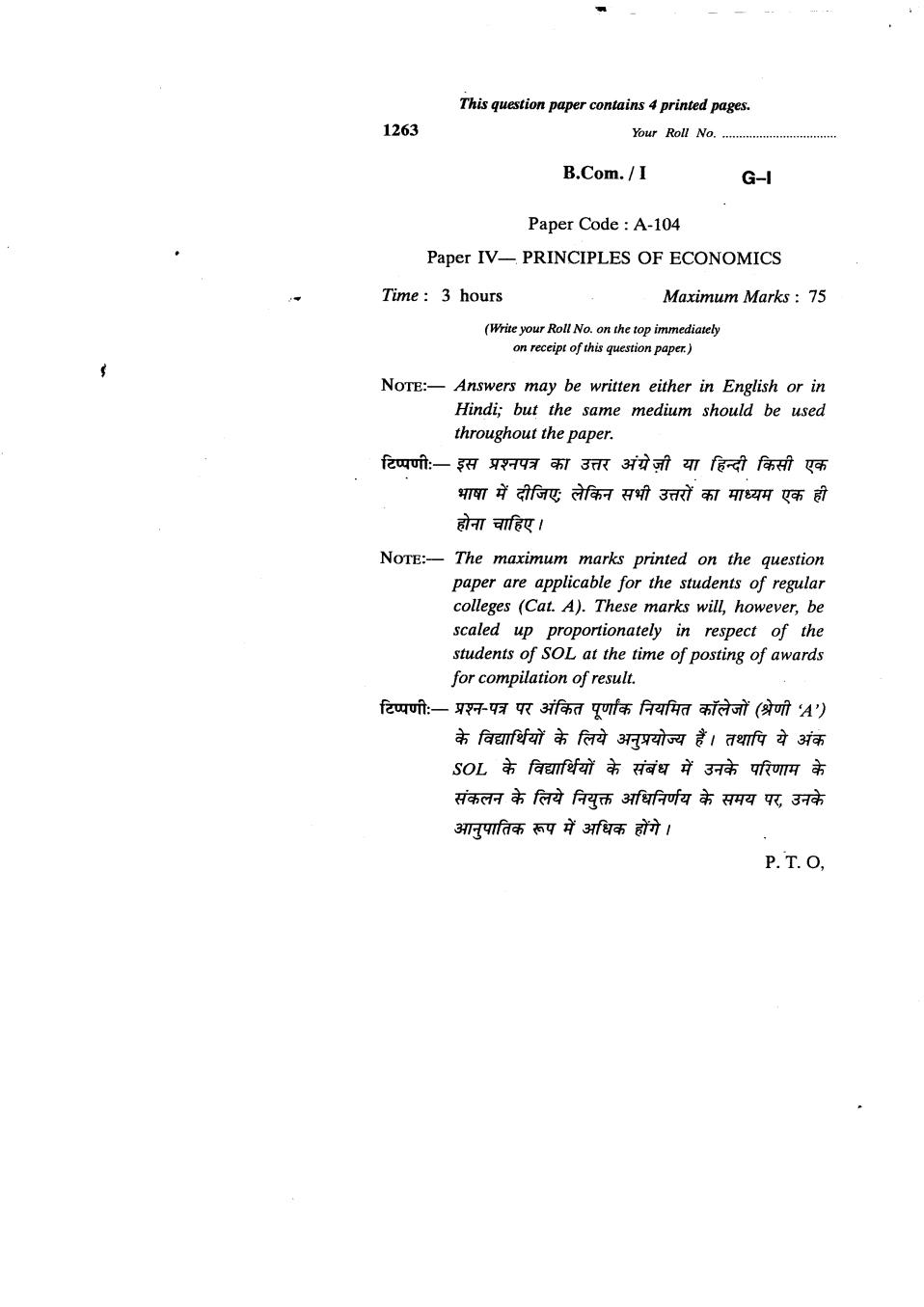
1263 Your Roll No.
B.Com. / I G-r
Paper Code : A-104
Paper ry- PRINCIPLES OF ECONOMICS
Time: 3 hours Maximum Marks : 75
'*':::::i::;*:",:::;:T;r',;'',
Nore:- Answers may be written either in English or in
Hindi; but the same medium should be used
throughout the papen
i:qufr.- Fs qnrql fir a.tr{ erAFfr qr f&7 ffi (6
qM dt E?'eq ae? srt? sf,d dfi art4q q:6 d
al+ qrft'q I
NorB:- The maximum marlcs printed on the question
paper are applicable for the students of regular
colleges (Cat. A). These marlcs will, however, be
scaled up proportionately in respect of the
students of SOL at the time of posting of awards
for compilation of result.
fffi:- swr-w w ei6d Trtt6 ffid 6fffi (M A')
+ ffirffi * ft?-a. r€r4)-q t r drrfr + €ji$
soL + ffitqT * sqer f -{+ qfrarTq +
w6{q t ft?"} fi5a. erfltffiq t sq-+ rd sat
qryqfdt sq + atfa6 dtl r
P. T. O,
Page 2
Anempt anY five questions.
All questions carry equal marl<s-
ffi'qf?vfl# # rar dFrqr
glf'ftqi t 316 sqn f,1
1. Explain how the problem of scarcity can be depicted
by the production possibility curve- Show the
difference between:
strrfi tiql4qr {fi 6t s6r{rdT t gdrcr 41 gqsl d
+.t E{rfqr qT rttrttt t, sftn{q I si-fi {frr{q:
(u) Movement from a point within to a point on the
production possibilitY boundary
Tf,{rfi €$nEHT {fr + eiqt qs fiifg t eifi T{ Rrd
.\.e
1et fi{-E tR IIHT
(b) Movement from a point to another point both on
: the boundary.
sf,nfi {iqt-d{r Erd; rR ferd !F fqg t Erqi qt d fFrd
qd liig rR Elt;TT | 15
2. (a) Explain the law of equi-marginal utility- Show how
the demand curve can be derived from the
marginal utilitY curve.
sq-€tqtd BqfrFjrar + Frqid +1 trqgrgq I Sqff,
srfrFrdr rfi + qi?T qs *;il qrq Fq;qr qr €zFtTT
tz
(b) Explain the diamond-water paradox'
Page 3
ftr-qffi Rqrqrs +t qrcqr *tffiq r 10,5
3. (a) Explain diagrammatically the price consumption
curve and deiive the'demand cunre from it for a
normal good.
*i'Td sq*rr rfi +} f{d + qrqrT t sqgrgq q
Wt q+, srnq qq + feq qpr erifi *t r*+r
*?rqq r
(b) Explain and draw indifference curves in the case
of perfect substitutes and perfect complements.
T16; qfMd qqoif q Tfo, qrs rqetf + fdq
ilRrdT *F Cq-gq q sTflr{q I
10,5
4' (a) Diagrammaticalry show a firm's equilibrium with
the help of isoquants and isocost line.
Trrr rflrq Ertr Ef Trq drrrd tgr sl {l-€Frfir t w
q.C + R-{-fi qil qfu{
{rwr{q I
(b) What do you mean by expansion path?
FRT{ qer + eTTrr Frr srfl} t ? 10,5
5. (u) "The long-run equilibrium of a competitive
industry occurs when firms are earning zero
profits." Elaborare.
'qs' qfrrsfr B-dl-rr {Ef6rd C re s-f6
t en-m t
qq qfr uil vl3 dr$T erFfu 6{ td
tfr t r,,
{Tfrr{q ,,
,. T. O,
Page 4
(b) Draw and explain short run supply curve of a firm.
srsFsltt fr q* WC *l fd *x ET {Frfr{q I
6. Distinguish between monopoly and dir*i.ir"li?;
monopoly. How are prices determined under simple
monopoly? Explain diagrammatically.
q*.rfrr*,R q FtEl q*,rfrrsR * qq tq +ifuq r lfs
qfirFr+.rt m.C +,,+ B{sfl stcrd trqtR" +.rfr t ? sFr
qtrflr{q I 15
7. Define public goods. What is a free-rider problem?
How does the existence of public good lead to market
failure?
qrffi* {€gsif +1 qRrnFd qifqq r ftEo }rffi
Trrren Hr t ? qrfur+ qKq *-S er{R eftFftrdT $T
6,RUr ffidl t? 15
8. Write short notes on any two of the following:
(a) Backward bending supply curve of labour
(b) Economic rent
(c) Adverse selection and moral hazard.
F{qitf*6tqtTilqrdMfrtuq:
(a) ettt s't qt$ sl *t {Er Es{r {frf Tfi
(b) 3TIRfq drrH
(") qffr{'q grrq q ifrq aq-eqn r 15
Document Details
| Board / Org | Default |
| Exam | DU SOL |
| Type | Question Paper |
| Pages | 4 |
| Updated | 22 Jul 2026 |