JNUEE 2021 Question Paper M.Sc Chemistry
Finished viewing? Save it for later —
Download JNUEE 2021 Question Paper M.Sc Chemistry (PDF · 17 pages)About JNUEE 2021 Question Paper M.Sc Chemistry
JNUEE 2021 Question Paper M.Sc Chemistry is available here for free download. Published by NTA for Jawaharlal Nehru University Entrance Examination, this question paper can be viewed online or downloaded as a PDF (17 pages). Candidates preparing for Jawaharlal Nehru University Entrance Examination can use JNUEE 2021 Question Paper M.Sc Chemistry to understand the exam pattern, the type of questions asked, and the overall difficulty level.
Frequently Asked Questions
How can I download JNUEE 2021 Question Paper M.Sc Chemistry?
Open this page and click the Download button to save JNUEE 2021 Question Paper M.Sc Chemistry as a PDF. It is completely free on AglaSem Docs.
Is JNUEE 2021 Question Paper M.Sc Chemistry free to download?
Yes. JNUEE 2021 Question Paper M.Sc Chemistry can be viewed online and downloaded as a PDF free of cost on AglaSem Docs.
How many pages does JNUEE 2021 Question Paper M.Sc Chemistry have?
JNUEE 2021 Question Paper M.Sc Chemistry contains 17 pages, which you can read online or download together as a single PDF.
Where can I find more Jawaharlal Nehru University Entrance Examination study material?
You can find more Jawaharlal Nehru University Entrance Examination question papers, sample papers, syllabus, and answer keys on AglaSem Docs.
JNUEE 2021 Question Paper M.Sc Chemistry – Text
Read the full text of this question paper below — useful to quickly search, copy and reference the content online without downloading the PDF.
📄 View text version (17 pages)
Page 1
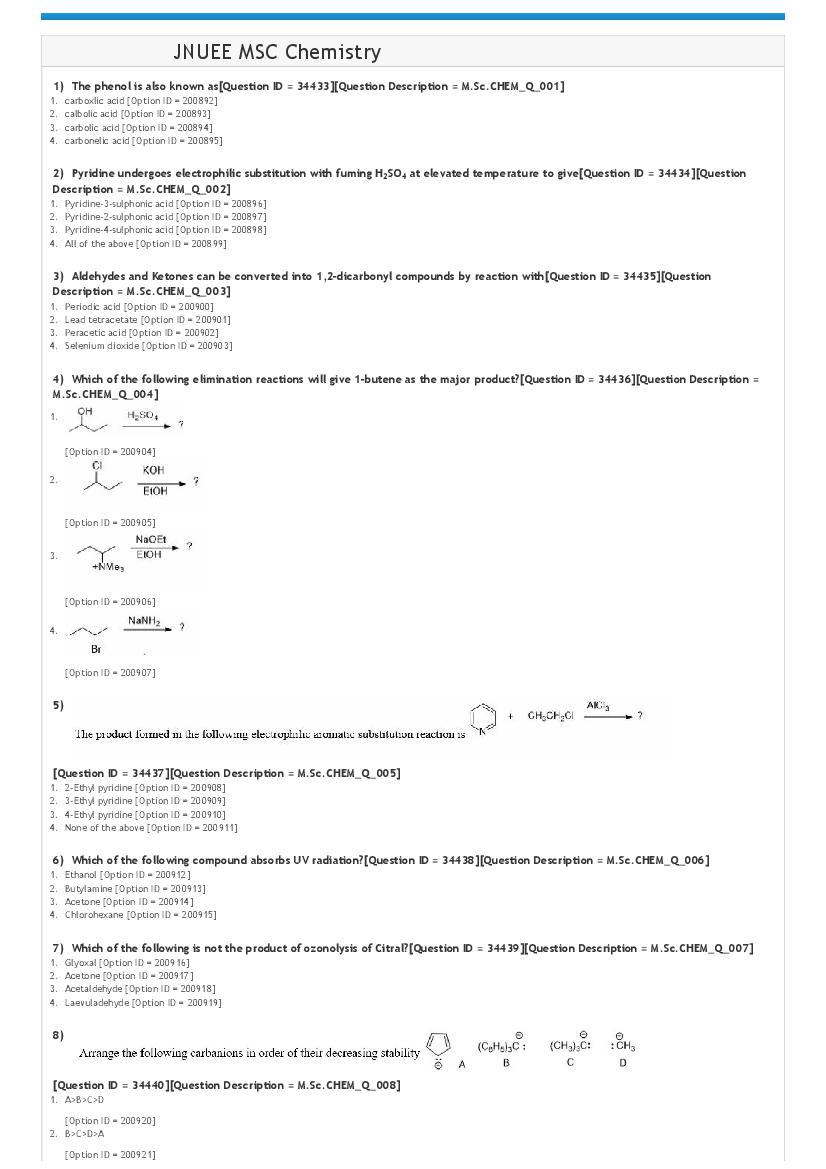
1) The phenol is also known as[Question ID = 34433][Question Description = M.Sc.CHEM_Q_001]
1. carboxlic acid [Option ID = 200892]
2. calbolic acid [Option ID = 200893]
3. carbolic acid [Option ID = 200894]
4. carbonelic acid [Option ID = 200895]
2) Pyridine undergoes electrophilic substitution with fuming H2SO4 at elevated temperature to give[Question ID = 34434][Question
Description = M.Sc.CHEM_Q_002]
1. Pyridine‐3‐sulphonic acid [Option ID = 200896]
2. Pyridine‐2‐sulphonic acid [Option ID = 200897]
3. Pyridine‐4‐sulphonic acid [Option ID = 200898]
4. All of the above [Option ID = 200899]
3) Aldehydes and Ketones can be converted into 1,2‐dicarbonyl compounds by reaction with[Question ID = 34435][Question
Description = M.Sc.CHEM_Q_003]
1. Periodic acid [Option ID = 200900]
2. Lead tetracetate [Option ID = 200901]
3. Peracetic acid [Option ID = 200902]
4. Selenium dioxide [Option ID = 200903]
4) Which of the following elimination reactions will give 1‐butene as the major product?[Question ID = 34436][Question Description =
M.Sc.CHEM_Q_004]
1.
[Option ID = 200904]
2.
[Option ID = 200905]
3.
[Option ID = 200906]
4.
[Option ID = 200907]
5)
[Question ID = 34437][Question Description = M.Sc.CHEM_Q_005]
1. 2‐Ethyl pyridine [Option ID = 200908]
2. 3‐Ethyl pyridine [Option ID = 200909]
3. 4‐Ethyl pyridine [Option ID = 200910]
4. None of the above [Option ID = 200911]
6) Which of the following compound absorbs UV radiation?[Question ID = 34438][Question Description = M.Sc.CHEM_Q_006]
1. Ethanol [Option ID = 200912]
2. Butylamine [Option ID = 200913]
3. Acetone [Option ID = 200914]
4. Chlorohexane [Option ID = 200915]
7) Which of the following is not the product of ozonolysis of Citral?[Question ID = 34439][Question Description = M.Sc.CHEM_Q_007]
1. Glyoxal [Option ID = 200916]
2. Acetone [Option ID = 200917]
3. Acetaldehyde [Option ID = 200918]
4. Laevuladehyde [Option ID = 200919]
8)
[Question ID = 34440][Question Description = M.Sc.CHEM_Q_008]
1. A>B>C>D
[Option ID = 200920]
2. B>C>D>A
[Option ID = 200921]
Page 2
[Option ID = 200922]
4. B>A>C>D
[Option ID = 200923]
9) The alpha and beta forms of D‐glucopyranose are called[Question ID = 34441][Question Description = M.Sc.CHEM_Q_009]
1. Epimers [Option ID = 200924]
2. Anomers [Option ID = 200925]
3. Enantiomers [Option ID = 200926]
4. Diastereomers [Option ID = 200927]
10) How many stereocenters are present in the small naturally occurring protein glycylalanylalanine?
[Question ID = 31121][Question Description = M.Sc.CHEM_Q_010]
1. One
[Option ID = 200928]
2. Two
[Option ID = 200929]
3. Three
[Option ID = 200930]
4. Zero
[Option ID = 200931]
11) The reagent used in Edman method of N‐terminal analysis of peptide is[Question ID = 31122][Question Description =
M.Sc.CHEM_Q_011]
1. Phenyl isothiocyanate [Option ID = 200932]
2. 2,4‐dichlorofluoro benzene [Option ID = 200933]
3. 2,4‐dinitrofluoro benzene [Option ID = 200934]
4. Benzyl chloroformate [Option ID = 200935]
12) Select among the following carbohydrates whose complete hydrolysis gives D‐glucose as the only product:
A. Dextrin B. Starch C. Sucrose D. Cellulose
Choose the correct answer from following options.
[Question ID = 31123][Question Description = M.Sc.CHEM_Q_012]
1. A, B, C
[Option ID = 200936]
2. A, B, D
[Option ID = 200937]
3. B, C, D
[Option ID = 200938]
4. A, C, D
[Option ID = 200939]
13)
[Question ID = 31124][Question Description = M.Sc.CHEM_Q_013]
1. KMnO4/NaOH
[Option ID = 200940]
2. K2Cr2O7/H2SO4
[Option ID = 200941]
3. Cl2/OH‐ then H+
[Option ID = 200942]
4. m‐chloroperbenzoic acid
[Option ID = 200943]
14) Which of the following would be best solvent for Friedel Crafts reaction?[Question ID = 31125][Question Description =
M.Sc.CHEM_Q_014]
1. Acetic anhydride [Option ID = 200944]
2. Nitrobenzene [Option ID = 200945]
3. Anisole [Option ID = 200946]
4. Toluene [Option ID = 200947]
15) The monomer unit of the natural rubber is[Question ID = 31126][Question Description = M.Sc.CHEM_Q_015]
1. Butadiene [Option ID = 200948]
2. Isoprene [Option ID = 200949]
3. Chloroprene [Option ID = 200950]
4. Isobutene [Option ID = 200951]
16) The allylic bromination is carried out using which of the following reagent[Question ID = 31127][Question Description =
M.Sc.CHEM_Q_016]
Page 3
2. N‐bromo succinimide [Option ID = 200953]
3. HBr/H2O2 [Option ID = 200954]
4. HOBr [Option ID = 200955]
17) The number of NMR signals in the spectrum of ethylbenzene would be[Question ID = 31128][Question Description =
M.Sc.CHEM_Q_017]
1. 4 [Option ID = 200956]
2. 3 [Option ID = 200957]
3. 2 [Option ID = 200958]
4. 5 [Option ID = 200959]
18) The laughing gas can be prepared from HNO2 by adding[Question ID = 31129][Question Description = M.Sc.CHEM_Q_018]
1. SO2 [Option ID = 200960]
2. NH2OH [Option ID = 200961]
3. H 2O2 [Option ID = 200962]
4. Fe2+ salt [Option ID = 200963]
19) Conversion of cyclohexanone oxime to caprolactam can be achieved by[Question ID = 31130][Question Description =
M.Sc.CHEM_Q_019]
1. Beckmann rearrangment [Option ID = 200964]
2. Holfmann rearrangment [Option ID = 200965]
3. Claisen rearrangment [Option ID = 200966]
4. Ferrier rearrangment [Option ID = 200967]
20)
[Question ID = 31131][Question Description = M.Sc.CHEM_Q_020]
1. I>II>III>IV [Option ID = 200968]
2. II>III>I>IV [Option ID = 200969]
3. II>I>III>IV [Option ID = 200970]
4. III>I>II>IV [Option ID = 200971]
21) Reduction of acetone in presence of Mg amalgam in ether gives[Question ID = 31132][Question Description = M.Sc.CHEM_Q_021]
1. Isopropanol [Option ID = 200972]
2. Propane‐1,2‐diol [Option ID = 200973]
3. Pinacol [Option ID = 200974]
4. Propane [Option ID = 200975]
22) The decreasing order of reaction rate of the following benzylalcohols with HBr is
C6H5CH2OH, p‐NO2C6H4CH2OH, p‐MeOC6H4CH2OH, p‐ClC6H4CH2OH
I II III IV
[Question ID = 31133][Question Description = M.Sc.CHEM_Q_022]
1. III>IV>I>II
[Option ID = 200976]
2. III>I>IV>II
[Option ID = 200977]
3. III>I>II>IV
[Option ID = 200978]
4. I>III>IV>II
[Option ID = 200979]
23)
[Question ID = 31134][Question Description = M.Sc.CHEM_Q_023]
1. I and II [Option ID = 200980]
2. I and III [Option ID = 200981]
3. II and III [Option ID = 200982]
4. All of above [Option ID = 200983]
24) The major product obtained on the treatment of 2‐bromobutane with alcoholic KOH is[Question ID = 31135][Question Description =
M.Sc.CHEM_Q_024]
1. 1‐butene [Option ID = 200984]
2. Cis‐2‐butene [Option ID = 200985]
3. Trans‐2‐butene [Option ID = 200986]
4. 2‐butanol [Option ID = 200987]
Page 4
[Question ID = 31136][Question Description = M.Sc.CHEM_Q_025]
1. Millon's test
[Option ID = 200988]
2. Hopkin's test
[Option ID = 200989]
3. Ninhydrin test
[Option ID = 200990]
4. Xanthoproteic test
[Option ID = 200991]
26)
[Question ID = 31137][Question Description = M.Sc.CHEM_Q_026]
1. II>III>I [Option ID = 200992]
2. III>I>II [Option ID = 200993]
3. III>II>I [Option ID = 200994]
4. II>I>III [Option ID = 200995]
27) Which of the following rearrangment involves an electron deficient oxygen atom?[Question ID = 31138][Question Description =
M.Sc.CHEM_Q_027]
1. Baeyer‐Villiger rearrangment [Option ID = 200996]
2. Pinacol‐pinacolone rearrangment [Option ID = 200997]
3. Hofmann rearrangment [Option ID = 200998]
4. Wolff rearrangment [Option ID = 200999]
28)
[Question ID = 33472][Question Description = M.Sc.CHEM_Q_028]
1. Isopropyl 2‐bromo‐3‐methyl butanoate [Option ID = 201000]
2. 1‐methylethyl 2‐bromobutyrate [Option ID = 201001]
3. 2‐bromo‐isopropyl isopropanoate [Option ID = 201002]
4. 1‐methylethyl 2‐bromo‐2‐methyl propanoate [Option ID = 201003]
29) Which of the following is classified as a dye from Xanthene group?[Question ID = 33473][Question Description = M.Sc.CHEM_Q_029]
1. Malachite green [Option ID = 201004]
2. Methyl orange [Option ID = 201005]
3. Indigo [Option ID = 201006]
4. Fluorescein [Option ID = 201007]
30) Which of the following groups are meta‐directing in electrophilic aromatic substitution on benzene ring?
(a) ‐CONH2,
(b) ‐NHCH3,
(c) ‐NHCOCH3,
(d) ‐+NMe3
[Question ID = 33474][Question Description = M.Sc.CHEM_Q_030]
1. a, c
[Option ID = 201008]
2. b, d
[Option ID = 201009]
3. a, d
[Option ID = 201010]
4. c, d
[Option ID = 201011]
31)
[Question ID = 33475][Question Description = M.Sc.CHEM_Q_031]
1.
Page 5
2.
[Option ID = 201013]
3.
[Option ID = 201014]
4.
[Option ID = 201015]
32)
[Question ID = 33476][Question Description = M.Sc.CHEM_Q_032]
1. B, C [Option ID = 201016]
2. C, D [Option ID = 201017]
3. D, A [Option ID = 201018]
4. D, B [Option ID = 201019]
33) Which of the following dienes would be reactive for Diels‐Alder reaction?
[Question ID = 33477][Question Description = M.Sc.CHEM_Q_033]
1. A, B, C [Option ID = 201020]
2. C, A, D [Option ID = 201021]
3. C, B, D [Option ID = 201022]
4. All of the above [Option ID = 201023]
34) The slope of the curve between logP versus logV in a reversible adiabatic expansion of a gas is (where = cp/cv)
[Question ID = 33478][Question Description = M.Sc.CHEM_Q_034]
1. +
[Option ID = 201024]
2. 1
[Option ID = 201025]
3. ‐1
[Option ID = 201026]
4. –
[Option ID = 201027]
35)
[Question ID = 33479][Question Description = M.Sc.CHEM_Q_035]
1.
[Option ID = 201028]
2.
[Option ID = 201029]
3.
Page 6
4.
[Option ID = 201031]
36) If θ is the angle between two vectors A = 2i ‐2j – k and B = 7i + 24k. The value of cos θ is
[Question ID = 33480][Question Description = M.Sc.CHEM_Q_036]
1. – 0.453
[Option ID = 201032]
2. + 0.3111
[Option ID = 201033]
3. – 0.1333
[Option ID = 201034]
4. + 0. 453
[Option ID = 201035]
37)
[Question ID = 33481][Question Description = M.Sc.CHEM_Q_037]
1.
[Option ID = 201036]
2.
[Option ID = 201037]
3.
[Option ID = 201038]
4.
[Option ID = 201039]
38) The most probable speed of an ideal gas molecule at 300K is 0.30 ms‐1. The average speed at 1200K would be
[Question ID = 33482][Question Description = M.Sc.CHEM_Q_038]
1. 0.39 ms‐1
[Option ID = 201040]
2. 0.92 ms‐1
[Option ID = 201041]
3. 0.67 ms‐1
[Option ID = 201042]
4. 1.2 ms‐1
[Option ID = 201043]
39) Given below are two statements with respect to conductance of a solution
Statement I: Specific conductance decreases on dilution
Statement II: Molar conductance increases on dilution
In light of the above statements,
choose the correct answer from the options given below [Question ID = 33483][Question Description = M.Sc.CHEM_Q_039]
1. Only Statement I is correct [Option ID = 201044]
2. Both statements I and II are correct [Option ID = 201045]
3. Both Statements I and II are incorrect [Option ID = 201046]
4. Only Statement II is correct [Option ID = 201047]
40) A standard hydrogen electrode has zero electrode potential because[Question ID = 33484][Question Description =
M.Sc.CHEM_Q_040]
1. Hydrogen is easiest to oxidize [Option ID = 201048]
2. This electrode potential is assumed to be zero [Option ID = 201049]
3. Hydrogen atom has only one electron [Option ID = 201050]
4. Hydrogen is the lightest element [Option ID = 201051]
41) A monobasic acid has dissociation constant of 1.8 x 10‐4 at 298K. The degree of dissociation and the hydrogen ion concentration of
Page 7
1. 0.00948 and 0.001897 mol dm‐3 [Option ID = 201052]
2. 0.03 and 0.0694 mol dm‐3 [Option ID = 201053]
3. 0.06 and 0.0003 mol dm‐3 [Option ID = 201054]
4. 0.03 and 0.006 mol dm‐3 [Option ID = 201055]
42) If the dissociation constant of HCN and CH3COOH are 4 x 10‐10M and 1.8 x 10‐5M respectively. The pH of a solution containing NaCN
would be ‐‐‐‐‐‐‐‐‐‐‐‐ the pH of a solution containing same amount of CH3COONa[Question ID = 33486][Question Description =
M.Sc.CHEM_Q_042]
1. Larger than [Option ID = 201056]
2. Smaller than [Option ID = 201057]
3. Equal to [Option ID = 201058]
4. Smaller or equal to [Option ID = 201059]
43) In the electrode concentration cell represented as
Pt; H2(p1) | HCl solution | H2(p2) ; Pt
The emf of the cell at 25℃ and p1 = 300 torr, p2 = 200 torr is
[Question ID = 31170][Question Description = M.Sc.CHEM_Q_043]
1. 5.19 x 10‐3 V
[Option ID = 201284]
2. ‐ 5.19 x 10‐2 V
[Option ID = 201285]
3.
[Option ID = 201286]
4.
[Option ID = 201287]
44) In the conductometric titration of Silver nitrate against Potassium Chloride[Question ID = 33487][Question Description =
M.Sc.CHEM_Q_044]
1. The conductance increases sharply till the end point [Option ID = 201060]
2. The conductance decreases sharply till the end point [Option ID = 201061]
3. The conductance remains more or less same till the end point [Option ID = 201062]
4. The conductance decreases sharply after the end point [Option ID = 201063]
45) Assuming that all the degrees of freedom are excited and contribute toward the energy of the molecule. The energy per mole of
CO2 molecule at temperature (T) is
[Question ID = 33488][Question Description = M.Sc.CHEM_Q_045]
1. 7/2 RT
[Option ID = 201064]
2. 7 RT
[Option ID = 201065]
3. 9/2 RT
[Option ID = 201066]
4. 13/2 RT
[Option ID = 201067]
46)
[Question ID = 31168][Question Description = M.Sc.CHEM_Q_046]
1.
[Option ID = 201276]
2.
[Option ID = 201277]
3.
[Option ID = 201278]
4.
[Option ID = 201279]
Page 8
The force constant of HCl would be around
[Question ID = 33489][Question Description = M.Sc.CHEM_Q_047]
1. 483 Nm‐1
[Option ID = 201068]
2. 48.3 Nm‐1
[Option ID = 201069]
3. 0.483 Nm‐1
[Option ID = 201070]
4. 0.00483 Nm‐1
[Option ID = 201071]
48) A real gas is expected to behave ideally at ………..Temperature and ……….pressure[Question ID = 33490][Question Description =
M.Sc.CHEM_Q_048]
1. Low, High respectively [Option ID = 201072]
2. High, Low respectively [Option ID = 201073]
3. High, High respectively [Option ID = 201074]
4. Low, Low respectively [Option ID = 201075]
49) A monochromatic radiation is passed through a 0.01M absorbing solution. The intensity of the radiation is reduced to one fourth of
its initial value after passing through a 10 cm length of the solution. The molar extinction coefficient of the solution is ?
[Question ID = 33491][Question Description = M.Sc.CHEM_Q_049]
1. 1.204 dm3mol‐1cm‐1
[Option ID = 201076]
2. 0.0602 dm3mol‐1cm‐1
[Option ID = 201077]
3. 6.02 dm3mol‐1cm‐1
[Option ID = 201078]
4. 12.04 dm3mol‐1cm‐1
[Option ID = 201079]
50) The number of atoms contained within a single face centered (fcc) unit cell is[Question ID = 31139][Question Description =
M.Sc.CHEM_Q_050]
1. 2 [Option ID = 201080]
2. 6 [Option ID = 201081]
3. 8 [Option ID = 201082]
4. 4 [Option ID = 201083]
51) When a certain crystal was irradiated with X‐rays of wavelength 229pm, a first order reflection was observed at an angle of 30o .
The corresponding interplanar spacing will be[Question ID = 31140][Question Description = M.Sc.CHEM_Q_051]
1. 2.29 x 10‐10m [Option ID = 201084]
2. 2.892 x 10‐10m [Option ID = 201085]
3. 1.3221 x 10‐10m [Option ID = 201086]
4. 1.539 x 10‐10m [Option ID = 201087]
52) In Freundlich adsorption isotherm, if amount ‘ҳ’ of a gas adsorbed on mass ‘m’ of the adsorbent, which of the following graph
would yield a straight line plot
[Question ID = 31169][Question Description = M.Sc.CHEM_Q_052]
1.
[Option ID = 201280]
2.
[Option ID = 201281]
3.
[Option ID = 201282]
4.
[Option ID = 201283]
53) Which of the following statements is not correct?[Question ID = 31141][Question Description = M.Sc.CHEM_Q_053]
1. The efficiency of a solid catalyst depends upon its surface area [Option ID = 201088]
2. Catalyst operates by providing alternate path for the reaction that involves a lower energy of activation [Option ID = 201089]
3. Catalyst lowers the energy of activation of the forward reaction without affecting the energy of activation of the backward reaction [Option ID = 201090]
4. Catalyst does not affect the overall enthalpy change of the reaction [Option ID = 201091]
54) If the solubility of KAl(SO4) 2 in water at 20℃ is 2.0 x 10‐3M. Its solubility product at the same temperature is
Page 9
1. 64 x 10‐12 M 4
[Option ID = 201092]
2. 32 x 10‐12 M 4
[Option ID = 201093]
3. 16 x 10‐9 M 3
[Option ID = 201094]
4. 32 x 10‐9 M 3
[Option ID = 201095]
55)
[Question ID = 31171][Question Description = M.Sc.CHEM_Q_055]
1.
[Option ID = 201288]
2.
[Option ID = 201289]
3.
[Option ID = 201290]
4.
[Option ID = 201291]
56)
[Question ID = 31143][Question Description = M.Sc.CHEM_Q_056]
1. A only
[Option ID = 201096]
2. B and D only
[Option ID = 201097]
3. A and B only
[Option ID = 201098]
4. D only
[Option ID = 201099]
57) Electromagnetic radiations with maximum wavelength is[Question ID = 31144][Question Description = M.Sc.CHEM_Q_057]
1. Ultraviolet [Option ID = 201100]
2. Radio waves [Option ID = 201101]
3. X‐rays [Option ID = 201102]
4. Visible [Option ID = 201103]
58) The difference between the heat of reaction at constant pressure and at constant volume for the burning of one mole of solid
Naphthalene in oxygen gas to give carbon dioxide gas and liquid water at 25℃ in kJ mol‐1 is
[Question ID = 31145][Question Description = M.Sc.CHEM_Q_058]
1. ‐ 4.95
[Option ID = 201104]
2. + 4.95
[Option ID = 201105]
3. ‐ 5.143
[Option ID = 201106]
4. + 5.143
[Option ID = 201107]
59) The standard enthalpy of Combustion of H2, cyclohexene and cyclohexane at 25℃ are ‐241, ‐3800 and ‐3920 kJmol‐1 respectively.
The standard enthalpy of hydrogenation of cyclohexene will be[Question ID = 31172][Question Description = M.Sc.CHEM_Q_059]
Page 10
[Option ID = 201292]
2.
[Option ID = 201293]
3.
[Option ID = 201294]
4.
[Option ID = 201295]
60) In the following equilibrium reaction
A(g) + 2B(g) ↔ 2C(g)
If we start with one mole of A and 2 moles of B, taken in a 2.0 L vessel. The equilibrium concentration of C was found to be 0.35M.
The equilibrium constant of the reaction would be around
[Question ID = 31146][Question Description = M.Sc.CHEM_Q_060]
1. 0.673 M‐1
[Option ID = 201108]
2. 0.295 M‐1
[Option ID = 201109]
3. 2.36 M‐1
[Option ID = 201110]
4. 0.894 M‐1
[Option ID = 201111]
61) The volume of the reacting system represented by
2A(g) + B(g) → 2C(g)
is suddenly reduced to half its value. If the reaction is second order w.r.t. A and first order w.r.t. B, the rate of reaction will [Question
ID = 31147][Question Description = M.Sc.CHEM_Q_061]
1. Diminish to one fourth of its initial value [Option ID = 201112]
2. Diminish to one eighth of its initial value [Option ID = 201113]
3. Increase to eight times its initial value [Option ID = 201114]
4. Increase to three times its initial value. [Option ID = 201115]
62)
[Question ID = 31160][Question Description = M.Sc.CHEM_Q_062]
1. ‐1 [Option ID = 201244]
2. 1 [Option ID = 201245]
3. Zero [Option ID = 201246]
4. nR [Option ID = 201247]
63) Out of the following variables
A. Vapour pressure
B. Specific Gravity
C. EMF of a dry cell and
D. Heat Capacity
The extensive variables is/are [Question ID = 31148][Question Description = M.Sc.CHEM_Q_063]
1. A and B only [Option ID = 201116]
2. A and C only [Option ID = 201117]
3. A, B and D only [Option ID = 201118]
4. D only [Option ID = 201119]
64)
[Question ID = 31161][Question Description = M.Sc.CHEM_Q_064]
1. 0.20, 0.29 and 0.80
[Option ID = 201248]
2. 0.20, 0.29 and 0.51
[Option ID = 201249]
3. 0.51, 0.20 and 0.29
[Option ID = 201250]
Page 11
[Option ID = 201251]
65) Given below are two statements regarding adsorption from solution
Statement I: For a solute that raises the surface tension, the surface excess concentration (Γ2) is negative.
Statement II: Soaps have higher concentration near the surface than in the bulk aqueous phase.
In light of the above statements, choose the correct answer from the options given below
[Question ID = 31149][Question Description = M.Sc.CHEM_Q_065]
1. Statement I is correct whereas Statement II is incorrect
[Option ID = 201120]
2. Statement II is correct whereas Statement I is incorrect
[Option ID = 201121]
3. Both Statements I and II are correct
[Option ID = 201122]
4. Both Statements I and II are incorrect
[Option ID = 201123]
66) The unit of van der waals constant ‘a’ is
[Question ID = 31150][Question Description = M.Sc.CHEM_Q_066]
1. dm3 atm mol‐2
[Option ID = 201124]
2. dm3 atm mol‐1
[Option ID = 201125]
3. dm3 mol‐1
[Option ID = 201126]
4. dm6 atm mol‐2
[Option ID = 201127]
67) The expression for Rydberg constant (RH ) is
[Question ID = 31162][Question Description = M.Sc.CHEM_Q_067]
1.
[Option ID = 201252]
2.
[Option ID = 201253]
3.
[Option ID = 201254]
4.
[Option ID = 201255]
68) Covalent radius of Si = 1.175 Å, the electronegativity of silicon using Allred‐Rochow approach is[Question ID = 31151][Question
Description = M.Sc.CHEM_Q_068]
1. 2.4 [Option ID = 201128]
2. 2.5 [Option ID = 201129]
3. 2.6 [Option ID = 201130]
4. 2.7 [Option ID = 201131]
69) The total angular wave function depends on the quantum numbers[Question ID = 31152][Question Description =
M.Sc.CHEM_Q_069]
1. n only [Option ID = 201132]
2. n and l only [Option ID = 201133]
3. l and m only [Option ID = 201134]
4. m only [Option ID = 201135]
70) The correct increasing order of metallic character is
[Question ID = 31153][Question Description = M.Sc.CHEM_Q_070]
1. Na3Bi < Na3Sb <Na3As <Na3P
[Option ID = 201136]
2. Na3P <Na3Sb <Na3As <Na3Bi
[Option ID = 201137]
3. Na3Bi <Na3As <Na3Sb <Na3P
[Option ID = 201138]
4. Na3P <Na3As <Na3Sb <Na3Bi
[Option ID = 201139]
Page 12
[Question ID = 31154][Question Description = M.Sc.CHEM_Q_071]
1. 0.225 ‐ 0.414 and 0.414 ‐ 0.732
[Option ID = 201140]
2. 0.225 ‐ 0.414 and 0.225 ‐ 0.414
[Option ID = 201141]
3. 0.414 ‐ 0.732 and 0.414 ‐ 0.732
[Option ID = 201142]
4. 0.155 ‐ 0.225 and 0.225 ‐ 0.414
[Option ID = 201143]
72) Which of the following structure is not related to TiO2?[Question ID = 31155][Question Description = M.Sc.CHEM_Q_072]
1. Rutile [Option ID = 201144]
2. Anatase [Option ID = 201145]
3. Wurtzite [Option ID = 201146]
4. Brookite [Option ID = 201147]
73) The pH of 0.145 M CH3COOH(aq) is 2.72. Ka of ethanoic acid is[Question ID = 31156][Question Description = M.Sc.CHEM_Q_073]
1. 1.8 × 10‐5 [Option ID = 201148]
2. 2.0 × 10‐5 [Option ID = 201149]
3. 2.3 × 10‐5 [Option ID = 201150]
4. 2.5 × 10‐5 [Option ID = 201151]
74) The correct order of increasing acidic strength is
[Question ID = 33492][Question Description = M.Sc.CHEM_Q_074]
1. [Fe(H2O)6]2+ < [Al(H2O)6]3+ < [Fe(H2O)6]3+
[Option ID = 201152]
2. [Al(H2O)6]3+ < [Fe(H2O)6]2+ < [Fe(H2O)6]3+
[Option ID = 201153]
3. [Fe(H2O)6]3+ < [Al(H2O)6]3+ < [Fe(H2O)6]2+
[Option ID = 201154]
4. [Fe(H2O)62+ < [Fe(H2O)6]3+ < [Al(H2O)6]3+
[Option ID = 201155]
75) Which one of the ionic crystal has highest negative lattice energy?[Question ID = 33493][Question Description =
M.Sc.CHEM_Q_075]
1. LiF [Option ID = 201156]
2. AgCl [Option ID = 201157]
3. NaCl [Option ID = 201158]
4. CsF [Option ID = 201159]
76) The formal charge on P atom and H atom in phosphonium ion are respectively[Question ID = 33494][Question Description =
M.Sc.CHEM_Q_076]
1. +1 and 0 [Option ID = 201160]
2. 0 and 0 [Option ID = 201161]
3. 0 and +1 [Option ID = 201162]
4. +1 and +1 [Option ID = 201163]
77) Which of the following molecules have same bond order
A. BO
B. CN
C. NO
D. NO+
Choose thecorrect answer from the options given below [Question ID = 33495][Question Description = M.Sc.CHEM_Q_077]
1. A and B only [Option ID = 201164]
2. A and C only [Option ID = 201165]
3. B and D only [Option ID = 201166]
4. A, B and C only [Option ID = 201167]
78) Which of the following is not correct as a consequence of Schottky and Frenkel defects?[Question ID = 33496][Question Description
= M.Sc.CHEM_Q_078]
1. A crystal is able to conduct electricity to a small extent. [Option ID = 201168]
2. The presence of holes lowers the stability of the crystals. [Option ID = 201169]
3. The presence of holes decreases the density of the crystals. [Option ID = 201170]
4. The closeness of similar charges tends to decrease the dielectric constant of the crystal. [Option ID = 201171]
79) Which of the following statement are correct?
A. The indicator phenolphthalein is a triprotic acid
B. The indicator phenolphthalein is colourless
C. The red color appears on treating phenolphthalein with excess of conc. alcoholic alkali.
D. In the presence of alkali, the lactone rings open to yield the triphenyl carbinol
Choose the correct answer from the options given below [Question ID = 33497][Question Description = M.Sc.CHEM_Q_079]
1. A and B only [Option ID = 201172]
Page 13
3. B and D only [Option ID = 201174]
4. A and D only [Option ID = 201175]
80) Which of the following statement is incorrect?
[Question ID = 33498][Question Description = M.Sc.CHEM_Q_080]
1. The oxidation number of each element in the uncombined state is zero.
[Option ID = 201176]
2. The electrode potential is given a positive sign if the electrode reaction involves oxidation when connected to SHE.
[Option ID = 201177]
3. The potential of an electrode depends upon the concentration of the ions in the solution.
[Option ID = 201178]
4. The galvanic cell is a device in which chemical energy is converted into electrical energy.
[Option ID = 201179]
81) Which of the following COMPLEX has both trigonal pyramidal and square pyramidal geometry?
[Question ID = 33499][Question Description = M.Sc.CHEM_Q_081]
1. [CdCl5]3‐
[Option ID = 201180]
2. [Sb(C6H5)5]
[Option ID = 201181]
3. [Ni(CN)5]3‐
[Option ID = 201182]
4. Fe(CO)5
[Option ID = 201183]
82)
[Question ID = 31163][Question Description = M.Sc.CHEM_Q_082]
1. A ‐ I, B ‐ III, C ‐ IV, D ‐ II
[Option ID = 201256]
2. A ‐ I, B ‐ II, C ‐ IV, D ‐ III
[Option ID = 201257]
3. A ‐ III, B ‐ II, C ‐ IV, D ‐ I
[Option ID = 201258]
4. A ‐ II, B ‐ III, C ‐ IV, D ‐ I
[Option ID = 201259]
83)
[Question ID = 31164][Question Description = M.Sc.CHEM_Q_083]
1. µ‐amido‐µ‐superoxidotetrakis(ethylenediamine)dicobalt(III) nitrate
[Option ID = 201260]
2. µ‐imido‐µ‐oxotetrakis(ethylenediamine)dicobalt(III) nitrate
[Option ID = 201261]
3. µ‐imido‐µ‐superoxidotetrakis(ethylenediamine)dicobalt(III) nitrate
[Option ID = 201262]
4. µ‐amido‐µ‐superoxidotetrakis(ethylenediamine)cobalt(III) nitrate
[Option ID = 201263]
84)
Page 14
1. A ‐ III, B ‐ II, C ‐ IV, D ‐ I [Option ID = 201264]
2. A ‐ I, B ‐ II, C ‐ IV, D ‐ III [Option ID = 201265]
3. A ‐ III, B ‐ II, C ‐ I, D ‐ IV [Option ID = 201266]
4. A ‐ II, B ‐ III, C ‐ I, D ‐ IV [Option ID = 201267]
85) Which of the following statement is incorrect related to Valence Bond Theory (VBT)?
[Question ID = 33500][Question Description = M.Sc.CHEM_Q_085]
1. It could not explain the nature of ligands.
[Option ID = 201184]
2. It could not explain why the pairing of electrons occurs in presence of strong ligands.
[Option ID = 201185]
3. It could not explain the distortion in some octahedral complexes.
[Option ID = 201186]
4. It could not explain the magnetic properties.
[Option ID = 201187]
86) The value of crystal field splitting is 30000 cm‐1 and the electronic pairing energy is 17000 cm‐1 for metal ion having d6
configuration. The crystal field stabilisation energy for octahedral complex is
[Question ID = 31166][Question Description = M.Sc.CHME_Q_086]
1.
[Option ID = 201268]
2.
[Option ID = 201269]
3.
[Option ID = 201270]
4.
[Option ID = 201271]
87) The reducing power of [CrO4]2‐, [MnO4]2‐ and [FeO4]2‐ follows in descending order
[Question ID = 33501][Question Description = M.Sc.CHEM_Q_087]
1. [CrO4]2‐ > [MnO4]2‐ > [FeO4]2‐
[Option ID = 201188]
2. [FeO4]2+ [MnO4]2‐ > [CrO4]2‐
[Option ID = 201189]
3. [MnO4]<> > [CrO4]2‐ > [FeO4]2‐
[Option ID = 201190]
4. [CrO4]2‐ > [FeO4]2‐ > [MnO4]2‐
[Option ID = 201191]
88) The lowest energy state in d9 octahedral complex is
[Question ID = 33502][Question Description = M.Sc.CHEM_Q_088]
1. 2A 1g
[Option ID = 201192]
2. 2A 2g
[Option ID = 201193]
3. 2B1g
[Option ID = 201194]
4. 2B2g
[Option ID = 201195]
89) The correct number of bonds present in Pyrophosphorous is[Question ID = 33503][Question Description = M.Sc.CHEM_Q_089]
1. 1 P‐OH, 2 P‐H, 1 P=O [Option ID = 201196]
2. 2 P‐OH, 2 P‐H, 1 P=O [Option ID = 201197]
Page 15
4. 4 P‐OH, 2 P‐H, 1 P=O [Option ID = 201199]
90) Which one of the following is amphoteric oxide?[Question ID = 33504][Question Description = M.Sc.CHEM_Q_090]
1. V2O3 [Option ID = 201200]
2. V2O5 [Option ID = 201201]
3. Mn2O3 [Option ID = 201202]
4. Mn2O7 [Option ID = 201203]
91) Choose the correct option in which all molecules have zero dipole moment.
[Question ID = 33505][Question Description = M.Sc.CHEM_Q_091]
1. BF3, H2S, CCl4
[Option ID = 201204]
2. BF3, CO2, SnCl4
[Option ID = 201205]
3. BF3, CO2, SnCl2
[Option ID = 201206]
4. NF3, CO2, CCl4
[Option ID = 201207]
92) Given below are two statements, one is labelled as Assertion A and the other is labelled as Reason R
Assertion A : BaF2 is more soluble than MgF2 in water.
Reason R : The lattice energies decrease unusually rapidly down the group because the large cations make contact with one another
without at the same time making contact with the F‐ ions.
In light of the above statements, choose the correct answer from the options given below [Question ID = 33506][Question Description =
M.Sc.CHEM_Q_092]
1. Both A and R are true and R is the correct explanation of A [Option ID = 201208]
2. Both A and R are true but R is NOT the correct explanation of A [Option ID = 201209]
3. A is true but Ris false [Option ID = 201210]
4. A is false but R is true [Option ID = 201211]
93) The complex that does not obey 18 electron rule is
[Question ID = 33507][Question Description = M.Sc.CHEM_Q_093]
1. [V(CO)7]+
[Option ID = 201212]
2. [IrCl3(PPh3)2(AsPh)2)]‐
[Option ID = 201213]
3. [(CH3CO)Rh(CO)I3]‐
[Option ID = 201214]
4. [HMn(CO)5]
[Option ID = 201215]
94) The correct order of increasing Ni—C stretching frequency is
[Question ID = 33508][Question Description = M.Sc.CHEM_Q_094]
1. Ni(CO)4 < Ni(CO)3(PF3) < Ni(CO)3[P(OPh)3] < Ni(CO)3PMe3
[Option ID = 201216]
2. Ni(CO)4 < Ni(CO)3[P(OPh)3] < Ni(CO)3(PF3) < Ni(CO)3PMe3
[Option ID = 201217]
3. Ni(CO)3PMe3 < Ni(CO)3[P(OPh)3] < Ni(CO)3(PF3) < Ni(CO)4
[Option ID = 201218]
4. Ni(CO)3PMe3 < Ni(CO)3(PF3) < Ni(CO)3[P(OPh)3] < Ni(CO)4
[Option ID = 201219]
95) Nitrosyl in linear and bent form with metal acts as, respectively[Question ID = 33509][Question Description = M.Sc.CHEM_Q_095]
1. One and three electron donor [Option ID = 201220]
2. Three and one electron donor [Option ID = 201221]
3. Both one electron donor [Option ID = 201222]
4. Both three electron donor [Option ID = 201223]
96)
Page 16
1. A ‐ IV, B ‐ II, C ‐ III, D ‐ I
[Option ID = 201224]
2. A ‐ I, B ‐ IV, C ‐ III, D ‐ II
[Option ID = 201225]
3. A ‐ III, B ‐ II, C ‐ I, D ‐ IV
[Option ID = 201226]
4. A ‐ IV, B ‐ I, C ‐ III, D ‐ II
[Option ID = 201227]
97) The oxidation state of iron in ferredoxin and ferritin are X and Y, respectively. Choose the correct option indicating correct values
of both, X and Y.
[Question ID = 33511][Question Description = M.Sc.CHEM_Q_097]
1. X = +2, +3 , Y = +3 only
[Option ID = 201228]
2. X = +3 only, Y = +3 only
[Option ID = 201229]
3. X = +2 only, Y = +2, +3
[Option ID = 201230]
4. X = +2, +3, Y = +2 only
[Option ID = 201231]
98) Turnbull's blue is
[Question ID = 31157][Question Description = M.Sc.CHEM_Q_098]
1. K4[Fe(CN)6]
[Option ID = 201232]
2. KFe[Fe(CN)6]
[Option ID = 201233]
3. K3[Fe(CN)5(NO)]
[Option ID = 201234]
4. Na3[Fe(CN)5(NO)]
[Option ID = 201235]
99)
[Question ID = 31158][Question Description = M.Sc.CHEM_Q_099]
1. A ‐ IV, B ‐ III, C ‐ II, D ‐ I
[Option ID = 201236]
2. A ‐ II, B ‐ IV, C ‐ I, D ‐ III
[Option ID = 201237]
3. A ‐ III, B ‐ II, C ‐ I, D ‐ IV
[Option ID = 201238]
4. A ‐ IV, B ‐ I, C ‐ III, D ‐ II
[Option ID = 201239]
100) Al(OH)3 and Ga(OH)3 are X and Y, respectively in nature. X and Y are
[Question ID = 31159][Question Description = M.Sc.CHEM_Q_100]
1. X = basic, Y = basic
[Option ID = 201240]
2. X = amphoteric, Y = basic
[Option ID = 201241]
3. X = basic, Y = amphoteric
[Option ID = 201242]
4. X = amphoteric, Y = amphoteric
Page 17
Document Details
| Board / Org | NTA |
| Exam | Jawaharlal Nehru University Entrance Examination |
| Type | Question Paper |
| Pages | 17 |
| Updated | 22 Jul 2026 |