UGC NET 2021 Question Paper Human Rights and Duties Shift 2
Finished viewing? Save it for later —
Download UGC NET 2021 Question Paper Human Rights and Duties Shift 2 (PDF · 85 pages)About UGC NET 2021 Question Paper Human Rights and Duties Shift 2
UGC NET 2021 Question Paper Human Rights and Duties Shift 2 is available here for free download. Published by NTA for UGC NET, this question paper can be viewed online or downloaded as a PDF (85 pages). Candidates preparing for UGC NET can use UGC NET 2021 Question Paper Human Rights and Duties Shift 2 to understand the exam pattern, the type of questions asked, and the overall difficulty level.
Frequently Asked Questions
How can I download UGC NET 2021 Question Paper Human Rights and Duties Shift 2?
Open this page and click the Download button to save UGC NET 2021 Question Paper Human Rights and Duties Shift 2 as a PDF. It is completely free on AglaSem Docs.
Is UGC NET 2021 Question Paper Human Rights and Duties Shift 2 free to download?
Yes. UGC NET 2021 Question Paper Human Rights and Duties Shift 2 can be viewed online and downloaded as a PDF free of cost on AglaSem Docs.
How many pages does UGC NET 2021 Question Paper Human Rights and Duties Shift 2 have?
UGC NET 2021 Question Paper Human Rights and Duties Shift 2 contains 85 pages, which you can read online or download together as a single PDF.
Where can I find more UGC NET study material?
You can find more UGC NET question papers, sample papers, syllabus, and answer keys on AglaSem Docs.
UGC NET 2021 Question Paper Human Rights and Duties Shift 2 – Text
Read the full text of this question paper below — useful to quickly search, copy and reference the content online without downloading the PDF.
📄 View text version (85 pages)
Page 1
Topic:‐ GP_Set2_C
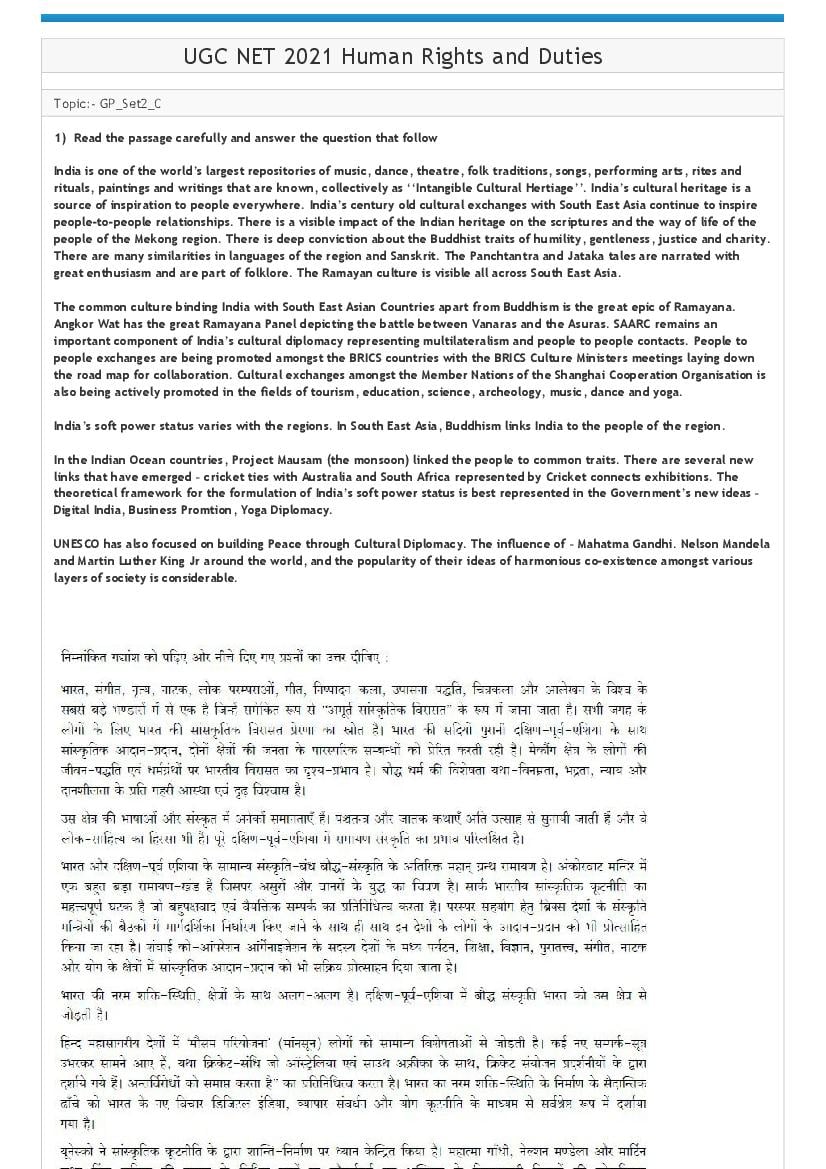
1) Read the passage carefully and answer the question that follow
India is one of the world’s largest repositories of music, dance, theatre, folk traditions, songs, performing arts, rites and
rituals, paintings and writings that are known, collectively as ‘‘Intangible Cultural Hertiage’’. India’s cultural heritage is a
source of inspiration to people everywhere. India’s century old cultural exchanges with South East Asia continue to inspire
people‐to‐people relationships. There is a visible impact of the Indian heritage on the scriptures and the way of life of the
people of the Mekong region. There is deep conviction about the Buddhist traits of humility, gentleness, justice and charity.
There are many similarities in languages of the region and Sanskrit. The Panchtantra and Jataka tales are narrated with
great enthusiasm and are part of folklore. The Ramayan culture is visible all across South East Asia.
The common culture binding India with South East Asian Countries apart from Buddhism is the great epic of Ramayana.
Angkor Wat has the great Ramayana Panel depicting the battle between Vanaras and the Asuras. SAARC remains an
important component of India’s cultural diplomacy representing multilateralism and people to people contacts. People to
people exchanges are being promoted amongst the BRICS countries with the BRICS Culture Ministers meetings laying down
the road map for collaboration. Cultural exchanges amongst the Member Nations of the Shanghai Cooperation Organisation is
also being actively promoted in the fields of tourism, education, science, archeology, music, dance and yoga.
India’s soft power status varies with the regions. In South East Asia, Buddhism links India to the people of the region.
In the Indian Ocean countries, Project Mausam (the monsoon) linked the people to common traits. There are several new
links that have emerged – cricket ties with Australia and South Africa represented by Cricket connects exhibitions. The
theoretical framework for the formulation of India’s soft power status is best represented in the Government’s new ideas –
Digital India, Business Promtion, Yoga Diplomacy.
UNESCO has also focused on building Peace through Cultural Diplomacy. The influence of – Mahatma Gandhi. Nelson Mandela
and Martin Luther King Jr around the world, and the popularity of their ideas of harmonious co‐existence amongst various
layers of society is considerable.
Page 2
(A) Ramayan
(B) Multilateral engagements
(C) Business Promotion
(D) People to people contacts
Choose the correct answer from the options given below :
(1) (A) and (D) only (2) (A), (C) and (D) only
(3) (B), (C) and (D) only (4) (B) and (D) only
[Question ID = 3557][Question Description = Q46_GP_20NOV_S2_SHAAN_Shift2]
1. 1
[Option ID = 13691]
2. 2
[Option ID = 13692]
3. 3
[Option ID = 13693]
4. 4
[Option ID = 13694]
2) Read the passage carefully and answer the question that follow
India is one of the world’s largest repositories of music, dance, theatre, folk traditions, songs, performing arts, rites and
rituals, paintings and writings that are known, collectively as ‘‘Intangible Cultural Hertiage’’. India’s cultural heritage is a
source of inspiration to people everywhere. India’s century old cultural exchanges with South East Asia continue to inspire
people‐to‐people relationships. There is a visible impact of the Indian heritage on the scriptures and the way of life of the
Page 3
There are many similarities in languages of the region and Sanskrit. The Panchtantra and Jataka tales are narrated with
great enthusiasm and are part of folklore. The Ramayan culture is visible all across South East Asia.
The common culture binding India with South East Asian Countries apart from Buddhism is the great epic of Ramayana.
Angkor Wat has the great Ramayana Panel depicting the battle between Vanaras and the Asuras. SAARC remains an
important component of India’s cultural diplomacy representing multilateralism and people to people contacts. People to
people exchanges are being promoted amongst the BRICS countries with the BRICS Culture Ministers meetings laying down
the road map for collaboration. Cultural exchanges amongst the Member Nations of the Shanghai Cooperation Organisation is
also being actively promoted in the fields of tourism, education, science, archeology, music, dance and yoga.
India’s soft power status varies with the regions. In South East Asia, Buddhism links India to the people of the region.
In the Indian Ocean countries, Project Mausam (the monsoon) linkded the people to common traits. There are several new
links that have emerged – cricket ties with Australia and South Africa represented by Cricket connects exhibitions. The
theoretical framework for the formulation of India’s soft power status is best represented in the Government’s new ideas –
Digital India, Business Promtion, Yoga Diplomacy.
UNESCO has also focused on building Peace through Cultural Diplomacy. The influence of – Mahatma Gandhi. Nelson Mandela
and Martin Luther King Jr around the world, and the popularity of their ideas of harmonious co‐existence amongst various
layers of society is considerable.
The common thread binding India and South East Asian Countries is/are
(A) Buddist tenets
(B) Yoga
(C) Cricket
(D) Ramayan
(E) Sanskrit
Choose the correct answer from the options given below :
Page 4
(3) (A) and (D) only (4) (A), (B), (D) and (E) only
[Question ID = 3558][Question Description = Q47_GP_20NOV_S2_SHAAN_Shift2]
1. 1 [Option ID = 13695]
2. 2 [Option ID = 13696]
3. 3 [Option ID = 13697]
4. 4 [Option ID = 13698]
3) Read the passage carefully and answer the question that follow
India is one of the world’s largest repositories of music, dance, theatre, folk traditions, songs, performing arts, rites and
rituals, paintings and writings that are known, collectively as ‘‘Intangible Cultural Hertiage’’. India’s cultural heritage is a
source of inspiration to people everywhere. India’s century old cultural exchanges with South East Asia continue to inspire
people‐to‐people relationships. There is a visible impact of the Indian heritage on the scriptures and the way of life of the
people of the Mekong region. There is deep conviction about the Buddhist traits of humility, gentleness, justice and charity.
There are many similarities in languages of the region and Sanskrit. The Panchtantra and Jataka tales are narrated with
great enthusiasm and are part of folklore. The Ramayan culture is visible all across South East Asia.
The common culture binding India with South East Asian Countries apart from Buddhism is the great epic of Ramayana.
Angkor Wat has the great Ramayana Panel depicting the battle between Vanaras and the Asuras. SAARC remains an
important component of India’s cultural diplomacy representing multilateralism and people to people contacts. People to
people exchanges are being promoted amongst the BRICS countries with the BRICS Culture Ministers meetings laying down
the road map for collaboration. Cultural exchanges amongst the Member Nations of the Shanghai Cooperation Organisation is
also being actively promoted in the fields of tourism, education, science, archeology, music, dance and yoga.
India’s soft power status varies with the regions. In South East Asia, Buddhism links India to the people of the region.
In the Indian Ocean countries, Project Mausam (the monsoon) linkded the people to common traits. There are several new
links that have emerged – cricket ties with Australia and South Africa represented by Cricket connects exhibitions. The
theoretical framework for the formulation of India’s soft power status is best represented in the Government’s new ideas –
Digital India, Business Promtion, Yoga Diplomacy.
UNESCO has also focused on building Peace through Cultural Diplomacy. The influence of – Mahatma Gandhi. Nelson Mandela
and Martin Luther King Jr around the world, and the popularity of their ideas of harmonious co‐existence amongst various
layers of society is considerable.
Page 5
(1) Digital India (2) Skill India
(3) Business Promotion (4) Yoga Diplomacy
[Question ID = 3559][Question Description = Q48_GP_20NOV_S2_SHAAN_Shift2]
1. 1 [Option ID = 13699]
2. 2 [Option ID = 13700]
3. 3 [Option ID = 13701]
4. 4 [Option ID = 13702]
4) Read the passage carefully and answer the question that follow
India is one of the world’s largest repositories of music, dance, theatre, folk traditions, songs, performing arts, rites and
rituals, paintings and writings that are known, collectively as ‘‘Intangible Cultural Hertiage’’. India’s cultural heritage is a
source of inspiration to people everywhere. India’s century old cultural exchanges with South East Asia continue to inspire
people‐to‐people relationships. There is a visible impact of the Indian heritage on the scriptures and the way of life of the
people of the Mekong region. There is deep conviction about the Buddhist traits of humility, gentleness, justice and charity.
There are many similarities in languages of the region and Sanskrit. The Panchtantra and Jataka tales are narrated with
great enthusiasm and are part of folklore. The Ramayan culture is visible all across South East Asia.
The common culture binding India with South East Asian Countries apart from Buddhism is the great epic of Ramayana.
Angkor Wat has the great Ramayana Panel depicting the battle between Vanaras and the Asuras. SAARC remains an
important component of India’s cultural diplomacy representing multilateralism and people to people contacts. People to
people exchanges are being promoted amongst the BRICS countries with the BRICS Culture Ministers meetings laying down
the road map for collaboration. Cultural exchanges amongst the Member Nations of the Shanghai Cooperation Organisation is
also being actively promoted in the fields of tourism, education, science, archeology, music, dance and yoga.
India’s soft power status varies with the regions. In South East Asia, Buddhism links India to the people of the region.
In the Indian Ocean countries, Project Mausam (the monsoon) linkded the people to common traits. There are several new
links that have emerged – cricket ties with Australia and South Africa represented by Cricket connects exhibitions. The
theoretical framework for the formulation of India’s soft power status is best represented in the Government’s new ideas –
Digital India, Business Promtion, Yoga Diplomacy.
UNESCO has also focused on building Peace through Cultural Diplomacy. The influence of – Mahatma Gandhi. Nelson Mandela
and Martin Luther King Jr around the world, and the popularity of their ideas of harmonious co‐existence amongst various
layers of society is considerable.
Page 6
(A) Archeology
(B) Folklore
(C) Tourism
(D) Yoga
(E) Education
Choose the correct answer from the options given below :
(1) (A), (C), (D) and (E) only (2) (A), (B), (C) and (E) only
(3) (A), (B) and (E) only (4) (B), (C), (D) and (E) only
[Question ID = 3560][Question Description = Q49_GP_20NOV_S2_SHAAN_Shift2]
Page 7
2. 2 [Option ID = 13704]
3. 3 [Option ID = 13705]
4. 4 [Option ID = 13706]
5) Read the passage carefully and answer the question that follow
India is one of the world’s largest repositories of music, dance, theatre, folk traditions, songs, performing arts, rites and
rituals, paintings and writings that are known, collectively as ‘‘Intangible Cultural Hertiage’’. India’s cultural heritage is a
source of inspiration to people everywhere. India’s century old cultural exchanges with South East Asia continue to inspire
people‐to‐people relationships. There is a visible impact of the Indian heritage on the scriptures and the way of life of the
people of the Mekong region. There is deep conviction about the Buddhist traits of humility, gentleness, justice and charity.
There are many similarities in languages of the region and Sanskrit. The Panchtantra and Jataka tales are narrated with
great enthusiasm and are part of folklore. The Ramayan culture is visible all across South East Asia.
The common culture binding India with South East Asian Countries apart from Buddhism is the great epic of Ramayana.
Angkor Wat has the great Ramayana Panel depicting the battle between Vanaras and the Asuras. SAARC remains an
important component of India’s cultural diplomacy representing multilateralism and people to people contacts. People to
people exchanges are being promoted amongst the BRICS countries with the BRICS Culture Ministers meetings laying down
the road map for collaboration. Cultural exchanges amongst the Member Nations of the Shanghai Cooperation Organisation is
also being actively promoted in the fields of tourism, education, science, archeology, music, dance and yoga.
India’s soft power status varies with the regions. In South East Asia, Buddhism links India to the people of the region.
In the Indian Ocean countries, Project Mausam (the monsoon) linkded the people to common traits. There are several new
links that have emerged – cricket ties with Australia and South Africa represented by Cricket connects exhibitions. The
theoretical framework for the formulation of India’s soft power status is best represented in the Government’s new ideas –
Digital India, Business Promtion, Yoga Diplomacy.
UNESCO has also focused on building Peace through Cultural Diplomacy. The influence of – Mahatma Gandhi. Nelson Mandela
and Martin Luther King Jr around the world, and the popularity of their ideas of harmonious co‐existence amongst various
layers of society is considerable.
The passage highlights
Page 8
(2) The role of culture for peace and harmonious relations with other countries
(3) India’s cultural hegemony
(4) India’s relations with BRICS countries
[Question ID = 3561][Question Description = Q50_GP_20NOV_S2_SHAAN_Shift2]
1. 1 [Option ID = 13707]
2. 2 [Option ID = 13708]
3. 3 [Option ID = 13709]
4. 4 [Option ID = 13710]
Topic:‐ GP_Set2_A
1)
Page 9
company?
(1) 119 : 145 (2) 116 : 135
(3) 119 : 135 (4) 119 : 130
[Question ID = 3562][Question Description = Q01_GP_20NOV_S2_SHAAN_Shift2]
1. 1 [Option ID = 13711]
2. 2 [Option ID = 13712]
3. 3 [Option ID = 13713]
4. 4 [Option ID = 13714]
2)
If 35% of the PCs sold by Company HP during November were sold at a discount, then how many PCs of Company HP during
that month were sold without a discount?
(1) 882 (2) 1635
(3) 1638 (4) 885
Page 10
1. 1 [Option ID = 13715]
2. 2 [Option ID = 13716]
3. 3 [Option ID = 13717]
4. 4 [Option ID = 13718]
3)
If the dealer earned a profit of Rs. 433 on each PC sold of Company DELL during October, then what was his total profit
earned on the PCs of that company during the same month?
(1) 6,49,900 (2) 6,45,900
(3) 6,49,400 (4) 6,49,500
[Question ID = 3564][Question Description = Q03_GP_20NOV_S2_SHAAN_Shift2]
Page 11
2. 2 [Option ID = 13720]
3. 3 [Option ID = 13721]
4. 4 [Option ID = 13722]
4)
The number of PCs sold of Company HP during July is approximately what percent (%) of the number of PCs sold of Company
HP during December?
(1) 110% (2) 140%
(3) 150% (4) 130%
[Question ID = 3565][Question Description = Q04_GP_20NOV_S2_SHAAN_Shift2]
1. 1 [Option ID = 13723]
2. 2 [Option ID = 13724]
3. 3 [Option ID = 13725]
4. 4 [Option ID = 13726]
5)
Page 12
(1) 10000 (2) 15000
(3) 10500 (4) 9500
[Question ID = 3566][Question Description = Q05_GP_20NOV_S2_SHAAN_Shift2]
1. 1
[Option ID = 13727]
2. 2
[Option ID = 13728]
3. 3
[Option ID = 13729]
4. 4
[Option ID = 13730]
Page 13
1) In which level of teaching promotion of critical thinking is the hall mark?
(1) Memory level (2) Understanding level
(3) Reflective level (4) Autonomous development level
[Question ID = 3567][Question Description = Q06_GP_20NOV_S2_SHAAN_Shift2]
1. 1 [Option ID = 13731]
2. 2 [Option ID = 13732]
3. 3 [Option ID = 13733]
4. 4 [Option ID = 13734]
2) The key behaviour of an effective teacher is marked by which of the following features? (A) Structuring (B) Teacher
task orientation (C) Instructional Variety (D) Lesson clarity (E) Probing Choose the correct answer from the options given
below :
(1) (A), (B) and (C) only (2) (A), (C) and (D) only
(3) (B), (C) and (D) only (4) (C), (D) and (E) only
[Question ID = 3568][Question Description = Q07_GP_20NOV_S2_SHAAN_Shift2]
1. 1
[Option ID = 13735]
2. 2
[Option ID = 13736]
3. 3
[Option ID = 13737]
4. 4
[Option ID = 13738]
3) Match List I with List II gives their characteristic features.
List I List II
(Modes of Evaluation) (Characteristic Features)
(A) Formative Evaluation (I) Compares one student with another student
(B) Summative Evaluation (II) Compares the progress of a student against prespecified standards
(C) Criterion‐referenced Evaluation (III) Used primarily for motivational and monitoring purposes of learning
(D) Norm‐referenced Evaluation (IV) Used primarily for gradation of progress made
Choose the correct answer from the options given below :
(1) (A)‐(IV), (B)‐(III), (C)‐(I), (D)‐(II) (2) (A)‐(III), (B)‐(IV), (C)‐(II), (D)‐(I)
Page 14
[Question ID = 3569][Question Description = Q08_GP_20NOV_S2_SHAAN_Shift2]
1. 1 [Option ID = 13739]
2. 2 [Option ID = 13740]
3. 3 [Option ID = 13741]
4. 4 [Option ID = 13742]
4) Given below are two statements :
Statement I : One of the basic principles of progressive view of teaching is that education should be life itself rather than a
preparation for living.
Statement II : According to reconstructionist view of education the new social order must be ‘genuinely democratic’.
In the light of the above statements, Choose the correct answer from the options given below :
(1) Both Statement I and Statement II are true. (2) Both Statement I and Statement II are false.
(3) Statement I is true but Statement II is false. (4) Statement I is false but Statement II is true.
[Question ID = 3570][Question Description = Q09_GP_20NOV_S2_SHAAN_Shift2]
1. 1 [Option ID = 13743]
2. 2 [Option ID = 13744]
3. 3 [Option ID = 13745]
4. 4 [Option ID = 13746]
5) Given below are two statements : One is labeled as Assertion A and the other is labeled as Reason R.
Assertion (A) : ‘Teaching’ involves critical and creative interchanges between teacher and learner and hence it is different
from ‘instruction’ and ‘training’.
Page 15
In the light of the above statements, Choose the most appropriate answer from the options given below :
(1) Both (A) and (R) are correct and (R) is the correct explanation of (A). (2) Both (A) and (R) are correct but (R) is NOT
the correct explanation of (A).
(3) (A) is correct but (R) is not correct. (4) (A) is not correct but (R) is correct.
[Question ID = 3571][Question Description = Q10_GP_20NOV_S2_SHAAN_Shift2]
1. 1 [Option ID = 13747]
2. 2 [Option ID = 13748]
3. 3 [Option ID = 13749]
4. 4 [Option ID = 13750]
6) In which of the following researches, attempts are made to establish context‐free generalizations?
(1) Phenomenology (2) Grounded theory
(3) Symbolic interactionism (4) Experimental Studies
[Question ID = 3572][Question Description = Q11_GP_20NOV_S2_SHAAN_Shift2]
1. 1 [Option ID = 13751]
2. 2 [Option ID = 13752]
3. 3 [Option ID = 13753]
4. 4 [Option ID = 13754]
7) Identify the main features of ‘qualitative research’ from the following :
(A) It is concerned with understanding the phenomena from the participant’s perspective
(B) It assumes that there are social facts with a single objective reality
(C) Researcher becomes immersed in the situation, present or past
(D) Researcher is detached from the study to avoid bias
(E) There is greater flexibility in both the methods and research process
Choose the correct answer from the options given below :
(1) (A), (C) and (E) only (2) (A), (B) and (C) only
(3) (B), (C) and (D) only (4) (C), (D) and (E) only
Page 16
1. 1 [Option ID = 13755]
2. 2 [Option ID = 13756]
3. 3 [Option ID = 13757]
4. 4 [Option ID = 13758]
8) Match List I with List II :
List I List II
Methods of research Features emphasized
(A) Experimental (I) Primary and secondary sources tapped with emphasis on internal criticism
(B) ExPost Facto (II) Status of facts and conditions are ascertained
(C) Descriptive (III) A variable is manipulated to see its effect on other variable
(D) Historical (IV) The differences are noted and factors causal or otherwise are determined
Choose the correct answer from the options given below :
(1) (A)‐(I), (B)‐(II), (C)‐(III), (D)‐(IV) (2) (A)‐(II), (B)‐(I), (C)‐(IV), (D)‐(III)
(3) (A)‐(III), (B)‐(IV), (C)‐(II), (D)‐(I) (4) (A)‐(IV), (B)‐(III), (C)‐(I), (D)‐(II)
[Question ID = 3574][Question Description = Q13_GP_20NOV_S2_SHAAN_Shift2]
1. 1 [Option ID = 13759]
2. 2 [Option ID = 13760]
3. 3 [Option ID = 13761]
4. 4 [Option ID = 13762]
9) Given below are two statements :
Statement I : Data analysis in research being a technical job, ‘research ethics’ does not matter.
Statement II : ICT is helpful almost at all stages of research.
In the light of the above statements, Choose the correct answer from the options given below :
(1) Both Statement I and Statement II are true. (2) Both Statement I and Statement II are false.
(3) Statement I is true but Statement II is false. (4) Statement I is false but Statement II is true.
Page 17
1. 1 [Option ID = 13763]
2. 2 [Option ID = 13764]
3. 3 [Option ID = 13765]
4. 4 [Option ID = 13766]
10) Given below are two statements : One is labeled as Assertion A and the other is labeled as Reason R.
Assertion (A) : When Null Hypothesis (H0) is rejected, researcher’s hypothesis (H1) is accepted.
Reason (R) : Null Hypothesis (H0) is a chance hypothesis and as such (H1) being true, the researcher’s hypothesis lies in the
domain of acceptability.
In the light of the above statements, Choose the most appropriate answer from the options given below :
(1) Both (A) and (R) are correct and (R) is the correct explanation of (A). (2) Both (A) and (R) are correct but (R) is NOT
the correct explanation of (A).
(3) (A) is correct but (R) is not correct. (4) (A) is not correct but (R) is correct.
[Question ID = 3576][Question Description = Q15_GP_20NOV_S2_SHAAN_Shift2]
1. 1 [Option ID = 13767]
2. 2 [Option ID = 13768]
3. 3 [Option ID = 13769]
4. 4 [Option ID = 13770]
11) Which of the following is an exclusive example of Non‐verbal cue that includes the pitch, rate, volume and use of
pauses?
(1) Linear Model of Communication (2) Interactional Model
(3) Non‐Verbal Cues (4) Para‐Language
[Question ID = 3577][Question Description = Q16_GP_20NOV_S2_SHAAN_Shift2]
1. 1 [Option ID = 13771]
2. 2 [Option ID = 13772]
3. 3 [Option ID = 13773]
4. 4 [Option ID = 13774]
Page 18
Assertion (A) : In the context of communication, the perceptual process creates, semantic‐noise also called word‐noise.
Reason (R) : The various meanings either cannotative or denotative are sources of semantic noise.
In the light of the above statements, Choose the most appropriate answer from the options given below :
(1) Both (A) and (R) are correct and (R) is the correct explanation of (A).
(2) Both (A) and (R) are correct but (R) is NOT the correct explanation of (A).
(3) (A) is correct but (R) is not correct.
(4) (A) is not correct but (R) is correct.
[Question ID = 3578][Question Description = Q17_GP_20NOV_S2_SHAAN_Shift2]
1. 1
[Option ID = 13775]
2. 2
[Option ID = 13776]
3. 3
[Option ID = 13777]
4. 4
[Option ID = 13778]
13) Given below are two statements :
Statement I : Appropriate word choice is an essential of effective oral communication.
Statement II : Facial expression and postures fall under visual communication.
In the light of the above statements, Choose the correct answer from the options given below :
(1) Both Statement I and Statement II are true. (2) Both Statement I and Statement II are false.
(3) Statement I is true but Statement II is false. (4) Statement I is false but Statement II is true.
Page 19
1. 1 [Option ID = 13779]
2. 2 [Option ID = 13780]
3. 3 [Option ID = 13781]
4. 4 [Option ID = 13782]
14) Identify the barriers to communication from the list given below :
(A) Time and distance
(B) By‐passed instructions
(C) Encoding of thoughts and ideas
(D) Decoding of thoughts and ideas
(E) Logical sequence
Choose the correct answer from the options given below :
(1) (A) and (B) only (2) (B) and (C) only
(3) (C) and (D) only (4) (D) and (E) only
[Question ID = 3580][Question Description = Q19_GP_20NOV_S2_SHAAN_Shift2]
1. 1
[Option ID = 13783]
2. 2
[Option ID = 13784]
3. 3
[Option ID = 13785]
4. 4
[Option ID = 13786]
15) Match List I with List II :
List I List II
Types of Communication Main features
(A) Downward Communication (I) Grows primarily to meet organizational/member’s need for communication
(B) Upward Communication (II) It forms a useful link in decision making for task coordination
(C) Horizontal Communication (III) Provides management with feedback about current issues and problems
(D) Grapevine Communication (IV) It is the most common communication system in an organization
Choose the correct answer from the options given below :
(1) (A)‐(I), (B)‐(II), (C)‐(IV), (D)‐(III) (2) (A)‐(II), (B)‐(I), (C)‐(III), (D)‐(IV)
(3) (A)‐(III), (B)‐(IV), (C)‐(I), (D)‐(II) (4) (A)‐(IV), (B)‐(III), (C)‐(II), (D)‐(I)
Page 20
1. 1 [Option ID = 13787]
2. 2 [Option ID = 13788]
3. 3 [Option ID = 13789]
4. 4 [Option ID = 13790]
16) If the cost price is 25% of selling price, then what is the profit percentage?
(1) 100 (2) 200
(3) 300 (4) 400
[Question ID = 3582][Question Description = Q21_GP_20NOV_S2_SHAAN_Shift2]
1. 1 [Option ID = 13791]
2. 2 [Option ID = 13792]
3. 3 [Option ID = 13793]
4. 4 [Option ID = 13794]
17) A seller mixes 26 kg rice of a price of Rs. 20/kg, with 30 kg of different variety rice of a price of Rs. 36/kg. He sells
both the mixed rices at Rs. 30/kg. What will be the profit in percentage?
(1) 5% (2) 10%
(3) 15% (4) 20%
[Question ID = 3583][Question Description = Q22_GP_20NOV_S2_SHAAN_Shift2]
1. 1 [Option ID = 13795]
2. 2 [Option ID = 13796]
3. 3 [Option ID = 13797]
4. 4 [Option ID = 13798]
18) A milk man purchases milk at Rs. X per litre and sells it at Rs. 2X per litre. Still he mixes 2 litres of water with every 6
litre of pure milk. What is his profit percentage?
(1) 33.33 (2) 66.66
(3) 133.33 (4) 166.66
[Question ID = 3584][Question Description = Q23_GP_20NOV_S2_SHAAN_Shift2]
1. 1 [Option ID = 13799]
2. 2 [Option ID = 13800]
3. 3 [Option ID = 13801]
Page 21
19) The average monthly income of P and Q is Rs. 5,050/‐. The average montly income of Q and R is Rs. 6,250/‐ and that
of P and R is Rs. 5,200. What will be the monthly income of P?
(1) Rs. 3,000/‐ (2) Rs. 3,500/‐
(3) Rs. 4,000/‐ (4) Rs. 4,500/‐
[Question ID = 3585][Question Description = Q24_GP_20NOV_S2_SHAAN_Shift2]
1. 1 [Option ID = 13803]
2. 2 [Option ID = 13804]
3. 3 [Option ID = 13805]
4. 4 [Option ID = 13806]
20) The average of 4 terms is 20, and the first term is 1/3rd of sum of the remaining 3 terms. What will be the value of
first term?
(1) 15 (2) 20
(3) 25 (4) 30
[Question ID = 3586][Question Description = Q25_GP_20NOV_S2_SHAAN_Shift2]
1. 1 [Option ID = 13807]
2. 2 [Option ID = 13808]
3. 3 [Option ID = 13809]
4. 4 [Option ID = 13810]
21)
Page 22
1. 1 [Option ID = 13811]
2. 2 [Option ID = 13812]
3. 3 [Option ID = 13813]
4. 4 [Option ID = 13814]
22)
[Question ID = 3588][Question Description = Q27_GP_20NOV_S2_SHAAN_Shift2]
1. 1 [Option ID = 13815]
2. 2 [Option ID = 13816]
Page 23
4. 4 [Option ID = 13818]
23)
[Question ID = 3589][Question Description = Q28_GP_20NOV_S2_SHAAN_Shift2]
1. 1 [Option ID = 13819]
2. 2 [Option ID = 13820]
3. 3 [Option ID = 13821]
4. 4 [Option ID = 13822]
24) ‘‘All radically egalitarian societies are societies that do not preserve individual liberties’’.
Which of the following statements is true with reference to the above statement?
(1) ‘‘No radically egalitarian societies are societies that preserve individual liberties’’ is obverse of the given statement and
it is logically equivalent.
(2) ‘‘No radically egalitarian societies are societies that preserve individual liberties’’ is obverse of the given statement and
it is not logically equivalent.
(3) ‘‘Some radically egalitarian societies are societies that preserve individual liberties’’ is converse of the given statement
and it is logically equivalent.
(4) ‘‘Some radically egalitarian societies are not societies that preserve individual liberties’’ is converse of the given
statement and it is logically equivalent.
Page 24
1. 1 [Option ID = 13823]
2. 2 [Option ID = 13824]
3. 3 [Option ID = 13825]
4. 4 [Option ID = 13826]
25) Two propositions are contradictories if :
(1) One is denial or negation of the other
(2) If they can both be true but cannot both be false
(3) If they have different subject and predicate term and differ from each other in both quality and quantity
(4) If they have the same subject and predicate terms but differ from each other only in quantity but not in quality
[Question ID = 3591][Question Description = Q30_GP_20NOV_S2_SHAAN_Shift2]
1. 1 [Option ID = 13827]
2. 2 [Option ID = 13828]
3. 3 [Option ID = 13829]
4. 4 [Option ID = 13830]
26) What is the binary equivalent of the decimal number 67.625?
(1) 1000010.110 (2) 1000011.110
(3) 1000010.101 (4) 1000011.101
[Question ID = 3592][Question Description = Q31_GP_20NOV_S2_SHAAN_Shift2]
1. 1
[Option ID = 13831]
2. 2
[Option ID = 13832]
3. 3
[Option ID = 13833]
4. 4
[Option ID = 13834]
27) Identify the correct order of the following different types of computer components ranked from fastest to slowest in
terms of access time.
(A) RAM
(B) Optical Drive
(C) CPU Cache
(D) SSD
Choose the correct answer from the options given below :
(1) (B), (D), (A), (C) (2) (C), (D), (A), (B)
(3) (A), (B), (C), (D) (4) (C), (A), (D), (B)
Page 25
1. 1 [Option ID = 13835]
2. 2 [Option ID = 13836]
3. 3 [Option ID = 13837]
4. 4 [Option ID = 13838]
28) Given below are two statements :
Statement I : The abbreviation ‘MOOC’ stands for ‘Massive Open Online Courses’.
Statement II : The abbreviation ‘SWAYAM’ stands for ‘Study Webs of Active‐Learning for Young Academic Minds’,
In the light of the above statements, Choose the correct answer from the options given below :
(1) Both Statement I and Statement II are true. (2) Both Statement I and Statement II are false.
(3) Statement I is true but Statement II is false. (4) Statement I is false but Statement II is true.
[Question ID = 3594][Question Description = Q33_GP_20NOV_S2_SHAAN_Shift2]
1. 1 [Option ID = 13839]
2. 2 [Option ID = 13840]
3. 3 [Option ID = 13841]
4. 4 [Option ID = 13842]
29) Which of the following statements are related to the role of ICT in citizen services?
(A) Access to public documents
(B) On‐line payments
(C) Better medical education across the country
Choose the correct answer from the options given below :
(1) (A), (B) and (C) (2) (A) and (C) only
(3) (B) and (C) only (4) (A) and (B) only
Page 26
1. 1 [Option ID = 13843]
2. 2 [Option ID = 13844]
3. 3 [Option ID = 13845]
4. 4 [Option ID = 13846]
30) Match List I with List II :
List I List II
(Computer Terms) (Description)
(A) HTML (I) Semantic Web
(B) Web 2.0 (II) Use of Internet to make phone calls
(C) Web 3.0 (III) Language used to create web pages
(D) VOIP (IV) Collaborative web
Choose the correct answer from the options given below :
(1) (A)‐(III), (B)‐(IV), (C)‐(I), (D)‐(II) (2) (A)‐(III), (B)‐(I), (C)‐(IV), (D)‐(II)
(3) (A)‐(II), (B)‐(IV), (C)‐(I), (D)‐(III) (4) (A)‐(IV), (B)‐(III), (C)‐(I), (D)‐(II)
[Question ID = 3596][Question Description = Q35_GP_20NOV_S2_SHAAN_Shift2]
1. 1 [Option ID = 13847]
2. 2 [Option ID = 13848]
3. 3 [Option ID = 13849]
4. 4 [Option ID = 13850]
31) Given below are two statements :
Statement I : Noise Pollution has an adverse impact on hearing ability as well as psychological well being of a person.
Statement II : Human perception of noise levels is linear.
In the light of the above statements, Choose the correct answer from the options given below :
(1) Both Statement I and Statement II are true. (2) Both Statement I and Statement II are false.
(3) Statement I is true but Statement II is false. (4) Statement I is false but Statement II is true.
Page 27
1. 1 [Option ID = 13851]
2. 2 [Option ID = 13852]
3. 3 [Option ID = 13853]
4. 4 [Option ID = 13854]
32) Which country is in the process of setting up the largest integrated solar‐wind energy park of 30 GW capacity?
(1) China (2) India
(3) Australia (4) Saudi Arabia
[Question ID = 3598][Question Description = Q37_GP_20NOV_S2_SHAAN_Shift2]
1. 1 [Option ID = 13855]
2. 2 [Option ID = 13856]
3. 3 [Option ID = 13857]
4. 4 [Option ID = 13858]
33) Given below are two statements : One is labeled as Assertion A and the other is labeled as Reason R.
Assertion (A) : There has to be an integrated approach to achieve the targets of Sustainable Development Goals (SDGs).
Reason (R) : Many of the SDGs are interconnected.
In the light of the above statements, Choose the most appropriate answer from the options given below :
(1) Both (A) and (R) are correct and (R) is the correct explanation of (A).
(2) Both (A) and (R) are correct but (R) is NOT the correct explanation of (A).
(3) (A) is correct but (R) is not correct.
(4) (A) is not correct but (R) is correct.
[Question ID = 3599][Question Description = Q38_GP_20NOV_S2_SHAAN_Shift2]
1. 1
[Option ID = 13859]
2. 2
Page 28
3. 3
[Option ID = 13861]
4. 4
[Option ID = 13862]
34) Given below are two statements : One is labeled as Assertion A and the other is labeled as Reason R.
Assertion (A) : Mankind’s interaction with Earth has led to a highly complex and diverse ecosystem to an increasingly
degraded environment.
Reason (R) : Many of the changes taking place in Earth’s environment are irreversible.
In the light of the above statements, Choose the most appropriate answer from the options given below :
(1) Both (A) and (R) are true and (R) is the correct explanation of (A).
(2) Both (A) and (R) are true but (R) is NOT the correct explanation of (A).
(3) (A) is true but (R) is false.
(4) (A) is false but (R) is true.
[Question ID = 3600][Question Description = Q39_GP_20NOV_S2_SHAAN_Shift2]
1. 1
[Option ID = 13863]
2. 2
[Option ID = 13864]
3. 3
[Option ID = 13865]
4. 4
[Option ID = 13866]
35) What percentage of India’s land is vulnerable to earthquakes?
(1) ~ 57% (2) ~ 42%
(3) ~ 37% (4) ~ 28%
[Question ID = 3601][Question Description = Q40_GP_20NOV_S2_SHAAN_Shift2]
1. 1 [Option ID = 13867]
2. 2 [Option ID = 13868]
3. 3 [Option ID = 13869]
4. 4 [Option ID = 13870]
Page 29
(1) Monocultural values (2) Multicultural values
(3) Regionalisation (4) Self centredness
[Question ID = 3602][Question Description = Q41_GP_20NOV_S2_SHAAN_Shift2]
1. 1 [Option ID = 13871]
2. 2 [Option ID = 13872]
3. 3 [Option ID = 13873]
4. 4 [Option ID = 13874]
37) CBCS stands for
(1) Choice Based Central Schemes (2) Choice Based Credit System
(3) Central Board of Credit Schemes (4) Credit Board of Central Sponsors
[Question ID = 3603][Question Description = Q42_GP_20NOV_S2_SHAAN_Shift2]
1. 1 [Option ID = 13875]
2. 2 [Option ID = 13876]
3. 3 [Option ID = 13877]
4. 4 [Option ID = 13878]
38) COVID‐19 acronym stands for
(1) Corona Virus Disease 2019
(2) Corona Virus Disease strain 19
(3) Corona Virus Disaster 2019
(4) Corona Virus Disease 2020
[Question ID = 3604][Question Description = Q43_GP_20NOV_S2_SHAAN_Shift2]
1. 1
[Option ID = 13879]
2. 2
[Option ID = 13880]
3. 3
[Option ID = 13881]
4. 4
[Option ID = 13882]
39) NITI Aayog is
(1) National Institution for Transforming India (2) National Institute of Technology Integration
(3) National Institute of Technological Innovation (4) National Institute of Transformation and Innovation
Page 30
1. 1 [Option ID = 13883]
2. 2 [Option ID = 13884]
3. 3 [Option ID = 13885]
4. 4 [Option ID = 13886]
40) Match List I with List II :
List I List II
(Days Celebrated) (When)
(A) Earth Day (I) 24 January
(B) UNO Day (II) 5th June
(C) Environment Day (III) 24th October
(D) International Day of Education (IV) 22nd April
Choose the correct answer from the options given below :
(1) (A)‐(I), (B)‐(III), (C)‐(II), (D)‐(IV) (2) (A)‐(IV), (B)‐(III), (C)‐(I), (D)‐(II)
(3) (A)‐(II), (B)‐(IV), (C)‐(I), (D)‐(III) (4) (A)‐(IV), (B)‐(III), (C)‐(II), (D)‐(I)
[Question ID = 3606][Question Description = Q45_GP_20NOV_S2_SHAAN_Shift2]
1. 1 [Option ID = 13887]
2. 2 [Option ID = 13888]
3. 3 [Option ID = 13889]
4. 4 [Option ID = 13890]
Topic:‐ 92HUMAN_A
1) The maximum number of bonded labourers are engaged in the sector
(1) Brick Kilns (2) Construction projects
(3) Match and fire cracker’s industry (4) Agriculture
[Question ID = 3717][Question Description = Q01_HumanRD_SHAAN_20NOV_S1_Shift2]
1. 1 [Option ID = 14331]
Page 31
3. 3 [Option ID = 14333]
4. 4 [Option ID = 14334]
2) Which among following is a constitutional commission?
(1) National Human Rights Commission (2) National Commission for women
(3) National Commission for minorities (4) National Commission for scheduled tribes
[Question ID = 3718][Question Description = Q02_HumanRD_SHAAN_20NOV_S1_Shift2]
1. 1 [Option ID = 14335]
2. 2 [Option ID = 14336]
3. 3 [Option ID = 14337]
4. 4 [Option ID = 14338]
3) Who determines the status of ‘Refugee’ at International level?
(1) U.N.G.A. (2) UNESCO
(3) UNHCR (4) UN Security Council
[Question ID = 3719][Question Description = Q03_HumanRD_SHAAN_20NOV_S1_Shift2]
1. 1 [Option ID = 14339]
2. 2 [Option ID = 14340]
3. 3 [Option ID = 14341]
4. 4 [Option ID = 14342]
4) Who wrote ‘Gandhian constitution for Free India’ that portrayed the Constitutional vision of M.K. Gandhi?
(1) Shriman Narayan Agarwal (2) Rajendra Prasad
(3) Mahadev Desai (4) Louis Fischer
[Question ID = 3720][Question Description = Q04_HumanRD_SHAAN_20NOV_S1_Shift2]
1. 1 [Option ID = 14343]
2. 2 [Option ID = 14344]
3. 3 [Option ID = 14345]
4. 4 [Option ID = 14346]
5) A day’s rest, on weekly basis, for the labourers was resolved by the International Labour Organisation through its
convention in the year
(1) 1938 (2) 1941
(3) 1921 (4) 1924
Page 32
1. 1 [Option ID = 14347]
2. 2 [Option ID = 14348]
3. 3 [Option ID = 14349]
4. 4 [Option ID = 14350]
6) ILO was established under
(1) League of Nations (2) United Nations Organisation
(3) Commonwealth of Nations (4) World Bank Group
[Question ID = 3722][Question Description = Q06_HumanRD_SHAAN_20NOV_S1_Shift2]
1. 1 [Option ID = 14351]
2. 2 [Option ID = 14352]
3. 3 [Option ID = 14353]
4. 4 [Option ID = 14354]
7) How many International Conferences on women have been organised by the United Nations till date?
(1) 6 (2) 4
(3) 8 (4) 3
[Question ID = 3723][Question Description = Q07_HumanRD_SHAAN_20NOV_S1_Shift2]
1. 1 [Option ID = 14355]
2. 2 [Option ID = 14356]
3. 3 [Option ID = 14357]
4. 4 [Option ID = 14358]
8) Who shall be ‘Right holder’ for the purpose of human rights?
(1) Citizen of India (2) Juristic Person
(3) State (4) Human being
[Question ID = 3724][Question Description = Q08_HumanRD_SHAAN_20NOV_S1_Shift2]
1. 1 [Option ID = 14359]
2. 2 [Option ID = 14360]
3. 3 [Option ID = 14361]
4. 4 [Option ID = 14362]
9) How many Instruments are there under the International Bill of Rights?
Page 33
(3) 6 (4) 7
[Question ID = 3725][Question Description = Q09_HumanRD_SHAAN_20NOV_S1_Shift2]
1. 1 [Option ID = 14363]
2. 2 [Option ID = 14364]
3. 3 [Option ID = 14365]
4. 4 [Option ID = 14366]
10) ‘Plebiscite’ literally means
(1) Consent of the people (2) Public opinion
(3) Voice of the people (4) Ordinance of the people
[Question ID = 3726][Question Description = Q10_HumanRD_SHAAN_20NOV_S1_Shift2]
1. 1 [Option ID = 14367]
2. 2 [Option ID = 14368]
3. 3 [Option ID = 14369]
4. 4 [Option ID = 14370]
11) Which provision of the Fundamental rights related to the exploitation of children?
(1) Article 23 (2) Article 24
(3) Article 17 (4) Article 30
[Question ID = 3727][Question Description = Q11_HumanRD_SHAAN_20NOV_S1_Shift2]
1. 1 [Option ID = 14371]
2. 2 [Option ID = 14372]
3. 3 [Option ID = 14373]
4. 4 [Option ID = 14374]
12) When was the Declaration on Right to Development was adopted?
(1) 1972 (2) 1992
(3) 2001 (4) 1986
[Question ID = 3728][Question Description = Q12_HumanRD_SHAAN_20NOV_S1_Shift2]
1. 1 [Option ID = 14375]
2. 2 [Option ID = 14376]
3. 3 [Option ID = 14377]
4. 4 [Option ID = 14378]
Page 34
interest of the dominant male, was authored by
(1) Simone de Beauvoir (2) Mary Wollstoncraft
(3) Sophie de Grouchy (4) Rosa Luxemburg
[Question ID = 3729][Question Description = Q13_HumanRD_SHAAN_20NOV_S1_Shift2]
1. 1 [Option ID = 14379]
2. 2 [Option ID = 14380]
3. 3 [Option ID = 14381]
4. 4 [Option ID = 14382]
14) What is the basic conceptual difference that separates ‘freedom’ from liberty?
(1) Number of freedoms (2) Freedoms are regulated by state through limitations
(3) Liberty is classified with the word ‘Personal’ before it (4) Freedoms fall in the category of political rights
[Question ID = 3730][Question Description = Q14_HumanRD_SHAAN_20NOV_S1_Shift2]
1. 1 [Option ID = 14383]
2. 2 [Option ID = 14384]
3. 3 [Option ID = 14385]
4. 4 [Option ID = 14386]
15) In which year the National commissions for schedule castes and scheduled tribes were separated?
(1) 2003 (2) 2005
(3) 1995 (4) 2011
[Question ID = 3731][Question Description = Q15_HumanRD_SHAAN_20NOV_S1_Shift2]
1. 1 [Option ID = 14387]
2. 2 [Option ID = 14388]
3. 3 [Option ID = 14389]
4. 4 [Option ID = 14390]
16) Which of the following thinkers is an advocate of participatory democracy?
(1) Plato (2) Aristotle
(3) Hobbes (4) Rousseau
Page 35
1. 1 [Option ID = 14391]
2. 2 [Option ID = 14392]
3. 3 [Option ID = 14393]
4. 4 [Option ID = 14394]
17) Geneva conventions have been adopted to protect:
(1) Refugees (2) Displaced persons
(3) War affected people (4) International criminals
[Question ID = 3733][Question Description = Q17_HumanRD_SHAAN_20NOV_S1_Shift2]
1. 1 [Option ID = 14395]
2. 2 [Option ID = 14396]
3. 3 [Option ID = 14397]
4. 4 [Option ID = 14398]
18) Which of the following historical documents declared ‘Men are born and remain free and equal in rights”?
(1) French Declaration of the rights of man and of the citizen (1789) (2) American Declaration of Independence (1776)
(3) Magna Carta (1215) (4) English bill of rights (1689)
[Question ID = 3734][Question Description = Q18_HumanRD_SHAAN_20NOV_S1_Shift2]
1. 1 [Option ID = 14399]
2. 2 [Option ID = 14400]
3. 3 [Option ID = 14401]
4. 4 [Option ID = 14402]
19) Magnacarta (1215) was an accord between
(1) King and his barons (2) Parliament and the king
(3) King and the people (4) Parliament and the citizens
[Question ID = 3735][Question Description = Q19_HumanRD_SHAAN_20NOV_S1_Shift2]
1. 1 [Option ID = 14403]
2. 2 [Option ID = 14404]
3. 3 [Option ID = 14405]
4. 4 [Option ID = 14406]
Page 36
of following level
(1) Judge of Highcourt (2) Chief Justice of High court
(3) District and sessions judge (4) Chief judicial magistrate and civil judge
[Question ID = 3736][Question Description = Q20_HumanRD_SHAAN_20NOV_S1_Shift2]
1. 1 [Option ID = 14407]
2. 2 [Option ID = 14408]
3. 3 [Option ID = 14409]
4. 4 [Option ID = 14410]
21) Which part of the union of India mainly come across with the Violation of human right due to the problem of internally
displaced persons?
(1) Chhattisgarh (2) Maharashtra
(3) Kashmir (4) Tribal region of West Bengal
[Question ID = 3737][Question Description = Q21_HumanRD_SHAAN_20NOV_S1_Shift2]
1. 1 [Option ID = 14411]
2. 2 [Option ID = 14412]
3. 3 [Option ID = 14413]
4. 4 [Option ID = 14414]
22) Which among following is not included in the Directive principles of State policy?
(1) Right to food (2) Free legal Aid
(3) Uniform civil code (4) Village Panchayats
[Question ID = 3738][Question Description = Q22_HumanRD_SHAAN_20NOV_S1_Shift2]
1. 1 [Option ID = 14415]
2. 2 [Option ID = 14416]
3. 3 [Option ID = 14417]
4. 4 [Option ID = 14418]
23) Which of the following is not a prescription by Karl Marx?
(1) Abolition of landed property (2) Abolition of income tax
(3) Abolition of the distinction between town and country gradually (4) Centralization of all credit in the hands of the
state
Page 37
1. 1 [Option ID = 14419]
2. 2 [Option ID = 14420]
3. 3 [Option ID = 14421]
4. 4 [Option ID = 14422]
24) The National scheme for liberation and rehabilitation of manual scavengers and their Dependents was launched by the
Government of India in :
(1) 1993 (2) 1992
(3) 1997 (4) 2001
[Question ID = 3740][Question Description = Q24_HumanRD_SHAAN_20NOV_S1_Shift2]
1. 1 [Option ID = 14423]
2. 2 [Option ID = 14424]
3. 3 [Option ID = 14425]
4. 4 [Option ID = 14426]
25) According to John Locke which of the following rights is not a natural right?
(1) Equality (2) Life
(3) Liberty (4) Property
[Question ID = 3741][Question Description = Q25_HumanRD_SHAAN_20NOV_S1_Shift2]
1. 1 [Option ID = 14427]
2. 2 [Option ID = 14428]
3. 3 [Option ID = 14429]
4. 4 [Option ID = 14430]
26) Who should be ‘Right obligator’ for the purpose of human rights?
(1) Majority people (2) Individual
(3) Juristic person (4) State
[Question ID = 3742][Question Description = Q26_HumanRD_SHAAN_20NOV_S1_Shift2]
1. 1 [Option ID = 14431]
Page 38
3. 3 [Option ID = 14433]
4. 4 [Option ID = 14434]
27) The National Rural Employment Guarantee Act was passed by the Lok Sabha in:
(1) 2004 (2) 2009
(3) 2005 (4) 2014
[Question ID = 3743][Question Description = Q27_HumanRD_SHAAN_20NOV_S1_Shift2]
1. 1 [Option ID = 14435]
2. 2 [Option ID = 14436]
3. 3 [Option ID = 14437]
4. 4 [Option ID = 14438]
28) Which provision of international Covenant on Economic, Social and Cultural rights provides for fair wages and equal
remuneration?
(1) Article 7(a) (i) (2) Article 8 (a)
(3) Article 10 (4) Article 12 (1)
[Question ID = 3744][Question Description = Q28_HumanRD_SHAAN_20NOV_S1_Shift2]
1. 1 [Option ID = 14439]
2. 2 [Option ID = 14440]
3. 3 [Option ID = 14441]
4. 4 [Option ID = 14442]
29) Who founded all India Scheduled Caste Federation?
(1) Jagjivan Ram (2) M.C. Rajan
(3) B.R. Ambedkar (4) Kesavrao Jedhe
[Question ID = 3745][Question Description = Q29_HumanRD_SHAAN_20NOV_S1_Shift2]
1. 1 [Option ID = 14443]
2. 2 [Option ID = 14444]
3. 3 [Option ID = 14445]
4. 4 [Option ID = 14446]
30) How many sections are there in the Protection of Human Rights Act, 1993?
(1) Fifty three (2) Forty three
(3) Thirty (4) Forty Five
Page 39
1. 1 [Option ID = 14447]
2. 2 [Option ID = 14448]
3. 3 [Option ID = 14449]
4. 4 [Option ID = 14450]
31) Sustainable Development Goals (SDGs) represent
(1) 2030 Agenda (2) 2000 Agenda
(3) Trade centric Agenda (4) Niti Ayog
[Question ID = 3747][Question Description = Q31_HumanRD_SHAAN_20NOV_S1_Shift2]
1. 1 [Option ID = 14451]
2. 2 [Option ID = 14452]
3. 3 [Option ID = 14453]
4. 4 [Option ID = 14454]
32) What was the major theme of the international conferences held in Rio, Kyoto, Hyogo and Sendai?
(1) Education (2) Environment
(3) Nuclear Terrorism (4) Social Development
[Question ID = 3748][Question Description = Q32_HumanRD_SHAAN_20NOV_S1_Shift2]
1. 1 [Option ID = 14455]
2. 2 [Option ID = 14456]
3. 3 [Option ID = 14457]
4. 4 [Option ID = 14458]
33) Universal Declaration of Human Rights was adopted by United Nations on
(1) 10th December 1928 (2) 10th June 1938
(3) 8th December 1943 (4) 10th December 1948
[Question ID = 3749][Question Description = Q33_HumanRD_SHAAN_20NOV_S1_Shift2]
1. 1 [Option ID = 14459]
2. 2 [Option ID = 14460]
3. 3 [Option ID = 14461]
4. 4 [Option ID = 14462]
34) Which amendment in the U.S. Constitution outlawed slavery?
(1) Fourteenth (2) Thirteenth
(3) First (4) Fifteenth
Page 40
1. 1 [Option ID = 14463]
2. 2 [Option ID = 14464]
3. 3 [Option ID = 14465]
4. 4 [Option ID = 14466]
35) How many fundamental duties are listed in the Constitution of India?
(1) 9 (2) 11
(3) 10 (4) 12
[Question ID = 3751][Question Description = Q35_HumanRD_SHAAN_20NOV_S1_Shift2]
1. 1 [Option ID = 14467]
2. 2 [Option ID = 14468]
3. 3 [Option ID = 14469]
4. 4 [Option ID = 14470]
36) Universal Declaration of Human Rights consists of
(1) 10 Articles (2) 20 Articles
(3) 30 Articles (4) 40 Articles
[Question ID = 3752][Question Description = Q36_HumanRD_SHAAN_20NOV_S1_Shift2]
1. 1 [Option ID = 14471]
2. 2 [Option ID = 14472]
3. 3 [Option ID = 14473]
4. 4 [Option ID = 14474]
37) Name the judge who observed that ‘Provision of judicial Review has been incorporated in Indian Constitution by way of
abundant caution’?
(1) Justice Patanjali Shastri (2) Justice H.R. Khanna
(3) Justice Krishna Iyar (4) Justice A.K. Sikari
[Question ID = 3753][Question Description = Q37_HumanRD_SHAAN_20NOV_S1_Shift2]
1. 1 [Option ID = 14475]
2. 2 [Option ID = 14476]
3. 3 [Option ID = 14477]
4. 4 [Option ID = 14478]
38) Which provision of International Covenant on Civil and Political Rights provides protection from slavery and slave trade?
Page 41
(3) Article 6 (4) Article 10
[Question ID = 3754][Question Description = Q38_HumanRD_SHAAN_20NOV_S1_Shift2]
1. 1 [Option ID = 14479]
2. 2 [Option ID = 14480]
3. 3 [Option ID = 14481]
4. 4 [Option ID = 14482]
39) Who propounded the theory of the ‘Rule of law’?
(1) Ivor Jennigs (2) A.V. Diecy
(3) K.C. Wheare (4) Jefforson
[Question ID = 3755][Question Description = Q39_HumanRD_SHAAN_20NOV_S1_Shift2]
1. 1
[Option ID = 14483]
2. 2
[Option ID = 14484]
3. 3
[Option ID = 14485]
4. 4
[Option ID = 14486]
40) Fourth World Conference on Women was held in
(1) London (2) Tehron
(3) Vienna (4) Beijing
[Question ID = 3756][Question Description = Q40_HumanRD_SHAAN_20NOV_S1_Shift2]
1. 1 [Option ID = 14487]
2. 2 [Option ID = 14488]
3. 3 [Option ID = 14489]
4. 4 [Option ID = 14490]
41) Identify the correct statements mentioned below :
(A) There is separation of powers between executive, legislature and judiciary in India
(B) There is division of powers between the Centre and the States in India
(C) All states have their own Constitutions in India
(D) The Supreme Court is the guardian of Constitution in India
Choose the most appropriate answer from the options given below :
Page 42
(3) (A), (C), (D) only (4) (A) and (D) only
[Question ID = 3757][Question Description = Q41_HumanRD_SHAAN_20NOV_S1_Shift2]
1. 1 [Option ID = 14491]
2. 2 [Option ID = 14492]
3. 3 [Option ID = 14493]
4. 4 [Option ID = 14494]
42) Which of the following struggles were led by M.K. Gandhi?
(A) Non‐Cooperation Movement
(B) Home Rule Movement
(C) Civil Disobedience Movement
(D) Movement against partition of Bengal in 1905
Choose the correct answer from the option given below :
(1) (A) and (B) only (2) (A) and (C) only
(3) (C) and (D) only (4) (B) and (C) only
Page 43
1. 1 [Option ID = 14495]
2. 2 [Option ID = 14496]
3. 3 [Option ID = 14497]
4. 4 [Option ID = 14498]
43) Directive principles of State Policy includes the following :
(A) to value the rich heritage of our composite culture
(B) to promote international peace and security
(C) to raise the level of nutrition and standard of living and to improve public both
(D) to defend the country and render national service when called upon to do so
Correct the correct answer from the option given below :
(1) (A), (B) only (2) (B), (C) only
(3) (B), (D) only (4) (A), (D) only
[Question ID = 3759][Question Description = Q43_HumanRD_SHAAN_20NOV_S1_Shift2]
1. 1 [Option ID = 14499]
2. 2 [Option ID = 14500]
3. 3 [Option ID = 14501]
4. 4 [Option ID = 14502]
44) Identify the quasi‐judicial agencies which dispose human rights issues.
(A) National Human Rights Tribunal
(B) National Human Rights Commission
(C) Human Rights Court
(D) State Human Rights Commission
Page 44
(1) (A), (C) only (2) (C), (D) only
(3) (B), (D) only (4) (B), (C) only
[Question ID = 3760][Question Description = Q44_HumanRD_SHAAN_20NOV_S1_Shift2]
1. 1 [Option ID = 14503]
2. 2 [Option ID = 14504]
3. 3 [Option ID = 14505]
4. 4 [Option ID = 14506]
45) Preamble of the Indian Constitution promises to promote Faternity assuring
(A) Social, Economic and Political justice
(B) Dignity of the Individual
(C) Republic form of Government
(D) Unity and integrity of the nation
Correct the correct answer from the options given below :
(1) (B), (D) only (2) (B), (C) only
(3) (A), (B) only (4) (A), (D) only
Page 45
1. 1 [Option ID = 14507]
2. 2 [Option ID = 14508]
3. 3 [Option ID = 14509]
4. 4 [Option ID = 14510]
46) Which of the statements about Karl Marx are true?
(A) He was against Private Property
(B) He was against Revolution
(C) He was against Religion
(D) He was against Workers
Correct the correct answer from the option given below :
(1) (A) and (B) (2) (A) and (C)
(3) (B) and (C) (4) (C) and (D)
[Question ID = 3762][Question Description = Q46_HumanRD_SHAAN_20NOV_S1_Shift2]
1. 1 [Option ID = 14511]
2. 2 [Option ID = 14512]
3. 3 [Option ID = 14513]
4. 4 [Option ID = 14514]
47) Identify the key features of the Declaration of Right to Development
(A) It is people centered development
(B) It is fair distribution of the benefits of development
(C) It is race, sex, language, religion based development
(D) It identifies the human person as the central subject of development
Page 46
(1) (A), (B) and (D) only (2) (A), (B) and (C) only
(3) (C) and (A) only (4) (A), (C) and (D) only
[Question ID = 3763][Question Description = Q47_HumanRD_SHAAN_20NOV_S1_Shift2]
1. 1 [Option ID = 14515]
2. 2 [Option ID = 14516]
3. 3 [Option ID = 14517]
4. 4 [Option ID = 14518]
48) Which of the following statements about the affirmative action are incorrect?
(A) Affirmative action is generally undertaken for the affluent sections of the society
(B) Indian Constitution provides for affirmative action
(C) Reservation in jobs and education is one form of affirmative action
(D) Affirmative action is not implemented in democratic countries
Choose the correct answer from the options given below :
(1) (B) and (C) only (2) (A), (B) and (C) only
(3) (A) and (D) only (4) (C) and (D) only
Page 47
1. 1 [Option ID = 14519]
2. 2 [Option ID = 14520]
3. 3 [Option ID = 14521]
4. 4 [Option ID = 14522]
49) Which of the following women leaders were associated with the Quit India Movement?
(A) Aruna Asaf Ali
(B) Sister Nivedita
(C) Sucheta Kripalini
(D) Annie Besant
Choose the correct answer from the options given below :
(1) (C) and (D) only (2) (B) and (D) only
(3) (B) and (C) only (4) (A) and (C) only
[Question ID = 3765][Question Description = Q49_HumanRD_SHAAN_20NOV_S1_Shift2]
1. 1 [Option ID = 14523]
2. 2 [Option ID = 14524]
3. 3 [Option ID = 14525]
4. 4 [Option ID = 14526]
50) Which of the following are true about ‘genocide’?
(A) It is derived from Greek word ‘genos’
(B) It is developed by prof. Raphael Lemkin
(C) It refers to the killing of a group of human beings
Page 48
Choose the correct answer from the options given below :
(1) (A), (B), (C) only (2) (A), (B), (D) only
(3) (A), (C), (D) only (4) (A), (B), (C), (D) only
[Question ID = 3766][Question Description = Q50_HumanRD_SHAAN_20NOV_S1_Shift2]
1. 1 [Option ID = 14527]
2. 2 [Option ID = 14528]
3. 3 [Option ID = 14529]
4. 4 [Option ID = 14530]
51) Which of the following are correct with regard to social contract theory?
(A) Social contract theory explains the origin of the state
(B) Social contract put an end to the ‘State of Nature’
(C) Hobbes is critical of the social contract theory
(D) Rousseau wrote the book ‘Social Contract’
Correct the most appropriate answer from the option given below :
(1) (C) and (D) only (2) (A), (C) and (D) only
(3) (A), (B) and (D) only (4) (A) and (C) only
Page 49
1. 1 [Option ID = 14531]
2. 2 [Option ID = 14532]
3. 3 [Option ID = 14533]
4. 4 [Option ID = 14534]
52) Which of the following directive principles of the Constitution of India are influenced by the ideas of M. K. Gandhi?
(A) Free legal aid to the poor
(B) Uniform civil code
(C) Organisation of village panchayats as units of self‐government
(D) Prohibition of intoxicating drinks and drugs
Choose the correct answer from the options given below :
(1) (A) and (B) only (2) (B) and (C) only
(3) (A) and (D) only (4) (C) and (D) only
[Question ID = 3768][Question Description = Q52_HumanRD_SHAAN_20NOV_S1_Shift2]
1. 1 [Option ID = 14535]
2. 2 [Option ID = 14536]
3. 3 [Option ID = 14537]
4. 4 [Option ID = 14538]
53) Which of the following safeguards are available under Article 20 of the Constitution of India?
(A) Prohibition of self‐incrimination
(B) Right to be informed of the ground of arrest
(C) Right to be produced before a magistrate within 24 hours of arrest
(D) Prohibition of punishment for the same offence more than once
Page 50
(1) (A) and (D) only (2) (A) and (B) only
(3) (B) and (D) only (4) (B) and (C) only
[Question ID = 3769][Question Description = Q53_HumanRD_SHAAN_20NOV_S1_Shift2]
1. 1 [Option ID = 14539]
2. 2 [Option ID = 14540]
3. 3 [Option ID = 14541]
4. 4 [Option ID = 14542]
54) Which of the following are related to the rights of the Scheduled Castes?
(A) Article 12 of the Constitution of India
(B) Article 18 of the Constitution of India
(C) Protection of Civil Rights Act, 1955
(D) Scheduled Castes and Scheduled Tribes (Prevention of Atrocities) Act, 1989
Choose the correct answer from the options given below :
(1) (A) and (B) only (2) (A) and (C) only
(3) (C) and (D) only (4) (B) and (D) only
Page 51
1. 1 [Option ID = 14543]
2. 2 [Option ID = 14544]
3. 3 [Option ID = 14545]
4. 4 [Option ID = 14546]
55) Which of the two following human rights conventions were adopted in 2006?
(A) Convention on the rights of persons with disabilities
(B) Convention for the protection of all persons from Enforced Disappearance
(C) Convention against Torture and other Cruel, Inhuman or Degrading Treatment or Punishment
(D) Convention on the prevention and punishment of the Crime of Genocide
(E) Convention on the Elimination of All Forms of Racial Discrimination
Choose the correct answer from the options given below :
(1) (C) and (E) only (2) (A) and (B) only
(3) (D) and (E) only (4) (C) and (D) only
[Question ID = 3771][Question Description = Q55_HumanRD_SHAAN_20NOV_S1_Shift2]
1. 1 [Option ID = 14547]
2. 2 [Option ID = 14548]
3. 3 [Option ID = 14549]
4. 4 [Option ID = 14550]
56) Social and Economic rights include
(A) Right to Social security
(B) Right to rest and leisure
(C) Right to protest
Page 52
Choose the correct answer from the options given below :
(1) (A), (B), (C) only (2) (B), (C), (D) only
(3) (A), (B), (D) only (4) (A), (B), (C), (D) only
[Question ID = 3772][Question Description = Q56_HumanRD_SHAAN_20NOV_S1_Shift2]
1. 1 [Option ID = 14551]
2. 2 [Option ID = 14552]
3. 3 [Option ID = 14553]
4. 4 [Option ID = 14554]
57) Which of the following are essential characteristics of democratic form of government?
(A) Freedom of speech and expression
(B) Universal adult franchise
(C) Federalism
(D) Free and compulsory public education
Choose the correct answer from the options given below :
(1) (C) and (D) only (2) (A) and (B) only
(3) (A) and (C) only (4) (B) and (D) only
Page 53
1. 1 [Option ID = 14555]
2. 2 [Option ID = 14556]
3. 3 [Option ID = 14557]
4. 4 [Option ID = 14558]
58) Which of the following relate to environmental matters?
(A) Agenda 21
(B) Kyoto protocol
(C) Agenda 22
(D) Paris Agreement
Choose the correct answer from the options given below :
(1) (A) and (B) only (2) (B) and (C) only
(3) (A), (B) and (D) only (4) (C) and (D) only
[Question ID = 3774][Question Description = Q58_HumanRD_SHAAN_20NOV_S1_Shift2]
1. 1 [Option ID = 14559]
2. 2 [Option ID = 14560]
3. 3 [Option ID = 14561]
4. 4 [Option ID = 14562]
59) Identify the correct statements
(A) International Court of Justice (ICJ) is the principal judicial organ of the United Nations
(B) ICJ is also known as ‘World Court’
Page 54
(D) Only states may be parties before the ICJ
Choose the correct answer from the options given below :
(1) (A) and (C) only (2) (B) and (C) only
(3) (C) and (D) only (4) (A), (B) and (D) only
[Question ID = 3775][Question Description = Q59_HumanRD_SHAAN_20NOV_S1_Shift2]
1. 1 [Option ID = 14563]
2. 2 [Option ID = 14564]
3. 3 [Option ID = 14565]
4. 4 [Option ID = 14566]
60) What are the principles of United Nations (UN)?
(A) Sovereign equality of all member states
(B) Peaceful settlement of international disputes by member states
(C) Non‐intervention in domestic matters by the UN
(D) No obligation of assistance on the part of the member states to the UN with regard to any UN action undertaken in
accordance with the UN charter
Choose the correct answer from the options given below :
(1) (A), (C) (D) only (2) (B) and (C) only (3) (A), (B), (C) only (4) (B), (C), (D) only
Page 55
1. 1 [Option ID = 14567]
2. 2 [Option ID = 14568]
3. 3 [Option ID = 14569]
4. 4 [Option ID = 14570]
61) Which of the following institutions are included in the World Bank Group?
(A) International Bank for Reconstruction and Development (IBRD)
(B) International Monetary Fund (IMF)
(C) International Development Association (IDA)
(D) World Intellectual Property Organisation (WIPO)
Choose the corret answer from the options given below :
(1) (A) and (D) only (2) (B) and (C) only
(3) (A) and (C) only (4) (C) and (D) only
[Question ID = 3777][Question Description = Q61_HumanRD_SHAAN_20NOV_S1_Shift2]
1. 1 [Option ID = 14571]
2. 2 [Option ID = 14572]
3. 3 [Option ID = 14573]
4. 4 [Option ID = 14574]
62) Which of the states have not yet set up their State Human Rights Commission?
(A) Arunachal Pradesh
(B) Mizoram
(C) Nagaland
Page 56
Choose the corret answer from the options given below :
(1) (A), (B), (C) only (2) (B), (C), (D) only
(3) (C), (D), (A) only (4) (A), (B), (D) only
[Question ID = 3778][Question Description = Q62_HumanRD_SHAAN_20NOV_S1_Shift2]
1. 1 [Option ID = 14575]
2. 2 [Option ID = 14576]
3. 3 [Option ID = 14577]
4. 4 [Option ID = 14578]
63) Identify the correct statements mentioned below
(A) Globalization leads to mutual economic interdependence among states
(B) Globalization leads to loss of national sovereignty to some extent
(C) Globalization is conducive to free trade
(D) Marxists generally favour Globalization
Choose the most appropriate answer from the options given below :
(1) (A), (B), (C), (D) only (2) (C) and (D) only
(3) (A), (B), (C) only (4) (A) and (D) only
Page 57
1. 1 [Option ID = 14579]
2. 2 [Option ID = 14580]
3. 3 [Option ID = 14581]
4. 4 [Option ID = 14582]
64) Which among these International Covenants have not been ratified by India?
(A) CAT (Convention against Torture and other Cruel inhuman or Degrading Treatment or Punishment)
(B) CRPD (Convention on the Rights of Persons with Disabilities)
(C) CMW (Convention on the Protection of the Rights of All Migrant Workers and Members of their Families)
(D) CRC (Convention on the Rights of the Child)
Choose the corret answer from the options given below :
(1) (A) and (D) (2) (B) and (C)
(3) (C) and (D) (4) (A) and (C)
[Question ID = 3780][Question Description = Q64_HumanRD_SHAAN_20NOV_S1_Shift2]
1. 1 [Option ID = 14583]
2. 2 [Option ID = 14584]
3. 3 [Option ID = 14585]
4. 4 [Option ID = 14586]
65) Which of the following International NGOs, are working in India?
(A) Save the children
(B) Action Aid
Page 58
(D) International Union for Conservation of Nature (IUCN)
Choose the corret answer from the options given below :
(1) (A), (B), (C) (2) (B), (C), (D)
(3) (A), (B), (C), (D) (4) (A), (C), (D)
[Question ID = 3781][Question Description = Q65_HumanRD_SHAAN_20NOV_S1_Shift2]
1. 1 [Option ID = 14587]
2. 2 [Option ID = 14588]
3. 3 [Option ID = 14589]
4. 4 [Option ID = 14590]
66) Match list I with List II
List I List II
(A) Equality before law (I) Article –14
(B) Protection of life and personal
(II) Article –21
liberty
(C) Equality of opportunity in public
(III) Article –16
employment
(D) Protection against Arrest and
(IV) Article –22
Detention in certain cases
Choose the corret answer from the options given below :
(1) (A)‐(II), (B)‐(IV), (C)‐(I), (D)‐(III)
(2) (A)‐(IV), (B)‐(I), (C)‐(III), (D)‐(II)
(3) (A)‐(II), (B)‐(I), (C)‐(IV), (D)‐(III)
(4) (A)‐(I), (B)‐(II), (C)‐(III), (D)‐(IV)
Page 59
1. 1
[Option ID = 14591]
2. 2
[Option ID = 14592]
3. 3
[Option ID = 14593]
4. 4
[Option ID = 14594]
67) Match List I with List II
List I (UDHR) List II (Articles)
(A) All human beings are born free
(I) Article –1
and equal in dignity and rights
(B) Everyone has the right to life,
(II) Article –3
liberty and security of person
(C) No one shall be subjected to
(III) Article –9
arbitrary arrest, detention or exile
(D) Everyone has the right to a
(IV) Article –15
Nationality
Choose the corret answer from the options given below :
(1) (A)‐(II), (B)‐(I), (C)‐(III), (D)‐(IV)
(2) (A)‐(I), (B)‐(II), (C)‐(III), (D)‐(IV)
(3) (A)‐(III), (B)‐(I), (C)‐(IV), (D)‐(II)
(4) (A)‐(II), (B)‐(IV), (C)‐(I), (D)‐(III)
[Question ID = 3783][Question Description = Q67_HumanRD_SHAAN_20NOV_S1_Shift2]
Page 60
[Option ID = 14595]
2. 2
[Option ID = 14596]
3. 3
[Option ID = 14597]
4. 4
[Option ID = 14598]
68) Match list I with List II
List I List II
(I) Behaviour with women in
(A) Maneka Gandhi V. Union of India
custody and prison
(B) Hussainara khatoon V. State of
(II) Norms to curb Arbitary Arrest
Bihar
(C) Kameshwar Singh V. State of (III) Just Fair and Rensonable
Rajathan Procedure
(D) D. K. Banu V. State of West (IV) Watch at home at night is
Bengal violation of Right to privacy
Choose the corret answer from the options given below :
(1) (A)‐(IV), (B)‐(II), (C)‐(I), (D)‐(III)
(2) (A)‐(I), (B)‐(II), (C)‐(IV), (D)‐(III)
(3) (A)‐(II), (B)‐(III), (C)‐(IV), (D)‐(I)
(4) (A)‐(III), (B)‐(I), (C)‐(IV), (D)‐(II)
[Question ID = 3784][Question Description = Q68_HumanRD_SHAAN_20NOV_S1_Shift2]
1. 1
[Option ID = 14599]
2. 2
[Option ID = 14600]
3. 3
[Option ID = 14601]
4. 4
[Option ID = 14602]
69) Match list I with List II
List I List II
Page 61
(I) 1955
Act
(B) The Bonded Labour (Abolition)
(II) 1986
Act
(C) The Protection of Civil Rights Act (III) 1976
(D) The Indecent Representation of
(IV) 1993
women (Prohibition) Act
Choose the corret answer from the options given below :
(1) (A)‐(I), (B)‐(II), (C)‐(III), (D)‐(IV)
(2) (A)‐(IV), (B)‐(III), (C)‐(I), (D)‐(II)
(3) (A)‐(II), (B)‐(III), (C)‐(IV), (D)‐(I)
(4) (A)‐(III), (B)‐(I), (C)‐(II), (D)‐(IV)
[Question ID = 3785][Question Description = Q69_HumanRD_SHAAN_20NOV_S1_Shift2]
1. 1
[Option ID = 14603]
2. 2
[Option ID = 14604]
3. 3
[Option ID = 14605]
4. 4
[Option ID = 14606]
70) Match list I with List II
List I List II
(Constitutional Provisions) (Parts of the Constitution)
(A) Fundamental Rights (I) Part – III
(B) Directive Principles (II) Part – IV
(C) Fundamental Duties (III) Part – IV A
(D) Citizenship (IV) Part – II
Choose the corret answer from the options given below :
(1) (A)‐(II), (B)‐(IV), (C)‐(III), (D)‐(I)
(2) (A)‐(IV), (B)‐(II), (C)‐(III), (D)‐(I)
(3) (A)‐(I), (B)‐(II), (C)‐(III), (D)‐(IV)
(4) (A)‐(III), (B)‐(I), (C)‐(IV), (D)‐(II)
Page 62
1. 1
[Option ID = 14607]
2. 2
[Option ID = 14608]
3. 3
[Option ID = 14609]
4. 4
[Option ID = 14610]
71) Match list I with List II
List I List II
(A) Human Rights Quarterly (I) First Generation of Human Rights
(B) Civil and Political Rights (II) Third Generation of Human Rights
(C) Collective Rights (III) Flagship Journal of Human Rights
(D) Cultural Rights (IV) Second Generation of Rights
Choose the correct answer from the options given below :
(1) (A)‐(III), (B)‐(I), (C)‐(II), (D)‐(IV)
(2) (A)‐(I), (B)‐(II), (C)‐(IV), (D)‐(III)
(3) (A)‐(II), (B)‐(I), (C)‐(IV), (D)‐(III)
(4) (A)‐(IV), (B)‐(II), (C)‐(III), (D)‐(I)
Page 63
1. 1
[Option ID = 14611]
2. 2
[Option ID = 14612]
3. 3
[Option ID = 14613]
4. 4
[Option ID = 14614]
72) Match list I with List II
List I List II
(A) Equality before law (I) Minority
(B) Cultural and Educational Rights (II) Any person
(C) Freedoms under Article 19 (1) (III) Children between age six to
of the Indian Constitution fourteen years
(D) Right to free and Compulsory
(IV) Citizens
Education
Choose the corret answer from the options given below :
(1) (A)‐(II), (B)‐(I), (C)‐(IV), (D)‐(III)
(2) (A)‐(II), (B)‐(I), (C)‐(III), (D)‐(IV)
(3) (A)‐(I), (B)‐(II), (C)‐(IV), (D)‐(III)
(4) (A)‐(III), (B)‐(IV), (C)‐(II), (D)‐(I)
[Question ID = 3788][Question Description = Q72_HumanRD_SHAAN_20NOV_S1_Shift2]
1. 1
[Option ID = 14615]
2. 2
[Option ID = 14616]
3. 3
[Option ID = 14617]
4. 4
[Option ID = 14618]
Page 64
List I List II
(A) The Declaration on the Elimination of All Forms of (I)
Intolerance and Discrimination based on Religion and Belief 1979
(II)
(B) The Basic Principles for the Treatment of Prisoners
1981
(C) The Body of Principles for Protection of All Persons under
(III) 1988
Any Forms of Detention or Imprisonment
(D) Convention against All Forms of Racial Discrimination against (IV)
Women 1990
Choose the corret answer from the options given below :
(1) (A)‐(I), (B)‐(II), (C)‐(III), (D)‐(IV)
(2) (A)‐(IV), (B)‐(III), (C)‐(II), (D)‐(I)
(3) (A)‐(II), (B)‐(IV), (C)‐(III), (D)‐(I)
(4) (A)‐(III), (B)‐(I), (C)‐(II), (D)‐(IV)
[Question ID = 3789][Question Description = Q73_HumanRD_SHAAN_20NOV_S1_Shift2]
1. 1
[Option ID = 14619]
2. 2
[Option ID = 14620]
3. 3
[Option ID = 14621]
4. 4
[Option ID = 14622]
74) Match list I with List II
List I List II
(A) Harold J. Lakski (I) Law and Life
(II) Vindication of the Rights of
(B) John stuart Mill
Women
(C) Mary Wollstone craft (III) Grammer of politics
(D) V.R. Krishna Iyer (IV) On the subjection of women
Choose the correct answer from the options given below:
(1) (A)‐(I), (B)‐(IV), (C)‐(II), (D)‐(III)
(2) (A)‐(II), (B)‐(IV), (C)‐(III), (D)‐(I)
Page 65
(4) (A)‐(IV), (B)‐(II), (C)‐(I), (D)‐(III)
[Question ID = 3790][Question Description = Q74_HumanRD_SHAAN_20NOV_S1_Shift2]
1. 1
[Option ID = 14623]
2. 2
[Option ID = 14624]
3. 3
[Option ID = 14625]
4. 4
[Option ID = 14626]
75) Match list I with List II
List I List II
(A) Brahmo Samaj (I) Swami Vivekananda
(B) Prarthana Samaj (II) Raja Rammohan Roy
(III) Atmaram Pandurang and
(C) Arya Samaj
M.G. Ranade
(D) Ramakrishna Mission (IV) Swami Dayanand Saraswati
Choose the corret answer from the options given below:
(1) (A)‐(I), (B)‐(II), (C)‐(III), (D)‐(IV)
(2) (A)‐(IV), (B)‐(III), (C)‐(II), (D)‐(I)
(3) (A)‐(III), (B)‐(IV), (C)‐(II), (D)‐(I)
(4) (A)‐(II), (B)‐(III), (C)‐(IV), (D)‐(I)
Page 66
1. 1
[Option ID = 14627]
2. 2
[Option ID = 14628]
3. 3
[Option ID = 14629]
4. 4
[Option ID = 14630]
76) Arrange the following legislations in India in chronological order
(A) The Dowry prohibition Act
(B) The Immoral Traffic (Prevention) Act
(C) The Protection of Women from Domestic Violence Act
(D) The Hindu Marriage Act
Choose the correct answer from the options given below :
(1) (A), (B), (C), (D) (2) (D), (B), (A), (C)
(3) (A), (C), (D), (B) (4) (B), (D), (A), (C)
[Question ID = 3792][Question Description = Q76_HumanRD_SHAAN_20NOV_S1_Shift2]
1. 1 [Option ID = 14631]
2. 2 [Option ID = 14632]
3. 3 [Option ID = 14633]
4. 4 [Option ID = 14634]
77) Arrange the following Fundamental Duties in chronological sequence:
Page 67
(B) To value and preserve the rich heritage of our composite culture
(C) To cherish and follow the noble ideals which inspired our national struggle for freedom
(D) To abide by the Constitution and respect its ideals and Institutions, the National Flag and National Anthem
Choose the correct answer from the options given below :
(1) (D), (B), (C), (A) (2) (C), (D), (A), (B)
(3) (B), (C), (A), (D) (4) (D), (C), (A), (B)
[Question ID = 3793][Question Description = Q77_HumanRD_SHAAN_20NOV_S1_Shift2]
1. 1 [Option ID = 14635]
2. 2 [Option ID = 14636]
3. 3 [Option ID = 14637]
4. 4 [Option ID = 14638]
78) Arrange the following Freedoms in Constitution in chronological sequence
(A) Freedom to move throughout the territory of India
(B) Freedom to Assemble Peaceably and without Arms
(C) Freedom to Practice any Profession, or to carry any Occupation, trade or business
(D) Freedom to reside, settle in any part of the territory of India
Choose the correct answer from the options given below :
(1) (D), (A), (B), (C) (2) (C), (D), (A), (B)
(3) (B), (A), (D), (C) (4) (A), (B), (C), (D)
Page 68
1. 1 [Option ID = 14639]
2. 2 [Option ID = 14640]
3. 3 [Option ID = 14641]
4. 4 [Option ID = 14642]
79) Arrange the following in chronological order
(A) Vienna Conference
(B) Tehran Conference
(C) Additional Protocols on Geneva Convention
(D) Geneva Conventions
Choose the correct answer from the options given below :
(1) (B), (C), (D), (A) (2) (D), (B), (C), (A)
(3) (A), (B), (C), (D) (4) (C), (D), (B), (A)
[Question ID = 3795][Question Description = Q79_HumanRD_SHAAN_20NOV_S1_Shift2]
1. 1 [Option ID = 14643]
2. 2 [Option ID = 14644]
3. 3 [Option ID = 14645]
4. 4 [Option ID = 14646]
80) Arrange the following provisions of the Indian Constitution in chronological sequence
(A) Abolition of Untouchability
Page 69
(C) Prohibition of Discrimination in Appointment and Employment
(D) Prohibition of Discrimination on the ground of Religion, Race, Caste, Sex and Place of Birth
Choose the correct answer from the options given below :
(1) (B), (D), (C), (A) (2) (B), (C), (A), (D)
(3) (D), (A), (C), (B) (4) (C), (B), (D), (A)
[Question ID = 3796][Question Description = Q80_HumanRD_SHAAN_20NOV_S1_Shift2]
1. 1 [Option ID = 14647]
2. 2 [Option ID = 14648]
3. 3 [Option ID = 14649]
4. 4 [Option ID = 14650]
81) Arrange the Chairpersons of National Human Rights Commission in chronological order of their tenure
(A) H.L. Dattu
(B) Rang Nath Mishra
(C) K.G. Balakrishnan
(D) J.S. Verma
Choose the correct answer from the options given below :
(1) (A), (B), (C), (D) (2) (B), (D), (C), (A)
(3) (D), (C), (B), (A) (4) (C), (B), (A), (D)
Page 70
1. 1 [Option ID = 14651]
2. 2 [Option ID = 14652]
3. 3 [Option ID = 14653]
4. 4 [Option ID = 14654]
82) Arrange the following laws relating to children in India in chronological order
(A) Child Labour (Prohibition and Regulations) Act
(B) Juvenile Justice (Care and Protection of Children) Act
(C) Prohibition of Child Marriage Act
(D) Right of Children to Free and Compulsory Education Act
Choose the correct answer from the options given below
(1) (A), (B), (C), (D) (2) (B), (C), (A), (D)
(3) (C), (D), (B), (A) (4) (D), (C), (A), (B)
[Question ID = 3798][Question Description = Q82_HumanRD_SHAAN_20NOV_S1_Shift2]
1. 1 [Option ID = 14655]
2. 2 [Option ID = 14656]
3. 3 [Option ID = 14657]
4. 4 [Option ID = 14658]
83) Arrange the following in order of their adoption :
(A) Convention relating to the Status of Refugees
(B) Declaration on the Rights of Indigenous Peoples
Page 71
(D) Convention on the Rights of Persons with Disabilities
Choose the correct answer from the options given below
(1) (C), (B), (A), (D) (2) (B), (C), (A), (D)
(3) (D), (A), (B), (C) (4) (A), (C), (D), (B)
[Question ID = 3799][Question Description = Q83_HumanRD_SHAAN_20NOV_S1_Shift2]
1. 1 [Option ID = 14659]
2. 2 [Option ID = 14660]
3. 3 [Option ID = 14661]
4. 4 [Option ID = 14662]
84) Arrange the following thinkers in chronological order :
(A) Jeremy Bentham
(B) John Locke
(C) Thomas Hobbes
(D) Jean Jacques Rousseau
Choose the correct answer from the options given below :
(1) (C), (A), (B), (D) (2) (A), (C), (B), (D)
(3) (C), (B), (D), (A) (4) (D), (B), (C), (A)
Page 72
1. 1 [Option ID = 14663]
2. 2 [Option ID = 14664]
3. 3 [Option ID = 14665]
4. 4 [Option ID = 14666]
85) Arrange the following Articles in chronological order :
(A) Right Against Discrimination
(B) Prohibition of Untouchability
(C) Right to Equality
(D) Right to Freedom
Choose the correct answer from the options given below
(1) (A), (C), (B), (D) (2) (C), (D), (A), (B)
(3) (C), (A), (B), (D) (4) (A), (D), (C), (B)
[Question ID = 3801][Question Description = Q85_HumanRD_SHAAN_20NOV_S1_Shift2]
1. 1 [Option ID = 14667]
2. 2 [Option ID = 14668]
3. 3 [Option ID = 14669]
4. 4 [Option ID = 14670]
86) Statement I : Human Rights encompass a wide variety of political, economic and social areas.
Statement I : Universal Declaration of Human Rights reveals three distinct sets of human rights.
In the light of the above statements, choose the most appropriate answer from the options given below :
Page 73
(3) Statement I is correct but Statement II is incorrect (4) Statement I is incorrect but Statement II is correct
[Question ID = 3802][Question Description = Q86_HumanRD_SHAAN_20NOV_S1_Shift2]
1. 1 [Option ID = 14671]
2. 2 [Option ID = 14672]
3. 3 [Option ID = 14673]
4. 4 [Option ID = 14674]
87) Statement I : Many Governments Worldwide recognize that economic and social human rights are just as important as
political human rights, and take steps to ensure that those rights are broadly delivered.
Statement II : The field of human rights is certainly without any controversy.
In the light of the above statements, choose the correct answer from the options given below :
(1) Both Statement I and Statement II are true (2) Both Statement I and Statement II are false
(3) Statement I is true but Statement II is false (4) Statement I is false but Statement II is true
Page 74
1. 1 [Option ID = 14675]
2. 2 [Option ID = 14676]
3. 3 [Option ID = 14677]
4. 4 [Option ID = 14678]
88) Statement I : The Bill of Rights took a major step in defining and limiting government action in political and civil
matters.
Statement II : The Declaration of American Independence held certain rights ‐ notably, life, liberty and the pursuit of
happiness ‐ as being ‘‘self ‐ evident’’.
In the light of the above statements, choose the most appropriate answer from the options given below :
(1) Both Statement I and Statement II are correct (2) Both Statement I and Statement II are incorrect
(3) Statement I is correct but Statement II is incorrect (4) Statement I is correct but Statement II is correct
[Question ID = 3804][Question Description = Q88_HumanRD_SHAAN_20NOV_S1_Shift2]
1. 1 [Option ID = 14679]
2. 2 [Option ID = 14680]
3. 3 [Option ID = 14681]
4. 4 [Option ID = 14682]
89) Given below are two statements : one is labelled as Assertion (A) and the other is labelled as Reason (R) :
Assertion (A) : Right to life and personal liberty also includes right to healthy environment.
Reason (R) : Right to life and personal liberty is mentioned in Article 19 of the Indian constitution.
In the light of the above statements, choose the most appropriate answer from the options given below :
(1) Both (A) and (R) are correct and (R) is the correct explanation of (A) (2) Both (A) and (R) are correct but (R) is NOT the
correct explanation of (A)
(3) (A) is correct but (R) is not correct (4) (A) is not correct but (R) is correct
Page 75
1. 1 [Option ID = 14683]
2. 2 [Option ID = 14684]
3. 3 [Option ID = 14685]
4. 4 [Option ID = 14686]
90) Given below are two statements : one is labelled as Assertion (A) and the other is labelled as Reason (R) :
Assertion (A) : Gender discrimination is a disrespect to human rights.
Reason (R) : It violates the principle of equality of rights maintained in Article I UN charter.
In the light of the above statements, choose the most appropriate answer from the options given below :
(1) Both (A) and (R) are correct and (R) is the correct explanation of (A) (2) Both (A) and (R) are correct but (R) is NOT the
correct explanation of (A)
(3) (A) is correct but (R) is not correct (4) (A) is not correct but (R) is correct
[Question ID = 3806][Question Description = Q90_HumanRD_SHAAN_20NOV_S1_Shift2]
1. 1 [Option ID = 14687]
2. 2 [Option ID = 14688]
3. 3 [Option ID = 14689]
4. 4 [Option ID = 14690]
Topic:‐ 92HUMAN_B
1) Read the passage carefully and answer the question that follow :
Page 76
of political and legal institutions. Natural rights are therefore attributable to individuals without distinction of time or place.
A contrast may be drawn with positive rights; that is, those rights conferred or guaranteed by a particular legal system.
Natural rights have been derided as nonsensical (by Bentham) on the ground that it is impossible to speak of rights without
enforceable duties, and enforceability exists only when a potentially coercive legal system exists. Furthermore, there has
been no unanimity even amongst those who recognize natural rights as to their content. Natural rights have been seen as
gift of God, as correlative to duties imposed on man by God, and as concomitant of human nature or reason, We might
distinguish : (1) Natural rights (2) Moral rights and (3) legal rights. The third are those recognized by positive law. The first
are those asserted to be universal and thus guides to the proper content of any legal system. The second are those which, it
is claimed, should be recognized by particular legal systems or which, while not universal, should be recognized under
existing conditions. The classification of rights will depend in part on understandings of their purpose and of their
consequences.
Who Confers natural rights on humans?
(1) Political system (2) Legal institution
(3) By agreement (4) Nature
[Question ID = 3807][Question Description = Q91_HumanRD_SHAAN_20NOV_S1_Shift2]
1. 1 [Option ID = 14691]
2. 2 [Option ID = 14692]
3. 3 [Option ID = 14693]
4. 4 [Option ID = 14694]
2) Read the passage carefully and answer the question that follow :
Natural rights are Rights which persons possess by nature : that is, without the intervention of agreement, or in the absence
of political and legal institutions. Natural rights are therefore attributable to individuals without distinction of time or place.
A contrast may be drawn with positive rights; that is, those rights conferred or guaranteed by a particular legal system.
Natural rights have been derided as nonsensical (by Bentham) on the ground that it is impossible to speak of rights without
Page 77
been no unanimity even amongst those who recognize natural rights as to their content. Natural rights have been seen as
gift of God, as correlative to duties imposed on man by God, and as concomitant of human nature or reason, We might
distinguish : (1) Natural rights (2) Moral rights and (3) legal rights. The third are those recognized by positive law. The first
are those asserted to be universal and thus guides to the proper content of any legal system. The second are those which, it
is claimed, should be recognized by particular legal systems or which, while not universal, should be recognized under
existing conditions. The classification of rights will depend in part on understandings of their purpose and of their
consequences.
Why Natural Rights have been called ‘Non‐sensical’ by Bentham?
(1) Rights exist in a political system (2) Rights are supported by legal system
(3) Rights do not exist in a potentially coercive legal system (4) Rights are not supported by public opinion
[Question ID = 3808][Question Description = Q92_HumanRD_SHAAN_20NOV_S1_Shift2]
1. 1 [Option ID = 14695]
2. 2 [Option ID = 14696]
3. 3 [Option ID = 14697]
4. 4 [Option ID = 14698]
3) Read the passage carefully and answer the question that follow :
Natural rights are Rights which persons possess by nature : that is, without the intervention of agreement, or in the absence
of political and legal institutions. Natural rights are therefore attributable to individuals without distinction of time or place.
A contrast may be drawn with positive rights; that is, those rights conferred or guaranteed by a particular legal system.
Natural rights have been derided as nonsensical (by Bentham) on the ground that it is impossible to speak of rights without
enforceable duties, and enforceability exists only when a potentially coercive legal system exists. Furthermore, there has
been no unanimity even amongst those who recognize natural rights as to their content. Natural rights have been seen as
gift of God, as correlative to duties imposed on man by God, and as concomitant of human nature or reason, We might
distinguish : (1) Natural rights (2) Moral rights and (3) legal rights. The third are those recognized by positive law. The first
Page 78
is claimed, should be recognized by particular legal systems or which, while not universal, should be recognized under
existing conditions. The classification of rights will depend in part on understandings of their purpose and of their
consequences.
How the moral rights are established and maintained?
(1) By societal acceptance (2) By positive law
(3) By International convention (4) By existing legal system and existing conditions
[Question ID = 3809][Question Description = Q93_HumanRD_SHAAN_20NOV_S1_Shift2]
1. 1 [Option ID = 14699]
2. 2 [Option ID = 14700]
3. 3 [Option ID = 14701]
4. 4 [Option ID = 14702]
4) Read the passage carefully and answer the question that follow :
Natural rights are Rights which persons possess by nature : that is, without the intervention of agreement, or in the absence
of political and legal institutions. Natural rights are therefore attributable to individuals without distinction of time or place.
A contrast may be drawn with positive rights; that is, those rights conferred or guaranteed by a particular legal system.
Natural rights have been derided as nonsensical (by Bentham) on the ground that it is impossible to speak of rights without
enforceable duties, and enforceability exists only when a potentially coercive legal system exists. Furthermore, there has
been no unanimity even amongst those who recognize natural rights as to their content. Natural rights have been seen as
gift of God, as correlative to duties imposed on man by God, and as concomitant of human nature or reason, We might
distinguish : (1) Natural rights (2) Moral rights and (3) legal rights. The third are those recognized by positive law. The first
are those asserted to be universal and thus guides to the proper content of any legal system. The second are those which, it
is claimed, should be recognized by particular legal systems or which, while not universal, should be recognized under
existing conditions. The classification of rights will depend in part on understandings of their purpose and of their
consequences.
What is the main characteristic of natural rights?
(1) Rationality (2) Rationality and nature of human beings
Page 79
[Question ID = 3810][Question Description = Q94_HumanRD_SHAAN_20NOV_S1_Shift2]
1. 1 [Option ID = 14703]
2. 2 [Option ID = 14704]
3. 3 [Option ID = 14705]
4. 4 [Option ID = 14706]
5) Read the passage carefully and answer the question that follow :
Natural rights are Rights which persons possess by nature : that is, without the intervention of agreement, or in the absence
of political and legal institutions. Natural rights are therefore attributable to individuals without distinction of time or place.
A contrast may be drawn with positive rights; that is, those rights conferred or guaranteed by a particular legal system.
Natural rights have been derided as nonsensical (by Bentham) on the ground that it is impossible to speak of rights without
enforceable duties, and enforceability exists only when a potentially coercive legal system exists. Furthermore, there has
been no unanimity even amongst those who recognize natural rights as to their content. Natural rights have been seen as
gift of God, as correlative to duties imposed on man by God, and as concomitant of human nature or reason, We might
distinguish : (1) Natural rights (2) Moral rights and (3) legal rights. The third are those recognized by positive law. The first
are those asserted to be universal and thus guides to the proper content of any legal system. The second are those which, it
is claimed, should be recognized by particular legal systems or which, while not universal, should be recognized under
existing conditions. The classification of rights will depend in part on understandings of their purpose and of their
consequences.
What are the consequences of a potentially coercive legal system?
(1) Rights are not accepted by the society (2) Rights are not given in a particular form
(3) Rights are sidelined and perished slowly (4) Rights are not listed in a document
Page 80
1. 1 [Option ID = 14707]
2. 2 [Option ID = 14708]
3. 3 [Option ID = 14709]
4. 4 [Option ID = 14710]
Topic:‐ 92HUMAN_C
1) Read the passage carefully and answer the question that follow :
French revolution is the first modern revolution because it changed the structure of society, rather than simply replacing
the existing ruler or even the political regime, and created new ideologies to explain its course when nothing suitable could
be adopted from the past. It produced the modern doctrine of nationalism, and spread it directly throughout Western
Europe something that has had enormous indirect consequences up to the present. The European wars of 1792‐1815,
sparked off by the French Revolution, spread both revolutionary ideas and nationalism (although the only newly free state
created by the French Revolution was Haiti). The French Revolution also provided the empirical origin of modern theories of
revolution, including that of Marx, as well as an important model for subsequent revolutions. Part of the reason for this was
that France was pre industrial, just as many of the countries that underwent subsequent revolutions were to be
Interpretations of the French Revolution have varied enormously, depending upon the political position and historical views
of the water.
The relationship between the French Enlightenment and the Revolution is extremely complex. Burke blamed the
Enlightenment, in which he included Rousseau, for the Revolution. But while the Enlightenment spread a sceptical
rationalism, it did not propose the extremism or the political solutions adopted during the Revolution
Which one of the following was not the impact of French Revolution?
(1) Replacement of the ruling authority (2) Spread of nationalism throughout the world
(3) Evolved new doctrines (4) Changed all the political systems in the world
Page 81
1. 1 [Option ID = 14711]
2. 2 [Option ID = 14712]
3. 3 [Option ID = 14713]
4. 4 [Option ID = 14714]
2) Read the passage carefully and answer the question that follow :
French revolution is the first modern revolution because it changed the structure of society, rather than simply replacing
the existing ruler or even the political regime, and created new ideologies to explain its course when nothing suitable could
be adopted from the past. It produced the modern doctrine of nationalism, and spread it directly throughout Western
Europe something that has had enormous indirect consequences up to the present. The European wars of 1792‐1815,
sparked off by the French Revolution, spread both revolutionary ideas and nationalism (although the only newly free state
created by the French Revolution was Haiti). The French Revolution also provided the empirical origin of modern theories of
revolution, including that of Marx, as well as an important model for subsequent revolutions. Part of the reason for this was
that France was pre industrial, just as many of the countries that underwent subsequent revolutions were to be
Interpretations of the French Revolution have varied enormously, depending upon the political position and historical views
of the water.
The relationship between the French Enlightenment and the Revolution is extremely complex. Burke blamed the
Enlightenment, in which he included Rousseau, for the Revolution. But while the Enlightenment spread a sceptical
rationalism, it did not propose the extremism or the political solutions adopted during the Revolution
Which of the following was the most important influence of French Revolution?
(1) It influenced the people (2) It spread revolutionary ideas
(3) It interpreted Marxism (4) It changed the socio‐economic circumstances
Page 82
1. 1 [Option ID = 14715]
2. 2 [Option ID = 14716]
3. 3 [Option ID = 14717]
4. 4 [Option ID = 14718]
3) Read the passage carefully and answer the question that follow :
French revolution is the first modern revolution because it changed the structure of society, rather than simply replacing
the existing ruler or even the political regime, and created new ideologies to explain its course when nothing suitable could
be adopted from the past. It produced the modern doctrine of nationalism, and spread it directly throughout Western
Europe something that has had enormous indirect consequences up to the present. The European wars of 1792‐1815,
sparked off by the French Revolution, spread both revolutionary ideas and nationalism (although the only newly free state
created by the French Revolution was Haiti). The French Revolution also provided the empirical origin of modern theories of
revolution, including that of Marx, as well as an important model for subsequent revolutions. Part of the reason for this was
that France was pre industrial, just as many of the countries that underwent subsequent revolutions were to be
Interpretations of the French Revolution have varied enormously, depending upon the political position and historical views
of the water.
The relationship between the French Enlightenment and the Revolution is extremely complex. Burke blamed the
Enlightenment, in which he included Rousseau, for the Revolution. But while the Enlightenment spread a sceptical
rationalism, it did not propose the extremism or the political solutions adopted during the Revolution
How Karl Marx is philosophy is related to the French Revolution?
(1) Determined his economic ideas (2) Shaped his social doctrine
(3) Created a historical context for his ideas (4) Provided empirical basis to his philosophy
Page 83
1. 1 [Option ID = 14719]
2. 2 [Option ID = 14720]
3. 3 [Option ID = 14721]
4. 4 [Option ID = 14722]
4) Read the passage carefully and answer the question that follow :
French revolution is the first modern revolution because it changed the structure of society, rather than simply replacing
the existing ruler or even the political regime, and created new ideologies to explain its course when nothing suitable could
be adopted from the past. It produced the modern doctrine of nationalism, and spread it directly throughout Western
Europe something that has had enormous indirect consequences up to the present. The European wars of 1792‐1815,
sparked off by the French Revolution, spread both revolutionary ideas and nationalism (although the only newly free state
created by the French Revolution was Haiti). The French Revolution also provided the empirical origin of modern theories of
revolution, including that of Marx, as well as an important model for subsequent revolutions. Part of the reason for this was
that France was pre industrial, just as many of the countries that underwent subsequent revolutions were to be
Interpretations of the French Revolution have varied enormously, depending upon the political position and historical views
of the water.
The relationship between the French Enlightenment and the Revolution is extremely complex. Burke blamed the
Enlightenment, in which he included Rousseau, for the Revolution. But while the Enlightenment spread a sceptical
rationalism, it did not propose the extremism or the political solutions adopted during the Revolution
Why the French Revolution cannot be interpreted in a definite manner?
(1) Because it influenced the political situation (2) As the Revolution changed the whole society
(3) Its impact was multi ‐ dimensional (4) It influenced the history of France
Page 84
1. 1 [Option ID = 14723]
2. 2 [Option ID = 14724]
3. 3 [Option ID = 14725]
4. 4 [Option ID = 14726]
5) Read the passage carefully and answer the question that follow :
French revolution is the first modern revolution because it changed the structure of society, rather than simply replacing
the existing ruler or even the political regime, and created new ideologies to explain its course when nothing suitable could
be adopted from the past. It produced the modern doctrine of nationalism, and spread it directly throughout Western
Europe something that has had enormous indirect consequences up to the present. The European wars of 1792‐1815,
sparked off by the French Revolution, spread both revolutionary ideas and nationalism (although the only newly free state
created by the French Revolution was Haiti). The French Revolution also provided the empirical origin of modern theories of
revolution, including that of Marx, as well as an important model for subsequent revolutions. Part of the reason for this was
that France was pre industrial, just as many of the countries that underwent subsequent revolutions were to be
Interpretations of the French Revolution have varied enormously, depending upon the political position and historical views
of the water.
The relationship between the French Enlightenment and the Revolution is extremely complex. Burke blamed the
Enlightenment, in which he included Rousseau, for the Revolution. But while the Enlightenment spread a sceptical
rationalism, it did not propose the extremism or the political solutions adopted during the Revolution
Identify the state which got the political system completely changed due to the influence of the French Revolution, outside
France?
(1) Italy (2) Spain
(3) England (4) Haiti
Page 85
1. 1 [Option ID = 14727]
2. 2 [Option ID = 14728]
3. 3 [Option ID = 14729]
4. 4 [Option ID = 14730]
Document Details
| Board / Org | NTA |
| Exam | UGC NET |
| Type | Question Paper |
| Pages | 85 |
| Updated | 22 Jul 2026 |