JKBOSE Class 12 Model Question Paper for Biotechnlogy
Finished viewing? Save it for later —
Download JKBOSE Class 12 Model Question Paper for Biotechnlogy (PDF · 3 pages)About JKBOSE Class 12 Model Question Paper for Biotechnlogy
JKBOSE Class 12 Model Question Paper for Biotechnlogy is available here for free download. Published by JKBOSE for Class 12, this sample paper can be viewed online or downloaded as a PDF (3 pages). Candidates preparing for Class 12 can use JKBOSE Class 12 Model Question Paper for Biotechnlogy to understand the exam pattern, the type of questions asked, and the overall difficulty level.
Frequently Asked Questions
How can I download JKBOSE Class 12 Model Question Paper for Biotechnlogy?
Open this page and click the Download button to save JKBOSE Class 12 Model Question Paper for Biotechnlogy as a PDF. It is completely free on AglaSem Docs.
Is JKBOSE Class 12 Model Question Paper for Biotechnlogy free to download?
Yes. JKBOSE Class 12 Model Question Paper for Biotechnlogy can be viewed online and downloaded as a PDF free of cost on AglaSem Docs.
How many pages does JKBOSE Class 12 Model Question Paper for Biotechnlogy have?
JKBOSE Class 12 Model Question Paper for Biotechnlogy contains 3 pages, which you can read online or download together as a single PDF.
Where can I find more Class 12 study material?
You can find more Class 12 question papers, sample papers, syllabus, and answer keys on AglaSem Docs.
JKBOSE Class 12 Model Question Paper for Biotechnlogy – Text
Read the full text of this sample paper below — useful to quickly search, copy and reference the content online without downloading the PDF.
📄 View text version (3 pages)
Page 1
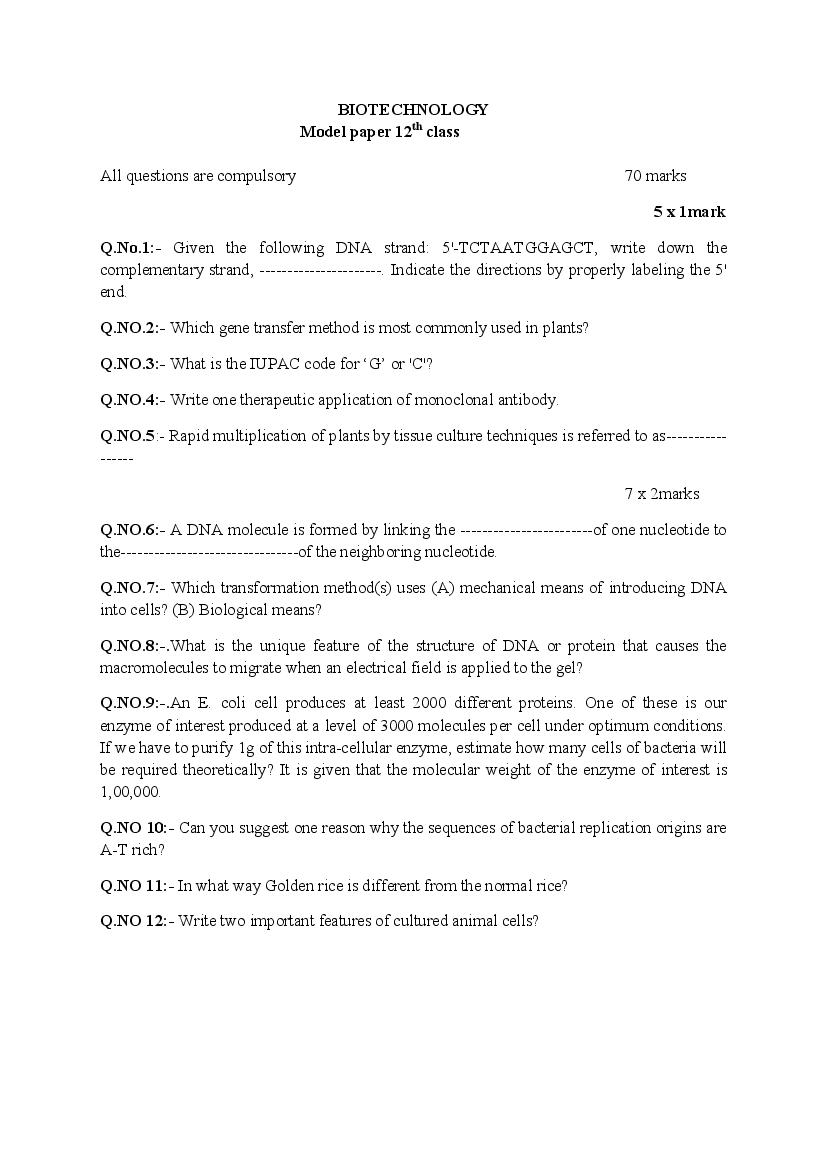
Model paper 12th class
All questions are compulsory 70 marks
5 x 1mark
Q.No.1:- Given the following DNA strand: 5'-TCTAATGGAGCT, write down the
complementary strand, ----------------------. Indicate the directions by properly labeling the 5'
end.
Q.NO.2:- Which gene transfer method is most commonly used in plants?
Q.NO.3:- What is the IUPAC code for ‘G’ or 'C'?
Q.NO.4:- Write one therapeutic application of monoclonal antibody.
Q.NO.5:- Rapid multiplication of plants by tissue culture techniques is referred to as-----------
------
7 x 2marks
Q.NO.6:- A DNA molecule is formed by linking the ------------------------of one nucleotide to
the--------------------------------of the neighboring nucleotide.
Q.NO.7:- Which transformation method(s) uses (A) mechanical means of introducing DNA
into cells? (B) Biological means?
Q.NO.8:-.What is the unique feature of the structure of DNA or protein that causes the
macromolecules to migrate when an electrical field is applied to the gel?
Q.NO.9:-.An E. coli cell produces at least 2000 different proteins. One of these is our
enzyme of interest produced at a level of 3000 molecules per cell under optimum conditions.
If we have to purify 1g of this intra-cellular enzyme, estimate how many cells of bacteria will
be required theoretically? It is given that the molecular weight of the enzyme of interest is
1,00,000.
Q.NO 10:- Can you suggest one reason why the sequences of bacterial replication origins are
A-T rich?
Q.NO 11:- In what way Golden rice is different from the normal rice?
Q.NO 12:- Write two important features of cultured animal cells?
Page 2
Q.NO.13:-.Given the following DNA sequence, 5' ACGTGCCTCG 3' Coding strand
3' TGCACGGAGC 5'
(a) Which strand is the sense strand? Antisense strand?
(b) What is the sequence of mRNA after transcription?
(c) What is the sequence of the antisense RNA?
Q.NO 14:- Give examples of pairs of amino acids that form (A) electrostatic interactions,
(B) hydrogen bonding, (C) hydrophobic interactions.
Q.NO 15:- Why is it that genomic libraries are used for isolating genes in bacteria? Why
are cDNA libraries not used for prokaryotes?
Q.NO 16:- E. coli is a rod shaped bacteria about 2 µm long and 1 µm in diameter. The
average density of a cell is 1 .28 g/ ml. Approximately 13.5% of the wet weight of E. coli is
soluble protein. Estimate the number of molecules of a particular enzyme per cell if the
enzyme has a molecular weight of 100,000 and represents 0.1 % of the total soluble protein.
Q.NO 17:- For hybridization, the DNA bound to the membrane is first denatured. What is
denaturation? How do you denature DNA on a membrane?
Q.NO 18:- Briefly explain how the serine residue in some enzymes can become acidic
(reactive).Also suggest how you can confirm that a serine residue is involved in the catalysis.
Q.NO 19:- Frozen cells should be thawed as rapidly as possible during their revival. Why?
What is the role of DMSO in cryopreservation?
Q.NO 20:- Why is Agrobacterium described as 'natural genetic engineer of plants'?
Q.NO 21:- How are monoclonal antibodies different from polyclonal antibodies?
Q.NO 22:- What is the role of serum for culturing animal cells?
Q.NO 23:- Is the concept of hybridization applicable to Western blot? Explain your answer?
Q.NO 24:- What were the surprises revealed from genome sequencing?
Page 3
Q .No.25:- Define: primary structure, secondary structure, tertiary structure, and quaternary
structure, of a protein. What are the major forces involved in the formation of each structural
organization?
Or
What are the unique features and properties of a cosmid that make it desirable as a cloning
vector?
Q .No.26:- What are the different types of molecules on which sequence data is obtained and
deposited in the database?
Or
Describe the methods used for the measurement and quantitative evaluation of microbial
growth?
Q. No.27:- How are plant cells converted to protoplasts? Why are protoplasts more amenable
to produce somatic cell hybrids and cybrids?
Or
What are stem cells? Describe the application of embryonic stem cell technology?