JNUEE 2021 Question Paper M.Sc Physics
Finished viewing? Save it for later —
Download JNUEE 2021 Question Paper M.Sc Physics (PDF · 19 pages)About JNUEE 2021 Question Paper M.Sc Physics
JNUEE 2021 Question Paper M.Sc Physics is available here for free download. Published by NTA for Jawaharlal Nehru University Entrance Examination, this question paper can be viewed online or downloaded as a PDF (19 pages). Candidates preparing for Jawaharlal Nehru University Entrance Examination can use JNUEE 2021 Question Paper M.Sc Physics to understand the exam pattern, the type of questions asked, and the overall difficulty level.
Frequently Asked Questions
How can I download JNUEE 2021 Question Paper M.Sc Physics?
Open this page and click the Download button to save JNUEE 2021 Question Paper M.Sc Physics as a PDF. It is completely free on AglaSem Docs.
Is JNUEE 2021 Question Paper M.Sc Physics free to download?
Yes. JNUEE 2021 Question Paper M.Sc Physics can be viewed online and downloaded as a PDF free of cost on AglaSem Docs.
How many pages does JNUEE 2021 Question Paper M.Sc Physics have?
JNUEE 2021 Question Paper M.Sc Physics contains 19 pages, which you can read online or download together as a single PDF.
Where can I find more Jawaharlal Nehru University Entrance Examination study material?
You can find more Jawaharlal Nehru University Entrance Examination question papers, sample papers, syllabus, and answer keys on AglaSem Docs.
JNUEE 2021 Question Paper M.Sc Physics – Text
Read the full text of this question paper below — useful to quickly search, copy and reference the content online without downloading the PDF.
📄 View text version (19 pages)
Page 1
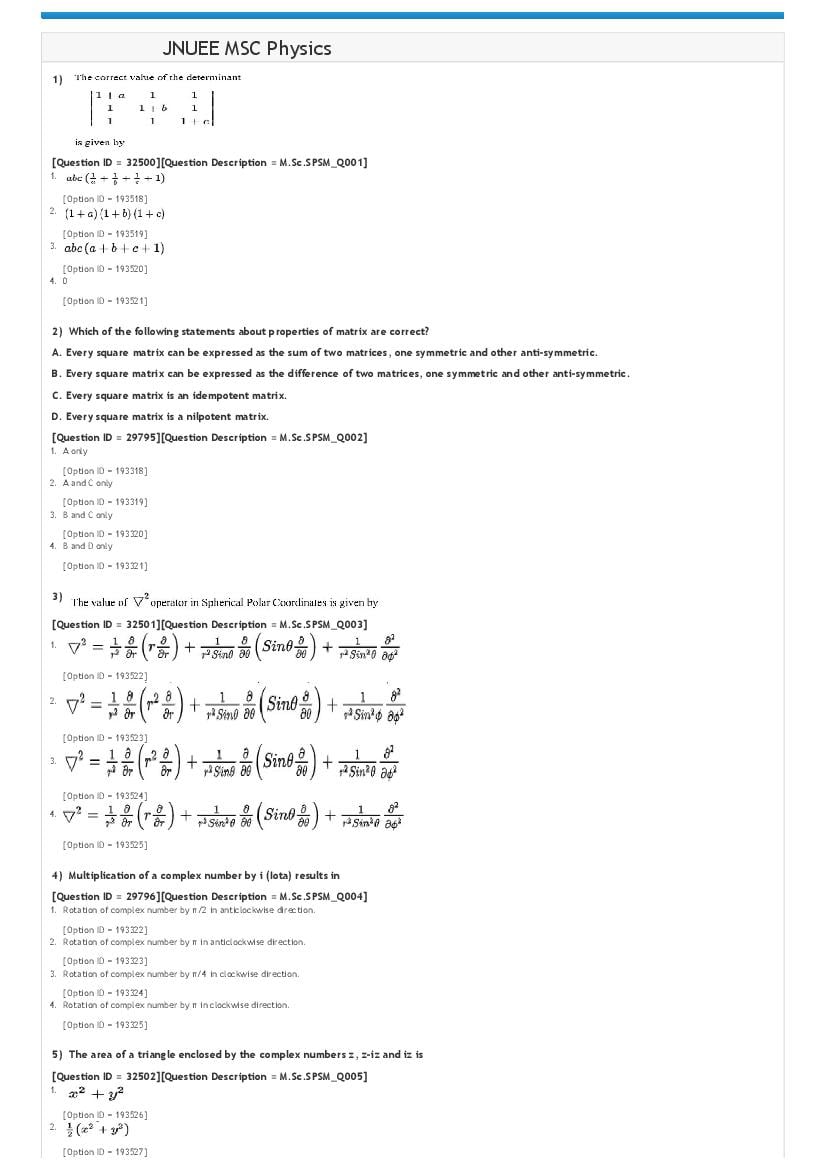
1)
[Question ID = 32500][Question Description = M.Sc.SPSM_Q001]
1.
[Option ID = 193518]
2.
[Option ID = 193519]
3.
[Option ID = 193520]
4. 0
[Option ID = 193521]
2) Which of the following statements about properties of matrix are correct?
A. Every square matrix can be expressed as the sum of two matrices, one symmetric and other anti‐symmetric.
B. Every square matrix can be expressed as the difference of two matrices, one symmetric and other anti‐symmetric.
C. Every square matrix is an idempotent matrix.
D. Every square matrix is a nilpotent matrix.
[Question ID = 29795][Question Description = M.Sc.SPSM_Q002]
1. A only
[Option ID = 193318]
2. A and C only
[Option ID = 193319]
3. B and C only
[Option ID = 193320]
4. B and D only
[Option ID = 193321]
3)
[Question ID = 32501][Question Description = M.Sc.SPSM_Q003]
1.
[Option ID = 193522]
2.
[Option ID = 193523]
3.
[Option ID = 193524]
4.
[Option ID = 193525]
4) Multiplication of a complex number by i (Iota) results in
[Question ID = 29796][Question Description = M.Sc.SPSM_Q004]
1. Rotation of complex number by π/2 in anticlockwise direction.
[Option ID = 193322]
2. Rotation of complex number by π in anticlockwise direction.
[Option ID = 193323]
3. Rotation of complex number by π/4 in clockwise direction.
[Option ID = 193324]
4. Rotation of complex number by π in clockwise direction.
[Option ID = 193325]
5) The area of a triangle enclosed by the complex numbers z, z‐iz and iz is
[Question ID = 32502][Question Description = M.Sc.SPSM_Q005]
1.
[Option ID = 193526]
2.
[Option ID = 193527]
Page 2
[Option ID = 193528]
4.
[Option ID = 193529]
6)
[Question ID = 32503][Question Description = M.Sc.SPSM_Q006]
1. 0
[Option ID = 193530]
2.
[Option ID = 193531]
3.
[Option ID = 193532]
4.
[Option ID = 193533]
7)
[Question ID = 32504][Question Description = M.Sc.SPSM_Q007]
1.
[Option ID = 193534]
2.
[Option ID = 193535]
3.
[Option ID = 193536]
4. None of the above
[Option ID = 193537]
8)
[Question ID = 32505][Question Description = M.Sc.SPSM_Q008]
1.
[Option ID = 193538]
2.
[Option ID = 193539]
3.
[Option ID = 193540]
4.
[Option ID = 193541]
9)
[Question ID = 32506][Question Description = M.Sc.SPSM_Q009]
1.
[Option ID = 193542]
2.
[Option ID = 193543]
3.
[Option ID = 193544]
4.
[Option ID = 193545]
10) The correct value of Fourier Sine transform of 1/x is
[Question ID = 32507][Question Description = M.Sc.SPSM_Q010]
1. 0
[Option ID = 193546]
2.
[Option ID = 193547]
3.
[Option ID = 193548]
4.
[Option ID = 193549]
Page 3
[Question ID = 32508][Question Description = M.Sc.SPSM_Q011]
1.
[Option ID = 193550]
2.
[Option ID = 193551]
3.
[Option ID = 193552]
4.
[Option ID = 193553]
12)
[Question ID = 32509][Question Description = M.Sc.SPSM_Q012]
1. π/4 [Option ID = 193554]
2. π/3 [Option ID = 193555]
3. π/2 [Option ID = 193556]
4. 0 [Option ID = 193557]
13)
[Question ID = 32510][Question Description = M.Sc.SPSM_Q013]
1. 1
[Option ID = 193558]
2. 2
[Option ID = 193559]
3. 3
[Option ID = 193560]
4. 4
[Option ID = 173165]
14)
[Question ID = 32511][Question Description = M.Sc.SPSM_Q014]
1.
[Option ID = 173166]
2.
[Option ID = 173167]
3.
[Option ID = 173168]
4.
[Option ID = 173169]
15) Consider the following statements for a particle moving in an elliptic orbit under the influence of a central force:
(a) The radius vector covers equal area in equal time.
(b) The motion takes place in a plane.
(c) The angular momentum is a constant of motion.
Which of the statements given above are correct?
[Question ID = 29797][Question Description = M.Sc.SPSM_Q015]
1. (a) and (b) only
[Option ID = 193326]
2. (b) and (c) only
[Option ID = 193327]
3. (a) and (c) only
[Option ID = 193328]
4. (a), (b) and (c)
[Option ID = 193329]
16) Billiard ball A moves with a velocity of 1.20 m/s in the +y direction on a billiard table and strikes an identical ball, B initially at rest. If A is
deflected such that its velocity is (0.56 î+ 0.80 ĵ) m/s, then the final velocity of B will be
[Question ID = 29798][Question Description = M.Sc.SPSM_Q016]
1. (0.56 î + 0.40 ĵ) m/s
Page 4
2. (‐0.56 î + 0.40 ĵ) m/s
[Option ID = 193331]
3. (0.56 î ‐ 0.40 ĵ) m/s
[Option ID = 193332]
4. (‐0.56 î ‐ 0.40 ĵ) m/s
[Option ID = 193333]
17) Four spheres each of diameter 2a and mass m are placed with their centers on the four corners of a square of side b. The moment of inertia
of the system about any side of the sphere will be
[Question ID = 32512][Question Description = M.Sc.SPSM_Q017]
1.
[Option ID = 173170]
2.
[Option ID = 173171]
3.
[Option ID = 173172]
4.
[Option ID = 173173]
18) If a planet revolves around the sun in a circular orbit of radius 'a' with a period of revolution 'T', then (k being a positive constant)
[Question ID = 32513][Question Description = M.Sc.SPSM_Q018]
1.
[Option ID = 173174]
2.
[Option ID = 173175]
3.
[Option ID = 173176]
4.
[Option ID = 173177]
19) If e is the coefficient of restitution, then which one of the following gives the condition for perfectly elastic bodies?[Question ID = 29799]
[Question Description = M.Sc.SPSM_Q019]
1. e = 0 [Option ID = 193334]
2. e = 0.5 [Option ID = 193335]
3. e = 0.8 [Option ID = 193336]
4. e = 1.0 [Option ID = 193337]
20) A body moving with uniform acceleration, accelerates for first ten seconds and then retards at double the value of the acceleration uniformly
for the next five seconds. The body will have the same velocity
(a) at the end of 4th and 13th seconds
(b) at the end of 9th and 12th seconds
(c) at the end of 8th and 11th seconds
Which of the above are correct?
[Question ID = 29800][Question Description = M.Sc.SPSM_Q020]
1. (a) and (b)
[Option ID = 193338]
2. (a) and (c)
[Option ID = 193339]
3. (a), (b) and (c)
[Option ID = 193340]
4. (b) and (c)
[Option ID = 193341]
21) Consider the following statements:
(a) Magnus effect is a consequence of Bernoulli’s principle.
(b) A cricketer, while spinning a ball makes it to experience Magnus effect.
Which of the statements given above is/are correct?
[Question ID = 29801][Question Description = M.Sc.SPSM_Q021]
1. (a) only
[Option ID = 193342]
2. (b) only
[Option ID = 193343]
Page 5
[Option ID = 193344]
4. Neither (a) nor (b)
[Option ID = 193345]
22) An elastic collision conserves[Question ID = 29802][Question Description = M.Sc.SPSM_Q022]
1. kinetic energy but not momentum [Option ID = 193346]
2. momentum but not kinetic energy [Option ID = 193347]
3. neither momentum nor kinetic energy [Option ID = 193348]
4. both kinetic energy and momentum [Option ID = 193349]
23) Consider the following statements:
(a) Volume of fluid flow in a tube in which a constant pressure difference is maintained increases when the temperature of the fluid increases.
(b) Density of the fluid decreases with the increase in temperature and there is more fluid volume per unit mass at high temperature.
Which of the statements given above is/are correct?
[Question ID = 29803][Question Description = M.Sc.SPSM_Q023]
1. (a) only
[Option ID = 193350]
2. (b) only
[Option ID = 193351]
3. Both (a) and (b)
[Option ID = 193352]
4. Neither (a) nor (b)
[Option ID = 193353]
24)
[Question ID = 32514][Question Description = M.Sc.SPSM_Q024]
1.
[Option ID = 173178]
2. 3
[Option ID = 173179]
3.
[Option ID = 173180]
4.
[Option ID = 173181]
25) If I1, I2 and I3 are the moments of inertia about a diameter of a thin hollow sphere, solid sphere and disc having same mass and same radius
respectively, then which one of the following is correct?
[Question ID = 32515][Question Description = M.Sc.SPSM_Q025]
1.
[Option ID = 173182]
2.
[Option ID = 173183]
3.
[Option ID = 173184]
4.
[Option ID = 173185]
26) In what type of fluid, there is the maximum probability of streamline flow?
[Question ID = 29804][Question Description = M.Sc.SPSM_Q026]
1. Low density, low viscosity
[Option ID = 193354]
2. Low density, high viscosity
[Option ID = 193355]
3. High density, low viscosity
[Option ID = 193356]
4. High density, high viscosity
[Option ID = 193357]
27)
[Question ID = 32516][Question Description = M.Sc.SPSM_Q027]
1.
[Option ID = 173186]
Page 6
[Option ID = 173187]
3.
[Option ID = 173188]
4.
[Option ID = 173189]
28) Given below are two statements, one is labelled as Assertion A and the other is labelled as Reason R
Assertion A: If h1, h2 (h1 > h2) are the heights of two satellites above the surface of earth and v1, v2 are their corresponding orbital speeds then
v 1< v2.
Reason R: Orbital velocity of a body is inversely proportional to its distance from the center of earth.
In light of the above statement, choose the correct answer from the options given below
[Question ID = 31167][Question Description = N_M.Sc.SPSM_Q028]
1. Both A and R are true and R is the correct explanation of A
[Option ID = 201272]
2. Both A and R are true but R is NOT the correct explanation of A
[Option ID = 201273]
3. A is true but R is false
[Option ID = 201274]
4. A is false but R is true
[Option ID = 201275]
29) A beam of plane‐polarized light falls on a polarizer which rotates about the axis of the ray with angular velocity 21 rad/s. The flux of energy
of the incident ray is 4.0 m W. The energy of light passing through the polarizer per one revolution will be
[Question ID = 26493][Question Description = M.Sc.SPSM_Q029]
1. 2.1 mJ
[Option ID = 193358]
2. 0.6 mJ
[Option ID = 193359]
3. 0.2 mJ
[Option ID = 193360]
4. 1.2 mJ
[Option ID = 193361]
30) A light source, which emits two wavelengths λ1 = 400 nm and λ2 = 600 nm, is used in a Young's double slit experiment. If recorded fringe
widths for λ1 and λ2 are β1 and β2 and the number of fringes for them within a distance y on one side of the central maximum are m1 and m2,
respectively, then which of the following is NOT correct
[Question ID = 26494][Question Description = M.Sc.SPSM_Q030]
1. β2 > β1
[Option ID = 193362]
2. m1 > m2
[Option ID = 193363]
3. The angular separation of fringes for λ1 is greater than λ2
[Option ID = 193364]
4. From the central maximum, 3r d maximum of λ2 overlaps with 5th minimum of λ1
[Option ID = 193365]
31)
[Question ID = 29824][Question Description = M.Sc.SPSM_Q031]
1.
[Option ID = 173194]
2.
[Option ID = 173195]
3.
[Option ID = 173196]
4.
[Option ID = 173197]
32) A half‐wave plate is an anisotropic optical element which introduces a retardation of λ/2 in the optical path length for the electric field
component parallel to its optic axis, where λ is the wavelength of the incident radiation. If linearly polarized light is incident on a half‐wave plate
with its polarization at 45° to the optical axis, the transmitted light is (compared to the initial polarization)
[Question ID = 26495][Question Description = M.Sc.SPSM_Q032]
Page 7
[Option ID = 193366]
2. left circularly polarized
[Option ID = 193367]
3. right circularly polarized
[Option ID = 193368]
4. linearly polarized and rotated by 90°
[Option ID = 193369]
33)
[Question ID = 29825][Question Description = M.Sc.SPSM_Q033]
1. 17 s‐1
[Option ID = 173198]
2. 34 s‐1
[Option ID = 173199]
3. 50 s‐1
[Option ID = 173200]
4. 100 s‐1
[Option ID = 173201]
34) Assertion A :
Newton's rings are formed in the reflected system. When the space between the lens and the glass plate is filled with a liquid of refractive index
greater than that of glass, the central spot of the pattern is bright.
Reason R :
The reflection in these cases will be from a denser to rarer medium and the two interfering rays are reflected under similar conditions.
[Question ID = 26496][Question Description = M.Sc.SPSM_Q034]
1. Both A and R are true and R is the correct explanation of A
[Option ID = 193370]
2. Both A and R are true but R is NOT the correct explanation of A
[Option ID = 193371]
3. A is true but R is false
[Option ID = 193372]
4. A is false but R is true
[Option ID = 193373]
35)
[Question ID = 29826][Question Description = M.Sc.SPSM_Q035]
1.
[Option ID = 173202]
2.
[Option ID = 173203]
3.
[Option ID = 173204]
4.
[Option ID = 173205]
36) A different gratting of length 2.5 x 10‐2 m is illumnated by a light with two wavelengths 5997 Å and 6003 Å. The maximum size of the grating
element d (in μm) required to resolve the two wavwlength in the first order is
[Question ID = 31173][Question Description = N_M.Sc.SPSM_Q036]
1. 75
[Option ID = 201296]
2. 50
[Option ID = 201297]
3. 25
[Option ID = 201298]
4. 100
[Option ID = 201299]
37)
Page 8
1.
[Option ID = 173210]
2.
[Option ID = 173211]
3.
[Option ID = 173212]
4.
[Option ID = 173213]
38)
[Question ID = 29829][Question Description = M.Sc.SPSM_Q038]
1.
[Option ID = 173214]
2.
[Option ID = 173215]
3.
[Option ID = 173216]
4.
[Option ID = 173217]
39)
[Question ID = 29830][Question Description = M.Sc.SPSM_Q039]
1. 2.5 s‐1 [Option ID = 173218]
2. 5 s‐1 [Option ID = 173219]
3. 25 s‐1 [Option ID = 173220]
4. 50 s‐1 [Option ID = 173221]
40)
[Question ID = 29831][Question Description = M.Sc.SPSM_Q040]
1. 1.0 ms‐1 [Option ID = 173222]
2. 4.0 ms‐1 [Option ID = 173223]
3. 2.0 ms‐1 [Option ID = 173224]
4. 0.5 ms‐1 [Option ID = 173225]
41)
Page 9
1. P ‐ 4, Q ‐ 2, R ‐ 4 , S ‐ 1
[Option ID = 173226]
2. P ‐ 1, Q ‐ 3 , R ‐1 , S ‐ 4
[Option ID = 173227]
3. P ‐ 4 , Q ‐2 , R ‐1 , S ‐ 4
[Option ID = 173228]
4. P ‐ 3, Q ‐ 1 , R ‐ 3, S ‐ 2
[Option ID = 173229]
42) White light, with a uniform intensity across the visible wavelength range, is perpendicularly incident on a water film, of index of refraction
n2 = 1.33 and thickness L = 320 nm, that is suspended in air. At what wavelength λ is the light reflected by the film brightest to an observer?
[Question ID = 26497][Question Description = M.Sc.SPSM_Q042]
1. 567 nm [Option ID = 193374]
2. 340 nm [Option ID = 193375]
3. 493 nm [Option ID = 193376]
4. 619 nm [Option ID = 193377]
43) The magnitude of the induced e.m.f. in a conductor depends on the[Question ID = 26498][Question Description = M.Sc.SPSM_Q043]
1. flux density of the magnetic field [Option ID = 193378]
2. amount of flux cut [Option ID = 193379]
3. amount of flux‐linkages [Option ID = 193380]
4. rate of change of flux‐linkages [Option ID = 193381]
44)
[Question ID = 29833][Question Description = M.Sc.SPSM_Q044]
1.
[Option ID = 173230]
2.
[Option ID = 173231]
3.
[Option ID = 173232]
4.
[Option ID = 173233]
45)
[Question ID = 29834][Question Description = M.Sc.SPSM_Q045]
1.
[Option ID = 173234]
2.
[Option ID = 173235]
3.
[Option ID = 173236]
4.
[Option ID = 173237]
46)
[Question ID = 29835][Question Description = M.Sc.SPSM_Q046]
1. 1.5 J [Option ID = 173238]
2. 0.15 J [Option ID = 173239]
3. 15 J [Option ID = 173240]
4. 150 J [Option ID = 173241]
Page 10
[Question ID = 29836][Question Description = M.Sc.SPSM_Q047]
1.
[Option ID = 173242]
2.
[Option ID = 173243]
3.
[Option ID = 173244]
4.
[Option ID = 173245]
48) Which one remains invariant under Lorentz‐Transformation?
[Question ID = 29837][Question Description = M.Sc.SPSM_Q048]
1.
[Option ID = 173246]
2.
[Option ID = 173247]
3.
[Option ID = 173248]
4. All of these
[Option ID = 173249]
49)
[Question ID = 29838][Question Description = M.Sc.SPSM_Q049]
1. 0.96 [Option ID = 173250]
2. 0.04 [Option ID = 173251]
3. 0.84 [Option ID = 173252]
4. 0.16 [Option ID = 173253]
50)
[Question ID = 29839][Question Description = M.Sc.SPSM_Q050]
1.
[Option ID = 173254]
2.
[Option ID = 173255]
3.
[Option ID = 173256]
4.
[Option ID = 173257]
51) The Coulomb's law is an implication of which law
[Question ID = 26499][Question Description = M.Sc.SPSM_Q051]
1. Ampere's law
[Option ID = 193382]
2. Gauss's law
[Option ID = 193383]
3. Biot‐Savart law
Page 11
4. Lenz law
[Option ID = 193385]
52)
[Question ID = 29840][Question Description = M.Sc.SPSM_Q052]
1.
[Option ID = 173258]
2.
[Option ID = 173259]
3.
[Option ID = 173260]
4.
[Option ID = 173261]
53)
[Question ID = 32537][Question Description = M.Sc.SPSM_Q053]
1. 175 A/m [Option ID = 173262]
2. 250 A/m [Option ID = 173263]
3. 325 A/m [Option ID = 173264]
4. 375 A/m [Option ID = 173265]
54)
[Question ID = 32538][Question Description = M.Sc.SPSM_Q054]
1. 0.225 mm
[Option ID = 173266]
2. 2.25 mm
[Option ID = 173267]
3. 0.16 mm
[Option ID = 173268]
4. 1.6 mm
[Option ID = 173269]
55)
[Question ID = 32539][Question Description = M.Sc.SPSM_Q055]
1.
[Option ID = 173270]
2.
[Option ID = 173271]
3.
[Option ID = 173272]
4.
[Option ID = 173273]
56) Alfvén's flux freezing theorem is related to magnetized fluid of
[Question ID = 26500][Question Description = M.Sc.SPSM_Q056]
1. finite conductivity
[Option ID = 193386]
2. infinite conductivity
[Option ID = 193387]
3. large viscosity
[Option ID = 193388]
4. All of these
[Option ID = 193389]
57)
[Question ID = 32540][Question Description = M.Sc.SPSM_Q057]
1.
Page 12
2.
[Option ID = 173275]
3.
[Option ID = 173276]
4.
[Option ID = 173277]
58)
[Question ID = 32541][Question Description = M.Sc.SPSM_Q058]
1. a>0, b>0
[Option ID = 173278]
2. a=0, b>0
[Option ID = 173279]
3. a>0, b=0
[Option ID = 173280]
4. a=0, b=0
[Option ID = 173281]
59) Consider the phase diagram of a simple fluid. Which of the following statements is correct?[Question ID = 26501][Question Description =
M.Sc.SPSM_Q059]
1. There is a point where a third‐order phase transition is seen. [Option ID = 193390]
2. A line of first‐order transitions ends in a critical point. [Option ID = 193391]
3. A line of second‐order transitions separates the liquid and solid phases. [Option ID = 193392]
4. The triple point coincides with the critical point. [Option ID = 193393]
60) An engine has heat input at 127o C and releases it at 27o C. The maximum possible efficiency of this engine is
[Question ID = 26502][Question Description = M.Sc.SPSM_Q060]
1. 0.15
[Option ID = 193394]
2. 0.2
[Option ID = 193395]
3. 0.25
[Option ID = 193396]
4. 0.3
[Option ID = 193397]
61)
[Question ID = 32542][Question Description = M.Sc.SPSM_Q061]
1. 3/5 [Option ID = 173282]
2. 5/3 [Option ID = 173283]
3. 2/5 [Option ID = 173284]
4. 5/2 [Option ID = 173285]
62)
[Question ID = 32543][Question Description = M.Sc.SPSM_Q062]
1.
[Option ID = 173286]
2.
[Option ID = 173287]
3.
[Option ID = 173288]
4.
[Option ID = 173289]
63)
[Question ID = 32544][Question Description = M.Sc.SPSM_Q063]
1. 0
[Option ID = 173290]
Page 13
[Option ID = 173291]
3.
[Option ID = 173292]
4.
[Option ID = 173293]
64)
[Question ID = 32545][Question Description = M.Sc.SPSM_Q064]
1.
[Option ID = 173294]
2.
[Option ID = 173295]
3.
[Option ID = 173296]
4.
[Option ID = 173297]
65)
[Question ID = 32546][Question Description = M.Sc.SPSM_Q065]
1. 0
[Option ID = 173298]
2.
[Option ID = 173299]
3.
[Option ID = 173300]
4.
[Option ID = 173301]
66)
[Question ID = 32547][Question Description = M.Sc.SPSM_Q066]
1.
[Option ID = 173302]
2.
[Option ID = 173303]
3.
[Option ID = 173304]
4.
[Option ID = 173305]
67) In a crystal, the vibrations of atoms about their fixed positions are referred to as[Question ID = 26503][Question Description =
M.Sc.SPSM_Q067]
1. photons [Option ID = 193398]
2. phonons [Option ID = 193399]
3. excitons [Option ID = 193400]
4. polarons [Option ID = 193401]
68)
Page 14
1. 3
[Option ID = 173306]
2. 9
[Option ID = 173307]
3. 27
[Option ID = 173308]
4. 81
[Option ID = 173309]
69)
[Question ID = 32549][Question Description = M.Sc.SPSM_Q069]
1.
[Option ID = 173310]
2.
[Option ID = 173311]
3.
[Option ID = 173312]
4.
[Option ID = 173313]
70)
[Question ID = 32550][Question Description = M.Sc.SPSM_Q070]
1. 0
[Option ID = 173314]
2.
[Option ID = 173315]
3.
[Option ID = 173316]
4.
[Option ID = 173317]
71) The Helium isotope 62He is unstable. what kind of decay would you expect to undergo?
[Question ID = 26504][Question Description = M.Sc.SPSM_Q071]
1. Positive beta decay
[Option ID = 193402]
2. Negative beta decay
[Option ID = 193403]
3. Alpha decay
[Option ID = 193404]
4. None of above
[Option ID = 193405]
72) Consequence of Heisenberg uncertainty principle. which of the following is NOT correct
[Question ID = 26505][Question Description = M.Sc.SPSM_Q072]
1. An electron in a atom can not be described by a well define orbit
[Option ID = 193406]
2. The position of atom can not be measured exactly
[Option ID = 193407]
3. The momentum of electron can not be measured exactly
[Option ID = 193408]
4. A harmonic Oscillator possesses a zero point energy
[Option ID = 193409]
73) If a rod is to appear shrunken by half along its direction of motion, at what speed should rod travel?
[Question ID = 26506][Question Description = M.Sc.SPSM_Q073]
1. 1.45 × 10⁸ m/s
[Option ID = 193410]
2. 2.45 × 10⁸ m/s
[Option ID = 193411]
3. 1.45 × 10⁷ m/s
[Option ID = 193412]
4. 2.45 × 10⁷ m/s
Page 15
74) A 100MeV electron moves along the axis of an evacuated tube of length 4m fixed to the laboratory frame. What length of the tube would be
measured by the observer moving with the electron?[Question ID = 26507][Question Description = M.Sc.SPSM_Q074]
1. 2 cm [Option ID = 193414]
2. 4 cm [Option ID = 193415]
3. 6 cm [Option ID = 193416]
4. 8 cm [Option ID = 193417]
75) Find the effective mass of a photon for wavelength ( λ) = 5,000 Å
[Question ID = 26508][Question Description = M.Sc.SPSM_Q075]
1. 4.4×10‐34 kg
[Option ID = 193418]
2. 4.4×10‐35 kg
[Option ID = 193419]
3. 4.4×10‐36 kg
[Option ID = 193420]
4. 4.4×10‐37 kg
[Option ID = 193421]
76) Consider the decay of muon at rest. If the energy released is divided equally among the final leptons, what will be the angle between paths
of any two leptons? (neglect the mass of leptons compared to the mass of muon)
[Question ID = 26509][Question Description = M.Sc.SPSM_Q076]
1. 60o
[Option ID = 193422]
2. 90o
[Option ID = 193423]
3. 120o
[Option ID = 193424]
4. 150o
[Option ID = 193425]
77) An electron is trapped in an infinitely deep potential well of width L = 106 fm. Calculate the wavelength of photon emitted from the
transition E4 → E3
[Question ID = 26510][Question Description = M.Sc.SPSM_Q077]
1. 4665 nm
[Option ID = 193426]
2. 4715 nm
[Option ID = 193427]
3. 5000 nm
[Option ID = 193428]
4. 5515 nm
[Option ID = 193429]
78) Calculate the maximum change in the wavelength of Compton scattered radiation.
[Question ID = 26511][Question Description = M.Sc.SPSM_Q078]
1. 0.0385 Å
[Option ID = 193430]
2. 0.0485 Å
[Option ID = 193431]
3. 0.0585 Å
[Option ID = 193432]
4. 0.0685 Å
[Option ID = 193433]
79) All vibrations producing a charge in the electric dipole moment of a molecule yield
[Question ID = 29805][Question Description = M.Sc.SPSM_Q079]
1. Raman Spectra
[Option ID = 193434]
2. Infrared Spectra
[Option ID = 193435]
3. Ultra‐violet Spectra
[Option ID = 193436]
4. X‐ray Spectra
[Option ID = 193437]
80) The continuous X‐ray spectrum is the result of
[Question ID = 29806][Question Description = M.Sc.SPSM_Q080]
1. Auger effect
[Option ID = 193438]
2. Compton effect
[Option ID = 193439]
3. Photoelectric effect
Page 16
4. Inverse photoelectric effect
[Option ID = 193441]
81) Addition of Binary number 1001100 and 1111010 is
[Question ID = 29807][Question Description = M.Sc.SPSM_Q081]
1. 11001100
[Option ID = 193442]
2. 11000110
[Option ID = 193443]
3. 10101000
[Option ID = 193444]
4. 11100011
[Option ID = 193445]
82) If the inputs of an exclusive‐NOR gate are A and B, what is the output?[Question ID = 29808][Question Description = M.Sc.SPSM_Q082]
1. A'B'+AB' [Option ID = 193446]
2. A'B'+AB [Option ID = 193447]
3. A'B+AB' [Option ID = 193448]
4. A'B+AB [Option ID = 193449]
83) Convert decimal (0.15625)10 to binary number[Question ID = 29809][Question Description = M.Sc.SPSM_Q083]
1. (0.11001)2 [Option ID = 193450]
2. (0.00101)2 [Option ID = 193451]
3. (0.11100)2 [Option ID = 193452]
4. (0.00011)2 [Option ID = 193453]
84) If the surface leakage current is 5 nA for a reverse voltage of 60 V, what is the surface leakage current for a reverse voltage of 75 V?
[Question ID = 29810][Question Description = M.Sc.SPSM_Q084]
1. 2.25 nA [Option ID = 193454]
2. 6.25 nA [Option ID = 193455]
3. 12.25 nA [Option ID = 193456]
4. 20.25 nA [Option ID = 193457]
85) A transistor has a collector current of 3 mA. If the current gain is 155, what is the base current?[Question ID = 29811][Question Description =
M.Sc.SPSM_Q085]
1. 2 µA [Option ID = 193458]
2. 10 µA [Option ID = 193459]
3. 19 µA [Option ID = 193460]
4. 39 µA [Option ID = 193461]
86) Potassium is illuminated with ultraviolet light of wavelength 2500 Å. If the work function of Potassium is 2.20 eV, what is the maximum
kinetic energy of the emitted electrons?
(h = 6.63 x 10‐34 Js, c = 3 x 10⁸ ms‐1)
[Question ID = 29812][Question Description = M.Sc.SPSM_Q086]
1. 0.12 eV
[Option ID = 193462]
2. 2.76 eV
[Option ID = 193463]
3. 4.26 eV
[Option ID = 193464]
4. 8.10 eV
[Option ID = 193465]
87) How fast does a rocket ship have to go for its length to be contracted to 90% of its rest length?[Question ID = 29813][Question Description =
M.Sc.SPSM_Q087]
1. 1.30 x 10⁸ ms‐1 [Option ID = 193466]
2. 4.25 x 10¹⁰ ms‐1 [Option ID = 193467]
3. 3.14 x 10¹² ms‐1 [Option ID = 193468]
4. 2.41 x 10¹⁵ ms‐1 [Option ID = 193469]
88) A material whose K absorption edge is 0.20 Å is irradiated with 0.15 Å X‐rays. What is the maximum kinetic energy of photoelectrons that are
emitted from the K‐shell?
(h = 6.63 x 10‐34Js, c = 3 x 10⁸ ms‐1)
[Question ID = 29814][Question Description = M.Sc.SPSM_Q088]
1. 2.6 keV
[Option ID = 193470]
2. 10.8 keV
[Option ID = 193471]
3. 20.7 keV
[Option ID = 193472]
4. 31.5 keV
[Option ID = 193473]
89) A sample of a certain element is placed in a 0.500 T magnetic field and suitably excited. How far apart are the Zeeman components of the
550 nm spectral line of this element?
Page 17
[Question ID = 29815][Question Description = M.Sc.SPSM_Q089]
1. 0.001 nm
[Option ID = 193474]
2. 0.007 nm
[Option ID = 193475]
3. 0.019 nm
[Option ID = 193476]
4. 0.040 nm
[Option ID = 193477]
90) What magnetic flux density B is required to observe the Zeeman effect if a spectrometer can resolve spectral lines separated by 0.45 Å at
5000 Å?
[h = 6.63 x 10‐34Js, c = 3 x 10⁸ ms‐1, (eh/4πm)=5.79 x 10‐5 eV/T]
[Question ID = 29816][Question Description = M.Sc.SPSM_Q090]
1. 1.23 T (Approx.)
[Option ID = 193478]
2. 3.85 T (Approx.)
[Option ID = 193479]
3. 6.25 T (Approx.)
[Option ID = 193480]
4. 10.33 T (Approx.)
[Option ID = 193481]
91) Let’s use Cu Kα (wavelength 0.154 nm) x‐ray radiation to perform diffraction measurements. Find the lattice parameter of face centered
cubic (fcc) nickel element when the Bragg’s angle is 45o for its (220) reflection.
[Question ID = 29817][Question Description = M.Sc.SPSM_Q091]
1. 0.308 nm
[Option ID = 193482]
2. 0.352 nm
[Option ID = 193483]
3. 0.218 nm
[Option ID = 193484]
4. 0.616 nm
[Option ID = 193485]
92) Which one of the following shows the resistivity behavior of metals with temperature?Let’s take a piece of silicon at room temperature (300
K) having the intrinsic carrier concentration 2.4 x 10¹⁰ per cm3. Now we dope it with 8 x 10¹⁸ boron atoms per cm3.
[Question ID = 32551][Question Description = M.Sc.SPSM_Q092]
1.
[Option ID = 173318]
2.
[Option ID = 173319]
3.
[Option ID = 173320]
4.
[Option ID = 173321]
93) Let's take a piece of Silicon at room temperature (300 K) having the intrinsic carrier concentration 2.4 × 10¹⁰ per cm3. Now we dope it with 8
Page 18
Find the type of semiconductor produced.
[Question ID = 29818][Question Description = M.Sc.SPSM_Q093]
1. n‐type
[Option ID = 193486]
2. p‐type
[Option ID = 193487]
3. intrinsic
[Option ID = 193488]
4. none of the above
[Option ID = 193489]
94) Let's take a piece of Silicon at room temperature (300 K) having the intrinsic carrier concentration 2.4 × 10¹⁰ per cm3. Now we dope it with 8 ×
1018 boron per cm3.
Find the concentration of electrons in the sample.
[Question ID = 29819][Question Description = M.Sc.SPSM_Q094]
1. 72 cm‐3
[Option ID = 193490]
2. 2.3 x 10‐9 cm‐3
[Option ID = 193491]
3. 4.3 x 108 cm‐3
[Option ID = 193492]
4. 3.1 x 10‐2 cm‐3
[Option ID = 193493]
95) Consider a p‐n junction in unbiased condition at thermal equilibrium. Which one of the following is true?[Question ID = 29820][Question
Description = M.Sc.SPSM_Q095]
1. net current flows in the direction from n to p [Option ID = 193494]
2. net current flows in the direction from p to n [Option ID = 193495]
3. no net current flows [Option ID = 193496]
4. none of the above [Option ID = 193497]
96) Consider a p‐type semiconductor at 300 K (kT=0.026 eV) where the Fermi level lies 0.5 eV above the valence band (VB) and 0.4 eV below
the conduction band (CB). If we increase the concentration of the acceptor atoms by 4 times, find the new position of the Fermi level.
[Question ID = 29821][Question Description = M.Sc.SPSM_Q096]
1. 0.042 eV below the CB
[Option ID = 193498]
2. 0.036 eV below the CB
[Option ID = 193499]
3. 0.464 eV above the VB
[Option ID = 193500]
4. 0.536 eV above the VB
[Option ID = 193501]
97) Which of the following crystal structure has 4 Bravais lattices?[Question ID = 29822][Question Description = M.Sc.SPSM_Q097]
1. Tetragonal [Option ID = 193502]
2. Hexagonal [Option ID = 193503]
3. Monoclinic [Option ID = 193504]
4. Orthorhombic [Option ID = 193505]
98) Find the ratio of atomic density between bcc crystal and simple cubic.
[Question ID = 32497][Question Description = M.Sc.SPSM_Q098]
1. 2:1
[Option ID = 193506]
2. 4:1
[Option ID = 193507]
3. 1:2
[Option ID = 193508]
4. 1:4
[Option ID = 193509]
99) Let’s take a plane that makes an intercept of 0.3 nm, 0.4 nm, and 0.5 nm on the coordinate axes of an orthorhombic crystal system having
a:b:c in the ratio of 1:2:5. Find the Miller indices of the said plane.
[Question ID = 32498][Question Description = M.Sc.SPSM_Q099]
1. (236)
[Option ID = 193510]
2. (345)
[Option ID = 193511]
3. (125)
[Option ID = 193512]
4. (321)
[Option ID = 193513]
Page 19
2θ=121o , find the interplanar spacing of next possible higher index peak.
[Question ID = 32499][Question Description = M.Sc.SPSM_Q100]
1. 0.0885 nm
[Option ID = 193514]
2. 0.153 nm
[Option ID = 193515]
3. 0.0765 nm
[Option ID = 193516]
4. none of the above
[Option ID = 193517]
Document Details
| Board / Org | NTA |
| Exam | Jawaharlal Nehru University Entrance Examination |
| Type | Question Paper |
| Pages | 19 |
| Updated | 09 Jun 2026 |