JKBOSE Class 12 Model Question Paper for Accounting
Finished viewing? Save it for later —
Download JKBOSE Class 12 Model Question Paper for Accounting (PDF · 9 pages)About JKBOSE Class 12 Model Question Paper for Accounting
JKBOSE Class 12 Model Question Paper for Accounting is available here for free download. Published by JKBOSE for Class 12, this sample paper can be viewed online or downloaded as a PDF (9 pages). Candidates preparing for Class 12 can use JKBOSE Class 12 Model Question Paper for Accounting to understand the exam pattern, the type of questions asked, and the overall difficulty level.
Frequently Asked Questions
How can I download JKBOSE Class 12 Model Question Paper for Accounting?
Open this page and click the Download button to save JKBOSE Class 12 Model Question Paper for Accounting as a PDF. It is completely free on AglaSem Docs.
Is JKBOSE Class 12 Model Question Paper for Accounting free to download?
Yes. JKBOSE Class 12 Model Question Paper for Accounting can be viewed online and downloaded as a PDF free of cost on AglaSem Docs.
How many pages does JKBOSE Class 12 Model Question Paper for Accounting have?
JKBOSE Class 12 Model Question Paper for Accounting contains 9 pages, which you can read online or download together as a single PDF.
Where can I find more Class 12 study material?
You can find more Class 12 question papers, sample papers, syllabus, and answer keys on AglaSem Docs.
JKBOSE Class 12 Model Question Paper for Accounting – Text
Read the full text of this sample paper below — useful to quickly search, copy and reference the content online without downloading the PDF.
📄 View text version (9 pages)
Page 1
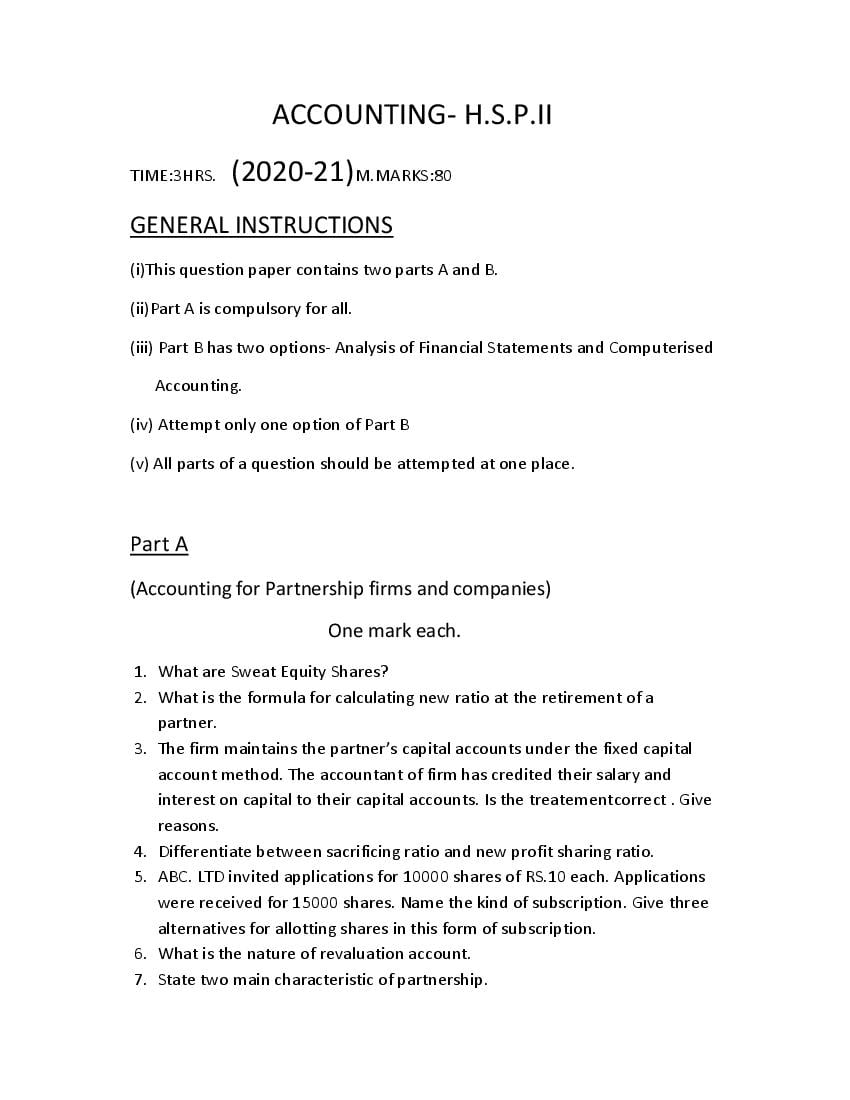
TIME:3HRS. (2020-21)M.MARKS:80
GENERAL INSTRUCTIONS
(i)This question paper contains two parts A and B.
(ii)Part A is compulsory for all.
(iii) Part B has two options- Analysis of Financial Statements and Computerised
Accounting.
(iv) Attempt only one option of Part B
(v) All parts of a question should be attempted at one place.
Part A
(Accounting for Partnership firms and companies)
One mark each.
1. What are Sweat Equity Shares?
2. What is the formula for calculating new ratio at the retirement of a
partner.
3. The firm maintains the partner’s capital accounts under the fixed capital
account method. The accountant of firm has credited their salary and
interest on capital to their capital accounts. Is the treatementcorrect . Give
reasons.
4. Differentiate between sacrificing ratio and new profit sharing ratio.
5. ABC. LTD invited applications for 10000 shares of RS.10 each. Applications
were received for 15000 shares. Name the kind of subscription. Give three
alternatives for allotting shares in this form of subscription.
6. What is the nature of revaluation account.
7. State two main characteristic of partnership.
Page 2
at unequal monthly intervals.
9. How does the factor location affect the goodwill of the firm.
10.X is a partner in M/S XYZ has advanced a loan of rs.200000 to the firm. Rate
of interest was not deducted but X demands interest on loan @10% p.a at
the year end. Is the demand of X justified.
11. Differentiate between call in arrear and call in advance.
12. What is meant by P&L appropriation account.
13.What is realisation account.
3 MARKS EACH.
14. Give the treatment of workmen compensation reserve Rs.13000 appearing
in the books of A&B on the admission of C.
4 MARKS EACH.
15. A&B were partners in a firm sharing profits in the ratio of 4:3. They
admitted C as a new partner for 3/7th share in the profits of the firm. The
new ratio will be 2:2:3. C brought Rs.200000 as his capital and Rs. 60000 for
his share of premium as Goodwill. Half of which was withdrawn by A&B
from the firm. Calculate sacrificing ratio and journal entries in the books of
firm.
16. Pass Journal entries for the following transactions
1) The assets of the firm realised RS.100000
2) Creditors paid Rs.26000 in full settlement of their account of Rs.30000
3) Dissolution expenses amount to Rs.1000
4) An unrecorded asset realised to Rs.1500
17. Gltd. Purchased plant from S ltd. for Rs.378000 payable in fully paid
shares of 10 each. Pass Journal entries when
1) Shares are issued at par
2) Shares are issued at 20% premium.
18. State the provisions of Companies Act 2013 for the creation of Debenture
Redemption Reserve.
Page 3
19. A company issued 1000 6% Debentures of Rs.100 each at Rs.110 payable
as follows:
Rs.30- On application (including premium of Rs.5)
Rs.30-On allotment (including premium of Rs.5)
Rs.50-On first and final call
All the debentures were applied for and allotted. All money due was
received except final call on 20 debentures. Pass journal entries for the
above.
20. What are different modes of dissolution of a partnership firm with or
without the interference of court.
8 MARKS EACH.
21. Gautam and Yashica are partners in a firm, sharing profits and losses in 3:1
respectively. The balance sheet of the firm as on 31st march 2018 was as
follows:
Balance Sheet as at 31.3.2018
LIABILITIES AMT(RS.) ASSETS AMT(RS.)
Sundry Crs. 50,000 Furniture 60,000
Bills payable 30,000 Stock 1,40,000
Capitals- Debtors 80,000
GAUTAM 4,00,000 Cash in hand 90,000
YASHICA 1,00,000 Machinery 2,10,000
5,80,000 5,80,000
th
Asma is admitted as a partner for 3/8 share in profits with a capital of
Rs.210000 and 50000 for her share of goodwill. It was decided that
i)New profit sharing ratio will be 3:2:3.
ii) Machinery will depreciate by 10% and furniture by 5000.
iii) Stock was re valued at 210000
iv) Provision for doubtful debts is to be created at 10% of debtors.
v) The capitals of all the partners were to be in the new profit ratio on the
basis of capital of new partner any adjustment to be done through
current accunts.
Page 4
of the new firm.
OR
X,Y,Z were in partnership sharing profits in propotion to their capitals. Their
Balance Sheet as on 31st march,2018 was as follows:
LIABILITIES AMOUNT ASSETS AMOUNT
Sundry Crs. 16,600 Cash 15,000
Workmen’s 9,000 Debtors 21,000
compensation less: prov. (1400) 19600
fund for doubtful
General Reserve 6,000 debts
Capitals- Stock 19,000
X 90,000 Machinery 58,000
Y 60,000 1,80,000 Building 1,00,000
Z 30,000
2,11,600 2,11,600
On the above date, Y retired owing to ill health. The following adjustments
were agreed upon for calculation of amount due to Y.
a) Provision for Doubtful Debts to be increased to 10% of Debtors.
b) Goodwill of the firm be valued at 36000 and be adjusted into the capital
accounts of X and Z, who will share profits in future in the ratio of 3:1.
c) Included in the value of sundry creditors was 2500 for an outstanding
legal claim, which will not arise.
d) X and Z also decided that the total capital of the new firm will be 120000
in their profit sharing ratio. Actual cash to be brought in or to be paid as
the case may be.
e) Y to be paid 9000 immediately and balance to be transferred to his Loan
account.
Prepare Revaluation account, Partners capital accounts and Balance sheet of
the new firm after Y’s retirement.
22. A Company invited applications for 50000 shares of 10 each on the
following terms-
On application- Rs.3
Page 5
On first and final call –Rs.5
Applications were received for 110000 shares. It was decided i)to refuse
allotment to the applications for 10000 shares ii) to allot 50% to Mr. Black
who applied for 20000 shares iii) to allot in full to Mr.Brown who applied
for 10000 shares iv) to allot balance of available shares equitably among
the other applicants and v) to utilise excess application money in part
payment of allotment and final call.
Give Journal entries till the stage of allotment assuming that the entire sum
due on allotment is received in full.
Or
a) Rajan was allotted 150 shares of Rs.100 each by Duplex Company. He
could not pay first call of Rs.25 and final call of Rs.15 on his shares,
consequently , his shares were forfeited. Pass entry for the forfeiture.
b) Raxon company forfeited 500 shares of Rs.10 each issued at
10%premium. Application money Rs.4(including premium) has been
received. Allotment Rs.3 has not been received. Final call has not been
made. Pass forfeiture entry.
PART B(ANALYSIS OF FINANCIAL STATEMENTS)
1 MARK EACH.
23. Interest received and paid is considered as which type of activity by the
finance company while preparing cash flow statement
24.Give advantages for preparing cash flow statement.
25.The two basic measures of operational efficiency of a company are:
a) Inventory Turnover ratio and working capital turnover ratio
b) Liquid ratio and operating ratio
c) Liquid ratio and current ratio
d) Gross profit ratio and net profit ratio
26.Common size analysis is also known as _____ analysis.
27.Mast head is an ________.
28.Working capital=________.
29.Operating cost ratio=_______*100.
Page 6
30.Under which major heads and subheads the following items be placed in
the balance sheet of the company as per schedule III part I of Co’s Act 2013
a) Security premium reserve
b) Provident fund
c) Short term loan and advances
4 MARKS.
31.Calculate the following ratio (i) liquid ratio (ii) Proprietary ratio
Information:
Sales 5,00,000
Cost of revenue from operations 2,40,000
Selling expenses 80,000
Office expenses 40,000
Total current assets 2,00,000
Current liablties 1,00,000
Closing inventory 20,000
Fixed assets 8,00,000
Equity share capital 3,00,000
General reserve 2,00,000
Or
The current assets of a company are 15,00,000. Its current ratio is 3 and liquid
ratio is 1.25. calculate the amount of current liabilities, liquid assets and
inventory.
6 MARKS.
32.From the following Balance sheet of Dreams Converge Ltd. as at 31.3.2018
and 31.3.2017; Calculate cash from operating activities. Showing your
workings clearly
Particulars Note 31.3.2018(Rs.) 31.3.2019(Rs.)
No.
I.EQUITY AND LIABILITY:
1.Shareholder’s fund : 7,00,000 5,00,000
a. Share capital
b. Reserve and surplus 3,50,000 2,00,000
2. Non current liabilities:
Page 7
3. Current liabilities:
a. Trade payable 1,22,000 1,05,000
b. short term provisions 50,000 30,000
(provision for tax)
TOTAL 12,72,000 9,35,000
II. ASSETS:
1.Non Current Assets:
a.Fixed assets:
i. Tangible assets 1 5,00,000 5,00,000
ii. Intangible assets 2 95,000 1,00,000
b.Non current Investments 1,00,000 0
2.Current Assets :
a. inventory 1,30,000 55,000
b. Trade Receivable 1,47,000 80,000
c. Cash and Cash Equivalents 3,00,000 2,00,000
TOTAL 12,72,000 9,35,000
NOTE PARTICULARS 31.3.2018 31.3.2017
NO.
1 TANGIBLE ASSETS
Machinery 2,80,000 2,00,000
(1,00,000) 80,000
1,80,000 1,20,000
Equipment 3,20,000 3,80,000
5,00,000 5,00,000
2. INTANGIBLE ASSETS
Goodwill 95,000 1,00,000
Additional information :
I.Machinery of the book value of 80,000 (accumulated depreciation 20,000)
was sold at a loss of 18,000.
PART B (OPTION 2)
(COMPUTERISED ACCOUNTING)
ONE MARK EACH.
23. List any two attributes of information to be stored in payroll data base.
Page 8
system :
a) Efficient record keeping
b) Ensures effective control over the system
c) Generation of reports and information in fixed format
d) Economy in the processing of accounting data.
25. Arrange the following steps of constructing Bank Reconciliation
Statements in Tally in Chronological sequence
a) Bringing up the monthly summary of Bank Book. Bringing the cursor
to the first month and pressing enter.
b)The display becomes Edit Screen in Reconciliation mode. The
primary components are A column for the ‘bankers date’ amounts
not reflected in banks and balance as per banks.
c) This Brings up the vouchers for the month. Since this is a bank
account , an additional button F5: reconcile will be visible on the
right Press F5.
26.Match the following :
a) Single valued i) Attributes that can be divided in smaller sub
attributes parts to represent some more basic attribute
with independent meaning.
b) composite ii) Attributes that cannot be further sub divided in
attribute smaller parts.
c) Atomic iii) Attributes with single value for an entity.
attributes
27. What is the activity sequence of the basic information processing
mode.
28. Differentiate between Generic Software and Specific Software on
the basis of installation and maintainence.
29. Which of the following situations may not require the use of null
Value:
a) when a particular attribute does not apply to an entity.
Page 9
c) unknown because it does not exist.
d)multi value attributes may be nested (or grouped) to constitute
complex ones.
3 MARKS.
30.Explain adjusting entries
Or
Explain ‘Transparency control’ and ‘scalability’ as features of
Computerised accounting system.
4 MARKS.
31. Name and explain the function which returns the future value of
an investment which has constant payment and interest.
6 MARKS.
32. What is meant by conditional formatting ? Give its two uses and
three benefits.