Karnataka 2nd PUC Mathematics Probability MCQ with Answers
Finished viewing? Save it for later —
Download Karnataka 2nd PUC Mathematics Probability MCQ with Answers (PDF · 21 pages)About Karnataka 2nd PUC Mathematics Probability MCQ with Answers
Karnataka 2nd PUC Mathematics Probability MCQ with Answers is available here for free download. Published by Karnataka Board for Class 12, this question bank can be viewed online or downloaded as a PDF (21 pages). Candidates preparing for Class 12 can use Karnataka 2nd PUC Mathematics Probability MCQ with Answers to understand the exam pattern, the type of questions asked, and the overall difficulty level.
Frequently Asked Questions
How can I download Karnataka 2nd PUC Mathematics Probability MCQ with Answers?
Open this page and click the Download button to save Karnataka 2nd PUC Mathematics Probability MCQ with Answers as a PDF. It is completely free on AglaSem Docs.
Is Karnataka 2nd PUC Mathematics Probability MCQ with Answers free to download?
Yes. Karnataka 2nd PUC Mathematics Probability MCQ with Answers can be viewed online and downloaded as a PDF free of cost on AglaSem Docs.
How many pages does Karnataka 2nd PUC Mathematics Probability MCQ with Answers have?
Karnataka 2nd PUC Mathematics Probability MCQ with Answers contains 21 pages, which you can read online or download together as a single PDF.
Where can I find more Class 12 study material?
You can find more Class 12 question papers, sample papers, syllabus, and answer keys on AglaSem Docs.
Karnataka 2nd PUC Mathematics Probability MCQ with Answers – Text
Read the full text of this question bank below — useful to quickly search, copy and reference the content online without downloading the PDF.
📄 View text version (21 pages)
Page 1
DEPARTMENT OF SCHOOL EDUCATION (PRE-UNIVERSITY)
18TH CROSS, MALLESHWARAM, BENGALURU – 560 012
CHAPTERWISE MULTIPLE CHOICE QUESTIONS FOR COMPETATIVE EXAM
SUBJECT: MATHEMATICS – II PUC
NAME OF THE CHAPTER: PROBABILITY
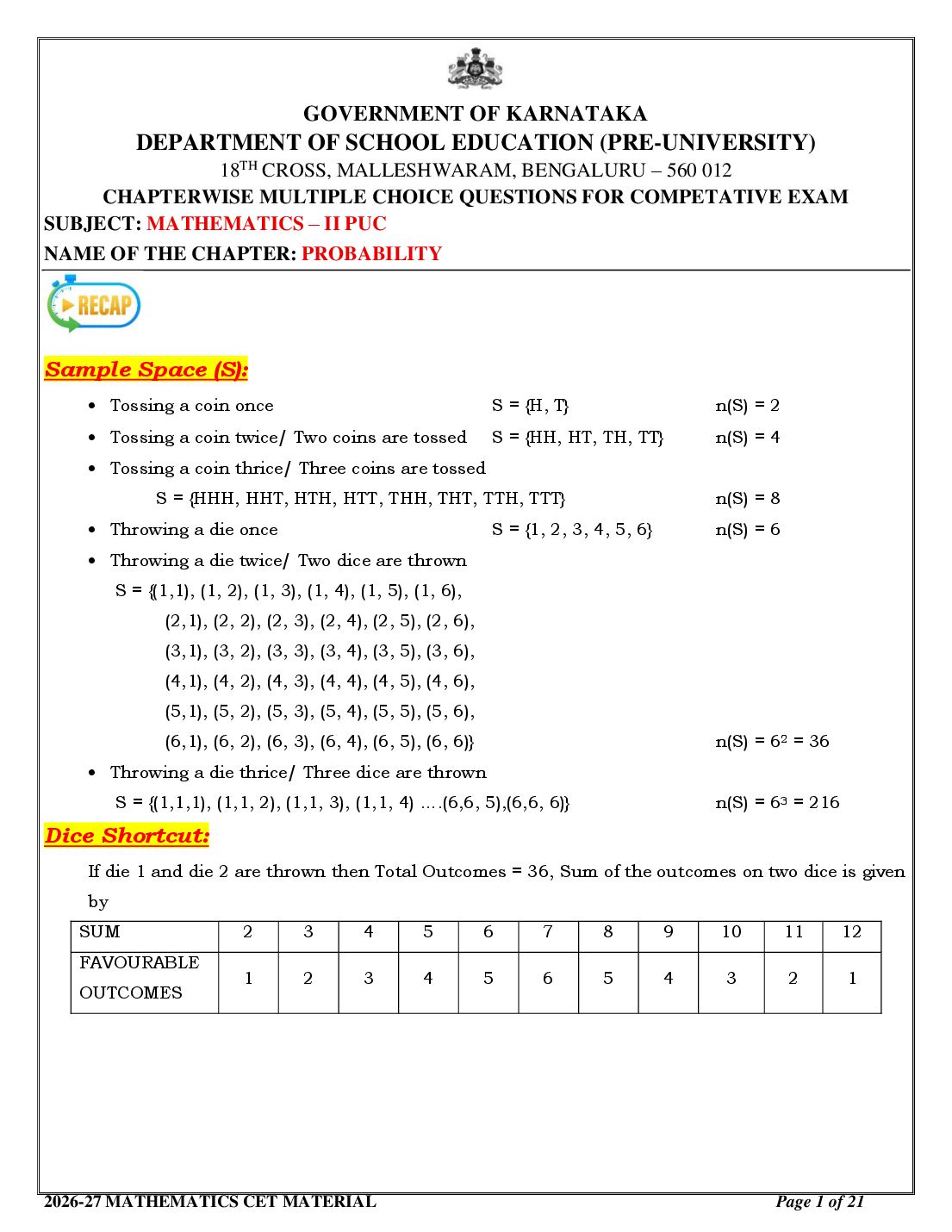
Sample Space (S):
Tossing a coin once S = {H, T} n(S) = 2
Tossing a coin twice/ Two coins are tossed S = {HH, HT, TH, TT} n(S) = 4
Tossing a coin thrice/ Three coins are tossed
S = {HHH, HHT, HTH, HTT, THH, THT, TTH, TTT} n(S) = 8
Throwing a die once S = {1, 2, 3, 4, 5, 6} n(S) = 6
Throwing a die twice/ Two dice are thrown
S = {(1,1), (1, 2), (1, 3), (1, 4), (1, 5), (1, 6),
(2,1), (2, 2), (2, 3), (2, 4), (2, 5), (2, 6),
(3,1), (3, 2), (3, 3), (3, 4), (3, 5), (3, 6),
(4,1), (4, 2), (4, 3), (4, 4), (4, 5), (4, 6),
(5,1), (5, 2), (5, 3), (5, 4), (5, 5), (5, 6),
(6,1), (6, 2), (6, 3), (6, 4), (6, 5), (6, 6)} n(S) = 62 = 36
Throwing a die thrice/ Three dice are thrown
S = {(1,1,1), (1,1, 2), (1,1, 3), (1,1, 4) ….(6,6, 5),(6,6, 6)} n(S) = 63 = 216
Dice Shortcut:
If die 1 and die 2 are thrown then Total Outcomes = 36, Sum of the outcomes on two dice is given
by
SUM 2 3 4 5 6 7 8 9 10 11 12
FAVOURABLE
1 2 3 4 5 6 5 4 3 2 1
OUTCOMES
2026-27 MATHEMATICS CET MATERIAL Page 1 of 21
Page 2
Total Cards = 52
Red Cards = 26
Black Cards = 26
Queen = 4, King = 4, Jack = 4, Aces = 4
Hearts = 4, Clubs = 4, Spades = 4, Diamonds= 4
Face Cards = 12 (4 Queen, 4 King, 4 Jack)
Probability:
𝑛(𝐴)
P(A) = 𝑛(𝑆)
P(Not A) = P(A’) = 1 − 𝑃(𝐴)
P(A or B) = P(A ∪ B) = P(A) + P(B) – P(A ∩ B)
𝐴 ⊆ 𝐵 ⇒ 𝑃(𝐴) ≤ 𝑃(𝐵)
𝑃(𝐴 ∩ 𝐵) ≤ 𝑃(𝐴)𝑃(𝐵) ≤ 𝑃(𝐴 ∪ 𝐵) ≤ 𝑃(𝐴) + 𝑃(𝐵)
P(Atleast one of A occur) = P(A∪B) = 1 – P(A’) P(B’)
𝑃(𝐴 𝑜𝑛𝑙𝑦) = 𝑃(𝐴 ∩ 𝐵′ ) = 𝑃(𝐴) − 𝑃(𝐴 ∩ 𝐵) = 𝑃(𝐴 − 𝐵)
𝑃(𝐵 𝑜𝑛𝑙𝑦) = 𝑃(𝐴′ ∩ 𝐵) = 𝑃(𝐵) − 𝑃(𝐴 ∩ 𝐵) = 𝑃(𝐵 − 𝐴)
P(Neither A nor B) = 𝑃(𝐴′ ∩ 𝐵′) = 1 − 𝑃(𝐴 ∪ 𝐵) = 1 - P(A) - P(B) + P(A ∩ B)
P(Atleast one of A or B does not occur) = 𝑃(𝐴′ ∪ 𝐵′ ) = 1 − 𝑃(𝐴 ∩ 𝐵) = 1 − 𝑃(𝐴) − 𝑃(𝐵) + 𝑃(𝐴 ∪ 𝐵)
P(A∩A′) = 0
P(A∪B) = P(A∩B′) + P(A′∩B) + P(A∩B)
P(Exactly one event) = 𝑃(𝐴′ ∩ 𝐵) + 𝑃(𝐴 ∩ 𝐵′)
𝑃(𝑁𝑜𝑛𝑒) = 1 − 𝑃(𝐴𝑡𝑙𝑒𝑎𝑠𝑡 𝑜𝑛𝑒)
When events are mutually exclusive, 𝑛(𝐴 ∩ 𝐵) = 0 ⇒ 𝑃(𝐴 ∩ 𝐵) = 0, 𝑃(𝐴 ∪ 𝐵) = 𝑃(𝐴) + 𝑃(𝐵)
When events are mutually exhaustive,
𝑛(𝐸1 ∪ 𝐸2 ∪ 𝐸3 … .∪ 𝐸𝑛 ) = 𝑛(𝑆) ⇒ 𝑃(𝐸1 ∪ 𝐸2 ∪ 𝐸3 … .∪ 𝐸𝑛 ) = 1
2026-27 MATHEMATICS CET MATERIAL Page 2 of 21
Page 3
If E and F are the events of a sample space say S, then
𝑃(𝐸∩𝐹)
𝑃(𝐸|𝐹) = where P(F) ≠ 0
𝑝(𝐹)
P(S|F) = P(F|F) = 1
0 ≤ P (E|F) ≤ 1,
P(E′|F) = 1 − P(E|F)
If A and B are two events in a sample space S and F is an event of S such that
P(F) ≠ 0, P(A ∪ B)|F) = P(A|F) + P(B|F) – P(A ∩ B)|F).
If A and B are two mutually exclusive events, then P(A ∪ B)|F) = P(A|F) + P(B|F)
Multiplication Theorem on Probability:
P (E ∩ F) = P (E) P (F|E), P (E) ≠ 0
P (E ∩ F) = P (F) P (E|F), P (F) ≠ 0
Independent events:
If E and F are independent events, then
o P (E ∩ F) = P (E) P (F)
o P (E|F) = P (E), P (F) ≠ 0
o P (F|E) = P (F), P(E) ≠ 0
o E’ and F are also independent,
o E’ and F’ are also independent.
Theorem of Total Probability:
Let {E1, E2, ...,En) be a partition of a sample space and suppose that each of E1, E2, ..., En has a
nonzero probability. Let A be any event associated with S, then
P(A) = P(E1) P (A|E1) + P (E2) P (A|E2) + ... + P (En) P(A|En)
ie., P(A) = ∑𝑛𝑖=1 𝑃(𝐸𝑖 )𝑃(𝐴|𝐸𝑖 )
Bayes’ theorem:
If E1, E2, ..., En are events which constitute a partition of sample space S, i.e. E1 , E2 , ..., En are
pairwise disjoint and E1∪ E2∪ ... ∪En = S and A be any event with nonzero probability, then
𝑷(𝑬𝒊 )𝑷(𝑨|𝑬𝒊 )
𝑷(𝑬𝒊 |𝑨)= 𝒏
∑𝒋=𝟏 𝑷(𝑬𝒋 )𝑷(𝑨|𝑬𝒋 )
2026-27 MATHEMATICS CET MATERIAL Page 3 of 21
Page 4
Without replacement
𝑅𝑒𝑞𝑢𝑖𝑟𝑒𝑑 𝑜𝑏𝑗𝑒𝑐𝑡𝑠
First selection: 𝑃 =
𝑇𝑜𝑡𝑎𝑙 𝑜𝑏𝑗𝑒𝑐𝑡𝑠
𝑅𝑒𝑚𝑎𝑖𝑛𝑖𝑛𝑔 𝑅𝑒𝑞𝑢𝑖𝑟𝑒𝑑 𝑜𝑏𝑗𝑒𝑐𝑡𝑠
Second selection: 𝑃 = 𝑅𝑒𝑚𝑎𝑖𝑛𝑖𝑛𝑔 𝑇𝑜𝑡𝑎𝑙 𝑜𝑏𝑗𝑒𝑐𝑡𝑠
With replacement
𝑅𝑒𝑞𝑢𝑖𝑟𝑒𝑑 𝑜𝑏𝑗𝑒𝑐𝑡𝑠
First selection: 𝑃 = 𝑇𝑜𝑡𝑎𝑙 𝑜𝑏𝑗𝑒𝑐𝑡𝑠
𝑅𝑒𝑞𝑢𝑖𝑟𝑒𝑑 𝑜𝑏𝑗𝑒𝑐𝑡𝑠
Second selection: 𝑃 =
𝑇𝑜𝑡𝑎𝑙 𝑜𝑏𝑗𝑒𝑐𝑡𝑠
Example:
Bag has 5 red and 3 blue balls.
Probability of drawing 2 red balls
5 4
P(Two red without replacement) = ∙
8 7
5 5
P(Two red with replacement) = ∙
8 8
Truth-lie Problems:
If P(Truth) = p then P(Lie) = 1 – p for a person then
Number of persons Situation Formula
One person Person speaks truth p
Person lies 1–p
Two persons Both speak truth pq
Both lie (1 – p)(1 – q)
Agreement pq + (1 – p)(1 – q)
Disagreement P(1 – q) + (1 – p)q
At least one truth 1 - (1 – p)(1 – q)
Exactly one truth P(1 – q) + (1 – p)q
Three persons Agreement Pqr + (1 – p)(1 -q)(1 -r)
If the person reports a statement as true, then
Situation Formula
Reported True ⇒ Actually True 𝑝2
Reported False ⇒ Actually False 𝑝2 + (1 − 𝑝)2
Reported True ⇒ Actually False (1 − 𝑝)2
𝑝2 + (1 − 𝑝)2
Reported False ⇒ Actually True
2026-27 MATHEMATICS CET MATERIAL Page 4 of 21
Page 5
Probability regarding 𝒏 letters and their envelopes :
If 𝒏 letters corresponding to n envelopes are placed in the envelopes at random, then
Total arrangements of n letters = n!
1
Probability that all letters are in right envelopes =
𝑛!
1 !𝑛
Probability that all letters are not in right envelopes = 1 − 𝑛! = 𝑛!
1 1 1 (−1)𝑛
Derangements of n letters ! 𝑛 = 𝑛! (1 − 1! + 2! − 3! + ⋯ + 𝑛!
)
𝑛𝐶𝑟 !(𝑛−𝑟)
Probability that exactly r letters are correctly placed = 𝑛!
CONDITIONAL PROBABILITY
1. Let A and B be two events. If P(A) = 0.2, P(B) = 0.4, P A B 0.6, then 𝑷(𝑨|𝑩) is equal to
(Easy, Exemplar, Conditional Probability)
A) 0.8 B) 0.5 C) 0.3 D) 0
2. Let A and B be two events such that 𝑷(𝑨) = 𝟎. 𝟔, 𝑷(𝑩) = 𝟎. 𝟐, and 𝑷(𝑨|𝑩) = 𝟎. 𝟓. Then 𝑷(𝑨′|𝑩′)
equals (Exemplar, Average, Conditional Probability)
1 3 3 6
𝐴) 10 B) 10 C) 8 D) 7
𝟒 𝟕
3. If 𝑷(𝑨) = , and 𝑷(𝑨 ∩ 𝑩) = , then 𝑷(𝑩|𝑨) is equal to
𝟓 𝟏𝟎
(Exemplar, Easy, Conditional Probability)
1 1 7 17
A) B) C) D)
10 8 8 20
𝟕 𝟏𝟕
4. If 𝑷(𝑨 ∩ 𝑩) = and 𝑷(𝑩) = , then 𝑷(𝑨|𝑩) equals
𝟏𝟎 𝟐𝟎
(Exemplar, Easy, Conditional Probability)
14 17 7 1
A) 17 B) 20 C) 8 D) 8
𝟑 𝟐 𝟑
5. If 𝑷(𝑨) = 𝟏𝟎 , 𝑷(𝑩) = 𝟓 and 𝑷(𝑨 ∪ 𝑩) = 𝟓, then 𝑷(𝑩|𝑨) + 𝑷(𝑨|𝑩) equals
(Exemplar, Easy, Conditional Probability)
1 1 5 7
A) 4 B) 3 C) 12 D) 12
𝟐 𝟑 𝟏
6. If 𝑷(𝑨) = 𝟓 , 𝑷(𝑩) = 𝟏𝟎 and 𝑷(𝑨 ∩ 𝑩) = 𝟓, then 𝑷(𝑨|𝑩). 𝑷(𝑩′|𝑨′) is equal to
(Exemplar, Average, Conditional Probability)
5 5 25
A) B) C) D) 1
6 7 42
2026-27 MATHEMATICS CET MATERIAL Page 5 of 21
Page 6
7. If A and B are two events such that 𝑷(𝑨) = 𝟐 , 𝑷(𝑩) = 𝟑 , 𝑷(𝑨/𝑩) = 𝟒, then 𝑷(𝑨′ ∩ 𝑩′) equals
(Exemplar, Average, Conditional Probability)
1 3 1 3
A) B) C) D) 16
12 4 4
8. If A and B are two events and A , B , then
(Exemplar, Average, Conditional Probability)
𝑃(𝐴∩𝐵)
A) 𝑃(𝐴|𝐵) = 𝑃(𝐴). 𝑃(𝐵) B) 𝑃(𝐴|𝐵) = 𝑃(𝐵)
C) 𝑃(𝐴|𝐵). 𝑃(𝐵|𝐴) = 1 D) 𝑃(𝐴|𝐵) = 𝑃(𝐴)|𝑃(𝐵)
9. In classrooms with poor lighting, the AI attendance system successfully recognizes
students 92% of the time. If a classroom is known to have poor lighting, what is the
probability that manual verification by the teacher is required?
(Average, Conditional Probability)
A) 0.08 B)0.92 C)0.16 D) 0.12
𝟑 𝟏 𝟒
10. If 𝑷(𝑩) = 𝟓 , 𝑷(𝑨|𝑩) = 𝟐 and 𝑷(𝑨′ ∪ 𝑩) = 𝟓, then 𝑷(𝑨 ∪ 𝑩)′ + 𝑷(𝑨′ ∪ 𝑩) =
(Exemplar, Average, Conditional Probability)
1 4 1
A) 5 B) 5 C) 2 D) 1
𝟕 𝟗 𝟒
11. Let 𝑷(𝑨) = 𝟏𝟑 , 𝑷(𝑩) = 𝟏𝟑 and 𝑷(𝑨 ∩ 𝑩) = 𝟏𝟑. Then 𝑷(𝑨′|𝑩) is equal to
(Exemplar, Average, Conditional Probability)
6 4 4 5
A) 13 B) 13 C) 9 D) 9
12. If A and B are such events that 𝑷(𝑨) > 𝟎 and 𝑷(𝑩) ≠ 𝟏, then 𝑷(𝑨′|𝑩′) equals.
(Exemplar, Average, Conditional Probability)
1−𝑃(𝐴∪𝐵)
A) 1 − 𝑃(𝐴|𝐵) B) 1 − 𝑃(𝐴′|𝐵) C) 𝑃(𝐵)
D) 𝑃(𝐴′)|𝑃(𝐵′)
13. Two events E and F are independent. If 𝑷(𝑬) = 𝟎. 𝟑, 𝑷(𝑬 ∪ 𝑭) = 𝟎. 𝟓, then 𝑷(𝑬|𝑭) − 𝑷(𝑭|𝑬)
equals (Exemplar, Average, Conditional probability)
2 3 1 1
A) 7 B) 35 C) 70 D) 7
𝟑 𝟓 𝟑
14. Let A and B be two events such that 𝑷(𝑨) = 𝟖 , 𝑷(𝑩) = 𝟖 and 𝑷(𝑨 ∪ 𝑩) = 𝟒. Then 𝑷(𝑨|𝑩). 𝑷(𝑨′|𝑩)
is equal to (Exemplar, Average, Conditional probability)
2 3 3 6
A)5 B) 8 C) 20 D) 25
1
15. If P (A) = , P (B) = 0, then P (A|B) is (Easy, Conditional probability)
2
1
A) 0 B) 2 C) not defined D) 1
2026-27 MATHEMATICS CET MATERIAL Page 6 of 21
Page 7
(Easy, Conditional probability)
A) A B but A ≠ B B) A = B C) A ∩ B = D) P(A) = P(B)
17. If A and B are two events such that A B and P(B) ≠ 0, then which of the following is
correct? (Average, Conditional probability)
𝑃(𝐵)
A) 𝑃(𝐴|𝐵) = 𝑃(𝐴) B) P(A|B) < P(A)
C) P(A|B) ≥ P(A) D) P(A|B) < P(B)
18. If A and B are two events such that P(A) ≠ 0 and P(B | A) = 1, then
(Average, Conditional probability)
A) A B B) B A C) B = D) A =
19. If P(A|B) > P(A), then which of the following is correct :
(Average, Conditional probability)
A) P (B|A) < P(B) B) P (A B) < P (A). P(B)
C) P (B|A) > P(B) D) P(B|A) = P(B)
20. The results of students of a college revealed the following facts, 25% of students failed
in mathematics, 15% of students failed in chemistry, 10% of students failed in both. If a
student is selected at random. The probability that he has failed in mathematics given
That he failed in chemistry is (Average, Conditional probability)
1 2 3 1
A) 5 B) 5 C) 5 D) 3
21. In the rectangle A B C D what is the probability that randomly chosen point that in ABCD
lies inside the triangle ABE is (Average, Conditional probability)
1 1 1 1
A) B) C) D)
15 10 5 3
22. If 𝑬 & 𝑭 are any events then which of the following is incorrect
(Easy, Conditional Probability)
A) 𝑃(𝐹|𝐹) = 1 B) 𝑃(𝑆|𝐹) < 1
C) 𝑃(𝐸 ′ |𝐹) = 1 − 𝑃(𝐸|𝐹) D) 𝑃((𝐸 ∪ 𝐹)|𝐺) = 𝑃(𝐸|𝐺) + 𝑃(𝐹|𝐺) − 𝑃((𝐸 ∩ 𝐹)|𝐺)
23. If 𝑷(𝑩) = 𝟎. 𝟓 𝒂𝒏𝒅 𝑷(𝑨 ∩ 𝑩) = 𝟎. 𝟑𝟐 then 𝑷(𝑨|𝑩) (Easy, Conditional Probability)
8 1 4 16
A) 25 B)2 C)25 D)25.
𝟏
24. If 𝑷(𝑨) = 𝟐 𝒂𝒏𝒅 𝑷(𝑩) = 𝟎 then find 𝑷(𝑨|𝑩) is (Easy, Conditional Probability)
1
A) 2 B)1 C)0 D)𝑛𝑜𝑡 𝑒𝑥𝑖𝑠𝑡𝑠.
2026-27 MATHEMATICS CET MATERIAL Page 7 of 21
Page 8
25. If 𝑷(𝑨) = 𝟐 𝒂𝒏𝒅 𝑷(𝑩) = 𝟎 then find 𝑷(𝑩|𝑨) is (Easy, Conditional Probability)
1
A) 2 B)1 C)0 D)𝑛𝑜𝑡 𝑒𝑥𝑖𝑠𝑡𝑠.
26. If A is a subset of B and P(A) ≠ 𝟎, then 𝑷(𝑩|𝑨) is (Easy, Conditional Probability)
1
A) 1 B)0 C)2 D)𝑛𝑜𝑡 𝑒𝑥𝑖𝑠𝑡𝑠.
27. If 𝑨 ∩ 𝑩 = 𝝓 𝒂𝒏𝒅 𝐏(𝐀) ≠ 𝟎, 𝒕𝒉𝒆𝒏 𝑷(𝑩|𝑨) is (Easy, Conditional Probability)
1
A) B)1 C)0 D)𝑛𝑜𝑡 𝑒𝑥𝑖𝑠𝑡𝑠.
2
𝟔 𝟓 𝟕
28. If 𝑷(𝑨) = 𝟏𝟏 , 𝑷(𝑩) = 𝟏𝟏 𝒂𝒏𝒅 𝑷 (𝑨 ∪ 𝑩) = 𝟏𝟏 then 𝑷(𝑨/𝑩) is (Average, Conditional Probability)
5 6 4 4
A) B) C) D) .
7 7 5 6
𝟔 𝟓 𝟕
29. If 𝑷(𝑨) = 𝟏𝟏 , 𝑷(𝑩) = 𝟏𝟏 𝒂𝒏𝒅 𝑷 (𝑨 ∪ 𝑩) = 𝟏𝟏 then 𝑷(𝑩/𝑨) is (Average, Conditional Probability)
5 6 4 4
A) B) C) D) .
7 7 5 6
30. If 𝑷(𝑨) = 𝟎. 𝟖, 𝑷(𝑩) = 𝟎. 𝟓, 𝑷(𝑩|𝑨) = 𝟎. 𝟒 then 𝑷(𝑨|𝑩) 𝒊𝒔 (Average, Conditional Probability)
16 4 1 4
A) 25 B)5 C)2 D)25
31. If A and B are any two events such that P(A) + P(B) – P(A and B) =P(A), then P(B/A) =
(Average, Conditional Probability)
𝑃(𝐵)
A) 1 B)0 C)𝑃(𝐴) D)𝑛𝑜𝑡 𝑒𝑥𝑖𝑠𝑡𝑠.
32. If A and B are two event such that P(A)≠ 𝟎 and P(B | A) = 1, then
(Easy, Conditional Probability)
A) A ⊂B B) B ⊂A C) B = ∅ D) A = ∅.
33. If A and B are events such that P(A|B) = P(B|A), then (Average, Conditional Probability)
A) A ⊂B but A ≠B B) A = B C) A∩B = ∅ D) P(A) = P(B).
34. If P(A|B) > P(A), then which of the following is correct : (Average, Conditional Probability)
A) P(B|A) < P(B) B) P(A ∩ B) < P(A).P(B)
C) P(B|A) > P(B) D) P(B|A) = P(B)
35. If A and B are two events such that A ⊂B and P(B) ≠0, then which of the following is
correct? (Average, Conditional Probability)
𝑃(𝐵)
A) 𝑃(𝐵/𝐴) = 𝑃(𝐴) B) P(A∩B) < P(A) C) P(A|B) = P(A) D) 𝑃(𝐵/𝐴) = 1
36. A die is rolled, consider the events 𝑬 = {𝟏, 𝟑, 𝟓}, 𝑭 = {𝟐, 𝟑}, then P(𝑬|𝑭)is
(Easy, Conditional Probability)
1 1 1 2
A) 3 B)2 C)5 D)3
37. A die is rolled, consider the event 𝑬 = {𝟏, 𝟑, 𝟓}, 𝑭 = {𝟐, 𝟑}, then 𝑷(𝑭|𝑬)is
(Easy, Conditional Probability)
1 1 1 2
A) 3 B)2 C)5 D)3
2026-27 MATHEMATICS CET MATERIAL Page 8 of 21
Page 9
(Easy, Conditional Probability)
1 1 1 2
A) 3 B)2 C)5 D)3
39. A die is rolled, consider an event 𝑬 = {𝟏, 𝟑, 𝟓}, 𝑮 = {𝟐, 𝟑, 𝟒, 𝟓}, then 𝑷(𝑬|𝑮)is
(Easy, Conditional Probability)
1 1 1 2
A) 3 B)2 C)5 D)3
40. A die is rolled, consider an event 𝑬 = {𝟏, 𝟑, 𝟓}, 𝑭 = {𝟐, 𝟑} and G = {2,3,4,5} then 𝑷(𝑬 ∪ 𝑭|𝑮)is
(Average, Conditional Probability)
1 1 3
A) 1 B)2 C)4 D)4
41. If 𝑷(𝑨) = 𝟎. 𝟒 𝑷(𝑩) = 𝟎. 𝟓 𝒂𝒏𝒅 𝑷(𝑨 ∩ 𝑩) = 𝟎. 𝟐𝟓 then 𝑷(𝑨′ |𝑩) 𝒊𝒔 (Average, Conditional Probability)
5 1 1 3
A) B) C) D) .
8 2 4 4
42. In a hostel, 60% of the students read Hindi newspaper, 40% read English newspaper and
20% read both Hindi and English newspapers. A student is selected at random. If she
reads Hindi newspaper, find the probability that she reads English newspaper.
(Average, Conditional Probability)
1 1 2 1
A) B) C) D) .
3 2 3 4
43. If P(A/B) = 0.8 & P(B/A) = 0.5 then the ratio P(A): P(B) is (Average, Conditional Probability)
A) 8 : 5 B)5 : 8 C) 2 : 5 D) 1 : 2
44. An electronic assembly consists of two subsystems, say, A and B. From previous testing
procedures, the following probabilities are assumed to be known, P (A fails) = 0.2, P (B fails
alone) = 0.15 and P (A and B fail) = 0.15, then P (A fails |B has failed) is
(Difficult, Conditional Probability)
A) 0.15 B) 0.5 C) 0.05 D) 0.75.
45. Statement 1: Given that E and F are events such that P(E) = 0.6, P(F) = 0.3 and P (E ∩ F) = 0.2,
then P(E|F) = 2/3
𝑃(E ∩ F)
Statement 2: Let E and F be two events with a random experiment, then P(E|F) = P(E)
(Average, Conditional Probability)
A) Statement 1 is true and Statement 2 is false.
B) Statement 1 is true and Statement 2 is true,
Statement 2 is correct explanation for Statement 1
C) Statement 1 is true and Statement 2 is true, Statement 2 is
not a correct explanation for Statement 1
D) Statement 1 is false and Statement 2 is false.
2026-27 MATHEMATICS CET MATERIAL Page 9 of 21
Page 10
Statement 2: If P(A) = 0, then P(A∩B) = 0 (Easy, Conditional Probability)
A) Statement 1 is true and Statement 2 is false.
B) Statement 1 is true and Statement 2 is true,
Statement 2 is correct explanation for Statement 1
C) Statement 1 is true and Statement 2 is true, Statement 2 is not a correct explanation for
Statement 1
D) Statement 1 is false and Statement 2 is true.
47. For the figure given below P (B/A )= (Easy, Conditional Probability)
4 4 4 5
A) B) C) D) .
7 12 9 12
48. For the figure given below the P(𝐁′ /A) is (Average, Conditional Probability)
1 4 2 3
A) B) C) D) .
5 5 3 4
49. In a college, 30 % students fail in physics, 25 % fail in mathematics and
10 % fail in both. One student is chosen at random. The probability that she fails in
physics if she has failed in mathematics is (Exemplar, Average, Conditional Probability)
1 2 9 1
A) 10 B) 5 C) 20 D) 3
50. Two dice are thrown. If it is known that the sum of numbers on the dice was less than 6,
the probability of getting a sum 3, is (Exemplar, Average, Conditional probability)
1 5 1 2
A) 18 B) 18 C) 5 D) 5
CONDITIONAL PROBABILITY
1 2 3 4 5 6 7 8 9 10
D C C A D C C B A D
11 12 13 14 15 16 17 18 19 20
D C C D C D C A C B
21 22 23 24 25 26 27 28 29 30
B B D D C A C C D A
31 32 33 34 35 36 37 38 39 40
C A D C D B A D B D
41 42 43 44 45 46 47 48 49 50
B A B B A B C B B C
2026-27 MATHEMATICS CET MATERIAL Page 10 of 21
Page 11
1. If A and B are independent events such that 𝟎 < 𝑷(𝑨) < 𝟏 and 𝟎 < 𝑷(𝑩) < 𝟏, then which of
the following is not correct? (Exemplar, Average, Independent Events)
A) A and B are mutually exclusive B) A and B’ are independent
C) A’ and B are independent D) A’ and B’ are independent
2. Two events E and F are independent events, which of the following is not true
(Easy, Independent Events)
A) P(F|E) = P (F) B) P (E|F) = P (E)
C) P(E ∪ F ) = P (E) + P (F) D)P(E ∩ F) = P(E) . P (F).
3. If A and B are independent events with 𝑷(𝑨) = 𝟎. 𝟑, 𝑷(𝑩) = 𝟎. 𝟒 then 𝑷(𝑩|𝑨) is
(Easy, Independent Events)
3 2 3 7
A) 10 B)5 C)25 D)10
4. If A and B are independent events with 𝑷(𝑨) = 𝟎. 𝟑, 𝑷(𝑩) = 𝟎. 𝟒 then 𝑷(𝑨|𝑩)
(Easy, Independent Events)
3 2 3 7
A) B) C) D)
10 5 25 10
5. Two events A and B will be independent, if (Average, Independent Events)
A) A and B are mutually exclusive B) P(AB′) = [1 – P(A)] [1 – P(B)]
C) P(A) = P(B) D) P(A) + P(B) = 1
6. If A and B are independent events then P(A/B) = (Easy, Independent Events)
A) P(A) B) P(B)/ P(A) C) P(B) D) P(A).P(B)
𝟑 𝟒
7. If A and B are two independent events with 𝑷(𝑨) = 𝟓 𝒂𝒏𝒅𝑷(𝑩) = 𝟗, then 𝑷(𝑨′ ∩ 𝑩′) equals
(Exemplar, Average, Independent Events)
4 8 1 2
A) B) C) D)
15 45 3 9
8. If two events are independent, then (Exemplar, Average, Independent Events)
A) they must be mutually exclusive
B) the sum of their probabilities must be equal to 1
C) (A) and (B) both are correct
D) None of the above is correct
9. If the events A and B are independent, then 𝑷(𝑨 ∩ 𝑩) is equal to
(Exemplar, Easy, Independent Events)
A) 𝑃(𝐴) + 𝑃(𝐵) B) 𝑃(𝐴) − 𝑃(𝐵) C) 𝑃(𝐴). 𝑃(𝐵) D) 𝑃(𝐴)|𝑃(𝐵)
10. A fair coin is tossed repeatedly. If the tail appears on first four tosses, then the
probability of the head appearing on the fifth toss is (Easy, Independent Events)
1 1 1 1 1
A) 5 B) 25 C) 5 (25 ) D) 2
2026-27 MATHEMATICS CET MATERIAL Page 11 of 21
Page 12
A) A and B’ are dependent B) A’ and B are dependent
C) A’ and B’ are dependent D) 𝑃 (𝐴 ∪ 𝐵) = 1 − 𝑃(𝐴′ )𝑃(𝐵′ ).
12. Two events A and B are said to be independent, if, (Easy, Independent Events)
A) A and B are mutually exclusive B) P(A′∩B′) = [1 – P(A)] [1 – P(B)]
C) P(A/B) = P(B) D) P(B/A) = P(A).
13. For any two independent events A and B. P(A)= x and P(B)= y
Assertion (A): The probability that at least one of the events A and B occurs is x + y -2xy.
Reason (R): 𝑃(E ∩ F ′ ) = 𝑃(E)𝑃(F ′ ). (Difficult, Independent Events)
A) A is false and R is true
B) A is false and R is false
C) Both A and R are true and R is the correct explanation of A.
D) Both A and R are true and R is not the correct explanation of A.
14. Assertion (A): In rolling a die, event A= {1, 3, 5} and event B = {3, 6} are independent events.
Reason (R): If A and B are two independent events then 𝑃(E ∩ F) = 𝑃(𝐸)𝑃(𝐹).
(Easy, Independent Events)
A) A is false and R is true B) A is false and R is false
C) Both A and R are true D) A is true and R is false
1 1 1
15. Assertion (A): Let A and B be two events such that P (A) = 5 , P (B) = 2 and P(A/B) = 5,
then A and B are independent events.
Reason (R): If A and B are two independent events then P (B/A) = P(B).
(Easy, Independent Events)
A) A is false and R is true
B) Both A and R are true and R is the correct explanation of A.
C) Both A and R are true and R is not the correct explanation of A.
D) A is false and R is false
16. Two cards are drawn from a well shuffled deck of 52 playing cards with replacement.
The probability, that both cards are queens, is(Exemplar, Average, Independent Events)
1 1 1 1 1 1 1 4
A) 13 × 13 B) 13 + 13 C) 13 × 17 D) 13 × 51
𝟏 𝟏
17. If A and B are two independent events such that 𝑷(𝑨) = 𝟒 and 𝑷(𝑩) = 𝟐 then
P(not A and not B) (Average, Independent Events)
1 3 7 1
A) 3 B)8 C)8 D)2
18. Two balls are drawn at random with replacement from a box containing 10 black and 8 red
balls find the probability that first ball is black and second is red
(Difficult, Independent Events)
25 16 20 28
A) 81 B)81 C)81 D) 153
2026-27 MATHEMATICS CET MATERIAL Page 12 of 21
Page 13
19. Probability of solving a specific problem independently by A and B are 𝟐 and 𝟑 respectively.
If both try to solve the problem then the probability that the problem is solved
(Difficult, Independent Events)
1 2 1 5
A) 6 B)3 C)3 D)6
20. A die is thrown and a card is selected at random from a deck of 52 playing cards. The
probability of getting an even number on the die and a spade card is
(Exemplar, Average, Independent Events)
1 1 1 3
A) 2 B) 4 C) 8 D) 4
Independent Events
1 2 3 4 5 6 7 8 9 10
A C B A B A D D D D
11 12 13 14 15 16 17 18 19 20
D B A C C A B C B C
Multiplication Theorem Of Probability
1. If 𝑷(𝑨) = 𝟎. 𝟖, 𝑷(𝑩) = 𝟎. 𝟓, 𝑷(𝑩|𝑨) = 𝟎. 𝟒 then 𝑷 (𝑨 ∪ 𝑩) 𝒊𝒔 (Average, Multiplication Theorem)
A) 0.32 B) 0.98 C) 0.9 D) 0.72
2. If 𝑷(𝑨) = 𝟎. 𝟒, 𝑷(𝑩) = 𝟎. 𝟖 and 𝑷(𝑩|𝑨) = 𝟎. 𝟔, then 𝑷(𝑨′ ∪ 𝑩) is equal to
(Exemplar, Average, Multiplication Theorem)
A) 0.24 B) 0.3 C) 0.48 D) 0.84
𝟓 𝟐
3. If 𝟐𝑷(𝑨) = 𝑷(𝑩) = 𝟏𝟑 𝒂𝒏𝒅 𝑷(𝑨|𝑩) = 𝟓, then 𝑷(𝑨 ∩ 𝑩) is (Average, Multiplication Theorem)
5 15 19 2
A) 26 B)26 C)26 D) 13.
4. A class has 7 boys and 5 girls. Three students are selected one after another without
replacement. The probability that all three are girls is (Average, Multiplication Theorem)
5 1 5 1
A) 66 B)22 C)44 D)11
5. If 𝑷(𝑨) = 𝟎. 𝟖, 𝑷(𝑩) = 𝟎. 𝟓, 𝑷(𝑩|𝑨) = 𝟎. 𝟒 then 𝑷(𝑨 ∩ 𝑩) 𝒊𝒔 (Average, Multiplication Theorem)
A) 0.32 B)0.2 C)0.4 D)0.3
𝟓 𝟐
6. If 𝟐𝑷(𝑨) = 𝑷(𝑩) = 𝟏𝟑 𝒂𝒏𝒅 𝑷(𝑨|𝑩) = 𝟓 then 𝑷(𝑨 ∪ 𝑩) is (Easy, Multiplication Theorem)
5 15 11 2
A) 26 B)26 C)26 D) 13.
7. A factory has 6 good and 4 defective products. Two products are selected
without replacement. If the first product is good, what is the probability that both selected
products are good? (Average, Multiplication Theorem)
1 2 1 1
A) 3 B)5 C)2 D) 5.
2026-27 MATHEMATICS CET MATERIAL Page 13 of 21
Page 14
entered is correct is 0.85 and the probability that the digit is correct is 0.90.
Assuming independence, the probability that the complete password is correct equals
(Average, Multiplication Theorem)
A) 0.76 B)0.95 C)0.80 D) 0.72
𝟑 𝟏 𝟒
9. You are given that A and B are two events such that 𝑷(𝑩) = 𝟓, 𝑷(𝑨|𝑩) = 𝟐 and 𝑷(𝑨 ∪ 𝑩) = 𝟓,
then P(A) equals (Exemplar, Easy, Multiplication Theorem)
3 1 1 3
A) B) C) D)
10 5 2 5
10. A security system has two independent sensors. Sensor A detects an intruder with
probability 0.9 and Sensor B with probability 0.8. The probability that both sensors
detect the intruder is (Average, Multiplication Theorem)
A) 0.72 B)0.8 C)0.9 D) 0.98
11. For the figure given below the P (Second Pick R) is (Average, Multiplication Theorem)
1 1 3 1
A) B) C) D) .
2 4 10 5
12. While shuffling a pack of 52 playing cards, 2 are accidentally dropped.
Find the probability that the missing cards to be different colours.
(Average, Multiplication Theorem)
29 1 26 27
A) 52 B) 2 C) 51 D) 51
13. The probability that it rains today is 0.6. If it rains today, the probability that it also
rains tomorrow is 0.7. The probability that it rains on both days.
(Average, Multiplication Theorem)
A)0.42 B) 0.30 C) 0.70 D) 0.60
14. Three cards drawn successively without replacement from a pack of 52 well shuffled cards.
The probability that 1st two cards are king and 3rd card drawn is ace is
(Difficult, Multiplication Theorem of Probability)
2 1 2 1
A) 13×13×13 B)13×13×13 C)13×17×25 D)13×17×25.
2026-27 MATHEMATICS CET MATERIAL Page 14 of 21
Page 15
The probability that the first is white and the second is black is
(Average, Multiplication Theorem)
4 2 3 1
A) B) C) D)
15 5 10 5
16. A coin is flipped and a dice is rolled. (Average, Multiplication Theorem)
1
Statement 1: The probability of getting a ‘tail’ and a 6’ is 12.
5
Statement 2: The probability of getting a ‘tail’ and a not 6’ is 12.
A) Statement 1 is true and Statement 2 is false.
B) Statement 1 is true and Statement 2 is true.
C) Statement 1 is false and Statement 2 is true.
D) Statement 1 is false and Statement 2 is false.
17. For the figure given below (Average, Multiplication Theorem)
20
Statement 1: P(both are white)=
56
30
Statement 2: P(at least one white) =56
6
Statement 3: P(both are black) =56
Which of the above statements are correct?
A) 1 and 3 only B) 2 and 3 only C) 1 and 3 only D) All 1, 2 and 3.
18. Two cards are drawn at random without replacement from a pack of 52 playing cards.
The probability that both are black cards is (Average, Multiplication Theorem)
1 1 25 25
A) 26 B)4 C)102 D)104.
19. Two balls are drawn at random with replacement from a box containing 10 black and 8 red
balls, then the probability that both are red is (Average, Multiplication Theorem)
25 16 20 28
A) 81 B)81 C)81 D) 153
2026-27 MATHEMATICS CET MATERIAL Page 15 of 21
Page 16
replacement and tested, the probability that both are dead is
(Exemplar, Average, Multiplication theorem)
33 9 1 3
A) 56 B) 64 C) 14 D) 28
Multiplication Theorem Of Probability
1 2 3 4 5 6 7 8 9 10
B D D B A C A A C A
11 12 13 14 15 16 17 18 19 20
A C A C A B C C B D
Total Probability Theorem
1. Which collection cannot be used directly in the Total Probability Theorem?
(Easy, Total Probability theorem)
A) Boys and Girls in a class
B) Even numbers and Odd numbers
C) Prime numbers and Composite numbers from 1 to 20
D) Multiples of 2 and Multiples of 3 from 1 to 12
𝟏 𝟏
2. Probability of solving a specific problem independently by A and B are 𝟐 and 𝟑 respectively.
If both try to solve the problem then the probability that exactly one of them solves the
problem is (Difficult, Total Probability theorem)
1 2 1 1
A) B) C) D)
6 3 3 2
3. Two balls are drawn at random with replacement from a box containing 10 black and 8 red
balls. The probability that one of them is black and other is red
(Difficult, Total Probability theorem)
40 20 16 56
A) 81 B)81 C)81 D) 153
4. Three buses A, B and C carry 20%, 35% and 45% of the students to a college.
The probabilities that a student reaches late are 0.15, 0.8 and 0.2, respectively.
Find the probability that a randomly selected student reaches on time.
(Difficult, Total Probability theorem)
A) 0.4 B) 0.8 C) 0.6 D) 0.2
5. A hospital has three departments. The probabilities that a patient visits them are 30%,
50% and 20%. The probabilities of being referred for surgery are 0.2, 0.3 and 0.5
respectively. If a patient is selected randomly, which expression correctly gives the
probability that the patient is not referred? (Average, Total Probability theorem)
A) 1 − ∑ 𝑃(𝐷𝑖 )𝑃(𝑆|𝐷𝑖 ) B) ∑ 𝑃(𝐷𝑖 )𝑃(𝐷𝑖 |𝑆) C) 𝑃(𝑆) − 1 D) 𝑃(𝐷1 ) + 𝑃(𝐷2 ) + 𝑃(𝐷3 )
2026-27 MATHEMATICS CET MATERIAL Page 16 of 21
Page 17
classrooms.
Classroom Proportion of Probability that the system
Students fails to recognize the face
I PUC 60% 0.04
II PUC 40% 0.02
The probability that a randomly selected student's face is not recognized is
(Difficult, Total Probability theorem)
A) 0.023 B) 0.032 C) 0.024 D) 0.035
7. Assertion (A): The Total Probability Theorem computes the probability of an event by
considering all mutually exclusive causes.
Reason (R): The events forming the partition are exhaustive and pairwise disjoint.
(Easy, Total Probability theorem)
A) Both A and R are true and R is the correct explanation.
B) Both are true but R is not the correct explanation.
C) A is true but R is false.
D) A is false but R is true
8. Three persons A, B and C, fire at a target in turn, starting with A. Their probability of
hitting the target are 0.4, 0.3 and 0.2 respectively. The probability of two hits is
(Exemplar, Average, Total probability theorem)
A) 0.024 B) 0.188 C) 0.336 D) 0.452
9. For the figure given below the P(Walk) is (Difficult, Total Probability theorem)
11 8 1 7
A) 15 B)15 C)15 D) 15.
10. Three factories produce 25%, 35% and 40% of mobile chargers. The
probabilities that a charger is non-defective are 0.98, 0.95 and 0.96
respectively. The probability that a randomly selected charger is defective
equals (Difficult, Total Probability theorem)
A) 0.028 B) 0.038 C) 0.048 D) 0.018
Total Probability Theorem
1 2 3 4 5 6 7 8 9 10
D D A C A B A B C B
2026-27 MATHEMATICS CET MATERIAL Page 17 of 21
Page 18
𝟏 𝟏
1. A and B are two students. Their chances of solving a problem correctly are 𝟑 and 𝟒
𝟏
respectively. If the probability of their making a common error is, 𝟐𝟎 and they obtain
the same answer, then the probability of their answer to be correct is
(Exemplar, Difficult, Bayes’ theorem)
1 1 13 10
A) 12 B) 40 C) 120 D) 13
𝟒
2.Probability that A speaks truth is 𝟓. A coin is tossed. A reports that a head appears.
The probability that actually there was head is (Average, Bayes’ Theorem)
4 1 1 2
A) 5 B) 2 C) 5 D) 5
3.Suppose that 5% of men and 0.25% of women have grey hair. A grey haired person is
selected at random. Assume that there are equal number of males and females then
probability of this person being male is (Average, Bayes’ Theorem)
10 21 20 11
A) B) C) D)
12 23 21 19
4.An investigation finds that 5% of examination centres had a paper leak before the exam. A
monitoring system raises an alert for 90% of centres where a leak occurred and also raises
a false alert for 10% of centres where there was no leak. If a centre is found to have an
alert, what is the probability that a paper leak actually occurred?(Difficult, Bayes’ Theorem)
9 9 18 9
A) 28 B) 47 C) 47 D) 19
5.In a factory which manufactures bolts, machines A, B and C manufacture respectively 25%,
35% and 40% of the bolts. Of their outputs, 5, 4 and 2 percent are respectively defective
bolts. A bolt is drawn at random from the product and is found to be defective. What is
the probability that it is manufactured by the machine B? (Average, Bayes’ Theorem)
8 28 18 38
A) B) C) D)
69 69 69 69
6. Among NEET aspirants, 40% attended a coaching institute and the remaining 60%
prepared through self-study. Among coaching students, 80% qualified in NEET. Among
self-study students, 50% qualified. Among the students who qualified, 30% of coaching
students and 20% of self-study students secured a government medical seat. A student is
selected at random from those who secured a government medical seat. What is the
probability that the student had studied in a coaching institute?
(Difficult, Bayes’ Theorem)
4 8 5 12
A) 9 B) 13 C) 8 D) 19
2026-27 MATHEMATICS CET MATERIAL Page 18 of 21
Page 19
stream and 70% belong to the Commerce stream. To qualify, a student must pass both
the Aptitude Test and the Interview. The two tests are independent.
For Science students, the probability of passing the Aptitude Test is 0.8 and the
probability of passing the Interview is 0.9.
For Commerce students, the corresponding probabilities are 0.6 and 0.8.
A randomly selected student is known to have qualified. What is the probability that
the student belongs to the Science stream? (Difficult, Bayes’ Theorem)
31 16 19 9
A) 18 B) 9 C) 12 D) 23
8. In a city, 40% of people are vaccinated. Among vaccinated people, 5% develop a mild
fever after vaccination. Among unvaccinated people, 2% develop a similar fever due to
other causes. A person is found to have this fever. The probability that the person is
vaccinated is (Difficult, Bayes’ Theorem)
5 5 3 2
A) B) C) D)
11 8 7 5
9. An email server receives 25% spam emails and 75% genuine emails. The spam filter
correctly identifies 96% of spam emails and wrongly marks 4% of genuine emails as
spam. If an email is marked as spam, find the probability that it is actually spam.
(Difficult, Bayes’ Theorem)
7 5 8 9
A) 9 B) 8 C) 9 D) 8
10. In a hospital, 20% of the patients have diabetes. A blood test is positive for 90%
of diabetic patients and for 10% of non-diabetic patients. A patient is selected at
random and the test result is positive. Find the probability that the patient has
diabetes. (Difficult, Bayes’ Theorem)
9 9 8 8
A) 13 B) 11 C) 12 D) 13
Bayes’ Theorem
1 2 3 4 5 6 7 8 9 10
D A C A B B D B C A
2026-27 MATHEMATICS CET MATERIAL Page 19 of 21
Page 20
1. Recent studies suggest that 12% of the world population is lefthanded. Depending on
parents' hand usage, the chances of having left handed children are as follows:
A: Both parents are left handed, chances of having left handed children = 24%
B: Both parents are right handed, chances of having left handed children = 9%
C: Father lefthanded and mother right handed, chances of having left handed
children =17%
D: Father right handed and mother left handed, chances of having left handed
children =22%
𝟏
Given P(A) = P(B) = P(C) = P(D) = and L denotes child is left handed. What is the
𝟒
probability that 𝑷(𝑨|𝑳)? (KCET 2026, Average, Total Probability theorem)
17 19 1 2
A) 100 B) 25 C) 3 D) 3
𝟏 𝟏
2. The probability that a man and his wife live after 20 years are 𝟒 and 𝟑 respectively. The
probability that neither the man nor his wife live after 20 years is
(KCET 2026, Average, Multiplication theorem)
3 1 7 1
A) 4 B) 12 C) 12 D) 2
3. If A and B are two non-mutually exclusive events such that 𝐏(𝐀 ∣ 𝐁) = 𝐏(𝐁 ∣ 𝐀), then
(KCET 2025, Average, Conditional Probability)
A) A ⊂ B but A ≠ B B)𝐴 = 𝐵 C)A ∩ B = 𝜙 D)P(A) = P(B)
4. If 𝑨 and 𝑩 are two events such that 𝑨 ⊂ 𝑩 and 𝑷(𝑩) ≠ 𝟎, then which of the following is
correct? (KCET 2025, Average, Conditional Probability)
P(B)
A) P(A ∣ B) = P(A) B)P(A ∣ B) < P(A) C)P( A ∣ B ) ≥ P(A) D) P(A) = P(B)
5. Meera visits only one of the two temples A and B in her locality. Probability that she
𝟐 𝟏
visits temple A is 𝟓 . If she visits temple A, 𝟑 is the probability that she meets her friend,
𝟐
whereas it is if she visits temple B. Meera met her friend at one of the two temples.
𝟕
The probability that she met her at temple B is (KCET 2025, Average, Bayes’ theorem)
7 5 3 9
A) B) C) D)
16 16 16 16
6. A bag contains 2n + 1 coins. It is known that n of these coins has head on both sides
whereas, the other n + 1 coins are fair. One coin is selected at random and tossed. If the
𝟑𝟏
probability that toss results in heads is 𝟒𝟐 , then the value of n is
(KCET 2023, Difficult, Total Probability theorem)
A) 6 B) 8 C)10 D) 5
2026-27 MATHEMATICS CET MATERIAL Page 20 of 21
Page 21
that the function is an onto function is (KCET 2023, Average, Multiple Concept)
1 5 1 7
A) B) C) D)
8 8 35 8
𝟏 𝑨 𝟏 𝑩 𝟐
8. If 𝑨 and 𝑩 are events, such that 𝑷(𝑨) = 𝟒 , 𝑷(𝑩) = 𝟐 and 𝑷(𝑨) = 𝟑, then 𝑷(𝑩) is
(KCET 2023, Easy, Conditional Probability)
1 2 1 1
A) 3 B) 3 C)2 D) 6
𝟏 𝟏 𝟏
9. If 𝑨 and 𝑩 are two events such that 𝑷(𝑨) = 𝟐 , 𝑷(𝑩) = 𝟐 and 𝑷(𝑨 ∣ 𝑩) = 𝟒, then 𝑷(𝑨′ ∩ 𝑩′ ) is
(KCET 2022, Average, Conditional Probability)
1 3 1 3
A) 8 B) 16 C)12 D) 4
10. A pandemic has been spreading all over the world. The probabilities are 0.7 that there will
be a lockdown, 0.8 that the pandemic is controlled in one month if there is a lockdown
and 0.3 that it is controlled in one month if there is no lockdown. The probability that
the pandemic will be controlled in one month is (KCET 2022, Easy, Bayes’ theorem)
A) 0.65 B) 1.65 C)1.46 D) 0.46
11. If 𝑨 and 𝑩 are two independent events such that 𝑷(𝑨‾) = 𝟎. 𝟕𝟓, 𝑷(𝑨 ∪ 𝑩) = 𝟎. 𝟔𝟓 and 𝑷(𝑩) = 𝒙,
then find the value of 𝒙. (KCET 2021, Average, Operations on events, independent events)
5 8 9 7
A) B) C) D)
14 15 14 15
12. Two dice are thrown. If it is known that the sum of numbers on the dice was less than 6
the probability of getting a sum as 3 is (KCET 2021, Average, Operations on events)
1 5 1 2
A) B) C) D)
18 18 5 5
𝟐 𝟐
13. If the events 𝑨 and 𝑩 are independent if 𝑷(𝑨′ ) = 𝟑 and 𝑷(𝑩′ ) = 𝟕, then 𝑷(𝑨 ∩ 𝑩) is equal to:
(KCET 2014, Average, Independent events)
5 3 4 1
A) 21 B) 21 C) 21 D) 21
KCET PYQS
1 2 3 4 5 6 7 8 9 10
C D D C D C D A A A
11 12 13
B B A
2026-27 MATHEMATICS CET MATERIAL Page 21 of 21
Document Details
| Board / Org | Karnataka Board |
| Exam | Class 12 |
| Type | Question Bank |
| Pages | 21 |
| Updated | 24 Sep 2026 |