Karnataka 2nd PUC Mathematics Relation and Function MCQ with Answers
Finished viewing? Save it for later —
Download Karnataka 2nd PUC Mathematics Relation and Function MCQ with Answers (PDF · 15 pages)About Karnataka 2nd PUC Mathematics Relation and Function MCQ with Answers
Karnataka 2nd PUC Mathematics Relation and Function MCQ with Answers is available here for free download. Published by Karnataka Board for Class 12, this question bank can be viewed online or downloaded as a PDF (15 pages). Candidates preparing for Class 12 can use Karnataka 2nd PUC Mathematics Relation and Function MCQ with Answers to understand the exam pattern, the type of questions asked, and the overall difficulty level.
Frequently Asked Questions
How can I download Karnataka 2nd PUC Mathematics Relation and Function MCQ with Answers?
Open this page and click the Download button to save Karnataka 2nd PUC Mathematics Relation and Function MCQ with Answers as a PDF. It is completely free on AglaSem Docs.
Is Karnataka 2nd PUC Mathematics Relation and Function MCQ with Answers free to download?
Yes. Karnataka 2nd PUC Mathematics Relation and Function MCQ with Answers can be viewed online and downloaded as a PDF free of cost on AglaSem Docs.
How many pages does Karnataka 2nd PUC Mathematics Relation and Function MCQ with Answers have?
Karnataka 2nd PUC Mathematics Relation and Function MCQ with Answers contains 15 pages, which you can read online or download together as a single PDF.
Where can I find more Class 12 study material?
You can find more Class 12 question papers, sample papers, syllabus, and answer keys on AglaSem Docs.
Karnataka 2nd PUC Mathematics Relation and Function MCQ with Answers – Text
Read the full text of this question bank below — useful to quickly search, copy and reference the content online without downloading the PDF.
📄 View text version (15 pages)
Page 1
DEPARTMENT OF SCHOOL EDUCATION (PRE-UNIVERSITY)
18TH CROSS, MALLESHWARAM, BENGALURU – 560 012
CHAPTERWISE MULTIPLE CHOICE QUESTIONS FOR COMPETATIVE EXAM
SUBJECT: MATHEMATICS – II PUC
NAME OF THE CHAPTER: RELATIONS AND FUNCTIONS
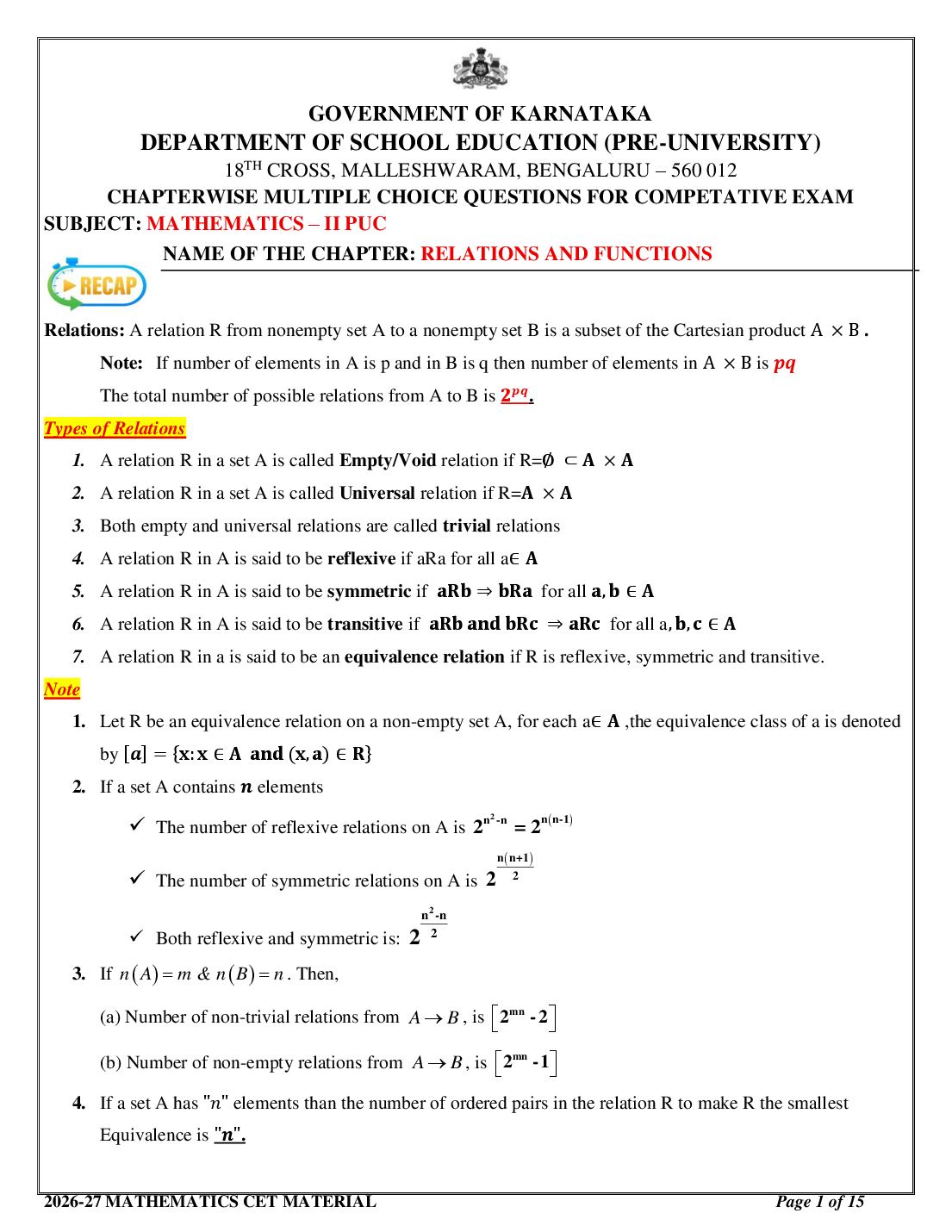
Relations: A relation R from nonempty set A to a nonempty set B is a subset of the Cartesian product A × B .
Note: If number of elements in A is p and in B is q then number of elements in A × B is 𝒑𝒒
The total number of possible relations from A to B is 𝟐𝒑𝒒 .
Types of Relations
1. A relation R in a set A is called Empty/Void relation if R=∅ ⊂ 𝐀 × 𝐀
2. A relation R in a set A is called Universal relation if R=𝐀 × 𝐀
3. Both empty and universal relations are called trivial relations
4. A relation R in A is said to be reflexive if aRa for all a∈ 𝐀
5. A relation R in A is said to be symmetric if 𝐚𝐑𝐛 ⇒ 𝐛𝐑𝐚 for all 𝐚, 𝐛 ∈ 𝐀
6. A relation R in A is said to be transitive if 𝐚𝐑𝐛 𝐚𝐧𝐝 𝐛𝐑𝐜 ⇒ 𝐚𝐑𝐜 for all a, 𝐛, 𝐜 ∈ 𝐀
7. A relation R in a is said to be an equivalence relation if R is reflexive, symmetric and transitive.
Note
1. Let R be an equivalence relation on a non-empty set A, for each a∈ 𝐀 ,the equivalence class of a is denoted
by [𝒂] = {𝐱: 𝐱 ∈ 𝐀 𝐚𝐧𝐝 (𝐱, 𝐚) ∈ 𝐑}
2. If a set A contains 𝒏 elements
The number of reflexive relations on A is 2n -n = 2nn-1
2
n n+1
The number of symmetric relations on A is 2 2
n 2 -n
Both reflexive and symmetric is: 2 2
3. If n A m & n B n . Then,
(a) Number of non-trivial relations from A B , is 2mn - 2
(b) Number of non-empty relations from A B , is 2mn - 1
4. If a set A has "𝑛" elements than the number of ordered pairs in the relation R to make R the smallest
Equivalence is "𝒏".
2026-27 MATHEMATICS CET MATERIAL Page 1 of 15
Page 2
Bell Triangle (Euler's Triangle):
The numbers can be generated using a triangular array:
Start with the first row containing only 1.
Each new row starts with the last number of the previous row.
Subsequent numbers in the new row are the sum of the number to their left and the number directly above
their left.
The first few rows of the Bell Triangle look like this:
Row
1 1
2 1 2
3 2 3 5
4 5 7 10 15
5 15 20 27 37 52
6 52 67 87 114 151 203
Row Numbers
1 1
2 1 (from end of Row 1) + 1 (above) = 2.
3 2 (from end of Row 2) + 1 (above) = 3; 3 + 2 (above) = 5.
4 5 (from end of Row 3) + 2 (above) = 7; 7 + 3 (above) = 10; 10 + 5 (above) = 15
5 15 (from end of Row 4) + 5 (above) = 20; 20 + 7 (above) = 27; 27 + 10 (above) = 37;
37 + 15(above) = 52.
Functions:
A relation from a set A to a set B is functions, if elements of set A has one and only one image in set B.
Remember Types of functions
1. A functions 𝑓: 𝑋 → 𝑌 is defined to be one-one (or injective) ∀ 𝑥1 , 𝑥2 ∈ 𝑋,𝑓(𝑥1 ) = 𝑓(𝑥2 ) ⇒ 𝑥1 = 𝑥2 .
2. A functions 𝑓: 𝑋 → 𝑌 is defined to be onto (or surjective)
For every 𝒚 ∈ 𝒀 (co domain), There exist 𝒙 ∈ 𝑿 (domain), Such that 𝒇(𝒙) = 𝒚.
3. A functions 𝑓: 𝑋 → 𝑌 is both one-one and onto, then it is called a bijective function.
4. Let 𝑓: 𝑋 → 𝑌 be bijective then the function 𝑔: 𝑌 → 𝑋 defined by 𝑔(𝑦) = 𝑥, where 𝑦 = 𝑓(𝑥) is called
inverse of 𝑓 and it is denoted 𝑓 −1 .
5. If 𝑿 is finite set then a one-one function 𝑓: 𝑋 → 𝑋 is onto. And an onto function 𝑓: 𝑋 → 𝑋 is necessarily
one-one.
For infinite set X this may not be true.
6. If f: A → B and g: B → C are two functions then the composite function of f and g, gof A → C will be
defined as gof ( x ) g [ f ( x )],x A
2026-27 MATHEMATICS CET MATERIAL Page 2 of 15
Page 3
Let f: A →B be a function, where 𝑛(𝐴) = 𝑚 and 𝑛(𝐵) = 𝑛
1. The number of functions from A to B is 𝒏𝒎 or 𝒏(𝑩)𝒏(𝑨) .
2. If 𝑛(𝐵) < 𝑛(𝐴) then number of one-one function is zero
3. If 𝑛(𝐵) ≥ 𝑛(𝐴) then number of one-one function is n B Pn A or n Pm
4. If 𝑛(𝐵) > 𝑛(𝐴) then number of onto function is zero
5. If 𝑛(𝐵) = 2 then number of onto functions 𝟐𝒎 − 𝟐
6. If 𝑛(𝐵) = 3 then number of onto functions 𝟑𝒎 − 𝟑 𝐗 𝟐𝒎 + 𝟑
7. If 𝑛(𝐵) = 𝑛(𝐴) = 𝑛 then, every one-one function from A to B is onto and vice versa and the number of such
bijective functions is 𝒏!
8. If f: R →R then the following functions are neither one one nor onto
i) f x x 2 ii) f x x
1 if x 0
iii) f x x greatest integer function iv) f x 0 if x 0
1 if x 0
9. The domain of the function 𝑓(𝑥) is the set of all possible values of 𝑥 for which 𝑓 is defined.
i) Domain of f x x is 𝒙 ≥ 𝟎.
1
ii) Domain of f x is 𝑹 − {𝟎}.
x
1
iii) Domain of f x or log x is 𝒙 > 𝟎
x
f x
iv) Domain of is such that 𝑔(𝑥) ≠ 0
g x
v) Domain of 𝑓 + 𝑔, 𝑓 − 𝑔 𝑎𝑛𝑑 𝑓𝑔 are all given by {𝒙: 𝒙 ∈ 𝑫𝒐𝒎𝒂𝒊𝒏 𝒐𝒇 𝒇 ∩ 𝑫𝒐𝒎𝒂𝒊𝒏 𝒐𝒇 𝒈}
Examples
1.If E= {1,2,3,4} and F= {1,2}, then the number of onto function from E to F is 𝟐𝟒 − 𝟐 = 𝟏𝟒 .
2.The number of functions f: {2,3,4} →{a, b, c} which are not onto is 𝟑𝟑 − 𝟑! = 𝟐𝟕 − 𝟔 = 𝟐𝟏.
3.If A= {a, b, c}, then the number of binary functions on A is 3! = 6
4. The number of bijective functions from set A to itself is 120, then A contains 5 elements.
5. A set has 3 elements and the set has 4 elements. Then the number of injective mappings that can be
defined from A to B is 4P3 =24.
6. The maximum number of equivalence relations on the set A = {1, 2} is 𝟐𝟐 − 𝟐 = 𝟐
7. A function 𝑓(𝑥) = 𝑥 3 and 𝑔(𝑥) = 𝑠𝑖𝑛𝑥 are odd function because 𝑓(−𝑥) = −𝑓(𝑥).
2026-27 MATHEMATICS CET MATERIAL Page 3 of 15
Page 4
9. The number of the functions defined from {1,2,3,4,5} → {𝑎, 𝑏}
Which are one-one is zero and onto is 𝟐𝟓 − 𝟐 = 𝟑𝟎
10. The domain of √𝑎2 − 𝑥 2 is [−𝑎, 𝑎] and Range = [0, 𝑎]
11. The domain of {𝑥} = 𝑥 − [𝑥] is (−∞, ∞) = 𝑅 and Range = (0,1)
12. The domain of log x is (0, ∞) and Range=R
13. The domain of 𝑒 𝑥 is 𝑅 and Range=(0, ∞)
CLASSROOM CHALLENGE
1. The relation R in the set {1,2,3} given by R = {(1,2), (2,1)} is (E)
(1) Reflexive. (2) Symmetric. (3) Transitive. (4) Equivalence relation.
2. Let R be the relation in the set {1,2,3,4} given by R = {(1,2), (2,2), (1,1), (4,4), (1,3), (3,3), (3,2)} is (A)
(1) R is reflexive and symmetric but not transitive. (2) R is reflexive and transitive. but not symmetric.
(3) R is symmetric and transitive but not reflexive. (4) R is an Equivalence relation.
3. Let R be the relation in the set {1,2,3} given by R = {(1,2), (2,2), (3,3)} (A)
(1) R is transitive but neither reflexive nor symmetric. (2) R is symmetric but neither reflexive nor transitive.
(3) R is reflexive and symmetric but not transitive. (4) R is reflexive and transitive but not symmetric.
4. Let R be the relation in the set {1,2,3} given by R = {(1,1), (2,2), (3,3), (1,2), (2,1), (2,3), (3,2)} (A)
(1) R is transitive but neither reflexive nor symmetric. (2) R is symmetric but neither reflexive nor transitive.
(3) R is reflexive and symmetric but not transitive. (4) R is reflexive and transitive but not symmetric.
5. Let R be the relation in the set N given by 𝐑 = {(𝐚, 𝐛): 𝐚 = 𝐛 − 𝟐, 𝐛 > 𝟔} choose the correct answer
(KCET 2026) (E)
(1) (2,4)∈ R (2) (3,8)∈ R (3) (8,7)∈ R (4) (6,8)∈ R
6. Let R be a relation on the set N of natural numbers defined by nRm if n divides m. Then R is (A)
(1) Reflexive and symmetric (2) Transitive and symmetric
(3) Equivalence (4) Reflexive, transitive but not symmetric
7. Let R be the relation in the set {1,2,3,4} given by R = {(a, b): a−b=10} is (E)
(1) Reflexive (2) Symmetric (3) Transitive (4) Empty relation
8. The relation R defined in the set {1,2,3,4,5,6} as R= {(𝒂, 𝒃): 𝒃 = 𝒂 + 𝟏 } then R is (A)
(1) {(1,2), (2,3), (3,4), (4,5), (5,6)} (2) {(3,6), (1,2)}
(3) {(0,3), (1,2), (5,6)} (4) {(3,7), (1,4) (4,5)}
9. Let the relation R be defined in N by aRb if 𝟑𝐚 + 𝟐𝐛 = 𝟐𝟕 then R is (KCET 2023) (E)
(1) {(1,12), (3,9), (5,6), (7,3), (9,0)} (2) {(1,12), (3,9}, (5,6), (7,3)}
(3) {(2,1), (9,3) , (6,5), (3,7)} (4) {(0,7), (1,12), (3,9), (5,6), (7,3)}
2026-27 MATHEMATICS CET MATERIAL Page 4 of 15
Page 5
(1) {(3,6), (6,5), (5,6), (7,3), (9,0)} (2) {(3,6), (3,9), (5,6), (7,3)}
(3) {(6,6), (9,3), (6,5), (3,7)} (4) {(3,6), (6,6), (9,4), (12,2)}
11. If a relation R on the set {1, 2, 3} be defined by R = {(1, 2)}, then R is (A)
(1) reflexive (2) transitive (3) symmetric (4) equivalence
12. Let L denote the set of all straight lines in a plane. Let a relation R be defined by xRy if and only if x is
perpendicular to y∀x, y∈L. Then R is (E)
(1) reflexive (2) transitive (3) symmetric (4) equivalence
13. Let S = {1, 2, 3}. Then number of equivalence relations containing (1, 2) is (H)
(1) 4 (2) 3 (3) 1 (4) 2
14. The number of equivalence relation in the set {1, 2, 3} containing (1, 2) and (2, 1) is (H)
(1) 5 (2) 2 (3) 4 (4) 3.
15. Let S = {1, 2, 3}. Then number of relations containing (1, 2) and (1, 3) which are reflexive and
symmetric but not transitive is (H)
(1) 1 (2) 3 (3) 4 (4) 5
16. Let A = {1, 2, 3}. Then number of relations containing (1, 2) and (2, 3) which are reflexive and
transitive but not symmetric is (H)
(1) 4 (2) 1 (3) 3 (4) 2.
17. Let A = {a, b, c} and the relation R be defined on A is R = {(a, a), (b, c), (a, b)} the ordered pairs to be
added to make it reflexive and transitive are (A)
(1) {(b, b), (c, c), (a, c)} (2) {(c, c), (a, c)} (3) {(c, c), (c, b)} (4) {(b, b), (a, c)}
18. The maximum number of equivalence relation on the set A 1, 2,3 are (H)
(1) 5 (2) 3 (3) 4 (4) 1
19. Let us define a relation R in 𝓡 (set of real numbers) as a R b if a b . Then R is (A)
(1) an equivalence relation (2) reflexive, transitive but not symmetric
(3) symmetric, transitive but not reflexive (4) neither transitive nor reflexive but symmetric.
20. Which of the following statement is not true regarding an equivalence classes for given an arbitrary
equivalence relation R in an arbitrary set X, R divides X into mutually disjoint subsets 𝑨𝒊 called
partitions or subdivisions of X satisfying (H)
(1) All the elements of 𝐴𝑖 are related to each other, for all 𝑖.
(2) No element of 𝐴𝑖 is related to any element of 𝐴𝑗 , 𝑖 ≠ 𝑗.
(3) ⋃ Aj = X and 𝐴𝑖 ∩ 𝐴𝑗 = ∅, 𝑖 ≠ 𝑗 .
(4) ⋃ Aj = X and 𝐴𝑖 ∩ 𝐴𝑗 ≠ ∅, 𝑖 ≠ 𝑗.
2026-27 MATHEMATICS CET MATERIAL Page 5 of 15
Page 6
R= {(𝒂, 𝒃): |𝒂 − 𝒃|𝒊𝒔𝒎𝒖𝒍𝒕𝒊𝒑𝒍𝒆𝒐𝒇 𝟒}, then the equivalence class of [𝟑] is
(1) {3, 6, 9, 12} (2) {3, 6, 9, 11} (3) {0, 3, 9, 12} (4) {3, 7, 11}
22. Let Z be the set of integers and R be the relation defined in Z such that 𝐚𝐑𝐛 if 𝐚 − 𝐛 is divisible by 3.
Then R partitions the set Z into_______________ pair wise disjoint subsets. (H)
(1) 5 (2) 3 (3) 4 (4) 1
23. Let A = {1, 2, 3, 4, 5, 6 …... 9} and R be the relation in 𝐀 × 𝐀 defined by
(a, b) R (c, d) if 𝐚 + 𝐝 = 𝐛 + 𝐜 for (a, b), (c, d) in 𝐀 × 𝐀 is an equivalence relation then equivalence
class of [(𝟐, 𝟓)] is (H)
(1) {(1,4), (2,5), (3,6), (4,7), (5,8), (6,9)} (2) {(1,4), (2,5), (3,6), (7,3)}
(3) {(2,5), (3,6), (6,5), (3,7)} (4) {(3,6), (4,7) (6,9), (7,3)}
24. Let A={1, 2, 3, 4, 5, 6.....18} and R be the relation in 𝐀 × 𝐀 defined by
(a, b) R (c, d) iff 𝐚𝐝 = 𝐛𝐜 for (a, b), (c, d) in 𝐀 × 𝐀 is an equivalence relation then number of order
pairs of the equivalence class of [(𝟑, 𝟐)] is (KCET2024) (H)
(1) 4 (2) 5 (3) 6 (4) 7
25. Assertion (A): In set A = {1, 2, 3} a relation R defined as R = {(1, 1), (2, 2)} is reflexive.
Reason (R): A relation R is reflexive in set A if (a, a) R for all a A (E)
(1) A is false but R is true (2) A is true and R is true
(3)A is true but R is false (4)A is false and R is false.
26. Assertion (A): In set A = {1, 2, 3} a relation R defined as R = {(1,1)} R is symmetric and transitive.
Reason (R): A relation R is symmetric in set A if (a, b) R then (b, a) R for all a, bA. (E)
(1) A is false but R is true (2) A is true and R is true
(3)A is true but R is false (4)A is false and R is false.
27. Assertion (A): Let S be the set of all real numbers. A relation R has been defined on S by
a R b⟺ |𝒂 − 𝒃| ≤ 𝟏 ,then R is an equivalence relation (H)
Reason (R): A relation R in a set A is an Equivalence relation if R is reflexive, symmetric and
transitive
(1) A is false but R is true (2) A is true and R is true
(3)A is true but R is false (4)A is false and R is false.
28. If n(A)=2 and total number of possible relations from set A to set B is 1024, then n(B) is (A)
(1) 20 (2) 10 (3) 5 (4) 512
2026-27 MATHEMATICS CET MATERIAL Page 6 of 15
Page 7
𝐑 𝟏 = {(𝒙, 𝒚): 𝒙 − 𝒚 𝒊𝒔 𝒅𝒊𝒗𝒊𝒔𝒊𝒃𝒍𝒆 𝒃𝒚 𝟑} and 𝐑 𝟐 be another relation on X given by
𝐑 𝟐 = {(𝒙, 𝒚): {𝒙, 𝒚} ⊂ {𝟏, 𝟒, 𝟕} 𝒐𝒓 {𝒙, 𝒚} ⊂ {𝟐, 𝟓, 𝟖} 𝒐𝒓 {𝒙, 𝒚} ⊂ {𝟑, 𝟔, 𝟗}}. Then (H)
(1) R1 is an Equivalence relation but R 2 is not an Equivalence relation
(2) R1 is not an Equivalence relation but R 2 is an Equivalence relation
(3) R1 is not an Equivalence relation andR 2 is also not an Equivalence relation
(4) Both R1 and R 2 is an equivalence relation and R1 = R 2
30. If A = {1, 2, 3} the number of reflexive relations in A is (E)
(1) 20 (2) 9 (3) 3 (4) 64
31. The number of all one-one function from set A = {1, 2, 3} to itself, are (A)
(1) 9 (2) 8 (3) 6 (4) 3
32. The domain of the real valued function f defined by 𝒇(𝒙) = √𝟐𝟓 − 𝒙𝟐 is____ (A)
(1) [−5,5] (2) [0,5] (3) [−5,0] (4) (-5,5)
33. The greatest integer function 𝐟: 𝐑 → 𝐑, given by𝐟(𝐱) = [𝒙], is (E)
(1) one-one and onto. (2) neither one-one nor onto
(3) one-one but not onto. (4) onto but not one- one
34. Let f: R→ R be defined by 𝐟(𝐱) = 𝐱 𝟒 ,x ∈R. Then (KCET2017) (A)
(1) f is one-one but not onto (2) f is one-one and onto
(3) f is many-one onto (4) f is neither one-one nor onto
35. Let 𝐟: 𝐍 → 𝐍, given by 𝐟(𝐱) = 𝟐𝐱, Choose the correct answer (A)
(1) 𝐟 is one-one onto. (2) 𝐟 is one-one but not onto.
(3) 𝐟 is many -one onto (4) 𝐟 is neither one- one nor onto
𝟏
36. Let f: R→ R be defined by 𝐟(𝐱) = 𝐱 , ∀ x ∈R. Then 𝐟 is (KCET2015) (A)
(1) one-one (2) onto (3) bijective (4) f is not defined
𝒏+𝟏
𝒊𝒇 𝒏 𝒊𝒔 𝒐𝒅𝒅
37. Let f: N→ N defined by 𝒇(𝒏) = {𝒏 𝟐 then 𝒇 is (KCET2014) (H)
𝒊𝒇 𝒏 𝒊𝒔 𝒆𝒗𝒆𝒏
𝟐
(1) f is one-one but not onto (2) f is one-one and onto
(3) f is onto but not one-one (4) f is neither one-one nor onto
𝒏
𝒊𝒇 𝒏 𝒊𝒔 𝒆𝒗𝒆𝒏
38. On the set of integers Z, define f: Z→ Z as 𝒇(𝒏) = {𝟐 then 𝒇 is (KCET2014) (H)
𝟎 𝒊𝒇 𝒏 𝒊𝒔 𝒐𝒅𝒅
(1) surjective but not injective (2) bijective
(3) injective but not surjective (4) neither injective nor surjective
39. Let f: R→ R be defined by 𝐟(𝐱) = 𝟑𝐱,x ∈R. Then (A)
(1) f is one-one but not onto (2) f is one-one and onto
(3) f is many-one onto (4) f is neither one-one nor onto
2026-27 MATHEMATICS CET MATERIAL Page 7 of 15
Page 8
40. Let the functions "𝒇" and "𝒈" be 𝒇 ∶ [𝟎, 𝟐 ] → 𝑹 given by 𝒇(𝒙) = 𝒔𝒊𝒏𝒙 and 𝒈 ∶ [𝟎, 𝟐 ] → 𝑹
Given by 𝒈(𝒙) = 𝒄𝒐𝒔𝒙, where R is the set of real numbers.
Consider the following statements:
Statement (I): 𝒇 𝒂𝒏𝒅 𝒈 are one-one
Statement (II): 𝒇 + 𝒈 is one-one (KCET2025) (H)
(1) Statement I is true and Statement II is false.
(2) Statement I is false and Statement II is true.
(3) Both Statement I and Statement II are true.
(4) Both Statement I and Statement II are true.
41. Which of the following function from R to R are not bijective? (H)
3 2
(1) 𝑓(𝑥) = 𝑥 (2) 𝑓(𝑥) = 𝑥 + 2 (3) 𝑓(𝑥) = 2𝑥 + 1 (4) 𝑓(𝑥) = 𝑥 + 1
42. Let f: R→ R be defined by 𝐟(𝐱) = 𝟐𝐱 − 𝟑. Is invertible. Then 𝐟 −𝟏 (𝐱) is given by (A)
x−3 x x+3
(1) 2 (2) 3 − 4 (3) 3x + 4 (4) 2
43. Let f: R→ R be defined by 𝐟(𝐱) = 𝟐𝐱 + 𝟔. Which is bijective mapping then 𝐟 −𝟏 (𝐱) is given by
(KCET2016) (A)
x
(1)2 − 3 (2) 2x + 6 (3) x − 3 (4) 6x + 2
𝟐
44. 𝐟(𝐱) = (𝒙 + 𝟏) for 𝒙 ≥ 𝟏, 𝒈(𝒙) is function whose graph is the reflection of the graph of 𝒇(𝒙) in the
line 𝒚 = 𝒙,then 𝒈(𝒙) is (KCET2026) (A)
(1) −√𝑥 −1 (2) √𝑥 +1 (3) √𝑥 −1 (4) √𝑥 − 1
45. Let S = {a, b, c} and T = {1, 2, 3} then which of the following functions f from S to T, 𝐟 −𝟏 exists.
(1) f = {(a, 3), (b, 2), (c, 1)} (2) f = {(a, 1), (b, 1), (c, 1)}
(3) f = {(a, 2), (b, 1), (c, 1)} (4) f = {(a, 1), (b, 2), (c, 1)}
46. The domain of the real valued function f defined by 𝒇(𝒙) = √𝒙𝟐 − 𝟑𝒙 + 𝟐 is____ (A)
(1) (−∞, 1) ∪ (2, ∞) (2) (−∞, 1] ∪ [2, ∞) (3) [1,2] (4) (1,2)
47. The domain of the real valued function f defined by 𝒇(𝒙) = √𝒙𝟐 − 𝟕𝒙 + 𝟏𝟐 is_ (KCET2019) (A)
(1) (−∞, 3) ∪ (4, ∞) (2) (−∞, 3] ∩ [4, ∞) (3) (−∞, 3] ∪ [4, ∞) (4) (3,4)
𝟏
48. The domain of the function 𝒇 ,given by 𝒇(𝒙) = is (KCET2025) (A)
√(𝒙−𝟐)(𝒙−𝟓)
(1) (−∞, 2) ∪ (5, ∞) (2) (−∞, 2] ∩ [5, ∞) (3) (−∞, 3] ∪ [5, ∞) (4) (3,5)
𝟏
49. Let f: R→ R be the function defined by 𝐟(𝐱) = 𝟐−𝐜𝐨𝐬𝐱 ∀𝐱 ∈ 𝐑. 𝐓𝐡𝐞𝐧 , 𝐭𝐡𝐞 𝐫𝐚𝐧𝐠𝐞 𝐨𝐟 𝐟 𝐢𝐬 (A)
1 1
(1) [3 , 1] (2) [3 , 2] (3) [−1,1] (4) (−1,1)
50. If 𝒈 = {(𝟏, 𝟏), (𝟐, 𝟑), (𝟑, 𝟓), (𝟒, 𝟕)} a function and 𝒈(𝒙) = 𝜶𝒙 + 𝜷,then what value should be assigned
to 𝜶 𝒂𝒏𝒅 𝜷. (H)
(1) 𝛼 = 9 and 𝛽 = 8 (2) 𝛼 = 2 and 𝛽 = −1
(3) 𝛼 = 1 and 𝛽 = −1 (4) 𝛼 = 3 and 𝛽 = 2
51. If the set A contains 5 elements and the set B contains 6 elements, then the number of one-one and onto
mappings from A to B is (E)
(1) 720 (2) 120 (3) 0 (4) 30
52. Let A = {1, 2, 3, ...n} and B = {a, b}. Then the number of surjections from A into B is (A)
(1) nP2 (2) 2n − 2 (3) 2n − 1 (4) 0.
𝟏
53. If 𝒇(𝒙) = 𝟖𝒙𝟑 and 𝒈(𝒙) = 𝒙𝟑 then 𝒇𝒐𝒈(𝒙) is (KCET 2017) (A)
1
(1) 83 𝑥 (2) 8𝑥 3 (3)8𝑥 (4) (8𝑥) 3
𝟐
54. If 𝒇(𝒙) = 𝒄𝒐𝒔𝒙 and 𝒈(𝒙) = 𝟑𝒙 defined on R, then 𝒇𝒐𝒈(𝒙) is (A)
(1) 3𝑐𝑜𝑠𝑥 2 (2) 3𝑐𝑜𝑠𝑥 2 (3) 3𝑐𝑜𝑠3𝑥 2 (4)𝑐𝑜𝑠3𝑥 2
2026-27 MATHEMATICS CET MATERIAL Page 8 of 15
Page 9
55. If f: R→ R is defined by 𝒇(𝒙) = 𝟏+𝒙𝟐 ,find 𝒇(𝒇(𝟐)). (KCET 2015) (A)
10 1 29
(1) 29 (2) 29 (3) 29 (4) 10
56. Let f, g: R→ R be two functions defined as 𝒇(𝒙) = |𝒙| + 𝒙 and 𝒈(𝒙) = |𝒙| − 𝒙 ∀𝒙𝝐𝑹.
Then (𝒇𝒐𝒈)(𝒙) for 𝒙 < 𝟎 is (KCET 2018) (A)
(1) (2) 4𝑥 (3)−4𝑥 (4) 2𝑥
57. Let 𝒇: {𝟐, 𝟑, 𝟒, 𝟓} → {𝟑, 𝟒, 𝟓, 𝟗} and 𝒈: {𝟑, 𝟒, 𝟓, 𝟗} → {𝟕, 𝟏𝟏, 𝟏𝟓} be functions defined as 𝒇(𝟐) = 𝟑 and
𝒈(𝟑) = 𝟕 then 𝒈𝒐𝒇(𝟐) is (E)
(1) 9 (2) 7 (3) 6 (4) 3
𝟐𝒙−𝟏
58. Let f: N→ R be the functions defined by 𝒇(𝒙) = and g: Q→ R be another function defined by
𝟐
𝟑
𝒈(𝒙) = 𝒙 + 𝟐.Then (𝒈𝒐𝒇)(𝟐) is (A)
(1) 19 (2) 3 (3) 5 (4) 2
𝟐𝒙 ∶ 𝒙>𝟑
59. If f: R→ R be defined by 𝒇(𝒙) = {𝒙𝟐 : 𝟏 < 𝒙 ≤ 𝟑 then 𝒇(−𝟐) + 𝒇(𝟑) + 𝒇(𝟒)𝒊𝒔 (KCET 2021) (A)
𝟑𝒙: 𝒙≤𝟏
(1) 14 (2) 9 (3) 5 (4) 11
60. f: R→ R and g: [0,∞)→ R defined by 𝒇(𝒙) = 𝒙𝟐 and 𝒈(𝒙) = √𝒙 .Which of the following is not true?
(KCET 2023) (A)
(1) (𝑓𝑜𝑔)(2) = 2 (2) (𝑔𝑜𝑓)(4) = 4 (3) (𝑔𝑜𝑓)(−2) = 2 (4) (𝑓𝑜𝑔)(−4) = 4
𝟐
61. If [𝒙] − 𝟓[𝒙] + 𝟔 = 𝟎 ,where [𝒙] denotes the greatest integer function, then (KCET 2024) (H)
(1) 𝑥 ∈ [3,4] (2) 𝑥 ∈ [2,4) (3) 𝑥 ∈ [2,3] (4) 𝑥 ∈ (2,3]
62. Let f: R→ R be defined by𝒇(𝒙) = 𝒙𝟐 + 𝟏 .Then the pre images of 17 and −𝟑 respectively
(KCET 2024) (A)
(1) ∅ , {4, −4} (2) {3,−3}, ∅ (3) {4, −4} , ∅ (4) {4, −4} , {2, −2}
63. Let 𝒇, 𝒈: 𝑹 → 𝑹 be two functions defined as 𝒇(𝒙) = |𝒙| + 𝒙 and 𝒈(𝒙) = |𝒙| − 𝒙 ∀𝒙 ∈ 𝑹.
Then (𝒇𝒐𝒈)(𝒙) for 𝒙 < 𝟎 is (KCET 2018) (H)
(1) 0 (2) 4𝑥 (3) −4𝑥 (4) 2𝑥
𝒙
64. Domain of 𝒇(𝒙) = 𝟏−|𝒙| is (KCET 2021) (A)
(1) 𝑅 − [−1,1] (2) (−∞, 1) (3) (−∞, 1) ∪ (0,1) (4) 𝑅 − {−1,1}
𝟏 𝝅
65. 𝒇(𝒙) = 𝟐 − 𝐭𝐚𝐧 ( 𝟐 𝒙),−𝟏 < 𝒙 < 𝟏 and 𝒈(𝒙) = √(𝟑 + 𝟒𝒙 − 𝟒𝒙𝟐 ) Find the domain of (𝒇 + 𝒈)
(KCET 2015) (H)
1 1 1 3
(1) (− 2 , 1) (2) (−1,1) (3) [ − 2 , 1) (4) [ − 2 , 2]
0 , if x is rational
66. Statement 1: The function f: R→R defined as f x is bijective (H)
1 ,if x is irrational
Statement 2: A function is said to be bijective if it is both one-one and onto
(1) Statement 1 is true, and Statement 2 is false.
(2) Statement 1 is false, and Statement 2 is true.
(3) Statement 1 is true, and Statement 2 is true
(4) Statement 1 is false, and Statement 2 is false.
2026-27 MATHEMATICS CET MATERIAL Page 9 of 15
Page 10
(1) {(5,2), (3,2) } (2) {(2,2), (3,3)} } (3) {(2,5), (3,3) } (4) {(5,2), (2,5)}
68. Let X = {-1, 0, 1}, Y = {0, 2} and a function f: X → Y defined by y = 2x , is4 (A)
(1) one-one and onto (2) one-one into (3) many-one onto (4) many-one into
69. Let f: {1, 2, 3} → {1,2,3} is a function, (E)
Statement 1: If f is one-one, then f must be onto.
Statement 2: If f is onto, then f must be one-one. Choose the correct answer.
(1) Statement 1 is true, and Statement 2 is false.
(2) Statement 1 is false, and Statement 2 is true.
(3) Statement 1 is true, and Statement 2 is true
(4) Statement 1 is false, and Statement 2 is false.
70. Let A be the set of all 100 students of Class XII in a college. Let f: A → N be function
defined by f (x)= roll number of the student Class XII. (E)
(1) f is neither one-one nor onto. (2) f is one-one but not onto
(3) f is not one-one but onto (4) f is not a function
CLASSROOM CHALLENGE
1 2 3 4 5 6 7 8 9 10
2 2 1 3 4 4 1 1 2 4
11 12 13 14 15 16 17 18 19 20
2 3 4 2 1 3 1 1 2 4
21 22 23 24 25 26 27 28 29 30
4 2 1 3 1 2 1 3 3 4
31 32 33 34 35 36 37 38 39 40
3 1 2 4 2 4 3 1 2 1
41 42 43 44 45 46 47 48 49 50
1 4 1 3 1 2 3 1 1 2
51 52 53 54 55 56 57 58 59 60
1 2 3 3 1 3 2 2 4 4
61 62 63 64 65 66 67 68 69 70
2 3 3 4 2 2 2 3 3 2
PRACTICE ZONE
1. The void/empty relation is
(1) symmetric and transitive (2) reflexive and symmetric
(3) reflexive and transitive (4) only reflexive
2. If the relation R : A B , where A = {1, 2, 3} and B = {1, 3, 5} is defined by R x, y : x y, x A, y B
then
(1) R 1,3 , 1,5 , 2,3 , 2,5 , 3,5 (2) R 1,1 , 1,5 , 2,3 , 3,5
(3) R 1 3,1 , 5,1 , 3, 2 , 5,3 (4) R 1 1,1 , 5,1 , 3, 2 , 5,3
2026-27 MATHEMATICS CET MATERIAL Page 10 of 15
Page 11
R is
(1) {1,2,3,4,5} (B) {2,3,4,5,6} (3){1,2,3} (4){4,5,6}
4. Let A be a set of first ten natural numbers and R be a relation on A, defined by (x, y) R x + 2y = 10,
then domain of R is
(1) {1,2,3, ......, 10} (B) {2,4,6,8} (3) {1,2,3,4} (4) {2,4,6,8,10}
5. Let R be a reflexive relation on a finite set A having n elements and let there be m ordered
pairs in R, then
(1) m n (B) m n (3) m n (4) m n
6. If the relation R; A B, where A = {1, 2, 3, 4} and B = {1, 3, 5} is defined by
R x, y : x y, x A, y B , then RoR 1 is
(1) 1,3 , 1,5 , 2,3 , 2,5 , 3,5 , 4,5 (2) 3,1 , 5,1 , 5, 2 , 5,3 , 5, 4
(3) 3,3 , 3,5 , 5,3 , 5,5 (4) 3,5
7. Let R be an equivalence relation on a finite set A having n elements. Then, the number of ordered pairs
in R is
(1) less than n (2) greater than or equal to n
(3) less than or equal to n (4) greater than n
8. Which one of the following relation is symmetric only
(1) A relation 'parallel' on the set of all lines in a plane
(2) A relation 'Congruent' on the set of all triangles in a plane
(3) A relation 'perpendicular' on the set of all lines in a plane
(4) A relation 'Similar' on the set of all triangles in a plane
9. For any two real numbers a and b, we defined aRb if and only if sin2 a cos 2 b 1 The relation R is
(1) reflexive but not symmetric (2) symmetric but not transitive
(3) transitive but not reflexive (4) an equivalence relation
10. For any two real numbers a and b, we defined aRb if and only if sec 2 a tan 2 b 1 The relation R is
(1) reflexive but not symmetric (2) symmetric but not transitive
(3) transitive but not reflexive (4) an equivalence relation
11. Let R be the relation R in the set Z of integers defined as R={(a, b): 3 divides a-b}
Then, the equivalence class [1] is
(1) 1, 2, 4,5... (2) 1, 2, 4,5,7.. (3) 1, 2, 4, 5,7 ,.. (4) 1, 2, 4, 5,..
2026-27 MATHEMATICS CET MATERIAL Page 11 of 15
Page 12
, if x is even
12. Let f : Z Z be given by f x 2 . Then f is
0 , if x is odd
(1) one-one but not onto (2) onto but not one-one
(3) one-one and onto (4) neither one-one nor onto
13. A function f represented by the arrow diagram is shown below:
For the above diagram, which of the following is Incorrect?
(1) Domain of f is {2,3,4,5}
(2) Range of f is {4,9,16,25}
(3) Co-domain of f is {1,4,9,16,25,36}
(4) The function f is defined as f: {2, 3, 4, 5} → R such that f(x)=x2
14. Does each of the following arrow diagrams represent a_____
(1) function (2) one-one (3) onto (4) Bijective
15. Which of the following graphs does not represent that of a one-one function?
16. Which graph represents a function
2026-27 MATHEMATICS CET MATERIAL Page 12 of 15
Page 13
17. Find the inverse of the function f x x 2 if 1 x 4
8 x if x 4
x if x 1 x if x 1
(1) f 1 x x if 1 x 16 (2) f 1 x x if 1 x 16
x2 x2
if x 16 if x 16
64 64
x2 if x 1 2 x if x 1
(3) f 1 x x if 1 x 16 (4) f 1 x x if 1 x 16
x2 x2
if x 16 if x 16
64 8
18. If f : R R is defined as f x log3 x , then f 1 x
1
(1) 3x (2) (3) log 3 x (4) x3
3x
x 1
19. Let f x , then 𝑓(𝑓(𝑥)) is
x 1
1 1 1 1
(1) (2) (3) (4)
x x x 1 x 1
20. If f ,g : R R are defined respectively by f x x 2 3x 1 , g x 2 x 3 , find
i) fog a) 4 x 9
ii) gof b) 4 x 2 6 x 1
iii) fof c) 2 x 2 6 x 1
iv) gog d) x 4 6 x3 14 x 2 15 x 5
(1) i-b, ii-c, iii-d, iv-a (2) i-b, ii-c, iii-a, iv-d
(3) i-c, ii-a, iii-d, iv-b (4) i-b, ii-d, iii-a, iv-c
21. Let 𝒇(𝒙) = 𝒙𝟐 − 𝟏𝟎𝒙 and 𝒈(𝒙) = 𝒆𝒙 + 𝟓 for 𝒙 ∈ ℝ. Then, for all 𝒙, 𝒈(𝟐𝒙) − (𝒇 ∘ 𝒈)(𝒙) =
(1) 30 (2) 20 (3) -30 (4) -20
𝟏 𝝅
22. Let 𝒇(𝒙) = 𝟏+𝐭𝐚𝐧 𝒙 , 𝟎 < 𝒙 < 𝟐. Then 𝒇−𝟏 (𝒙) =
1−tan 𝑥 𝑥 1−𝑥 𝑥
(1) (2) tan−1 (1+𝑥) (3) tan−1 ( 𝑥 ) (4) tan−1 (1−𝑥)
tan 𝑥
𝝅 𝝅
23. Let the functions 𝒇 and 𝒈 be defined by 𝒇(𝒙) = 𝟑𝐬𝐢𝐧 𝒙, − 𝟐 ≤ 𝒙 ≤ 𝟐 and
𝒈(𝒙) = 𝟔 − 𝟑𝒙𝟐 , 𝒙 ∈ ℝ. Then 𝒇−𝟏 (𝒈(𝒙)) =
(1) sin−1 (2 − 𝑥 2 ) (2) 3 sin−1(6 − 3𝑥 2 ) (3) 3 sin−1 (2 − 𝑥 2 ) (4) sin−1(6 − 3𝑥 2 )
2026-27 MATHEMATICS CET MATERIAL Page 13 of 15
Page 14
The relation 𝑹 = {(𝒂𝟏 , 𝒂𝟏 ), (𝒂𝟐 , 𝒂𝟐 ), (𝒂𝟑 , 𝒂𝟑 ), … , (𝒂𝒏 , 𝒂𝒏 )} on the set 𝑿 is
(1) reflexive, symmetric but not transitive (2) reflexive, transitive but not symmetric
(3) transitive, symmetric but not reflexive (4) reflexive, symmetric and transitive
25. Let 𝑿 = {𝒂, 𝒃, 𝒄, 𝒅, 𝒆, 𝒇} and 𝒀 = {𝟕, 𝟖, 𝟗, 𝟏𝟎, 𝟏𝟏} be two sets. Which one of the following is true?
(1) {(𝑎, 8), (𝑏, 7), (𝑐, 9), (𝑑, 10), (𝑒, 11)} is an one-to-one function from 𝑋 to 𝑌
(2) {(𝑎, 7), (𝑏, 11), (𝑐, 8), (𝑑, 10), (𝑒, 9), (𝑓, 11)} is an one-to-one function from 𝑋 to 𝑌
(3) {(𝑎, 7), (𝑏, 8), (𝑐, 9), (𝑑, 10), (𝑒, 11)} is an one-to-one function from 𝑋 to 𝑌
(4) one-to-one function cannot be defined from 𝑋 to 𝑌
𝟐𝟎𝟐𝟓𝒙+𝟐𝟎𝟐𝟔 𝟐𝟎𝟐𝟓
26. Let 𝒇(𝒙) = 𝟐𝟎𝟐𝟕𝒙−𝟐𝟎𝟐𝟓 , 𝒙 ∈ ℝ, 𝒙 ≠ 𝟐𝟎𝟐𝟕 be a function. Then 𝒇𝟏𝟎𝟎𝟎 (𝟏𝟎𝟎), where 𝒇𝟐 (𝒙) = 𝒇(𝒇(𝒙)) is
equal
to
(1) 10 (2) 20028 (3) 100 (4) 1000
27. The inverse function of 𝒇(𝒙) = 𝝀𝒙 + 𝟏, 𝒙 ∈ ℝ is itself. Then the value of 𝝀 is
1 1
(1) 1 (2) -1 (3) 2 (4) − 2
28. The range of 𝒇(𝒙) = [𝐜𝐨 𝐬 𝒙], where [𝒙] is the greatest integer less than or equal to 𝒙, is
(1) (−1,1) (2) {−1,0} (3) {1,0} (4) {−1,0,1}
𝒙+𝟏
29. The domain of the function 𝒇(𝒙) = √𝟐−𝒙 is
(1) [1,2) (2) [−1,2] (3) [−1,2) (4) [−1,3)
−𝝅 𝝅
30. Let 𝒇: [ 𝟐 , 𝟐 ] → (−∞, ∞) be given by 𝒇(𝒙) = 𝐭𝐚𝐧(𝒙)𝐬𝐢𝐧(𝒙). Then 𝒇(𝒙) is
(1) an even function but not 1-1 function (2) an odd function
(3) an even function (4) an odd function but not an onto function
PRACTICE ZONE
1 2 3 4 5 6 7 8 9 10
1 1 1 2 1 3 2 3 4 3
11 12 13 14 15 16 17 18 19 20
3 2 4 1 3 1 1 1 2 1
21 22 23 24 25 26 27 28 29 30
1 3 1 4 4 3 2 4 3 1
2026-27 MATHEMATICS CET MATERIAL Page 14 of 15
Page 15
Document Details
| Board / Org | Karnataka Board |
| Exam | Class 12 |
| Type | Question Bank |
| Pages | 15 |
| Updated | 24 Sep 2026 |