UGC NET Physical Education Question Paper 2018
Finished viewing? Save it for later —
Download UGC NET Physical Education Question Paper 2018 (PDF · 60 pages)About UGC NET Physical Education Question Paper 2018
UGC NET Physical Education Question Paper 2018 is available here for free download. Published by NTA for UGC National Eligibility Test, this question paper can be viewed online or downloaded as a PDF (60 pages). Candidates preparing for UGC National Eligibility Test can use UGC NET Physical Education Question Paper 2018 to understand the exam pattern, the type of questions asked, and the overall difficulty level.
Frequently Asked Questions
How can I download UGC NET Physical Education Question Paper 2018?
Open this page and click the Download button to save UGC NET Physical Education Question Paper 2018 as a PDF. It is completely free on AglaSem Docs.
Is UGC NET Physical Education Question Paper 2018 free to download?
Yes. UGC NET Physical Education Question Paper 2018 can be viewed online and downloaded as a PDF free of cost on AglaSem Docs.
How many pages does UGC NET Physical Education Question Paper 2018 have?
UGC NET Physical Education Question Paper 2018 contains 60 pages, which you can read online or download together as a single PDF.
Where can I find more UGC National Eligibility Test study material?
You can find more UGC National Eligibility Test question papers, sample papers, syllabus, and answer keys on AglaSem Docs.
UGC NET Physical Education Question Paper 2018 – Text
Read the full text of this question paper below — useful to quickly search, copy and reference the content online without downloading the PDF.
📄 View text version (64 pages)
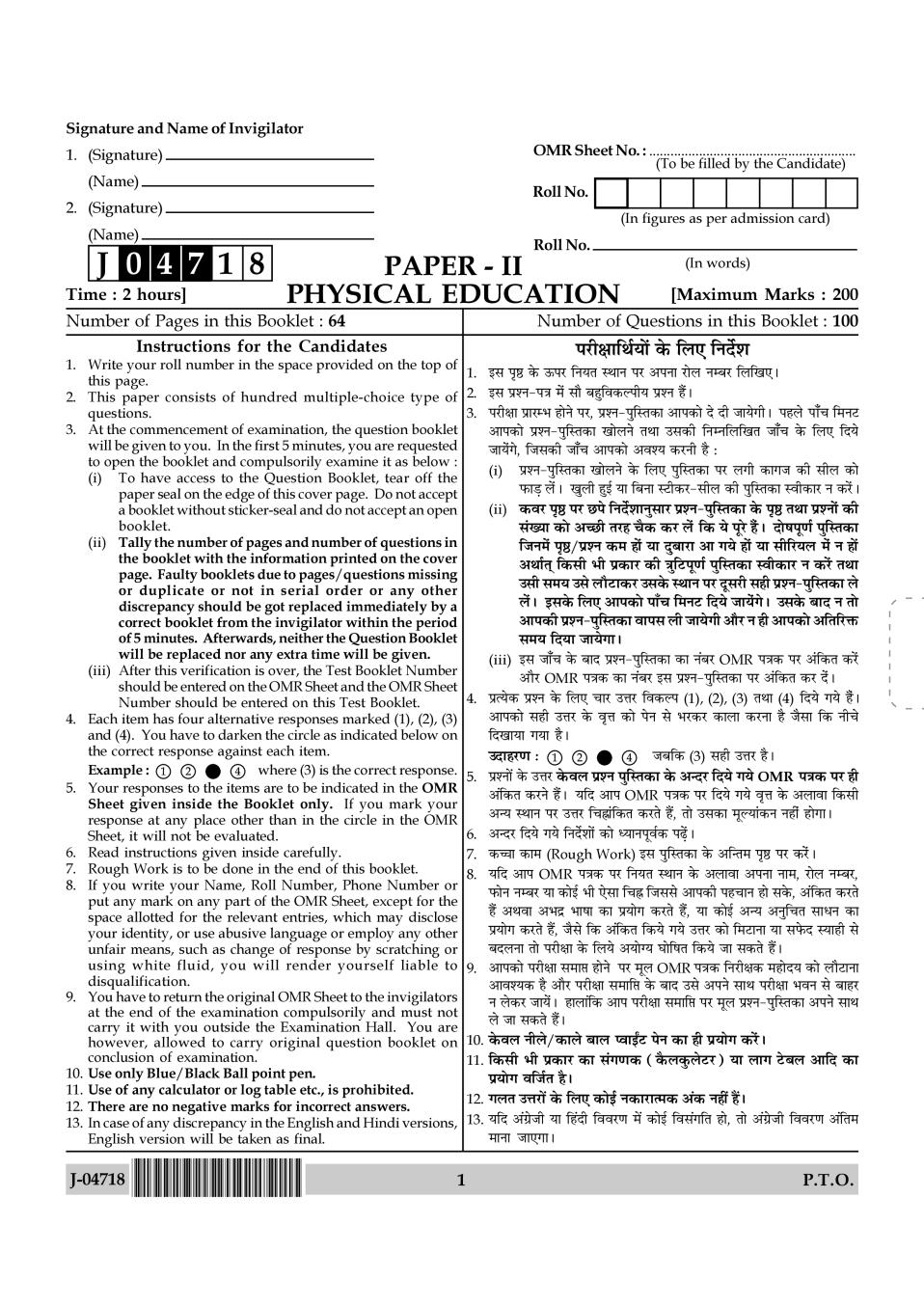
Page 1
1. (Signature) OMR Sheet No. : ..........................................................
(To be filled by the Candidate)
(Name)
Roll No.
2. (Signature)
(In figures as per admission card)
(Name)
Roll No.
J 0 4 7 1 8 PAPER - II (In words)
Time : 2 hours] PHYSICAL EDUCATION [Maximum Marks : 200
Number of Pages in this Booklet : 64 Number of Questions in this Booklet : 100
Instructions for the Candidates ¬⁄UˡÊÊÁÕ¸ÿÙ¢ ∑§ Á‹∞ ÁŸŒ¸‡Ê
1. Write your roll number in the space provided on the top of
1. ß‚ ¬ÎDU ∑§ ™§¬⁄U ÁŸÿà SÕÊŸ ¬⁄U •¬ŸÊ ⁄UÙ‹U Ÿê’⁄U Á‹Áπ∞–
this page.
2. This paper consists of hundred multiple-choice type of 2. ß‚ ¬˝‡Ÿ-¬òÊ ◊¢ ‚ÊÒ ’„ÈÁfl∑§À¬Ëÿ ¬˝‡Ÿ „Ò¥–
questions. 3. ¬⁄UˡÊÊ ¬˝Ê⁄êU÷ „ÙŸ ¬⁄U, ¬˝‡Ÿ-¬ÈÁSÃ∑§Ê •Ê¬∑§Ù Œ ŒË ¡ÊÿªË– ¬„‹U ¬UÊ°ø Á◊Ÿ≈U
3. At the commencement of examination, the question booklet •Ê¬∑§Ù ¬˝‡Ÿ-¬ÈÁSÃ∑§Ê πÙ‹Ÿ ÃÕÊ ©‚∑§Ë ÁŸêŸÁ‹Áπà ¡Ê°ø ∑§ Á‹∞ ÁŒÿ
will be given to you. In the first 5 minutes, you are requested ¡Êÿ¢ª, Á¡‚∑§Ë ¡Ê°ø •Ê¬∑§Ù •fl‡ÿ ∑§⁄UŸË „Ò —
to open the booklet and compulsorily examine it as below :
(i) ¬˝‡Ÿ-¬ÈÁSÃ∑§Ê πÙ‹Ÿ ∑§ Á‹∞ ¬ÈÁSÃ∑§Ê ¬⁄U ‹ªË ∑§Êª¡ ∑§Ë ‚Ë‹ ∑§Ê
(i) To have access to the Question Booklet, tear off the
paper seal on the edge of this cover page. Do not accept »§Ê«∏ ‹¢U– πÈ‹Ë „È߸ ÿÊ Á’ŸÊ S≈UË∑§⁄U-‚Ë‹U ∑§Ë ¬ÈÁSÃ∑§Ê SflË∑§Ê⁄U Ÿ ∑§⁄¢U–
a booklet without sticker-seal and do not accept an open (ii) ∑§fl⁄U ¬ÎDU ¬⁄U ¿U¬ ÁŸŒ¸‡ÊÊŸÈ‚Ê⁄U ¬˝‡Ÿ-¬ÈÁSÃ∑§Ê ∑§ ¬ÎDU ÃÕÊ ¬˝‡ŸÙ¢ ∑§Ë
booklet. ‚¢ÅÿÊ ∑§Ù •ë¿UË Ã⁄U„ øÒ∑§ ∑§⁄U ‹¢U Á∑§ ÿ ¬Í⁄U „Ò¢U– ŒÙ·¬Íáʸ ¬ÈÁSÃ∑§Ê
(ii) Tally the number of pages and number of questions in Á¡Ÿ◊¢ ¬ÎDU/¬˝‡Ÿ ∑§◊ „Ù¢ ÿÊ ŒÈ’Ê⁄UÊ •Ê ªÿ „Ù¢ ÿÊ ‚ËÁ⁄Uÿ‹U ◊¢ Ÿ „Ù¢
the booklet with the information printed on the cover •ÕʸØ Á∑§‚Ë ÷Ë ¬˝∑§Ê⁄U ∑§Ë òÊÈÁ≈U¬Íáʸ ¬ÈÁSÃ∑§Ê SflË∑§Ê⁄U Ÿ ∑§⁄¢U ÃÕÊ
page. Faulty booklets due to pages/questions missing
or duplicate or not in serial order or any other ©‚Ë ‚◊ÿ ©‚ ‹Uı≈UÊ∑§⁄U ©‚∑§ SÕÊŸ ¬⁄U ŒÍ‚⁄UË ‚„Ë ¬˝‡Ÿ-¬ÈÁSÃ∑§Ê ‹
discrepancy should be got replaced immediately by a ‹¢– U ß‚∑§ Á‹∞ •Ê¬∑§Ù ¬Ê°ø Á◊Ÿ≈U ÁŒÿ ¡Êÿ¢ª– ©‚∑§ ’ÊŒ Ÿ ÃÙ
correct booklet from the invigilator within the period •Ê¬∑§Ë ¬˝‡Ÿ-¬ÈÁSÃ∑§Ê flʬ‚ ‹Ë ¡ÊÿªË •ı⁄U Ÿ „Ë •Ê¬∑§Ù •ÁÃÁ⁄UQ§
of 5 minutes. Afterwards, neither the Question Booklet ‚◊ÿ ÁŒÿÊ ¡ÊÿªÊ–
will be replaced nor any extra time will be given. (iii) ß‚ ¡Ê°ø ∑§ ’ÊŒ ¬˝‡Ÿ-¬ÈÁSÃ∑§Ê ∑§Ê Ÿ¥’⁄U OMR ¬òÊ∑§ ¬⁄U •¢Á∑§Ã ∑§⁄¢U
(iii) After this verification is over, the Test Booklet Number
should be entered on the OMR Sheet and the OMR Sheet
•Uı⁄U OMR ¬òÊ∑§ ∑§Ê Ÿ¥’⁄U ß‚ ¬˝‡Ÿ-¬ÈÁSÃ∑§Ê ¬⁄U •¢Á∑§Ã ∑§⁄U Œ¢–
Number should be entered on this Test Booklet. 4. ¬˝àÿ∑§ ¬˝‡Ÿ ∑§ Á‹∞ øÊ⁄U ©ûÊ⁄U Áfl∑§À¬ (1), (2), (3) ÃÕÊ (4) ÁŒÿ ªÿ „Ò¢–
4. Each item has four alternative responses marked (1), (2), (3) •Ê¬∑§Ù ‚„Ë ©ûÊ⁄U ∑§ flÎûÊ ∑§Ù ¬Ÿ ‚ ÷⁄U∑§⁄U ∑§Ê‹Ê ∑§⁄UŸÊ „Ò ¡Ò‚Ê Á∑§ ŸËø
and (4). You have to darken the circle as indicated below on ÁŒπÊÿÊ ªÿÊ „Ò–
the correct response against each item. ©ŒÊ„⁄UáÊ — ¡’Á∑§ (3) ‚„Ë ©ûÊ⁄U „Ò–
Example : where (3) is the correct response. 5. ¬˝‡ŸÊ¥ ∑§ ©ûÊ⁄U ∑§fl‹ ¬˝‡Ÿ ¬ÈÁSÃ∑§Ê ∑§ •ãŒ⁄U ÁŒÿ ªÿ OMRU ¬òÊ∑§ ¬⁄U „Ë
5. Your responses to the items are to be indicated in the OMR
•¥Á∑§Ã ∑§⁄UŸ „Ò¥– ÿÁŒ •Ê¬ OMRU ¬òÊ∑§ ¬⁄U ÁŒÿ ªÿ flÎûÊ ∑§ •‹ÊflÊ Á∑§‚Ë
Sheet given inside the Booklet only. If you mark your
response at any place other than in the circle in the OMR •ãÿ SÕÊŸ ¬⁄U ©ûÊ⁄U ÁøqÊ¢Á∑§Ã ∑§⁄Uà „Ò¥, ÃÙ ©‚∑§Ê ◊ÍÀUÿÊ¢∑§Ÿ Ÿ„Ë¢ „٪ʖ
Sheet, it will not be evaluated. 6. •ãŒ⁄U ÁŒÿ ªÿ ÁŸŒ¸‡ÊÙ¢ ∑§Ù äÿÊŸ¬Ífl¸∑§ ¬…∏¢U–
6. Read instructions given inside carefully. 7. ∑§ìÊÊ ∑§Ê◊ (Rough Work) ß‚ ¬ÈÁSÃ∑§Ê ∑§ •ÁãÃ◊ ¬ÎDU ¬⁄U ∑§⁄¢U–
7. Rough Work is to be done in the end of this booklet. 8. ÿÁŒ •Ê¬ OMR ¬òÊ∑§ ¬⁄U ÁŸÿà SÕÊŸ ∑§ •‹ÊflÊ •¬ŸÊ ŸÊ◊, ⁄UÊ‹ Ÿê’⁄U,
8. If you write your Name, Roll Number, Phone Number or
put any mark on any part of the OMR Sheet, except for the
»§ÊŸ Ÿê’⁄U ÿÊ ∑§Ê߸ ÷Ë ∞‚Ê Áøq Á¡‚‚ •Ê¬∑§Ë ¬„øÊŸ „Ê ‚∑§, •¥Á∑§Ã ∑§⁄UÃ
space allotted for the relevant entries, which may disclose „Ò¥ •ÕflÊ •÷Œ˝ ÷Ê·Ê ∑§Ê ¬˝ÿʪ ∑§⁄Uà „Ò¥, ÿÊ ∑§Ê߸ •ãÿ •ŸÈÁøà ‚ÊœŸ ∑§Ê
your identity, or use abusive language or employ any other ¬˝ÿʪ ∑§⁄Uà „Ò¥, ¡Ò‚ Á∑§ •¥Á∑§Ã Á∑§ÿ ªÿ ©ûÊ⁄U ∑§Ê Á◊≈UÊŸÊ ÿÊ ‚»§Œ SÿÊ„Ë ‚
unfair means, such as change of response by scratching or ’Œ‹ŸÊ ÃÊ ¬⁄UˡÊÊ ∑§ Á‹ÿ •ÿÊÇÿ ÉÊÊÁ·Ã Á∑§ÿ ¡Ê ‚∑§Ã „Ò¥–
using white fluid, you will render yourself liable to 9. •Ê¬∑§Ù ¬⁄UˡÊÊ ‚◊Ê# „ÙŸ §¬⁄U ◊Í‹ OMR ¬òÊ∑§ ÁŸ⁄UˡÊ∑§ ◊„ÙŒÿ ∑§Ù ‹Uı≈UÊŸÊ
disqualification. •Êfl‡ÿ∑§ „Ò •ı⁄U ¬⁄UˡÊÊ ‚◊ÊÁ# ∑§ ’ÊŒ ©‚ •¬Ÿ ‚ÊÕ ¬⁄UˡÊÊ ÷flŸ ‚ ’Ê„⁄U
9. You have to return the original OMR Sheet to the invigilators Ÿ ‹∑§⁄U ¡Êÿ¢– „Ê‹Ê¥Á∑§ •Ê¬ ¬⁄UˡÊÊ ‚◊ÊÁ# ¬⁄U ◊Í‹ ¬˝‡Ÿ-¬ÈÁSÃ∑§Ê •¬Ÿ ‚ÊÕ
at the end of the examination compulsorily and must not
carry it with you outside the Examination Hall. You are ‹ ¡Ê ‚∑§Ã „Ò¥–
however, allowed to carry original question booklet on 10. ∑§fl‹ ŸË‹/∑§Ê‹ ’Ê‹U åflÊßZ≈U ¬Ÿ ∑§Ê „Ë ¬˝ÿʪ ∑§⁄¢U–
conclusion of examination. 11. Á∑§‚Ë ÷Ë ¬˝∑§Ê⁄U ∑§Ê ‚¢ªáÊ∑§ (∑Ò§‹∑ȧ‹≈U⁄U) UÿÊ ‹Êª ≈U’‹ •ÊÁŒ ∑§Ê
10. Use only Blue/Black Ball point pen. ¬˝ÿÙª flÁ¡¸Ã „Ò–
11. Use of any calculator or log table etc., is prohibited.
12. ª‹Ã ©ûÊ⁄UÊ¥ ∑§ Á‹∞ ∑§Ê߸ Ÿ∑§Ê⁄UÊà◊∑§ •¥∑§ Ÿ„Ë¥ „Ò¥–
12. There are no negative marks for incorrect answers.
13. In case of any discrepancy in the English and Hindi versions, 13. ÿÁŒ •¥ª˝¡Ë ÿÊ Á„¥ŒË Áflfl⁄UáÊ ◊¥ ∑§Ê߸ Áfl‚¥ªÁà „Ê, ÃÊ •¥ª˝¡Ë Áflfl⁄UáÊ •¥ÁÃ◊
English version will be taken as final. ◊ÊŸÊ ¡Ê∞ªÊ–
J-04718 !J-04718-PAPER-II! 1 P.T.O.
Page 2
PAPER - II
Note : This paper contains hundred (100) objective type questions of two (2) marks each. All
questions are compulsory.
1. Individual who have “made significant achievement in education, culture, development and
peace through sports” is awarded with :
(1) Pierre de Coubertin Medal (2) Olympic Laurel
(3) Olympic Order (4) Olympic Cup
2. The definition “Play consists of responses repeated purely for functional pleasure” is given
by :
(1) Bettelheim (2) Piaget (3) Guthrie (4) Lewin
3. Identify the disease which is referred to as Hypokinetic disease :
(1) AIDS (2) Dengue
(3) Cirrhosis of Liver (4) Rheumatic Arthritis
4. Identify the muscle protein which is not a part of thick filament :
(1) Myosin (2) C-Protein (3) Tropomyosin (4) M-Protein
5. Reynolds Number is a number that can be used to determine whether or not the flow around
a object will be turbulent or laminar. If U→ Speed of the Projectile, d→ Diameter of the
sphere and V→ Viscosity of the Medium. Then Reynolds Number is calculated by :
Ud Vd UV
(1) Re = (2) Re = (3) Re = (4) Re = UdV
V U d
6. Two forces that are equal in magnitude, act in opposite directions at a distance from an axis
of rotation, and produces rotation with no translation is known as :
(1) Impulse (2) Impulse - Couple
(3) Force - Couple (4) Inverse Dynamics
J-04718 !J-04718-PAPER-II! 2 Paper-II
Page 3
¬˝‡Ÿ¬òÊ - II
ÁŸŒ¸‡Ê — ß‚ ¬˝‡Ÿ-¬òÊ ◊¥ ‚ÊÒ (100) ’„È-Áfl∑§À¬Ëÿ ¬˝‡Ÿ „Ò¥– ¬˝àÿ∑§ ¬˝‡Ÿ ∑§ ŒÊ (2) •¥∑§ „Ò¥– ‚÷Ë ¬˝‡Ÿ •ÁŸflÊÿ¸ „Ò¥–
1. Á¡‚ √ÿÁÄàÊ Ÿ ““π‹-∑ͧŒ ∑§ ◊Êäÿ◊ ‚ Á‡ÊˇÊÊ, ‚¥S∑ΧÁÃ, Áfl∑§Ê‚ ÃÕÊ ‡ÊÊ¥Áà ∑§ ˇÊòÊ ◊¥ ◊„ûfl¬Íáʸ ©¬‹Áéœ „ÊÁ‚‹ ∑§Ë
„Ò”” ©‚ ∑§ÊÒŸ-‚Ê ¬È⁄US∑§Ê⁄U ÁŒÿÊ ¡ÊÃÊ „Ò?
(1) ¬Ë•⁄U Œ ∑ͧ’⁄UÁ≈UŸ ◊«U‹ (2) •Ê‹Áê¬∑§ ‹Ê⁄U‹
(3) •Ê‹Áê¬∑§ •Ê«¸U⁄U (4) •Ê‹Áê¬∑§ ∑§¬
2. ÿ„ ¬Á⁄U÷Ê·Ê Á∑§ ““π‹ ◊¥ Áfl‡ÊÈh× Á∑˝§ÿÊ∑§‹Ê¬ ‚¥’¥œË •ÊŸãŒ ∑§ Á‹ÿ •ŸÈÁ∑˝§ÿÊ•Ê¥ ∑§Ë ¬ÈŸ⁄UÊflÎÁûÊ „ÊÃË „Ò–”” Á∑§‚Ÿ
ŒË „Ò?
(1) ’≈U‹„Êß◊ (2) ¬Ëª≈U (3) ªÈÕ⁄UË (4) ‹ÁflŸ
3. ©‚ ⁄Uʪ ∑§Ê ÁøÁã„à ∑§ËÁ¡∞ Á¡‚ „Ê߬Ê∑§ÊߟÁ≈U∑§ ⁄Uʪ ∑§„Ê ¡ÊÃÊ „Ò —
(1) ∞«˜U‚ (2) «¥UªÍ
(3) Á‚⁄UÊÚÁ‚‚ •ÊÚ»§ ‹Ëfl⁄U (4) ⁄U„˜ÿÍ◊ÒÁ≈U∑§ •ÊÕ¸⁄UÊßÁ≈U‚
4. ©‚ ◊Ê¥‚¬‡ÊË ¬˝Ê≈UËŸ ∑§Ê ¬„øÊÁŸÿ ¡Ê ÁÕ∑§ Á»§‹Ê◊ã≈U ∑§Ê Á„S‚Ê Ÿ„Ë¥ „Ò —
(1) Á◊•ÊÁ‚Ÿ (2) ‚Ë - ¬˝Ê≈UËŸ (3) ≈˛UʬÊÁ◊•ÊÁ‚Ÿ (4) ∞◊ - ¬˝Ê≈UËŸ
5. ⁄UŸÊÚÀ«˜‚ ‚¥ÅÿÊ fl„ ‚¥ÅÿÊ „Ò Á¡‚∑§Ê ¬˝ÿʪ ÿ„ ÁŸœÊ¸⁄UáÊ ∑§⁄UŸ ∑§ Á‹∞ Á∑§ÿÊ ¡Ê ‚∑§ÃÊ „Ò Á∑§ Á∑§‚Ë flSÃÈ ∑§ øÊ⁄UÊ¥ •Ê⁄U
¬˝flÊ„ •‡Êʥà ÿÊ ¬⁄UÃŒÊ⁄U „Ò ÿÊ Ÿ„Ë¥– ÿÁŒ U→ ¬˝ˇÊ¬∑§ ∑§Ë øÊ‹ „Ò, d→ ªÊ‹Ê ∑§Ê √ÿÊ‚ „Ò •ÊÒ⁄U V→ ◊Êäÿ◊ ∑§Ë
‡ÿÊŸÃÊ „Ò, ÃÊ ⁄UŸÊÚÀ«˜U‚ ‚¥ÅÿÊ ∑§Ë ªáÊŸÊ Á∑§‚∑§ mÊ⁄UÊ „ÊÃË „Ò?
Ud Vd UV
(1) Re = (2) Re = (3) Re = (4) Re = UdV
V U d
6. ŒÊ ’‹ ¡Ê ◊ÊòÊÊ ◊¥ ‚◊ÃÈÀÿ „Ò¥, ¬Á⁄U÷˝◊áÊ ∑§Ë œÈ⁄UË ‚ Á∑§‚Ë ŒÍ⁄UË ¬⁄U Áfl⁄UÊœË ÁŒ‡ÊÊ•Ê¥ ◊¥ ∑§Êÿ¸ ∑§⁄Uà „Ò¥ •ÊÒ⁄U Á’ŸÊ Á∑§‚Ë
SÕÊŸÊãÃ⁄UáÊ ∑§ ¬Á⁄U÷˝◊áÊ ©à¬ÛÊ ∑§⁄Uà „Ò ∑§Ê ∑§„Ê ¡ÊÃÊ „Ò —
(1) •Êflª (2) •Êflª - ÿÈÇ◊Ÿ
(3) ’‹-ÿÈÇ◊Ÿ (4) ¬˝ÁËÊ◊ ªÁÃ∑§Ë
J-04718 !J-04718-PAPER-II! 3 Paper-II
Page 4
(1) Convex Curve (2) Concave - Convex Curve
(3) Concave Curve (4) Convex - Concave Curve
8. Moment to moment changes in perceived physiological activation is called :
(1) Trait anxiety (2) Cognitive state anxiety
(3) Tension (4) Somatic state anxiety
9. The ecology of teaching and learning in physical education helps to understand :
(1) Dynamics of work setting
(2) Teaching methodology
(3) Social efficiency of teacher and student
(4) Supervision methods
10. All antibodies are compounds made up of :
(1) Poly peptide chains (2) Mineral Corticords
(3) Triglycerides (4) Disacharide Chains
11. The amount of Carbohydrate to be consumed one hour prior to exercise is :
(1) 1 gram of Carbohydrate per kilogram of body weight
(2) 2 grams of Carbohydrate per kilogram of body weight
(3) 2.5 grams of Carbohydrate per kilogram of body weight
(4) 3 grams of Carbohydrate per kilogram of body weight
12. While the trainees practice a movement repeatedly and the coach constantly supervises,
helps and makes corrections, the method is termed as :
(1) Task method (2) Presentation method
(3) Co-operative method (4) Observation method
13. Which of the characteristics of sports training denotes the process of scientific observation,
experimentation, analysis and synthesis ?
(1) Educational process (2) Planned and Systematic process
(3) Process of perfection (4) Scientific process
J-04718 !J-04718-PAPER-II! 4 Paper-II
Page 5
(1) ©ûÊ‹ fl∑˝§ (2) •flË - ©ûÊ‹ fl∑˝§
(3) •flË fl∑˝§ (4) ©ûÊ‹ - •flË fl∑˝§
8. ¬˝àÿˇÊôÊÊŸÊà◊∑§ ‡ÊÊ⁄UËÁ⁄U∑§ Á∑˝§ÿÊà◊∑§ ‚Á∑˝§ÿáÊ ◊¥ ˇÊáÊ-ˇÊáÊ ¬Á⁄UfløŸÊ¥ ∑§Ê ∑§„Ê ¡ÊÃÊ „Ò —
(1) Áfl‡Ê·ÃÊ ŒÈÁ‡ø¥ÃÊ (2) ‚¥ôÊÊŸÊà◊∑§ ÁSÕà ŒÈÁ‡ø¥ÃÊ
(3) ßÊfl (4) ∑§ÊÁÿ∑§ ÁSÕÁà ŒÈÁ‡ø¥ÃÊ
9. ‡ÊÊ⁄UËÁ⁄U∑§ Á‡ÊˇÊÊ ◊¥ •äÿʬŸ •ÊÒ⁄U •Áœª◊ ∑§Ë ¬ÊÁ⁄UÁSÕÁÃ∑§Ë __________‚◊¤ÊŸ ◊¥ ‚„ÊÿÃÊ ∑§⁄ÃÊ „Ò–
(1) ∑§Êÿ¸ √ÿflSÕÊ ∑§ •ÊÿÊ◊
(2) •äÿʬŸ ¬˝áÊÊ‹Ë ÁflôÊÊŸ
(3) Á‡ÊˇÊ∑§ •ÊÒ⁄U ¿UÊòÊ ∑§Ë ‚Ê◊ÊÁ¡∑§ ŒˇÊÃÊ
(4) ¬ÿ¸flˇÊáÊ ÁflÁœ
10. ‚÷Ë ⁄Uʪ¬˝ÁÃ∑§Ê⁄U∑§ __________‚ ÁŸÁ◊¸Ã ÿÊÒÁª∑§ „Ò¥–
(1) ¬ÊÚÁ‹¬å≈UÊß«U ∑§«∏Ë (2) πÁŸ¡ ∑§ÊÚÁ≈¸U∑§ÊÚ«¸˜U‚
(3) ≈˛UÊßÁÇ‹‚⁄UÊß«U (4) «UÊß‚Ò∑§⁄UÊß«U ∑§«∏Ë
11. •èÿÊ‚ ‚ ∞∑§ ÉÊ¥≈UÊ ¬„‹ ©¬÷ʪ ∑§Ë ¡ÊŸflÊ‹Ë ∑§Ê’ʸ„Êß«˛U≈U ∑§Ë ◊ÊòÊÊ „Ò —
(1) ‡Ê⁄UË⁄U ∑§ ¬˝Áà Á∑§‹Ê fl¡Ÿ ¬⁄U 1 ª˝Ê◊ ∑§Ê’ʸ„Êß«˛˛≈U
(2) ‡Ê⁄UË⁄U ∑§ ¬˝Áà Á∑§‹Ê fl¡Ÿ ¬⁄U 2 ª˝Ê◊ ∑§Ê’ʸ„Êß«˛U≈U
(3) ‡Ê⁄UË⁄U ∑§ ¬˝Áà Á∑§‹Ê fl¡Ÿ ¬⁄U 2.5 ª˝Ê◊ ∑§Ê’ʸ„Êß«˛U≈U
(4) ‡Ê⁄UË⁄U ∑§ ¬˝Áà Á∑§‹Ê fl¡Ÿ ¬⁄U 3 ª˝Ê◊ ∑§Ê’ʸ„Êß«˛U≈U
12. ¡’ ∑§Ê߸ ¬˝Á‡ÊˇÊÈ Á∑§‚Ë ‚¥ø‹Ÿ ∑§Ê ’Ê⁄U-’Ê⁄U •èÿÊ‚ ∑§⁄UÃÊ „Ò •ÊÒ⁄U ∑§Êø ÁŸ⁄¥UÃ⁄U ¬ÿ¸flˇÊáÊ ∑§⁄UÃÊ „Ò, ‚„ÊÿÃÊ ∑§⁄UÃÊ „Ò
•ÊÒ⁄U òÊÈÁ≈U ‚ÈœÊ⁄U ∑§⁄UÃÊ „Ò, ÃÊ ß‚ ÁflÁœ ∑§Ê ∑§„Ê ¡ÊÃÊ „Ò —
(1) ∑§Êÿ¸ ÁflÁœ (2) ¬˝SÃÈÃË∑§⁄UáÊ ÁflÁœ
(3) ‚„ÿʪ ÁflÁœ (4) •fl‹Ê∑§Ÿ ÁflÁœ
13. π‹∑ͧŒ ¬˝Á‡ÊˇÊáÊ ∑§Ë ∑§ÊÒŸ-‚Ë Áfl‡Ê·ÃÊ flÒôÊÊÁŸ∑§ •fl‹Ê∑§Ÿ, ¬˝ÿʪ, Áfl‡‹·áÊ •ÊÒ⁄U ‚¥‡‹·áÊ ∑§Ë ¬˝Á∑˝§ÿÊ ∑§Ê ÁŸÁŒ¸c≈U
∑§⁄UÃÊ „Ò?
(1) ‡ÊÒÁˇÊ∑§ ¬˝Á∑˝§ÿÊ (2) ÁŸÿÊÁ¡Ã •ÊÒ⁄U √ÿflÁSÕà ¬˝Á∑˝§ÿÊ
(3) ¬ÍáʸÃÊ ∑§Ë ¬˝Á∑˝§ÿÊ (4) flÒôÊÊÁŸ∑§ ¬˝Á∑˝§ÿÊ
J-04718 !J-04718-PAPER-II! 5 Paper-II
Page 6
(1) Are never used
(2) Are often generated as the data are collected, interpreted and analysed
(3) Are always selected after the research study has been completed
(4) Are very specific and stated prior to beginning the study
15. A type of sampling used in qualitative research that involves selecting cases that disconfirm
the researcher’s expectations and generalizations is referred to as :
(1) Extreme - case sampling (2) Negative- case sampling
(3) Critical - case sampling (4) Typical - case sampling
16. Which evaluation promotes high levels of learning among all the students and pinpoints
areas where further development and learning are needed ?
(1) Formative evaluation (2) Summative evaluation
(3) Subjective evaluation (4) Objective evaluation
17. If we have a test of 50 items with mean of 30 and standard deviation of 6, what will be the
reliability of the test using Kuder Richardson Method ?
(1) 0.70 (2) 0.82 (3) 0.68 (4) 0.78
18. The primary focus of supervision must watch :
(1) Learning Situation (2) Maintenance of Records
(3) Activity Programme (4) Competition Programme
19. The Intramural Programmes are an excellent grounds for :
(1) Student Recreation (2) Basic Instructional Work
(3) Talent Identification (4) Skill Development
20. “Play” Theories are :
(a) Catharsis Theory (b) Attribution Theory
(c) Psycho-analytic Theory (d) Social Learning Theory
Code :
(1) (a), (c) (2) (b), (d) (3) (a), (b) (4) (c), (d)
J-04718 !J-04718-PAPER-II! 6 Paper-II
Page 7
(1) ∑§÷Ë ¬˝ÿʪ Ÿ„Ë¥ Á∑§∞ ¡ÊÖ
(2) ’„ÈœÊ ‚ÎÁ¡Ã Á∑§∞ ¡Êà „Ò¥ ÄÿÊ¥Á∑§ •Ê¥∑§«∏Ê¥ ∑§Ê ‚¥ª˝„áÊ, √ÿÊÅÿÊ •ÊÒ⁄U Áfl‡‹·áÊ Á∑§ÿÊ ¡ÊÃÊ „Ò–
(3) ‡ÊÊœ •äÿÿŸ ¬Í⁄UÊ „ÊŸ ∑§ ¬‡øÊØ ‚ŒÒfl øÈŸ ¡Êà „Ò¥–
(4) •àÿãà „Ë ÁflÁ‡Êc≈ „Êà „Ò¥ •ÊÒ⁄U •äÿÿŸ ¬˝Ê⁄Uê÷ ∑§⁄UŸ ‚ ¬„‹ ’ÃÊ∞ ¡Êà „Ò¥–
15. ªÈáÊÊà◊∑§ ‡ÊÊœ ◊¥ ¬˝ÿÈÄàÊ ∞∑§ ¬˝∑§Ê⁄ ∑§Ê ¬˝ÁÃøÿŸ Á¡‚◊¥ ©Ÿ ◊Ê◊‹Ê¥ ∑§Ê øÿŸ ‡ÊÊÁ◊‹ „ÊÃÊ „Ò ¡Ê ‡ÊÊœ∑§ûÊʸ ∑§Ë
•Ê‡ÊÊ•Ê¥ •ÊÒ⁄U ‚Ê◊ÊãÿË∑§⁄UáÊ ∑§Ë ¬ÈÁc≈ Ÿ„Ë¥ ∑§⁄Uà „Ò ∑§Ê ∑§„Ê ¡ÊÃÊ „Ò —
(1) •ÁÇÊÿ - ◊Ê◊‹Ê ¬˝ÁÃøÿŸ (2) Ÿ∑§Ê⁄UÊà◊∑§ - ◊Ê◊‹Ê ¬˝ÁÃøÿŸ
(3) •Ê‹ÊøŸÊà◊∑§ - ◊Ê◊‹Ê ¬˝ÁÃøÿŸ (4) ‹ÊˇÊÁáÊ∑§ - ◊Ê◊‹Ê ¬˝ÁÃøÿŸ
16. ∑§ÊÒŸ-‚Ê ◊ÍÀÿÊ¥∑§Ÿ ‚÷Ë ¿UÊòÊÊ¥ ∑§ ’Ëø ‚ËπŸ ∑§ ©ìÊ SÃ⁄UÊ¥ ∑§Ê ’…∏ÊflÊ ŒÃÊ „Ò ÃÕÊ ©Ÿ ˇÊòÊÊ¥ ∑§Ê ߥÁªÃ ∑§⁄UÃÊ „Ò¥ ¡„Ê° •ÊÒ⁄U
Áfl∑§Ê‚ ÃÕÊ ‚ËπŸ ∑§Ë •Êfl‡ÿ∑§ÃÊ „Ò?
(1) ⁄UøŸÊà◊∑§ ◊ÍÀÿÊ¥∑§Ÿ (2) ‚¥∑§Á‹Ã ◊ÍÀÿÊ¥∑§Ÿ
(3) Áfl·ÿÁŸc∆U ◊ÍÀÿÊ¥∑§Ÿ (4) flSÃÈÁŸc∆U ◊ÍÀÿÊ¥∑§Ÿ
17. ÿÁŒ „◊¥ 50 ◊ŒÊ¥ ∑§Ê ¬⁄UˡÊáÊ ∑§⁄UŸÊ „Ò Á¡‚∑§Ê ◊Êäÿ 30 •ÊÒ⁄U ◊ÊŸ∑§ Áflø‹Ÿ 6 „Ò, ∑ȧŒ⁄U Á⁄Uø«¸U‚Ÿ ¬hÁà ∑§Ê ¬˝ÿʪ
∑§⁄Uà „È∞ ¬⁄UˡÊáÊ ∑§Ë Áfl‡fl‚ŸËÿÃÊ ÄÿÊ „ʪË?
(1) 0.70 (2) 0.82 (3) 0.68 (4) 0.78
18. ¬ÿ¸flˇÊáÊ ∑§Ê ¬˝ÊÕÁ◊∑§ äÿÊŸ __________ ŒπŸÊ „ʪʖ
(1) ‚ËπŸ ∑§Ë ÁSÕÁà (2) Á⁄U∑§ÊÚ«UÊZ ∑§Ê ⁄Uπ-⁄UπÊfl
(3) ∑§Êÿ¸∑§‹Ê¬ ∑§Êÿ¸∑˝§◊ (4) ¬˝ÁÃÿÊÁªÃÊ ∑§Êÿ¸∑˝§◊
19. •¥Ã—¬˝ÊøË⁄U ∑§Êÿ¸∑˝§◊ __________ ∑§ Á‹∞ ©à∑Χc≈U •ÊœÊ⁄U „Ò¥–
(1) ¿UÊòÊ ◊ŸÊ⁄¥U¡Ÿ (2) ◊Í‹ •ŸÈŒ‡ÊÊà◊∑§ ∑§Êÿ¸
(3) ¬˝ÁÃ÷Ê ¬„øÊŸ (4) ∑§Ê҇ʋ Áfl∑§Ê‚
20. ““å‹”” Á‚hÊãà „Ò¥ —
(a) Áfl⁄UøŸ Á‚hÊãà (b) ªÈáÊ⁄UʬáÊ Á‚hÊãÃ
(c) ◊ŸÊÁfl‡‹·áÊÊà◊∑§ Á‚hÊãà (d) ‚Ê◊ÊÁ¡∑§ •Áœª◊ Á‚hÊãÃ
∑ͧ≈U —
(1) (a), (c) (2) (b), (d) (3) (a), (b) (4) (c), (d)
J-04718 !J-04718-PAPER-II! 7 Paper-II
Page 8
(a) First Winter Olympic were organised in 1928 at Chamonix, France
(b) Concept of Youth Olympic Games was given by Johann Rosenzopf in 1998
(c) Ist Winter Youth Olympic were conduced in 2012, Innsbruck (Austria)
(d) Ist Summer Youth Olympic were conduced in 2008, Singapore
Code :
(1) (a), (b) and (c) (2) (b) and (c)
(3) (a), (c) and (d) (4) (a), (b), (c) and (d)
22. Identify from the followings which are thermotherapy modalities :
(a) Commercial gel (b) Hydrocolator Packs
(c) Ultrasound (d) Vibration
(e) TENS (f) Diathermy
Find the correct answer from the code given below :
(1) (a), (c), (e) (2) (b), (d), (f) (3) (a), (e), (f) (4) (b), (c), (f)
23. Pulmonary ventilation of a person, irrespective of gender, depending on :
(a) Vital capacity
(b) Tidal volume
(c) Heart rate
(d) Respiratory rate
(e) Stroke volume
Find the correct answer from the code given below :
(1) (a), (d) (2) (b), (d) (3) (c), (e) (4) (b), (c)
J-04718 !J-04718-PAPER-II! 8 Paper-II
Page 9
(a) ¬„‹Ê ‡ÊËÃ∑§Ê‹ËŸ •Ê‹Áê¬∑§ π‹Ê¥ ∑§Ê •ÊÿÊ¡Ÿ fl·¸ 1928 ◊¥ ø◊ÊÁŸÄ‚, »˝§Ê¥‚ ◊¥ „È•Ê ÕÊ–
(b) ÿÈflÊ •Ê‹Áê¬∑§ ∑§Ë •flœÊ⁄UáÊÊ fl·¸ 1998 ◊¥ ¡Ê„Ê㟠⁄UÊ¡Ÿ¡Ê»§ Ÿ ŒË ÕË–
(c) ¬„‹Ê ‡ÊËÃ∑§Ê‹ËŸ ÿÈflÊ •Ê‹Áê¬∑§ π‹Ê¥ (Áfl¥≈U⁄U ÿÍÕ •Ê‹Áê¬∑§) fl·¸ 2012 ◊¥ ßã‚’˝∑§ (•ÊÁS≈˛UÿÊ) ◊¥
•ÊÿÊÁ¡Ã Á∑§ÿÊ ªÿÊ ÕÊ–
(d) ¬˝Õ◊ ª˝Ëc◊ ∑§Ê‹ËŸ ÿÈflÊ •Ê‹Áê¬∑§ π‹Ê¥ ∑§Ê •ÊÿÊ¡Ÿ fl·¸ 2008 ◊¥ Á‚¥ªÊ¬È⁄U ◊¥ „È•Ê ÕÊ–
∑ͧ≈UU —
(1) (a), (b) •ÊÒ⁄U (c) (2) (b) •ÊÒ⁄U (c)
(3) (a), (c) •ÊÒ⁄U (d) (4) (a), (b), (c) •ÊÒ⁄U (d)
22. ÁŸêŸÁ‹Áπà ◊¥ ‚ Õ◊ʸÁÕ⁄ÒU¬Ë ¬˝ÁflÁœÿÊ¥ ∑§Ë ¬„øÊŸ ∑§ËÁ¡∞ —
(a) flÊÁáÊÁíÿ∑§ ¡‹ (b) „Êß«˛UÊ∑§Ê‹≈U⁄U ¬Ò∑˜§‚
(c) •À≈˛UÊ‚Ê©ã«U (d) S¬ãŒŸ
(e) ≈UË.߸.∞Ÿ.∞‚. (f) «UÊÿÊÕ◊˸
ÁŸêŸÁ‹Áπà ∑ͧ≈U ‚ ‚„Ë ©ûÊ⁄U ∑§Ê ¬ÃÊ ‹ªÊßÿ¥ —
(1) (a), (c), (e) (2) (b), (d), (f) (3) (a), (e), (f) (4) (b), (c), (f)
23. Á∑§‚Ë √ÿÁÄàÊ ∑§Ê »È§ç»È§‚Ëÿ ‚¥flÊß Á‹¥ª ∑§ ÁŸ⁄U¬ˇÊ __________ ¬⁄U ÁŸ÷¸⁄U ∑§⁄UÃÊ „Ò–
(a) ◊„àfl¬Íáʸ ˇÊ◊ÃÊ
(b) íflÊ⁄UËÿ ¬Á⁄U◊ÊáÊ
(c) NŒÿ ªÁÃ
(d) ‡flÊÚ‚ ªÁÃ
(e) •ÊÉÊÊà ¬Á⁄U◊ÊáÊ
ÁŸêŸÁ‹Áπà ∑ͧ≈ ‚ ‚„Ë ©ûÊ⁄U ∑§Ê ¬ÃÊ ‹ªÊßÿ–
(1) (a), (d) (2) (b), (d) (3) (c), (e) (4) (b), (c)
J-04718 !J-04718-PAPER-II! 9 Paper-II
Page 10
(a) The sciatic nerve is the largest and longest nerve in the human body.
(b) Lateral movements of the femur are facilitated by lateral tilt of the pelvis toward the
opposite side.
(c) The hamstrings contribute to both hip extension and knee flexion.
Code :
(1) (a) and (b) are correct (2) (b) and (c) are correct
(3) (a) and (c) are correct (4) (a), (b) and (c) are correct
25. Which of the following is/are correct ?
(a) Moment of force is the force multiplied by the perpendicular distance between the line
of action of the force and the axis of rotation.
(b) Tuberosities and condyles near joint axes decreases the lever arms of muscle.
(c) The radial tuberosity and capitulum of the humerus increase the mechanical advantage.
Code :
(1) (a) and (b) are correct (2) (b) and (c) are correct
(3) (a) and (c) are correct (4) (a), (b) and (c) are correct
26. Personal factors of state anxiety are :
(a) Cognitive appraisal (b) Competition
(c) Expectation (d) Coping style
Code :
(1) (a), (b), (c) (2) (b), (c), (d) (3) (a), (c), (d) (4) (c), (d), (a)
J-04718 !J-04718-PAPER-II! 10 Paper-II
Page 11
(a) ◊ÊŸfl ‡Ê⁄UË⁄U ◊¥ Á‚ÿÊÁ≈U∑§ SŸÊÿÈ ‚’‚ ’«∏Ë •ÊÒ⁄U ‹¥’Ë SŸÊÿÈ „Ò¥–
(b) »§Ë◊⁄UU ∑§Ë ¬ÊÁ‡¸fl∑§ ªÁà Áfl¬⁄UËà ÁŒ‡ÊÊ ∑§ üÊÊÊÁáÊ ∑§ ¬ÊÁ‡¸fl∑§ ¤ÊÈ∑§Êfl ∑§ ∑§Ê⁄UáÊ ‚ÈÁflœÊ¡Ÿ∑§ „ÊÃÊ „Ò–
(c) „ÒÁêS≈˛¥UÇ‚ ∑ͧÀ„Ê ÁflSÃÊ⁄U •ÊÒ⁄U ÉÊÈ≈UŸÊ •Ê∑È¥§øŸ ŒÊŸÊ¥ ◊¥ ‚„ÊÿÃÊ ∑§⁄Uà „Ò¥–
∑ͧ≈U —
(1) (a) •ÊÒ⁄U (b) ‚„Ë „Ò¥– (2) (b) •ÊÒ⁄U (c) ‚„Ë „Ò¥–
(3) (a) •ÊÒ⁄U (c) ‚„Ë „Ò¥– (4) (a), (b) •ÊÒ⁄U (c) ‚„Ë „Ò¥–
25. ÁŸêŸÁ‹Áπà ◊¥ ‚ ∑§ÊÒŸ-‚Ê ‚„Ë „Ò?
(a) ’‹ ∑§Ê ‚¥flª fl„ ’‹ „Ò ¡Ê ’‹ ∑§ ∑§Êÿ¸ ∑§Ë ⁄UπÊ •ÊÒ⁄U ¬Á⁄U÷˝◊áÊ ∑§Ë œÈ⁄UË ∑§ ’Ëø •Á÷‹ê’ ŒÍ⁄UË ‚ ªÈÁáÊÃ
„ÊÃÊ „Ò–
(b) íflÊߥ≈U ∞Ä‚‚ ∑§ ‚◊ˬ ≈˜UÿÍ’⁄UÊ‚Êß≈UË¡ •ÊÒ⁄U ∑§ÊÚã«UÊßÀ‚ ◊Ê¥‚¬‡ÊË ∑§ ©ûÊÊ‹∑§ ÷È¡Ê•Ê¥ ∑§Ê ∑§◊ ∑§⁄Uà „Ò¥–
(c) sÍ◊⁄U‚ ∑§Ê ∑Ò§Á¬≈ÈU‹◊ •ÊÒ⁄U ⁄UÁ«Uÿ‹ ≈KÍ’⁄UÊÁ‚≈UË ÿÊ¥ÁòÊ∑§Ë ‹Ê÷ ◊¥ flÎÁh ∑§⁄Uà „Ò¥–
∑ͧ≈U —
(1) (a) •ÊÒ⁄U (b) ‚„Ë „Ò¥– (2) (b) •ÊÒ⁄U (c) ‚„Ë „Ò¥–
(3) (a) •ÊÒ⁄U (c) ‚„Ë „Ò¥– (4) (a), (b) •ÊÒ⁄U (c) ‚„Ë „Ò¥–
26. ŒÈÁ‡ø¥ÃÊ ∑§Ë ÁSÕÁà ∑§ √ÿÁÄàʪà ∑§Ê⁄U∑§ „Ò¥ —
(a) ‚¥ôÊÊŸÊà◊∑§ ◊ÍÀÿÊ¥∑§Ÿ (b) ¬˝ÁÃÿÊÁªÃÊ
(c) ¬˝àÿʇÊÊ (d) ‚Ê◊ŸÊ ∑§⁄U ‚∑§Ÿ ∑§Ë ‡ÊÒ‹Ë
∑ͧ≈U —
(1) (a), (b), (c) (2) (b), (c), (d) (3) (a), (c), (d) (4) (c), (d), (a)
J-04718 !J-04718-PAPER-II! 11 Paper-II
Page 12
(a) Social System (b) Influence System
(c) Power System (d) Emergence of Leader
Code :
(1) (b), (c) (2) (a), (d) (3) (a), (b) (4) (c), (d)
28. Primarily Teaching/Learning in physical education can be viewed by three interactive task
systems :
(a) Student- social system (b) Organisational task system
(c) Instructional task system (d) Evaluation task system
Code :
(1) (b), (d), (c) (2) (b), (c), (a)
(3) (a), (b), (d) (4) (a), (d), (c)
29. Carbohydrate loading requires :
(a) Manipulation in diet
(b) Heavy exercise
(c) Dehydration
(d) Starvation
(e) Niacin Intake
Code :
(1) (a), (b), (c) (2) (b), (c), (e) (3) (b), (d), (e) (4) (a), (b), (d)
J-04718 !J-04718-PAPER-II! 12 Paper-II
Page 13
(a) ‚Ê◊ÊÁ¡∑§ ¬˝áÊÊ‹Ë (b) ¬˝÷Êfl ¬˝áÊÊ‹Ë
(c) ‡ÊÁÄàÊ ¬˝áÊÊ‹Ë (d) ŸÃÊ ∑§Ê ¬˝ÊŒÈ÷ʸfl
∑ͧ≈U —
(1) (b), (c) (2) (a), (d) (3) (a), (b) (4) (c), (d)
28. ‡ÊÊ⁄UËÁ⁄U∑§ Á‡ÊˇÊÊ ◊¥ •äÿʬŸ/•Áœª◊ ∑§Ê ◊ÈÅÿ M§¬ ‚ ÃËŸ •ãÃÁ∑˝¸§ÿÊà◊∑§ ∑§Êÿ¸ ∑§ M§¬ ◊¥ ŒπÊ ¡Ê ‚∑§ÃÊ „Ò —
(a) ¿UÊòÊ-‚Ê◊ÊÁ¡∑§ ¬˝áÊÊ‹Ë (b) ‚¥ª∆UŸÊà◊∑§ ∑§Êÿ¸ ¬˝áÊÊ‹Ë
(c) •ŸÈŒ‡ÊÊà◊∑§ ∑§Êÿ¸ ¬˝áÊÊ‹Ë (d) ◊ÍÀÿÊ¥∑§Ÿ ∑§Êÿ¸ ¬˝áÊÊ‹Ë
∑ͧ≈U —
(1) (b), (d), (c) (2) (b), (c), (a)
(3) (a), (b), (d) (4) (a), (d), (c)
29. ∑§Ê’ʸ„Êß«˛U≈U ÷⁄UáÊ ∑§ Á‹∞ •Êfl‡ÿ∑§ÃÊ „ÊÃË „Ò¥ —
(a) •Ê„Ê⁄U ◊¥ »§⁄U-’Œ‹
(b) ∑§Á∆UŸ •èÿÊ‚
(c) ÁŸ¡¸‹Ë∑§⁄UáÊ
(d) ÷Èπ◊⁄UË
(e) ÁŸÿÊÁ‚Ÿ ª˝„áÊ
∑ͧ≈U —
(1) (a), (b), (c) (2) (b), (c), (e) (3) (b), (d), (e) (4) (a), (b), (d)
J-04718 !J-04718-PAPER-II! 13 Paper-II
Page 14
(a) Vitamin A
(b) Vitamin B
(c) Vitamin K
(d) Vitamin D
(e) Vitamin C
Find the correct answer from the code given below :
(1) (a), (b), (c) (2) (b), (e) (3) (b), (c) (4) (b), (d), (c)
31. Find out the correct combination of the significant changes that occur due to first
metamorphosis.
(a) Arms and legs become longer.
(b) Basic movements are refined.
(c) Good emotional control develops.
(d) Gain in height.
(e) Coupling ability of simple movements is acquired.
Code :
(1) (a), (b), (c), (e) (2) (a), (b), (d), (e)
(3) (b), (c), (d), (e) (4) (a), (c), (d), (e)
32. Find the correct combination of the principles of tactical preparation from the code given
below :
(a) Creative self effort
(b) Formulation of a non-modifiable tactical plan
(c) Evaluation and assessment
(d) Observation and perception of task
(e) Unity of theory and practice
Code :
(1) (a), (b), (c), (e) (2) (a), (b), (c), (d)
(3) (a), (c), (d), (e) (4) (b), (c), (d), (e)
J-04718 !J-04718-PAPER-II! 14 Paper-II
Page 15
(a) Áfl≈UÊÁ◊Ÿ ∞
(b) Áfl≈UÊÁ◊Ÿ ’Ë
(c) Áfl≈UÊÁ◊Ÿ ∑§
(d) Áfl≈UÊÁ◊Ÿ «UË
(e) Áfl≈UÊÁ◊Ÿ ‚Ë
ŸËø ÁŒ∞ ª∞ ∑ͧ≈U ‚ ‚„Ë ©ûÊ⁄U ∑§Ê ¬ÃÊ ‹ªÊßÿ —
(1) (a), (b), (c) (2) (b), (e) (3) (b), (c) (4) (b), (d), (c)
31. ¬„‹ M§¬ÊãÃ⁄UáÊ ∑§ ∑§Ê⁄UáÊ „ÊŸ flÊ‹ ◊„àfl¬Íáʸ ¬Á⁄UfløŸÊ¥ ∑§Ê ‚„Ë ‚¥ÿÊ¡Ÿ ¬ÃÊ ‹ªÊßÿ —
(a) ÷È¡Ê •ÊÒ⁄U ¬Ò⁄U ‹¥’ „Ê ¡Êà „Ò¥–
(b) ’ÈÁŸÿÊŒË ªÁà ¬Á⁄Uc∑Χà „Ê ¡Êà „Ò¥–
(c) •ë¿U ‚¥flªÊà◊∑§ ÁŸÿ¥òÊáÊ ∑§Ê Áfl∑§Ê‚ „ÊÃÊ „Ò–
(d) ™°§øÊ߸ ’…∏ÃË „Ò–
(e) ‚ÊœÊ⁄UáÊ ªÁÃÿÊ¥ ∑§Ë ‚¥ÿÊ¡Ÿ ˇÊ◊ÃÊ •Á¡¸Ã ∑§Ë ¡ÊÃË „Ò–
∑ͧ≈U —
(1) (a), (b), (c), (e) (2) (a), (b), (d), (e)
(3) (b), (c), (d), (e) (4) (a), (c), (d), (e)
32. ÁŸêŸÁ‹Áπà ∑ͧ≈U ◊¥ ‚ ⁄UáÊŸËÁÃ∑§ ÃÒÿÊ⁄UË ∑§ Á‚hÊãÃÊ¥ ∑§Ê ‚„Ë ‚¥ÿÊ¡Ÿ ¬ÃÊ ‹ªÊßÿ —
(a) ⁄UøŸÊà◊∑§ •Êà◊-¬˝ÿÊ‚
(b) •¬Á⁄UfløŸËÿ ⁄UáÊŸËÁÃ∑§ ÿÊ¡ŸÊ ∑§Ê ÁŸ◊ʸáÊ
(c) ◊ÍÀÿÊ¥∑§Ÿ •ÊÒ⁄U ÁŸœÊ¸⁄UáÊ
(d) ∑§Êÿ¸ ∑§Ê •fl‹Ê∑§Ÿ •ÊÒ⁄U ¬˝àÿˇÊ ôÊÊŸ
(e) Á‚hÊãà •ÊÒ⁄U √ÿfl„Ê⁄U ∑§Ë ∞∑§ÃÊ
∑ͧ≈U —
(1) (a), (b), (c), (e) (2) (a), (b), (c), (d)
(3) (a), (c), (d), (e) (4) (b), (c), (d), (e)
J-04718 !J-04718-PAPER-II! 15 Paper-II
Page 16
(a) A study’s questions
(b) Analytic generalization
(c) It’s unit(s) of analysis
(d) The criteria for interpreting the finding
Code :
(1) (a), (b) and (c) (2) (b), (c) and (d)
(3) (c), (d) and (a) (4) (d), (a) and (b)
34. In which of the following case study designs does the researcher focus his/her primary interest
on understanding something more general than the particular case ?
(a) Intrinsic case study (b) Instrumental case study
(c) Collective case study (d) Retrospective case study
Code :
(1) (a) and (b) (2) (b) and (c) (3) (c) and (d) (4) (d) and (a)
35. Which of the following is concerned with knowledge test ?
(a) Discrimination index (b) Difficulty rating
(c) Composite scores (d) Response quality
Code :
(1) (a), (b), (c) (2) (a), (c), (d)
(3) (a), (b), (d) (4) (a), (b), (c), (d)
J-04718 !J-04718-PAPER-II! 16 Paper-II
Page 17
(a) •äÿÿŸ ∑§ ¬˝‡Ÿ
(b) Áfl‡‹·áÊÊà◊∑§ ‚Ê◊ÊãÿË∑§⁄UáÊ
(c) Áfl‡‹·áÊ ∑§Ë ∞∑§ ß∑§Ê߸
(d) ÁŸc∑§·¸ ∑§Ë √ÿÊÅÿÊ ∑§ Á‹∞ ◊ÊŸŒ¥«U
∑ͧ≈U —
(1) (a), (b) •ÊÒ⁄U (c) (2) (b), (c) •ÊÒ⁄U (d)
(3) (c), (d) •ÊÒ⁄U (a) (4) (d), (a) •ÊÒ⁄U (b)
34. ÁŸêŸÁ‹Áπà Á∑§‚ ∑§‚ S≈U«UË Á«U¡Êߟ ◊¥ ‡ÊÊœ∑§ûÊʸ Á∑§‚Ë Áfl‡Ê· ∑§‚ ∑§Ë ÃÈ‹ŸÊ ◊¥ ∑ȧ¿U •Áœ∑§ ‚Ê◊Êãÿ ∑§Ê ‚◊¤ÊŸ
◊¥ •¬ŸË ¬˝Ê⁄UÁê÷∑§ L§Áø ∑§Ê ∑§ÁãŒ˝Ã ∑§⁄UÃÊ „Ò?
(a) ◊Í‹÷Íà ∑§‚ S≈U«UË (b) ‚„Êÿ∑§ ∑§‚ S≈U«UË
(c) ‚Ê◊ÍÁ„∑§ ∑§‚ S≈U«UË (d) ÷ÍˡÊË ∑§‚ S≈U«UË
∑ͧ≈U —
(1) (a) •ÊÒ⁄U (b) (2) (b) •ÊÒ⁄U (c) (3) (c) •ÊÒ⁄U (d) (4) (d) •ÊÒ⁄U (a)
35. ÁŸêŸ ◊¥ ‚ ∑§ÊÒŸ-‚Ê ôÊÊŸ ¬⁄UˡÊáÊ ‚ ‚¥’¥ÁœÃ „Ò?
(a) Áfl÷Œ ‚Íø∑§Ê¥∑§ (b) ∑§Á∆UŸÊ߸ ⁄UÁ≈¥Uª
(c) ‚Áê◊üÊ •¥∑§ (d) ¬˝àÿÈûÊ⁄U ªÈáÊflûÊÊ
∑ͧ≈U —
(1) (a), (b), (c) (2) (a), (c), (d)
(3) (a), (b), (d) (4) (a), (b), (c), (d)
J-04718 !J-04718-PAPER-II! 17 Paper-II
Page 18
(a) Dash (b) Basketball throw
(c) Obstacle Race (d) Wall Pass
(e) Broad Jump
Code :
(1) (b), (c), (d), (e) (2) (a), (b), (c), (e)
(3) (b), (c), (e) (4) (b), (c), (d)
37. Find out correct combination of Management Ways of Communication :
(a) Audio Visual Communication
(b) Electric/Wire Communication
(c) Indirect Communication
(d) Oral Communication
(e) Written Communication
Code :
(1) (d), (e), (a), (b) (2) (a), (b), (c), (d), (e)
(3) (e), (d), (c), (b) (4) (b), (c), (d), (e), (a)
38. Find out correct combination of Decision Making in the Management using the code given
below :
(a) Determine the need to make decision
(b) Select the best alternative
(c) Establish criteria to be applied
(d) List alternative choices
(e) Assign priorities for each of the criteria
(f) Implement the choice and evaluate its effectiveness
Code :
(1) (f), (d), (e), (c), (a) and (b) (2) (a), (c), (e), (d), (b) and (f)
(3) (d), (e), (f), (c), (a) and (b) (4) (c), (d), (a), (e), (b) and (f)
J-04718 !J-04718-PAPER-II! 18 Paper-II
Page 19
(a) »§⁄Uʸ≈UÊ («ÒU‡Ê) (b) ’ÊS∑§≈U’Ê‹ »¥§∑§ŸÊ
(c) ’ÊœÊ-ŒÊÒ«∏ (d) ŒËflÊ⁄U ¬Ê‚
(e) ‹¥’Ë ∑ͧŒ
∑ͧ≈U —
(1) (b), (c), (d), (e) (2) (a), (b), (c), (e)
(3) (b), (c), (e) (4) (b), (c), (d)
37. ¬˝’㜟 ◊¥ ‚¥øÊ⁄U ∑§ Ã⁄UË∑§Ê¥ ∑§Ê ‚„Ë ‚¥ÿÊ¡Ÿ ¬ÃÊ ‹ªÊßÿ —
(a) üÊ√ÿ ŒÎ‡ÿ ‚¥øÊ⁄U
(b) ß‹ÒÁÄ≈˛U∑§/flÊÿ⁄U ‚¥øÊ⁄U
(c) •¬˝àÿˇÊ ‚¥øÊ⁄U
(d) ◊ÊÒÁπ∑§ ‚¥øÊ⁄U
(e) Á‹Áπà ‚¥øÊ⁄U
∑ͧ≈U —
(1) (d), (e), (a), (b) (2) (a), (b), (c), (d), (e)
(3) (e), (d), (c), (b) (4) (b), (c), (d), (e), (a)
38. ÁŸêŸÁ‹Áπà ∑ͧ≈ ∑§Ê ¬˝ÿʪ ∑§⁄Uà „È∞ ¬˝’㜟 ◊¥ ÁŸáʸÿ ∑§⁄UŸ ∑§ ‚„Ë ‚¥ÿÊ¡Ÿ ∑§Ê ¬ÃÊ ‹ªÊßÿ —
(a) ÁŸáʸÿ ∑§⁄UŸ ∑§Ë •Êfl‡ÿ∑§ÃÊ ∑§Ê ÁŸœÊ¸⁄UáÊ
(b) ‚flʸûÊ◊ Áfl∑§À¬ ∑§Ê øÿŸ
(c) ‹ÊªÍ Á∑§∞ ¡ÊŸ flÊ‹ ◊ÊŸŒ¥«U SÕÊÁ¬Ã ∑§⁄UŸÊ
(d) Áfl∑§À¬Ê¥ ∑§Ë ‚ÍøË ’ŸÊŸÊ
(e) ¬˝àÿ∑§ ◊ÊŸŒ¥«U ∑§Ê ¬˝ÊÕÁ◊∑§ÃÊ ¬˝ŒÊŸ ∑§⁄UŸÊ
(f) Áfl∑§À¬ ∑§Ê ‹ÊªÍ ∑§⁄UŸÊ •ÊÒ⁄U ß‚∑§Ë ¬˝÷Êfl∑§ÊÁ⁄UÃÊ ∑§Ê ◊ÍÀÿÊ¥∑§Ÿ ∑§⁄UŸÊ
∑ͧ≈U —
(1) (f), (d), (e), (c), (a) •ÊÒ⁄U (b) (2) (a), (c), (e), (d), (b) •ÊÒ⁄U (f)
(3) (d), (e), (f), (c), (a) •ÊÒ⁄U (b) (4) (c), (d), (a), (e), (b) •ÊÒ⁄U (f)
J-04718 !J-04718-PAPER-II! 19 Paper-II
Page 20
sequence :
(a) Cycling (Track Events) (b) Basketball
(c) Weightlifting (d) Boxing
Code :
(1) (a), (c), (b), (d) (2) (b), (a), (c), (d)
(3) (a), (b), (d), (c) (4) (b), (c), (a), (d)
40. Find the correct sequence of nerve impulse transmission, from the code given below :
(a) Depolarization (b) Release of Acetyl choline
(c) Stimulus (d) Action Potential
(e) Spike Potential
Code :
(1) (d), (c), (a), (e), (b) (2) (c), (a), (d), (b), (e)
(3) (c), (d), (a), (e), (b) (4) (d), (a), (c), (b), (e)
41. Find the correct sequence from the code given below :
(a) Compression (b) Stabilization (c) Ice (d) Rest
(e) Elevation
Code :
(1) (c), (a), (d), (b), (e) (2) (d), (c), (a), (e), (b)
(3) (c), (a), (e), (b), (d) (4) (d), (a), (c), (e), (b)
J-04718 !J-04718-PAPER-II! 20 Paper-II
Page 21
(a) ‚ÊßÁÄ‹¥ª (≈Ò˛U∑§ S¬œÊ¸) (b) ’ÊS∑§≈U’ÊÚ‹
(c) ÷Ê⁄UÊûÊÊ‹Ÿ (d) ◊ÈÄ∑§’Ê¡Ë
∑ͧ≈U —
(1) (a), (c), (b), (d) (2) (b), (a), (c), (d)
(3) (a), (b), (d), (c) (4) (b), (c), (a), (d)
40. ŸËø ÁŒ∞ ª∞ ∑ͧ≈U ◊¥ ‚ ‚„Ë ∑˝§◊ ∑§Ê øÈÁŸ∞ —
(a) •œ˝ÈfláÊ (Á«U¬Ê‹Ê⁄UÊß¡‡ÊŸ) (b) ∞Á‚≈UÊß‹ ∑§ÊÁ‹Ÿ ∑§Ë ÁŸÿ¸ÈÁÄàÊ
(c) ©Œ˜ŒË¬Ÿ (ÁS≈U◊È‹‚) (d) ∞ćʟ ¬Ê≈UÁã‡Êÿ‹
(e) S¬Êß∑§ ¬Ê≈UÁã‡Êÿ‹
∑ͧ≈U —
(1) (d), (c), (a), (e), (b) (2) (c), (a), (d), (b), (e)
(3) (c), (d), (a), (e), (b) (4) (d), (a), (c), (b), (e)
41. ŸËø ÁŒÿ ªÿ ∑ͧ≈U ‚ ‚„Ë ∑˝§◊ ∑§Ê øÈÁŸÿ —
(a) ‚¥¬Ë«Ÿ (∑§ê¬˝‡ÊŸ) (b) SÕÊÿË∑§⁄UáÊ (c) ’»¸§ (d) ÁflüÊÊ◊
(e) ©ÛÊÿŸ
∑ͧ≈U —
(1) (c), (a), (d), (b), (e) (2) (d), (c), (a), (e), (b)
(3) (c), (a), (e), (b), (d) (4) (d), (a), (c), (e), (b)
J-04718 !J-04718-PAPER-II! 21 Paper-II
Page 22
(a) Terminal Swing (b) Pre-Swing
(c) Initial Contact (d) Initial Swing
(e) Loading Response (f) Mid Stance
(g) Terminal Stance (h) Mid Swing
Code :
(1) (c), (g), (f), (b), (d), (h), (e), (a) (2) (c), (e), (f), (g), (b), (d), (h), (a)
(3) (c), (f), (e), (g), (b), (h), (d), (a) (4) (c), (g), (e), (f), (h), (d), (b), (a)
43. Arrange the following articulating surfaces of various joint of body from top to bottom if a
person is standing in anatomical position :
(a) Acetabulum (b) Glenoid Cavity
(c) Medial and Lateral Condyle (d) Trochlear Notch
Code :
(1) (a), (d), (b), (c) (2) (b), (d), (a), (c)
(3) (b), (a), (c), (d) (4) (a), (b), (c), (d)
44. Find the correct chronological order of theories from the code given below :
(a) Life Cycle Theory of Leadership
(b) Two Factor Theory of Aggression
(c) Need Achievement Theory of Motivation
(d) Reversal Theory of Anxiety
Code :
(1) (c), (d), (b), (a) (2) (a), (b), (d), (c)
(3) (b), (c), (a), (d) (4) (d), (a), (c), (b)
J-04718 !J-04718-PAPER-II! 22 Paper-II
Page 23
(a) ≈UÁ◊¸Ÿ‹ ÁSfl¥ª (b) ¬˝Ë-ÁSfl¥ª
(c) ßÁŸÁ‡Êÿ‹ ∑§Ê¥ ≈ÒUÄ≈U (d) ßÁŸÁ‡Êÿ‹ ÁSfl¥ª
(e) ‹ÊÁ«¥Uª Á⁄US¬Ê¥‚ (f) Á◊«U S≈UÊ¥‚
(g) ≈UÁ◊¸Ÿ‹ S≈UÊ¥‚ (h) Á◊«U ÁSfl¥ª
∑ͧ≈U —
(1) (c), (g), (f), (b), (d), (h), (e), (a) (2) (c), (e), (f), (g), (b), (d), (h), (a)
(3) (c), (f), (e), (g), (b), (h), (d), (a) (4) (c), (g), (e), (f), (h), (d), (b), (a)
43. ÿÁŒ ∞∑§ √ÿÁÄàÊ ‡Ê⁄UË⁄U ⁄UøŸÊ ◊ÈŒ˝Ê ◊¥ π«∏Ê „Ò ÃÊ ÁflÁ÷ÛÊ ¡Ê«∏ ∑§ ÁŸêŸÁ‹Áπà ‚ÈS¬c≈U ‚Äʥ ∑§Ê ‡Ê⁄UË⁄U ◊¥ ™§¬⁄U ‚ ŸËø
∑§Ë •Ê⁄U ∑§ ∑˝§◊ ◊¥ √ÿflÁSÕà ∑§ËÁ¡∞ —
(a) ∞‚≈UéÿÈ‹◊ (b) Ç‹ŸÊß«U ∑§Áfl≈UË
(c) Á◊Á«Uÿ‹ •ÊÒ⁄U ‹Ò≈U⁄U‹ ∑§ÊÚã«UÊß‹ (d) ≈˛UÊÚøÁ‹ÿ⁄U ŸÊÚø
∑ͧ≈U —
(1) (a), (d), (b), (c) (2) (b), (d), (a), (c)
(3) (b), (a), (c), (d) (4) (a), (b), (c), (d)
44. ŸËø ÁŒ∞ ª∞ ∑ͧ≈U ◊¥ ‚ Á‚hÊãÃÊ¥ ∑§ ‚„Ë ∑§Ê‹∑˝§◊ ∑§Ê øÈÁŸ∞ —
(a) ŸÃÎàfl ∑§Ê ¡ËflŸ-ø∑˝§ Á‚hÊãÃ
(b) •Ê∑˝§◊áÊ ∑§Ê ŒÊ ∑§Ê⁄U∑§ Á‚hÊãÃ
(c) ¬˝⁄UáÊÊ ∑§Ê •Êfl‡ÿ∑§ÃÊ ©¬‹Áéœ Á‚hÊãÃ
(d) ŒÈÁ‡ø¥ÃÊ ∑§Ê ©à∑˝§◊áÊ Á‚hÊãÃ
∑ͧ≈U —
(1) (c), (d), (b), (a) (2) (a), (b), (d), (c)
(3) (b), (c), (a), (d) (4) (d), (a), (c), (b)
J-04718 !J-04718-PAPER-II! 23 Paper-II
Page 24
conceptualization. Arrange the following in sequential order :
(a) Define the goal for instructional practices.
(b) Assess how instructional practices and organisational conditions can help/hinder
achievement of outcome.
(c) Develop a clear programme vision.
(d) Develop the curriculum plan.
Code :
(1) (c), (a), (b), (d) (2) (a), (b), (c), (d)
(3) (b), (d), (a), (c) (4) (b), (c), (d), (a)
46. Find out the correct chronological sequence of four distinct phases of public health from the
code given below :
(a) Social engineering phase (b) Disease control phase
(c) Health for all phase (d) Health promotional phase
Code :
(1) (b), (d), (a), (c) (2) (d), (b), (a), (c)
(3) (c), (b), (d), (a) (4) (a), (b), (d), (c)
47. Arrange the objectives of a School Health Programme in right sequential order and select the
correct answers from the code given below :
(a) Prevention of disease.
(b) Early diagnosis and treatment.
(c) Awakening health consciousness in students and staff.
(d) The provision of healthful school environment.
Code :
(1) (d), (b), (c), (a) (2) (d), (c), (a), (b)
(3) (a), (d), (b), (c) (4) (c), (d), (a), (b)
J-04718 !J-04718-PAPER-II! 24 Paper-II
Page 25
„Ò– ÁŸêŸÁ‹Áπà ∑§Ê ∑˝§◊ÊŸÈ‚Ê⁄U √ÿflÁSÕà ∑§ËÁ¡∞ —
(a) •ŸÈŒ‡ÊÊà◊∑§ √ÿfl„Ê⁄UÊ¥ ∑§ ‹ˇÿ ¬Á⁄U÷ÊÁ·Ã ∑§⁄UŸÊ–
(b) ◊ÍÀÿÊ¥∑§Ÿ ∑§⁄UŸÊ Á∑§ Á∑§‚ Ã⁄U„ •ŸÈŒ‡ÊÊà◊∑§ √ÿfl„Ê⁄U •ÊÒ⁄U ‚¥ª∆UŸÊà◊∑§ Œ‡ÊÊ∞° ¬Á⁄UáÊÊ◊ ¬˝ÊåàÊ ∑§⁄UŸ ◊¥ ‚„Êÿ∑§/
’Êœ∑§ „Ê ‚∑§ÃË „Ò¥–
(c) ∞∑§ S¬c≈U ∑§Êÿ¸∑˝§◊ ŒÎÁc≈U ∑§Ê Áfl∑§Ê‚ ∑§⁄UŸÊ–
(d) ¬Ê∆˜Uÿ∑˝§◊ ÿÊ¡ŸÊ ∑§Ê Áfl∑§Ê‚ ∑§⁄UŸÊ–
∑ͧ≈U —
(1) (c), (a), (b), (d) (2) (a), (b), (c), (d)
(3) (b), (d), (a), (c) (4) (b), (c), (d), (a)
46. ÁŸêŸÁ‹Áπà ∑ͧ≈U ◊¥ ‚ ‹Ê∑§ SflÊSâÿ ∑§ øÊ⁄U ÁflÁ‡Êc≈U ø⁄UáÊÊ¥ ∑§Ê ‚„Ë ∑§Ê‹∑˝§Á◊∑§ ∑˝§◊ ¬ÃÊ ‹ªÊßÿ —
(a) ‚Ê◊ÊÁ¡∑§ ߥ¡ËÁŸÿÁ⁄¥Uª ø⁄UáÊ (b) ⁄Uʪ ÁŸÿ¥òÊáÊ ø⁄UáÊ
(c) ‚’∑§ Á‹∞ SflÊSâÿ ø⁄UáÊ (d) SflÊSâÿ ‚¥flœ¸ŸÊà◊∑§ ø⁄UáÊ
∑ͧ≈U —
(1) (b), (d), (a), (c) (2) (d), (b), (a), (c)
(3) (c), (b), (d), (a) (4) (a), (b), (d), (c)
47. S∑ͧ‹ SflÊSâÿ ∑§Êÿ¸∑˝§◊Ê¥ ∑§ ©Œ˜‡ÿÊ¥ ∑§Ê ‚„Ë ∑˝§◊ ◊¥ √ÿflÁSÕà ∑§Á⁄Uÿ •ÊÒ⁄U ÁŸêŸÁ‹Áπà ∑ͧ≈U ◊¥ ‚ ‚„Ë ©ûÊ⁄U øÈÁŸÿ —
(a) ⁄Uʪ ‚ ’øÊfl–
(b) ‡ÊËÉÊ˝ ÁŸM§¬áÊ •ÊÒ⁄U ©¬øÊ⁄U–
(c) ÁfllÊÁÕ¸ÿÊ¥ •ÊÒ⁄U ∑§◊¸øÊÁ⁄UÿÊ¥ ◊¥ SflÊSâÿ øÃŸÊ ¡Êª˝Ã ∑§⁄UŸÊ–
(d) SflÊSâÿ¬˝Œ ÁfllÊ‹ÿ flÊÃÊfl⁄UáÊ ∑§Ë √ÿflSÕÊ–
∑ͧ≈U —
(1) (d), (b), (c), (a) (2) (d), (c), (a), (b)
(3) (a), (d), (b), (c) (4) (c), (d), (a), (b)
J-04718 !J-04718-PAPER-II! 25 Paper-II
Page 26
(a) Determination of goal and sub-goals
(b) Determination of periods and meso-cycles
(c) Determination of load dynamics and indices
(d) Performance prognosis and determination of performance structure
(e) Determination of dates of tests, controls, competitions
Code :
(1) (a), (d), (c), (b), (e) (2) (d), (a), (b), (e), (c)
(3) (a), (b), (c), (d), (e) (4) (e), (a), (c), (b), (d)
49. Find the correct sequence from the code given below :
(a) Efferent process
(b) Action of the concerned muscles
(c) Forming of movement programme
(d) Execution of movement starts
(e) Afference process
Code :
(1) (a), (c), (b), (e), (d) (2) (c), (a), (b), (d), (e)
(3) (b), (c), (d), (e), (a) (4) (c), (b), (d), (e), (a)
50. Arrange the following anthropometric landmarks in a sequence from top to bottom when a
person is standing in anatomical position from the code given below :
(a) Styloid Process (b) Tragion
(c) Medial Malleolus (d) Xiphoid Process
Code :
(1) (d), (b), (c), (a) (2) (d), (b), (a), (c)
(3) (b), (d), (c), (a) (4) (b), (d), (a), (c)
J-04718 !J-04718-PAPER-II! 26 Paper-II
Page 27
(a) ‹ˇÿ •ÊÒ⁄U ©¬‹ˇÿ ∑§Ê ÁŸœÊ¸⁄UáÊ
(b) •flÁœÿÊ¥ •ÊÒ⁄U ◊äÿ-ø∑˝§Ê¥ ∑§Ê ÁŸœÊ¸⁄UáÊ
(c) ÷Ê⁄U ªÁÃ∑§Ë •ÊÒ⁄U ‚Íø∑§Ê¥∑§Ê¥ ∑§Ê ÁŸœÊ¸⁄UáÊ
(d) ¬˝Œ‡Ê¸Ÿ ¬ÍflʸŸÈ◊ÊŸ •ÊÒ⁄U ¬˝Œ‡Ê¸Ÿ ‚¥⁄UøŸÊ ∑§Ê ÁŸœÊ¸⁄UáÊ
(e) ¬⁄UˡÊáÊÊ¥, ÁŸÿ¥òÊáÊÊ¥, ¬˝ÁÃÿÊÁªÃÊ•Ê¥ ∑§Ë ÁÃÁÕÿÊ¥ ∑§Ê ÁŸœÊ¸⁄UáÊ
∑ͧ≈U —
(1) (a), (d), (c), (b), (e) (2) (d), (a), (b), (e), (c)
(3) (a), (b), (c), (d), (e) (4) (e), (a), (c), (b), (d)
49. ŸËø ÁŒ∞ ª∞ ∑ͧ≈U ◊¥ ‚ ‚„Ë ∑˝§◊ ∑§Ê øÈÁŸ∞ —
(a) •¬flÊ„Ë ¬˝Á∑˝§ÿÊ
(b) ‚¥’¥ÁœÃ ◊Ê¥‚¬Á‡ÊÿÊ¥ ∑§Ë Á∑˝§ÿÊ
(c) ‚¥ø‹Ÿ ∑§Êÿ¸∑˝§◊ ∑§Ê ÁŸ◊ʸáÊ
(d) ‚¥ø‹Ÿ ∑§Ê Á∑˝§ÿÊãflÿŸ •Ê⁄Uê÷ „ÊÃÊ „Ò
(e) •Á÷flÊ„Ë ¬˝Á∑˝§ÿÊ
∑ͧ≈U —
(1) (a), (c), (b), (e), (d) (2) (c), (a), (b), (d), (e)
(3) (b), (c), (d), (e), (a) (4) (c), (b), (d), (e), (a)
50. ÁŸêŸÁ‹Áπà ∑ͧ≈U ◊¥ ‚ ™§¬⁄U ‚ ŸËø ÁŒ∞ ª∞ ◊ÊŸflÁ◊Áà Áøã„Ê¥ ∑§Ê √ÿflÁSÕà ∑§ËÁ¡∞ ¡’ ∞∑§ ‡Ê⁄UË⁄U ⁄UøŸÊ ∑§ •ŸÈM§¬
ÁSÕÁà ◊¥ π«∏Ê „Ò?
(a) S≈UÊß‹ÊÚß«U ¬˝Ê‚‚ (b) ≈˛UÁ¡•ÊÚŸ
(c) Á◊Á«Uÿ‹ ◊ÒÁ‹•Ê‹‚ (d) Á¡»§Êß«U ¬˝Ê‚‚
∑ͧ≈U —
(1) (d), (b), (c), (a) (2) (d), (b), (a), (c)
(3) (b), (d), (c), (a) (4) (b), (d), (a), (c)
J-04718 !J-04718-PAPER-II! 27 Paper-II
Page 28
given below :
(a) Checking (b) Cleaning (c) Counting (d) Repairing
(e) Dusting
Code :
(1) (b), (c), (d), (a) and (e) (2) (a), (b), (c), (d) and (e)
(3) (a), (c), (e), (b) and (d) (4) (c), (d), (e), (a) and (b)
52. Arrange in sequential order of Principles of Effective Budgeting.
(a) Be prepared early. (b) Be Flexible.
(c) Be Realistic. (d) Be easily Understood.
(e) Be based on Program Objectives.
Code :
(1) (e), (c), (b), (a), (d) (2) (d), (c), (a), (b), (e)
(3) (b), (c), (d), (e), (a) (4) (a), (b), (c), (e), (d)
53. Which are the purposes of Measurement and Evaluation ?
(a) Prediction (b) Motivation
(c) Achievement (d) Diagnosis
Code :
(1) (a), (b), (c) (2) (a), (c), (d)
(3) (b), (c), (d) (4) (a), (b), (c), (d)
J-04718 !J-04718-PAPER-II! 28 Paper-II
Page 29
∑§ËÁ¡∞ —
(a) ¡Ê°ø (b) ‚»§Ê߸ (c) ÁªŸÃË (d) ◊⁄Uê◊Ã
(e) œÍ‹ ¤ÊÊ«∏ŸÊ
∑ͧ≈U —
(1) (b), (c), (d), (a) •ÊÒ⁄U (e) (2) (a), (b), (c), (d) •ÊÒ⁄U (e)
(3) (a), (c), (e), (b) •ÊÒ⁄U (d) (4) (c), (d), (e), (a) •ÊÒ⁄U (b)
52. ¬˝÷ÊflË ’¡≈U ÁŸ◊ʸáÊ ∑§ Á‚hÊãÃÊ¥ ∑§Ê ∑˝§◊ÊŸÈ‚Ê⁄U √ÿflÁSÕà ∑§ËÁ¡∞ —
(a) ¬„‹ ÃÒÿÊ⁄U ⁄U„¥– (b) ‹øË‹Ê ’Ÿ¥–
(c) ÿÕÊÕ¸flÊŒË ’Ÿ¥– (d) ‚„¡ ‚◊¤ÊŸ ÿÊÇÿ „Ê¥–
(e) ∑§Êÿ¸∑˝§◊ ©g‡ÿÊ¥ ¬⁄U •ÊœÊÁ⁄Uà „Ê¥–
∑ͧ≈U —
(1) (e), (c), (b), (a), (d) (2) (d), (c), (a), (b), (e)
(3) (b), (c), (d), (e), (a) (4) (a), (b), (c), (e), (d)
53. ◊ʬŸ fl ◊ÍÀÿÊ¥∑§Ÿ ∑§ ©g‡ÿ ∑§ÊÒŸ-‚ „Ò¥?
(a) ¬ÍflʸŸÈ◊ÊŸ (b) •Á÷¬˝⁄UáÊÊ
(c) ©¬‹Áéœ (d) ÁŸŒÊŸ
∑ͧ≈U —
(1) (a), (b), (c) (2) (a), (c), (d)
(3) (b), (c), (d) (4) (a), (b), (c), (d)
J-04718 !J-04718-PAPER-II! 29 Paper-II
Page 30
code given below :
(a) Synthesis (b) Analysis
(c) Knowledge (d) Evaluation
(e) Application (f) Comprehension
Code :
(1) (c), (f), (e), (a), (b), (d)
(2) (c), (f), (b), (e), (a), (d)
(3) (c), (f), (e), (b), (a), (d)
(4) (c), (f), (b), (a), (e), (d)
55. Given below are two statements, one labelled as Assertion (A) and the other labelled as
Reason (R) :
Assertion (A) : Oriention should neither be too long nor too short but “adequate”.
Reason (R) : Teaching technique orientation is a “get set” position in sprint run.
In the context of the above statements, which one of the following is true ?
(1) Both (A) and (R) are true and (R) is the correct explanation of (A).
(2) Both (A) and (R) are true, but (R) is not the correct explanation of (A).
(3) (A) is true, but (R) is false.
(4) (A) is false, but (R) is true.
56. Given below are two statements, one labelled as Assertion (A) and the other labelled as
Reason (R) :
Assertion (A) : Maintaining a crouched position in 100 m start is costly in terms of muscular
energy requirement due to the force-length relationship of muscle and the
increased joint movements. But Biomechanicaly it has advantage.
Reason (R) : Balance is enhanced by increasing the size of the base of support in the
direction of the disturbing force.
In the context of the above statements, which one of the following is true ?
(1) Both (A) and (R) are true and (R) is the correct explanation of (A).
(2) Both (A) and (R) are true, but (R) is not the correct explanation of (A).
(3) (A) is true, but (R) is false.
(4) (A) is false, but (R) is true.
J-04718 !J-04718-PAPER-II! 30 Paper-II
Page 31
(a) ‚¥‡‹·áÊ (b) Áfl‡‹·áÊ
(c) ôÊÊŸ (d) ◊ÍÀÿÊ¥∑§Ÿ
(e) •ŸÈ¬˝ÿʪ (f) ’Êœ
∑ͧ≈U —
(1) (c), (f), (e), (a), (b), (d)
(2) (c), (f), (b), (e), (a), (d)
(3) (c), (f), (e), (b), (a), (d)
(4) (c), (f), (b), (a), (e), (d)
55. ŸËø ŒÊ ∑§ÕŸ ÁŒ∞ ª∞ „Ò¥, ∞∑§ ∑§Ê •Á÷∑§ÕŸ (A) •ÊÒ⁄U ŒÍ‚⁄U ∑§Ê Ã∑¸§ (R) ∑§„Ê ªÿÊ „Ò —
•Á÷∑§ÕŸ (A) : •Á÷ÁflãÿÊ‚ ∑§Ê Ÿ ÃÊ ’„Èà ŒËÉʸ •ÊÒ⁄U Ÿ „Ë ’„Èà ‹ÉÊÈ „ÊŸÊ øÊÁ„∞ •Á¬ÃÈ “¬ÿʸåàÊ” „ÊŸÊ øÊÁ„∞–
Ã∑¸§ (R) : •äÿʬŸ Ã∑§ŸË∑§ •Á÷ÁflãÿÊ‚ ÁS¬˝¥≈U ŒÊÒ«∏ ◊¥ ∞∑§ ““ª≈U ‚≈U”” ∑§Ë ÁSÕÁà „ÊÃË „Ò–
©¬⁄UÊÄàÊ ∑§ÕŸÊ¥ ∑§ ‚¥Œ÷¸ ◊¥ ÁŸêŸÁ‹Áπà ◊¥ ‚ ∑§ÊÒŸ‚Ê ‚„Ë „Ò?
(1) (A) •ÊÒ⁄U (R) ŒÊŸÊ¥ ‚„Ë „Ò¥ •ÊÒ⁄U (R), (A) ∑§Ê ‚„Ë S¬c≈UË∑§⁄UáÊ „Ò–
(2) (A) •ÊÒ⁄U (R) ŒÊŸÊ¥ ‚„Ë „Ò¥, ¬⁄¥UÃÈU (R), (A) ∑§Ê ‚„Ë S¬c≈UË∑§⁄UáÊ Ÿ„Ë¥ „Ò–
(3) (A) ‚„Ë „Ò, ¬⁄¥UÃÈ (R) ª‹Ã „Ò–
(4) (A) ª‹Ã „Ò, ¬⁄¥UÃÈ (R) ‚„Ë „Ò–
56. ŸËø ŒÊ ∑§ÕŸ ÁŒ∞ ª∞ „Ò¥, ∞∑§ ∑§Ê •Á÷∑§ÕŸ (A) •ÊÒ⁄U ŒÍ‚⁄U ∑§Ê Ã∑¸§ (R) ∑§„Ê ªÿÊ „Ò–
•Á÷∑§ÕŸ (A) : 100 ◊Ë≈U⁄U ◊¥ ¤ÊÈ∑§Ë „È߸ ÁSÕÁÃ, ◊Ê¥‚¬‡ÊË ∑§Ë ’‹-‹¥’Ê߸ ‚¥’¥œ •ÊÒ⁄U ’…∏ „È∞ ¡Ê«∏ ‚¥ø‹Ÿ ∑§
∑§Ê⁄UáÊ ◊Ê¥‚¬‡ÊËÿ ™§¡Ê¸ •Êfl‡ÿ∑§ÃÊ ∑§Ë ŒÎÁc≈U ‚ •flSÕÊ •Áœ∑§ πø˸‹Ë „ÊÃË „Ò Á∑¥§ÃÈ ¡Òfl
ÿÊ¥ÁòÊ∑§Ë ŒÎÁc≈U ‚ ÿ„ ‹Ê÷¬˝Œ „Ò–
Ã∑¸§ (R) : øÊ‹∑§ ’‹ ∑§Ë ÁŒ‡ÊÊ ◊¥ •ÊœÊ⁄U ∑§ •Ê∑§Ê⁄U ◊¥ flÎÁh ‚¥ÃÈ‹Ÿ ∑§Ê ’…∏Ê ŒÃÊ „Ò–
©¬⁄UÊÄàÊ ∑§ÕŸÊ¥ ∑§ ‚¥Œ÷¸ ◊¥ ÁŸêŸÁ‹Áπà ◊¥ ‚ ∑§ÊÒŸ‚Ê ‚„Ë „Ò?
(1) (A) ∞fl¥ (R) ŒÊŸÊ¥ ‚„Ë „Ò¥ •ÊÒ⁄U (R), (A) ∑§Ë ‚„Ë √ÿÊÅÿÊ „Ò–
(2) (A) ∞fl¥ (R) ŒÊŸÊ¥ ‚„Ë „Ò¥, ‹Á∑§Ÿ (R), (A) ∑§Ë ‚„Ë √ÿÊÅÿÊ Ÿ„Ë¥ „Ò–
(3) (A) ‚„Ë „Ò, ‹Á∑§Ÿ (R) ª‹Ã „Ò–
(4) (A) ª‹Ã „Ò, ‹Á∑§Ÿ (R) ‚„Ë „Ò–
J-04718 !J-04718-PAPER-II! 31 Paper-II
Page 32
Reason (R) :
Assertion (A) : Of vital importance to the success of any testing programme is the attitude
with which the students approach the tests.
Reason (R) : The physical educator should seek to capitalize on the positive motivating
properties that are generally inherent in physical performance tests.
In the context of the above statements, which one of the following is true ?
(1) Both (A) and (R) are true and (R) is the correct explanation of (A).
(2) Both (A) and (R) are true, but (R) is not the correct explanation of (A).
(3) (A) is true, but (R) is false.
(4) (A) is false, but (R) is true.
58. Given below are two statements, one labelled as Assertion (A) and the other labelled as
Reason (R) :
Assertion (A) : Management is a process of “Performing or accomplishing things”.
Reason (R) : An ingenious way of dealing with human beings is an art of human
engineering.
In the context of the above statements, which one of the following is true ?
(1) Both (A) and (R) are true and (R) is the correct explanation of (A).
(2) Both (A) and (R) are true, but (R) is not the correct explanation of (A).
(3) (A) is true, but (R) is false.
(4) (A) is false, but (R) is true.
59. Given below are two statements, one labelled as Assertion (A) and the other labelled as
Reason (R) :
Assertion (A) : Validity of Physical Fitness tests is determined using composite scores of all
the test items in the battery as the performance criterion.
Reason (R) : While establishing the validity, the test items should also be correlated to
eliminate duplication.
In the context of the above statements, which one of the following is true ?
(1) Both (A) and (R) are true and (R) is the correct explanation of (A).
(2) Both (A) and (R) are true, but (R) is not the correct explanation of (A).
(3) (A) is true, but (R) is false.
(4) (A) is false, but (R) is true.
J-04718 !J-04718-PAPER-II! 32 Paper-II
Page 33
•Á÷∑§ÕŸ (A) : Á∑§‚Ë ÷Ë ¬⁄UˡÊáÊ ∑§Êÿ¸∑˝§◊ ∑§Ë ‚»§‹ÃÊ ∑§ Á‹∞ ¿UÊòÊÊ¥ ∑§Ê ¬⁄UˡÊáÊÊ¥ ∑§ ¬˝Áà ŒÎÁc≈U∑§ÊáÊ •àÿãÃ
◊„àfl¬Íáʸ „ÊÃÊ „Ò–
Ã∑¸§ (R) : ‡ÊÊ⁄UËÁ⁄U∑§ Á‡ÊˇÊ∑§ ∑§Ê ©Ÿ ‚∑§Ê⁄UÊà◊∑§ ¬˝⁄U∑§ ªÈáÊÊ¥ ∑§Ê ‹Ê÷ ©∆UÊŸÊ øÊÁ„∞ ¡Ê ‚Ê◊ÊãÿÃÿÊ ‡ÊÊ⁄UËÁ⁄U∑§
¬˝Œ‡Ê¸Ÿ ¬⁄UˡÊáÊÊ¥ ◊¥ •¥ÃÁŸ¸Á„à „Êà „Ò¥–
©¬ÿȸÄàÊ ∑§ÕŸÊ¥ ∑§ ‚¥Œ÷¸ ◊¥ ÁŸêŸÁ‹Áπà ◊¥ ∑§ÊÒŸ-‚Ê ‚„Ë „Ò?
(1) (A) ∞fl¥ (R) ŒÊŸÊ¥ ‚„Ë „Ò¥ •ÊÒ⁄U (R), (A) ∑§Ë ‚„Ë √ÿÊÅÿÊ „Ò–
(2) (A) ∞fl¥ (R) ŒÊŸÊ¥ ‚„Ë „Ò, ‹Á∑§Ÿ (R), (A) ∑§Ë ‚„Ë √ÿÊÅÿÊ Ÿ„Ë¥ „Ò–
(3) (A) ‚„Ë „Ò, ‹Á∑§Ÿ (R) ª‹Ã „Ò–
(4) (A) ª‹Ã „Ò, ‹Á∑§Ÿ (R) ‚„Ë „Ò–
58. ŸËø ŒÊ ∑§ÕŸ ÁŒ∞ ª∞ „Ò¥, ∞∑§ ∑§Ê •Á÷∑§ÕŸ (A) •ÊÒ⁄U ŒÍ‚⁄U ∑§Ê Ã∑¸§ (R) ∑§„Ê ªÿÊ „Ò —
•Á÷∑§ÕŸ (A) : ¬˝’㜟 øË¡Ê¥ ∑§Ê ‚ê¬ÛÊ ∑§⁄UŸ ÿÊ ¬Í⁄UÊ ∑§⁄UŸ ∑§Ë ¬˝Á∑˝§ÿÊ „Ò–
Ã∑¸§ (R) : ◊ŸÈcÿ ∑§ ‚ÊÕ ÁŸ¬≈UŸ ∑§Ê Áfl‹ˇÊáÊ Ã⁄UË∑§Ê ◊ÊŸfl •Á÷ÿÊ¥ÁòÊ∑§Ê ∑§Ë ∑§‹Ê „Ò–
©¬ÿȸÄàÊ ∑§ÕŸÊ¥ ∑§ ‚¥Œ÷¸ ◊¥ ÁŸêŸÁ‹Áπà ◊¥ ∑§ÊÒŸ-‚Ê ‚„Ë „Ò?
(1) (A) •ÊÒ⁄U (R) ŒÊŸÊ¥ ‚„Ë „Ò¥ •ÊÒ⁄U (A) ∑§Ê (R) ‚„Ë S¬c≈UË∑§⁄UáÊ „Ò–
(2) (A) •ÊÒ⁄U (R) ŒÊŸÊ¥ ‚„Ë „Ò¥, ¬⁄¥UÃÈU (A) ∑§Ê (R) ‚„Ë S¬c≈UË∑§⁄UáÊ Ÿ„Ë¥ „Ò–
(3) (A) ‚„Ë „Ò, ¬⁄¥UÃÈ (R) ª‹Ã „Ò–
(4) (A) ª‹Ã „Ò, ¬⁄¥UÃÈ (R) ‚„Ë „Ò–
59. ŸËø ŒÊ ∑§ÕŸ ÁŒ∞ ª∞ „Ò¥, ∞∑§ •Á÷∑§ÕŸ (A) „Ò •ÊÒ⁄U ŒÍ‚⁄UÊ Ã∑¸§ (R) „Ò —
•Á÷∑§ÕŸ (A) : ‡ÊÊ⁄UËÁ⁄U∑§ SflSÕÃÊ ¬⁄UˡÊáÊÊ¥ ∑§Ë flÒœÃÊ ¬˝Œ‡Ê¸Ÿ ◊ÊŸŒá«U ∑§ M§¬ ◊¥ ’Ò≈U⁄UË ◊¥ ‚÷Ë ¬⁄UˡÊáÊ ◊ŒÊ¥ ∑§
‚¥ÿÈÄàÊ •¥∑§Ê¥ ∑§Ê ¬˝ÿÈÄàÊ ∑§⁄U ÁŸœÊ¸Á⁄Uà ∑§Ë ¡ÊÃË „Ò–
Ã∑¸§ (R) : flÒœÃÊ SÕÊÁ¬Ã ∑§⁄Uà „È∞ ¬⁄UˡÊáÊ ◊ŒÊ¥ ∑§Ê ÷Ë ŒÊ„⁄UË∑§⁄UáÊ Áfl‹ÊÁ¬Ã ∑§⁄UŸ ∑§ Á‹∞ ‚„‚¥’¥ÁœÃ
∑§⁄UŸÊ øÊÁ„∞–
©¬ÿȸÄàÊ ∑§ÕŸÊ¥ ∑§ ‚¥Œ÷¸ ◊¥ ÁŸêŸÁ‹Áπà ◊¥ ∑§ÊÒŸ-‚Ê ‚„Ë „Ò?
(1) (A) ∞fl¥ (R) ŒÊŸÊ¥ ‚„Ë „Ò¥ •ÊÒ⁄U (R), (A) ∑§Ë ‚„Ë √ÿÊÅÿÊ „Ò–
(2) (A) ∞fl¥ (R) ŒÊŸÊ¥ ‚„Ë „Ò¥, ‹Á∑§Ÿ (R), (A) ∑§Ë ‚„Ë √ÿÊÅÿÊ Ÿ„Ë¥ „Ò–
(3) (A) ‚„Ë „Ò, ‹Á∑§Ÿ (R) ª‹Ã „Ò–
(4) (A) ª‹Ã „Ò, ‹Á∑§Ÿ (R) ‚„Ë „Ò–
J-04718 !J-04718-PAPER-II! 33 Paper-II
Page 34
Reason (R) :
Assertion (A) : When the tester is interested in obtaining the reliability of multiple trials or
the objectivity of a test with more than two judges, Inter class correlation
coefficient by Analysis of variance is applied.
Reason (R) : Product moment correlation does not permit through examination of the
different sources of variability on multiple trials.
In the context of the above statements, which one of the following is true ?
(1) Both (A) and (R) are true and (R) is the correct explanation of (A).
(2) Both (A) and (R) are true, but (R) is not the correct explanation of (A).
(3) (A) is true, but (R) is false.
(4) (A) is false, but (R) is true.
61. Given below are two statements, one labelled as Assertion (A) and the other labelled as
Reason (R) :
Assertion (A) : In applied research problems should be directed towards issues that
ultimately prove useful to practitioners.
Reason (R) : The scientists should look not just at the effects that they observe but try to
find the causes underlying them.
In the context of the above statements, which one of the following is true ?
(1) Both (A) and (R) are true and (R) is the correct explanation of (A).
(2) Both (A) and (R) are true, but (R) is not the correct explanation of (A).
(3) (A) is true, but (R) is false.
(4) (A) is false, but (R) is true.
62. Given below are two statements, one labelled as Assertion (A) and the other labelled as
Reason (R) :
Assertion (A) : Some historians also test theory against their evidence and use theory as a
basis for generalization.
Reason (R) : Generalization are large, synthetic statements that offer a historian’s sense
of multiple pieces of evidence.
In the context of the above statements, which one of the following is true ?
(1) Both (A) and (R) are true and (R) is the correct explanation of (A).
(2) Both (A) and (R) are true, but (R) is not the correct explanation of (A).
(3) (A) is true, but (R) is false.
(4) (A) is false, but (R) is true.
J-04718 !J-04718-PAPER-II! 34 Paper-II
Page 35
•Á÷∑§ÕŸ (A) : ¡’ ∞∑§ ¬⁄UˡÊ∑§ ∑§Ë •Ÿ∑§ ¬⁄UˡÊáÊÊ¥ ∑§Ë Áfl‡fl‚ŸËÿÃÊ ¬˝ÊåàÊ ∑§⁄UŸ ÿÊ ŒÊ ‚ •Áœ∑§ ÁŸáʸÿ∑§Ê¥
∑§ ‚ÊÕ ¬⁄UˡÊáÊ ∑§Ë flSÃÈÁŸc∆UÃÊ ◊¥ M§Áø „Ò, ¬˝‚⁄UáÊ Áfl‡‹·áÊ mÊ⁄UÊ •¥Ã⁄U-üÊáÊË ‚„‚¥’¥œ ªÈáÊÊ¥∑§
∑§Ê ¬˝ÿʪ Á∑§ÿÊ ¡ÊÃÊ „Ò–
Ã∑¸§ (R) : ¬˝Ê«U Ä≈U ◊Ê◊¥≈U ‚„‚¥’¥œ •Ÿ∑§ ¬⁄UˡÊáÊÊ¥ ¬⁄U ¬Á⁄UflÁøÃÊ ∑§ ÁflÁ÷ÛÊ dÊÃÊ¥ ∑§Ë ‚¥ê¬Íáʸ ¬⁄UˡÊáÊ ∑§
◊Êäÿ◊ ‚ •ŸÈ◊Áà Ÿ„Ë¥ ŒÃÊ „Ò–
©¬ÿȸÄàÊ ∑§ÕŸÊ¥ ∑§ ‚¥Œ÷¸ ◊¥ ÁŸêŸÁ‹Áπà ◊¥ ‚ ∑§ÊÒŸ-‚Ê ‚„Ë „Ò?
(1) (A) ∞fl¥ (R) ŒÊŸÊ¥ ‚„Ë „Ò¥ •ÊÒ⁄U (R), (A) ∑§Ë ‚„Ë √ÿÊÅÿÊ „Ò–
(2) (A) ∞fl¥ (R) ŒÊŸÊ¥ ‚„Ë „Ò¥, ‹Á∑§Ÿ (R), (A) ∑§Ë ‚„Ë √ÿÊÅÿÊ Ÿ„Ë¥ „Ò–
(3) (A) ‚„Ë „Ò, ‹Á∑§Ÿ (R) ª‹Ã „Ò–
(4) (A) ª‹Ã „Ò, ‹Á∑§Ÿ (R) ‚„Ë „Ò–
61. ŸËø ŒÊ ∑§ÕŸ ÁŒ∞ ª∞ „Ò¥, ∞∑§ ∑§Ê •Á÷∑§ÕŸ (A) •ÊÒ⁄U ŒÍ‚⁄U Ã∑¸§ (R) ∑§„Ê ªÿÊ „Ò¥ —
•Á÷∑§ÕŸ (A) : •ŸÈ¬˝ÿÈÄàÊ ‡ÊÊœ ◊¥ ‚◊SÿÊ∞¥ ◊ÈgÊ¥ ∑§Ë ÁŒ‡ÊÊ ◊¥ „ÊŸÊ øÊÁ„∞ ¡Ê •¥Ã× ¬Ò˝ÁÄ≈U‚ ∑§⁄UŸ flÊ‹Ê¥ ∑§ Á‹∞
©¬ÿÊªË Á‚h „ÊÃÊ „Ò–
Ã∑¸§ (R) : flÒôÊÊÁŸ∑§Ê¥ ∑§Ê ¡Ê fl •fl‹Ê∑§Ÿ ∑§⁄Uà „Ò¥ ∑§ ¬˝÷ÊflÊ¥ ∑§Ê „Ë Ÿ„Ë¥ ŒπŸÊ øÊÁ„∞ •Á¬ÃÈ ©Ÿ∑§ ◊Í‹
∑§Ê⁄UáÊÊ¥ ∑§Ê ¬ÃÊ ‹ªÊŸ ∑§Ê ¬˝ÿàŸ ÷Ë ∑§⁄UŸÊ øÊÁ„∞–
©¬ÿȸÄàÊ ∑§ÕŸÊ¥ ∑§ ‚¥Œ÷¸ ◊¥ ÁŸêŸÁ‹Áπà ◊¥ ∑§ÊÒŸ-‚Ê ‚„Ë „Ò?
(1) (A) •ÊÒ⁄U (R) ŒÊŸÊ¥ ‚„Ë „Ò¥ •ÊÒ⁄U (A) ∑§Ê (R) ‚„Ë S¬c≈UË∑§⁄UáÊ „Ò–
(2) (A) •ÊÒ⁄U (R) ŒÊŸÊ¥ ‚„Ë „Ò¥, ¬⁄¥UÃÈ (A) ∑§Ê (R) ‚„Ë S¬c≈UË∑§⁄UáÊ Ÿ„Ë¥ „Ò–
(3) (A) ‚„Ë „Ò¥, ¬⁄¥UÃÈ (R) ª‹Ã „Ò–
(4) (A) ª‹Ã „Ò, ¬⁄¥UÃÈ (R) ‚„Ë „Ò–
62. ŸËø ŒÊ ∑§ÕŸ ÁŒ∞ ª∞ „Ò¥, ∞∑§ ∑§Ê •Á÷∑§ÕŸ (A) •ÊÒ⁄U ŒÍ‚⁄U ∑§Ê Ã∑¸§ (R) ∑§„Ê ªÿÊ „Ò¥ —
•Á÷∑§ÕŸ (A) : ∑ȧ¿U ßÁÄʂ∑§Ê⁄U Á‚hÊãÃÊ¥ ∑§Ê ©Ÿ∑§ ‚Êˇÿ ∑§Ë ÃÈ‹ŸÊ ◊¥ ¡Ê°ø ÷Ë ∑§⁄Uà „Ò¥ •ÊÒ⁄U ‚Ê◊ÊãÿË∑§⁄UáÊ ∑§
•ÊœÊ⁄U ∑§ M§¬ ◊¥ Á‚hÊãà ∑§Ê ¬˝ÿʪ ∑§⁄Uà „Ò¥–
Ã∑¸§ (R) : ‚Ê◊ÊãÿË∑§⁄UáÊ ’΄Ø ‚Ê¥‡‹Á·∑§ ∑§ÕŸ „Ò¥ ¡Ê ∑§ß¸ ‚ÊˇÿÊ¥ ∑§ ßÁÄʂ∑§Ê⁄U ∑§ ÷Êfl ∑§Ê ¬˝SÃÈà ∑§⁄UÃÊ
„Ò–
©¬ÿȸÄàÊ ∑§ÕŸÊ¥ ∑§ ‚¥Œ÷¸ ◊¥ ÁŸêŸÁ‹Áπà ◊¥ ∑§ÊÒŸ-‚Ê ‚„Ë „Ò?
(1) (A) •ÊÒ⁄U (R) ŒÊŸÊ¥ ‚„Ë „Ò¥ •ÊÒ⁄U (A) ∑§Ê (R) ‚„Ë S¬c≈UË∑§⁄UáÊ „Ò–
(2) (A) •ÊÒ⁄U (R) ŒÊŸÊ¥ ‚„Ë „Ò¥, ¬⁄¥UÃÈ (A) ∑§Ê (R) ‚„Ë S¬c≈UË∑§⁄UáÊ Ÿ„Ë¥ „Ò–
(3) (A) ‚„Ë „Ò, ¬⁄¥UÃÈ (R) ª‹Ã „Ò–
(4) (A) ª‹Ã „Ò, ¬⁄¥UÃÈ (R) ‚„Ë¥ „Ò–
J-04718 !J-04718-PAPER-II! 35 Paper-II
Page 36
Reason (R) :
Assertion (A) : Demand profiles for different stages of training should be determined on
the basis of performance capacity and performance structure.
Reason (R) : Demand profiles are the most effective means that serve as the base for
talent identification and its development.
In the context of the above statements, which one of the following is true ?
(1) Both (A) and (R) are true and (R) is the correct explanation of (A).
(2) Both (A) and (R) are true, but (R) is not the correct explanation of (A).
(3) (A) is true, but (R) is false.
(4) (A) is false, but (R) is true.
64. Given below are two statements, one labelled as Assertion (A) and the other labelled as
Reason (R) :
Assertion (A) : The more stable an increase in motor ability or skill, the slower will be the
pace of its decline in the absence of training doses
Reason (R) : Prolonged training breaks and transitional periods proved to be beneficial
for slow decline in motor ability or skill.
In the context of the above statements, which one of the following is true ?
(1) Both (A) and (R) are true and (R) is the correct explanation of (A).
(2) Both (A) and (R) are true, but (R) is not the correct explanation of (A).
(3) (A) is true, but (R) is false.
(4) (A) is false, but (R) is true.
65. Given below are two statements, one labelled as Assertion (A) and the other labelled as
Reason (R) :
Assertion (A) : Immunity in an individual depends upon the humoral and cellular responses
of the host.
Reason (R) : The immunity produced is general for varying period of time depending
upon the type of disease.
In the context of the above statements, which one of the following is true ?
(1) Both (A) and (R) are true and (R) is the correct explanation of (A).
(2) Both (A) and (R) are true, but (R) is not the correct explanation of (A).
(3) (A) is true, but (R) is false.
(4) (A) is false, but (R) is true.
J-04718 !J-04718-PAPER-II! 36 Paper-II
Page 37
•Á÷∑§ÕŸ (A) : ¬˝Á‡ÊˇÊáÊ ∑§Ë ÁflÁ÷ÛÊ •flSÕÊ•Ê¥ ∑§ Á‹∞ ◊Ê¥ª M§¬⁄UπÊ ∑§Ê ÁŸœÊ¸⁄UáÊ ¬˝Œ‡Ê¸Ÿ ˇÊ◊ÃÊ •ÊÒ⁄U ¬˝Œ‡Ê¸Ÿ
‚¥⁄UøŸÊ ∑§ •ÊœÊ⁄U ¬⁄U „ÊŸÊ øÊÁ„∞–
Ã∑¸§ (R) : ◊Ê°ª M§¬⁄UπÊ ‚flʸÁœ∑§ ¬˝÷Êfl‡ÊÊ‹Ë ‚ÊœŸ „Ò¥ ¡Ê ¬˝ÁÃ÷Ê ∑§Ë ¬„øÊŸ ∑§⁄UŸ ÃÕÊ ß‚∑§ Áfl∑§Ê‚ ∑§
Á‹∞ •ÊœÊ⁄U ∑§ M§¬ ◊¥ ∑§Ê◊ ∑§⁄UÃË „Ò¥–
©¬⁄UÊÄàÊ ∑§ÕŸÊ¥ ∑§ ‚¥Œ÷¸ ◊¥ ÁŸêŸÁ‹Áπà ◊¥ ‚ ∑§ÊÒŸ‚Ê ‚„Ë „Ò?
(1) (A) ∞fl¥ (R) ŒÊŸÊ¥ ‚„Ë „Ò¥ •ÊÒ⁄U (R), (A) ∑§Ë ‚„Ë √ÿÊÅÿÊ „Ò–
(2) (A) ∞fl¥ (R) ŒÊŸÊ¥ ‚„Ë „Ò¥, ‹Á∑§Ÿ (R), (A) ∑§Ë ‚„Ë √ÿÊÅÿÊ Ÿ„Ë¥ „Ò–
(3) (A) ‚„Ë „Ò, ‹Á∑§Ÿ (R) ª‹Ã „Ò–
(4) (A) ª‹Ã „Ò, ‹Á∑§Ÿ (R) ‚„Ë „Ò–
64. ŸËø ŒÊ ∑§ÕŸ ÁŒ∞ ª∞ „Ò¥, ∞∑§ ∑§Ê •Á÷∑§ÕŸ (A) •ÊÒ⁄U ŒÍ‚⁄U ∑§Ê Ã∑¸§ (R) ∑§„Ê ªÿÊ „Ò–
•Á÷∑§ÕŸ (A) : ◊Ê≈U⁄U ˇÊ◊ÃÊ ÿÊ ∑§Ê҇ʋ ◊¥ Á¡ÃŸË ÁSÕ⁄U flÎÁh „ʪË, ß‚∑§ Áª⁄UÊfl≈U ∑§Ë ªÁà ©ÃŸË „Ë œË◊Ë „ʪË,
¬˝Á‡ÊˇÊáÊ ∑§ •Ê÷Êfl ◊¥–
Ã∑¸§ (R) : ¬˝Á‡ÊˇÊáÊ ∑§ ŒËÉʸ •¥Ã⁄UÊ‹ •ÊÒ⁄U ¬Á⁄UflÃ˸ •flÁœÿÊ¥ ◊Ê≈U⁄U ˇÊ◊ÃÊ ÿÊ ∑§Ê҇ʋ ◊¥ œË◊Ë Áª⁄UÊfl≈U ∑§
Á‹∞ ‹Ê÷∑§Ê⁄UË Á‚h „È߸ „Ò¥–
©¬⁄UÊÄàÊ ∑§ÕŸÊ¥ ∑§ ‚¥Œ÷¸ ◊¥ ÁŸêŸÁ‹Áπà ◊¥ ‚ ∑§ÊÒŸ‚Ê ‚„Ë „Ò?
(1) (A) ∞fl¥ (R) ŒÊŸÊ¥ ‚„Ë „Ò¥ •ÊÒ⁄U (R), (A) ∑§Ë ‚„Ë √ÿÊÅÿÊ „Ò–
(2) (A) ∞fl¥ (R) ŒÊŸÊ¥ ‚„Ë „Ò¥, ‹Á∑§Ÿ (R), (A) ∑§Ë ‚„Ë √ÿÊÅÿÊ Ÿ„Ë¥ „Ò–
(3) (A) ‚„Ë „Ò, ‹Á∑§Ÿ (R) ª‹Ã „Ò–
(4) (A) ª‹Ã „Ò, ‹Á∑§Ÿ (R) ‚„Ë „Ò–
65. ŸËø ŒÊ ∑§ÕŸ ÁŒ∞ ª∞ „Ò¥, ∞∑§ ∑§Ê •Á÷∑§ÕŸ (A) •ÊÒ⁄U ŒÍ‚⁄U ∑§Ê Ã∑¸§ (R) ∑§„Ê ªÿÊ „Ò–
•Á÷∑§ÕŸ (A) : Á∑§‚Ë √ÿÁÄàÊ ◊¥ ⁄Uʪ¬˝ÁÃ⁄UˇÊÊ ©‚∑§ sÍ◊⁄U‹ •ÊÒ⁄U ‚ÀÿÈ‹⁄U ¬˝ÁÃÁ∑˝§ÿÊ ¬⁄U ÁŸ÷¸⁄U ∑§⁄UÃÊ „Ò–
Ã∑¸§ (R) : ©à¬ÛÊ ⁄Uʪ ¬˝ÁÃ⁄UˇÊÊ, ⁄Uʪ ∑§ ¬˝∑§Ê⁄U ¬⁄U ÁŸ÷¸⁄U •‹ª-•‹ª ‚◊ÿÊflÁœ ∑§ Á‹∞ ‚Ê◊Êãÿ „ÊÃÊ „Ò–
©¬⁄UÊÄàÊ ∑§ÕŸÊ¥ ∑§ ‚¥Œ÷¸ ◊¥ ÁŸêŸÁ‹Áπà ◊¥ ‚ ∑§ÊÒŸ‚Ê ‚„Ë „Ò?
(1) (A) ∞fl¥ (R) ŒÊŸÊ¥ ‚„Ë „Ò¥ •ÊÒ⁄U (R), (A) ∑§Ë ‚„Ë √ÿÊÅÿÊ „Ò–
(2) (A) ∞fl¥ (R) ŒÊŸÊ¥ ‚„Ë „Ò¥, ‹Á∑§Ÿ (R), (A) ∑§Ë ‚„Ë √ÿÊÅÿÊ Ÿ„Ë¥ „Ò–
(3) (A) ‚„Ë „Ò, ‹Á∑§Ÿ (R) ª‹Ã „Ò–
(4) (A) ª‹Ã „Ò, ‹Á∑§Ÿ (R) ‚„Ë „Ò–
J-04718 !J-04718-PAPER-II! 37 Paper-II
Page 38
Reason (R) :
Assertion (A) : Health of a community if described in relation to the mortality rate prevalent
in it is fully justifiable.
Reason (R) : Reducing the number of death in the population is an obvious goal of health
care programme and success or failure to do so is a measure of nations
commitment to better health.
In the context of the above statements, which one of the following is true ?
(1) Both (A) and (R) are true and (R) is the correct explanation of (A).
(2) Both (A) and (R) are true, but (R) is not the correct explanation of (A).
(3) (A) is true, but (R) is false.
(4) (A) is false, but (R) is true.
67. Given below are two statements, one labelled as Assertion (A) and the other labelled as
Reason (R) :
Assertion (A) : It is difficult to structure a programme of physical education that is perfect
for the kinder garden children.
Reason (R) : Variation in maturation along with many other differences among boys
and girls require that the curriculum provide a variety of experiences for
students to enjoy.
In the context of the above statements, which one of the following is true ?
(1) Both (A) and (R) are true and (R) is the correct explanation of (A).
(2) Both (A) and (R) are true, but (R) is not the correct explanation of (A).
(3) (A) is true, but (R) is false.
(4) (A) is false, but (R) is true.
68. Given below are two statements, one labelled as Assertion (A) and the other labelled as
Reason (R) :
Assertion (A) : Curriculum is a means of implementing the educational and professional
philosophies into action.
Reason (R) : It has a wider perspective which includes essential and allied elements
aiming to maintain purposeful protocol of the educational and professional
objectives.
In the context of the above statements, which one of the following is true ?
(1) Both (A) and (R) are true and (R) is the correct explanation of (A).
(2) Both (A) and (R) are true, but (R) is not the correct explanation of (A).
(3) (A) is true, but (R) is false.
(4) (A) is false, but (R) is true.
J-04718 !J-04718-PAPER-II! 38 Paper-II
Page 39
•Á÷∑§ÕŸ (A) : Á∑§‚Ë ‚◊ÈŒÊÿ ◊¥ flø◊ÊŸ ◊ÎàÿÈ Œ⁄U ∑§ ‚ʬˇÊ ‚◊ÈŒÊÿ ∑§ SflÊSâÿ ∑§Ê fláʸŸ ¬ÍáʸÃÊ ãÿÊÿÊÁøà „Ò–
Ã∑¸§ (R) : ¡Ÿ‚¥ÅÿÊ ◊¥ ◊ÎàÿÈ ∑§Ë ‚¥ÅÿÊ ∑§◊ ∑§⁄UŸÊ SflÊSâÿøÿʸ ∑§Êÿ¸∑˝§◊ ∑§Ê S¬c≈U ‹ˇÿ „Ò •ÊÒ⁄U ∞‚Ê ∑§⁄UŸ
◊¥ ‚»§‹ÃÊ ÿÊ Áfl»§‹ÃÊ ’„Ã⁄U SflÊSâÿ ∑§ ¬˝Áà ⁄UÊc≈˛U ∑§Ë ¬˝ÁÃ’hÃÊ ∑§Ê ¬Ò◊ÊŸÊ „Ò–
©¬⁄UÊÄàÊ ∑§ÕŸÊ¥ ∑§ ‚¥Œ÷¸ ◊¥ ÁŸêŸÁ‹Áπà ◊¥ ‚ ∑§ÊÒŸ‚Ê ‚„Ë „Ò?
(1) (A)U ∞fl¥ (R) ŒÊŸÊ¥ ‚„Ë „Ò¥ •ÊÒ⁄U (R), (A) ∑§Ë ‚„Ë √ÿÊÅÿÊ „Ò–
(2) (A) ∞fl¥ (R) ŒÊŸÊ¥ ‚„Ë „Ò, ‹Á∑§Ÿ (R), (A) ∑§Ë ‚„Ë √ÿÊÅÿÊ Ÿ„Ë¥ „Ò–
(3) (A) ‚„Ë „Ò, ‹Á∑§Ÿ (R) ª‹Ã „Ò–
(4) (A) ª‹Ã „Ò, ‹Á∑§Ÿ (R) ‚„Ë „Ò–
67. ŸËø ŒÊ ∑§ÕŸ ÁŒ∞ ª∞ „Ò, ∞∑§ ∑§Ê •Á÷∑§ÕŸ (A) •ÊÒ⁄U ŒÍ‚⁄U ∑§Ê Ã∑¸§ (R) ∑§„Ê ªÿÊ „Ò —
•Á÷∑§ÕŸ (A) : ‡ÊÊ⁄UËÁ⁄U∑§ Á‡ÊˇÊÊ ∑§Êÿ¸∑˝§◊ ¡Ê Á∑§ã«U⁄UªÊ≈¸UŸ ’Ê‹∑§Ê¥ ∑§ Á‹∞ ‚¥¬Íáʸ „Ê ∑§Ê …Ê¥øÊ ’ŸÊŸÊ ∑§Á∆UŸ „ÊÃÊ
„Ò–
Ã∑¸§ (R) : ’Ê‹∑§Ê¥ •ÊÒ⁄U ’ÊÁ‹∑§Ê•Ê¥ ∑§Ë ¬Á⁄U¬Ä√ÊÃÊ ◊¥ Á÷ÛÊÃÊ •ÊÒ⁄U •Ÿ∑§ •ãÿ •¥Ã⁄U ∑§ ∑§Ê⁄UáÊ •¬ÁˇÊÃ
„ÊÃÊ „Ò Á∑§ ¬Ê∆K∑˝§◊ ¿UÊòÊÊ¥ ∑§Ê •Ê¥ŸŒ ©∆UÊŸ ∑§ Á‹∞ ÁflÁ÷ÛÊ ¬˝∑§Ê⁄U ∑§ •ŸÈ÷fl ¬˝ŒÊŸ ∑§⁄¥U–
©¬ÿȸÄàÊ ∑§ÕŸÊ¥ ∑§ ‚¥Œ÷¸ ◊¥ ÁŸêŸÁ‹Áπà ◊¥ ∑§ÊÒŸ-‚Ê ‚„Ë „Ò?
(1) (A) •ÊÒ⁄U (R) ŒÊŸÊ¥ ‚„Ë „Ò¥ •ÊÒ⁄U (A) ∑§Ê (R) ‚„Ë S¬c≈UË∑§⁄UáÊ „Ò–
(2) (A) •ÊÒ⁄U (R) ŒÊŸÊ¥ ‚„Ë „Ò¥, ¬⁄¥UÃÈ (A) ∑§Ê (R) S¬c≈UË∑§⁄UáÊ Ÿ„Ë¥ „Ò–
(3) (A) ‚„Ë „Ò, ¬⁄¥UÃÈ (R) ª‹Ã „Ò¥–
(4) (A) ª‹Ã „Ò, ¬⁄¥UÃÈ (R) ‚„Ë „Ò–
68. ŸËø ŒÊ ∑§ÕŸ ÁŒ∞ ª∞ „Ò¥, ∞∑§ ∑§Ê •Á÷∑§ÕŸ (A) •ÊÒ⁄U ŒÍ‚⁄U ∑§Ê Ã∑¸§ (R) ∑§„Ê ªÿÊ „Ò¥ —
•Á÷∑§ÕŸ (A) : ¬Ê∆K∑˝§◊ ‡ÊÒˇÊÁáÊ∑§ •ÊÒ⁄U ¬‡Êfl⁄U Œ‡Ê¸ŸÊ¥ ∑§Ê ∑§ÊÿʸÁãflà ∑§⁄UŸ ∑§Ê ‚ÊœŸ „Ò–
Ã∑¸§ (R) : ß‚∑§Ê √ÿʬ∑§ ¬Á⁄U¬˝ˇÿ „ÊÃÊ „Ò Á¡‚◊¥ •Êfl‡ÿ∑§ •ÊÒ⁄U ‚„Êÿ∑§ Ãàfl ‡ÊÊÁ◊‹ „Êà „Ò¥ Á¡Ÿ∑§Ê ‹ˇÿ
‡ÊÒˇÊÁáÊ∑§ ÃÕÊ ¬‡Êfl⁄U ©g‡ÿÊ¥ ∑§ ‚ÊÕ¸∑§ ŸÿÊøÊ⁄U ∑§Ê ’ŸÊ∞ ⁄UπŸÊ „ÊÃÊ „Ò¥–
©¬⁄UÊÄàÊ ∑§ÕŸÊ¥ ∑§ ‚¥Œ÷¸ ◊¥ ÁŸêŸÁ‹Áπà ◊¥ ‚ ∑§ÊÒŸ‚Ê ‚„Ë „Ò?
(1) (A) •ÊÒ⁄U (R) ŒÊŸÊ¥ ‚„Ë „Ò¥ •ÊÒ⁄U (A) ∑§Ê (R) ‚„Ë S¬c≈UË∑§⁄UáÊ „Ò–
(2) (A) •ÊÒ⁄U (R) ŒÊŸÊ¥ ‚„Ë „Ò¥, ¬⁄¥UÃÈ (A) ∑§Ê (R) ‚„Ë S¬c≈UË∑§⁄UáÊ Ÿ„Ë¥ „Ò¥–
(3) (A) ‚„Ë „Ò, ¬⁄¥UÃÈ (R) ª‹Ã „Ò–
(4) (A) ª‹Ã „Ò, ¬⁄¥UÃÈ (R) ‚„Ë „Ò–
J-04718 !J-04718-PAPER-II! 39 Paper-II
Page 40
Reason (R) :
Assertion (A) : Stimulus identification in information processing is primarily a sensory stage
analysing environmental information assembled from various sources.
Reason (R) : The stage begins with the stimulus identification providing information about
the nature of environmental stimuli to decide what movement to make.
In the context of the above statements, which one of the following is true ?
(1) Both (A) and (R) are true and (R) is the correct explanation of (A).
(2) Both (A) and (R) are true, but (R) is not the correct explanation of (A).
(3) (A) is true, but (R) is false.
(4) (A) is false, but (R) is true.
70. Given below are two statements, one labelled as Assertion (A) and the other labelled as
Reason (R) :
Assertion (A) : Personal traits and situational factors interact or mix with each other in
unique ways to influence behaviour.
Reason (R) : The behaviour of an individual is determined by environmental influences
and social enforcement.
In the context of the above statements, which one of the following is true ?
(1) Both (A) and (R) are true and (R) is the correct explanation of (A).
(2) Both (A) and (R) are true, but (R) is not the correct explanation of (A).
(3) (A) is true, but (R) is false.
(4) (A) is false, but (R) is true.
71. Given below are two statements, one labelled as Assertion (A) and the other labelled as
Reason (R) :
Assertion (A) : A drive shot in golf can easily make a golf ball with dimples carry
250 yards, but the same golf ball without dimples will carry about 100 yards
with the same drive shot.
Reason (R) : The dimples on golf ball act like a very effective trip wire, which results in
early separation of laminar flow and reduced drag, allows the golf ball to
travel further for the same effort. .
In the context of the above statements, which one of the following is true ?
(1) Both (A) and (R) are true and (R) is the correct explanation of (A).
(2) Both (A) and (R) are true, but (R) is not the correct explanation of (A).
(3) (A) is true, but (R) is false.
(4) (A) is false, but (R) is true.
J-04718 !J-04718-PAPER-II! 40 Paper-II
Page 41
•Á÷∑§ÕŸ (A) : ‚ÍøŸÊ ‚¥‚ÊœŸ ◊¥ ©à¬˝⁄U∑§ ∑§Ë ¬„øÊŸ ∑§⁄UŸÊ ◊ÈÅÿM§¬ ‚ ‚¥flŒË •flSÕÊ „Ò ¡Ê ÁflÁ÷ÛÊ dÊÃÊ¥ ‚
¡Ê«∏Ë ªß¸ ¬ÿʸfl⁄UáÊËÿ ‚ÍøŸÊ ∑§Ê Áfl‡‹·áÊ ∑§⁄UÃÊ „Ò–
Ã∑¸§ (R) : ÿ„ •flSÕÊ ©à¬˝⁄U∑§ ∑§Ë ¬„øÊŸ ∑§⁄UŸ ‚ ¬˝Ê⁄Uê÷ „ÊÃÊ „Ò ¡Ê ¬ÿʸfl⁄UáÊËÿ ©à¬˝⁄U∑§Ê¥ ∑§ ¬˝∑ΧÁà ’Ê⁄U
◊¥ ‚ÍøŸÊ ¬˝ŒÊŸ ∑§⁄UÃÊ „Ò Á∑§ ∑§ÊÒŸ-‚Ê ∑§Œ◊ ©∆UÊŸÊ „Ò–
©¬⁄UÊÄàÊ ∑§ÕŸÊ¥ ∑§ ‚¥Œ÷¸ ◊¥ ÁŸêŸÁ‹Áπà ◊¥ ‚ ∑§ÊÒŸ‚Ê ‚„Ë „Ò?
(1) (A) ∞fl¥ (R) ŒÊŸÊ¥ ‚„Ë „Ò¥ •ÊÒ⁄U (R), (A) ∑§Ë ‚„Ë √ÿÊÅÿÊ „Ò–
(2) (A) ∞fl¥ (R) ŒÊŸÊ¥ ‚„Ë „Ò¥, ‹Á∑§Ÿ (R), (A) ∑§Ë ‚„Ë √ÿÊÅÿÊ Ÿ„Ë¥ „Ò–
(3) (A) ‚„Ë „Ò, ‹Á∑§Ÿ (R) ª‹Ã „Ò–
(4) (A) ª‹Ã „Ò, ‹Á∑§Ÿ (R) ‚„Ë „Ò–
70. ŸËø ŒÊ ∑§ÕŸ ÁŒ∞ ª∞ „Ò¥, ∞∑§ ∑§Ê •Á÷∑§ÕŸ (A) •ÊÒ⁄U ŒÍ‚⁄U ∑§Ê Ã∑¸§ (R) ∑§„Ê ªÿÊ „Ò¥ —
•ÁÕ∑§ÕŸ (A) : √ÿÁÄàʪà ‹ˇÊáÊ •ÊÒ⁄U ¬Á⁄UÁSÕÁáãÿ ∑§Ê⁄U∑§ √ÿfl„Ê⁄U ∑§Ê ¬˝÷ÊÁflà ∑§⁄UŸ ∑§ Á‹∞ ÁflÁøòÊ Ã⁄UË∑§ ‚
∞∑§-ŒÍ‚⁄U ∑§ ‚ÊÕ •ãÃÁ∑¸˝§ÿÊ ∑§⁄Uà „Ò¥ ÿÊ Á◊‹ ¡Êà „Ò¥–
Ã∑¸§ (R) : ∞∑§ √ÿÁÄàÊ ∑§Ê √ÿfl„Ê⁄U ¬ÿʸfl⁄UáÊËÿ ¬˝÷ÊflÊ¥ ÃÕÊ ‚Ê◊ÊÁ¡∑§ ¬ÈŸ’¸‹Ÿ ∑§ mÊ⁄UÊ ÁŸœÊ¸Á⁄Uà „ÊÃÊ „Ò–
©¬⁄UÊÄàÊ ∑§ÕŸÊ¥ ∑§ ‚¥Œ÷¸ ◊¥ ÁŸêŸÁ‹Áπà ◊¥ ‚ ∑§ÊÒŸ‚Ê ‚„Ë „Ò?
(1) (A) •ÊÒ⁄U (R) ŒÊŸÊ¥ ‚„Ë „Ò¥ •ÊÒ⁄U (A) ∑§Ê (R) ‚„Ë S¬c≈UË∑§⁄UáÊ „Ò–
(2) (A) •ÊÒ⁄U (R) ŒÊŸÊ¥ ‚„Ë „Ò¥, ¬⁄¥UÃÈU (A) ∑§Ê (R) ‚„Ë S¬c≈UË∑§⁄UáÊ Ÿ„Ë¥ „Ò–
(3) (A) ‚„Ë „Ò, ¬⁄¥UÃÈ (R) ª‹Ã „Ò–
(4) (A) ª‹Ã „Ò, ¬⁄¥UÃÈ (R) ‚„Ë „Ò–
71. ŸËø ŒÊ ∑§ÕŸ ÁŒ∞ ª∞ „Ò¥, ∞∑§ ∑§Ê •Á÷∑§ÕŸ (A) •ÊÒ⁄U ŒÍ‚⁄U ∑§Ê Ã∑¸§ (R) ∑§„Ê ªÿÊ „Ò —
•Á÷∑§ÕŸ (A) : ªÊÀ»§ ◊¥ ∞∑§ «˛UÊßfl ‡ÊÊÚ≈U ª«˜U…∏Ê flÊ‹ ªÊÀ»§ ª¥Œ ∑§Ê ‚⁄U‹ÃÊ ‚ 250 ª¡ Ã∑§ ¬„È°øÊ ‚∑§ÃÊ „Ò
¡’Á∑§ Á’ŸÊ ª«˜U…∏Ê flÊ‹Ê ªÊÀ»§ ª¥Œ ©‚Ë «˛UÊßfl ‡ÊÊÚ≈U ‚ ‹ª÷ª 100 ª¡ Ã∑§ ¬„È°øÊ ¬ÊÃÊ „Ò–
Ã∑¸§ (R) : ªÊÀ»§ ∑§ ª¥Œ ◊¥ ª«˜U…∏Ê •àÿãàÊ „Ë ¬˝÷ÊflË “Á≈˛U¬ flÊÿ⁄” ∑§ M§¬ ◊¥ ∑§Ê◊ ∑§⁄UÃÊ „Ò Á¡‚∑§
¬Á⁄UáÊÊ◊SflM§¬ ¬⁄UÃŒÊ⁄U ¬˝flÊ„ ∑§Ê ¡ÀŒË •‹ªÊfl „ÊÃÊ „Ò •ÊÒ⁄U ÉÊ≈UÊ „È•Ê Ã‹ÉÊ·¸áÊ ªÊÀ»§ ª¥Œ ∑§Ê
‚◊ÊŸ ¬˝ÿÊ‚ ‚ „Ë •Áœ∑§ ŒÍ⁄UË Ãÿ ∑§⁄UŸ ŒÃÊ „Ò–
©¬⁄UÊÄàÊ ∑§ÕŸÊ¥ ∑§ ‚¥Œ÷¸ ◊¥ ÁŸêŸÁ‹Áπà ◊¥ ‚ ∑§ÊÒŸ‚Ê ‚„Ë „Ò?
(1) (A) ∞fl¥ (R) ŒÊŸÊ¥ ‚„Ë „Ò¥ •ÊÒ⁄U (R), (A) ∑§Ë ‚„Ë √ÿÊÅÿÊ „Ò–
(2) (A) ∞fl¥ (R) ŒÊŸÊ¥ ‚„Ë „Ò¥, ‹Á∑§Ÿ (R), (A) ∑§Ë ‚„Ë √ÿÊÅÿÊ Ÿ„Ë¥ „Ò–
(3) (A) ‚„Ë „Ò, ‹Á∑§Ÿ (R) ª‹Ã „Ò–
(4) (A) ª‹Ã „Ò, ‹Á∑§Ÿ (R) ‚„Ë „Ò–
J-04718 !J-04718-PAPER-II! 41 Paper-II
Page 42
Reason (R) :
Assertion (A) : When one is pulling or pushing a large load, the force applied will fluctuate
less if one takes small steps rather than large steps.
Reason (R) : If one take large steps, large variations of ΣFFF will lead to large variations
of ΣFC with consequent acceleration and deceleration of the load.
In the context of the above statements, which one of the following is true ?
(1) Both (A) and (R) are true and (R) is the correct explanation of (A).
(2) Both (A) and (R) are true, but (R) is not the correct explanation of (A).
(3) (A) is true, but (R) is false.
(4) (A) is false, but (R) is true.
73. Given below are two statements, one labelled as Assertion (A) and the other labelled as
Reason (R) :
Assertion (A) : At an altitude of 2000 m or above endurance performance decreases
considerably due to hyperventilation and increased cardiovascular response
to altitude.
Reason (R) : Altitude does not adversely affect short-term (anaerobie) sprint and power
performances that depend on energy from high-energy phosphates and
glycolytic reaction.
In the context of the above statements, which one of the following is true ?
(1) Both (A) and (R) are true and (R) is the correct explanation of (A).
(2) Both (A) and (R) are true, but (R) is not the correct explanation of (A).
(3) (A) is true, but (R) is false.
(4) (A) is false, but (R) is true.
74. Given below are two statements, one labelled as Assertion (A) and the other labelled as
Reason (R) :
Assertion (A) : The measurement or estimation of energy expenditure allows the exercise
physiologists to assess the physiological cost of an activity and is measured
by the oxygen cost of performing work.
Reason (R) : The metabolic (MET) equivalent provides a generic method of expressing
energy expenditure. One MET is equal to resting oxygen consumption .
In the context of the above statements, which one of the following is true ?
(1) Both (A) and (R) are true and (R) is the correct explanation of (A).
(2) Both (A) and (R) are true, but (R) is not the correct explanation of (A).
(3) (A) is true, but (R) is false.
(4) (A) is false, but (R) is true.
J-04718 !J-04718-PAPER-II! 42 Paper-II
Page 43
•Á÷∑§ÕŸ (A) : ¡’ ∑§Ê߸ Á∑§‚Ë ’΄Œ˜ ÷Ê⁄U ∑§Ê πË¥ø ⁄U„Ê „Ò ÿÊ œ∑§‹ ⁄U„Ê „Ò ÃÊ ÿÁŒ fl„ ’«∏ ∑§Œ◊Ê¥ ∑§Ë •¬ˇÊÊ
¿UÊ≈U ∑§Œ◊ ©∆UÊÃÊ „Ò ÃÊ ‹ªÊ∞ ª∞ ’‹ ◊¥ ∑§◊ ©ÃÊ⁄U-ø…∏Êfl „ʪʖ
Ã∑¸§ (R) : ÿÁŒ ’«∏ ∑§Œ◊ ©∆UÊ∞ ¡Êà „Ò¥ ΣFFF ◊¥ •Áœ∑§ ¬Á⁄fløŸ ∑§ ∑§Ê⁄UáÊ ΣFC ◊¥ ’«∏Ê ¬Á⁄UfløŸ „ʪÊ
Á¡‚∑§ ¬Á⁄UáÊÊ◊SflM§¬ ÷Ê⁄U ◊¥ àfl⁄UáÊ •ÊÒ⁄U Áflàfl⁄UáÊ „ʪʖ
©¬⁄UÊÄàÊ ∑§ÕŸÊ¥ ∑§ ‚¥Œ÷¸ ◊¥ ÁŸêŸÁ‹Áπà ◊¥ ‚ ∑§ÊÒŸ‚Ê ‚„Ë „Ò?
(1) (A) ∞fl¥ (R) ŒÊŸÊ¥ ‚„Ë „Ò¥ •ÊÒ⁄U (R), (A) ∑§Ë ‚„Ë √ÿÊÅÿÊ „Ò–
(2) (A) ∞fl¥ (R) ŒÊŸÊ¥ ‚„Ë „Ò¥, ‹Á∑§Ÿ (R), (A) ∑§Ë ‚„Ë √ÿÊÅÿÊ Ÿ„Ë¥ „Ò–
(3) (A) ‚„Ë „Ò, ‹Á∑§Ÿ (R) ª‹Ã „Ò–
(4) (A) ª‹Ã „Ò, ‹Á∑§Ÿ (R) ‚„Ë „Ò–
73. ŸËø ŒÊ ∑§ÕŸ ÁŒ∞ ª∞ „Ò¥, ∞∑§ ∑§Ê •Á÷∑§ÕŸ (A) •ÊÒ⁄U ŒÍ‚⁄U ∑§Ê Ã∑¸§ (R) ∑§„Ê ªÿÊ „Ò–
•Á÷∑§ÕŸ (A) : 2000 ◊Ë. ÿÊ •Áœ∑§ ∑§Ë ÃÈ¥ªÃÊ ¬⁄U „Ê߬⁄Ufl¥Á≈U‹‡ÊŸ ÃÕÊ ÃÈ¥ªÃÊ ∑§ ∑§Ê⁄UáÊ ’…∏Ë „È߸ ∑§ÊÁ«¸UÿÊflS∑ȧ‹⁄U
Á∑˝§ÿÊ ‚ ˇÊ◊ÃÊ ¬˝Œ‡Ê¸Ÿ ◊¥ •Áœ∑§ ∑§◊Ë •ÊÃË „Ò–
Ã∑¸§ (R) : ÃÈ¥ªÃÊ •À¬∑§ÊÁ‹∑§ (∞ŸÊ⁄UÊÁ’∑§) ÁS¬˝¥≈U •ÊÒ⁄U ‡ÊÁÄàÊ ¬˝Œ‡Ê¸Ÿ ¬⁄U ¬˝ÁÃ∑ͧ‹ ¬˝÷Êfl Ÿ„Ë¥ «UÊ‹ÃÊ „Ò ¡Ê
©ìÊ-™§¡Ê¸ »§ÊÚS»§≈U ÃÕÊ Ç‹Êß∑§ÊÁ‹Á≈U∑§ ¬˝ÁÃÁ∑˝§ÿÊ ¬⁄U ÁŸ÷¸⁄U ∑§⁄UÃÊ „Ò–
©¬⁄UÊÄàÊ ∑§ÕŸÊ¥ ∑§ ‚¥Œ÷¸ ◊¥ ÁŸêŸÁ‹Áπà ◊¥ ‚ ∑§ÊÒŸ‚Ê ‚„Ë „Ò?
(1) (A) ∞fl¥ (R) ŒÊŸÊ¥ ‚„Ë „Ò¥ •ÊÒ⁄U (R), (A) ∑§Ë ‚„Ë √ÿÊÅÿÊ „Ò–
(2) (A) ∞fl¥ (R) ŒÊŸÊ¥ ‚„Ë „Ò¥, ‹Á∑§Ÿ (R), (A) ∑§Ë ‚„Ë √ÿÊÅÿÊ Ÿ„Ë¥ „Ò–
(3) (A) ‚„Ë „Ò, ‹Á∑§Ÿ (R) ª‹Ã „Ò–
(4) (A) ª‹Ã „Ò, ‹Á∑§Ÿ (R) ‚„Ë „Ò–
74. ŸËø ŒÊ ∑§ÕŸ ÁŒ∞ ª∞ „Ò¥, ∞∑§ ∑§Ê •Á÷∑§ÕŸ (A) •ÊÒ⁄U ŒÍ‚⁄U ∑§Ê Ã∑¸§ (R) ∑§„Ê ªÿÊ „Ò–
•Á÷∑§ÕŸ (A) : ™§¡Ê¸ √ÿÿ ∑§Ê ◊ʬŸ •ÕflÊ •ŸÈ◊ÊŸ •èÿÊ‚ ‡Ê⁄UË⁄UÁ∑˝§ÿÊ ÁflôÊÊŸË ∑§Ê Á∑§‚Ë Á∑˝§ÿÊ∑§‹Ê¬ ∑§
‡Ê⁄UË⁄UÁ∑˝§ÿÊà◊∑§ ‹ÊªÃ ∑§ ÁŸœÊ¸⁄UáÊ ∑§Ë •ŸÈ◊Áà ŒÃÊ „Ò •ÊÒ⁄U ÿ„ ÁŸc¬ÊŒ∑§ ∑§Êÿ¸ ∑§ •ÊÚÄ‚Ë¡Ÿ
‹ÊªÃ ∑§ mÊ⁄UÊ ◊Ê¬Ê ¡ÊÃÊ „Ò–
Ã∑¸§ (R) : ◊≈UÊ’ÊÁ‹∑§ (∞◊ ߸ ≈UË) ‚◊ÃÈÀÿ ™§¡Ê¸ √ÿÿ •Á÷√ÿÄàÊ ∑§⁄UŸ ∑§Ë ¡ŸÁ⁄U∑§ ¬hÁà „Ò– ∞∑§
∞◊ ߸ ≈UË ÁflüÊÊ◊ ◊¥ •ÊÚÄ‚Ë¡Ÿ π¬Ã ∑§ ‚◊ÃÈÀÿ „Ò–
©¬⁄UÊÄàÊ ∑§ÕŸÊ¥ ∑§ ‚¥Œ÷¸ ◊¥ ÁŸêŸÁ‹Áπà ◊¥ ‚ ∑§ÊÒŸ‚Ê ‚„Ë „Ò?
(1) (A) ∞fl¥ (R) ŒÊŸÊ¥ ‚„Ë „Ò¥ •ÊÒ⁄U (R), (A) ∑§Ë ‚„Ë √ÿÊÅÿÊ „Ò–
(2) (A) ∞fl¥ (R) ŒÊŸÊ¥ ‚„Ë „Ò¥, ‹Á∑§Ÿ (R), (A) ∑§Ë ‚„Ë √ÿÊÅÿÊ Ÿ„Ë¥ „Ò–
(3) (A) ‚„Ë „Ò, ‹Á∑§Ÿ (R) ª‹Ã „Ò–
(4) (A) ª‹Ã „Ò, ‹Á∑§Ÿ (R) ‚„Ë „Ò–
J-04718 !J-04718-PAPER-II! 43 Paper-II
Page 44
Reason (R) :
Assertion (A) : Existentialism is more a reaction against traditional philosophies that seek
to discover an ultimate order and universal meaning in metaphysical
principles.
Reason (R) : In existentialism, humans define their own meaning in life, and try to make
rational decisions despite existing in a irrational universe.
In the context of the above statements, which one of the following is true ?
(1) Both (A) and (R) are true and (R) is the correct explanation of (A).
(2) Both (A) and (R) are true, but (R) is not the correct explanation of (A).
(3) (A) is true, but (R) is false.
(4) (A) is false, but (R) is true.
76. Given below are two statements, one labelled as Assertion (A) and the other labelled as
Reason (R) :
Assertion (A) : Adolescence is a time of rapid growth and inconsistant change that varies
widely among individuals.
Reason (R) : The adolescent prefrontal cortex responsible for growth is not fully developed.
In the context of the above statements, which one of the following is true ?
(1) Both (A) and (R) are true and (R) is the correct explanation of (A).
(2) Both (A) and (R) are true, but (R) is not the correct explanation of (A).
(3) (A) is true, but (R) is false.
(4) (A) is false, but (R) is true.
77. Match List - I with List - II and select the correct option from the code given below :
List - I List - II
(a) Profile of Mood State (i) Spielberger Gorsuch and Lushene
(b) Sport Cohesion Questionaire (ii) Smith, Schutze, Small and Placek
(c) State - Trait Anxiety Inventory (iii) Lander and Lueschen
(d) Athletic Coping Skills Inventory - 28 (iv) Mcxlair, Lorr and Droppleman
Code :
(a) (b) (c) (d)
(1) (iv) (iii) (i) (ii)
(2) (iii) (i) (ii) (iv)
(3) (i) (iv) (iii) (ii)
(4) (ii) (i) (iv) (iii)
J-04718 !J-04718-PAPER-II! 44 Paper-II
Page 45
•Á÷∑§ÕŸ (A) : •ÁSÃàflflÊŒ ¬⁄Uê¬⁄Uʪà Œ‡Ê¸ŸÊ¥ ∑§ ÁflL§h •Áœ∑§ ¬˝ÁÃÁ∑˝§ÿÊ SflM§¬ „Ò ¡Ê ÃÊÁàfl∑§ Á‚hÊãÃÊ¥ ◊¥
‚flʸëÿ √ÿflSÕÊ ÃÕÊ ‡Êʇflà •Õ¸ ∑§Ë πÊ¡ ∑§⁄UŸ ∑§Ë ◊Ê¥ª ∑§⁄UÃÊ „Ò–
Ã∑¸§ (R) : •ÁSÃàflflÊŒ ◊¥ ◊ÊŸfl ¡ËflŸ ◊¥ •¬Ÿ •Õ¸ ∑§Ë Sflÿ¥ ¬Á⁄U÷Ê·Ê ∑§⁄UÃÊ „Ò •ÊÒ⁄U •Ã∑¸§‚¥ªÃ ’˝rÊÊá«U
◊¥ Áfll◊ÊŸ „ÊŸ ∑§ ’Êfl¡ÍŒ Ã∑¸§‚¥ªÃ ÁŸáʸÿ ∑§⁄UŸ ∑§Ê ¬˝ÿÊ‚ ∑§⁄UÃÊ „Ò–
©¬⁄UÊÄàÊ ∑§ÕŸÊ¥ ∑§ ‚¥Œ÷¸ ◊¥ ÁŸêŸÁ‹Áπà ◊¥ ‚ ∑§ÊÒŸ‚Ê ‚„Ë „Ò?
(1) (A) •ÊÒ⁄U (R) ŒÊŸÊ¥ ‚„Ë „Ò¥ •ÊÒ⁄U (A) ∑§Ê (R) ‚„Ë S¬c≈UË∑§⁄UáÊ „Ò–
(2) (A) •ÊÒ⁄U (R) ŒÊŸÊ¥ ‚„Ë „Ò¥, ¬⁄¥UÃÈU (A) ∑§Ê (R) ‚„Ë S¬c≈UË∑§⁄UáÊ Ÿ„Ë¥ „Ò–
(3) (A) ‚„Ë „Ò, ¬⁄¥UÃÈ (R) ª‹Ã „Ò¥–
(4) (A) ª‹Ã „Ò, ¬⁄¥UÃÈ (R) ‚„Ë „Ò–
76. ŸËø ŒÊ ∑§ÕŸ ÁŒ∞ ª∞ „Ò¥, ∞∑§ ∑§Ê •Á÷∑§ÕŸ (A) •ÊÒ⁄U ŒÍ‚⁄U ∑§Ê Ã∑¸§ (R) ∑§„Ê ªÿÊ „Ò —
•Á÷∑§ÕŸ (A) : Á∑§‡ÊÊ⁄UÊflSÕÊ ÃËfl˝ Áfl∑§Ê‚ •ÊÒ⁄U Áfl‚¥ªÃ ¬Á⁄UfløŸ ∑§Ê ‚◊ÿ „ÊÃÊ „Ò ¡Ê Á÷ÛÊ-Á÷ÛÊ Á∑§‡ÊÊ⁄UÊ¥ ◊¥
Á÷ÛÊ-Á÷ÛÊ „ÊÃÊ „Ò–
Ã∑¸§ (R) : Á∑§‡ÊÊ⁄U Á¬˝»˝¥§≈U‹ ∑§Ê≈¸UÄ‚ ¡Ê Áfl∑§Ê‚ ∑§ Á‹∞ ©ûÊ⁄UŒÊÿË „ÊÃÊ „Ò ¬Í⁄UË Ã⁄U„ ‚ Áfl∑§Á‚à Ÿ„Ë¥ „ÊÃÊ
„Ò–
©¬⁄UÊÄàÊ ∑§ÕŸÊ¥ ∑§ ‚¥Œ÷¸ ◊¥ ÁŸêŸÁ‹Áπà ◊¥ ‚ ∑§ÊÒŸ‚Ê ‚„Ë „Ò?
(1) (A) •ÊÒ⁄U (R) ŒÊŸÊ¥ ‚„Ë „Ò¥ •ÊÒ⁄U (A) ∑§Ê (R) ‚„Ë S¬c≈UË∑§⁄UáÊ „Ò–
(2) (A) •ÊÒ⁄U (R) ŒÊŸÊ¥ ‚„Ë „Ò¥, ¬⁄¥UÃÈU (A) ∑§Ê (R) ‚„Ë S¬c≈UË∑§⁄UáÊ Ÿ„Ë¥ „Ò–
(3) (A) ‚„Ë „Ò, ¬⁄¥UÃÈ (R) ª‹Ã „Ò¥–
(4) (A) ª‹Ã „Ò, ¬⁄¥UÃÈ (R) ‚„Ë „Ò–
77. ‚ÍøË-I ∑§Ê ‚ÍøË-II ‚ ‚È◊Á‹Ã ∑§ËÁ¡∞ •ÊÒ⁄U ŸËø ÁŒ∞ ª∞ ∑ͧ≈ U◊¥ ‚ ‚„Ë ©ûÊ⁄U øÈÁŸ∞ —
‚ÍøË-I ‚ÍøË-II
(a) ◊ŸÊŒ‡ÊÊ ¬˝Ê»§Êß‹ (i) S¬ËÀ’ª¸ ªÊ‚¸ø •ÊÒ⁄U ‹Í‡ÊŸ
(b) π‹ ‚¥’hÃÊ (ii) ÁS◊Õ, ‡ÊÍ≈˜U¡, S◊ÊÚ‹ •ÊÒ⁄U å‹‚∑§
(c) ÁSÕÁÃ-‹ˇÊáÊ ŒÈÁ‡ø¥ÃÊ ‚ÍøË (iii) ‹Êã«U⁄U •ÊÒ⁄U ‹Í‡øŸ
(d) ∞Õ‹Á≈U∑§ ‚Ê◊ŸÊ ∑§⁄UŸ ∑§Ë ∑§Ê҇ʋ ‚ÍøË - 28 (iv) ◊ÒÄ‚‹ÿ⁄U ‹ÊÚ⁄U •ÊÒ⁄U «˛UÊÚ¬‹◊ÒŸ
∑ͧ≈U —
(a) (b) (c) (d)
(1) (iv) (iii) (i) (ii)
(2) (iii) (i) (ii) (iv)
(3) (i) (iv) (iii) (ii)
(4) (ii) (i) (iv) (iii)
J-04718 !J-04718-PAPER-II! 45 Paper-II
Page 46
List - I List - II
(a) Self-fulfilling prophecy (i) The perception of self formed through experience
with the interpretation of one’s environment
(b) Self - esteem (ii) Reflects the sum total of your experience thoughts
and emotions
(c) Self - image (iii) Expecting something to happen actually helps cause
it to happen
(d) Self - concept (iv) Pride in oneself in which one becomes aware and
accepting one’s imperfection while cherishing one’s
inherent strengths and positive qualities
Code :
(a) (b) (c) (d)
(1) (ii) (i) (iii) (iv)
(2) (i) (iii) (iv) (ii)
(3) (iii) (iv) (ii) (i)
(4) (iv) (ii) (i) (iii)
79. Match List - I with List - II and select the correct option from the code given below :
List - I List - II
(Sports person) (Desirable Postures for High level sports performance)
(a) Sprinters (i) Anterior Pelvic Tilt and lordosis
(b) Female Gymnasts (ii) Rounded back
(c) Racquet sports (iii) Anterior Pelvic Tilt and protruding buttocks
(d) Rowing and Canocing (iv) Inverted feet
Code :
(a) (b) (c) (d)
(1) (i) (iii) (iv) (ii)
(2) (iv) (iii) (ii) (i)
(3) (iii) (i) (iv) (ii)
(4) (i) (ii) (iii) (iv)
J-04718 !J-04718-PAPER-II! 46 Paper-II
Page 47
‚ÍøË-I ‚ÍøË-II
(a) Sflׂʜ∑§ ÷ÁflcÿÊÁ∑§Ã (i) •¬Ÿ ¬ÿʸfl⁄UáÊ ∑§Ë √ÿÊÅÿÊ ∑§⁄U∑§ •ŸÈ÷fl ∑§ ◊Êäÿ◊ ‚ Sfl ÁŸ◊ʸáÊ
∑§Ê ¬˝àÿˇÊ ôÊÊŸ
(b) •Êà◊ - ‚ê◊ÊŸ (ii) •Ê¬∑§ •ŸÈ÷fl, Áøãß •ÊÒ⁄U ÷ÊflŸÊ•Ê¥ ∑§ ∑ȧ‹ ÿʪ ∑§Ê ¬˝ÁÃÁ’Áê’Ã
∑§⁄UÃÊ „Ò–
(c) •Êà◊ Á’ê’ (iii) ∑ȧ¿U „ÊŸ ∑§Ë •Ê‡ÊÊ ∑§⁄UŸÊ ¡Ê flÊSÃfl ◊¥ ß‚∑§ „ÊŸ ◊¥ ‚„ÊÿÃÊ
∑§⁄UÃÊ „Ò
(d) •Êà◊ œÊ⁄UáÊÊ (iv) Sflÿ¥ ◊¥ ªfl¸ ∑§Ê •ŸÈ÷fl ∑§⁄UŸÊ Á¡‚ ◊¥ fl„ •¬ŸË •¬ÍáʸÃÊ ∑§ ¬˝ÁÃ
‚¡ª „ÊÃÊ „Ò ÃÕÊ ©‚ SflË∑§Ê⁄U ∑§⁄UÃÊ „Ò ¡Ê ©‚∑§Ë •ÃÁŸ¸Á„Ã
‡ÊÁÄàÊÿÊ¥ ÃÕÊ ‚∑§Ê⁄UÊà◊∑§ ªÈáÊÊ¥ ∑§Ê ‚¥¡Ê∞ ⁄UπÃÊ „Ò
∑ͧ≈U —
(a) (b) (c) (d)
(1) (ii) (i) (iii) (iv)
(2) (i) (iii) (iv) (ii)
(3) (iii) (iv) (ii) (i)
(4) (iv) (ii) (i) (iii)
79. ‚ÍøË-I ∑§Ê ‚ÍøË-II ‚ ‚È◊Á‹Ã ∑§ËÁ¡∞ •ÊÒ⁄U ŸËø ÁŒ∞ ª∞ ∑ͧ≈U ◊¥ ‚ ‚„Ë ©ûÊ⁄U øÈÁŸ∞ —
‚ÍøË-I ‚ÍøË-II
(Áπ‹Ê«∏Ë) (©ìÊ SÃ⁄UËÿ π‹ ¬˝Œ‡Ê¸Ÿ ∑§ Á‹∞ flÊ¥¿UŸËÿ •Ê‚Ÿ)
(a) ÁS¬˝¥≈U‚¸ (i) ∞ã≈UËÁ⁄Uÿ⁄U ¬ÁÀfl∑§ Á≈UÀ≈U •ÊÒ⁄U ‹Ê«UʸÁ‚‚
(b) ◊Á„‹Ê Á¡êŸÊS≈U (ii) ⁄UÊ©ã«U«U ’Ò∑§
(c) ⁄ÒU∑§≈U S¬Ê≈¸˜U‚ (iii) ∞ã≈UËÁ⁄Uÿ⁄U ¬ÁÀfl∑§ Á≈UÀ≈U •ÊÒ⁄U ¬˝Ê≈˛ÂUÁ«¥Uª ’≈UÄ‚
(d) ⁄UÊßZª •ÊÒ⁄U ∑Ò§ŸÊÁ‚¥ª (iv) ߟfl≈¸U«U »§Ë≈UU
∑ͧ≈U —
(a) (b) (c) (d)
(1) (i) (iii) (iv) (ii)
(2) (iv) (iii) (ii) (i)
(3) (iii) (i) (iv) (ii)
(4) (i) (ii) (iii) (iv)
J-04718 !J-04718-PAPER-II! 47 Paper-II
Page 48
List - I (Muscle) List - II (Proximal Attachment)
(a) Rectus femoris (i) Anterior superior iliac spine
(b) Sartorius (ii) Lateral ischial fuberosity
(c) Biceps femoris (long Head) (iii) Medial ischial tuberosity
(d) Semitendinosus (iv) Anterior inferior iliac spine
Code :
(a) (b) (c) (d)
(1) (i) (iv) (iii) (ii)
(2) (iv) (i) (ii) (iii)
(3) (iv) (ii) (i) (iii)
(4) (i) (iv) (ii) (iii)
81. Match List - I with List - II and select the correct option from the code given below :
List - I List - II
(a) ATP (i) Sustained Power
(b) ATP+Pc+Lactic Acid (ii) Aerobic endurance
(c) ATP+Pc (iii) Strength - Power
(d) Electron Transport- oxidative Phosphorylation (iv) Anaerobic Power-endurance
Code :
(a) (b) (c) (d)
(1) (iv) (ii) (i) (iii)
(2) (iii) (i) (iv) (ii)
(3) (iii) (iv) (i) (ii)
(4) (iv) (i) (ii) (iii)
82. Match List - I with List - II and select the correct option from the code given below :
List - I List - II
(a) Metenolone (i) Peptide Hormone
(b) Chorionic Gonadotrophin (ii) Diureties
(c) Salbutamol (iii) Anabolic Agent
(d) Desmopressin (iv) Beta - 2 Agonist
Code :
(a) (b) (c) (d)
(1) (iii) (iv) (i) (ii)
(2) (iv) (iii) (ii) (i)
(3) (ii) (iv) (i) (iii)
(4) (iii) (i) (iv) (ii)
J-04718 !J-04718-PAPER-II! 48 Paper-II
Page 49
‚ÍøË-I (◊Ê¥‚¬‡ÊË) ‚ÍøË-II (‚◊ˬSÕ ‚¥ÿÊ¡Ÿ)
(a) ⁄UÄ≈‚ »§◊ÊÁ⁄U‚ (i) ∞ã≈UËÁ⁄Uÿ⁄U ‚ȬËÁ⁄Uÿ⁄U ßÁ‹ÿ∑§ S¬Êߟ
(b) ‚Ê≈UʸÁ⁄Uÿ‚ (ii) ‹Ò≈U⁄U‹ ßÁSøÿ‹ »˜§ÿÍU’⁄UÊÁ‚≈UË
(c) ’Êß‚å‚ »§◊ÊÁ⁄U‚ (‹Ê¥ª „«U) (iii) ◊Á«Uÿ‹ ßÁSøÿ‹ ≈˜UÿÍ’⁄UÊÁ‚≈UË
(d) ‚◊Ë≈Uã«UËŸÊ‚‚ (iv) ∞ã≈UËÁ⁄Uÿ⁄U ß㻧ËÁ⁄Uÿ⁄U ßÁ‹ÿ∑§ S¬Êߟ
∑ͧ≈U —
(a) (b) (c) (d)
(1) (i) (iv) (iii) (ii)
(2) (iv) (i) (ii) (iii)
(3) (iv) (ii) (i) (iii)
(4) (i) (iv) (ii) (iii)
81. ‚ÍøË-I ∑§Ê ‚ÍøË-II ‚ ‚È◊Á‹Ã ∑§ËÁ¡∞ •ÊÒ⁄U ŸËø ÁŒ∞ ª∞ ∑ͧ≈U ‚ ‚„Ë ©ûÊ⁄UU øÈÁŸ∞ —
‚ÍøË-I ‚ÍøË-II
(a) ∞ ≈UË ¬Ë (i) ‚Ãà ‡ÊÁÄàÊ
(b) ∞ ≈UË ¬Ë+¬Ë ‚Ë+‹ÒÁÄ≈U∑§ •ê‹ (ii) ∞⁄UÊÁ’∑§ ˇÊ◊ÃÊ
(c) ∞ ≈UË ¬Ë+¬Ë ‚Ë (iii) ’‹ - ‡ÊÁÄàÊ
(d) ß‹ÒÄ≈˛UÊÚŸ ¬Á⁄Ufl„Ÿ-•ÊÚÁÄ‚«UÁ≈Ufl »§ÊS»§Ê⁄UÊß‹‡ÊŸ (iv) ∞ŸÊ⁄UÊÁ’∑§ ‡ÊÁÄàÊ ˇÊ◊ÃÊ
∑ͧ≈U —
(a) (b) (c) (d)
(1) (iv) (ii) (i) (iii)
(2) (iii) (i) (iv) (ii)
(3) (iii) (iv) (i) (ii)
(4) (iv) (i) (ii) (iii)
82. ‚ÍøË-I ∑§Ê ‚ÍøË-II ‚ ‚È◊Á‹Ã ∑§ËÁ¡∞ •ÊÒ⁄U ŸËø ÁŒ∞ ª∞ ∑ͧ≈U ‚ ‚„Ë ©ûÊ⁄UU øÈÁŸ∞ —
‚ÍøË-I ‚ÍøË-II
(a) ◊≈UŸÊ‹ÊŸ (i) ¬Áå≈U«U „Ê◊ʸŸ
(b) ∑§ÊÁ⁄U•ÊÁŸ∑§ ªÊŸÊ«UÊ≈˛UÊÁ»§Ÿ (ii) Á«UÿÍ⁄Á≈UÄ‚
(c) ‚ÊÀéÿÍ≈UÊ◊ÊÚ‹ (iii) •ŸÊ’ÊÁ‹∑§ ∞¡ã≈U
(d) «US◊ʬ˝Á‚Ÿ (iv) ’Ë≈UÊ - 2 •ªÊÚÁŸS≈U
∑ͧ≈U —
(a) (b) (c) (d)
(1) (iii) (iv) (i) (ii)
(2) (iv) (iii) (ii) (i)
(3) (ii) (iv) (i) (iii)
(4) (iii) (i) (iv) (ii)
J-04718 !J-04718-PAPER-II! 49 Paper-II
Page 50
List - I List - II
(Association/Federation) (Establishment)
(a) FIVA (i) 1932
(b) FIBA (ii) 1907
(c) ISSF (iii) 1947
(d) ITTF (iv) 1926
Code :
(a) (b) (c) (d)
(1) (iii) (i) (ii) (iv)
(2) (iv) (ii) (iii) (i)
(3) (ii) (iv) (i) (iii)
(4) (iv) (iii) (ii) (i)
84. Match List - I with List - II and select the correct option from the code given below :
List - I (IOC Women & sports Awards, 2017) List - II (Winner)
(a) World Trophy Winner (i) Japan Ladies Tennis
Federation
(b) Asia (ii) Ms. Lide Anne
(c) Africa (iii) Mrs. Birgitta Kervinen
(d) Europe (iv) Ms. Androulla Vassiliou
(v) Ms. Pin Ziang
Code :
(a) (b) (c) (d)
(1) (iv) (v) (ii) (iii)
(2) (iv) (i) (iii) (ii)
(3) (iii) (i) (ii) (iv)
(4) (iii) (v) (iv) (ii)
85. Match List - I with List - II and select the correct option from the code given below :
List - I List - II
(a) Teaching career opportunity (i) Commercial Sports Club
(b) Coaching career opportunity (ii) Athletic Administration
(c) Fitness and health related career opportunity (iii) Adapted Physical Education
(d) Sports management career opportunity (iv) Health Clubs
Code :
(a) (b) (c) (d)
(1) (iii) (i) (iv) (ii)
(2) (iii) (i) (ii) (iv)
(3) (i) (ii) (iv) (iii)
(4) (ii) (iii) (i) (iv)
J-04718 !J-04718-PAPER-II! 50 Paper-II
Page 51
‚ÍøË-I (∞‚ÊÁ‚∞‡ÊŸ/»§«U⁄U‡ÊŸ) ‚ÍøË-II (SÕʬŸÊ)
(a) ∞»§ •Ê߸ flË ∞ (i) 1932
(b) ∞»§ •Ê߸ ’Ë ∞ (ii) 1907
(c) •Ê߸ ∞‚ ∞‚ ∞»§ (iii) 1947
(d) •Ê߸ ≈UË ≈UË ∞»§ (iv) 1926
∑ͧ≈U —
(a) (b) (c) (d)
(1) (iii) (i) (ii) (iv)
(2) (iv) (ii) (iii) (i)
(3) (ii) (iv) (i) (iii)
(4) (iv) (iii) (ii) (i)
84. ‚ÍøË-I ∑§Ê ‚ÍøË-II ‚ ‚È◊Á‹Ã ∑§ËÁ¡∞ •ÊÒ⁄U ŸËø ÁŒ∞ ª∞ ∑ͧ≈U ‚ ‚„Ë ©ûÊ⁄UU øÈÁŸ∞ —
‚ÍøË-I ‚ÍøË-II
(•Ê߸•Ê‚Ë ◊Á„‹Ê •ÊÒ⁄U π‹ ¬È⁄US∑§Ê⁄U, 2017) (Áfl¡ÃÊ)
(a) Áfl‡fl ≈˛UÊÚ»§Ë Áfl¡ÃÊ (i) ¡Ê¬ÊŸ ◊Á„‹Ê ≈UÁŸ‚ »§«U⁄U‡ÊŸ
(b) ∞Á‡ÊÿÊ (ii) ‚ÈüÊË ‹Êß«U ∞Ÿ
(c) •»˝§Ë∑§Ê (iii) üÊË◊ÃË Á’ª¸^Ê ∑§Áfl¸ŸŸ
(d) ÿÍ⁄Uʬ (iv) ‚ÈüÊË ∞ã«˛‰U‹Ê flÁ‚Á‹©
(v) ‚ÈüÊË Á¬Ÿ Á¡ÿÊ¥ª
∑ͧ≈U —
(a) (b) (c) (d)
(1) (iv) (v) (ii) (iii)
(2) (iv) (i) (iii) (ii)
(3) (iii) (i) (ii) (iv)
(4) (iii) (v) (iv) (ii)
85. ‚ÍøË-I ∑§Ê ‚ÍøË-II ‚ ‚È◊Á‹Ã ∑§ËÁ¡∞ •ÊÒ⁄U ŸËø ÁŒ∞ ª∞ ∑ͧ≈U ‚ ‚„Ë ©ûÊ⁄UU øÈÁŸ∞ —
‚ÍøË-I ‚ÍøË-II
(a) •äÿʬŸ ¬‡ÊÊ •fl‚⁄U (i) flÊÁáÊÁíÿ∑§ S¬Ê≈¸˜U‚ Ä‹’
(b) ∑§ÊÁø¥ª ¬‡ÊÊ •fl‚⁄U (ii) ∞Õ‹Á≈U∑§ ¬˝‡ÊÊ‚Ÿ
(c) Á»§≈UŸ‚ •ÊÒ⁄U SflÊSâÿ ‚ ‚¥’¥ÁœÃ ¬‡ÊÊ •fl‚⁄U (iii) •¬ŸÊ߸ ªß¸ ‡ÊÊ⁄UËÁ⁄U∑§ Á‡ÊˇÊÊ
(d) π‹∑ͧŒ ¬˝’㜟 ¬‡ÊÊ •fl‚⁄U (iv) „ÀÕ Ä‹’
∑ͧ≈U —
(a) (b) (c) (d)
(1) (iii) (i) (iv) (ii)
(2) (iii) (i) (ii) (iv)
(3) (i) (ii) (iv) (iii)
(4) (ii) (iii) (i) (iv)
J-04718 !J-04718-PAPER-II! 51 Paper-II
Page 52
List - I List - II
(a) Conceptual Skills (i) A practical exhibition and explanation of an
art, action or skill
(b) Human Skills (ii) Boundaries of an organisation in terms of
objectives goals and area of operation
(c) Demonstration (iii) A technique of producing innovative ideas
(d) Jurisdiction (iv) An excellent way of dealing with human beings
Code :
(a) (b) (c) (d)
(1) (i) (ii) (iii) (iv)
(2) (ii) (iii) (iv) (i)
(3) (iv) (ii) (i) (iii)
(4) (iii) (iv) (i) (ii)
87. Match List - I with List - II and select the correct option from the code given below :
List - I List - II
n σ 2t−M ( n −M )
(a) Point Biserial Correlation (i)
σ 2t ( n −1 )
2rht
(b) Discrimination Index (ii) 1+rht
X p− X q
(c) Kuder Richardson Method (iii) pq
Sx
Cu−Cl
(d) Spearman-Brown Prophecy Formula (iv)
Nu
Code :
(a) (b) (c) (d)
(1) (ii) (iv) (i) (iii)
(2) (ii) (iv) (iii) (i)
(3) (iii) (iv) (ii) (i)
(4) (iii) (iv) (i) (ii)
J-04718 !J-04718-PAPER-II! 52 Paper-II
Page 53
‚ÍøË-I ‚ÍøË-II
(a) ‚¥∑§À¬ŸÊà◊∑§ ∑§Ê҇ʋ (i) Á∑§‚Ë ∑§‹Ê, ∑§Ê⁄¸UflÊ߸ ÿÊ ∑§Ê҇ʋ ∑§Ê √ÿÊfl„ÊÁ⁄U∑§ ¬˝Œ‡Ê¸Ÿ ÃÕÊ
S¬c≈UË∑§⁄UáÊ
(b) ◊ÊŸfl ∑§Ê҇ʋ (ii) ©g‡ÿÊ¥, ‹ˇÿÊ¥ •ÊÒ⁄U ¬˝øÊ‹Ÿ ∑§ ˇÊòÊ ∑§Ë ŒÎÁc≈U ‚ Á∑§‚Ë ‚¥ª∆UŸ ∑§Ë
‚Ë◊Ê∞°
(c) ¬˝Œ‡Ê¸Ÿ (iii) ŸflÊã◊·Ë ÁfløÊ⁄UÊ¥ ∑§Ê ¡ã◊ ŒŸ ∑§Ë Ã∑§ŸË∑§
(d) •Áœ∑§Ê⁄U ˇÊòÊ (iv) ◊ŸÈcÿÊ¥ ∑§ ‚ÊÕ ÁŸ¬≈UŸ ∑§ ©à∑Χc≈U Ã⁄UË∑§
∑ͧ≈U —
(a) (b) (c) (d)
(1) (i) (ii) (iii) (iv)
(2) (ii) (iii) (iv) (i)
(3) (iv) (ii) (i) (iii)
(4) (iii) (iv) (i) (ii)
87. ‚ÍøË-I ∑§Ê ‚ÍøË-II ‚ ‚È◊Á‹Ã ∑§ËÁ¡∞ •ÊÒ⁄U ŸËø ÁŒ∞ ª∞ ∑ͧ≈U ‚ ‚„Ë ©ûÊ⁄UU øÈÁŸ∞ —
‚ÍøË-I ‚ÍøË-II
n σ 2t−M ( n −M )
(a) åflÊ¥ß≈U ’Êß‚ËÁ⁄Uÿ‹ ‚„‚¥’¥œ (i)
σ 2t ( n −1 )
2rht
(b) Áfl÷Œ ‚Íø∑§Ê¥∑§ (ii) 1+rht
X p− X q
(c) ∑ȧŒ⁄U Á⁄Uø«¸U‚Ÿ ÁflÁœ (iii)
Sx
pq
Cu−Cl
(d) S¬Ëÿ⁄U◊ÒŸ - ’˝Ê©Ÿ ÷ÁflcÿÊÁÄàÊ ‚ÍòÊ (iv)
Nu
∑ͧ≈U —
(a) (b) (c) (d)
(1) (ii) (iv) (i) (iii)
(2) (ii) (iv) (iii) (i)
(3) (iii) (iv) (ii) (i)
(4) (iii) (iv) (i) (ii)
J-04718 !J-04718-PAPER-II! 53 Paper-II
Page 54
List - I List - II
(a) Seal Crawl (i) Fisher Motor Performance Test
(b) Baby Hurdles (ii) Perceptual - Motor Obstacle Course
(c) Agility Tire Run (iii) Newton Motor Ability Test
(d) Tunnel Crawl (iv) Glover Physical Fitness Test
Code :
(a) (b) (c) (d)
(1) (ii) (iv) (iii) (i)
(2) (iii) (iv) (ii) (i)
(3) (iv) (iii) (i) (ii)
(4) (iv) (iii) (ii) (i)
89. Match List - I with List - II and select the correct option from the code given below :
List - I (Ethical Issues) List - II (Modalities)
(a) Scientific misconducts (i) Drawings
(b) Scientific mistakes (ii) Categorical
(c) Nonpublication data (iii) Sanctions
(d) Plagiarism (iv) Cooking data
Code :
(a) (b) (c) (d)
(1) (ii) (iii) (i) (iv)
(2) (iv) (ii) (iii) (i)
(3) (iii) (ii) (iv) (i)
(4) (i) (iv) (ii) (iii)
90. Match List - I with List - II and select the correct option from the code given below :
List - I (Description of researches) List - II (Types of researches)
(a) Research in which quantitative (i) Across-stage mixed model research
and qualitative technique are mixed
in a single study
(b) Research in which quantitative and (ii) Mixed Research
qualitative approaches are across the
stage of the research process
(c) Research in which a quantitative (iii) Mixed Model Research
phase and a qualitative phase are
included in overall research study
(d) The use of a qualitative research (iv) Mixed Method Research
objective, collection of qualitative data,
and performance of quantitative
analysis is
Code :
(a) (b) (c) (d)
(1) (i) (ii) (iii) (iv)
(2) (ii) (iii) (iv) (i)
(3) (iii) (iv) (i) (ii)
(4) (iv) (i) (ii) (iii)
J-04718 !J-04718-PAPER-II! 54 Paper-II
Page 55
‚ÍøË-I ‚ÍøË-II
(a) ‚Ë‹ ∑˝§ÊÚ‹ (i) Á»§‡Ê⁄U ◊Ê≈U⁄U ¬˝Œ‡Ê¸Ÿ ¬⁄UˡÊáÊ
(b) ’’Ë „«¸UÀ‚ (ii) ¬‚¸åøÈ•‹-◊Ê≈U⁄U •ÊÚéS≈ÒU∑§‹ ∑§Ê‚¸
(c) ∞Á¡Á‹≈UË ≈UÊÿ⁄U ⁄UŸ (iii) ãÿÍ≈UŸ ªÊ◊∑§ ÿÊÇÿÃÊ ¬⁄UˡÊáÊ
(d) ≈UŸ‹ ∑˝§ÊÚ‹ (iv) Ç‹Êfl⁄U ‡ÊÊ⁄UËÁ⁄U∑§ SflÊSÕÃÊ ¬⁄UˡÊáÊ
∑ͧ≈U —
(a) (b) (c) (d)
(1) (ii) (iv) (iii) (i)
(2) (iii) (iv) (ii) (i)
(3) (iv) (iii) (i) (ii)
(4) (iv) (iii) (ii) (i)
89. ‚ÍøË-I ∑§Ê ‚ÍøË-II ‚ ‚È◊Á‹Ã ∑§ËÁ¡∞ •ÊÒ⁄U ŸËø ÁŒ∞ ª∞ ∑ͧ≈U ‚ ‚„Ë ©ûÊ⁄UU øÈÁŸ∞ —
‚ÍøË-I ‚ÍøË-II
(a) flÒôÊÊÁŸ∑§ ∑§ŒÊøÊ⁄U (i) ©¬øÊ⁄UÊà◊∑§ ∑§Êÿ¸∑§‹Ê¬
(b) flÒôÊÊÁŸ∑§ ª‹ÁÃÿÊ° (ii) S¬c≈U
(c) ªÒ⁄U ¬˝∑§Ê‡ÊŸ •Ê¥∑§«∏ (iii) ¬˝ÁÃ’¥œ
(d) ‚ÊÁ„àÿ∑§ øÊ⁄UË (iv) »§¡ËZ •Ê¥∑§«∏
∑ͧ≈U —
(a) (b) (c) (d)
(1) (ii) (iii) (i) (iv)
(2) (iv) (ii) (iii) (i)
(3) (iii) (ii) (iv) (i)
(4) (i) (iv) (ii) (iii)
90. ‚ÍøË-I ∑§Ê ‚ÍøË-II ‚ ‚È◊Á‹Ã ∑§ËÁ¡∞ •ÊÒ⁄U ŸËø ÁŒ∞ ª∞ ∑ͧ≈U ‚ ‚„Ë Áfl∑§À¬U øÈÁŸ∞ —
‚ÍøË-I ‚ÍøË-II
(‡ÊÊœ ∑§Ê Áflfl⁄UáÊ) (‡ÊÊœ ∑§ ¬˝∑§Ê⁄U)
(a) ‡ÊÊœ Á¡‚◊¥ ∞∑§ „Ë •äÿÿŸ ◊¥ ◊ÊòÊÊà◊∑§ •ÊÒ⁄U (i) ø⁄UáÊ •Ê⁄U-¬Ê⁄U Á◊ÁüÊà •ÊŒ‡Ê¸ ‡ÊÊœ
ªÈáÊÊà◊∑§ Ã∑§ŸË∑§ Á◊ÁüÊà Á∑§∞ ¡Êà „Ò¥
(b) ‡ÊÊœ Á¡‚◊¥ ◊ÊòÊÊà◊∑§ •ÊÒ⁄U ªÈáÊÊà◊∑§ ©¬Êª◊ ‡ÊÊœ (ii) Á◊ÁüÊà ‡ÊÊœ
¬˝Á∑˝§ÿÊ ∑§ •Ê⁄U-¬Ê⁄U ø⁄UáÊ ◊¥ „Ò¥
(c) ‡ÊÊœ Á¡‚◊¥ ◊ÊòÊÊà◊∑§ •flSÕÊ ªÈáÊÊà◊∑§ •flSÕÊ ‚◊ª˝ (iii) Á◊ÁüÊà •ÊŒ‡Ê¸ ‡ÊÊœ
‡ÊÊœ •äÿÿŸ ◊¥ ‡ÊÊÁ◊‹ Á∑§∞ ¡Êà „Ò¥
(d) ªÈáÊÊà◊∑§ ‡ÊÊœ ©g‡ÿ ∑§Ê ¬˝ÿʪ, ªÈáÊÊà◊∑§ •Ê¥∑§«∏Ê ∑§Ê (iv) Á◊ÁüÊà ÁflÁœ ‡ÊÊœ
‚¥ª˝„ •ÊÒ⁄U ◊ÊòÊÊà◊∑§ Áfl‡‹·áÊ ∑§Ê ¬˝Œ‡Ê¸Ÿ „Ò
∑ͧ≈UU —
(a) (b) (c) (d)
(1) (i) (ii) (iii) (iv)
(2) (ii) (iii) (iv) (i)
(3) (iii) (iv) (i) (ii)
(4) (iv) (i) (ii) (iii)
J-04718 !J-04718-PAPER-II! 55 Paper-II
Page 56
List - I List - II
(a) Way of life (i) Excessive use of only one type of training means
(b) Unsatisfactory job (ii) Frequent weight gain
(c) Major errors in training (iii) Slower Pulse recovery
(d) Somatic-functional (iv) Environment
symptoms
Code :
(a) (b) (c) (d)
(1) (iv) (ii) (iii) (i)
(2) (ii) (i) (iv) (iii)
(3) (ii) (iv) (i) (iii)
(4) (iii) (ii) (iv) (i)
92. Match List - I with List - II and select the correct option from the code given below :
List - I List - II
(a) Removal of weaknesses and (i) Pre-competition meso-cycle
giving recovery and relaxation
(b) Aims to regain previous training state (ii) Basic Meso-cycle
(c) Aims at achieving top form (iii) Intermediate Meso-cycle
(d) Development of selected motor abilities or skills (iv) Introductory Meso-cycle
Code :
(a) (b) (c) (d)
(1) (iii) (iv) (i) (ii)
(2) (i) (iii) (ii) (iv)
(3) (ii) (i) (iii) (iv)
(4) (iv) (ii) (i) (iii)
93. Match the minerals given in List- I with symptoms of their deficiency given in List - II and
select the correct option from the code given below :
List - I List - II
(a) Selenium (i) Goitre
(b) Calcium (ii) Stunted growth
(c) Sulphur (iii) Wrist or hip fracture
(d) Iodine (iv) Depressed Immunity
Code :
(a) (b) (c) (d)
(1) (ii) (iii) (iv) (i)
(2) (iv) (iii) (ii) (i)
(3) (iv) (ii) (i) (iii)
(4) (iii) (iv) (ii) (i)
J-04718 !J-04718-PAPER-II! 56 Paper-II
Page 57
‚ÍøË-I ‚ÍøË-II
(a) ¡ËflŸ ‡ÊÒ‹Ë (i) ∞∑§ „Ë ¬˝∑§Ê⁄U ∑§ ¬˝Á‡ÊˇÊáÊ ‚ÊœŸÊ¥ ∑§Ê •àÿÊÁœ∑§ ¬˝ÿʪ
(b) •‚¥ÃÊ·¬˝Œ ŸÊÒ∑§⁄UË (ii) ’Ê⁄U-’Ê⁄U fl¡Ÿ flÎÁh
(c) ¬˝Á‡ÊˇÊáÊ ◊¥ ¬˝◊Èπ òÊÈÁ≈UÿÊ¥ (iii) ŸÊ«∏Ë-S¬ãŒŸ ∑§Ê œË◊Ë ªÁà ‚ ‚Ê◊Êãÿ „ÊŸÊ
(d) ∑§ÊÁÿ∑§-∑§Êÿʸà◊∑§ ‹ˇÊáÊ (iv) ¬ÿʸfl⁄UáÊ
∑ͧ≈U —
(a) (b) (c) (d)
(1) (iv) (ii) (iii) (i)
(2) (ii) (i) (iv) (iii)
(3) (ii) (iv) (i) (iii)
(4) (iii) (ii) (iv) (i)
92. ‚ÍøË-I ∑§Ê ‚ÍøË-II ‚ ‚È◊Á‹Ã ∑§ËÁ¡∞ •ÊÒ⁄U ŸËø ÁŒ∞ ª∞ ∑ͧ≈U ‚ ‚„Ë ©ûÊ⁄U øÈÁŸ∞ —
‚ÍøË-I ‚ÍøË-II
(a) ÁŸ’¸‹ÃÊ ŒÍ⁄U ∑§⁄UŸÊ •ÊÒ⁄U SflÊSâÿ ‹Ê÷ ÃÕÊ ÁflüÊÊ◊ (i) ¬Ífl¸ ¬˝ÁÃÿÊÁªÃÊ ◊äÿ ø∑˝§
¬˝ŒÊŸ ∑§⁄UŸÊ
(b) Á¬¿U‹ ¬˝Á‡ÊˇÊáÊ ∑§Ë •flSÕÊ ∑§Ê ¬ÈŸ—¬˝ÊåàÊ ∑§⁄UŸ ∑§Ê ‹ˇÿ (ii) ’ÈÁŸÿÊŒË ◊äÿ ø∑˝§
∑§⁄UÃÊ „Ò–
(c) ‚flʸëÿ »§ÊÚ◊¸ ¬˝ÊåàÊ ∑§⁄UŸ ∑§Ê ‹ˇÿ ∑§⁄UÃÊ „Ò– (iii) ◊äÿflÃ˸ ◊äÿ ø∑˝§
(d) øÿÁŸÃ ªÁà ˇÊ◊ÃÊ•Ê¥ •ÊÒ⁄U ∑§Ê҇ʋʥ ∑§Ê Áfl∑§Ê‚ (iv) •Ê⁄¥UÁ÷∑§ ◊äÿ-ø∑˝§
∑ͧ≈U —
(a) (b) (c) (d)
(1) (iii) (iv) (i) (ii)
(2) (i) (iii) (ii) (iv)
(3) (ii) (i) (iii) (iv)
(4) (iv) (ii) (i) (iii)
93. ‚ÍøË-I ◊¥ ÁŒ∞ ª∞ πÁŸ¡Ê¥ ∑§Ê ‚ÍøË-II ◊¥ ÁŒ∞ ª∞ ©Ÿ∑§Ë ∑§◊Ë ∑§ ⁄Uʪ ‹ˇÊáÊÊ¥ ‚ ‚È◊Á‹Ã ∑§ËÁ¡∞ •ÊÒ⁄U ŸËø ÁŒ∞ ª∞
∑ͧ≈U ‚ ‚„Ë Áfl∑§À¬ øÈÁŸ∞ —
‚ÍøË-I ‚ÍøË-II
(a) ‚‹ÁŸÿ◊ (i) ÉÊÉÊÊ
(b) ∑Ò§ÁÀ‚ÿ◊ (ii) •flL§h Áfl∑§Ê‚
(c) ‚À»§⁄U (iii) ∑§‹Ê߸ ÿÊ ∑ȧÀ„Ê ≈ÍU≈UŸÊ
(d) •ÊÿÊÁ«UŸ (iv) ◊㌠¬˝ÁÃ⁄UˇÊÊ
∑ͧ≈U —
(a) (b) (c) (d)
(1) (ii) (iii) (iv) (i)
(2) (iv) (iii) (ii) (i)
(3) (iv) (ii) (i) (iii)
(4) (iii) (iv) (ii) (i)
J-04718 !J-04718-PAPER-II! 57 Paper-II
Page 58
List - II and select the correct option from the code given below :
List - I List - II
(a) Measles (i) 1 and ½ to 3 days
(b) Influenza (ii) 2 to 6 days, occasionally longer
(c) Diptheria (iii) 30 to 180 days
(d) Hepatitis B (iv) 10 to 14 days
Code :
(a) (b) (c) (d)
(1) (ii) (i) (iv) (iii)
(2) (iv) (iii) (i) (ii)
(3) (iii) (ii) (iv) (i)
(4) (iv) (i) (ii) (iii)
95. Match List - I with List - II and select the correct option from the code given below :
List - I List - II
(a) Curriculum modalities (i) Under-training professionals to acquire skills of
various sport and physical activities and show
measurable performance proficiency
(b) Authentic assessment (ii) Means and methods of attaining goals and objectives
(c) Skill and process (iii) Flexible situations involving temporary programme
and system
(d) Alternative learning (iv) Allow students to demonstrate the necessary
performance qualities in the appropriate context
Code :
(a) (b) (c) (d)
(1) (ii) (iv) (i) (iii)
(2) (iii) (i) (ii) (iv)
(3) (iv) (ii) (iii) (i)
(4) (i) (iii) (iv) (ii)
J-04718 !J-04718-PAPER-II! 58 Paper-II
Page 59
∑ͧ≈U ‚ ‚„Ë Áfl∑§À¬ øÈÁŸ∞ —
‚ÍøË-I ‚ÍøË-II
(a) π‚⁄UÊ (i) 1½ ‚ 3 ÁŒŸ
(b) ßãç‹È∞ã¡Ê (ii) 2 ‚ 6 ÁŒŸ, ∑§÷Ë-∑§÷Ë ‹¥’Ê ÷Ë
(c) Á«UåÕËÁ⁄UÿÊ (iii) 30 ‚ 180 ÁŒŸ
(d) „¬Ê≈UÊßÁ≈U‚ ’Ë (iv) 10 ‚ 14 ÁŒŸ
∑ͧ≈U —
(a) (b) (c) (d)
(1) (ii) (i) (iv) (iii)
(2) (iv) (iii) (i) (ii)
(3) (iii) (ii) (iv) (i)
(4) (iv) (i) (ii) (iii)
95. ‚ÍøË-I ∑§Ê ‚ÍøË-II ‚ ‚È◊Á‹Ã ∑§ËÁ¡∞ •ÊÒ⁄U ÁŸø ÁŒ∞ ª∞ ∑ͧ≈U ‚ ‚„Ë ©ûÊ⁄U øÈÁŸ∞ —
‚ÍøË-I ‚ÍøË-II
(a) ¬Ê∆K∑˝§◊ M§¬Êà◊∑§ÃÊ (i) ÁflÁ÷ÛÊ π‹Ê¥ •ÊÒ⁄U ‡ÊÊ⁄UËÁ⁄U∑§ ªÁÃÁflÁœÿÊ¥ ∑§Ê ∑§Ê҇ʋ •Á¡¸Ã ∑§⁄UŸ
ÃÕÊ ◊ʬŸËÿ ¬˝Œ‡Ê¸Ÿ ÁŸ¬ÈáÊÃÊ Œ‡ÊʸŸ ∑§ Á‹∞ ¬˝Á‡ÊˇÊáÊʜ˟ ¬‡Êfl⁄U
(b) ¬˝◊ÊÁáÊ∑§ ◊ÍÀÿÊ¥∑§Ÿ (ii) ‹ˇÿ •ÊÒ⁄U ©g‡ÿ „ÊÁ‚‹ ∑§⁄UŸ ∑§ ‚ÊœŸ •ÊÒ⁄U ÁflÁœ
(c) ∑§Ê҇ʋ •ÊÒ⁄U flË⁄UÃÊ (iii) ‹ÊøŒÊ⁄U ¬Á⁄UÁSÕÁÃÿÊ¥ Á¡‚◊¥ •SÕÊÿË ∑§Êÿ¸∑˝§◊ •ÊÒ⁄U ¬˝áÊÊ‹Ë ‡ÊÊÁ◊‹
„Ò
(d) flÒ∑§ÁÀ¬∑§ •Áœª◊ (iv) ¿UÊòÊÊ¥ ∑§Ê ©¬ÿÈÄàÊ ‚¥Œ÷¸ ◊¥ •Êfl‡ÿ∑§ ¬˝Œ‡Ê¸Ÿ ªÈáÊÊ¥ ∑§Ê ¬˝Œ‡Ê¸Ÿ ∑§⁄UŸ
„ÃÈ •ŸÈ◊ÃË
∑ͧ≈U —
(a) (b) (c) (d)
(1) (ii) (iv) (i) (iii)
(2) (iii) (i) (ii) (iv)
(3) (iv) (ii) (iii) (i)
(4) (i) (iii) (iv) (ii)
J-04718 !J-04718-PAPER-II! 59 Paper-II
Page 60
Sports nutrition is the integration and application of scientifically based nutrition and exercise
physiology principles that support and enhance training, performance, and recovery. It has
emphasized that the macronutrient and micronutrient requirement is training specific.
Carbohydrates are generally classified as monosaccharides, dissaccharides and
polysaccharides. Scientists have categorized carbohydrate containing foods based on the
body’s glucose response after their ingestion, digestion and absorption. An athlete’s daily
carbohydrate requirement depends upon the intensity and duration of exercise. A primary
function of protein is to build and maintain tissues. Proteins are found in both plant and
animal foods. The protein quality is determined based on the amounts and types of amino
acids and extent to which the amino acids are abserved. The breakdown of muscle is stimulated
by the stress hormone cortisol, which is secreted by the adrenal glands. When body is in
stress, one response is the oxidation of amino acid. At the beginning of an endurance exercise
task, there is usually sufficient carbohydrate stored as muscle glycogen, so little of the energy
needed comes from amino acids initially. But as muscle glycogen stores decline substantially,
the skeletal muscle uses some amino acids for the energy. Exercising muscle may use
carbohydrate (glucose and/or glycogen) for metabolism, and in this process some of the
pyruvate produced by glycolysis is converted to the amino acid alanine. This alanine is not
used by the skeletal muscle, but is converted in to pyruvate to produce glucose in the liver.
Athletes need more protein than nonathletes and it varies for different types of activity i.e.
Strength, endurance, ultraendurance, high intensity etc.
96. The method of categorizing carbohydrate containing food based on the body’s glucose response
after their ingestion, digestion, and absorbtion is known as :
(1) Glycemic Response (2) Glycemic Index
(3) Hyper glycemia (4) GLUT
97. The daily carbohydrate recommendation for athlete participating in very high intensity and
very short duration (less than 1 minute) activity is :
(1) 5 -7 g / Kg body weight (2) 8 -10 g / Kg body weight
(3) 10 -12 g / Kg body weight (4) 13 -15 g / Kg body weight
98. The breakdown of muscle, which is stimulated by cortisol, secreted by the adrenal glands is
known as :
(1) Aminolysis (2) Actomyolysis (3) Proteolysis (4) Myteolysis
J-04718 !J-04718-PAPER-II! 60 Paper-II
Page 61
π‹ ¬Ê·áÊ flÒôÊÊÁŸ∑§ M§¬ ‚ •ÊœÊÁ⁄Uà ¬Ê·áÊ •ÊÒ⁄U •èÿÊ‚ ‡Ê⁄UË⁄UÁ∑˝§ÿÊ ÁflôÊÊŸ Á‚hÊãÃÊ¥ ¡Ê ¬˝Á‡ÊˇÊáÊ, ¬˝Œ‡Ê¸Ÿ ÃÕÊ
SflÊSâÿ ‹Ê÷ ∑§Ê ’…∏ÊÃÊ „Ò ∑§Ê ∞∑§Ë∑§⁄UáÊ ÃÕÊ •ŸÈ¬˝ÿʪ „Ò– ß‚Ÿ ’‹ ÁŒÿÊ „Ò Á∑§ ’΄˜Ã˜ ¬Ê·∑§ •ÊÒ⁄U ‚͡◊ ¬Ê·∑§ ∑§Ë
•Êfl‡ÿ∑§ÃÊ ¬˝Á‡ÊˇÊáÊ ÁflÁ‡Êc≈U „ÊÃË „Ò– ∑§Ê’ʸ„Êß«˛U≈U ‚Ê◊ÊãÿÃÿÊ ◊ÊŸÊ‚ÒÄ⁄UÊß«˜U‚,Á«U‚ÒÄ⁄UÊß«˜U‚ •ÊÒ⁄U ¬ÊÚ‹Ë‚ÒÄ⁄UÊß«˜U‚ ∑§
M§¬ ◊¥ flªË¸∑Χà Á∑§∞ ¡Êà „Ò¥– flÒôÊÊÁŸ∑§Ê¥ Ÿ ∑§Ê’ʸ„Êß«˛U≈U ÿÈÄàÊ πÊlÊ¥ ∑§Ê ©Ÿ∑§ •ãê˝¸„áÊ, ¬ÊøŸ •ÊÒ⁄U •fl‡ÊÊ·áÊ ∑§
¬‡øÊØ ‡Ê⁄UË⁄U ∑§Ë Ç‹Í∑§Ê¡ ¬˝ÁÃÁ∑˝§ÿÊ ∑§ •ÊœÊ⁄U ¬⁄U flªË¸∑Χà Á∑§ÿÊ „Ò– ∞∑§ ∞Õ‹Ë≈U ∑§Ë ∑§Ê’ʸ„Êß«˛U≈U ∑§Ë ŒÒÁŸ∑§
•Êfl‡ÿ∑§ÃÊ •èÿÊ‚ ∑§Ë ‚ÉÊŸÃÊ ÃÕÊ •flÁœ ¬⁄U ÁŸ÷¸⁄U ∑§⁄UÃË „Ò– ¬˝Ê≈UËŸ ∑§Ê ¬˝◊Èπ ∑§Êÿ¸ ©ûÊ∑§Ê¥ ∑§Ê ÁŸ◊ʸáÊ •ÊÒ⁄U
‚¥⁄UˇÊáÊ ∑§⁄UŸÊ „Ò– ¬˝Ê≈UËŸ ¬ÊҜʥ •ÊÒ⁄U ¬‡ÊÈ ŒÊŸÊ¥ ‚ ¬˝ÊåàÊ ÷Ê¡Ÿ ◊¥ Á◊‹ÃÊ „Ò– ¬˝Ê≈UËŸ ∑§Ë ªÈáÊflûÊÊ ∞Á◊ŸÊ •ê‹ ∑§Ë ◊ÊòÊÊ
•ÊÒ⁄U ¬˝∑§Ê⁄U ÃÕÊ Á∑§‚ ‚Ë◊Ê Ã∑§ ∞Á◊ŸÊ •ê‹ •fl‡ÊÊÁ·Ã Á∑§∞ ¡Êà „Ò¥ ∑§ •ÊœÊ⁄U ¬⁄U ÁŸœÊ¸Á⁄Uà „ÊÃË „Ò– ◊Ê¥‚¬‡ÊË ∑§Ê
≈ÍU≈UŸÊ ßÊfl „Ê◊ʸŸ ∑§ÊÁ≈¸U‚Ê‹ ‚ ©à¬˝Á⁄Uç „ÊÃÊ „Ò ¡Ê ∞ã«˛UŸ‹ ª¥˝ÁÕ ‚ ÁŸ∑§‹ÃÊ „Ò– ¡’ ‡Ê⁄UË⁄U ßÊfl ◊¥ „ÊÃÊ „Ò ÃÊ ∞∑§
¬˝ÁÃÁ∑˝§ÿÊ ∑§ M§¬ ◊¥ ∞Á◊ŸÊ¥ •ê‹ ∑§Ê •ÊÚÄ‚Ë∑§⁄UáÊ „ÊÃË „Ò– ‚„Ÿ‡ÊË‹ÃÊ •èÿÊ‚ ∑§Êÿ¸ ∑§ •Ê⁄Uê÷ ◊¥ ‚Ê◊ÊãÿÃÿÊ
¬ÿʸåàÊ ∑§Ê’ʸ„Êß«˛U≈U, ◊Ê¥‚¬‡ÊË Ç‹Êß∑§Ê¡Ÿ ◊¥ ¡◊Ê ⁄U„ÃÊ „Ò, ß‚Á‹∞ ™§¡Ê¸ ∑§Ë ÕÊ«∏Ë ‚Ë •Êfl‡ÿ∑§ÃÊ ‡ÊÈM§ ◊¥ ∞Á◊ŸÊ¥
•ê‹ ‚ •ÊÃË „Ò– ¡Ò‚ „Ë ◊Ê¥‚¬‡ÊË Ç‹Êß∑§Ê¡Ÿ ÷¥«UÊ⁄U ◊¥ ÷Ê⁄UË ∑§◊Ë •ÊÃË „Ò, ∑¥§∑§Ê‹ ◊Ê¥‚¬‡ÊË ∑ȧ¿U ∞Á◊ŸÊ •ê‹ ∑§Ê
¬˝ÿʪ ™§¡Ê¸ ∑§ Á‹∞ ∑§⁄UÃË „Ò– •èÿÊ‚⁄Uà ◊Ê¥‚¬‡ÊË ◊≈UÊ’ÊÁ‹í◊ ∑§ Á‹∞ ∑§Ê’ʸ„Êß«˛U≈U (Ç‹Í∑§Ê¡ •ÊÒ⁄U/ÿÊ Ç‹Êß∑§Ê¡Ÿ)
∑§Ê ¬˝ÿʪ ∑§⁄U ‚∑§ÃÊ „Ò •ÊÒ⁄U ß‚ ¬˝Á∑˝§ÿÊ ◊¥ Ç‹Êß∑§ÊÁ‹Á‚‚ ‚ ©à¬ÛÊ ∑ȧ¿U ¬ÊßM§fl≈U ∞Á◊ŸÊ •ê‹ ∞‹ÊŸÊߟ ◊¥
¬Á⁄UflÁøà „Ê ¡ÊÃÊ „Ò– ß‚ ∞‹ÊŸÊߟ ∑§Ê ∑¥§∑§Ê‹ ◊Ê¥‚¬‡ÊË mÊ⁄UÊ ¬˝ÿʪ Ÿ„Ë¥ Á∑§ÿÊ ¡ÊÃÊ „Ò Á∑¥§ÃÈ ÿ∑Χà ߂ Ç‹Í∑§Ê¡ ©à¬ÛÊ
∑§⁄UŸ ∑§ Á‹∞ ¬ÊßM§fl≈U ◊¥ ¬Á⁄UflÁøà ∑§⁄U ŒÃÊ „Ò– ∞Õ‹Ë≈UÊ¥ ∑§Ê ªÒ⁄U-∞Õ‹Ë≈UÊ¥ ‚ •Áœ∑§ ¬˝Ê≈UËŸ ∑§Ë •Êfl‡ÿ∑§ÃÊ „ÊÃË
„Ò¥ •ÊÒ⁄U ÁflÁ÷ÛÊ ¬˝∑§Ê⁄U ∑§Ë ªÁÃÁflÁœÿÊ¥ •Õʸà ’‹, ˇÊ◊ÃÊ •àÿÁœ∑§ ˇÊ◊ÃÊ, ©ìÊ ª„ŸÃÊ ßàÿÊÁŒ ∑§ Á‹∞ •‹ª •‹ª
„ÊÃÊ „Ò–
96. ∑§Ê’ʸ„Êß«˛U≈U ÿÈÄàÊ πÊlÊ¥ ∑§Ê ©Ÿ∑§ •ãê˝¸„áÊ, ¬ÊøŸ •ÊÒ⁄U •fl‡ÊÊ·áÊ ∑§ ¬‡øÊØ ‡Ê⁄UË⁄U ∑§Ë Ç‹Í∑§Ê¡ ¬˝ÁÃÁ∑˝§ÿÊ ∑§ •ÊœÊ⁄U
¬⁄U flªË¸∑§⁄UáÊ ∑§Ë ÁflÁœ ∑§Ê ∑§„Ê ¡ÊÃÊ „Ò —
(1) Ç‹Êß‚Á◊∑§ ¬˝ÁÃÁ∑˝§ÿÊ (2) Ç‹Êß‚Á◊∑§ ‚Íø∑§Ê¥∑§
(3) „Ê߬⁄UÇ‹ÊßÁ‚Á◊ÿÊ (4) Ç‹≈U
97. •àÿÁœ∑§ ª„Ÿ •ÊÒ⁄U •àÿÁœ∑§ ‹ÉÊÈ •flÁœ (1 Á◊Ÿ≈U ‚ ÷Ë ∑§◊) ∑§Êÿ¸∑§‹Ê¬ ◊¥ ÷ʪ ‹Ÿ flÊ‹ ∞Õ‹Ë≈U ∑§ Á‹∞
ŒÒÁŸ∑§ ∑§Ê’ʸ„Êß«˛U ≈U •ŸÈ‡Ê¥‚Ê „Ò —
(1) 5 -7 ª˝Ê. / Á∑§.ª˝Ê. ‡Ê⁄UË⁄U fl¡Ÿ (2) 8 -10 ª˝Ê. / Á∑§.ª˝Ê. ‡Ê⁄UË⁄U fl¡Ÿ
(3) 10 -12 ª˝Ê. /Á∑§.ª˝Ê. ‡Ê⁄UË⁄U fl¡Ÿ (4) 13 -15 ª˝Ê. / Á∑§.ª˝Ê. ‡Ê⁄UË⁄U fl¡Ÿ
98. ∑§ÊÁ≈¸U‚Ê‹, Á¡‚∑§Ê dÊfl ∞«˛UŸ‹ ª˝¥ÁÕ ‚ „ÊÃÊ „Ò, ‚ ©ûÊÁ¡Ã „Ê∑§⁄U ◊Ê¥‚¬‡ÊË ∑§ ≈ÍU≈UŸ ∑§Ê ∑§„Ê ¡ÊÃÊ „Ò —
(1) ∞Á◊ŸÊÁ‹Á‚‚ (2) ∞Ä≈UÊ◊ÊßÁ‹Á‚‚ (3) ¬˝ÊÁ≈U•ÊÁ‹Á‚‚ (4) ◊ÊßÁ≈U•ÊÁ‹Á‚
J-04718 !J-04718-PAPER-II! 61 Paper-II
Page 62
glucose, a process known as :
(1) Gluconeogenesis (2) Glucoaminogenesis
(3) Glucoalainegenesis (4) Glucogenesis
100. The recommended daily protein intake for endurance athlete is :
(1) 0.7 - 1.0 grams/Kg. of body weight
(2) 1.2 - 1.4 grams/Kg. of body weight
(3) 2.5 - 3.0 grams/Kg. of body weight
(4) 3.2 - 3.6 grams/Kg. of body weight
-o0o-
J-04718 !J-04718-PAPER-II! 62 Paper-II
Page 63
¬˝Á∑˝§ÿÊ ∑§Ê ∑§„Ê ¡ÊÃÊ „Ò —
(1) Ç‹Í∑§ÊÁŸ•Ê¡ŸÁ‚‚ (2) Ç‹Í∑§Ê∞Á◊ŸÊ¡ŸÁ‚‚
(3) Ç‹Í∑§Ê∞‹Êߟ¡ŸÁ‚‚ (4) Ç‹Í∑§Ê¡ŸÁ‚‚
100. ‚„Ÿ‡ÊË‹ ∞Õ‹Ë≈U ∑§ Á‹∞ •ŸÈ‡Ê¥Á‚à ŒÒÁŸ∑§ ¬˝Ê≈UËŸ •¥Ãª˝¸„áÊ „Ò —
(1) 0.7 - 1.0 ª˝Ê./Á∑§.ª˝Ê. ‡Ê⁄UË⁄U fl¡Ÿ
(2) 1.2 - 1.4 ª˝Ê./Á∑§.ª˝Ê. ‡Ê⁄UË⁄U fl¡Ÿ
(3) 2.5 - 3.0 ª˝Ê./Á∑§.ª˝Ê. ‡Ê⁄UË⁄U fl¡Ÿ
(4) 3.2 - 3.6 ª˝Ê./Á∑§.ª˝Ê. ‡Ê⁄UË⁄U fl¡Ÿ
-o0o-
J-04718 !J-04718-PAPER-II! 63 Paper-II
Page 64
J-04718 !J-04718-PAPER-II! 64 Paper-II
Document Details
| Board / Org | NTA |
| Exam | UGC National Eligibility Test |
| Type | Question Paper |
| Pages | 60 |
| Updated | 30 Apr 2026 |