BITSAT Sample Paper
Finished viewing? Save it for later —
Download BITSAT Sample Paper (PDF · 28 pages)About BITSAT Sample Paper
BITSAT Sample Paper is available here for free download. Published by BITS Pilani for BITSAT, this sample paper can be viewed online or downloaded as a PDF (28 pages). Candidates preparing for BITSAT can use BITSAT Sample Paper to understand the exam pattern, the type of questions asked, and the overall difficulty level.
Frequently Asked Questions
How can I download BITSAT Sample Paper?
Open this page and click the Download button to save BITSAT Sample Paper as a PDF. It is completely free on AglaSem Docs.
Is BITSAT Sample Paper free to download?
Yes. BITSAT Sample Paper can be viewed online and downloaded as a PDF free of cost on AglaSem Docs.
How many pages does BITSAT Sample Paper have?
BITSAT Sample Paper contains 28 pages, which you can read online or download together as a single PDF.
Where can I find more BITSAT study material?
You can find more BITSAT question papers, sample papers, syllabus, and answer keys on AglaSem Docs.
BITSAT Sample Paper – Text
Read the full text of this sample paper below — useful to quickly search, copy and reference the content online without downloading the PDF.
📄 View text version (28 pages)
Page 1
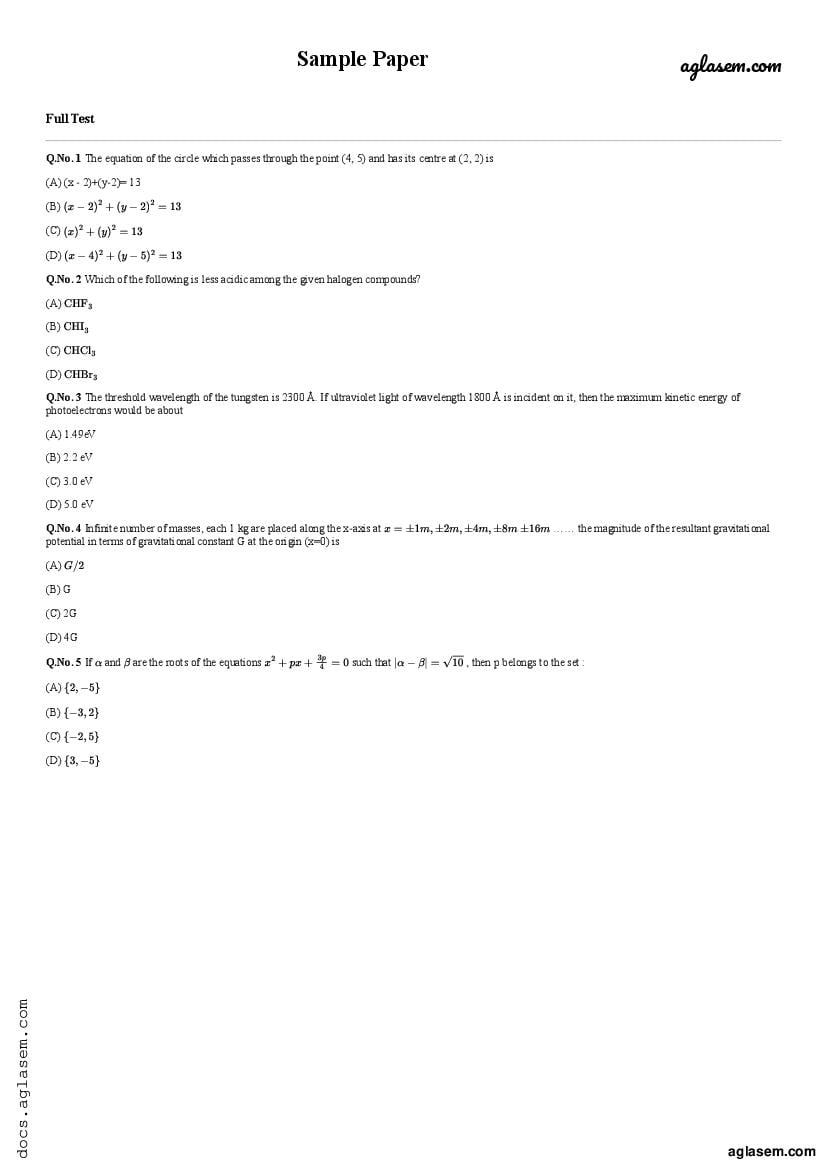
Full Test
Q.No. 1 The equation of the circle which passes through the point (4, 5) and has its centre at (2, 2) is
(A) (x - 2)+(y-2)= 13
(B) (x − 2) + (y − 2)2 2
= 13
(C) (x) + (y)
2 2
= 13
(D) (x − 4) + (y − 5)2 2
= 13
Q.No. 2 Which of the following is less acidic among the given halogen compounds?
(A) CHF 3
(B) CHI 3
(C) CHCl 3
(D) CHBr 3
Q.No. 3 The threshold wavelength of the tungsten is 2300 Å. If ultraviolet light of wavelength 1800 Å is incident on it, then the maximum kinetic energy of
photoelectrons would be about
(A) 1.49eV
(B) 2.2 eV
(C) 3.0 eV
(D) 5.0 eV
Q.No. 4 Infinite number of masses, each 1 kg are placed along the x-axis at x = ±1m, ±2m, ±4m, ±8m ±16m …… the magnitude of the resultant gravitational
potential in terms of gravitational constant G at the origin (x=0) is
(A) G/2
(B) G
(C) 2G
(D) 4G
Q.No. 5 If α and β are the roots of the equations x + px + such that |α − β| = √10 , then p belongs to the set :
2 3p
= 0
4
(A) {2, −5}
(B) {−3, 2}
(C) {−2, 5}
(D) {3, −5}
Page 2
(A) 110 m/s
(B) 55 m/s
(C) 650 m/s
(D) 550 m/s
Q.No. 7 If A x B means A is to the south of B; A + B means A is to the north of B; A % B means A is to the east of B; A - B means A is to the west of B; then in P %
Q + R - S, S is in which direction with respect to Q?
(A) South-West
(B) South-East
(C) North-East
(D) North-West
Q.No. 8 Following are colours shown by some alkaline earth metals in flame test. Which of the following are not correctly matched ? Metal Colour (i) Calcium - (i)
Apple green (ii) Strontium - (ii) Crimson (iii) Barium - (ii) Brick Red
(A) (i) and (iii)
(B) (i) only
(C) (ii) and (iv)
(D) (ii) and (iii)
Q.No. 9 Figure shows a capillary rise H. If the air is blown through the horizontal tube in the direction as shown then rise in capillary tube will be
(A) =H
(B) > H
(C) < H
(D) zero
Page 3
x
x −5x+9
must lie between
(A) 1/11 and 1
(B) 1 and 1/11
(C) -11 and 1
(D) -1/11 and 1
Q.No. 11 A uniform rod AB of length l, and mass m is free to rotate about point A. The rod is released from rest in the horizontal position. Given that the moment of
2
inertia of the rod about A is mℓ
3
, the initial angular acceleration of the rod will be
(A)
gℓ
2
(B) 3
2
gℓ
(C)
3g
2ℓ
(D)
2g
3ℓ
Q.No. 12 An e has magnetic quantum number as –3, what is its principal quantum number?
−
(A) 1
(B) 2
(C) 3
(D) 4
Q.No. 13 If cos −1
x − cos
−1 y
2
= α then 4x − 4xy cos α + y is equal to
2 2
(A) 2 sin 2α
(B) 4
(C) 4 sin α 2
(D) −4 sin α 2
Q.No. 14 If the constraints in a linear programming problem are changed then
(A) The problem is to be re-evaluated.
(B) Solution is not defined.
(C) The objective function has to be modified.
(D) The change in constraints is ignored.
Q.No. 15 A hydrogen atom is in ground state. Then to get six lines in emission spectrum, wavelength of incident radiation should be
(A) 800 Å
(B) 825 Å
(C) 975 Å
(D) 1025 Å
Q.No. 16 The valency shell of element A contains 3 electrons while the valency shell of element B contains 6 electrons. If A combines with B, the probable formula
of the compound formed will be
Page 4
(B) A B 2
(C) A B 2 3
(D) A B 3 2
Q.No. 17 Let a, b and c be three vectors satisfying the All conditions , then equals a × b = (a × c), |a| = |c| = 1, |b| = 4 and |b × c| = √5. If b − 2c = λa
(A) 1
(B) -1
(C) 2
(D) -4
dy
Q.No. 18 An integrating factor of the differential equation sin x dx
+ 2y cos x = 1 is
(A) sin x 2
(B) 2
sin x
(C) log | sin x|
(D) sin
1
2
x
Q.No. 19 The projection of line joining (3, 4, 5) and (4,6,3) on the line joining (-1,2,4) and (1,0,5) is
(A) 4
3
(B) 2
3
(C) 8
3
(D) 1/3
Q.No. 20 Which of the following cube in the answer figure cannot be made based on the unfolded cube in the question figure?
(A)
Page 5
(C)
(D)
Q.No. 21 Which of the following ions can be separated by aq. NH OH in presence of NH Cl
4 +
(A) Al 3+
and Fe
3+
(B) Cr 3⋅
and Al
3
(C) Cu 2+
and Al
3+
(D) None of these
Q.No. 22 Chloroform, CHCl, boils at 61.7 °C. If the K for chloroform is 3.63°C/molal, what is the boiling point of a solution of 15 kg of CHCl and 0.616 kg of
b 3
acenaphthalene C H ? 12 10
(A) 61.9
(B) 62.0
(C) 52.2
(D) 62.67
Q.No. 23 Consider elastic collision of a particle of mass m moving with a velocity u with another particle of the same mass at rest. After the collision the projectile
and the struck particle move in directions making angles , and , respectively with the initial direction of motion. The sum of the angles θ + θ , is:
1 2
(A) 45°
(B) 90°
(C) 135°
(D) 180°
Page 6
(A) 2
3
μF
(B) 4
3
μF
(C) Infinite
(D) (1 + √3)μF
Q.No. 25 Select the pair wherein the words have closest relationship to the original pair. DRIVER : DRIVING ::
(A) Carpenter : Wood
(B) Counsellor : Counselling
(C) Garden : Plants
(D) Psychologist : Teaching
Q.No. 26 In a set of reactions, ethylbenzene yielded a product D .
(A)
Page 7
(C)
(D)
Marks No. of Marks No. of
10 − 20 2 60 − 70 12
20 − 30 3 70 − 80 14
Q.No. 27 The marks obtained by 60 students in a certain test are given below : Median of the above data is
30 − 40 4 80 − 90 10
40 − 50 5 90 − 100 4
50 − 60 6
(A) 68.33
(B) 70
(C) 68.11
(D) None of these
Q.No. 28 A test charge qₒ is placed at the centre of a spherical conductor of radius R. A charge Q is placed on the spherical conductor. What will be the electrostatic
force on the charge Q due to qₒ?
(A) zero
(B) 1
4πε 0
⋅
Qq 0
R
2
(C) 1
4πε 0
⋅
Qq 0
2R
2
(D) 1
4πε 0
⋅
Qq 0
4R
2
Page 8
(A) on
(B) underneath
(C) toward
(D) off
Q.No. 30 If the series limit wavelength of Lyman series for the hydrogen atom is 912 Å, then the series limit wavelength for Balmer series of hydrogen atoms
(A) 912 Å
(B) 912 * 2 Å
(C) 912 * 4 Å
(D) 912 Å / 2
Q.No. 31 A particle moving along x-axis has acceleration f, at time t, given by f = f (1 − 0
t
T
) , where f , and T are constants. The particle at t = 0 has zero velocity.
0
In the time interval between t = 0 and the instant when f = 0, the particle's velocity (v ) is x
(A) 1
2
f0 T
2
(B) f T
0
2
(C) 1
2
f0 T
(D) f T 0
Q.No. 32 In a Δ ABC if cos A
a
=
cos B
b
=
cos C
c
and the a b c side a = 2, then area of the triangle is
(A) 1
(B) 2
(C) √3/2
(D) √3
Q.No. 33 If A, B, C are the angles of a triangle and e iA
,e
iB
,e
ic
are in A.P. Then the triangle must be
(A) right angled
(B) isosceles
(C) equilateral
(D) None of these
Q.No. 34 A point object O is placed in front of a glass rod having spherical end of radius of curvature 30 cm. The image would be formed at
(A) 30 cm left
(B) infinity
(C) 1 cm to the right
(D) 18 cm to the left
Q.No. 35 A body of mass M hits normally a rigid wall with velocity V and bounces back with the same velocity. The impulse experienced by the body is
(A) MV
(B) 1.5 MV
(C) 2 MV
(D) zero
Q.No. 36 A compound of molecular formula of C H 7 16 shows optical isomerism, compound will be
Page 9
(B) 2,2-Dimethylbutane
(C) 3-Methylhexane
(D) None of the above
Q.No. 37 An electron of mass m and charge e initially at rest get accelerated by a constant electric field E. The rate of change of de-Broglie wavelength of this
electron at time t ignoring relativistic effects is
(A) −h
eEt
2
(B) −cht
E
(C) −mh
eEt
2
(D) −h
eE
Q.No. 38 The value of c in (0, 2) satisfying the mean value theorem for the function f (x) = x(x − 1) , x ∈ [0, 2] is equal to
2
(A) 4/3
(B) 7/8
(C) 1/4
(D) -7/8
Q.No. 39 3.92 g of ferrous ammonium sulphate react completely with 50ml N
10
KMnO 4 solution. The percentage purity of the sample is
(A) 50
(B) 78.4
(C) 80
(D) 39.2
Q.No. 40 If a body cools down from 80°C to 60°C in 10 min when the temperature of the surrounding is 30°C, then the temperature of the body after next 10 min
will be
(A) 50°C
(B) 48°C
(C) 30°C
(D) None of these
Q.No. 41 The approximate depth of an ocean is 2700 m. The compressibility of water is 4 x 10-11 Pa-l and density of water is 103 kg/m2.What fractional
compression of water will be obtained at the bottom of the ocean ?
(A) 1.0 x 10²
(B) 1.2 x 10²
(C) 1.4 x 10 -2
(D) 0.8 x 10⁻²
Q.No. 42 Read the following passage carefully and answer the questions given below it. The likelihood of at least 600,000 deaths being caused annually in India by
fine particulate matter pollution in the air is cause for worry, even if the data released by the World Health Organisation are only a modelled estimate. The conclusion
that so many deaths could be attributed to particulate matter 2.5 micrometres a or less in size is, of course, caveated, sincero comprehensive measurement of PM2.5
is not yet being n done and the linkages between pollution, disease and in deaths need further study. What is not in doubt is that 1 residents in many urban areas are
forced to breathe unhealthy levels of particulates, and the smallest of these - PM10 and less - can penetrate and get lodged deep in the lungs. The WHO Global
Burden of Disease study has been working to estimate pollution-linked health impacts, such as stroke and ischaemic heart disease, acute lower respiratory infection
and chronic obstructive pulmonary disease. Data on fine particulates in India show that in several locations the pollutants come from burning of biomass, such as
coal, fuel wood, farm litter and cow dung cakes. In highly built-up areas, construction debris, road dust and vehicular exhaust add to the problem. The Prime
Minister launched an Air Quality Index last year aimed at improving pollution control. The new data, which the WHO says provide the best evidence available on
the terrible toll taken by particulates, should lead to intensified action. A neglected aspect of urban air pollution control is the virtual discarding of the Construction
and Demolition 3 Waste Management Rules, notified to sustainably manage debris that is dumped in the cities, creating ·severe particulate pollution. The
Environment Ministry has highlighted the role that debris can play as a resource. Municipal and government contracts are, under the rules, required to utilise up to
20 per cent materials made from construction and demolition waste, and local authorities must place containers to hold debris. This is is dumped in the cities
,creating severe particulate pollution. must be implemented without delay. Providing cleaner fuels and scientifically designed cookstoves to those who have no
option but to burn biomass, would have a big impact on reducing particulate matter in the northern and eastern States, which are the worst-hit during winter, when
biomass is also used for heating. Greening the cities could be made a mission, involving civil society, with a focus on landscaping open spaces and paving all public
areas to reduce dust. These measures can result in lower PM10 and PM2.5 levels. measurement of these particulates is currently absent in many cities, a lacuna that
needs to be addressed. Which of the following is/are not true in the context of the passage?
(A) Eastern and Southern states are worst hit in winter by burning of biomass.
(B) The smallest particulate matter PM2.5 penetrates and gets lodged in lungs.
(C) Data on fine particulates in India show that in several locations the pollutants come from the smoke emitted by vehicles.
(D) None is true
Page 10
(A) unity
(B) zero
(C) infinity
(D) some finite non-zero constant
n
Q.No. 44 If p(n) = then P(n) is true for
4 (2n)!
< 2
n+1 (n!)
(A) n ≥ 1
(B) n > 0
(C) n < 0
(D) n ≥ 2
Q.No. 45 The beam of light has three wavelengths 4144 Å, 4972 Å and 6216 Å with a total intensity of 3.6 x 10 Wm equally distributed amongst the three
−3 2
wavelengths. The beam falls normally on the area 1 cm of a clean metallic surface of work function 2.3 eV. Assume that there is no loss of light by reflection and
2
that each energetically capable photon ejects one electron. Calculate the number of photoelectrons liberated in 2s.
(A) 2 × 10 9
(B) 1.075 × 10 12
(C) 9 × 10 8
(D) 3.75 × 10 6
Q.No. 46 If x satisfies |3x − 2| + |3x − 4| + |3x − 6| ≥ 12 then
(A) 0 ≤ x ≥ 8
3
(B) x ≥ 8
3
or
−4
3
(C) x ≤ 0 or x ≥ 8
3
(D) x ≥ 2 only
Q.No. 47 There are two sources kept at distances 2λ. A large screen is perpendicular to line joining the sources. Number of maximas on the screen in this case is (
\lambda \)= wavelength of light)
(A) 1
(B) 3
(C) 5
(D) 7
Q.No. 48 The points represented by the complex numbers 1 + i, −2 + 3i, 5
3
i on the argand plane are
(A) vertices of an equilateral triangle
(B) vertices of an isosceles triangle
(C) collinear
(D) None of these
Q.No. 49 The ratio in which the join of (2, 1, 5) and (3,4,3) is divided by the plane(x+y+z) = 1/2 is:
(A) 3:5
(B) 5:7
(C) 1:3
Page 11
(B)
(C)
(D)
⎢⎥
(D) 4:5
Q.No. 50 If A =
⎡
⎣
⎡
⎣
⎡
⎣
⎡
⎣
0
3
6
0
3
5
0
3
5
−3
−5
0
2
7
5
2
7
6
1
7
6
⎤
⎦
⎤
⎦
⎤
⎦
−2
−7
−6
⎤
⎦
⎡
⎣
1
3
2
3
2
5
⎤
⎦
and B =
⎡
⎣
−1
0
3
−2
⎤
5
1
⎦
and A+B-D=0 (zero matrix) ,then D matrix will be
Q.No. 51 When an aqueous solution of copper (II) sulphate is saturated with ammonia, the blue compound crystallises on evaporation. The formula of this blue
compound is:
(A) [Cu(NH ) ]SO ⋅ H O (square planar)
(A) 6 J
(B) 18 J
(C) 24 J
(D) 36 J
[Ag⁺]?
(A) 2.32 × 10
(B) 2.32 × 10
(C) 2.32 × 10
(D) 1.16 × 10
(A) MNNNO
(B) MONNO
(C) MONON
(D) MONNN
3
3
3
Q.No. 56 If x>0 ,then 1 +
(A) x
(B) x
(C) 2x
(D) √x
2
4
(B) [Cu(NH ) ]SO (Tetrahedral)
4
(C) [Cu(NH ) SO (Octahedral)
6
(D) [Cu (SO )(NH ) ] (Octahedral)
4
−1
−4
−3
−4
4
4
4
3 5
2
Q.No. 52 A body of mass 1 kg is executing S.H.M. Its displacement y (cm) at t seconds is given by y = 6 sin (100t +
Q.No. 55 Choose the correct alternatives from the given ones that will complete the series. L_NO_ _MLLM_00_ML
log
1!
Q.No. 57 The oxidation state of sulphur in Na2S4O6 is
e
2 x
+
(log
2!
e2
x)
2
+ … =
π
4
) Its maximum kinetic energy is
Q.No. 53 Coefficient of variation of two distributions are 50 and 60, their arithmetic means are 30 and 25, respectively. Difference of their standard deviations is
(A) 0
(B) 1
(C) 1.3
(D) 2.5
Q.No. 54 A 100.0 mL dilute solution of Ag⁺ is electrolysed for 15.0 minutes with a current of 1.25 mA and the silver is removed completely. What was the initial
Page 12
(B) +3/2
(C) +5/2
(D) -2
Q.No. 58 Identify the structure of water in the gaseous phase.
(A) H − O
¨
− H
(B)
(C)
(D) None of these
Q.No. 59 If the edge lengths of a cuboid are measured to be 1.2 cm, 1.5 cm and 1.8 cm, then the volume of the cuboid is
(A) 3.240 cm 3
(B) 3.24 cm 3
(C) 3.2 cm 3
(D) 3.0 cm 3
Q.No. 60 Consider the reactions (A) H O + 2HI → I + 2H O (B) HOCl + H O
2 2 2 2 2 2 → H3 O
+
+ Cl
−
+ O2 Which of the following statements is correct about
H O with reference to these reactions? Hydrogen peroxide is ?.
2 2
(A) an oxidising agent in both (A) and (B)
(B) an oxidising agent in (A) and reducing agent in (B)
(C) a reducing agent in (A) and oxidising agent in (B)
(D) a reducing agent in both (A) and (B)
Q.No. 61 Equal weights of NaCl and KCl are dissolved separately in equal volumes of solutions Molarity of the two solutions will be
(A) Equal
(B) That of NaCl will be less than that of KCI
(C) That of NaCl will be more than that of KCI
(D) That of NaCl will be about half of that of KCl solution
Q.No. 62 The number of double bonds in gammexane is :
(A) 0
(B) 1
(C) 2
(D) 3
1 2
Q.No. 63 The matrix A + 4A − 5I , where I is identity matrix and A = [
2
] equals
4 −3
2 1
(A) 4 [ ]
2 0
Page 13
(B) 4 [ ]
2 2
2 1
(C) 32 [ ]
2 0
1 1
(D) 32 [ ]
1 0
Q.No. 64 A plano convex lens fits exactly into a plano concave lens. Their plane surface are parallel to each other. If the lenses are made of different materials of
refractive indices μ &μ and R is the radius of curvature of the curved surface of the lenses, then focal length of combination is
1 2
(A) R
μ 1 −μ 2
(B) 2R
μ 1 −μ 2
(C) R
2(μ 1 −μ 2 )
(D) R
2−(μ 1 +μ 2 )
Q.No. 65 A cube is subjected to a uniform volume compression. If the side of the cube decreases by 2% the bulk strain is
(A) 0.02
(B) 0.03
(C) 0.04
(D) 0.06
Q.No. 66 A biconvex lens has a radius of curvature of magnitude 20 cm. Which one of the following options best describe the image formed of an object of height 2
cm placed 30 cm from the lens?
(A) Virtual, upright, height=1 cm
(B) Virtual, upright, height=0.5 cm
(C) Real, inverted, height=4 cm
(D) Real, inverted, height = 1cm
Q.No. 67 Let the straight line x = b divide the area enclosed by y = (1 − x) , y = 0 and x=0 into two parts R (0 ≤ x ≤ b) and R (b ≤ x ≤ 1) such that R1 -
2
1 2
R2=1/4. Then b equals
(A) 3/4
(B) 1/2
(C) 1/3
(D) 1/4
Q.No. 68 If sin and f (1) = 2 f (p + q) = f (p) ⋅ f (q), ∀p, q ∈ R , then x is equal to
−1 −1 −1 3π f (1) f (2) f (3) (x+y+z)
x + sin y + sin z = + y + z − f (1) f (2) f (3)
2 x +y +z
(A) 0
(B) 1
(C) 2
(D) 3
Q.No. 69 A hoop rolls down an inclined plane. The fraction of its total kinetic energy that is associated rotational motion is
(A) 1:2
(B) 1:3
(C) 1:4
(D) 2:3
Q.No. 70 During vapourisation
(A) change of state from liquid to vapour state occurs.
(B) temperature remains constant.
(C) both liquid and vapour states coexist in equilibrium.
(D) All of the above
Q.No. 71 Let the orthocentre and centroid of a triangle be A(-3, 5) and B(3, 3) respectively. If C is the circumcentre of this triangle, then the radius of the circle
having line segment AC as diameter, is:
(A) 2√10
Page 14
2
(C) 3√ 5
2
(D) √10
Q.No. 72 pH of a 0.1 M monobasic acid is found to be 2. Hence, its osmotic pressure at a given temperature TK is
(A) 0.1 RT
(B) 0.11 RT
(C) 1.1 RT
(D) 0.01 RT
Q.No. 73
Here [Y] is a
(A) single compound
(B) mixture of two compounds
(C) mixture of three compounds
(D) no reaction is possible Following compounds are given:
Q.No. 74 If :p Raju is tall and q: Raju is intelligent, then the symbolic statement −p ∨ q means
(A) Raju is not tall or he is intelligent.
(B) Raju is tall or he is intelligent
(C) Raju is not tall and he is intelligent .
(D) Raju is not tall implies he is intelligent
Q.No. 75 Which of the following relation represents correct relation between standard electrode potential and equilibrium constant? I. log K = II.
∘
nF E
2.303RT
∘ ∘
III. log K = IV. log K = 0.4342 Choose the correct statement(s).
nFE ∘
−nF E nFE
K = e RT
2.303RT RT
(A) I, II and III are correct
(B) II and III are correct
(C) I, II and IV are correct
(D) I and IV are correct
Q.No. 76 An observer on the top of a tree, finds the angle of depression of a car moving towards the tree to be 30°. After 3 minutes this angle becomes 60°. After
how much more time, the car will reach the tree?
(A) 4min
(B) 4.5 min
(C) 1.5 min
(D) 2 min
Q.No. 77 If a stone of mass 0.05 kg is thrown out a window of a train moving at a constant speed of 100 km/h then magnitude of the net force acting on the stone is
(A) 0.5 N
(B) zero
(C) 50 N
(D) 5 N
Q.No. 78 A capillary tube of radius R is immersed in water and water rises in it to a height H. Mass of water in the capillary tube is M. If the radius of the tube is
doubled, mass of water that will rise in the capillary tube will now be:
Page 15
(B) 2M
(C) M/2
(D) 4M
2
Q.No. 79 The locus of the point of intersection of the lines at x = a ( 1−t
1+t
2 ) and y = 2at
1+t
2
represent (t being a parameter)
(A) circle
(B) parabola
(C) ellipse
(D) hyperbola
Q.No. 80 In the following P-V diagram of an ideal gas, two adiabates cut two-isotherms at T 1
= 300K and T 2 = 200K. The value of V A
= 2 unit, V B =
8 unit, V C = 16 . Find the value of VD
(A) 4 unit
(B) < 4 unit
(C) > 5 unit
(D) 5 unit
Q.No. 81 If a, b, c are in GP., then
(A) a , b , c are in GP.
2 2 2
(B) a (b + c), c (a + b), b (a + c) are in GP.
2 2 2
(C) a
b+c
,
c+a
b
,
c
a+b
are in GP.
(D) None of these
Q.No. 82 What is the minimum energy required to launch a satellite of mass m from the surface of a planet of mass M and radius R in a circular orbit at an altitude
of 2R?
(A) 5GmM
6R
(B) 2GmM
3R
(C) GmM
2R
(D) GmM
3R
p q − y r − z
Q.No. 83 If p − x q r − z = 0 then the value of p
x
+
q
y
+
r
z
is
p − x q − y r
(A) 0
(B) 1
(C) 2
(D) 4pqr
Page 16
image planes is 1.8 m. The magnification of the image formed by one of the half-lenses is 2. If f and d be the focal length of the lens and separation between the two
halves respectively then,
(A) f=0.4 m
(B) f=0.6 m
(C) d=0.5 m
(D) d=0.9 m
Q.No. 85 The hybridisation of Fe in K Fe(CN) , is 3 6
(A) sp 3
(B) dsp 3
(C) sp d 3 2
(D) d sp
2 3
Q.No. 86 Which of the following electromagnetic radiations has the smallest wavelength?
(A) Ultraviolet rays
(B) X-rays
(C) ү-rays
(D) Microwaves
Q.No. 87 When 92 undergoes fission, 0.1% of its original mass is changed into energy. How much energy is released if 1 kg of 92 undergoes fission?
235 235
U U
(A) 9 × 10 10
J
(B) 9 × 10 11
J
(C) 9 × 10 12
J
(D) 9 × 10 13
J
Q.No. 88 A common emitter amplifier has a voltage gain of 50, an input impedance of 100 Ω and an output impedance of 200 Ω. The power gain of the amplifier is
(A) 500
(B) 1000
(C) 1250
(D) 50
Q.No. 89 Two oscillators are started simultaneously in same phase. After 50 oscillations of one, they get out of phase by ⊼, that is half oscillation. The percentage
difference of frequencies of the two oscillators is nearest to
(A) 2%
(B) 1%
(C) 0.5%
Page 17
(A) Paramagnetic and Bond order < O
(B) Paramagnetic and Bond order> O ,
(C) Diamagnetic and Bond order < 0
(D) Diamagnetic and Bond order > O
(A) x = −4.9t + 19.6(0 ≤ t ≤ 1)
(A) 3V/m
(B) 6V/m
(C) 9V/m
(D) 12V/m
Q.No. 95 If matrix A =
(A) 7
(B) -7
(C) 15
(D) -11
2
(B) x = −4.9t + 19.6(0 ≤ t ≤ 2)
2
(C) x = −9.8t + 19.6(0 ≤ t ≤ 2)
2
(D) x = −4.9t − 19.6(0 ≤ t ≤ 2)
2
Q.No. 93 In hydrogen atom spectrum λ
respectively. The value of
(A) 27/32
(B) 32/27
(C) 4/9
(D) 9/4
(A) x+y-1=0
(B) x-y-1=0
(C) x+y+1=0
(D) x-y+1=0
is
⎢⎥
Q.No. 90 According to molecular orbital theory which of the following statement about the magnetic character and bond order is correct regarding O
⎡
⎣
λ 3−1
λ 2−1
1
0
2
1
2
4
−1
1
2
2
2
Q.No. 91 A ball is dropped from a platform 19.6m high. Its position function is –
Q.No. 92 The magnetic field in a travelling electromagnetic wave has a peak value of 20 nT. The peak value of electric field strength is
⎤
⎦
3−1
and A
and λ 2−1
Q.No. 94 If the amplitude of z–2=3i is π/4, then the locus of z = x + iy is
3 −2
−1
=
Q.No. 96 Which of the following can act as both Bronsted acid and Bronsted base?
(A) Na CO
(B) OH
(C) HCO
(D) NH
2
3
−
3
3
Q.No. 97 Which one the following removes temporary hardness of water?
(A) Slaked lime
(B) Plaster of Paris
(C) Epsom
(D) Hydrolith
Q.No. 98 The energy of an electron in second Bohr orbit of hydrogen atom is :
(A) −5.44 × 10
(B) −5.44 × 10
−19
−19
eV
cal
1
k
adj(A) then k is
+
2
represent the wavelengths emitted due to transition from second and first excited states to the ground state
Page 18
kJ
(D) −5.44 × 10 −19
J
Q.No. 99 A particle of mass m moving in the x direction with speed 2v is hit by another particle of mass 2m moving in the y direction with speed v. If the collision is
perfectly inelastic, the percentage loss in the energy during the collision is close to
(A) 56%
(B) 62%
(C) 44%
(D) 50%
Q.No. 100 If f (x) = x then f (x) is increasing in interval :
x
(A) [0, e]
(B) [0, 1
e
]
(C) [0, 1]
(D) None of these
Cu/ZnO−C 2 O 3
Q.No. 101 Which of the following feature of catalysts is described in reactions given below? (i) CO(g) + 2H (g) 2
⟶
CH 3 OH(g) (ii)
Cu Ni
CO(g) + H 2 (g) ⟶ HCHO(g) (iii) CO(g) + 3H (g) ⟶ CH (g) + H O(g)
2 4 2
(A) Activity
(B) Selectivity
(C) Catalytic promoter
(D) Catalytic poison
Q.No. 102 The acceleration due to gravity on the surface of the moon is 1/6 that on the surface of earth and the diameter of the moon is one-fourth that of earth. The
ratio of escape velocities on earth and moon will be
(A) √6
2
(B) √24
(C) 3
(D) √3
2
Q.No. 103 Pick out the wrong statement.
(A) Nitrogen has the ability to form pt-pt bonds with itself
(B) Bismuth forms metallic bonds in elemental
(C) Catenation tendency is higher in nitrogen when compared with other elements of the same group.
(D) Nitrogen has higher first ionisation enthalpy when compared with other elements of the same group.
Q.No. 104 In how many ways can 12 gentlemen sit around a round table so that three specified gentlemen are always together ?
(A) 9 !
(B) 10 !
(C) 3! 10!
(D) 3! 9!
Q.No. 105 The normality of 26% (wt/vol) solution of ammonia (density=0.855 ) is approximately:
(A) 1.5
(B) 0.4
(C) 15.3
(D) 4
Q.No. 106 An aromatic compound has molecular formula C H Br .Give the possible isomers and the appropriate method to distinguish them.
7 7
(A) 3 isomers; by heating with AgNO solution
3
(B) 4 isomers; by treating with AgNO solution
3
(C) 4 isomers; by oxidation
(D) 5 isomers, by oxidation
Q.No. 107 For the reaction CO(g) + 1
2
O 2 (g) → CO 2 (g) Which one of the statement is correct at constant T and P?.
Page 19
(B) ΔH < ΔE
(C) ΔH > ΔE
(D) ΔH Is independent of physical state of the reactants.
Q.No. 108 100 ml O and H kept at same temperature and pressure. What is true about their number of molecules ?
2 2
(A) NO 2 > NH 2
(B) NO 2 < NH 2
(C) NO 2 = NH 2
(D) NO + NH
2 2 = 1mole
3π
1, when 0 < x ≤
Q.No. 109 If f (x) = { 2 3π
4
2 sin x, when < x < π
9 4
(A) f(x) is continuous at x = 0
(B) f(x) is continuous at x = π
(C) f(x) is continuous at x = 3π
4
(D) f(x) is discontinuous at x = 3π
4
Q.No. 110 The most reactive amine towards reactions with dil. HCl is
(A) CH − NH
3 2
(B)
(C) (CH ) N
3 3
(D)
Q.No. 111 Select the related letter/word/ number from the given alternatives. Distance: Odometer :: ?: Barometer
(A) Humidity
(B) Pressure
(C) Thickness
(D) Wind
Q.No. 112 An elastic string of unstretched length L and force constant k is stretched by a small length x. It is further stretched by another small length y. The work
done in the second stretching is
(A) 1/2Ky 2
Page 20
(C) 1/2K (x + y )
2 2
(D) 1/2k(x + y) 2
Q.No. 113 Two simple pendulums of length 0.5 m and 20 m respectively are given small linear displacement in one direction at the same time. They will again be in
the phase when the pendulum of shorter length has completed oscillations [nT = (n − 1)T , where T₁ is time period of shorter length & T₂ be time period of longer
1 2
wavelength and n are no. of oscillations completed]
(A) 5
(B) 1
(C) 2
(D) 3
Q.No. 114 The blue colour of snail is due to presence of
(A) albumin
(B) haemocyanin
(C) globulins
(D) fibrinogen
Q.No. 115 The IUPAC name of the compound is
(A) 3,3-dimethyl - 1- cyclohexanol
(B) 1, 1-dimethyl-3-hydroxy cyclohexane
(C) 3,3-dimethyl-1-hydroxy cyclohexane
(D) 1, 1-dimethyl-3-cyclohexanol
Q.No. 116 Thirty percent of the bases in a sample of DNA extracted from eukaryotic cells is adenine. What percentage of cytosine is present in this DNA?
(A) 10%
(B) 20%
(C) 30%
(D) 40%
Q.No. 117 Let T(k) be the statement 1 + 3 + 5 + ... + (2k − 1) = k + 10 .Which of the following is correct?
2
(A) T(1) is true
(B) T(k) is true => T(k+ I) is true
(C) T(n) is true for all n ∈ N
(D) All above are correct
Q.No. 118 If ρ = {(x, y)|x + y
2 2
= 1; x, y ∈ R} then ρ is
(A) reflexive
(B) symmetric
(C) transitive
(D) anti-symmetric
Q.No. 119 In a binomial distribution, the mean is 4 and variance is 3. Then its mode is
(A) 5
(B) 6
(C) 4
(D) None of these
Page 21
Q.No. 120 Let y = e 2x
.Then ( d y
dx
2 )(
d x
dy
2 ) is
(A) 1
(B) e −2x
(C) 2e 2x
(D) −2e −2x
Q.No. 121 Let A, B, and C are the angles of a plain triangle and tan(A/2)=1/3,tan(B/2) =2/3. Then tan(C/2) is equal to
(A) 7/9
(B) 2/9
(C) 1/3
(D) 2/3
Q.No. 122 When 0.50 Å X-rays strike a material, the photoelectrons from the k shell are observed to move in a circle of radius 23 mm in a magnetic field of
2 × 10 tesla acting perpendicularly to the direction of emission of photoelectrons. What is the binding energy of k-shell electrons?
−2
(A) 3.5 keV
(B) 6.2 keV
(C) 2.9 keV
(D) 5.5 keV
2x + 1 < x + 2
Q.No. 123 Number of solution for the system of inequalities {
x − 1 > 2x
(A) 1
(B) 2
(C) 3
(D) 0
Q.No. 124 A copper rod of length l rotates about its end with angular velocity ω in uniform magnetic field B. The emf developed between the ends of the rod if the
field is normal to the plane of rotation is
(A) Bωℓ 2
(B) 1
2
Bωℓ
2
(C) 2Bωℓ 2
(D) 1
4
Bωℓ
2
Q.No. 125 The value of the integral ∫ b
a
√xdx
is
√ x+√ a+b−x
(A) π
(B) 1
2
(b − a)
(C) π/2
(D) b − a
Q.No. 126 Which of the following can possibly be used as analgesic without causing addiction and modification?
(A) morphine
(B) N-acetyl-para-aminophenol
(C) diazepam
(D) tetrahydrocatenol
Q.No. 127 The non stoichiometric compound Fe 0.94 O is formed when x% of Fe 2+
ions are replaced by as many 2
3
Fe
3+
ions, x is
(A) 18
(B) 12
(C) 15
(D) 6
Q.No. 128 Which among the following is not an antibiotic?
(A) Penicillin
(B) Oxytocin
Page 22
(D) Tetracycline
Q.No. 129 Negation of “Paris in France and London is in England" is
(A) Paris is in England and London is in France
(B) Paris is not in France or London is not in England
(C) Paris is in England or London is in France
(D) None of these
Q.No. 130 Which of the following arrangements does not represent the correct order of the property stated against it ?
(A) V 2+
< Cr
2+
< Mn
2+
< Fe
2+
paramagnetic behaviour
(B) Ni 2+
< Co
2+
< Fe
2+
< Mn
2+
ionic size
(C) Co 3+
< Fe
3+
< Cr
3+
< Sc
3+
stability in aqueous solution
(D) Sc < Ti < Cr < Mn number of oxidation states
Q.No. 131 Choose the correct alternatives from the given ones that will complete the series. 22,26,53, 69, 194, ?
(A) 230
(B) 260
(C) 250
(D) 245
Q.No. 132 The number of ways in which first, second and third prizes can be given to 5 competitors is ?
(A) 10
(B) 60
(C) 15
(D) 125
Q.No. 133 lim x→0
√
x−sin x
x+sin
2
x
is equal to
(A) 1
(B) 0
(C) ∞
(D) None of these
Q.No. 134 If elements with principal quantum number n>4 were not allowed in nature, the number of possible elements would be
(A) 60
(B) 32
(C) 4
(D) 64
Q.No. 135 A bag contains 5 brown and 4 white socks. A man pulls out 2 socks. Find the probability that they are of the same colour.
(A) 4/9
(B) 2/9
(C) 5/9
(D) 7/9
Q.No. 136 The value of lim n→∞
1+2+3+…n
2
n +100
is equal to
(A) ∞
(B) 1/2
(C) 2
(D) 0
Page 23
suspended from the mid-point of the wire. Strain in the wire is
2
(A) x
2L
2
(B) x
L
(C)
2
x
L
2
(D) x
2L
Q.No. 138 A 10V battery with internal resistance 1Ω and a 15V battery with internal resistance 0.6Ω are connected in parallel to a voltmeter (see figure). The
reading in the voltmeter will be close to :
(A) 12.5 V
(B) 24.5V
(C) 13.1 V
(D) 11.9 V
Q.No. 139 In an electron gun, the potential difference between the filament and plate is 3000 V. What will be the velocity of electron emitting from the gun?
(A) 3 × 10 m/s 8
(B) 3.18 × 10 m/s 7
(C) 3.52 × 10 m/s 7
(D) 3.26 × 10 m/s 7
Q.No. 140 Which of the following metal is leached by cyanide proces
(A) Ag
(B) Na
(C) Al
(D) Cu
n
Q.No. 141 If ∑ then a-n is equal to
n r Cr 3
(−1) =
r=0 r+3C r a+3
Page 24
(B) 1
(C) 2
(D) None of these
Q.No. 142 In the circuit given below, V(t) is the sinusoidal voltage source, voltage drop V AB (t) across the resistance R is
(A) is half wave rectified
(B) is full wave rectified
(C) has the same peak value in the positive and negative half cycles
(D) has different peak values during positive and negative half cycle
Q.No. 143 The set (A∖B) ∪ (B∖A) is equal to
(A) [A∖(A ∩ B)] ∩ [B∖(A ∩ B)]
(B) (A ∪ B)∖(A ∩ B)
(C) A∖(A ∩ B)
–
A ∩ B∖A ∪ B (D)
Q.No. 144 Two spheres of different materials one with double the radius and one-fourth wall thickness of the other are filled with ice. If the time taken for complete
melting of ice in the larger sphere is 25 minute and for smaller one is 16 minute, the ratio of thermal conductivities of the materials of larger spheres to that of
smaller sphere is
(A) 4:5
(B) 5:4
(C) 25:8
(D) 8:25
Q.No. 145 Let f (x) = ax+b
cx+d
then fof (x) , provided that:
(A) d=-a
(B) d=a
(C) a=b=1
(D) a=b=c=d=1
Q.No. 146 A particle of mass m1 moving with velocity v collides with a mass m2 at rest, then they get embedded. Just after collision, velocity of the system
(A) increases
(B) decreases
(C) remains constant
(D) becomes zero
Q.No. 147 Figure here shows the vertical cross section of a vessel filled with a liquid of density ρ. The normal thrust per unit area on the walls of the vessel at the
point P, as shown, will be
Page 25
(B) Hρg
(C) (H-h) ρg
(D) (H-h) ρg cos
Q.No. 148 A man takes a step forward with probability 0.4 and backward with probability 0.6. The probability that at the end of eleven steps he is one step away
from starting point is
5 5
(A) 2 ⋅3
5
10
5
(B) 462 × ( 6
25
)
5
(C) 231 × 3
5
10
(D) None of these
Q.No. 149 For a given reaction, ΔH = 35.5kJmol −1
and ΔS = 83.6JK −1
mol
−1
. The reaction is spontaneous at : (Assume that and do not vary with temperature)
(A) T>425K
(B) All temperatures.
(C) T>298 K.
(D) T<425K
Q.No. 150 The rate constant of a reaction is 1.5 × 10 −3
at 25°C and 2.1 × 10 −2
at 60°C. The activation energy is:
−2
(A) 35
333
R log e
2.1×10
1.5×10
−2
(B) 298×333
35
R log e
21
1.5
(C) 298×333
35
R log e 2.1
(D) 298×333
35
R log e
2.1
1.5
Answer Sheet
Q.No Answer
Q.No. 1 (B)
Q.No. 2 (A)
Q.No. 3 (A)
Q.No. 4 (D)
Q.No. 5 (C)
Q.No. 6 (B)
Q.No. 7 (B)
Page 26
Q.No. 9 (B)
Q.No. 10 (D)
Q.No. 11 (C)
Q.No. 12 (D)
Q.No. 13 (C)
Q.No. 14 (A)
Q.No. 15 (C)
Q.No. 16 (C)
Q.No. 17 (D)
Q.No. 18 (A)
Q.No. 19 (A)
Q.No. 20 (C)
Q.No. 21 (C)
Q.No. 22 (D)
Q.No. 23 (B)
Q.No. 24 (B)
Q.No. 25 (B)
Q.No. 26 (D)
Q.No. 27 (A)
Q.No. 28 (A)
Q.No. 29 (D)
Q.No. 30 (C)
Q.No. 31 (C)
Q.No. 32 (D)
Q.No. 33 (C)
Q.No. 34 (A)
Q.No. 35 (C)
Q.No. 36 (A)
Q.No. 37 (A)
Q.No. 38 (A)
Q.No. 39 (A)
Q.No. 40 (B)
Q.No. 41 (B)
Q.No. 42 (D)
Q.No. 43 (C)
Q.No. 44 (D)
Q.No. 45 (B)
Q.No. 46 (C)
Q.No. 47 (B)
Q.No. 48 (C)
Q.No. 49 (B)
Q.No. 50 (C)
Q.No. 51 (A)
Q.No. 52 (B)
Q.No. 53 (A)
Q.No. 54 (D)
Q.No. 55 (D)
Q.No. 56 (D)
Q.No. 57 (C)
Q.No. 58 (C)
(A)
Q.No. 59
Q.No. 60 (B)
Q.No. 61 (C)
Q.No. 62 (A)
Q.No. 63 (A)
Q.No. 64 (A)
Q.No. 65 (D)
Page 27
Q.No. 67 (B)
Q.No. 68 (C)
Q.No. 69 (A)
Q.No. 70 (D)
Q.No. 71 (B)
Q.No. 72 (B)
Q.No. 73 (C)
Q.No. 74 (A)
Q.No. 75 (C)
Q.No. 76 (C)
Q.No. 77 (A)
Q.No. 78 (B)
Q.No. 79 (A)
Q.No. 80 (A)
Q.No. 81 (A)
Q.No. 82 (A)
Q.No. 83 (C)
Q.No. 84 (A)
Q.No. 85 (D)
Q.No. 86 (C)
Q.No. 87 (D)
Q.No. 88 (C)
Q.No. 89 (B)
Q.No. 90 (B)
Q.No. 91 (B)
Q.No. 92 (B)
Q.No. 93 (A)
Q.No. 94 (D)
Q.No. 95 (C)
Q.No. 96 (C)
Q.No. 97 (A)
Q.No. 98 (D)
Q.No. 99 (A)
Q.No. 100 (B)
Q.No. 101 (B)
Q.No. 102 (B)
Q.No. 103 (C)
Q.No. 104 (D)
Q.No. 105 (C)
Q.No. 106 (C)
Q.No. 107 (B)
Q.No. 108 (C)
Q.No. 109 (C)
Q.No. 110 (B)
Q.No. 111 (B)
Q.No. 112 (B)
Q.No. 113 (B)
Q.No. 114 (B)
Q.No. 115 (A)
Q.No. 116 (B)
(B)
Q.No. 117
Q.No. 118 (B)
Q.No. 119 (C)
Q.No. 120 (D)
Q.No. 121 (A)
Q.No. 122 (B)
Q.No. 123 (D)
Page 28
Q.No. 125 (B)
Q.No. 126 (B)
Q.No. 127 (A)
Q.No. 128 (B)
Q.No. 129 (B)
Q.No. 130 (A)
Q.No. 131 (A)
Q.No. 132 (B)
Q.No. 133 (B)
Q.No. 134 (A)
Q.No. 135 (A)
Q.No. 136 (B)
Q.No. 137 (A)
Q.No. 138 (C)
Q.No. 139 (D)
Q.No. 140 (A)
Q.No. 141 (A)
Q.No. 142 (D)
Q.No. 143 (B)
Q.No. 144 (D)
Q.No. 145 (A)
Q.No. 146 (B)
Q.No. 147 (C)
Q.No. 148 (B)
Q.No. 149 (A)
Q.No. 150 (B)
Document Details
| Board / Org | BITS Pilani |
| Exam | BITSAT |
| Type | Sample Paper |
| Pages | 28 |
| Updated | 15 Jul 2026 |