JKBOSE Class 12 Model Question Paper for Botany – Text
Read the full text of this sample paper below — useful to quickly search, copy and reference the content online without downloading the PDF.
📄 View text version (2 pages)
Page 1
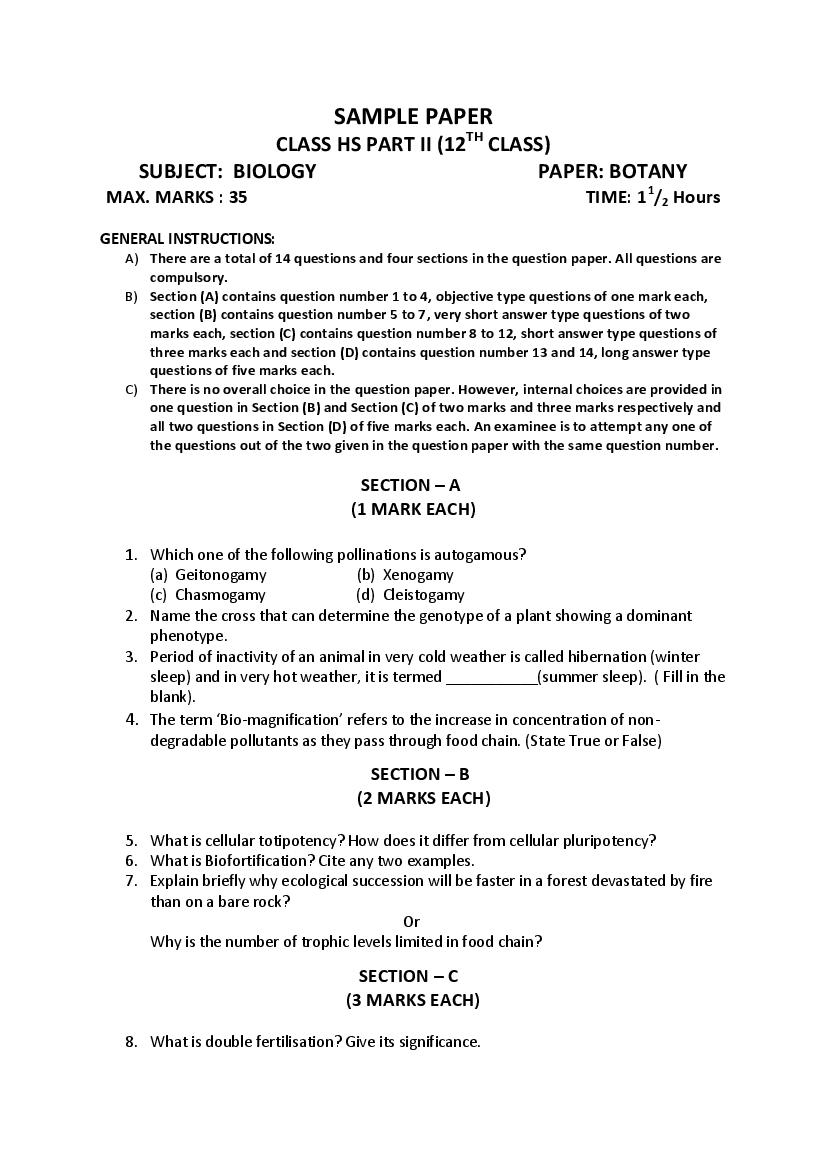
SAMPLE PAPER CLASS HS PART II (12TH CLASS) SUBJECT: BIOLOGY PAPER: BOTANY MAX. MARKS : 35 TIME: 1 1/2 Hours GENERAL INSTRUCTIONS: A) There are a total of 14 questions and four sections in the question paper. All questions are compulsory. B) Section (A) contains question number 1 to 4, objective type questions of one mark each, section (B) contains question number 5 to 7, very short answer type questions of two marks each, section (C) contains question number 8 to 12, short answer type questions of three marks each and section (D) contains question number 13 and 14, long answer type questions of five marks each. C) There is no overall choice in the question paper. However, internal choices are provided in one question in Section (B) and Section (C) of two marks and three marks respectively and all two questions in Section (D) of five marks each. An examinee is to attempt any one of the questions out of the two given in the question paper with the same question number. SECTION – A (1 MARK EACH) 1. Which one of the following pollinations is autogamous? (a) Geitonogamy (b) Xenogamy (c) Chasmogamy (d) Cleistogamy 2. Name the cross that can determine the genotype of a plant showing a dominant phenotype. 3. Period of inactivity of an animal in very cold weather is called hibernation (winter sleep) and in very hot weather, it is termed ___________(summer sleep). ( Fill in the blank). 4. The term ‘Bio-magnification’ refers to the increase in concentration of non- degradable pollutants as they pass through food chain. (State True or False) SECTION – B (2 MARKS EACH) 5. What is cellular totipotency? How does it differ from cellular pluripotency? 6. What is Biofortification? Cite any two examples. 7. Explain briefly why ecological succession will be faster in a forest devastated by fire than on a bare rock? Or Why is the number of trophic levels limited in food chain? SECTION – C (3 MARKS EACH) 8. What is double fertilisation? Give its significance.
Page 2
9. What is agamospermy? How is agamospermy different from parthenogenesis and parthenocarpy? 10. Compare and contrast the advantages and disadvantages of production of genetically modified crops. 11. What are agrochemicals? How do they affect soil and water? 12. What do you understand by a leading strand and a lagging strand during DNA replication? Why is replication not continuous on both the templates of replicating DNA molecule? Or Snapdragon shows incomplete dominance for flower colour. Work out a cross between a plant with red flowers and another with white flowers up to F2 generation. SECTION – D (5 MARKS EACH) 13. A true breeding Pea plant homozygous for axial violet flowers (AAVV) is crossed with another Pea plant with terminal white flowers (aavv). What would be the phenotype and genotype of F1 and F2 generations? Give the phenotypic ratio of F2 generation. List Mendel’s generalisations that can be derived from the above cross. Or What is operon? With the help of lac operon explain the idea of operon concept. 14. Define the terms ‘Productivity’ and ‘Decomposition’? differentiate between: (a) Net Primary productivity and Gross primary productivity, (b) Primary productivity and Secondary productivity, (c) Fragmentation and Catabolism of Detritus, (d) Humification and Mineralisation. Or What are the causes and consequences of loss of biodiversity? ****