NCERT Book Class 10 Science Chapter 4 Carbon and its Compounds
Finished viewing? Save it for later —
Download NCERT Book Class 10 Science Chapter 4 Carbon and its Compounds (PDF · 21 pages)About NCERT Book Class 10 Science Chapter 4 Carbon and its Compounds
NCERT Book Class 10 Science Chapter 4 Carbon and its Compounds is available here for free download. Published by NCERT for Class 10, this books can be viewed online or downloaded as a PDF (21 pages). Candidates preparing for Class 10 can use NCERT Book Class 10 Science Chapter 4 Carbon and its Compounds to understand the exam pattern, the type of questions asked, and the overall difficulty level.
Frequently Asked Questions
How can I download NCERT Book Class 10 Science Chapter 4 Carbon and its Compounds?
Open this page and click the Download button to save NCERT Book Class 10 Science Chapter 4 Carbon and its Compounds as a PDF. It is completely free on AglaSem Docs.
Is NCERT Book Class 10 Science Chapter 4 Carbon and its Compounds free to download?
Yes. NCERT Book Class 10 Science Chapter 4 Carbon and its Compounds can be viewed online and downloaded as a PDF free of cost on AglaSem Docs.
How many pages does NCERT Book Class 10 Science Chapter 4 Carbon and its Compounds have?
NCERT Book Class 10 Science Chapter 4 Carbon and its Compounds contains 21 pages, which you can read online or download together as a single PDF.
Where can I find more Class 10 study material?
You can find more Class 10 question papers, sample papers, syllabus, and answer keys on AglaSem Docs.
NCERT Book Class 10 Science Chapter 4 Carbon and its Compounds – Text
Read the full text of this books below — useful to quickly search, copy and reference the content online without downloading the PDF.
📄 View text version (1 page)
Page 1
Carbon and its
Compounds
I n the last Chapter, we came to know many compounds of importance
to us. In this Chapter we will study about some more interesting
compounds and their properties. Also, we shall be learning about carbon,
an element which is of immense significance to us in both its elemental
form and in the combined form.
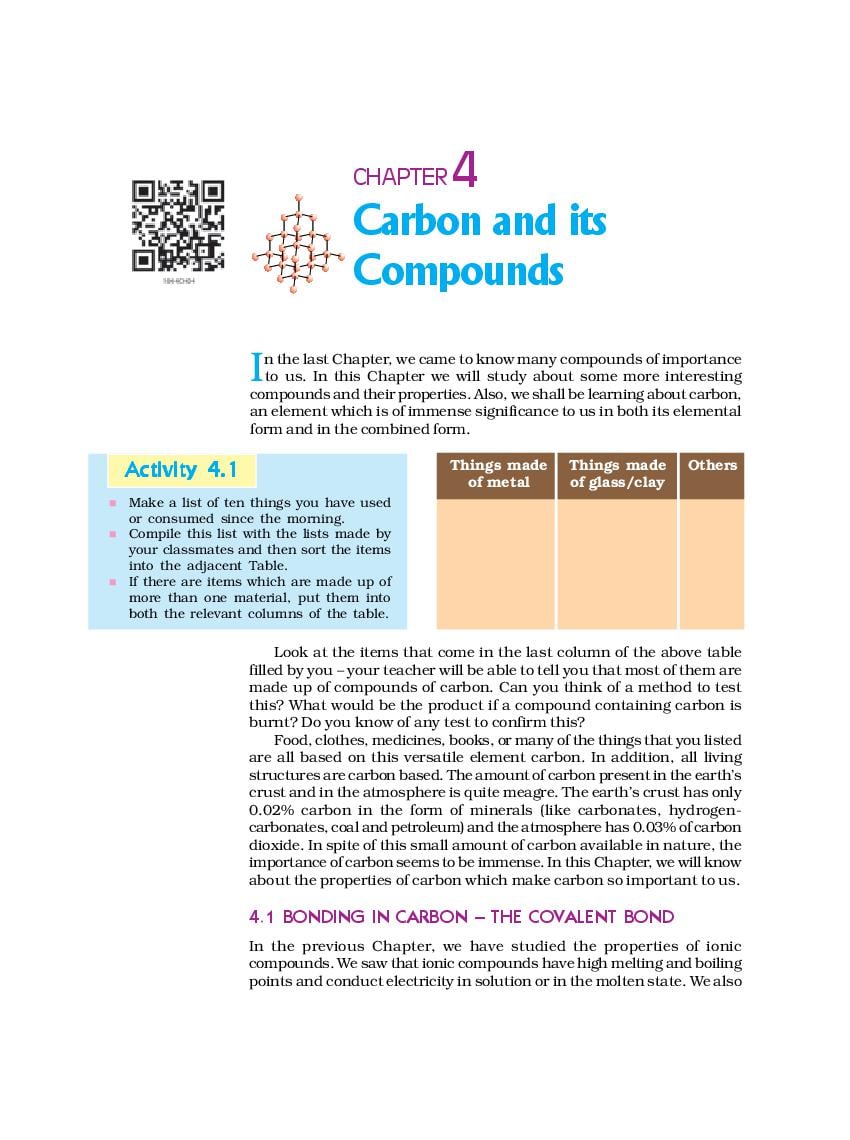
Activity 4.1 Things made Things made Others
of metal of glass/clay
n Make a list of ten things you have used
or consumed since the morning.
n Compile this list with the lists made by
your classmates and then sort the items
into the adjacent Table.
n If there are items which are made up of
more than one material, put them into
both the relevant columns of the table.
Look at the items that come in the last column of the above table
filled by you – your teacher will be able to tell you that most of them are
made up of compounds of carbon. Can you think of a method to test
this? What would be the product if a compound containing carbon is
burnt? Do you know of any test to confirm this?
Food, clothes, medicines, books, or many of the things that you listed
are all based on this versatile element carbon. In addition, all living
structures are carbon based. The amount of carbon present in the earth’s
crust and in the atmosphere is quite meagre. The earth’s crust has only
0.02% carbon in the form of minerals (like carbonates, hydrogen-
carbonates, coal and petroleum) and the atmosphere has 0.03% of carbon
dioxide. In spite of this small amount of carbon available in nature, the
importance of carbon seems to be immense. In this Chapter, we will know
about the properties of carbon which make carbon so important to us.
4.1 BONDING IN CARBON – THE COVALENT BOND
In the previous Chapter, we have studied the properties of ionic
compounds. We saw that ionic compounds have high melting and boiling
points and conduct electricity in solution or in the molten state. We also
58 Science
Showing the first page only. Download the PDF above for the complete document.
Document Details
| Board / Org | NCERT |
| Exam | Class 10 |
| Type | Books |
| Pages | 21 |
| Language | english |
| Updated | 29 Aug 2026 |