IMU CET 2027 Sample Paper UG
Finished viewing? Save it for later —
Download IMU CET 2027 Sample Paper UG (PDF · 24 pages)About IMU CET 2027 Sample Paper UG
IMU CET 2027 Sample Paper UG is available here for free download. Published by IMU for IMU CET, this sample paper can be viewed online or downloaded as a PDF (24 pages). Candidates preparing for IMU CET can use IMU CET 2027 Sample Paper UG to understand the exam pattern, the type of questions asked, and the overall difficulty level.
Frequently Asked Questions
How can I download IMU CET 2027 Sample Paper UG?
Open this page and click the Download button to save IMU CET 2027 Sample Paper UG as a PDF. It is completely free on AglaSem Docs.
Is IMU CET 2027 Sample Paper UG free to download?
Yes. IMU CET 2027 Sample Paper UG can be viewed online and downloaded as a PDF free of cost on AglaSem Docs.
How many pages does IMU CET 2027 Sample Paper UG have?
IMU CET 2027 Sample Paper UG contains 24 pages, which you can read online or download together as a single PDF.
Where can I find more IMU CET study material?
You can find more IMU CET question papers, sample papers, syllabus, and answer keys on AglaSem Docs.
IMU CET 2027 Sample Paper UG – Text
Read the full text of this sample paper below — useful to quickly search, copy and reference the content online without downloading the PDF.
📄 View text version (24 pages)
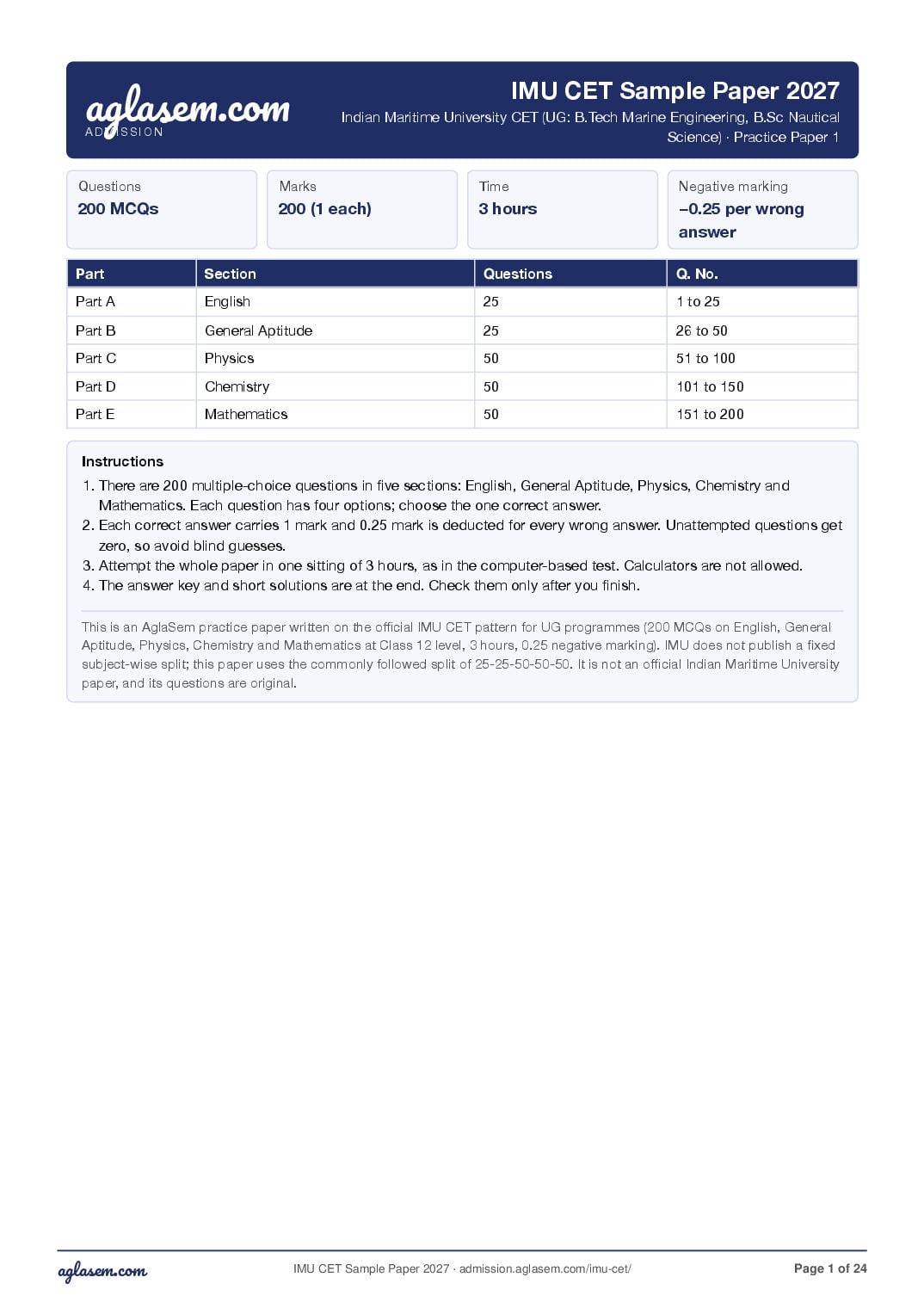
Page 1
Indian Maritime University CET (UG: B.Tech Marine Engineering, B.Sc Nautical
ADMISSION
Science) · Practice Paper 1
Questions Marks Time Negative marking
200 MCQs 200 (1 each) 3 hours −0.25 per wrong
answer
Part Section Questions Q. No.
Part A English 25 1 to 25
Part B General Aptitude 25 26 to 50
Part C Physics 50 51 to 100
Part D Chemistry 50 101 to 150
Part E Mathematics 50 151 to 200
Instructions
1. There are 200 multiple-choice questions in five sections: English, General Aptitude, Physics, Chemistry and
Mathematics. Each question has four options; choose the one correct answer.
2. Each correct answer carries 1 mark and 0.25 mark is deducted for every wrong answer. Unattempted questions get
zero, so avoid blind guesses.
3. Attempt the whole paper in one sitting of 3 hours, as in the computer-based test. Calculators are not allowed.
4. The answer key and short solutions are at the end. Check them only after you finish.
This is an AglaSem practice paper written on the official IMU CET pattern for UG programmes (200 MCQs on English, General
Aptitude, Physics, Chemistry and Mathematics at Class 12 level, 3 hours, 0.25 negative marking). IMU does not publish a fixed
subject-wise split; this paper uses the commonly followed split of 25-25-50-50-50. It is not an official Indian Maritime University
paper, and its questions are original.
IMU CET Sample Paper 2027 · admission./imu-cet/ Page 1 of 24
Page 2
English
Read the passage and answer the next five questions:
For centuries, sailors could fix their latitude with fair accuracy by measuring the height of the Sun at noon
or of the Pole Star at night. Longitude was a far harder problem. Because the Earth turns through 15
degrees every hour, a navigator who knew the exact time at his home port and the local time on board
could work out how far east or west he had travelled. The difficulty lay in carrying the home-port time
across months at sea. Pendulum clocks, reliable on land, lost their rhythm on a rolling deck, and changes
in temperature and humidity made their errors worse.
The cost of this ignorance was counted in lives and cargo. Ships ran aground on coasts they believed to
be far away, and captains often wasted weeks sailing along a known line of latitude simply to be sure of
reaching land. In 1714 the British Parliament offered a large reward for a practical method of finding
longitude at sea.
Many expected the answer to come from astronomers, who proposed reading the position of the Moon
against the stars as a kind of clock in the sky. In the end, after decades of argument, much of the reward
went to John Harrison, a self-taught carpenter and clockmaker whose compact sea watch kept time
remarkably well on long trial voyages. Harrison's success did not end the use of lunar tables overnight,
since his watches were expensive and difficult to copy, but within a century the marine chronometer had
become a standard instrument on ocean-going ships.
1. According to the passage, why was longitude harder to find than latitude?
(A) The Pole Star cannot be seen from southern seas
(B) Accurate charts of most coastlines were not yet available
(C) Home-port time could not be kept accurately on board
(D) The Sun is not visible at noon on long voyages
2. A navigator finds that local time on board is 2 hours behind the time at the home port. Using the idea in
the passage, the ship is:
(A) 30 degrees east of the home port
(B) 30 degrees west of the home port
(C) 30 degrees south of the home port
(D) 15 degrees west of the home port
3. Why did captains sometimes sail along a known line of latitude?
(A) To reach land safely without knowing longitude
(B) To avoid paying harbour charges at busy ports
(C) To read the Moon's position more easily
(D) To test the accuracy of their pendulum clocks
4. The word 'practical' in the second paragraph is closest in meaning to:
(A) Official (B) Expensive
(C) Workable (D) Theoretical
5. Which statement is NOT supported by the passage?
(A) Pendulum clocks performed poorly on a rolling deck
(B) Astronomers suggested using the Moon as a sky clock
(C) Harrison's watches replaced lunar tables at once
(D) A reward for finding longitude was offered in 1714
IMU CET Sample Paper 2027 · admission./imu-cet/ Page 2 of 24
Page 3
(A) Timid (B) Frank
(C) Shrewd (D) Hostile
7. Choose the word nearest in meaning to METICULOUS.
(A) Indifferent (B) Painstaking
(C) Careless (D) Hasty
8. Choose the word nearest in meaning to OBSOLETE.
(A) Outdated (B) Fragile
(C) Fashionable (D) Durable
9. Choose the word opposite in meaning to ABUNDANT.
(A) Plentiful (B) Copious
(C) Scarce (D) Ample
10. Choose the word opposite in meaning to TRANSIENT.
(A) Permanent (B) Fleeting
(C) Brief (D) Passing
11. Choose the word opposite in meaning to PRUDENT.
(A) Wise (B) Sensible
(C) Reckless (D) Cautious
12. Find the part of the sentence that has an error:
Neither the captain nor the officers / was aware of / the change in the weather.
(A) Neither the captain nor the officers
(B) was aware of
(C) the change in the weather
(D) No error
13. Find the part of the sentence that has an error:
The ship had already sailed / when we reached / at the harbour.
(A) The ship had already sailed (B) when we reached
(C) at the harbour (D) No error
14. Find the part of the sentence that has an error:
Hardly had the engine started / when the alarm / went off.
(A) Hardly had the engine started (B) when the alarm
(C) went off (D) No error
15. Fill in the blank: The tanker left Kochi and was bound ____ Singapore.
(A) for (B) at
(C) with (D) to
16. Fill in the blank: She has been working on this project ____ March.
(A) for (B) by
(C) since (D) from
17. Fill in the blank: If I ____ the weather forecast, I would have postponed the trip.
(A) saw (B) had seen
(C) have seen (D) would see
IMU CET Sample Paper 2027 · admission./imu-cet/ Page 3 of 24
Page 4
(A) on (B) at
(C) to (D) for
19. The idiom 'to be in the same boat' means:
(A) To agree on every point in a debate
(B) To share the same difficult situation
(C) To travel together on a long voyage
(D) To compete for the same position
20. The idiom 'to take something with a pinch of salt' means:
(A) To add details to a story (B) To accept it with pleasure
(C) To not fully believe it (D) To reject it angrily
21. The idiom 'to learn the ropes' means:
(A) To make a fresh start (B) To learn how a job is done
(C) To get out of a tight spot (D) To learn how to tie knots
22. Choose the correct passive form: The crew repaired the engine.
(A) The engine is repaired by the crew.
(B) The engine had repaired by the crew.
(C) The engine has been repaired by the crew.
(D) The engine was repaired by the crew.
23. Choose the correct indirect speech: He said, "I am leaving tomorrow."
(A) He said that he will leave the next day.
(B) He said that he was leaving the next day.
(C) He said that he is leaving tomorrow.
(D) He said that I was leaving the next day.
24. One word for: a person who hides on a ship to travel without paying the fare.
(A) Stowaway (B) Castaway
(C) Mariner (D) Pilgrim
25. One word for: a place where ships are built or repaired.
(A) Quarry (B) Arsenal
(C) Dockyard (D) Hangar
Part B
General Aptitude
26. Find the next number: 3, 8, 15, 24, 35, ?
(A) 50 (B) 46
(C) 49 (D) 48
27. Find the next number: 2, 6, 12, 20, 30, ?
(A) 40 (B) 36
(C) 42 (D) 44
28. Find the next letter: B, E, H, K, ?
(A) O (B) L
(C) M (D) N
IMU CET Sample Paper 2027 · admission./imu-cet/ Page 4 of 24
Page 5
(A) OPSU (B) QPSU
(C) QPST (D) QOSU
30. If CAT = 24 (sum of letter positions), then DOG = ?
(A) 24 (B) 27
(C) 25 (D) 26
31. Pointing to a man, Ravi said, "He is the son of my father's only sister." How is the man related to Ravi?
(A) Uncle (B) Nephew
(C) Cousin (D) Brother
32. A is the brother of B. C is the mother of A. D is the father of C. How is B related to D?
(A) Son (B) Nephew
(C) Grandchild (D) Grandfather
33. A man walks 5 km north, turns right and walks 3 km, then turns right again and walks 9 km. How far is
he from the starting point?
(A) 17 km (B) 4 km
(C) 7 km (D) 5 km
34. A sailor faces east. He turns 90° clockwise and then 180°. Which direction does he face now?
(A) North (B) South
(C) West (D) East
35. Statements: All ships are vessels. Some vessels are tankers.
Conclusions: I. Some ships are tankers. II. Some tankers are vessels.
(A) Only II follows (B) Only I follows
(C) Both I and II follow (D) Neither I nor II follows
36. Statements: All anchors are metals. No metal is plastic.
Conclusions: I. No anchor is plastic. II. Some metals are anchors.
(A) Both I and II follow (B) Neither I nor II follows
(C) Only I follows (D) Only II follows
37. Find the odd one out.
(A) Aileron (B) Bow
(C) Starboard (D) Stern
38. Knot : Speed :: Fathom : ?
(A) Distance (B) Weight
(C) Depth (D) Time
39. The price of an item is raised by 20% and then reduced by 20%. The net change is:
(A) 2% decrease (B) 4% increase
(C) 4% decrease (D) No change
40. ₹1,800 is divided among three people in the ratio 2 : 3 : 4. The largest share is:
(A) ₹900 (B) ₹600
(C) ₹800 (D) ₹400
41. A can finish a job in 12 days and B in 18 days. Working together, they will finish it in:
(A) 15 days (B) 8 days
(C) 7.2 days (D) 6 days
IMU CET Sample Paper 2027 · admission./imu-cet/ Page 5 of 24
Page 6
round trip is:
(A) 22.5 km/h (B) 21 km/h
(C) 24 km/h (D) 25 km/h
43. A 150 m long train runs at 54 km/h. How long does it take to pass a signal pole?
(A) 12 seconds (B) 9 seconds
(C) 10 seconds (D) 15 seconds
44. The compound interest on ₹10,000 for 2 years at 10% per annum, compounded annually, is:
(A) ₹1,100 (B) ₹2,000
(C) ₹2,200 (D) ₹2,100
45. The average of five numbers is 24. When one number is removed, the average of the rest is 22. The
number removed is:
(A) 30 (B) 32
(C) 34 (D) 28
Study the table and answer the next three questions. Cargo handled by three ports (million tonnes):
Port 2022 2023 2024
P 40 45 50
Q 30 36 42
R 25 20 30
46. What was the total cargo handled by the three ports together in 2023?
(A) 111 million tonnes (B) 122 million tonnes
(C) 101 million tonnes (D) 95 million tonnes
47. By what percentage did the cargo handled at Port Q rise from 2022 to 2024?
(A) 28.6% (B) 40%
(C) 12% (D) 30%
48. What was the average yearly cargo handled at Port R over the three years?
(A) 30 million tonnes (B) 22.5 million tonnes
(C) 25 million tonnes (D) 20 million tonnes
49. The Suez Canal connects the:
(A) Caspian Sea and Black Sea
(B) Mediterranean Sea and Red Sea
(C) Black Sea and Mediterranean Sea
(D) Red Sea and Arabian Sea
50. India is separated from Sri Lanka by the:
(A) Palk Strait (B) Strait of Malacca
(C) Bass Strait (D) Strait of Hormuz
IMU CET Sample Paper 2027 · admission./imu-cet/ Page 6 of 24
Page 7
Physics
51. The dimensional formula of Planck's constant is:
(A) [ML²T⁻¹] (B) [MLT⁻¹]
(C) [ML²T⁻³] (D) [ML²T⁻²]
52. A ball is thrown vertically upward at 20 m/s. Taking g = 10 m/s², the maximum height it reaches is:
(A) 30 m (B) 20 m
(C) 40 m (D) 10 m
53. A projectile is launched at 20 m/s. Taking g = 10 m/s², its maximum possible horizontal range is:
(A) 80 m (B) 40 m
(C) 20 m (D) 28.3 m
54. A car starts from rest with a uniform acceleration of 2 m/s². The distance covered in the first 5 s is:
(A) 12.5 m (B) 10 m
(C) 50 m (D) 25 m
55. Blocks of 2 kg and 3 kg are in contact on a smooth floor. A 10 N horizontal force pushes the 2 kg block.
The force exerted by the 2 kg block on the 3 kg block is:
(A) 10 N (B) 5 N
(C) 6 N (D) 4 N
56. A block just begins to slide down a rough plane inclined at 30°. The coefficient of static friction is:
(A) 1/2 (B) √3
(C) 1/√3 (D) √3/2
57. A 60 kg man stands in a lift moving up with an acceleration of 2 m/s². Taking g = 10 m/s², his apparent
weight is:
(A) 720 N (B) 120 N
(C) 480 N (D) 600 N
58. If the linear momentum of a body increases by 50%, its kinetic energy increases by:
(A) 125% (B) 100%
(C) 50% (D) 150%
59. A pump lifts 600 kg of water through a height of 10 m in 1 minute. Taking g = 10 m/s², its power output
is:
(A) 6000 W (B) 100 W
(C) 1000 W (D) 600 W
60. A ball moving with speed u collides head-on and elastically with an identical ball at rest. After the
collision:
(A) The first ball stops; the second moves at u
(B) Both balls move together at speed u/2
(C) The first ball rebounds with speed u
(D) Both balls move at speed u the same way
61. The moment of inertia of a thin uniform ring of mass M and radius R about a diameter is:
(A) 2MR²/5 (B) MR²
(C) MR²/4 (D) MR²/2
IMU CET Sample Paper 2027 · admission./imu-cet/ Page 7 of 24
Page 8
energy:
(A) Stays the same (B) Halves
(C) Doubles (D) Becomes four times
63. For a solid sphere rolling without slipping, the fraction of its total kinetic energy that is rotational is:
(A) 2/7 (B) 2/5
(C) 5/7 (D) 1/2
64. The acceleration due to gravity at a height equal to the Earth's radius R above the surface is:
(A) g/√2 (B) g/2
(C) g/9 (D) g/4
65. A planet has the same mean density as the Earth but twice its radius. The escape velocity from it is:
(A) Twice that of the Earth (B) Half that of the Earth
(C) √2 times that of the Earth (D) Equal to that of the Earth
66. If the orbital radius of a satellite is made four times, its period of revolution becomes:
(A) 2 times (B) 8 times
(C) 16 times (D) 4 times
67. A wire is replaced by another of the same material with double the length and double the radius. Under
the same load, the extension becomes:
(A) Half (B) The same
(C) Four times (D) Double
68. The excess pressure inside a soap bubble of radius r and surface tension T is:
(A) 4T/r (B) 2T/r
(C) T/r (D) 8T/r
69. A Carnot engine works between 527 °C and 127 °C. Its efficiency is:
(A) 25% (B) 76%
(C) 24% (D) 50%
70. During the isothermal expansion of an ideal gas:
(A) The internal energy does not change
(B) The work done by the gas is zero
(C) No heat is exchanged with surroundings
(D) The temperature of the gas rises
71. The ratio of specific heats γ = Cp/Cv for a monatomic ideal gas is:
(A) 3/2 (B) 7/5
(C) 5/3 (D) 4/3
72. If the absolute temperature of a black body is doubled, the power it radiates becomes:
(A) 8 times (B) 16 times
(C) 2 times (D) 4 times
73. A pendulum clock that keeps correct time on the Earth is taken to the Moon (g_moon = g/6). Its time
period becomes:
(A) √6 times longer (B) Unchanged
(C) 6 times longer (D) √6 times shorter
IMU CET Sample Paper 2027 · admission./imu-cet/ Page 8 of 24
Page 9
(A) 0.1 rad/s (B) 100 rad/s
(C) 1 rad/s (D) 10 rad/s
75. A pipe 85 cm long is closed at one end. If the speed of sound is 340 m/s, its fundamental frequency is:
(A) 200 Hz (B) 400 Hz
(C) 50 Hz (D) 100 Hz
76. A ship's horn of frequency 450 Hz approaches a stationary listener at one-tenth of the speed of sound.
The frequency heard is:
(A) 405 Hz (B) 500 Hz
(C) 450 Hz (D) 495 Hz
77. Two charges in air repel with force F. They are placed in a medium of dielectric constant 4 and their
separation is halved. The new force is:
(A) 4F (B) F
(C) 16F (D) F/4
78. The electric field at a point inside a uniformly charged thin spherical shell is:
(A) kQ/r² (B) Infinite
(C) kQ/R² (D) Zero
79. A parallel-plate capacitor of capacitance C is filled with a dielectric of constant 6 and its plate
separation is doubled. The new capacitance is:
(A) 3C (B) C/3
(C) 12C (D) 6C
80. Capacitors of 2 μF, 3 μF and 6 μF are connected in series. The equivalent capacitance is:
(A) 11 μF (B) 2 μF
(C) 6 μF (D) 1 μF
81. A wire of resistance R is stretched uniformly to twice its length. Its new resistance is:
(A) 4R (B) 2R
(C) R/2 (D) R/4
82. A cell of emf 12 V and internal resistance 1 Ω is connected to a 5 Ω resistor. The terminal voltage of the
cell is:
(A) 11 V (B) 2 V
(C) 12 V (D) 10 V
83. Bulbs rated 100 W, 220 V and 60 W, 220 V are connected in series across 220 V mains. Which glows
brighter?
(A) The 100 W bulb (B) Neither bulb glows
(C) Both glow equally (D) The 60 W bulb
84. A proton moves in a circle in a uniform magnetic field. If its speed is doubled, its period of revolution:
(A) Remains unchanged (B) Doubles
(C) Halves (D) Becomes four times
85. The magnetic field at the centre of a circular loop of radius R carrying current I is:
(A) μ₀I/(4πR) (B) μ₀IR/2
(C) μ₀I/(2R) (D) μ₀I/(2πR)
IMU CET Sample Paper 2027 · admission./imu-cet/ Page 9 of 24
Page 10
(A) Mass (B) Energy
(C) Momentum (D) Charge
87. A 2 m long rod moves at 4 m/s perpendicular to a uniform magnetic field of 0.5 T. The emf induced
across its ends is:
(A) 2 V (B) 16 V
(C) 1 V (D) 4 V
88. The rms voltage of the AC mains is 220 V. Its peak value is about:
(A) 440 V (B) 220 V
(C) 156 V (D) 311 V
89. A step-up transformer has 100 turns in the primary and 500 turns in the secondary. With 220 V AC
input, the output voltage is:
(A) 550 V (B) 1100 V
(C) 220 V (D) 44 V
90. The power of a convex lens of focal length 25 cm is:
(A) +0.25 D (B) +25 D
(C) −4 D (D) +4 D
91. An object is placed 30 cm in front of a convex lens of focal length 20 cm. The image is formed at:
(A) 50 cm behind the lens (B) 10 cm in front of the lens
(C) 60 cm behind the lens (D) 12 cm behind the lens
92. The critical angle for light going from a medium of refractive index √2 into air is:
(A) 30° (B) 90°
(C) 60° (D) 45°
93. In Young's double-slit experiment, λ = 600 nm, slit separation = 0.5 mm and screen distance = 1 m. The
fringe width is:
(A) 0.6 mm (B) 0.3 mm
(C) 1.2 mm (D) 2.4 mm
94. Light of photon energy 5 eV falls on a metal of work function 2 eV. The stopping potential is:
(A) 3 V (B) 2 V
(C) 5 V (D) 7 V
95. The de Broglie wavelength of an electron accelerated from rest through 100 V is about:
(A) 12.3 nm (B) 1.23 nm
(C) 0.123 nm (D) 0.0123 nm
96. A radioactive sample has a half-life of 10 days. The fraction left undecayed after 30 days is:
(A) 1/3 (B) 1/16
(C) 1/6 (D) 1/8
97. To make n-type silicon, it is doped with:
(A) Gallium (B) Aluminium
(C) Boron (D) Phosphorus
98. Marine and aircraft RADAR systems use:
(A) Microwaves (B) X-rays
(C) Infrared waves (D) Ultraviolet rays
IMU CET Sample Paper 2027 · admission./imu-cet/ Page 10 of 24
Page 11
about:
(A) 333 kg/m³ (B) 1000 kg/m³
(C) 1500 kg/m³ (D) 667 kg/m³
100. A loaded ship sails from a river into the sea. Compared with the river, in sea water the ship:
(A) Becomes lighter (B) Floats at the same depth
(C) Sinks slightly deeper (D) Rises slightly
Part D
Chemistry
101. The number of molecules in 9 g of water is:
(A) 1.51 × 10²³ (B) 6.02 × 10²³
(C) 3.01 × 10²³ (D) 9.03 × 10²³
102. 4 g of NaOH is dissolved in water to make 250 mL of solution. Its molarity is:
(A) 0.04 M (B) 0.4 M
(C) 1.6 M (D) 0.1 M
103. A compound contains 40% C, 6.7% H and 53.3% O by mass. Its empirical formula is:
(A) CHO (B) CH₂O
(C) CH₃O (D) C₂H₄O
104. The maximum number of electrons that the shell with n = 3 can hold is:
(A) 9 (B) 32
(C) 18 (D) 8
105. The ground-state electronic configuration of chromium (Z = 24) is:
(A) [Ar] 3d⁵ 4s¹ (B) [Ar] 3d⁴ 4s²
(C) [Ar] 3d⁶ (D) [Ar] 4s² 4p⁴
106. The number of radial nodes in a 3s orbital is:
(A) 2 (B) 1
(C) 3 (D) 0
107. Which of these has the highest first ionisation enthalpy?
(A) B (B) C
(C) O (D) N
108. The shape of the XeF₄ molecule is:
(A) Square planar (B) Octahedral
(C) See-saw (D) Tetrahedral
109. The hybridisation of each carbon atom in ethyne (C₂H₂) is:
(A) sp³d (B) sp²
(C) sp³ (D) sp
110. Which of these molecules is paramagnetic?
(A) O₂ (B) H₂
(C) N₂ (D) F₂
IMU CET Sample Paper 2027 · admission./imu-cet/ Page 11 of 24
Page 12
(A) SO₂ (B) NH₃
(C) H₂O (D) CO₂
112. A process at constant temperature and pressure is spontaneous when:
(A) ΔG is positive (B) ΔG is negative
(C) ΔH is positive (D) ΔS is negative
113. Given C + O₂ → CO₂, ΔH = −393.5 kJ and CO + ½O₂ → CO₂, ΔH = −283.0 kJ. ΔH for C + ½O₂ → CO is:
(A) −283.0 kJ (B) +110.5 kJ
(C) −676.5 kJ (D) −110.5 kJ
114. For N₂(g) + 3H₂(g) ⇌ 2NH₃(g), the relation between Kp and Kc is:
(A) Kp = Kc(RT)⁻² (B) Kp = Kc(RT)
(C) Kp = Kc (D) Kp = Kc(RT)²
115. The synthesis of ammonia is exothermic. Raising the temperature at equilibrium will:
(A) Increase the value of Kc (B) Increase the yield of NH₃
(C) Decrease the yield of NH₃ (D) Have no effect on the yield
116. For acetic acid pKa = 4.76. A buffer has [CH₃COO⁻]/[CH₃COOH] = 10. Its pH is:
(A) 3.76 (B) 5.76
(C) 4.76 (D) 6.76
117. The Ksp of AgCl is 1.0 × 10⁻¹⁰. Its solubility in pure water is:
(A) 2.0 × 10⁻⁵ mol/L (B) 5.0 × 10⁻⁶ mol/L
(C) 1.0 × 10⁻⁵ mol/L (D) 1.0 × 10⁻¹⁰ mol/L
118. The oxidation state of chromium in K₂Cr₂O₇ is:
(A) +3 (B) +7
(C) +6 (D) +12
119. In the reaction 2Na + Cl₂ → 2NaCl, chlorine is:
(A) Both oxidised and reduced (B) Reduced
(C) Oxidised (D) Neither oxidised nor reduced
120. Which 0.1 molal aqueous solution has the highest boiling point?
(A) Glucose (B) CaCl₂
(C) NaCl (D) Urea
121. E° values: Cu²⁺/Cu = +0.34 V and Zn²⁺/Zn = −0.76 V. The standard emf of the Daniell cell is:
(A) −1.10 V (B) 0.76 V
(C) 0.42 V (D) 1.10 V
122. The charge needed to deposit 1 mol of aluminium from Al³⁺ ions is:
(A) 2 × 96500 C (B) 96500 C
(C) 3 × 96500 C (D) 96500/3 C
123. On dilution, the molar conductivity of a weak electrolyte such as acetic acid:
(A) Falls to zero (B) Remains constant
(C) Increases sharply (D) Decreases steadily
124. A first-order reaction has k = 0.0693 min⁻¹. Its half-life is:
(A) 6.93 min (B) 1 min
(C) 10 min (D) 100 min
IMU CET Sample Paper 2027 · admission./imu-cet/ Page 12 of 24
Page 13
(A) L mol⁻¹ s⁻¹ (B) mol L⁻¹ s⁻¹
(C) L² mol⁻² s⁻¹ (D) s⁻¹
126. A catalyst increases the rate of a reaction by:
(A) Shifting the equilibrium forward
(B) Changing the enthalpy of reaction
(C) Raising the activation energy
(D) Lowering the activation energy
127. The chemical formula of plaster of Paris is:
(A) CaSO₄ (B) CaSO₄·½H₂O
(C) CaCO₃ (D) CaSO₄·2H₂O
128. Temporary hardness of water, caused by calcium and magnesium bicarbonates, is removed by:
(A) Chlorination (B) Boiling
(C) Filtration (D) Adding common salt
129. Which of these ions is colourless in aqueous solution?
(A) Cu²⁺ (B) Fe³⁺
(C) Zn²⁺ (D) Ni²⁺
130. Zirconium and hafnium have almost the same atomic radii because of:
(A) The inert pair effect
(B) Lanthanoid contraction
(C) Diagonal relationship
(D) Strong shielding by s electrons
131. The oxidation state of iron in K₄[Fe(CN)₆] is:
(A) +3 (B) +6
(C) +2 (D) +4
132. The IUPAC name of (CH₃)₂CHCH₂OH is:
(A) 1-Methylpropan-1-ol (B) Butan-1-ol
(C) 2-Methylpropan-2-ol (D) 2-Methylpropan-1-ol
133. The number of structural isomers of pentane (C₅H₁₂) is:
(A) 3 (B) 2
(C) 5 (D) 4
134. Which of these compounds is optically active?
(A) Butan-2-ol (B) 2-Methylpropan-2-ol
(C) Propan-2-ol (D) Ethanol
135. Which of these is an electrophile?
(A) NH₃ (B) NO₂⁺
(C) OH⁻ (D) H₂O
136. The most stable carbocation among the following is:
(A) CH₃⁺ (B) CH₃CH₂⁺
(C) (CH₃)₃C⁺ (D) (CH₃)₂CH⁺
IMU CET Sample Paper 2027 · admission./imu-cet/ Page 13 of 24
Page 14
(A) 1,2-Dibromopropane (B) Propane
(C) 1-Bromopropane (D) 2-Bromopropane
138. Ozonolysis of but-2-ene followed by Zn/H₂O gives:
(A) Ethanoic acid (B) Propanone
(C) Methanal (D) Ethanal
139. Chloroform slowly oxidised by air in light forms a poisonous gas. The gas is:
(A) Phosgene (COCl₂) (B) Dichloromethane
(C) Chloromethane (D) Carbon tetrachloride
140. In the Lucas test, turbidity appears immediately with:
(A) Secondary alcohols (B) Methanol
(C) Tertiary alcohols (D) Primary alcohols
141. Which compound gives a silver mirror with Tollens' reagent?
(A) Ethanol (B) Propanone
(C) Diethyl ether (D) Ethanal
142. Which compound undergoes the Cannizzaro reaction?
(A) Ethanal (B) Benzaldehyde
(C) Propanal (D) Propanone
143. The strongest acid among the following is:
(A) ClCH₂COOH (B) HCOOH
(C) CH₃COOH (D) Cl₃CCOOH
144. In aqueous solution, the most basic of these is:
(A) (CH₃)₂NH (B) NH₃
(C) (CH₃)₃N (D) CH₃NH₂
145. Acetamide heated with Br₂ and aqueous NaOH gives:
(A) Acetonitrile (B) Ethylamine
(C) Acetic acid (D) Methylamine
146. Benzenediazonium chloride treated with CuCl/HCl gives chlorobenzene. This is the:
(A) Wurtz reaction (B) Sandmeyer reaction
(C) Friedel–Crafts reaction (D) Gattermann–Koch reaction
147. Hydrolysis of sucrose gives:
(A) Glucose and galactose (B) Glucose only
(C) Glucose and fructose (D) Fructose and galactose
148. Which nitrogen base is found in DNA but not in RNA?
(A) Guanine (B) Thymine
(C) Uracil (D) Adenine
149. Deficiency of vitamin C causes:
(A) Beriberi (B) Night blindness
(C) Rickets (D) Scurvy
IMU CET Sample Paper 2027 · admission./imu-cet/ Page 14 of 24
Page 15
instead. A common metal for this is:
(A) Copper (B) Lead
(C) Zinc (D) Tin
Part E
Mathematics
151. If n(A) = 20, n(B) = 15 and n(A ∩ B) = 5, then n(A ∪ B) is:
(A) 30 (B) 35
(C) 25 (D) 40
152. The number of relations on a set with 3 elements is:
(A) 256 (B) 9
(C) 512 (D) 64
153. The domain of f(x) = √(4 − x²) is:
(A) (−∞, 2] (B) (−2, 2)
(C) [−2, 2] (D) [0, 2]
154. The value of i²⁰²⁷ is:
(A) −1 (B) −i
(C) 1 (D) i
155. (1 + i)/(1 − i) equals:
(A) i (B) −i
(C) 1 (D) 1 + i
156. If 2 is a root of x² − kx + 8 = 0, then k equals:
(A) 4 (B) −6
(C) 8 (D) 6
157. The 20th term of the AP 3, 8, 13, 18, … is:
(A) 103 (B) 98
(C) 93 (D) 100
158. The 3rd and 6th terms of a GP are 12 and 96. The first term is:
(A) 6 (B) 4
(C) 2 (D) 3
159. In how many ways can the letters of OCEAN be arranged so that the vowels are always together?
(A) 120 (B) 72
(C) 36 (D) 24
160. The number of diagonals of a decagon is:
(A) 70 (B) 35
(C) 40 (D) 45
161. The term independent of x in the expansion of (x + 1/x)¹⁰ is:
(A) 120 (B) 252
(C) 210 (D) 45
IMU CET Sample Paper 2027 · admission./imu-cet/ Page 15 of 24
Page 16
(A) (√3 − 1)/2 (B) (√3 + 1)/(2√2)
(C) (√6 − √2)/4 (D) (√6 + √2)/4
163. If tan θ = 3/4 and θ is acute, then sin 2θ equals:
(A) 7/25 (B) 12/25
(C) 24/25 (D) 3/5
164. The maximum value of 3 sin x + 4 cos x is:
(A) 12 (B) 1
(C) 7 (D) 5
165. The value of tan⁻¹(√3) − sec⁻¹(−2) is:
(A) −π/3 (B) π/3
(C) −2π/3 (D) π
166. The distance between the parallel lines 3x + 4y = 5 and 3x + 4y = 15 is:
(A) 1 (B) 4
(C) 10 (D) 2
167. The angle that the line √3x − y + 1 = 0 makes with the positive x-axis is:
(A) 120° (B) 60°
(C) 45° (D) 30°
168. The radius of the circle x² + y² − 4x + 6y − 12 = 0 is:
(A) √12 (B) 5
(C) 25 (D) 7
169. The eccentricity of the hyperbola x²/16 − y²/9 = 1 is:
(A) 5/3 (B) 4/5
(C) 5/4 (D) 3/4
170. lim (x → 0) (sin 3x)/x equals:
(A) 3 (B) 1
(C) 1/3 (D) 0
171. lim (x → ∞) (1 + 2/x)ˣ equals:
(A) e (B) 2
(C) √e (D) e²
172. f(x) = (x² − 4)/(x − 2) for x ≠ 2 and f(2) = k. If f is continuous at x = 2, then k is:
(A) 4 (B) −4
(C) 2 (D) 0
173. The derivative of xˣ (x > 0) is:
(A) x · xˣ⁻¹ (B) xˣ(1 + log x)
(C) xˣ(1 − log x) (D) xˣ log x
174. The derivative of sin⁻¹x + cos⁻¹x (|x| < 1) is:
(A) π/2 (B) 0
(C) 2/√(1 − x²) (D) 1
175. If x = at² and y = 2at, then dy/dx equals:
(A) 1/(2t) (B) t
(C) 1/t (D) 2t
IMU CET Sample Paper 2027 · admission./imu-cet/ Page 16 of 24
Page 17
(A) 9 (B) 2
(C) 6 (D) 12
177. The function f(x) = x³ − 3x has a local maximum at:
(A) x = √3 (B) x = 0
(C) x = 1 (D) x = −1
178. The radius of a circular oil slick grows at 0.2 cm/s. When the radius is 5 cm, its area grows at:
(A) 2π cm²/s (B) 4π cm²/s
(C) 10π cm²/s (D) π cm²/s
179. ∫ eˣ (sin x + cos x) dx equals:
(A) −eˣ sin x + C (B) eˣ(sin x − cos x) + C
(C) eˣ cos x + C (D) eˣ sin x + C
180. ∫ dx/(x² + 9) equals:
(A) (1/9) tan⁻¹(x/9) + C (B) 3 tan⁻¹(3x) + C
(C) tan⁻¹(x/3) + C (D) (1/3) tan⁻¹(x/3) + C
181. ∫ sin²x dx from 0 to π/2 equals:
(A) 1/2 (B) π/4
(C) π/2 (D) π
182. ∫ |x| dx from −1 to 1 equals:
(A) 0 (B) 1
(C) 1/2 (D) 2
183. The area of the region enclosed by y = x² and y = x is:
(A) 1/6 (B) 1/2
(C) 5/6 (D) 1/3
184. The general solution of dy/dx = (1 + y²)/(1 + x²) is:
(A) log(1 + y²) = log(1 + x²) + C (B) tan⁻¹y = tan⁻¹x + C
(C) y = x + C (D) tan⁻¹y = x + C
185. The differential equation of the family of curves y = Ae²ˣ (A arbitrary) is:
(A) dy/dx = 2y (B) d²y/dx² = 2y
(C) dy/dx = 2x (D) dy/dx = y
186. A is a 3 × 3 matrix with |A| = 4. Then |2A| is:
(A) 8 (B) 64
(C) 16 (D) 32
187. A is a 3 × 3 matrix with |A| = 5. Then |adj A| is:
(A) 5 (B) 25
(C) 15 (D) 125
188. The inverse of the matrix [[2, 1], [5, 3]] is:
(A) [[−3, 1], [5, −2]] (B) [[3, −1], [−5, 2]]
(C) [[3, 1], [5, 2]] (D) [[2, −5], [−1, 3]]
189. The determinant with rows (1, a, a²), (1, b, b²), (1, c, c²) equals:
(A) (a + b)(b + c)(c + a) (B) (a − b)(b − c)(c − a)
(C) 0 (D) abc(a − b)
IMU CET Sample Paper 2027 · admission./imu-cet/ Page 17 of 24
Page 18
(A) 1 (B) −4
(C) 2 (D) 4
191. If |a| = 2, |b| = 3 and the angle between a and b is 30°, then |a × b| is:
(A) 3√3 (B) 6
(C) 1.5 (D) 3
192. The scalar projection of 2i + 3j + 6k on 2i + 2j + k is:
(A) 16/7 (B) 16/3
(C) 16 (D) 7/3
193. a and b are unit vectors with |a + b| = √3. The angle between them is:
(A) 30° (B) 90°
(C) 60° (D) 120°
194. The direction cosines of a line with direction ratios 2, −1, 2 are:
(A) 2/9, −1/9, 2/9 (B) 2, −1, 2
(C) 1/3, −2/3, 1/3 (D) 2/3, −1/3, 2/3
195. The distance of the point (2, 3, −5) from the plane x + 2y − 2z = 9 is:
(A) 9 (B) 1
(C) 6 (D) 3
196. The maximum of Z = 3x + 2y subject to x + y ≤ 4, x ≥ 0, y ≥ 0 is:
(A) 12 (B) 10
(C) 8 (D) 4
197. A and B are independent events with P(A) = 0.4 and P(B) = 0.5. Then P(A ∪ B) is:
(A) 0.7 (B) 0.2
(C) 0.9 (D) 0.5
198. Bag I has 3 red and 2 black balls; Bag II has 2 red and 3 black balls. A bag is chosen at random and a
red ball is drawn. The probability that it came from Bag I is:
(A) 3/5 (B) 3/10
(C) 1/2 (D) 2/5
199. The variance of the first 10 natural numbers is:
(A) 8.25 (B) 9.17
(C) 8.5 (D) 5.5
200. The standard deviation of 2, 4, 6, 8, 10 is:
(A) 4 (B) 2√2
(C) √10 (D) 8
IMU CET Sample Paper 2027 · admission./imu-cet/ Page 18 of 24
Page 19
1 C 2 B 3 A 4 C 5 C 6 B 7 B 8 A 9 C 10 A
11 C 12 B 13 C 14 D 15 A 16 C 17 B 18 A 19 B 20 C
21 B 22 D 23 B 24 A 25 C 26 D 27 C 28 D 29 B 30 D
31 C 32 C 33 D 34 A 35 A 36 A 37 A 38 C 39 C 40 C
41 C 42 A 43 C 44 D 45 B 46 C 47 B 48 C 49 B 50 A
51 A 52 B 53 B 54 D 55 C 56 C 57 A 58 A 59 C 60 A
61 D 62 C 63 A 64 D 65 A 66 B 67 A 68 A 69 D 70 A
71 C 72 B 73 A 74 D 75 D 76 B 77 B 78 D 79 A 80 D
81 A 82 D 83 D 84 A 85 C 86 B 87 D 88 D 89 B 90 D
91 C 92 D 93 C 94 A 95 C 96 D 97 D 98 A 99 D 100 D
101 C 102 B 103 B 104 C 105 A 106 A 107 D 108 A 109 D 110 A
111 D 112 B 113 D 114 A 115 C 116 B 117 C 118 C 119 B 120 B
121 D 122 C 123 C 124 C 125 B 126 D 127 B 128 B 129 C 130 B
131 C 132 D 133 A 134 A 135 B 136 C 137 D 138 D 139 A 140 C
141 D 142 B 143 D 144 A 145 D 146 B 147 C 148 B 149 D 150 C
151 A 152 C 153 C 154 B 155 A 156 D 157 B 158 D 159 C 160 B
161 B 162 C 163 C 164 D 165 A 166 D 167 B 168 B 169 C 170 A
171 D 172 A 173 B 174 B 175 C 176 A 177 D 178 A 179 D 180 D
181 B 182 B 183 A 184 B 185 A 186 D 187 B 188 B 189 B 190 D
191 D 192 B 193 C 194 D 195 D 196 A 197 A 198 A 199 A 200 B
Solutions
English
1. (C) The passage says longitude needs the exact home-port time, and the difficulty lay in carrying that time across a
long voyage.
2. (B) The Earth turns 15° per hour, so 2 hours means 30° of longitude; local time behind home time means the ship is
to the west.
3. (A) The passage says captains wasted weeks sailing along a known latitude simply to be sure of reaching land.
4. (C) A practical method is one that can actually be used, i.e. workable.
5. (C) The passage says Harrison's success did not end the use of lunar tables overnight, because his watches were
costly and hard to copy.
6. (B) Candid means open and honest, i.e. frank.
7. (B) Meticulous means showing great attention to detail: painstaking.
8. (A) Obsolete means no longer in use: outdated.
9. (C) Abundant means plentiful; its opposite is scarce. The other three are synonyms.
10. (A) Transient means lasting a short time; its opposite is permanent.
11. (C) Prudent means careful and sensible; its opposite is reckless.
12. (B) With 'neither … nor', the verb agrees with the nearer subject, 'officers', so it should be 'were aware of'.
13. (C) 'Reach' takes a direct object: 'when we reached the harbour', not 'reached at'.
14. (D) 'Hardly had … when' is the correct inverted pattern, so the sentence has no error.
IMU CET Sample Paper 2027 · admission./imu-cet/ Page 19 of 24
Page 20
16. (C) 'Since' is used with a point of time in the perfect continuous tense.
17. (B) Third conditional: if + past perfect, would have + past participle.
18. (A) The verb 'insist' takes the preposition 'on'.
19. (B) To be in the same boat is to face the same problem as others.
20. (C) It means to treat a claim with some doubt.
21. (B) Originally nautical, it now means to learn the basic methods of a job.
22. (D) Simple past active (repaired) becomes 'was repaired' in the passive.
23. (B) With a past reporting verb, 'am leaving' becomes 'was leaving', 'I' becomes 'he' and 'tomorrow' becomes 'the
next day'.
24. (A) A stowaway hides on a ship or aircraft to travel free. A castaway is a shipwrecked person.
25. (C) A dockyard (shipyard) is where ships are built and repaired. A hangar houses aircraft.
General Aptitude
26. (D) The terms are n² − 1 for n = 2, 3, 4 …: 2²−1 = 3, … , 7² − 1 = 48.
27. (C) Differences are 4, 6, 8, 10, 12, so the next term is 30 + 12 = 42 (the terms are n(n + 1)).
28. (D) Each letter moves 3 places forward: K (11) + 3 = N (14).
29. (B) Each letter is replaced by the next letter: P→Q, O→P, R→S, T→U.
30. (D) D = 4, O = 15, G = 7; 4 + 15 + 7 = 26.
31. (C) Ravi's father's sister is Ravi's aunt; her son is Ravi's cousin.
32. (C) B is C's child and C is D's child, so B is D's grandchild (B's gender is not given).
33. (D) He ends 4 km south and 3 km east of the start: √(4² + 3²) = 5 km.
34. (A) East turned 90° clockwise is south; turning 180° from south gives north.
35. (A) II is the converse of 'some vessels are tankers', so it follows. I need not follow: the tankers may be vessels that
are not ships.
36. (A) Anchors lie inside metals, which share nothing with plastic, so I follows; II is the converse of 'all anchors are
metals'.
37. (A) Starboard, bow and stern are parts or sides of a ship; an aileron is a control surface on an aircraft wing.
38. (C) A knot measures a ship's speed; a fathom (6 feet) is used to measure the depth of water.
39. (C) 1.2 × 0.8 = 0.96, a 4% decrease.
40. (C) Total parts = 9, one part = ₹200, largest share = 4 × 200 = ₹800.
41. (C) Together they do 1/12 + 1/18 = 5/36 per day, so they need 36/5 = 7.2 days.
42. (A) Average speed = 2 × 18 × 30/(18 + 30) = 1080/48 = 22.5 km/h.
43. (C) 54 km/h = 15 m/s; time = 150/15 = 10 s.
44. (D) Amount = 10,000 × 1.1² = 12,100, so CI = ₹2,100.
45. (B) Sum of five = 120, sum of four = 88, so the removed number is 32.
46. (C) 45 + 36 + 20 = 101 million tonnes.
47. (B) (42 − 30)/30 × 100 = 40%.
48. (C) (25 + 20 + 30)/3 = 25 million tonnes.
49. (B) The Suez Canal in Egypt links the Mediterranean Sea (Port Said) with the Red Sea (Suez).
50. (A) The Palk Strait lies between Tamil Nadu and northern Sri Lanka.
Physics
51. (A) h = E/ν, so [h] = [ML²T⁻²]/[T⁻¹] = [ML²T⁻¹].
52. (B) H = u²/2g = 400/20 = 20 m.
IMU CET Sample Paper 2027 · admission./imu-cet/ Page 20 of 24
Page 21
54. (D) s = ½at² = ½ × 2 × 25 = 25 m.
55. (C) a = 10/5 = 2 m/s²; force on the 3 kg block = 3 × 2 = 6 N.
56. (C) At the point of sliding, μ = tan θ = tan 30° = 1/√3.
57. (A) N = m(g + a) = 60 × 12 = 720 N.
58. (A) K = p²/2m, so K becomes 1.5² = 2.25 times, an increase of 125%.
59. (C) P = mgh/t = 600 × 10 × 10/60 = 1000 W.
60. (A) In a 1-D elastic collision of equal masses, the velocities are exchanged.
61. (D) About its axis I = MR²; by the perpendicular axis theorem, each diameter has I = MR²/2.
62. (C) L = Iω is conserved and K = L²/2I, so halving I doubles K (the extra energy comes from her muscles).
63. (A) K_rot = ½(2/5 mR²)ω² = mv²/5 and K_total = 7mv²/10, so the fraction is 2/7.
64. (D) g' = g R²/(R + h)² = g R²/(2R)² = g/4.
65. (A) vₑ = √(2GM/R) with M ∝ ρR³ gives vₑ ∝ R√ρ, so it doubles.
66. (B) Kepler's third law: T² ∝ r³, so T ∝ r^(3/2) = 4^(3/2) = 8.
67. (A) ΔL = FL/(πr²Y): length ×2 and r² ×4 gives ΔL × 2/4 = half.
68. (A) A soap bubble has two surfaces, so ΔP = 2 × 2T/r = 4T/r.
69. (D) η = 1 − T₂/T₁ = 1 − 400 K/800 K = 0.5. (76% comes from wrongly using °C.)
70. (A) Internal energy of an ideal gas depends only on temperature, so ΔU = 0 and the heat absorbed equals the work
done.
71. (C) Cv = 3R/2 and Cp = 5R/2, so γ = 5/3.
72. (B) Stefan's law: P ∝ T⁴, and 2⁴ = 16.
73. (A) T = 2π√(l/g); g becomes g/6, so T becomes √6 times larger.
74. (D) ω = √(k/m) = √(100/1) = 10 rad/s.
75. (D) For a closed pipe f = v/4L = 340/(4 × 0.85) = 100 Hz.
76. (B) f' = f·v/(v − v/10) = 450 × 10/9 = 500 Hz.
77. (B) F ∝ 1/(K r²) = 1/(4 × ¼) = 1, so the force is unchanged.
78. (D) By Gauss's law, no charge is enclosed by a surface inside the shell, so E = 0.
79. (A) C = Kε₀A/d: K × 6 and d × 2 gives 3C.
80. (D) 1/C = 1/2 + 1/3 + 1/6 = 1, so C = 1 μF.
81. (A) Volume is constant, so doubling length halves the area; R ∝ L/A becomes 4R.
82. (D) I = 12/(5 + 1) = 2 A; V = E − Ir = 12 − 2 = 10 V.
83. (D) R = V²/P, so the 60 W bulb has more resistance; with equal current, P = I²R is larger in it.
84. (A) T = 2πm/(qB) does not depend on speed; the radius doubles instead.
85. (C) B = μ₀I/(2R) at the centre of a single circular loop.
86. (B) The induced current opposes the change causing it; otherwise energy would be created from nothing.
87. (D) e = Blv = 0.5 × 2 × 4 = 4 V.
88. (D) V₀ = √2 × Vrms = 1.414 × 220 ≈ 311 V.
89. (B) Vs = Vp × Ns/Np = 220 × 5 = 1100 V (ideal transformer).
90. (D) P = 1/f (in metres) = 1/0.25 = +4 D.
91. (C) 1/v = 1/f + 1/u = 1/20 − 1/30 = 1/60, so v = +60 cm (real image).
92. (D) sin c = 1/n = 1/√2, so c = 45°.
93. (C) β = λD/d = (600 × 10⁻⁹ × 1)/(0.5 × 10⁻³) = 1.2 × 10⁻³ m.
94. (A) Kmax = 5 − 2 = 3 eV, so the stopping potential is 3 V.
95. (C) λ = 1.227/√V nm = 1.227/10 ≈ 0.123 nm.
IMU CET Sample Paper 2027 · admission./imu-cet/ Page 21 of 24
Page 22
97. (D) Phosphorus is pentavalent and donates a free electron; boron, aluminium and gallium are trivalent (p-type).
98. (A) RADAR uses microwaves, which travel in narrow beams and reflect well from metal objects.
99. (D) Weight = buoyancy: ρ = (2/3) × 1000 ≈ 667 kg/m³.
100. (D) Sea water is denser, so less volume needs to be displaced to support the same weight; the ship rises a little.
Chemistry
101. (C) 9 g = 0.5 mol; 0.5 × 6.022 × 10²³ = 3.01 × 10²³.
102. (B) Moles = 4/40 = 0.1; M = 0.1/0.25 L = 0.4 M.
103. (B) Mole ratio C : H : O = 3.33 : 6.7 : 3.33 = 1 : 2 : 1.
104. (C) Maximum electrons in a shell = 2n² = 18.
105. (A) A half-filled 3d⁵ subshell is extra stable, so one 4s electron moves to 3d.
106. (A) Radial nodes = n − l − 1 = 3 − 0 − 1 = 2.
107. (D) Nitrogen's half-filled 2p³ is stable, so its IE is higher than oxygen's (2p⁴) and that of B and C.
108. (A) Xe has 4 bond pairs and 2 lone pairs (sp³d²); the lone pairs sit opposite each other, giving a square planar
shape.
109. (D) Each carbon forms one σ bond to H, one σ and two π bonds to C: sp hybridised, linear.
110. (A) By MO theory O₂ has two unpaired electrons in the π* orbitals.
111. (D) CO₂ is linear, so its two C=O bond dipoles cancel.
112. (B) At constant T and P, a process is spontaneous if the Gibbs energy decreases (ΔG < 0).
113. (D) Subtract the second equation from the first (Hess's law): −393.5 − (−283.0) = −110.5 kJ.
114. (A) Kp = Kc(RT)^Δn with Δn = 2 − 4 = −2.
115. (C) By Le Chatelier's principle, heating favours the endothermic (backward) reaction, and K falls.
116. (B) Henderson equation: pH = pKa + log 10 = 4.76 + 1 = 5.76.
117. (C) Ksp = s², so s = √(1.0 × 10⁻¹⁰) = 1.0 × 10⁻⁵ mol/L.
118. (C) 2(+1) + 2x + 7(−2) = 0 gives x = +6.
119. (B) Chlorine goes from 0 to −1, gaining electrons: it is reduced (it is the oxidising agent).
120. (B) ΔTb = i·Kb·m; CaCl₂ gives 3 ions (i = 3), the most particles.
121. (D) E°cell = E°cathode − E°anode = 0.34 − (−0.76) = 1.10 V.
122. (C) Al³⁺ + 3e⁻ → Al needs 3 mol of electrons = 3 F.
123. (C) Its degree of dissociation rises greatly on dilution, so Λm increases sharply.
124. (C) t½ = 0.693/k = 0.693/0.0693 = 10 min.
125. (B) For zero order, rate = k, so k has the units of rate.
126. (D) A catalyst gives an alternative path of lower Ea; it does not change ΔH or the equilibrium position.
127. (B) Plaster of Paris is calcium sulphate hemihydrate; gypsum is CaSO₄·2H₂O.
128. (B) Boiling converts the soluble bicarbonates into insoluble carbonates (or hydroxide), which settle out.
129. (C) Zn²⁺ is 3d¹⁰, so no d–d transition is possible.
130. (B) Poor shielding by 4f electrons shrinks the 5d elements so that Hf ≈ Zr in size.
131. (C) 4(+1) + x + 6(−1) = 0 gives x = +2.
132. (D) The longest chain with the OH carbon is three carbons, OH on C-1 and a methyl group on C-2.
133. (A) n-pentane, isopentane (2-methylbutane) and neopentane (2,2-dimethylpropane).
134. (A) C-2 of butan-2-ol carries H, OH, CH₃ and C₂H₅: four different groups, so it is chiral.
135. (B) The nitronium ion is electron-deficient; the others have lone pairs and act as nucleophiles.
136. (C) Tertiary carbocations are most stabilised by hyperconjugation and the +I effect of methyl groups.
IMU CET Sample Paper 2027 · admission./imu-cet/ Page 22 of 24
Page 23
138. (D) CH₃CH=CHCH₃ splits at the double bond into two molecules of CH₃CHO.
139. (A) 2CHCl₃ + O₂ → 2COCl₂ + 2HCl; chloroform is stored in dark, filled bottles.
140. (C) Tertiary alcohols form stable carbocations and react at once with ZnCl₂/conc. HCl.
141. (D) Aldehydes are oxidised by Tollens' reagent; ketones such as propanone are not.
142. (B) The Cannizzaro reaction needs an aldehyde without α-hydrogen, such as benzaldehyde (C₆H₅CHO).
143. (D) Three chlorine atoms withdraw electrons (−I effect) and stabilise the carboxylate ion most.
144. (A) In water the order is (CH₃)₂NH > CH₃NH₂ > (CH₃)₃N > NH₃, from inductive, solvation and steric effects together.
145. (D) Hofmann bromamide degradation gives an amine with one carbon fewer: CH₃CONH₂ → CH₃NH₂.
146. (B) Replacement of the diazo group by Cl or Br using Cu(I) salts is the Sandmeyer reaction.
147. (C) Sucrose is a disaccharide of α-D-glucose and β-D-fructose.
148. (B) DNA has A, G, C, T; RNA has uracil in place of thymine.
149. (D) Rickets: vitamin D; beriberi: vitamin B₁; night blindness: vitamin A.
150. (C) Zinc is more electropositive than iron and acts as a sacrificial anode (cathodic protection).
Mathematics
151. (A) n(A ∪ B) = 20 + 15 − 5 = 30.
152. (C) A × A has 9 elements, so there are 2⁹ = 512 subsets (relations).
153. (C) We need 4 − x² ≥ 0, i.e. −2 ≤ x ≤ 2.
154. (B) 2027 = 4 × 506 + 3, so i²⁰²⁷ = i³ = −i.
155. (A) Multiply by (1 + i)/(1 + i): (1 + i)²/2 = 2i/2 = i.
156. (D) The product of roots is 8, so the other root is 4; k = sum of roots = 6.
157. (B) a₂₀ = 3 + 19 × 5 = 98.
158. (D) r³ = 96/12 = 8, so r = 2 and a = 12/4 = 3.
159. (C) Treat O, E, A as one block: 3! arrangements of the block, C, N, and 3! inside the block: 6 × 6 = 36.
160. (B) n(n − 3)/2 = 10 × 7/2 = 35.
161. (B) T(r+1) = ¹⁰Cᵣ x^(10 − 2r); r = 5 gives ¹⁰C₅ = 252.
162. (C) sin(45° − 30°) = (1/√2)(√3/2) − (1/√2)(1/2) = (√6 − √2)/4.
163. (C) sin θ = 3/5, cos θ = 4/5, so sin 2θ = 2 × 3/5 × 4/5 = 24/25.
164. (D) The maximum of a sin x + b cos x is √(a² + b²) = 5.
165. (A) tan⁻¹√3 = π/3 and sec⁻¹(−2) = cos⁻¹(−1/2) = 2π/3; π/3 − 2π/3 = −π/3.
166. (D) d = |15 − 5|/√(3² + 4²) = 10/5 = 2.
167. (B) Slope = √3 = tan 60°.
168. (B) Centre (2, −3); r = √(4 + 9 + 12) = 5.
169. (C) e = √(1 + b²/a²) = √(1 + 9/16) = 5/4.
170. (A) (sin 3x)/x = 3 × (sin 3x)/(3x) → 3.
171. (D) The standard limit (1 + a/x)ˣ → eᵃ with a = 2.
172. (A) For x ≠ 2, f(x) = x + 2, which tends to 4.
173. (B) log y = x log x gives y'/y = log x + 1.
174. (B) sin⁻¹x + cos⁻¹x = π/2, a constant.
175. (C) dy/dx = (dy/dt)/(dx/dt) = 2a/(2at) = 1/t.
176. (A) dy/dx = 3x² − 3 = 12 − 3 = 9.
177. (D) f'(x) = 3x² − 3 = 0 at x = ±1; f''(−1) = −6 < 0, so x = −1 is a maximum.
178. (A) dA/dt = 2πr dr/dt = 2π × 5 × 0.2 = 2π cm²/s.
IMU CET Sample Paper 2027 · admission./imu-cet/ Page 23 of 24
Page 24
180. (D) ∫ dx/(x² + a²) = (1/a) tan⁻¹(x/a) + C with a = 3.
181. (B) sin²x = (1 − cos 2x)/2; the integral is (π/2)/2 = π/4.
182. (B) By symmetry it is 2 × ∫₀¹ x dx = 2 × ½ = 1.
183. (A) ∫₀¹ (x − x²) dx = 1/2 − 1/3 = 1/6.
184. (B) Separating variables: dy/(1 + y²) = dx/(1 + x²), then integrate both sides.
185. (A) dy/dx = 2Ae²ˣ = 2y, which eliminates A.
186. (D) |kA| = kⁿ|A| = 2³ × 4 = 32.
187. (B) |adj A| = |A|ⁿ⁻¹ = 5² = 25.
188. (B) |A| = 6 − 5 = 1, so A⁻¹ = adj A = [[3, −1], [−5, 2]].
189. (B) Subtracting rows and taking out factors gives the Vandermonde result (a − b)(b − c)(c − a).
190. (D) No unique solution when k × 1 − 2 × 2 = 0, i.e. k = 4; then 4x + 2y = 3 and 4x + 2y = 10 are inconsistent.
191. (D) |a × b| = |a||b| sin 30° = 6 × ½ = 3.
192. (B) a·b = 4 + 6 + 6 = 16 and |b| = 3, so the projection is 16/3.
193. (C) |a + b|² = 2 + 2a·b = 3, so a·b = ½ and θ = 60°.
194. (D) Divide by √(4 + 1 + 4) = 3.
195. (D) |2 + 6 + 10 − 9|/√(1 + 4 + 4) = 9/3 = 3.
196. (A) Corner points (0, 0), (4, 0), (0, 4) give Z = 0, 12, 8; maximum 12.
197. (A) P(A ∪ B) = 0.4 + 0.5 − 0.4 × 0.5 = 0.7.
198. (A) Bayes: (½ × 3/5)/(½ × 3/5 + ½ × 2/5) = 3/5.
199. (A) Variance = (n² − 1)/12 = 99/12 = 8.25.
200. (B) Mean = 6; squared deviations 16, 4, 0, 4, 16 sum to 40; variance = 8, SD = 2√2.
IMU CET Sample Paper 2027 · admission./imu-cet/ Page 24 of 24
Document Details
| Board / Org | IMU |
| Exam | IMU CET |
| Type | Sample Paper |
| Pages | 24 |
| Language | english |
| Updated | 27 Oct 2026 |