JNUEE 2021 Question Paper M.Tech Computer Science N Tech Data Sci
Finished viewing? Save it for later —
Download JNUEE 2021 Question Paper M.Tech Computer Science N Tech Data Sci (PDF · 14 pages)About JNUEE 2021 Question Paper M.Tech Computer Science N Tech Data Sci
JNUEE 2021 Question Paper M.Tech Computer Science N Tech Data Sci is available here for free download. Published by NTA for JNUEE, this question paper can be viewed online or downloaded as a PDF (14 pages). Candidates preparing for JNUEE can use JNUEE 2021 Question Paper M.Tech Computer Science N Tech Data Sci to understand the exam pattern, the type of questions asked, and the overall difficulty level.
Frequently Asked Questions
How can I download JNUEE 2021 Question Paper M.Tech Computer Science N Tech Data Sci?
Open this page and click the Download button to save JNUEE 2021 Question Paper M.Tech Computer Science N Tech Data Sci as a PDF. It is completely free on AglaSem Docs.
Is JNUEE 2021 Question Paper M.Tech Computer Science N Tech Data Sci free to download?
Yes. JNUEE 2021 Question Paper M.Tech Computer Science N Tech Data Sci can be viewed online and downloaded as a PDF free of cost on AglaSem Docs.
How many pages does JNUEE 2021 Question Paper M.Tech Computer Science N Tech Data Sci have?
JNUEE 2021 Question Paper M.Tech Computer Science N Tech Data Sci contains 14 pages, which you can read online or download together as a single PDF.
Where can I find more JNUEE study material?
You can find more JNUEE question papers, sample papers, syllabus, and answer keys on AglaSem Docs.
JNUEE 2021 Question Paper M.Tech Computer Science N Tech Data Sci – Text
Read the full text of this question paper below — useful to quickly search, copy and reference the content online without downloading the PDF.
📄 View text version (13 pages)
Page 1
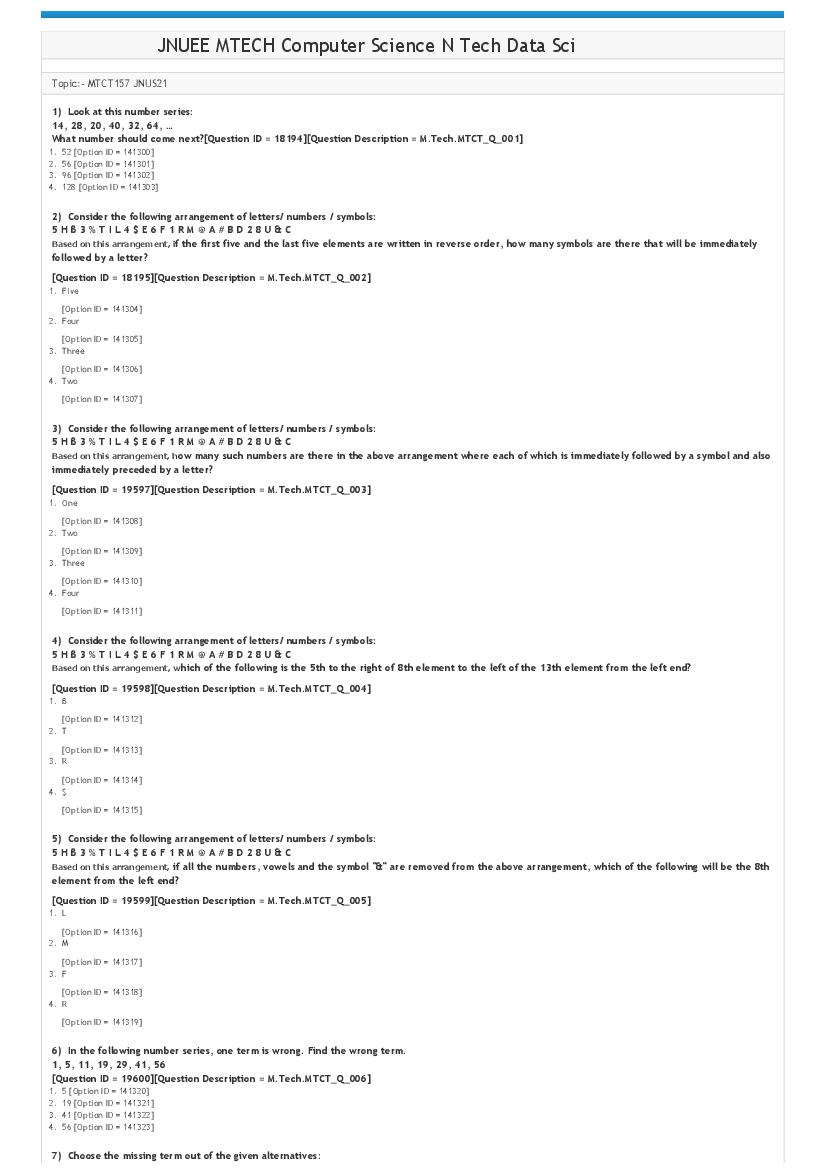
Topic:‐ MTCT157 JNUS21
1) Look at this number series:
14, 28, 20, 40, 32, 64, …
What number should come next?[Question ID = 18194][Question Description = M.Tech.MTCT_Q_001]
1. 52 [Option ID = 141300]
2. 56 [Option ID = 141301]
3. 96 [Option ID = 141302]
4. 128 [Option ID = 141303]
2) Consider the following arrangement of letters/ numbers / symbols:
5Hβ3%TIL4$E6F1RM@A#BD28U&C
Based on this arrangement, if the first five and the last five elements are written in reverse order, how many symbols are there that will be immediately
followed by a letter?
[Question ID = 18195][Question Description = M.Tech.MTCT_Q_002]
1. Five
[Option ID = 141304]
2. Four
[Option ID = 141305]
3. Three
[Option ID = 141306]
4. Two
[Option ID = 141307]
3) Consider the following arrangement of letters/ numbers / symbols:
5Hβ3%TIL4$E6F1RM@A#BD28U&C
Based on this arrangement, how many such numbers are there in the above arrangement where each of which is immediately followed by a symbol and also
immediately preceded by a letter?
[Question ID = 19597][Question Description = M.Tech.MTCT_Q_003]
1. One
[Option ID = 141308]
2. Two
[Option ID = 141309]
3. Three
[Option ID = 141310]
4. Four
[Option ID = 141311]
4) Consider the following arrangement of letters/ numbers / symbols:
5Hβ3%TIL4$E6F1RM@A#BD28U&C
Based on this arrangement, which of the following is the 5th to the right of 8th element to the left of the 13th element from the left end?
[Question ID = 19598][Question Description = M.Tech.MTCT_Q_004]
1. β
[Option ID = 141312]
2. T
[Option ID = 141313]
3. R
[Option ID = 141314]
4. $
[Option ID = 141315]
5) Consider the following arrangement of letters/ numbers / symbols:
5Hβ3%TIL4$E6F1RM@A#BD28U&C
Based on this arrangement, if all the numbers, vowels and the symbol "&" are removed from the above arrangement, which of the following will be the 8th
element from the left end?
[Question ID = 19599][Question Description = M.Tech.MTCT_Q_005]
1. L
[Option ID = 141316]
2. M
[Option ID = 141317]
3. F
[Option ID = 141318]
4. R
[Option ID = 141319]
6) In the following number series, one term is wrong. Find the wrong term.
1, 5, 11, 19, 29, 41, 56
[Question ID = 19600][Question Description = M.Tech.MTCT_Q_006]
1. 5 [Option ID = 141320]
2. 19 [Option ID = 141321]
3. 41 [Option ID = 141322]
4. 56 [Option ID = 141323]
7) Choose the missing term out of the given alternatives:
Page 2
[Question ID = 19601][Question Description = M.Tech.MTCT_Q_007]
1. NETIZ
[Option ID = 141324]
2. NETIZAT
[Option ID = 141325]
3. ETIZAT
[Option ID = 141326]
4. NETIZA
[Option ID = 141327]
8) Read the following information to answer the given question:
• Gokul started driving from his house towards North direction.
• After covering 80 km, he turned towards left and covered a distance of 60 km.
What will be the shortest distance from Gokul's house to his current location ?
[Question ID = 19602][Question Description = M.Tech.MTCT_Q_008]
1. 100 km
[Option ID = 141328]
2. 110 km
[Option ID = 141329]
3. 130 km
[Option ID = 141330]
4. 140 km
[Option ID = 141331]
9) The pair of words Elusive : Capture have a certain relationship to each other. Select the lettered pair that have the same relationship as the above
mentioned pair of words[Question ID = 19603][Question Description = M.Tech.MTCT_Q_009]
1. Sensible : Decide [Option ID = 141332]
2. Headstrong : Control [Option ID = 141333]
3. Elastic : Stretch [Option ID = 141334]
4. Gullible : Trick [Option ID = 141335]
10) Given below are two statements:
Statement I: All books are stones.
Statement II: All stones are papers.
Conclusion :
I. Some papers are books.
II. Some papers are stones.
In light of the above statements, choose the most appropriate answer from the options given below:
[Question ID = 19604][Question Description = M.Tech.MTCT_Q_010]
1. Only conclusion I follows
[Option ID = 141336]
2. Only conclusion II follows
[Option ID = 141337]
3. Both I and II follows
[Option ID = 141338]
4. Neither I nor II follows
[Option ID = 141339]
11) Find the odd‐one‐out from the given alternatives.[Question ID = 19605][Question Description = M.Tech.MTCT_Q_011]
1. 626 [Option ID = 141340]
2. 841 [Option ID = 141341]
3. 962 [Option ID = 141342]
4. 1090 [Option ID = 141343]
12) Find the missing term in the sequence:
AZWD, CXUF, ?, GTQJ
[Question ID = 19606][Question Description = M.Tech.MTCT_Q_012]
1. EVSH
[Option ID = 141344]
2. EUSH
[Option ID = 141345]
3. EUTH
[Option ID = 141346]
4. EVTH
[Option ID = 141347]
13) In a certain code, COMPATIBLE is written as BQNPDDKAHS. How is STABILISED written in that code?
[Question ID = 19607][Question Description = M.Tech.MTCT_Q_013]
1. TUBCJCDRHK
[Option ID = 141348]
2. JCBUTEDTHM
[Option ID = 141349]
3. JCBUTCDRHK
Page 3
4. JCBUTEFTJM
[Option ID = 141351]
14) Find the number of triangles in the given figure.
[Question ID = 19608][Question Description = M.Tech.MTCT_Q_014]
1. 11 [Option ID = 141352]
2. 13 [Option ID = 141353]
3. 15 [Option ID = 141354]
4. 17 [Option ID = 141355]
15) If 15th March 1816 was Friday, what day of the week would 15th April 1916 be ?
[Question ID = 19609][Question Description = M.Tech.MTCT_Q_015]
1. Monday
[Option ID = 141356]
2. Wednesday
[Option ID = 141357]
3. Thursday
[Option ID = 141358]
4. Saturday
[Option ID = 141359]
16) If A is coded as ‐, B is coded as +, C is coded as * and D is coded as /, then evaluation of the following expression results in ‐
6 A 7 B 2 C 32 D 2 C 3 ?
[Question ID = 19610][Question Description = M.Tech.MTCT_Q_016]
1. 95 [Option ID = 141360]
2. 97 [Option ID = 141361]
3. 105 [Option ID = 141362]
4. 115 [Option ID = 141363]
17)
[Question ID = 19611][Question Description = M.Tech.MTCT_Q_017]
1. 0 [Option ID = 141364]
2. 1 [Option ID = 141365]
3. 2 [Option ID = 141366]
4. x [Option ID = 141367]
18)
[Question ID = 19612][Question Description = M.Tech.MTCT_Q_018]
1. Not differentiable at x= 0 [Option ID = 141368]
2. Differentiable at x= 0 [Option ID = 141369]
3. Not differentiable at x= 1 [Option ID = 141370]
4. Differentiable at x= 1 [Option ID = 141371]
19) Let f(x + y) = f(x) + f(y) for all x and y. If the function f(x) is continuous at x = 0. Then ‐
[Question ID = 19613][Question Description = M.Tech.MTCT_Q_019]
1. f(x) is discontinuous for all x
[Option ID = 141372]
2. f(x) is continuous for all x
[Option ID = 141373]
3. Neither f(x) is continuous nor discontinuous for all x
[Option ID = 141374]
4. None of the above
[Option ID = 141375]
20)
Page 4
1.
[Option ID = 141376]
2.
[Option ID = 141377]
3.
[Option ID = 141378]
4.
[Option ID = 141379]
21)
[Question ID = 19615][Question Description = M.Tech.MTCT_Q_021]
1. 2 [Option ID = 141380]
2. 0 [Option ID = 141381]
3. ‐2 [Option ID = 141382]
4. None of the above [Option ID = 141383]
22)
[Question ID = 13512][Question Description = M.Tech.MTCT_Q_022]
1. 3, 0, 2 [Option ID = 141384]
2. 6, ‐8, 6 [Option ID = 141385]
3. 0,0,0 [Option ID = 141386]
4. 3, 6, ‐8 [Option ID = 141387]
23) The eigenvalues of a triangular matrix are the[Question ID = 13513][Question Description = M.Tech.MTCT_Q_023]
1. entries on its main diagonal [Option ID = 141388]
2. entries on its off diagonal elements [Option ID = 141389]
3. entries on its first row [Option ID = 141390]
4. zeros [Option ID = 141391]
24) If A is invertible, then A‐1 is invertible, and
[Question ID = 13514][Question Description = M.Tech.MTCT_Q_024]
1.
[Option ID = 141392]
2.
[Option ID = 141393]
3.
[Option ID = 141394]
4.
[Option ID = 141395]
25)
[Question ID = 13515][Question Description = M.Tech.MTCT_Q_025]
1. 1 [Option ID = 141396]
2. 2 [Option ID = 141397]
3. 3 [Option ID = 141398]
4. 4 [Option ID = 141399]
26)
[Question ID = 13516][Question Description = M.Tech.MTCT_Q_026]
Page 5
2. 6.24350989 [Option ID = 141401]
3. 62.4350989 [Option ID = 141402]
4. 0.0624350989 [Option ID = 141403]
27)
[Question ID = 13517][Question Description = M.Tech.MTCT_Q_027]
1. 1.85546 [Option ID = 141404]
2. 18.5546 [Option ID = 141405]
3. 185.546 [Option ID = 141406]
4. 0.185546 [Option ID = 141407]
28) Newton’s method of root finding of a function F(x) fails if,[Question ID = 13518][Question Description = M.Tech.MTCT_Q_028]
1. is not defined
[Option ID = 141408]
2. is not defined
[Option ID = 141409]
3. is not defined
[Option ID = 141410]
4. F(x) can be any function [Option ID = 141411]
29)
[Question ID = 13519][Question Description = M.Tech.MTCT_Q_029]
1.
[Option ID = 141412]
2.
[Option ID = 141413]
3.
[Option ID = 141414]
4.
[Option ID = 141415]
30)
[Question ID = 13520][Question Description = M.Tech.MTCT_Q_030]
1. Algebraic equation [Option ID = 141416]
2. Transcendental equation [Option ID = 141417]
3. Polynomial equation [Option ID = 141418]
4. None of the above [Option ID = 141419]
31)
[Question ID = 13521][Question Description = M.Tech.MTCT_Q_031]
1.
[Option ID = 141420]
2.
[Option ID = 141421]
3.
[Option ID = 141422]
4.
[Option ID = 141423]
32)
Page 6
1.
[Option ID = 141424]
2.
[Option ID = 141425]
3.
[Option ID = 141426]
4.
[Option ID = 141427]
33) A fair coin is tossed 4 times independently. What is the chance of getting at least 3 heads or at least 3 tails?[Question ID = 13523][Question
Description = M.Tech.MTCT_Q_033]
1. 5/16 [Option ID = 141428]
2. 1/2 [Option ID = 141429]
3. 9/16 [Option ID = 141430]
4. 5/8 [Option ID = 141431]
34) Let the Alternate Hypothesis H1 be the statement “Supplementing a lecture with a video demonstration makes it more effective in student
achievement”. What is the hypothesis testing paradigm to be used to test the appropriate null hypothesis H0 ?[Question ID = 13524][Question Description
= M.Tech.MTCT_Q_034]
1. One sample, one tailed test [Option ID = 141432]
2. One sample, two tailed test [Option ID = 141433]
3. Two sample, one tailed test [Option ID = 141434]
4. Two sample, two tailed test [Option ID = 141435]
35)
[Question ID = 13525][Question Description = M.Tech.MTCT_Q_035]
1. A ‐ II , B ‐ I , C ‐ IV, D ‐ III [Option ID = 141436]
2. A ‐ I , B ‐ III, C ‐ IV , D ‐ II [Option ID = 141437]
3. A ‐ III , B ‐ I, C ‐ IV, D ‐ II [Option ID = 141438]
4. A ‐ III, B ‐ I, C ‐ II, D ‐ IV [Option ID = 141439]
36)
[Question ID = 13526][Question Description = M.Tech.MTCT_Q_036]
1.
[Option ID = 141440]
2.
[Option ID = 141441]
3.
[Option ID = 141442]
4.
[Option ID = 141443]
37) Which distribution has the same value for mean and standard deviation?[Question ID = 13527][Question Description = M.Tech.MTCT_Q_037]
1. Poisson distribution [Option ID = 141444]
2. Exponential distribution [Option ID = 141445]
3. Gamma distribution [Option ID = 141446]
Page 7
38) What is the number of subgroups (including the trivial subgroup and itself) of an abelian group of order 36[Question ID = 13528][Question Description
= M.Tech.MTCT_Q_038]
1. 4 [Option ID = 141448]
2. 6 [Option ID = 141449]
3. 9 [Option ID = 141450]
4. 12 [Option ID = 141451]
39) What is the order of 3 in the group of multiplicative units in Z16 , which is the ring of residue classes of integers modulo 16?[Question ID = 13529]
[Question Description = M.Tech.MTCT_Q_039]
1. 2 [Option ID = 141452]
2. 4 [Option ID = 141453]
3. 8 [Option ID = 141454]
4. 16 [Option ID = 141455]
40)
[Question ID = 13530][Question Description = M.Tech.MTCT_Q_040]
1.
[Option ID = 141456]
2.
[Option ID = 141457]
3.
[Option ID = 141458]
4.
[Option ID = 141459]
41)
[Question ID = 13531][Question Description = M.Tech.MTCT_Q_041]
1.
[Option ID = 141460]
2.
[Option ID = 141461]
3.
[Option ID = 141462]
4.
[Option ID = 141463]
42)
[Question ID = 13532][Question Description = M.Tech.MTCT_Q_042]
1. It is a finite ring under the operations of addition and matrix multiplication. [Option ID = 141464]
2. It is a finite field under the operations of addition and matrix multiplication. [Option ID = 141465]
3. It is an abelian group under the operation of addition. [Option ID = 141466]
4. The invertible elements form a group under matrix multiplication. [Option ID = 141467]
43) Which statement correctly describes the non‐trivial proper normal subgroups of the group D3 of the symmetries of an equilateral triangle in the
plane?[Question ID = 13533][Question Description = M.Tech.MTCT_Q_043]
1. The subgroup of rotations is the only non‐trivial proper normal subgroup of D3. [Option ID = 141468]
2. The subgroup generated by each reflection are the only non‐trivial proper normal subgroups of D3. [Option ID = 141469]
3. All the non‐trivial proper subgroups of D3 are normal. [Option ID = 141470]
4. None of non‐trivial proper subgroups of D3 is normal. [Option ID = 141471]
44)
[Question ID = 13534][Question Description = M.Tech.MTCT_Q_044]
1.
[Option ID = 141472]
2.
[Option ID = 141473]
3.
[Option ID = 141474]
4.
[Option ID = 141475]
Page 8
[Question ID = 13535][Question Description = M.Tech.MTCT_Q_045]
1. Zero [Option ID = 141476]
2. One [Option ID = 141477]
3. Finite, but greater than one [Option ID = 141478]
4. Infinite [Option ID = 141479]
46) What is the minimum possible nullity of a 110 X 1100 real matrix?[Question ID = 13536][Question Description = M.Tech.MTCT_Q_046]
1.
[Option ID = 141480]
2.
[Option ID = 141481]
3.
[Option ID = 141482]
4.
[Option ID = 141483]
47) Which type of Linked List does not store NULL in the Next field ?[Question ID = 13537][Question Description = M.Tech.MTCT_Q_047]
1. Singly Linked List [Option ID = 141484]
2. Circular Linked List [Option ID = 141485]
3. Doubly Linked List [Option ID = 141486]
4. None of the Above [Option ID = 141487]
48) Compute the result of the following post‐fix expression.
532*+4‐5+
[Question ID = 13538][Question Description = M.Tech.MTCT_Q_048]
1. 12 [Option ID = 141488]
2. 13 [Option ID = 141489]
3. 14 [Option ID = 141490]
4. 15 [Option ID = 141491]
49) Given below are two statements regarding Deque:
Statement I: In Input Restricted Deque, deletion is restricted at a single end but allows insertion at both the ends.
Statement II: In Output Restricted Deque, insertion is restricted at a single end but allows deletion at both the ends.
In light of the above statements, choose the correct answer from the options given below:
[Question ID = 13539][Question Description = M.Tech.MTCT_Q_049]
1. Both Statement I and Statement II are true
[Option ID = 141492]
2. Both Statement I and Statement II are false
[Option ID = 141493]
3. Statement I is true but Statement II is false
[Option ID = 141494]
4. Statement I is false but Statement II is true
[Option ID = 141495]
50) Following are some statements regarding Binary Tree ‐
A. At each level of i, the maximum number of nodes is 2i .
B. The maximum number of nodes possible at height h is 2h+1 .
C. The minimum number of nodes possible at height h is equal to h+1.
Choose the correct answer from the options given below:
[Question ID = 13540][Question Description = M.Tech.MTCT_Q_050]
1. A, B and C only
[Option ID = 141496]
2. A and B only
[Option ID = 141497]
3. B and C only
[Option ID = 141498]
4. A and C only
[Option ID = 141499]
51) In a Right‐Threaded Binary Tree, if the thread appears in the left field then the left field will be made to point to the :
[Question ID = 13541][Question Description = M.Tech.MTCT_Q_051]
1. in‐order predecessor of the node.
[Option ID = 141500]
2. pre‐order predecessor of the node.
[Option ID = 141501]
3. post‐order predecessor of the node.
[Option ID = 141502]
4. None of the Above
[Option ID = 141503]
52) Given below are two statements regarding the Complete Graph:
Page 9
Statement II: The Complete Graph on 0 nodes is a trivial graph known as the Singleton Graph.
In light of the above statements, choose the correct answer from the options given below:
[Question ID = 13542][Question Description = M.Tech.MTCT_Q_052]
1. Both Statement I and Statement II are true
[Option ID = 141504]
2. Both Statement I and Statement II are false
[Option ID = 141505]
3. Statement I is true but Statement II is false
[Option ID = 141506]
4. Statement I is false but Statement II is true
[Option ID = 141507]
53) The location of a global variable is bound at ‐[Question ID = 13543][Question Description = M.Tech.MTCT_Q_053]
1. Load Time [Option ID = 141508]
2. Language Definition Time [Option ID = 141509]
3. Procedure Entry Time [Option ID = 141510]
4. Translation Time [Option ID = 141511]
54) A Sentinel ‐ Controlled loop is also known as ‐[Question ID = 13544][Question Description = M.Tech.MTCT_Q_054]
1. Definite Repetition Loop [Option ID = 141512]
2. Infinite Repetition Loop [Option ID = 141513]
3. Indefinite Repetition Loop [Option ID = 141514]
4. None of the Above [Option ID = 141515]
55) The important parts of a function declaration are ‐[Question ID = 13545][Question Description = M.Tech.MTCT_Q_055]
1. Return type, Function name, Value [Option ID = 141516]
2. Return type, Function name, Parameters [Option ID = 141517]
3. Return Type, Value, Parameters [Option ID = 141518]
4. None of the above [Option ID = 141519]
56) An Integrated Development Environment (IDE) has ‐
A. Source files
B. Libraries used
C. Compiler / Linker setting for program compilation
Choose the correct answer from the options given below:
[Question ID = 13546][Question Description = M.Tech.MTCT_Q_056]
1. A, B and C only [Option ID = 141520]
2. A and B only [Option ID = 141521]
3. B and C only [Option ID = 141522]
4. A and C only [Option ID = 141523]
57) Following are the statements about Constructors:
Statement I: Constructors can also perform more complex initilization tasks, such as opening files, allocating memory and configuring interfaces.
Statement II: Constructors can also be called for existing objects.
In light of the above statements, choose the correct answer from the options given below:
[Question ID = 13547][Question Description = M.Tech.MTCT_Q_057]
1. Both Statement I and Statement II are true
[Option ID = 141524]
2. Both Statement I and Statement II are false
[Option ID = 141525]
3. Statement I is true but Statement II is false
[Option ID = 141526]
4. Statement I is false but Statement II is true
[Option ID = 141527]
58) Virtual Function allow you to ‐[Question ID = 13548][Question Description = M.Tech.MTCT_Q_058]
1. create an array of type pointer‐to‐base class that can hold pointers to derived classes. [Option ID = 141528]
2. create functions that can never be accessed. [Option ID = 141529]
3. group objects of different classes so they can all be accessed by the same function code. [Option ID = 141530]
4. use the same function call to execute member functions of objects from different classes. [Option ID = 141531]
59) A Process consists of ‐
A. An executable program
B. The associated data needed by the program
C. The execution context of the program
Choose the correct answer from the options given below:
[Question ID = 13549][Question Description = M.Tech.MTCT_Q_059]
1. A, B and C only [Option ID = 141532]
2. A and B only [Option ID = 141533]
3. B and C only [Option ID = 141534]
4. A and C only [Option ID = 141535]
60)
Page 10
1. A ‐ I, B ‐ II , C ‐ III , D ‐ IV [Option ID = 141536]
2. A ‐ III, B ‐IV , C ‐ I, D ‐ II [Option ID = 141537]
3. A ‐ IV, B ‐ III, C ‐ I, D ‐ II [Option ID = 141538]
4. A ‐ II, B ‐ IV, C ‐ I, D ‐ III [Option ID = 141539]
61) Which one is NOT the correct reason for Process Suspension in an Operating System ?[Question ID = 13551][Question Description =
M.Tech.MTCT_Q_061]
1. Swapping [Option ID = 141540]
2. Parent Process Request [Option ID = 141541]
3. Normal Completion [Option ID = 141542]
4. Interactive User Request [Option ID = 141543]
62) Which of the following are hardware approaches to handle Mutual Exclusion ?
A. Interrupt Disabling
B. Compare and Swap Instruction
C. Exchange Information
Choose the correct answer from the options given below:
[Question ID = 13552][Question Description = M.Tech.MTCT_Q_062]
1. A, B and C only [Option ID = 141544]
2. A and B only [Option ID = 141545]
3. B and C only [Option ID = 141546]
4. A and C only [Option ID = 141547]
63) In the context of Memory Management in Operating System, the limitation of fixed partition will be ‐[Question ID = 13553][Question Description =
M.Tech.MTCT_Q_063]
1. Inefficient use of memory due to internal fragmentation [Option ID = 141548]
2. Inefficient use of processor due to the need for compaction [Option ID = 141549]
3. External fragmentation [Option ID = 141550]
4. None of the Above [Option ID = 141551]
64) Out of the following CPU Scheduling Policies, the possibility of starvation will be in ‐
A. Shortest Process Next
B. Shortest Remaining Time
C. Highest Response Ratio Next
Choose the correct answer from the options given below:
[Question ID = 13554][Question Description = M.Tech.MTCT_Q_064]
1. A, B and C only [Option ID = 141552]
2. A and B only [Option ID = 141553]
3. B and C only [Option ID = 141554]
4. A and C only [Option ID = 141555]
65) The passing of the data and network information down through the layers of the sending device and back up through the layers of receiving device is
made possible by‐[Question ID = 13555][Question Description = M.Tech.MTCT_Q_065]
1. Intermediate node between each pair of adjacent layers. [Option ID = 141556]
2. Interface between each pair of adjacent layers. [Option ID = 141557]
3. Peer to Peer processes between each pair of adjacent layers. [Option ID = 141558]
4. None of the Above. [Option ID = 141559]
66) In a digital transmission, the receiver clock is 0.1 percent faster than the sender clock. How many extra bits per second does the receiver receive if
the data rate is 1 kbps?[Question ID = 13556][Question Description = M.Tech.MTCT_Q_066]
1. 1 bps [Option ID = 141560]
2. 10 bps [Option ID = 141561]
3. 100 bps [Option ID = 141562]
4. None of the Above [Option ID = 141563]
67) Virtual‐Circuit Networks are used in‐[Question ID = 13557][Question Description = M.Tech.MTCT_Q_067]
1. Telephone Networks [Option ID = 141564]
2. Internet [Option ID = 141565]
3. Asynchronous Transfer Mode (ATM) networks [Option ID = 141566]
4. None of the Above [Option ID = 141567]
68) Which of the Data Link Layer protocol is used for noise‐less channel?[Question ID = 13558][Question Description = M.Tech.MTCT_Q_068]
1. Stop ‐and‐ Wait [Option ID = 141568]
2. Stop‐and‐Wait ARQ [Option ID = 141569]
3. GO‐BACK‐ N [Option ID = 141570]
4. Selective Repeat [Option ID = 141571]
69) What is the Vulnerable Time in ALOHA protocol?[Question ID = 13559][Question Description = M.Tech.MTCT_Q_069]
1. beginning of the synchronized time slot [Option ID = 141572]
2. beginning of the next time slot [Option ID = 141573]
3. at which station finished sending its frame [Option ID = 141574]
4. in which there is a possibility of collision [Option ID = 141575]
70) A problem with the Distance Vector Routing is instability, which means that a network using the protocol can become unstable. Which one is the
correct solution to deal with the instability?[Question ID = 13560][Question Description = M.Tech.MTCT_Q_070]
1. Hop count [Option ID = 141576]
2. Split horizon [Option ID = 141577]
3. Define the transient links [Option ID = 141578]
4. Loop prevention [Option ID = 141579]
71) The degree of a relation, in a relational database, is‐[Question ID = 13561][Question Description = M.Tech.MTCT_Q_071]
1. the number of attributes [Option ID = 141580]
2. the number of tuples [Option ID = 141581]
3. the number of participating entities [Option ID = 141582]
4. the number of relations [Option ID = 141583]
72) Given below are two statements:
Statement I: The attribute in Foreign Key (FK) may not have the same domain as the Primary key (PK) attribute.
Page 11
In light of the above statements, choose the correct answer from the options given below:
[Question ID = 13562][Question Description = M.Tech.MTCT_Q_072]
1. Both Statement I and Statement II are true
[Option ID = 141584]
2. Both Statement I and Statement II are false
[Option ID = 141585]
3. Statement I is true but Statement II is false
[Option ID = 141586]
4. Statement I is false but Statement II is true
[Option ID = 141587]
73) Which of the following database operations require the two relations to be Union‐Compatible?
A. Inter‐Section
B. Set‐Difference
C. Join
D. Cross Product
Choose the correct answer from the options given below
[Question ID = 13563][Question Description = M.Tech.MTCT_Q_073]
1. A, B and C only [Option ID = 141588]
2. A and B only [Option ID = 141589]
3. A, C and D only [Option ID = 141590]
4. C and D only [Option ID = 141591]
74) Which of the following are Sparse Index ?
A. Primary Index
B. Clustering Index
C. Secondary Index
Choose the correct answer from the options given below:
[Question ID = 13564][Question Description = M.Tech.MTCT_Q_074]
1. A, B and C only [Option ID = 141592]
2. A and C only [Option ID = 141593]
3. A and B only [Option ID = 141594]
4. B and C only [Option ID = 141595]
75) In a conservative two‐phase locking protocol [Question ID = 13565][Question Description = M.Tech.MTCT_Q_075]
1. all locking operations precede the first unlock operaton in the transaction. [Option ID = 141596]
2. a transaction lock all the items it accesses before the transaction begin execution. [Option ID = 141597]
3. a transaction does not release any of its write locks until after it commits or aborts. [Option ID = 141598]
4. a transaction does not release any of its locks (exclusive or shared) until after it commits or aborts. [Option ID = 141599]
76) Given below are two statements regarding database recovery:
Statement I: The deferred update techniques do not physically update the database on disk until after a transaction reaches its commit point.
Statement II: In the immediate update techniques, the database can not be updated by some operations of a transaction before the transaction reaches
its commit point.
In light of the above statements, choose the correct answer from the options given below:
[Question ID = 13566][Question Description = M.Tech.MTCT_Q_076]
1. Both Statement I and Statement II are true
[Option ID = 141600]
2. Both Statement I and Statement II are false
[Option ID = 141601]
3. Statement I is true but Statement II is false
[Option ID = 141602]
4. Statement I is false but Statement II is true
[Option ID = 141603]
77) In the context of Von‐Newmann's Architecture, consider the following:
A. Data and instructions are stored in a single read write memory.
B. The contents of this memory are addressable by location, without regards to the type of data.
C. Execution occurs in a sequential fashion.
Choose the correct answer from the options given below:
[Question ID = 13567][Question Description = M.Tech.MTCT_Q_077]
1. A, B and C only
[Option ID = 141604]
2. A and B only
[Option ID = 141605]
3. A and C only
[Option ID = 141606]
4. B and C only
[Option ID = 141607]
78) Given below are two statements regarding Main Memory to Cache Memory mapping:
Statement I: Larger blocks increase the number of blocks that fit into a cache.
Statement II: As a block become larger, each conditional word is farther from the requested word and therefore less likely to be needed in the near
future.
In light of the above statements, choose the correct answer from the options given below:
[Question ID = 13568][Question Description = M.Tech.MTCT_Q_078]
1. Both Statement I and Statement II are true
[Option ID = 141608]
2. Both Statement I and Statement II are false
[Option ID = 141609]
Page 12
[Option ID = 141610]
4. Statement I is false but Statement II is true
[Option ID = 141611]
79) A typical computer system with multiple I/O modules, may result in multiple possible interrupts at the same time. The device identification
techniques used by the system will be ‐
A. Software Poll
B. Daisy Chain
C. Bus Arbitration
Choose the correct answer from the options given below:
[Question ID = 13569][Question Description = M.Tech.MTCT_Q_079]
1. A, B and C only [Option ID = 141612]
2. A and B only [Option ID = 141613]
3. A and C only [Option ID = 141614]
4. B and C only [Option ID = 141615]
80) Which one is the characteristic of Reduced Instructon Set Computer (RISC) ?[Question ID = 13570][Question Description = M.Tech.MTCT_Q_080]
1. A large number of instructions [Option ID = 141616]
2. A large variety of addressing modes [Option ID = 141617]
3. Variable length instruction formats [Option ID = 141618]
4. Single‐cycle instruction execution [Option ID = 141619]
81) In a computer system, for the Control Unit to perform its function, it must have inputs that allow it to determine the state of the system. Which one
is NOT used as the input for the Control Unit ?[Question ID = 13571][Question Description = M.Tech.MTCT_Q_081]
1. Clock [Option ID = 141620]
2. Instruction Register [Option ID = 141621]
3. Control Signals to Control Bus [Option ID = 141622]
4. Flags [Option ID = 141623]
82) If a binary code in BCD format is 0110 then what will be the corresponding Excess ‐3 code ?[Question ID = 13572][Question Description =
M.Tech.MTCT_Q_082]
1. 010 [Option ID = 141624]
2. 0101 [Option ID = 141625]
3. 1001 [Option ID = 141626]
4. 0111 [Option ID = 141627]
83) An Algorithm in Computer Science [Question ID = 13573][Question Description = M.Tech.MTCT_Q_083]
1. is a language representation of computer program [Option ID = 141628]
2. is a computer program [Option ID = 141629]
3. is a data flow diagram [Option ID = 141630]
4. is a flow chart [Option ID = 141631]
84) Which algorithm is NOT a part of heuristic algorithms ‐[Question ID = 13574][Question Description = M.Tech.MTCT_Q_084]
1. Generate and test [Option ID = 141632]
2. Hill climbing [Option ID = 141633]
3. Greedy algorithm [Option ID = 141634]
4. Radix sort [Option ID = 141635]
85) Cocke–Younger–Kasami(CYK)‐ Algorithm is a ‐[Question ID = 13575][Question Description = M.Tech.MTCT_Q_085]
1. Searching algorithm [Option ID = 141636]
2. Parsing algorithm [Option ID = 141637]
3. Heuristic algorithm [Option ID = 141638]
4. Sorting algorithm [Option ID = 141639]
86) Which of the following data structure is used for the implementation of tree sort algorithm ‐[Question ID = 13576][Question Description =
M.Tech.MTCT_Q_086]
1. An Array [Option ID = 141640]
2. Balanced Tree [Option ID = 141641]
3. Binary search Tree [Option ID = 141642]
4. Unbalanced Tree [Option ID = 141643]
87) Which one of the following is a variant of Heap Sort algorithm ‐[Question ID = 13577][Question Description = M.Tech.MTCT_Q_087]
1. Quick Sort [Option ID = 141644]
2. Bubble Sort [Option ID = 141645]
3. Shell Sort [Option ID = 141646]
4. Tournament Sort [Option ID = 141647]
88) First In First Out algorithm(FIFO) can be used in which Data Structure ?[Question ID = 13578][Question Description = M.Tech.MTCT_Q_088]
1. Array [Option ID = 141648]
2. Linked list [Option ID = 141649]
3. Stack [Option ID = 141650]
4. Queue [Option ID = 141651]
89) In context of Discrete Mathmatics, Floor Function is the one which ‐
[Question ID = 13579][Question Description = M.Tech.MTCT_Q_089]
1. Maps the real number to the greatest previous integer
[Option ID = 141652]
2. Maps the real number to the smallest previous integer
[Option ID = 141653]
3. Maps the real number to the smallest following integer
[Option ID = 141654]
4. None of the Above
[Option ID = 141655]
90) "First Order Logic" is also known as ‐[Question ID = 13580][Question Description = M.Tech.MTCT_Q_090]
1. Propositional logic [Option ID = 141656]
Page 13
3. Fuzzy logic [Option ID = 141658]
4. Binary logic [Option ID = 141659]
91) (X) (B) is read as ‐
[Question ID = 13581][Question Description = M.Tech.MTCT_Q_091]
1. There exists a X for all B
[Option ID = 141660]
2. For all X, B is a set
[Option ID = 141661]
3. For all X, there exist a B
[Option ID = 141662]
4. For all B, there exists a X
[Option ID = 141663]
92) Universal Quantifier is represented as ‐[Question ID = 13582][Question Description = M.Tech.MTCT_Q_092]
1. [Option ID = 141664]
2. [Option ID = 141665]
3. [Option ID = 141666]
4. ϕ [Option ID = 141667]
93) Canonical forms for a boolean expression has ‐[Question ID = 13583][Question Description = M.Tech.MTCT_Q_093]
1. Four Types [Option ID = 141668]
2. Three types [Option ID = 141669]
3. Two Types [Option ID = 141670]
4. Five types [Option ID = 141671]
94) The logic whichDOES NOT work only as True or False is ‐[Question ID = 13584][Question Description = M.Tech.MTCT_Q_094]
1. Propositional logic [Option ID = 141672]
2. Predicate logic [Option ID = 141673]
3. Fuzzy logic [Option ID = 141674]
4. Binary logic [Option ID = 141675]
95) Which of the following is NOT an applied area of Automata Theory ‐[Question ID = 13585][Question Description = M.Tech.MTCT_Q_095]
1. Web design [Option ID = 141676]
2. Compiler design [Option ID = 141677]
3. Text processing [Option ID = 141678]
4. Parsing [Option ID = 141679]
96) Moore Machine is an application of ‐[Question ID = 13586][Question Description = M.Tech.MTCT_Q_096]
1. Finite Automata without input [Option ID = 141680]
2. Finite Automata with output [Option ID = 141681]
3. Non Finite Automata with output [Option ID = 141682]
4. Finite Automata without output [Option ID = 141683]
97) Deterministic pushdown automaton accepts ‐[Question ID = 13587][Question Description = M.Tech.MTCT_Q_097]
1. Formal languages [Option ID = 141684]
2. Context sensitive languages [Option ID = 141685]
3. Deterministic context free languages [Option ID = 141686]
4. Natural languages [Option ID = 141687]
98) The oldest context free grammar is described in ‐[Question ID = 13588][Question Description = M.Tech.MTCT_Q_098]
1. Hindi [Option ID = 141688]
2. English [Option ID = 141689]
3. Sanskrit [Option ID = 141690]
4. German [Option ID = 141691]
99) A Syntax Tree can also be termed as ‐
[Question ID = 13589][Question Description = M.Tech.MTCT_Q_099]
1. Parse tree
[Option ID = 141692]
2. Semantic tree
[Option ID = 141693]
3. Graphs
[Option ID = 141694]
4. Linked list
[Option ID = 141695]
100) In Automata Theory, the symbol Σ is used as ‐[Question ID = 13590][Question Description = M.Tech.MTCT_Q_100]
1. Output alphabet [Option ID = 141696]
2. Input string [Option ID = 141697]
3. Input alphabet [Option ID = 141698]
4. Output string [Option ID = 141699]